6 Famous Non-Scientists with Ties to the Academy
Actors, a past president, and even a “world champion” racer. Here are six famous non-scientists with ties to The New York Academy of Sciences.
Published March 19, 2026
By Nick Fetty
For more than 200 years, the academy has prided itself on its egalitarian and democratic roots. Anyone with an interest, even curiosity, in science could become a member. This includes celebrities as well as those who wouldn’t be considered scientists in the traditional sense.
Here are six non-scientists with ties to the Academy, listed alphabetically.
Fernando Alonso, Formula One Racer
It’s not every day that a “world champion” visits the Academy. But that’s exactly what happened when two-time Formula One titlist Fernando Alonso visited in 2012.
Alonso gave a speech to motorheads and other attendees during an event at the Academy’s former office on the 40th floor of 7 World Trade Center. At this point in his career he was racing for Ferrari, the Italian luxury sports car manufacturer that dominates the world of F1 racing. Appropriate for a talk at the Academy, Alonso focused on the STEM aspects of racing and automotive performance.
“I think there is never enough technology,” he said, according to reporting from the London-based Daily Telegraph. “Technology is our motivation and the main goal for engineers and designers.”
The Spaniard won the world titles in 2005 and 2006 while racing for French-based Renault. He has since joined the Aston Martin Aramco Formula One Team and is geared up for the start of the 2026 race season. He’s driving a new car designed by British engineer Adrian Newey, “the most successful car designer in F1 history.”
The 2026 race season got underway earlier this month with the Qatar Airways Australian Grand Prix.
Salvador Dalí, Artist
Fellow Spaniard, artist Salvador Dalí, also has an Academy connection.
Part of the surrealistic art movement of the 20th century, Dalí was known for his “eccentric behavior and his eerie paintings.” His 1931 painting The Persistence of Memory depicts a realistic landscape with surreal melting clocks, a scene that a brain under the influence of hallucinogens might conjure up (see Aldous Huxley section below.)
The late Adnan Waly, PhD, a German-born nuclear physicist and longtime Academy member, recalled when the Spanish surrealist made a surprise appearance at an Academy event.
“I was at the Academy attending a lecture of the Nuclear Section. I found a seat in an empty row because not too many people were interested in nuclear physics at the time. The door opened, and in came a gentleman flanked by two gorgeous women. It was Salvadore Dalí with his moustache and his cane. He sat in my row with the ladies, and he put his cane up, two hands on the cane and his chin resting on it, as was his habit. He looked at the pictures that were presented,” Dr. Waly recalled.
“One of the pictures was of a cloud chamber — a photograph of particles moving apart from a center,” Dr. Waly continued. “Some time afterwards I saw a television program where Dalí was interviewed, and his latest painting was exactly what he had seen at the Academy, with tracks coming out from the center. ‘You don’t know what this is?’ Dalí said to the interviewer. ‘These are pimmesons.’ The lecture had been on the π meson.”
Dalí passed away in 1989 at the age of 84. Today the Academy continues its long, proud history of combining the arts and the sciences. This includes events with artists and providing space for works to be exhibited.
Michael J. Fox, Actor
Known for starring roles in 1980s classics like Back to the Future and Family Ties, Michael J. Fox’s acting career was forever changed by his Parkinson’s disease (PD) diagnosis at the age of 29.
Instead of sitting on the sidelines, Fox took an active role in advocating for the disease. In 2000, shortly after going public with his diagnosis, he founded the Michael J. Fox Foundation for Parkinson’s Research. To date, the organization has raised more than $2.5 billion to support research.
Fox’s foundation teamed up with the Academy in 2007 to host the inaugural PD Therapeutics Conference. The event was “the first and only major scientific symposium exclusively focused on the development of innovative drugs to target Parkinson’s disease.”
In addition to his advocacy and despite his condition, Fox continued to act. He voiced lead roles in multiple movies and has made various guest appearances on television. His appearance on HBO’s Curb Your Enthusiasm served as a chance to use humor to teach viewers about PD.
“It has long been recognized that humor can help those suffering from chronic conditions better cope with their diseases, and any chance to increase awareness of Parkinson’s disease among the general public is important,” Dr. Cheryl Waters of the Neurological Institute at Columbia University Medical Center told ABC News in 2011.
Though his condition has worsened to the point that he is now officially retired from acting, Fox remains optimistic that with adequately funded science a cure is possible.
“I know we’ve done a lot, but we haven’t cured Parkinson’s,” Fox told TIME magazine earlier this year. “I’m always pushing and never happy until we get this done. We’ve changed the way people think about the disease, and we know there’s an end, and we’ll find it.”
Aldous Huxley, Author
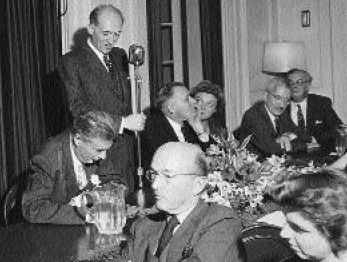
The English-born writer and philosopher is perhaps best known for works like Brave New World (1932) and The Doors of Perception (1963). Though less known, Aldous Huxley is also tied to what’s believed to be the first public utterance of the term psychedelic.
Huxley befriended Humphry Osmond, a psychiatrist researching the therapeutic potential of substances like LSD in the 1950s. He was known to supply Huxley with hallucinogens like LSD and mescaline.
In 1956, Huxley delivered a keynote address at an Academy conference in which he predicted that “drugs [like Meprobamate] were capable of changing the quality of human consciousness.” The following year, he authored a piece entitled “The History of Tension” published in Annals of the New York Academy of Sciences. The piece, in part, detailed the cultural history and application of substances like hallucinogenic mushrooms and peyote.
“Meanwhile, all that one can predict with any degree of certainty is that it will be necessary to reconsider and re-evaluate many of our traditional notions about ethics and religion, and many of our current views about the nature of the mind, in the context of the pharmacological revolution,” Huxley concluded. “It will be extremely disturbing; but it will also be enormous fun.”
Huxley passed away on November 4, 1963, the same day as fellow British writer C.S. Lewis, author of The Chronicles of Narnia (1950-1956). Both deaths were overshadowed by the assassination of U.S. president John F. Kennedy.
Appropriate for the man co-credited with coining the term psychedelic, Huxley had one dying wish. “At his request,” New York Magazine reported, “his wife shot him up with LSD a couple of hours before his end, and he tripped his way out of the world.”
Thomas Jefferson, 3rd President of the United States
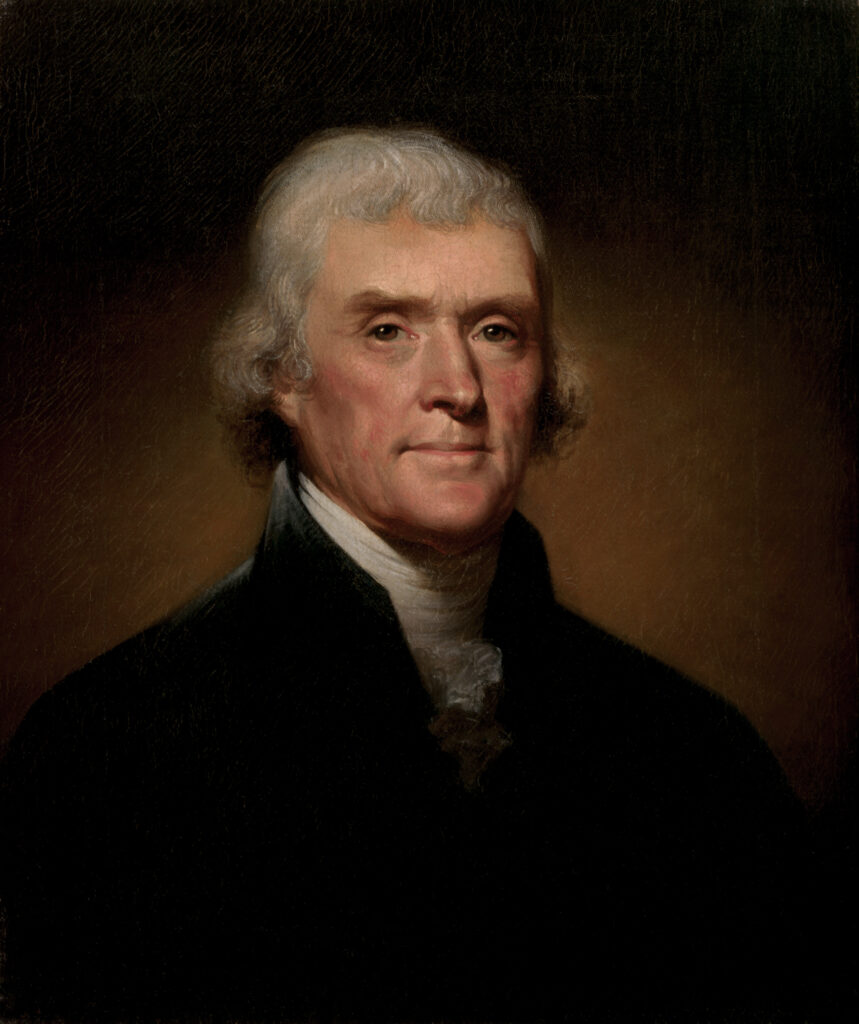
Thomas Jefferson was a Founding Father and the third president of the United States.
A true renaissance man, Jefferson’s interests and skills were boundless. Even within the then-relatively young field of science, he dabbled in everything from architecture and agriculture to astronomy and paleontology. An inventor too, he developed an improved concept for a field plow, believing that “agriculture was the most important science, understandable since agriculture was the backbone of human civilization at the time.” Jefferson even had the foresight to identify areas that could be better understood through the practice of science.
“The botany of America is far from exhausted, its mineralogy is untouched, and its zoology totally mistaken. We have spent the prime of our lives in procuring your students the precious blessing of liberty. Let them spend theirs in showing that it is the great parent of science and of virtue, and that a nation will be great in both ways in proportion as it is free,” Jefferson wrote in a letter to the Harvard University president in the early 19th century.
With his diverse interests and proven success as a leader, it was only natural to enlist his expertise when the Lyceum of Natural History (which changed its name to The New York Academy of Sciences in 1876) was established in 1817. Jefferson was among five other dignitaries elected “honorary members” in 1817. Samual Mitchell, the Academy’s first president once said that “he supported the Republican Party because Mr. Jefferson was its leader, and supported Mr. Jefferson because he was a philosopher.”
While some of Jefferson’s views and actions would without doubt be considered insensitive (to put it mildly) today, he nonetheless played a significant role in shaping the United States, the Academy, and science broadly.
Christohpher Reeve, Actor
Like fellow actor Michael J. Fox, Christopher Reeve’s career began on the silver screen before he became a science advocate.
Born in NYC, Reeve studied at Cornell University and Julliard, before getting his breakthrough as Superman in the eponymous 1978 film. He went on to play the red-and-blue-decked DC Comics superhero in the three subsequent films in the 1980s.
At six-foot-four with an athletic build, Reeve physically embodied the part of a superhero. He even “performed many of his [own] stunts, including dangerous ‘flying’ exercises,” according to a 2004 CNN article. But Reeve’s life took a drastic and unexpected turn when a 1995 horse-riding accident paralyzed him from the neck down.
Following the accident, Reeve required a wheelchair to move and a respirator to breathe. Around this era, stem cells and cloning were emerging as potential, albeit ethically controversial in some circles, methods for repairing damaged tissues and organs. The conservative George W. Bush administration at this time opposed federal funding for embryonic stem cell research.
During an event at the Academy in May 2002, Reeve, an advocate of stem cell research, debated James Kelly, who presented an apprehensive take on the new treatment. Kelly, who was paralyzed in a car accident, felt that “using human eggs to treat injury and disease is too far in the future, too costly, and would divert funding from more promising research,” according to a 2002 article from the Knight Ridder news service.
Reeve retorted that “therapeutic cloning is different from reproductive cloning.” He suggested that U.S. policy around the matter should take a “strictly regulated” approach like England. Despite the at-times contentious debate, events like this highlight the need for earnest discussions from various viewpoints, to advance science.
Christopher Reeve passed away just two years after the event, at the age of 54.
Not a member of this inclusive and impactful community? Join the Academy today.