Marine Life Sustaining Wind Farms
As cities like New York expand offshore wind energy to meet renewable power goals, concerns remain about the impact windfarm infrastructure can have on marine ecosystems. In the Fall 2025 Junior Academy Challenge, one team proposed transforming wind turbines into reef-like living ecosystems that support marine animals and help them thrive rather than causing harm.
Published May 8, 2026
By Nicole Pope
Winner of the Junior Academy Challenge – Fall 2025
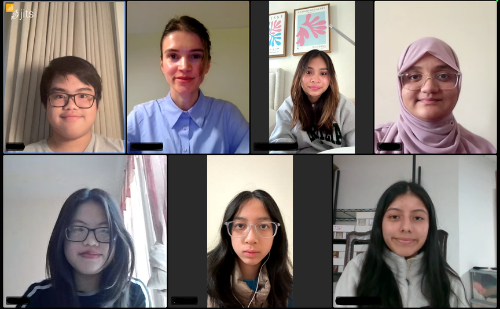
“Marine Biodiversity”
Sponsored by The New York Academy of Sciences and Empire Wind 1
Team members: Dakila G. (Team Lead) (New York, United States), Aizah Z. (New York, United States), Lucy L. (New York, United States), Biying L. (New York, United States), Mikaela V. (New York, United States), Anna L. (New York, United States)
Mentor: Krenare Bruqi (France)
Renewable energy enables societies around the world to meet growing demand for electricity without further exacerbating the effects of climate change. The teams of high-school students who participated in the Fall 2025 Junior Academy Challenge discovered, however, that while the benefits of renewable energy are undeniable, building the infrastructure for renewable energy sources such as windfarms and operating them can still impact the environment and local marine life.
“I learned that the overall establishment of a supposed environmentally friendly structure can have significant effect on the local ecosystem,” says Team Lead Dakila G. “This challenge taught me about the various ecological effects of offshore windfarms in marine biodiversity. Marine animals tend to dramatically decrease in number during construction due to noise and trawling effects.” As New York City plans to introduce new offshore windfarms to meet its commitment to achieving a fully renewable electricity grid within the next 15 years, challenge participants were tasked with finding innovative solutions to ensure that offshore wind farms can offer a truly sustainable energy source, allowing marine life to thrive.
A Wide Range of Marine Biodiversity
“Our community in New York City is home to a wide range of marine biodiversity, from fish and birds to marsh plants and shellfish,” explains team member Lucy L. “It is essential to find solutions to protect these habitats and ecosystems since they play a major role in keeping our environment clean.” Wind is an abundant resource, which peaks in the afternoon and evening, just when energy demands rise and wind farms form an important part of the city’s energy development plans.
As a first step toward developing their BioTurbine Collective solution, the team researched the various aspects of offshore windfarms that can disturb or damage the marine environment. “During construction, noise, habitat destruction, and displacement force marine animals to migrate, disrupt communication, and increase the risk of biodiversity loss, which harms the ecosystem’s balance,” says team member Mikaela V. “Furthermore, I realized how strongly the ocean is affected by human actions and how important it is to design wind farms efficiently to reduce all the negative impacts to try to protect our ocean, therefore, our planet.”
Real World Problem Solving
The disruption is not limited to the construction stage. The rotating wind turbines can alter currents and water movement and impact the distribution of plankton and other nutrients that marine species rely on. The noise the wind farms emit can affect navigation and communication among marine life while cables generate electromagnetic fields.
“This topic required real world problem solving skills and strong collaboration skills with my peers,” explains Anna L. “We had to analyze all the layers interconnected within a single topic, as a group we had to consider the scientific, social and environmental factors to our solution. We had to research, collaborate and bring our utmost creativity skills.” The brainstorming among team members paid off, and they focused their efforts on a novel solution: Turning the wind turbines into reef-like, living ecosystems that support marine animals and enable them to thrive, rather than harming them.
To achieve this result, their design incorporates several innovative elements. Turbine foundations are built of eco-friendly materials such as limestone and recycled concrete to create safe homes for fish, bivalves, crabs, shrimps and other sea creatures. Bubble curtains reduce construction noise by up to 95%, protecting sensitive species like marine birds and pelagic fish. Water is kept clean by shellfish reefs and kelp forests that remove nitrogen and phosphorus, while also providing shelter and nutrition to marine species.
The team also envisages blocking trawl fishing around the turbines to prevent overfishing and support the recovery of fish populations. The BioTurbine Collective team added smart technology components to their project with underwater cameras and eDNA monitoring systems to provide visuals and data on the animals and their behavior. The students envisaged using 3-D printers to craft the artificial reefs that will add more shellfish habitats.
Testing Their Approach
The team members tested their approach, using an environmental simulation model, Ecopath. The results were exciting and showed clear signs of biodiversity improvements. Reef fish (+40%), bivalves (+30%) and crustaceans in particular increased in number significantly. They also found that trawl exclusion produced strong gains, especially for bottom-dwelling species. Noise and electromagnetic field reduction had more limited effects but still contributed to protecting sensitive species like sharks and birds.
“My teammates were really dedicated people and had a genuine interest in marine biodiversity,” says team member Biying L., explaining that participants had varying interpretations of the problem at first. Through intense and convivial discussions, they arrived at a solution. “We had diverse and meaningful ideas that came together well.” For the students, the challenge offered a valuable opportunity to apply their skills to real-world problems while learning and collaborating with their peers.
“Throughout this challenge, I have been exposed to various new topics and have been able to expand my knowledge with regard to marine biodiversity and how we can help encourage it,” says team member Aizah Z. “Overall, this project has allowed me to develop new skills such as thinking outside of the box by teaching me a significant amount about marine biodiversity and also assisting with collaboration.”