Genomic Montage: When Science Meets Art
Photographer and artist Kevin Clarke’s first genomic montage, a self-portrait, resulted in a peer-reviewed publication in the journal ‘Clinical Chemistry.’
Published December 1, 2005
By Adrienne J. Burke
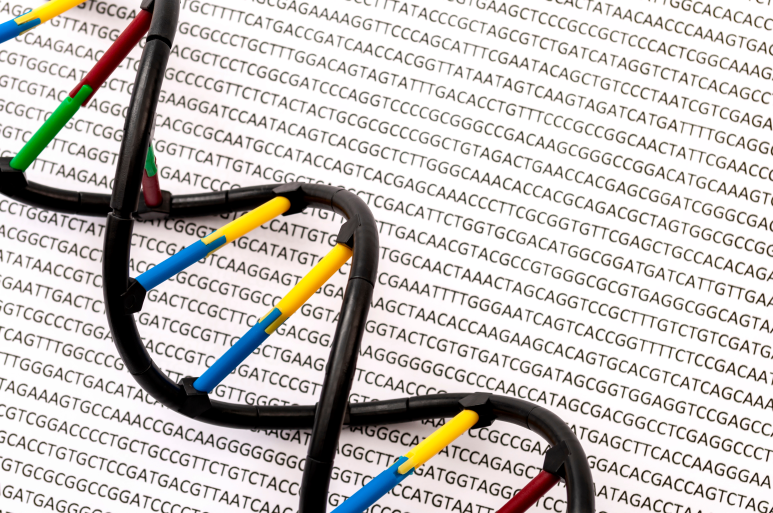
Having once suffered a near-fatal bout with appendicitis in Yucatan, Clarke had the idea to represent himself by integrating a segment of his own genetic material into a photograph he had taken of the Day of the Dead celebration there. The Cooper Union-trained photographer asked scientists at Applied Biosystems, a biotech company in Foster City, Calif., if they could inexpensively derive a reading of his DNA from a blood sample.
The experiments they carried out at his request are described in the 1989 paper “Automated DNA sequencing methods involving polymerase chain reaction,” which introduced the method that was ultimately employed in labs around the world to decode the human genome.
At least one if its authors went on to become a multimillionaire by selling DNA sequencing machines. And Clarke went on to invent a uniquely 21st century method of photographic portraiture. Nine of Clarke’s portraits are now on exhibit in a solo show, Becoming Human, at the Sara Tecchia Roma New York gallery in Chelsea.
Faceless Portraits
Clarke, who lives in Tribeca and began his career as a fashion photographer featured in magazines such as Vanity Fair, is best known for his 1980’s picture book “The Red Couch, a Portrait of America” comprised of portraits of people across the US sitting on a velvet sofa. It was through that project that he got his first introduction to DNA: Scientist Paul Schimmel, now a chemical biology professor at Scripps Research Institute, posed on the red couch at MIT holding the picture of a nucleotide sequence that had appeared on the cover of Science.
Among Clarke’s other well-known subjects have been composer John Cage, artist Chuck Close, dancer Merce Cunningham, politician Al Sharpton, and scientist James Watson.
But you won’t see any famous faces on the walls at Sara Tecchia Roma. As with his self-portrait, Clarke leaves the subject’s visage out of the picture. Instead of taking the subject’s picture, he takes a tissue sample — by cheek swab or hair root. And he spends time getting to know the person. The artwork then, is a compilation of images of representative objects or scenes that convey a personality, overlaid with a lab-generated reading of their genome.
“Determines Self from Other”
For instance, Watson, who co-discovered the helical structure of DNA, is portrayed by a series of tall metal bookcases, labeled with a series of As, Cs, Gs, and Ts. The shelves, photographed in varying stages of erectness, appear to twist and collapse in a spiral. And the sequence of letters represents the order of nucleotides in the HLA-DQA-1 ß region of Watson’s own genome. The choice of genetic material is artistically deliberate: Known as the gene that recognizes viral DNA in the body, Clarke says it “determines self from other.”
To represent Steve Cannon, an East Village art dealer and gallery owner who lost his eyesight five years ago, Clarke photographed a nappy Velveteen Rabbit slouched on a quilt. The inverted image of the toy, known in a child’s tale to have come alive, is overlaid with Cannon’s genetic sequence, generated for Clarke in exchange for art by Seqwright, a Houston-based genomics company. The anthropomorphized stuffed animal conveys a sense of tactility and comfort, which Clarke says are characteristic of Cannon. Though the subject won’t be able to view his portrait, he can touch the object that was chosen to represent him.
In a study for a portrait he is currently working on of the artist Chuck Close, Clarke digitally ran strands of DNA through a stretched out Slinky. Clark says the circles made by the Slinky represent not only Close’s famous photorealistic style of portraiture that involves creating pixels by painting circles onto a grid, but also the dynamism, momentum and movement of the artist who is bound by a wheelchair.
Cozy Science
Gallery owner Sara Tecchia says that, although she didn’t choose Clarke’s work for its scientific qualities, she is pleased by the way the show is instigating discussions about science. “People view science as something far away and cool, but Kevin’s work makes it warm and more cozy,” she says. “A lot of people don’t even know what their DNA is, but here they see it as part of a puzzle.”
Tecchia says her gallery seeks to represent artists whose work encourages intellectual dialogue. Clarke’s art, she says, appeals perfectly to her desire to show artists who are doing something no one else is doing, either in subject matter or in process. “We all know that Kevin knows how to photograph a normal portrait. This approach is a very conscious decision. A risk.”
Clarke compares his process of creating a portrait to the art of heraldry: “In the way a coat of arms contains symbolism, I’m recognizing metaphors that correspond to something that these people have projected to me,” he says.
In fact, in the way a regal 14th century family might have commissioned a coat of arms, modern families of means have commissioned Clarke to create genetic portraits. Clarke charges between $12,000 and $15,000 for a commission, and the eight chromogenic prints on exhibit here are offered for sale for between $3,500 and $18,000. A smaller portrait of Watson, offset on paper, is priced at $350.
Becoming Human runs through January 14 at Sara Tecchia Roma New York, 529 West 20th Street, between Tenth and Eleventh Avenues.
Also read: Code to Commodity: Genetics and Art