Tether, The Bio-Acoustic Sentinel
In response to the challenge of harnessing AI for the benefit of humanity, students in the Spring 2026 Junior Academy Innovation Challenge developed Tether, an AI-powered tool that improves post-surgical care by supporting patients at home and keeping clinicians informed.
Published July 29, 2026
By Nicole Pope
Winner of the Junior Academy Challenge – Spring 2026
“Human Centered AI”
Sponsored by The New York Academy of Sciences
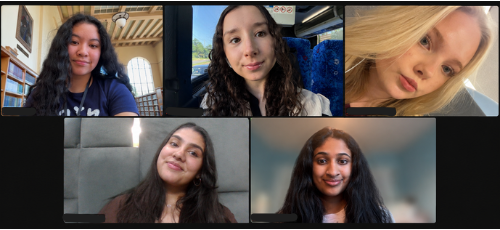
Team members: Nitya M. (Team Lead) (Sweden), Matilda S. (Sweden), Vivian W. (Delaware, United States), Veda S. (New York, United States), Ava G. (New York, United States), Arhan H. (United Arab Emirates)
Mentor: Sivaram S. (India)
Artificial intelligence (AI) offers great promise in a wide range of fields. The technology, in its multiple forms, is now spreading to all areas of our daily lives. Questions have also been raised: how to ensure that this powerful technology is used for the good of humanity and limits its misuse. This Junior Academy Spring 2026 challenge tasked young participants with designing an AI-based innovative solution that centers human beings.
After much consideration, the winning team produced a smart solution to a medical issue that is often neglected: the crisis that many surgery patients face after they are discharged from hospital. The students designed a user-friendly, disease-agnostic tool they called Tether, the Bio-Acoustic Sentinel, powered by smart technology, to complement – rather than replace – human-delivered health support. Their aim was twofold: to ensure that discharged patients do not feel isolated and confused when they return home; and give clinicians the information they need to check on a patient’s progress, thus maintaining the human touch at the heart of medicine. “While working on our project, as an aspiring medical professional, I was able to uncover and understand a lot more deeply what is known as the healthcare field,” explains team member Veda S. “It is more than just studying diseases and writing prescriptions. It is about the responsibility that we hold as a society to provide care that is equitable and accessible.”
Patients are usually tired, stressed, and particularly vulnerable post-surgery. Some 40% to 80% of them suffer from “post-hospital brain” and struggle to recall instructions given by the medical staff, unless these are repeated and strengthened within the first 72 hours. “Through surveying over 100 participants across multiple countries, we were able to connect with real individuals who experienced confusion with discharge instructions and hospital readmissions,” explains team member Ava G. “Hearing these perspectives made the issue feel immediate and personal, reinforcing the importance of designing solutions that are accessible, clear, and equitable for patients. It showed me that medicine is not just about treatment, but also about communication, accessibility, and community-centered design.”
Tether, which operates on cellphones, replaces clunky patient portals and can provide early warning signs of complications. When patients check in once a day by just speaking to their phone, AI analyzes their voice, detecting minute changes or “vocal jitter” that could signal cardiac stress or respiratory problems. Through Tether, discharged patients also receive simple instructions, free of medical jargon. To protect patients’ privacy, the data collected via the application is not uploaded to the cloud, but remains on the individual’s cellphone – though it can, evidently, be remotely monitored by clinicians. “Through this project, I learned that solving real-world problems is not just about ideas, but also about understanding people,” says team member Vivian W. “From our research and discussions, I saw how important it is to think about the needs of different communities when designing solutions.”
The team initially set out with the goal of designing a solution that could work in all healthcare systems, before narrowing their field to Sweden and the US – two countries that offered the best datasets on the issue they were targeting. “Whenever we disagreed we kept asking each other the same question, who are you thinking about: the older patient who barely uses a phone? The non-English speaker? The doctor with fifteen minutes between charts?” explains team member Arhan H. “Reframing every debate around a specific person turned arguments into design questions and from there we built together rather than against each other.” For maximum accessibility, the team opted to make their AI-powered resource a multilingual tool. “We designed Tether in 26 languages, so when the time comes it can serve new countries and systems without missing a beat,” explains Team Lead Nitya M. “This experience showed me that visionary thinking is important, but leadership actually means working through hard choices and trade-offs.”
Failure to provide sufficient post-discharge care results in 14-18% of patients being readmitted within 30 days due to support breakdown. Preventable readmissions and medication errors are estimated to cost the global economy $52.4 billion annually. Addressing the post-discharge crisis therefore brings numerous benefits. Aside from reassuring patients and supporting their recovery, Tether also acts as an efficiency multiplier, allowing medical staff to monitor several patients simultaneously. The team showed that the $50 monthly cost of operating Tether would be rapidly recouped by preventing unnecessary readmissions. “The combination of medicine and business was unknown to me,” says team member Matilda S. “Participating in this challenge gave me the opportunity to understand the connection between them and how it can bring immense value to medical professionals and patients.”