Advancing Science 40 Stories Atop New York City

The Academy’s new home on the 40th floor of 7 World Trade Center will convey our distinguished heritage while also establishing an efficient environment for new ideas.

Published July 1, 2006

By Hugh Hardy

Reception area at 7 WTC. Image courtesy of H3 Hardy Collaboration Architecture.

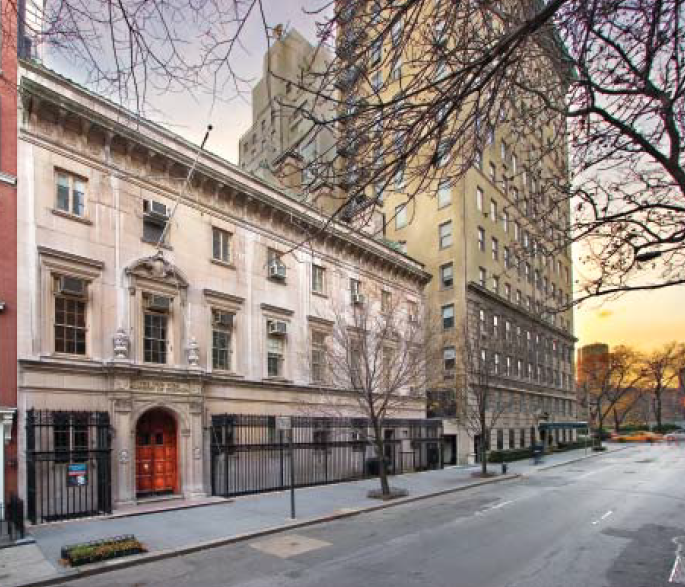
In 1950, a mansion on East 63rd Street was the answer to The New York Academy of Sciences’ (the Academy’s) dreams. With its sixteenth-century Italian mantel in the entry hall and a library of carved English oak, the building exuded an air of old-world scholarship and elegance that suited members and impressed visitors.

Today, however, the Academy needs more office and meeting space than the mansion can provide. What’s more, the building’s traditional interiors and furnishings give no hint of the Academy’s progressive nature and mission. Rather than shrink from change, as its current rooms dictate, this institution embraces it. This outlook will become astoundingly clear when members make their first visit to the Academy’s new home, forty stories in the air, at 7 World Trade Center. With spectacular urban and water views from all points of the compass, this aerie will dramatize the institution’s central role in New York’s scientific life and signal its vitality to visitors who come from around the world to participate in its activities.

Of course, the Academy is not abandoning its traditions. Science is built upon the work of previous generations and on many legacies of investigation and thought, even as it crosses frontiers into the unknown. This project’s design challenge lies in conveying the Academy’s distinguished heritage while also establishing a contemporary and efficient environment for its forward-looking activities.

A Magnificent Blank Slate

The Academy looked for space in many older office buildings, where it would have had to make decisions about what lobby space, offices, and conference rooms to keep and what to change. Instead, by renting (on advantageous terms) the entire 40th floor of a spanking new building, the organization was presented with an expanse of raw space, a magnificent blank slate. Seven World Trade Center is the only structure in the city whose floor plate is a parallelogram from bottom to top, and it offers 28,000 usable square feet per floor, without a single column between its central core and its perimeter walls of glass.

Our floor plan for the Academy bisects the building’s parallelogram on a north-south axis to accommodate two basic functions, one private, one public. The eastern portion is devoted to public areas, containing a lobby, reception space, three meeting rooms, “breakout” areas, and the president’s office. The western half of the floor contains offices for the staff and support areas.

The Academy’s links to the past are made clear in the entrance lobby, where a monumental bronze bust of Charles Darwin, which long graced the Academy’s garden, is prominently displayed to the left of the entry. Behind the reception desk is a sculptural metal “art wall.” Its openwork filigree echoes nineteenth-century street patterns and illustrates the Academy’s three original downtown locations. This patterned surface forms a sloping wall, dividing the entrance lobby from a generous socializing space by the windows. From here, views of Lower Manhattan will astonish visitors. At this vantage point, flatscreen monitors will direct participants to their meeting areas, announce current activities, and present the latest multimedia web offerings from www.nyas.org.

A Focus on Flexibility and Sustainability
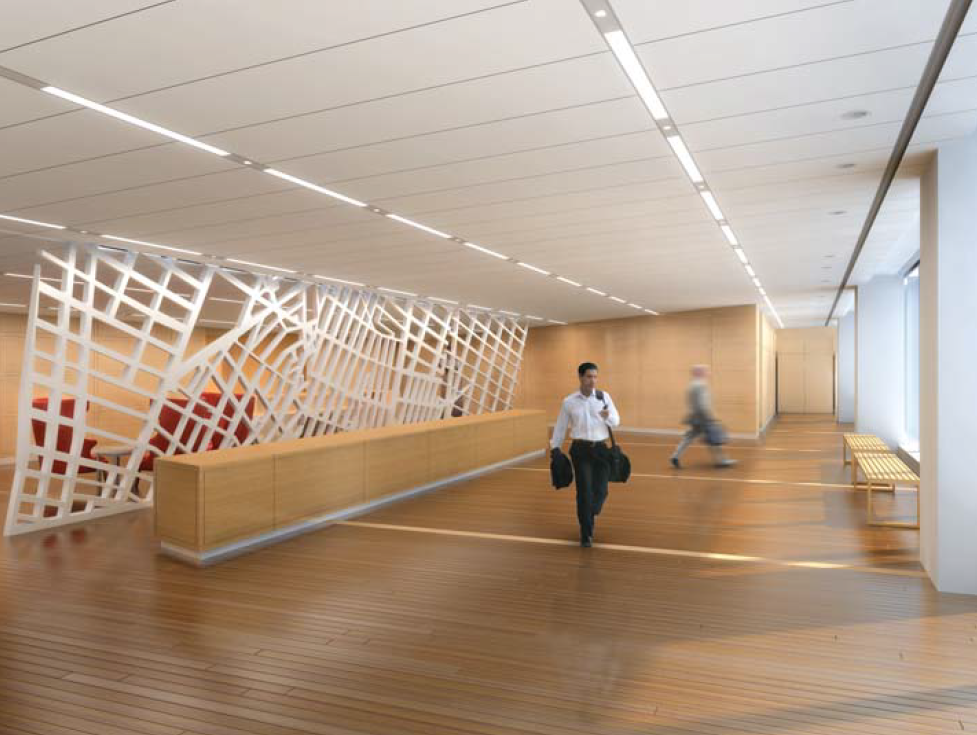
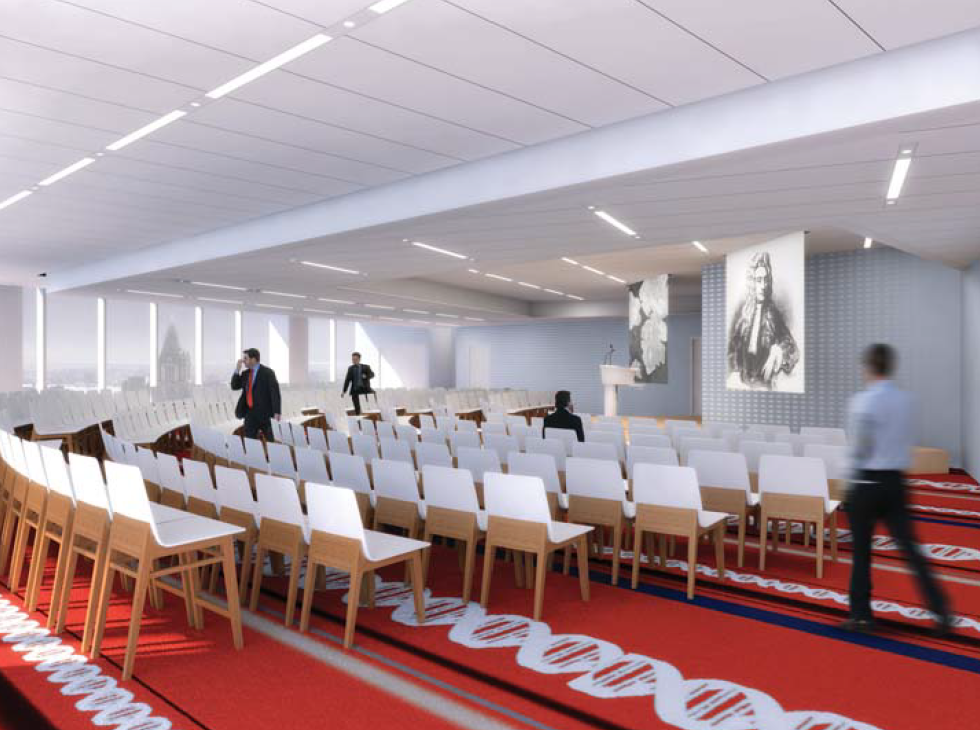
A meeting room at 7 WTC. Image courtesy of H3 Hardy Collaboration Architecture.

Conferences and meeting presentations require concentration, without the distraction of fascinating views. Therefore, three meeting rooms are fashioned so that each can shut out the panoramas. One of the conference rooms, shaped like a pod, is totally enclosed, while the others have shades that can hide the view. Groups from 30 to 300 people can be accommodated.

To the northeast, in one of the wide corners of the parallelogram, movable walls provide further flexibility, permitting corridors to be joined with the largest presentation room. A pantry permits catered food service for special events. Throughout the project, we worked with the goal of flexibility, knowing that activities will change within rooms from hour to hour, day to day.

Green concerns informed our planning. Lighting zones are monitored by motion sensors, and lights turn off after an allotted time if no one is present. Photometric sensors tied to westernmost lights automatically turn lights off during bright afternoon sunlight. In addition, almost all of the lighting is energy efficient fluorescent. Carpet tile is being used to reduce waste.

If areas of the carpet wear out over time or are stained, only those tiles need to be replaced instead of an entire run of carpet. The desk chairs are 44 percent recycled and 99 percent recyclable, and offices and workstations use high proportions of recycled materials, including steel paneling and mineral board, and glues and finishes that do not contain volatile organic compounds. Fabric for all of the upholstered walls and cubicles is 100 percent recycled polyester.

Combining Utility and Aesthetics

This institution has long held art in high esteem, using many forms of expression to suggest the shared interests of artists and scientists. An 80-foot-long gallery runs the length of the building’s interior core and will contain artworks relating to the Academy’s programs. Photographic panels, designed by the graphics firm 2×4, will decorate the conference rooms.

Those large images—some in black-and-white, some in color—depict details of the natural environment as seen through an electron microscope, as well as flowers distorted by anamorphic projection. The Academy’s new interior design utilizes materials that juxtapose tradition with innovation. We custom-designed a red carpet woven with a decorative gray-and-blue version of the DNA double helix. The carpet will offset paneling of light-colored wood.

After the Academy’s move this fall, visitors will enjoy a distinctive new facility that will encourage communication, discovery, and the generation of research and ideas. The Academy’s physical transformation represents its confidence in the future and its prominent role in the scientific and intellectual leadership of New York.

Learn more about the Academy’s history.


About the Author

Hugh Hardy and his firm, H3 Hardy Collaboration Architecture, are designing the space. Among Hardy’s well known projects in New York are the redesign of Bryant Park, the visitor center at the New York Botanic Garden, and the restoration of the BAM Harvey Theater.

Back to the Future: The Academy’s History

A pitiless creditor, arson, and rivalry between medical schools: All play a role in the history of the Academy’s real estate. Learn about the Academy’s history, dating back to 1817.

Published July 1, 2006

By Simon Baatz

The New York Institution on Chambers Street, home to several intellectual societies, housed the Academy in the early 19th century.

In a pleasant twist of fate, its move Downtown returns The New York Academy of Sciences (the Academy) to a location just blocks away from where it was founded nearly 200 years ago. On January 29, 1817, a group of 21 men, almost all recent graduates or professors of the College of Physicians and Surgeons, met for the first time in a room of that institution, then located on Barclay Street near Broadway, close to City Hall.

Known (until 1876) as the Lyceum of Natural History, the group was open to anyone with an interest in natural knowledge. By contrast, the two leading scientific societies of the prior century, Philadelphia’s American Philosophical Society and Boston’s American Academy of Arts and Sciences, were limited to the socially prominent.

A Link to the Medical School

The Lyceum’s link to a medical school was no coincidence: In the early 19th century, science was not part of the college curriculum and there was no career structure for science per se, so medicine was the logical profession for young men with scientific curiosity.

With the aim of hosting public lectures on science and establishing a museum of natural history, the Lyceum needed more capacious quarters, a situation that sounds familiar today. And so, in April 1817, the Lyceum moved to a set of rooms in the New York Institution on the south side of Chambers Street directly opposite City Hall. The New York Institution was a cultural and intellectual mecca; the three-story building, on loan to New York’s literary societies from the City, housed the New York Historical Society, the New York Literary and Philosophical Society, the American Academy of the Fine Arts, and the Lyceum of Natural History.

Rapid Expansion

The Lyceum of Natural History was able to take good advantage of the City’s generosity; over the next two decades, the membership and activities of the society expanded rapidly. The growth of the Lyceum caused the members to imagine that they might own their own building, thus ending their dependence on a loan that could be revoked at any moment. In 1831 the Lyceum did eventually move from the New York Institution into a temporary home provided by the New York Dispensary at the corner of White and Centre Streets. But this also was unsatisfactory and in 1834 the members initiated a subscription campaign to raise the funds to construct a new building.

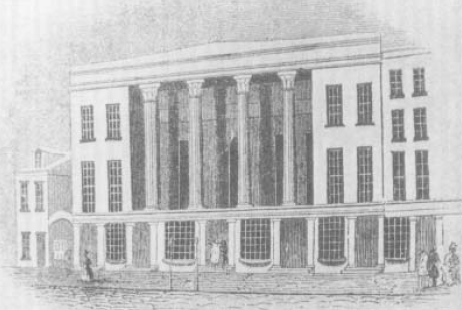
A safe harbor with NYU at the Stuyvesant Institute on Broadway.

Their efforts seemed successful; two years later the Lyceum moved into its handsome new home on Broadway between Houston and Prince Streets. It was a notable accomplishment for scientific endeavor in New York City. There was a large lecture room on the first floor and on the second floor, a spacious gallery for the Lyceum’s collections in natural history. The members set aside rooms for a library at the rear of the building and several small meeting rooms on the third floor.

But it was all too good to last. To buy the land and build, the Lyceum incurred debt, hoping to pay it off through ongoing donations. Then came the severe economic recession of 1837. That stalled fund-raising and soon the Lyceum had to take on more debt, for a total of $35,000. The members struggled valiantly to hold onto their building but to no avail; a creditor threatened legal action and in 1843 the Lyceum sold its home at auction for $37,000.

A Serious Blow

The loss of the Broadway building was a serious blow. For a while, a small group of dispirited devotees met in the home of the Lyceum’s president. But then the Lyceum found shelter under the wing of a successful upstart, the newly founded medical school at New York University. That school felt that a tie to the Lyceum would bring it prestige in its competition with the well-established College of Physicians and Surgeons, later to be part of Columbia University.

Less than a year after their own building was sold, the Lyceum, along with its magnificent natural history collection and its superb library of books, moved to the NYU medical school’s home at the Stuyvesant Institute on Broadway between Bleecker and Bond Streets. In 1851 the Lyceum moved with the medical school to a new building on the outskirts of the city at 14th Street close to Third Avenue.

But 15 years later, disaster struck. The NYU medical school was adjacent to the Academy of Music, a large opera house on the corner of 14th Street. On the night of Monday, May 21, 1866, an arsonist set a fire to the rear of the Academy of Music. The flames quickly spread and soon the entire block on 14th Street between Irving Place and Third Avenue was ablaze.

The NYU medical school, along with the Mott Surgical Museum and the collections of the Lyceum of Natural History, burned to the ground despite the best efforts of New York City firemen. A collection of birds donated to the Lyceum by John James Audubon, a mineralogical collection from the New York State Geological Survey, and the ichthyological specimens of Samuel Latham Mitchill, an energetic founder of the Lyceum—all vanished in the flames.

Another Severe Setback

The loss of the Lyceum’s collections was a severe setback to the cause of science in New York; it was not certain that they would ever be replaced. But ironically, the loss cleared the way for the creation of a new institution, the American Museum of Natural History (AMNH). Thanks to the generosity of New York City and State, and of the city’s wealthiest citizens, the AMNH opened on Central Park West in 1874.

Its establishment meant a circumscribed role for the Lyceum of Natural History—it would no longer attempt to rebuild its own museum. But the creation of the AMNH had its blessings; renamed the New York Academy of Sciences, the former Lyceum moved into rooms in the museum’s capacious building on Central Park West and assumed a modest, yet significant, role as a spokesperson for the scientific community in New York City.

In the early decades of the 20th century, the Academy organized a comprehensive survey of the natural history of Puerto Rico, a project that coincided with the research of such notable members as Franz Boas and Nathaniel Lord Britton.

Rising from the Ashes

Farewell to the magnificent Woolworth Mansion on East 63rd Street.
Courtesy CBRE.

But it was Eunice Miner, a former researcher at the AMNH who was executive secretary of the Academy from 1939 through 1968, who did more than any other member to revitalize the Academy and to secure it a permanent home. In her rounds of New York philanthropists, Miner attracted the attention of Norman Woolworth, scion of the family that owned a network of chain stores. Woolworth was so impressed that, on learning of the Academy’s search for a new home, he donated his own ornate five-story mansion on East 63rd with the sole requirement that the Academy pay all the necessary legal fees.

It was a spectacular gift. The Academy, the oldest science organization in New York City, could now boast a magnificent home—and a permanent measure of independence and self-sufficiency. After many happy years, and after much careful consideration, Academy members voted to sell the mansion in 2005. But in the other whimsical twist of fate, the Academy’s new home looks down upon the magnificent Gothic spire of the landmark Woolworth Building, which housed the Woolworth company for 80 years and is now being converted into residential apartments. And, of course, the proceeds from the sale of the mansion have resulted in an endowment that will be the bulwark of the Academy for years to come, back Downtown.

Also read: Academy’s Past: Where It All Began (11-part series) and Knowledge, Culture and Science in the Metropolis: The New York Academy of Sciences (1817-1970)


About the Author

Simon Baatz, who teaches American history at George Mason University, is the author of Knowledge, Culture, and Science in the Metropolis: The New York Academy of Sciences 1817-1970 (1990). His most recent book, For the Thrill of It: The Murder that Shocked Chicago, a history of the Leopold-Loeb case, will be published by HarperCollins in 2007.

The Journey of a Psychopharmacological Pioneer

From escaping Nazi-occupied Czechoslovakia to pharmaceutical breakthroughs to rubbing elbows with Aldous Huxley, Frank Berger has seen a lot in his life and career.

Published May 1, 2000

By Merle Spiegel

Image courtesy of Artinun via stock.adobe.com.

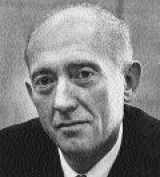
Anti-anxiety medications represent a significant share of the vast number of pharmaceuticals in widespread use today. In 1955, however, when Frank Berger invented meprobamate, it was the first and only anti-anxiety tranquilizer on the market. Berger, an Academy member for 51 years and a member of its Lyceum Society and Darwin Associates, was a true pioneer in the field of psychopharmacology.

Born in Czechoslovakia, Berger received his MD degree from the University of Prague and worked as a microbiologist at the National Institute of Health in Prague. The day after Hitler occupied Czechoslovakia in 1939, he and his wife fled to England—with the assistance of the Quakers. After quickly learning to speak English, Berger first worked as a physician in a refugee camp. Two years later, he became a resident physician in an infectious diseases hospital and then a researcher in microbiology in the West Riding of Yorkshire Laboratories.

Berger looked back on his amazingly successful career in a recent interview.

How did you get started in pharmaceutical research?

I was looking for a preservative for penicillin and came up with a compound called mephenesin, which stabilized penicillin by killing contaminants in the air that broke it down. However, a more elegant preservative was discovered at the same time, making mephenesin unnecessary for this use. While studying the compound in animals, I had noticed that it produced remarkable relaxation of the voluntary muscles without affecting respiration, heartbeat, and other vital functions—and I realized that it might have applications in medicine. Mephenesin was first used to produce muscle relaxation along with anesthesia in surgery. It was effective but not practical—since it wasn’t very soluble, and large amounts had to be injected intravenously.

Did you try to develop a more soluble form?

No, at this point my work on mephenesin had become pretty well known, and I was offered a position at the University of Rochester Medical School in the U.S. I wanted to focus on producing relaxation in people with muscle spasms such as cerebral palsy and spastic paralysis. Soon, though, I realized that mephenesin was even more effective in reducing anxiety—which, in turn, reduced muscle tension. And it was clear to me that anxiety was one of the big unsolved problems in medicine at the time.

However, mephenesin had a short duration of action and didn’t remain effective for long. Nevertheless, Squibb decided to market mephenesin under the brand name Tolserol in 1948, and it became the company’s bestselling product that year.

Were you able to find a long-acting form of mephenesin?

I was recruited by Carter-Wallace to do just that. Carter-Wallace was a well-known manufacturer of over-the-counter products—Carter’s Little Liver Pills, for example— and wanted to expand into pharmaceuticals. I discovered a new compound called meprobamate, which was very effective in treating anxiety and was pretty long-acting as well. Meprobamate was patented in 1955 and marketed as Miltown by Carter-Wallace and as Equanil by Wyeth.

How successful was it?

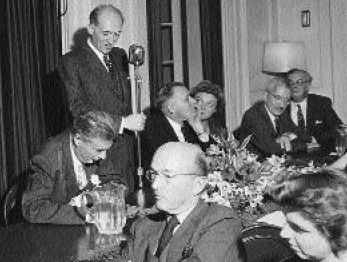
Frank Berger at the podium addressing The New York Academy of Sciences’ 1956 conference on psychopharmacology. Novelist and philosopher Aldous Huxley is to the left of Berger. Harry Beckman, professor of pharmacology and author of the best-selling Treatment in General Practice, is second from right, and renowned scientist Julian Huxley is at far right.

It became popular very quickly and soon was the most widely used prescription drug in the U.S. Meprobamate and other tranquilizing drugs were the subject of a major conference at The New York Academy of Sciences (the Academy) in October 1956. In the keynote address, Aldous Huxley predicted that these drugs were capable of changing the quality of human consciousness—a development that he thought would be more revolutionary than achievements in nuclear physics.

What did you do next?

In addition to building Carter-Wallace’s pharmaceutical business, I spent the next few years developing a compound that could be used in place of aspirin and codeine for everyday treatment of muscle and back pain. The result, carisoprodol, provides pain relief to the skeletal muscles without affecting the mind. It was marketed as Soma by Carter-Wallace and as Rela by Schering .

Did you stay at Carter-Wallace until you retired?

No, I returned to academia as professor of psychiatry at the University of Louisville, and served as a consultant to several pharmaceutical companies. This gave me a wonderful opportunity to spend part of each year in Geneva, Paris, London, and Milan. Even now, at the age of 87, I haven’t really retired. I still go to the office early each morning and keep up with what’s going on in my field.

What do you think is the most exciting development in pharmacology today?

Viagra. Just as meprobamate was the first drug to treat anxiety, Viagra is the first drug to treat sexual dysfunction. It’s a major breakthrough.

Also read:The Origin of the Term “Psychedelic”