A Satirical and Skeptical Take on Current News
Author and physicist Bob Park takes intelligent design, homeopathic medicine, and conspiracy theorists to task.
Published November 1, 2005
By Adrienne J. Burke
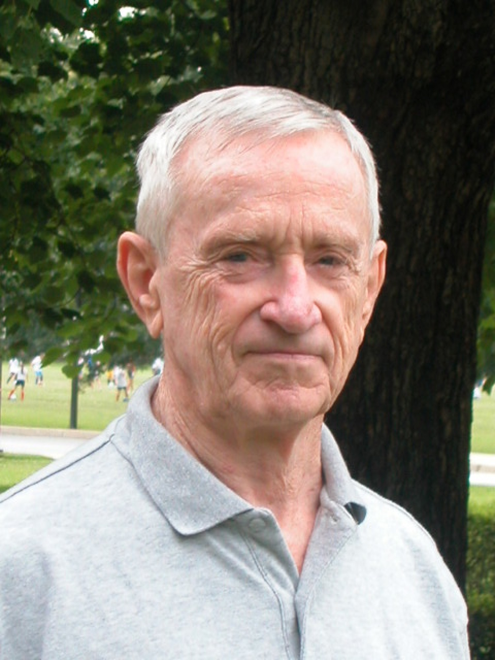

There’s a sardonic sort of disclaimer on the weekly science news website, What’s New by Bob Park: “Opinions are the author’s and are not necessarily shared by the University, but they should be.”
Park, past chair of the University of Maryland physics department and director of the DC office of the American Physical Society, bills his online opinion page as a “satirical and skeptical take on current news.” He’s devoted to “helping the public distinguish genuine scientific advances from foolish and fraudulent claims.”
Park is a frequent contributor to the New York Times op-ed page and the Washington Post science section, and in 2000 he authored the book “Voodoo Science: the Road from Foolishness to Fraud.”
On Halloween night, he spoke at the CUNY Graduate Center about the spooky ways science is twisted to support unscientific ideas such as intelligent design.” The event was hosted by the Center’s Science & the Arts Series. Noting that “there is no claim so preposterous that a person with a PhD cannot be found to vouch for it,” Park offered these seven warning signs you should heed in order to avoid being hoodwinked by voodoo science.
1. A discovery is pitched directly to the public.
“The integrity of science rests on the willingness of scientists to expose new ideas” for review by the scientific community, Park says. When so-called scientists announce their work in a press release, as did the Raelians when they supposedly cloned a human, Park says the public should smell fraud.
2. A “powerful establishment” is said to be suppressing the discovery.
Park recalls that in the 1970s an inventor named Sam Lynch claimed to have invented a car that ran on water. Lynch held that the powerful oil industry stood in the way. “The establishment will presumably stop at nothing to suppress discoveries that might shift the balance of wealth,” Park says. But in fact, the science behind Lynch’s invention couldn’t be substantiated. It violated the first law of thermodynamics.
3. An effect is always at the very limit of detection.
Ever noticed that no one has ever captured a really clear picture of a UFO or the Loch Ness monster? Park says to be leery of photographic evidence that shows nothing in the background to let you judge dimensions. The “effect” in “intelligent design” is interesting, Park says.
Proponents of intelligent design claim that things are so complicated in life that it couldn’t have possibly have happened by chance. “How do they know that?” Park asks. “We couldn’t have explained much of anything 100 years ago, and 200 years ago almost nothing. In fact, Richard Dawkins says it’s time these guys got off their butts and start doing some work. It’s hard work to find out how these things happen.”
4. Evidence for a discovery is anecdotal.
“If modern science has learned anything in the last 100 years,” Park says, “it’s to distrust anecdotal evidence.” The most important discovery of modern medicine, he argues, is not vaccines or antibiotics, he says, but double-blind testing.
Park cites Echinacea as an example of a cure lacking anything more than anecdotal support. Early settlers in the U.S. adopted the use of Echinacea to cure colds from Native Americans. But in was only a year ago that a study finally showed that Echinacea doesn’t live up to the claims. What took so long? “What scientist is going to build a career by finding out that some ancient Native American cure doesn’t work?” Park asks.
5. A belief is said to be credible because it has endured for centuries.
Park points to homeopathic medicine — a practice that he says relies on significantly diluted doses of substances that are said to cause the same symptoms they’re being prescribed to cure — as an example of voodoo science that has endured.
More than 100 years after Avogadro’s number showed that no molecules of the prescribed substance could possibly remain at such dilution levels, Park says homeopaths use the same dilutions that Sam Hahnemann prescribed in the 18th century. For instance, the homeopathic flu medicine oscillicoccinum is sold with the dilution of “200c” printed on the box. That’s 10 to the 400th. There’s no possibility that even one molecule has survived. It exceeds the dilution limit of the universe, and it’s sold for $12 for a two-day supply. “The whole thing is preposterous,” Park says. “People are being deceived everywhere.”
6. An important discovery is made in isolation.
“This is great for Hollywood movies…but that isn’t the way science works,” Park says. Science is open, he argues. “If I think I’ve found something out, the first thing I’m going to do is go talk to my colleagues…If it passes the giggle test there, I’ll probably give it at a scientific conference, and if it passes that [test], I’ll send it off to anonymous referees who would like nothing better than to pick my work apart…because that’s the way we make sure things are right.
A discovery made in isolation is one of those things you want to worry about, Park says. Progress is made by a community of scientists.
7. New laws of nature must be proposed to explain an observation.
Pointing to a picture of the Grand Canyon, which intelligent design advocates believe was cut by Noah’s flood 6,000 years ago, Park notes that there are numerous scientific ways to find the age of the Grand Canyon. “The easiest is to go down and take a glass full of water out of the river and let the sand sit and make a calculation of how much sand is being carried by the turbulence of the water. Or you can do radioactive dating or all kinds of things that all come out with just about the same answer.” To prove the intelligent design argument, he says, “You’d have to come up with a new law of nature.”
“Coming up with a new law of nature is not a trivial thing,” says Park. “If somebody claims to have found a new law, he’s probably wrong. But if he’s also working in isolation and these other warning signs are there, you’d be a fool to believe him!”
Also read: Deepfakes and Democracy in the Digital Age