A Systems Approach to a Messy Pollution Problem
Small-quantity, toxic substance generators can have large cumulative environmental impacts.
Published October 28, 2005
By Christine Van Lenten
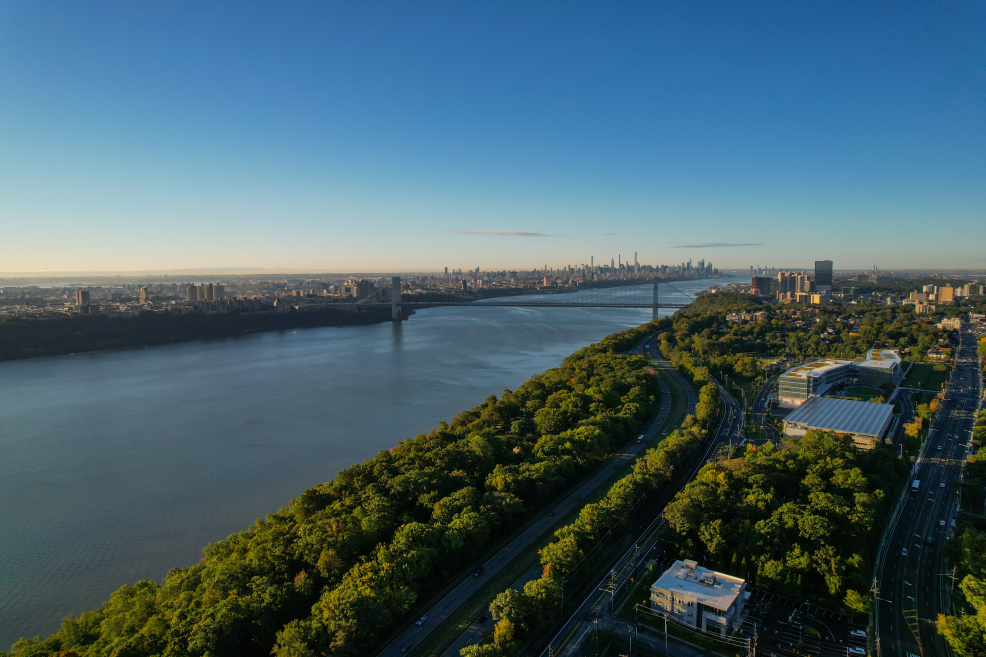
The Hudson River watershed is home to 20 million people whose daily activities – at homes, recreational settings, businesses, industries, construction sites, farms, landfills, and dumps – involve materials containing toxic substances. Through myriad pathways, some substances are emitted into the air, discharged to wastewater, washed into waterways, or migrate through soil into groundwater that transports them to waterways. Eventually, some drain into the harbor, polluting its waters and contaminating sediment.
Reducing water and air pollution will benefit the watershed ecosystem. And cleaner sediment can reduce disposal costs associated with dredging the harbor to keep it navigable.
But in a setting of this complexity and magnitude, how do you get a handle on pollution that’s “under the radar” of the existing regulatory scheme?
Putting Theory into Practice
It takes a multidisciplinary approach, and the field of industrial ecology has emerged to offer it. Practitioners apply rigorous systems thinking to model the flows of materials and energy through economies. Their aims are to understand how production, use, and disposal of materials and energy affect human health and the environment and to identify leverage points for beneficial change.
The field has largely been the province of academicians. But in 2000, at the request of EPA and the Port Authority, the New York Academy of Sciences’ Harbor Project began putting theory into practice, to study how five highly toxic substances – mercury, cadmium, polychlorinated biphenyls (PCBs), polycyclic aromatic hydrocarbons (PAHs), and dioxins – find their way into harbor waters, sediment, and air, and how their release can be prevented.
Getting the Right People to the Table
What puts muscle into the Harbor Project is a remarkable consortium that the Academy has assembled by convening hundreds of people representing 60-70 regional stakeholders. Drawn from industry, labor, large and small businesses, universities, community and environmental groups, and all levels of government, they include scientists, environmental advocates, community representatives, economists, policymakers, and communication experts.
Members participate by:
- guiding research
- contributing data and expertise
- formulating recommendations for pollution prevention strategies, industry best practices, and public policies
- promoting implementation
- engaging in outreach to the public
Because each pollutant presents its own unique, complex set of challenges and has its own universe of stakeholders, the core consortium is augmented by experts on each pollutant. Healthy debate, moderated by the consortium’s chair, Dr. Charles W. Powers, helps members define and frame core issues and craft recommendations that will be environmentally sound, cost-effective, and politically feasible. Member buy-in promotes successful implementation.
Getting Results
With funding from EPA, the Port Authority, and other sources, a small Academy staff led by Dr. Marta Panero conducts and commissions research, tapping scientific and other expertise from academic and regulatory institutions. They also coordinate consortium efforts and produce reports.
Academy staff use industrial ecology methodologies and secondary data to conduct watershed-wide assessments for each contaminant, identifying primary sources, historical and current uses, disposal practices, and pathways to the environment. This permits quantification of substances used in production, consumed, disposed of, and left in the environment. It also reveals significant data gaps. Then, using existing sampling data, researchers calculate, for the harbor alone, a mass balance: how much of the contaminant that entered the regional watershed environment has made its way into the harbor, and by what routes.
Integrating scientific findings with stakeholders’ expertise illuminates “upstream” problems and informs recommendations that can strengthen public policy and environmental management.
For example, in 2002, following issuance of the project’s report on mercury, New York State enacted a law requiring labeling and recycling of all mercury bearing products. Along with coal-burning power plants, hospitals, labs, fluorescent lights, and car switches, dental wastes generated by some 8,500 dentists in the watershed are a significant source of mercury. A final rule regulating dental wastes containing mercury will be issued this year. It will reflect a significant overall finding: that small-quantity, toxic-substance generators can have large cumulative environmental impacts.
The project has also issued reports on cadmium and PCBs.
Project staff share information widely, and the project is steadily gaining recognition as a model for collaborative environmental problem-solving. Among kudos: a 2005 EPA Environmental Quality award and a 2004 award from the National Pollution Prevention Roundtable.
What’s Ahead
Reports on PAHs and dioxins will be published in 2006. The project is also focusing on implementation of recommended pollution prevention strategies. A planned outreach campaign to prevent more cadmium, mercury, and PCBs from entering the watershed environment, initially targeted at 10 communities, will build understanding of why improper disposal is harmful and encourage recycling practices and the use of products that are contaminant-free. Those practices, coupled with institutional advances in monitoring and managing toxic substances, can shift activities that affect the harbor in the direction of sustainability.
Also read: Storm Surge Barriers for New York Harbor?