Academy Education Experts Lead K–12 Workshop
Scientific literacy begins with curiosity. At the American Association for the Advancement of Science Annual Meeting, educators from The New York Academy of Sciences showed scientists how hands-on experiences can bring complex research to life for K–12 students.
Published March 13, 2026
By Zamara Choudhary, Adrienne Umali, and Danielle Mink-Bellizzi
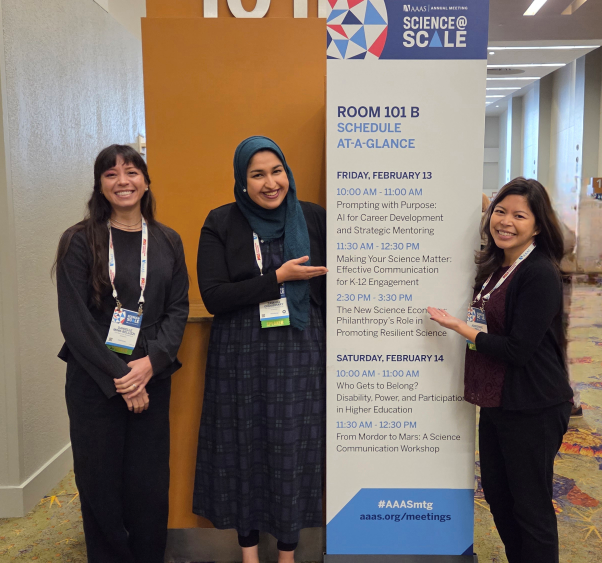
Making science matter starts with making it matter to young people.
In Making Your Science Matter: Effective Communication for K–12 Engagement, we invited scientists to rethink how they share their work beyond the lab and university classroom. At a time of mounting misinformation, declining public trust, and uneven access to quality STEM education, the session underscored a simple but urgent truth: scientists themselves are powerful catalysts for building scientific literacy.
The Academy engages more than 16,000 K–12 students annually through mentorship and hands-on programming. Yet, nearly half of young people lack a clear understanding of what STEM careers look like. Furthermore, 79% of students entering Academy programs report never having met a scientist before. That first interaction between student and scientist can be transformative.
We began the workshop by grounding it in why scientist engagement with K-12 students is of utmost importance. We explained the “opportunity gap” in STEM is not about ability, but access. By equipping scientists to engage effectively with diverse K–12 audiences, we aim to multiply points of contact between young people and scientists of various backgrounds. Representation matters. When students see scientists who remind them of themselves, understanding scientific concepts and pursuing a career in STEM become more approachable and attainable.
Scientists also stand to benefit immensely from interacting with K-12 students. Communicating science to young audiences strengthens public engagement skills and provides concrete teaching experience—an increasingly important asset in a competitive and evolving job market. As more researchers consider roles in education, policy, and community engagement, the ability to translate complex ideas into accessible, meaningful experiences is no longer optional.
The Proven Impact of Hands-on Engagement
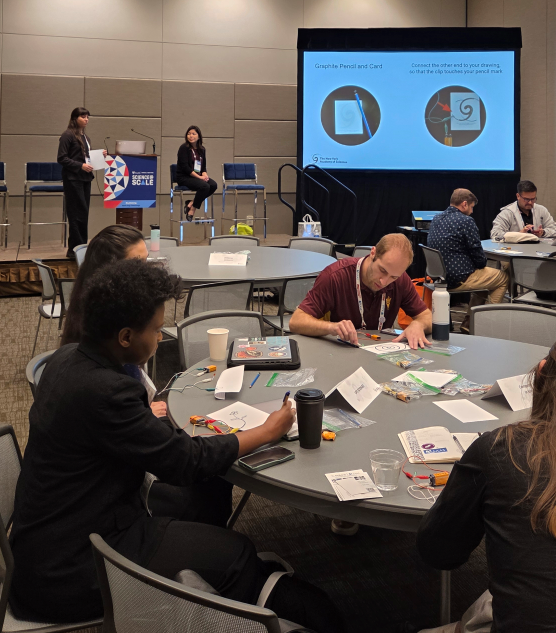
We then guided participants through an interactive activity that illustrated key principles necessary for turning complex ideas into discovery-driven experiences. Participants built simple circuits using a battery, an LED, and their own graphite drawing. When they saw the LED flicker to life through their drawing, the excitement in the room was palpable. Simple activities like these spark curiosity. Through trial and error, participants learned that failure is data. Failure, reframed as information, then becomes a powerful teaching tool.
The workshop culminated with a design challenge, where participants worked together in discipline-based groups to create a physical model explaining a scientific concept to a specific age category. They were asked to consider: what must a student understand before the model makes sense? How can I connect that idea to something they already know? Each group then presented their model to other groups, who took on the role of students in that specific age category. A final discussion prompted participants to reflect on what they learned throughout the workshop and how they might apply activity-based learning to cultivating curiosity of and knowledge of science with young people.
Data from the Academy’s programs reinforce what participants experienced firsthand: sustained, hands-on engagement with scientists increases students’ understanding of what scientists do and how science affects everyday life. By helping researchers design experiences that spark curiosity and belonging, workshops like this one remind us that effective science communication is not about simplifying facts or “dumbing down” information. It is about building bridges—across ages, disciplines, and communities—so that the next generation is ready to ask, and answer, the questions that matter most.
Interested in learning more about the Academy’s Education programs and applying these strategies to your own work? Learn more here.