Academy’s Past – A Return Downtown
The Academy returned to its roots in Lower Manhattan when it moved into a brand new, state-of-the-art skyscraper at 7 World Trade Center.
Published December 19, 2025
By Nick Fetty
7 World Trade Center | 2006-2023
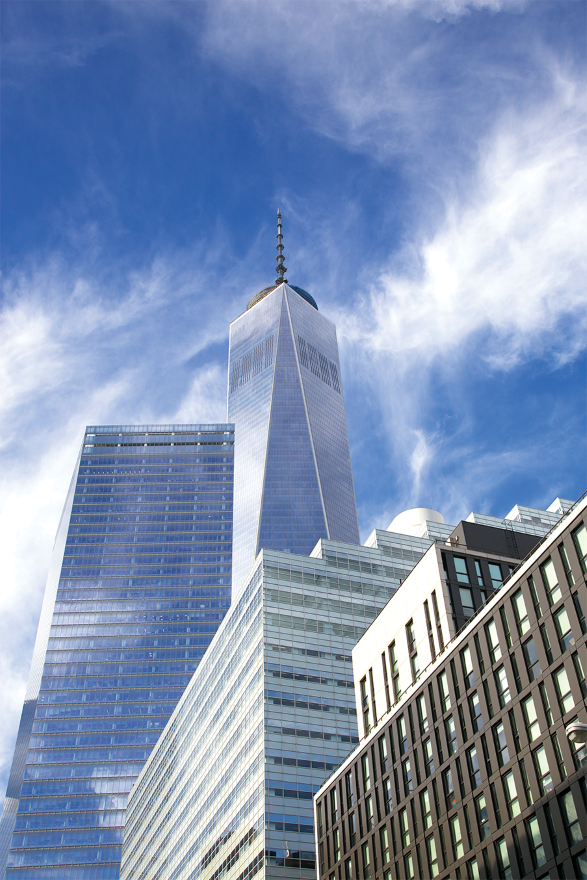
As Lower Manhattan was rebuilt after the devastating attacks of September 11, 2001, the Academy had the opportunity to return to its roots in Lower Manhattan.
The first tenant of 7 World Trade Center after construction was completed in 2006, the Academy moved into the 40th floor of the 52-story, 1.7 million-square-foot skyscraper. The $700 million building was the first building to come back online after the trade center campus was destroyed.
7 World Trade Center was “a model of environmental and operational efficiency in high-rise construction” and was dubbed Manhattan’s “greenest” building by the U.S. Green Building Council (USGBC), according to the Academy’s 2005-06 Annual Report. The building achieved gold status under USGBC’s Leading in Energy and Environmental Design (LEED) rating system, the first office building in NYC to attain this status. Additional accolades included the Municipal Art Society of New York’s 2006 award for Best New Building, and the 2006 Merit Award for Architecture from the American Institute of Architects New York Chapter.
“Returning to the area of New York where we were born seems only fitting in light of our approaching bicentennial,” former Academy President Ellis Rubinstein wrote in the 2005-06 Annual Report. “And being the first tenants to have leased space in the first building to rise at the Trade Center site since September 11, 2001 reaffirms our commitment, as a New York City-based institution, to the rebirth of its historic downtown heart.”
Advancing the Mission of Science for the Public Good
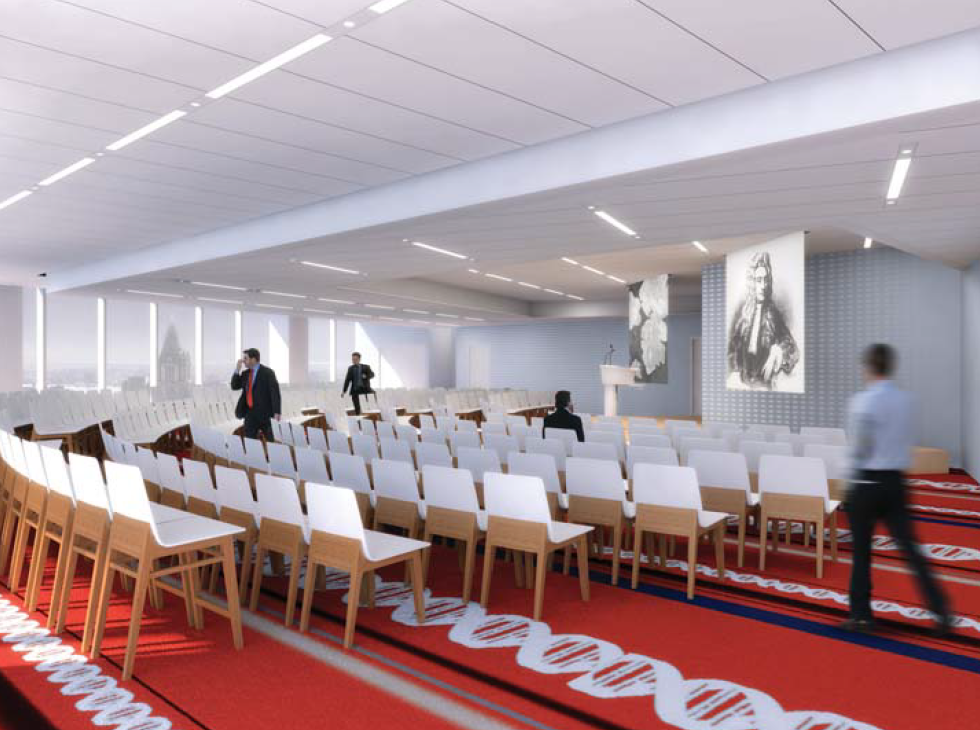
During this time the Academy continued its longtime scientific programs, including publication of Annals of the New York Academy of Sciences; the Frontiers of Science Program, which provides a platform to interdisciplinary discussion groups led by prominent researchers working in some of the most applicable and popular areas of science; and public outreach, particularly with area K-12 schools. The Academy also developed new, innovative initiatives such as Science & The City, a program focused on public engagement with scientific activities in NYC—including many sponsored by the Academy—as well as podcasts and other resources.
The elegant, expansive space on the building’s 40th floor provided breathtaking views of the city for attendees of the Academy’s events with such high-profile guests as UN Secretary General Ban Ki-moon, NYC mayor Michael Bloomberg, former UK Prime Minister Tony Blair, and the King of Sweden, Carl XVI Gustaf. A popular activity for some guests was to take a “selfie” with the bronze bust of Charles Darwin, donated to the Academy after a 1909 Academy-sponsored conference celebrating the 100th anniversary of Darwin’s birth and the 50th anniversary of On the Origin of Species’ publication.
The onset and devastating impact of COVID-19 throughout the world necessitated the Academy to move to more online, virtual programs. No different from most other organizations, the Academy had to adapt. In 2023, the Academy moved to a smaller headquarters just a few blocks away from 7 WTC.
This is the tenth piece in an eleven-part series exploring the Academy’s past homes. Read:
- Where It All Began (Part 1)
- A Budding Institution (Part 2)
- The Need for More Space (Part 3)
- A Home to Ourselves (Part 4)
- A Generous Gift and a New Home (Part 5)
- Fire Leads to Academy Setback (Part 6)
- A New Name for a New Era (Part 7)
- An Era of “Unprecedented Prosperity” (Part 8)
- Moving on Up(town) (Part 9)
- Right Up There on Broadway (Part 11)