Bringing the Lab into the Classroom with NYC’s Youngest Scientists
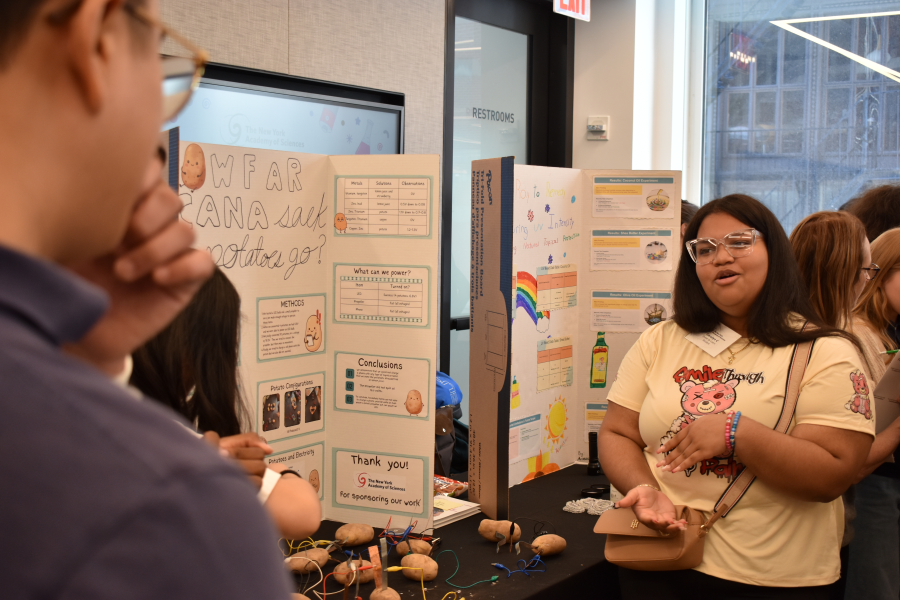
The Scientist-in-Residence Student Showcase is a culminating celebration where NYC students present the results of the research projects that, over the school year, turned their classrooms and communities into real-world labs.
Published June 24, 2026
By Agata Regula
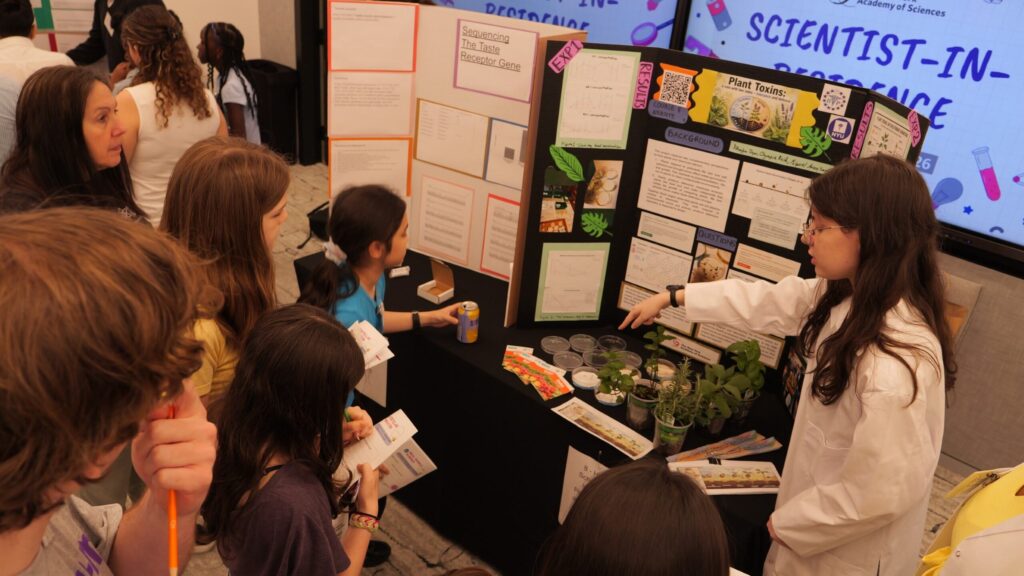
The New York Academy of Sciences’ Scientist-in-Residence program (SiR), created in 2012, empowers NYC students to engage directly with working scientists from local universities and scientific institutions. By matching 2nd-12th grade teachers with scientists in their subject area, SiR aims to bring science to life in the classroom. Throughout the school year, scientists work with students in their schools, conducting hands-on inquiry-based projects in which students take leading roles. The SiR student showcase allows students to present, discuss, and celebrate these projects with their peers and members of the wider NYC scientific community.
The 2026 SiR cohort was made up of over 1500 students from 47 schools across NYC, 85% of which qualify for Title I funding. More than 250 of those students, representing 45 of the participating schools, had the opportunity to present at the showcase. With tables set up for presentations throughout the room at Cure’s campus, adults and students circulated, discussing their projects and seeing the work their peers had conducted this year. Although the room was full of excitement and conversation, students did not leave their scientific spirit at the door—one group of 5th graders from P.S. 376, who researched the effects of loud sounds on long-term auditory health, could be seen using decibel meters to assess the noise level in the room.
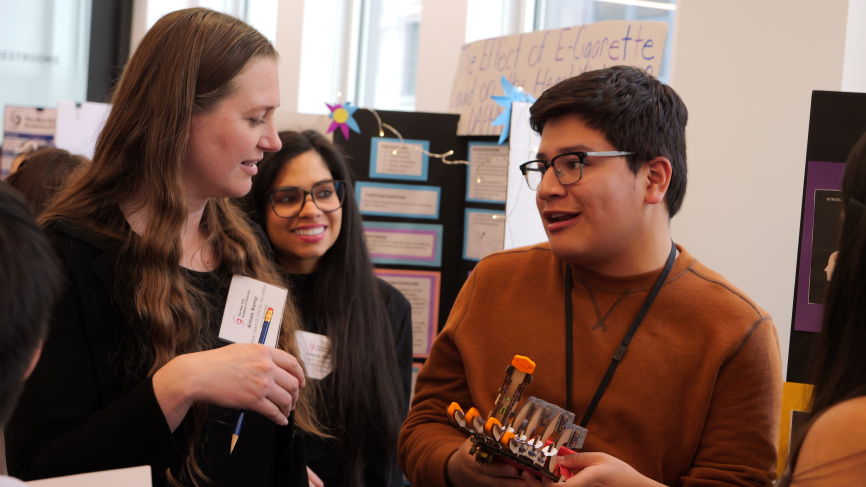
At the 2026 SiR showcase, the daily agenda featured remarks from speakers working in STEM disciplines including aerospace technology, engineering, and entomology, followed by two rounds of poster presentation sessions by student representatives from the 47 participating classrooms. For most of the students, the poster sessions represented their first opportunity to present their research to a broad audience of STEM professionals, teachers, and fellow students, including some who were much younger or older than themselves. This allowed them to practice using their science communication skills to spread information, showcase their knowledge, and explain new research to a diverse audience. Students had to adapt their presentations for both established scientists and children as young as eight, a challenging task for even many STEM professionals.
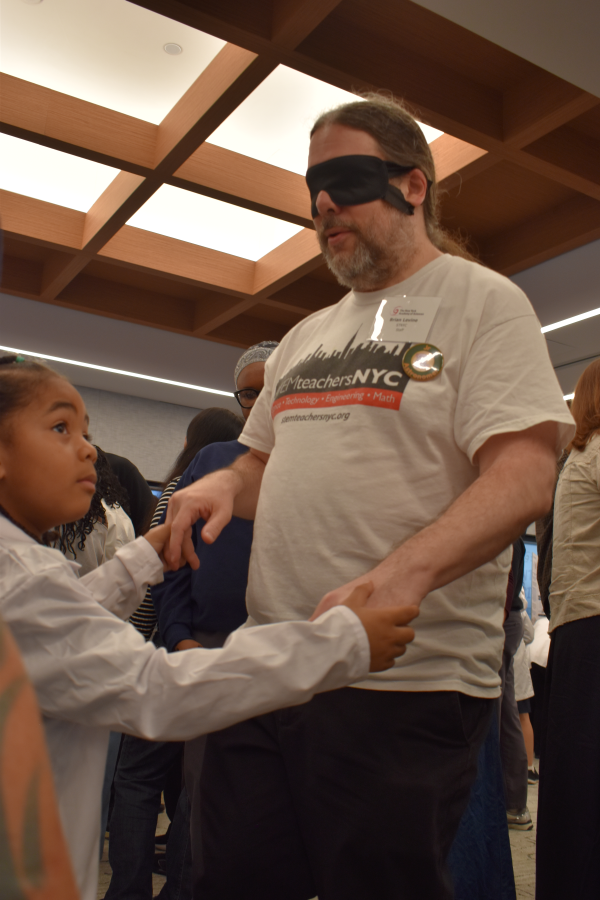
NYC-area STEM leaders and advocates offered to share their own experiences in science-recounting stories from their careers while imparting meaningful lessons and advice to the students present. Speakers included:
- Nicholas B. Dirks, President and CEO, The New York Academy of Sciences
- Seema Kumar, CEO, Cure; Member of the Board of Governors, The New York Academy of Sciences
- David Lefer, Industry Professor, NYU Tandon School of Engineering
- Noah Guy Lewis Guiberson, PhD, Postdoctoral Associate, Weill Cornell Medicine
- Shekar Krishnan, District 25 New York City Council Member & Education Committee Member
- Emily Rice, PhD, Associate Professor, CUNY Macaulay Honors College
- Hannah Stower, PhD, Assistant Director of Education and Engagement, Institute for Translational Neuroscience / Department of Neuroscience at NYU Langone Health
- Carly Tribull, PhD, Associate Professor, SUNY Farmingdale State College
- Fernando Vazquez, PhD, Manager, American Museum of Natural History
NYC as a Lab
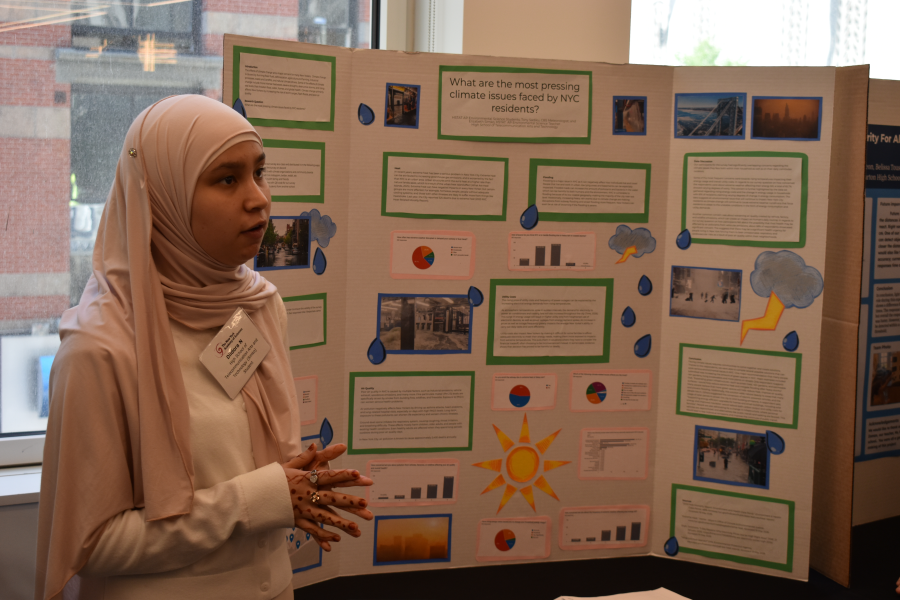
Many student projects made use of NYC’s plentiful ecosystems, waterways, and green areas when conducting their research, including in-school vs. out-of-school air quality, researching street trees and solar panels, exploring ways to diminish the heat island effect and examining anthropogenic effects on the urban environment. Students across the five boroughs used their research to do key work in their community and become advocates for a greener NYC.
Students from United Charter High School – Advanced Math and Science, for example, focused on NYC’s Combined Sewer Overflow system, where stormwater runoff, which is normally released back into waterways, is combined with raw sewage, and often litter, before it reaches its destination. To prevent water contamination, the students designed a water filtration system using only household materials, which successfully filtered out simulated litter and other water pollutants.
For many people, including professional researchers, combating pollution and climate change can seem like a daunting or even impossible task. But by focusing on their local communities, these student groups are translating abstract problems into local concerns with tangible solutions. Additionally, engaging in locally-focused science strengthens the students’ bonds to their communities and shows them that as future scientists, they can directly impact the lives of those around them.
Building STEM Identity and Belonging
Before meeting a real scientist for the first time, many kids might imagine a man, wearing a white lab coat and goggles, holding test tubes, and having messy hair. Although some students wore lab coats to the showcase to connect with their inner scientist, the SiR program is an amazing opportunity for kids to meet a real scientist and begin to understand that a scientist can look like anyone, and that they too belong in STEM.
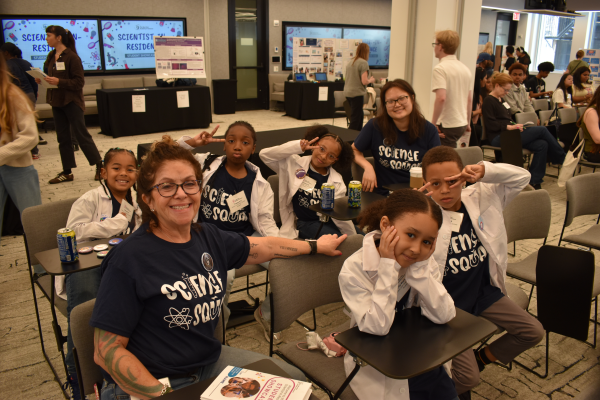
Council Member Shekar Krishnan gave such inspiring words of encouragement to the students, sharing the fact that his Indian mother is a prime example of the Hidden Figures type of scientist: she dedicated her life to discovering breakthroughs and making advancements in biotechnology and treating drug-resistant infections; meanwhile other scientists received the credit. He emphasized how far we have come as a scientific society from that time, while simultaneously calling for students to apply scientific inquiry to their own heritage and culture, citing experiments he performed during high school to study turmeric’s compounds.
“It is incredibly important for students to see themselves represented in STEM careers,” one SiR teacher noted. Being paired with a female scientist the teacher observed, “helped many of our students, especially our girls, see that these careers are possible for them.” Fostering a long-term research-focused relationship between students and scientists helps students dispel stereotypes they may have internalized of what a scientist can be, and help understand that there is more to science than just textbooks.
Students aren’t the only ones who benefit from participating in SiR: one participating teacher said that after completing a year with the program, “I feel more like a scientist and feel supported in growing that identity in myself and my students.” Similarly, a 25-26 scientist mentor noted that after participating in the program they “became more confident in my ability to teach research skills to learners with limited experience, and I learned a lot about how much science I really do know.” Imposter syndrome doesn’t just occur in young, budding scientists; it is something that any distinguished STEM professional can struggle with. For scientists, participating in SiR offers the opportunity to showcase their knowledge and gain valuable experience with hands-on teaching.
Over the past 15 years, SiR has served more than 400 teachers and scientists and over 17,000 students. With hopefully many more years to come, everyone involved with the program can look forward to continuing to foster opportunity and strengthen NYC’s scientific community through supporting its educators, professionals, and future generations.
A big thank you to all of our program sponsors, and to Cure for supporting this special event.
Learn more about how you can be part of this exciting program for the upcoming school year.