CNN’s Dr. Sanjay Gupta Honored for Science Communication
From war zones and natural disasters to medical marijuana and pandemics, Dr. Gupta’s career has covered the gambit of public health issues.
Published May 4, 2026
By Nick Fetty
In an era of misinformation and partisanship, CNN’s chief medical correspondent, Sanjay Gupta, MD, understands the importance of effective science communication.
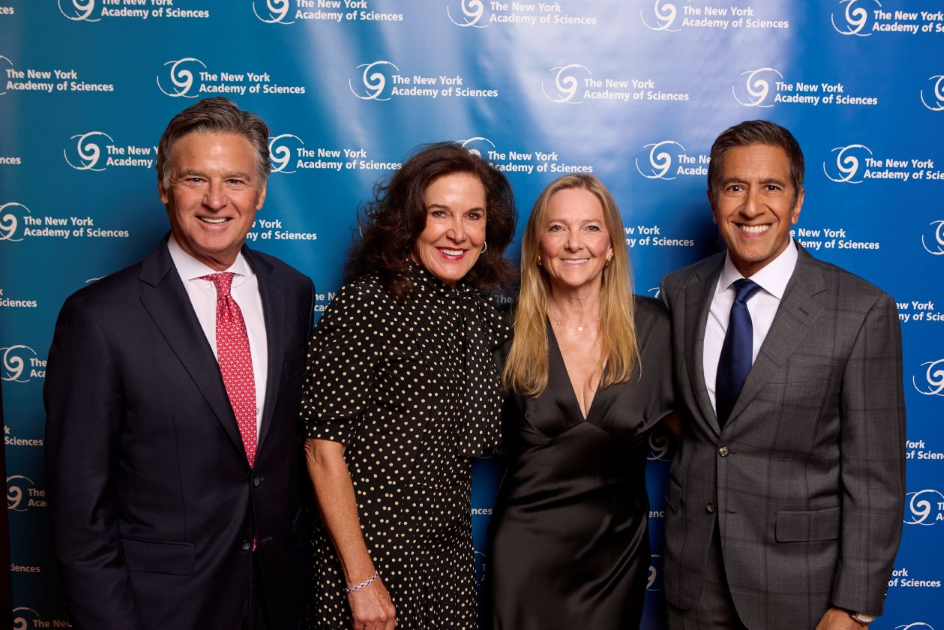
The New York Academy of Sciences honored Dr. Gupta with its 2026 Science Communicator Award during the second annual Spring Soirée, hosted on April 21st at the University Club in New York City. CNN was a Benefactor-level supporter for the event.
“For over twenty years, Sanjay has occupied a peculiar and precious space: where the lab meets the living room,” said Dan Barrow, MD, the Pamela R. Rollins Professor and chairman of the Department of Neurological Surgery at Emory University School of Medicine, as he introduced Dr. Gupta.
“He understood something that far too many science communicators never quite figure out. The goal isn’t to impress. It’s to illuminate,” Dr. Barrow concluded.
Dr. Gupta then took to the stage to accept the award and deliver his remarks.
“Many years ago when I first started doing television [my wife] Rebecca gave me the single best piece of advice I’d ever heard about being on camera. She said treat the lens as if it were a patient,” Dr. Gupta said. “It changed how I spoke, what I said, how much empathy I could transmit. The lens for me stopped being a piece of glass and started being something, someone that I really cared about.”
Dr. Gupta is just the third person to receive this honor after the inaugural award was bestowed upon documentarians Janet Tobias and Jared Lipworth during the 2025 Spring Soirée.
From the September 11 Attacks to the COVID-19 Pandemic
A practicing neurosurgeon, Dr. Gupta has been with CNN since 2001. He broke stories about the threat of anthrax following the September 11 terrorist attacks. He’s reported from war-torn regions in Iraq, Kuwait, Lebanon, and Afghanistan, and has performed life-saving brain surgery for patients in desert operating rooms. He has also extensively covered natural and manmade disasters including:
- Tsunamis in Sri Lanka (2004)
- Hurricane Katrina in New Orleans (2005)
- The Gulf of Mexico oil spill (2006)
- Flooding in Pakistan (2010)
- Earthquakes in Haiti (2010)
- Earthquakes and tsunamis in Japan (2011)
- The Ebola outbreak in West Africa (2014)
- Earthquakes in Nepal (2015)
- Hurricane Maria in Puerto Rico (2017)
This award from the Academy is just the latest on a shelf already full of accolades Dr. Gupta has to his name including the John F. Kennedy University Laureate award, PEOPLE magazine’s “Sexiest Men Alive” list, and multiple Emmy® awards. In 2019 he was elected to the National Academy of Medicine, “considered one of the highest honors in the medical field.”
In addition to his work with CNN, Dr. Gupta also serves as an associate professor of neurosurgery at Emory University Hospital and associate chief of neurosurgery at Grady Memorial Hospital in Atlanta.
Hail to the Victors

The University of Michigan holds a special place in Dr. Gupta’s heart. Not only is it his alma mater (twice over), but his parents first met in Ann Arbor in the 1960s. He once delivered a rousing commencement address in Michigan’s historic “Big House.”
“If you ever cheer for another team in competition with the Wolverines, then some 500,000 alumni will hunt you down and paint you maize and blue,” Dr. Gupta said during the 2012 address.
Using his decades of on-camera experience, Dr. Gupta even tried his hand as a “‘sideline reporter’ of sorts” during Michigan’s 2018 championship run in men’s basketball. Though they fell short of the title in 2018, Dr. Gupta was proud to watch them best the UConn Huskies 69-63 to claim the 2026 championship.
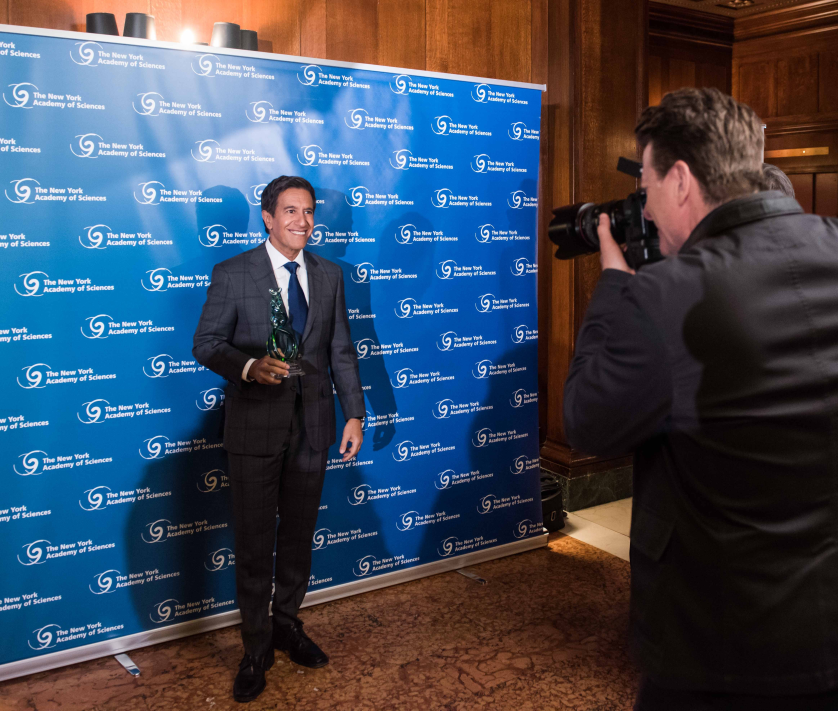
“It only took us 37 years,” he said with a smile during a photoshoot after the Soirée’s program, referring to Michigan’s 1989 title run.
His fondness for his upbringing in the Wolverine State came through during his Soirée remarks. In an era when approximately 80 percent of Americans cannot cite a single living scientist, Dr. Gupta said he was grateful to be raised by one in his mother, Damyanti. At the age of 24, “she was designing cars as the first woman hired in the United States as an engineer at the Ford Motor Co.” Growing up, the word “impossible” was not allowed in the Gupta household.
“My mom to me was the first and best example of science and what it can do for mankind,” Dr. Gupta concluded. “[We’re living in a] time where science has never been more powerful and never more questioned. But that tension is why science communication matters. Not as an afterthought, once the real work is done, but as part of the work itself.”