Healthcare’s Real AI Breakthrough May Be Getting Proven Care to More Patients
Former New York City Health Commissioner Dr. Dave Chokshi argues that AI’s greatest promise may not be discovering the next miracle cure but helping proven care reach the patients medicine still misses.
Published May 21, 2026
Artificial intelligence is often framed as a force that will expand the frontiers of what healthcare can discover: new drug targets, better diagnostics, faster clinical decision-making, and predictive tools capable of seeing patterns humans can’t.
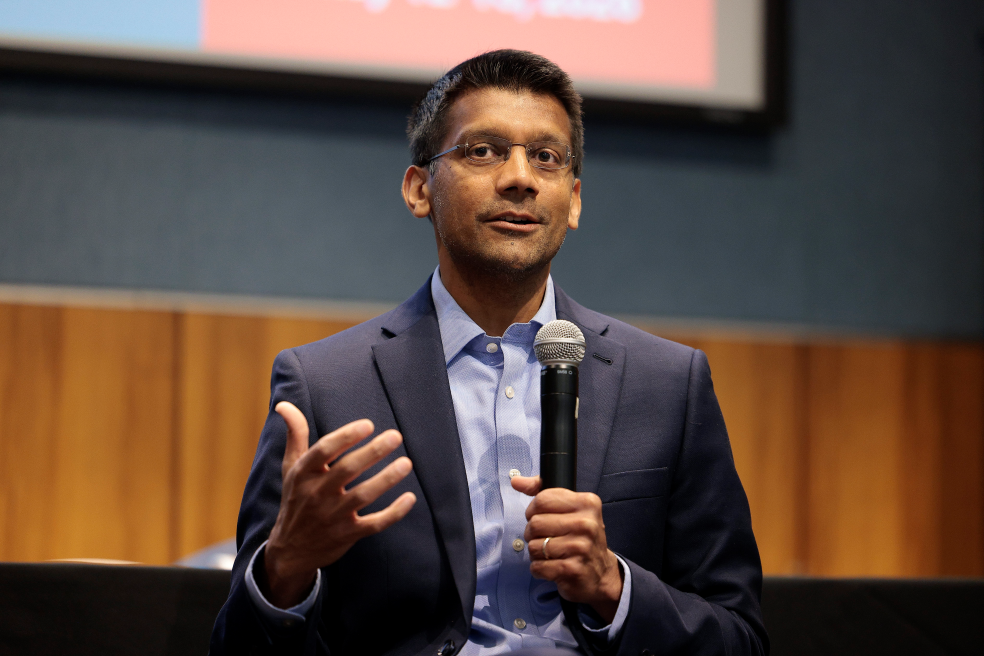
But Dave A. Chokshi, MD, MSc, offered a different challenge at The New Wave of AI in Healthcare 2026, a May 12–13 conference in New York City presented by the Windreich Department of Artificial Intelligence and Human Health at the Icahn School of Medicine at Mount Sinai and The New York Academy of Sciences. In a fireside chat on health leadership in the era of AI, moderated by Girish Nadkarni, MD, MPH, Chief AI Officer at Mount Sinai, the former New York City Health Commissioner and current physician argued that healthcare shouldn’t measure AI’s success only by what it helps invent. It should also ask what AI can help deliver.
Closing the Gap Between Discovery and Delivery
For Dr. Chokshi, one of the most urgent opportunities is closing what he called “the discovery-delivery gap” or the “no-do gap”: the stubborn distance between what science has already made possible and what patients actually receive.
“You read about AI and drug discovery, and don’t get me wrong, I’m excited about that as well,” he said, “but we literally have medicines that are curative right now, or have near-perfect efficacy in preventing diseases right now that do not reach the patients who would most benefit from them.”
Dr. Chokshi made the gap concrete with examples where proven interventions still fall short of reaching the people who need them. Curative hepatitis C antivirals have been available for more than a decade and can eliminate the virus before it leads to liver cancer or the need for a liver transplant, yet “less than a third of patients receive those medicines who are diagnosed with hepatitis C.” For pre-exposure prophylaxis for HIV prevention, he pointed to lenacapavir, a twice-yearly injectable that he described as having “100% efficacy at preventing HIV” in a Phase 3 clinical trial. And for hypertension, he noted that “half of the patients with high blood pressure are not controlled.”
The problem, in other words, isn’t always discovery. It’s delivery.
That distinction matters. In an era of rapid AI development, it’s tempting to imagine the future of healthcare as a race toward the next breakthrough. Dr. Chokshi’s perspective points instead to a quieter, more persistent failure: the inability of the health system to reliably connect people with interventions that already work.
“We know how to control blood pressure. This is not rocket science. We don’t need AI to tell us what to do about that,” Dr. Chokshi said. “Okay, but so how can AI help? AI can help through doing things like augmenting our case finding.”
In practice, that means using AI to help health systems identify people who may have an undiagnosed condition, qualify for a proven intervention, or have fallen out of care before receiving or completing treatment. Rather than replacing clinical judgment, AI could help surface the patients most likely to be missed and connect them sooner to care already known to work.
From Breakthrough to Follow-Through
Case finding is only the beginning. Dr. Chokshi also emphasized navigation: the complex, often exhausting work of helping patients move from diagnosis to treatment, through scheduling, prior authorization, follow-up, and completion of care. It’s in those handoffs that healthcare systems lose people. Not because the science is inadequate, but because the delivery system is fragmented, burdensome, and too often indifferent to patients’ time and circumstances.
That is where AI could become transformative: not as a substitute for care, but as infrastructure for follow-through.
“Those are some of the use cases that I’m most excited about,” Dr. Chokshi said. “How do we direct AI, not just to the breakthroughs, but to the follow-throughs?”
The question shifts the ethical center of AI in healthcare. If AI is used mainly to make already efficient systems more profitable, or to give more tools to patients who already have access, it could widen existing gaps. But aimed at the people healthcare routinely misses, AI could become a tool for equity.
The Patients Healthcare Does Not See
Dr. Chokshi returned to the idea during the audience discussion, describing “the patients we do not see.”
“When we’re making rounds in the hospital, or when I see patients in my clinic, we say we’re seeing patients. But I’m always thinking about, from the public health perspective, the patients who never make it across our threshold in the first place,” he said.
The scale of that challenge is enormous. As Dr. Chokshi noted, “there are 100 million people in the United States who don’t have regular access to a doctor.” Those patients may be absent from care because of cost, distrust, immigration status concerns, logistical barriers, or earlier experiences of abandonment by the healthcare system. Reaching them takes more than digital tools. It takes trust.
That is why Dr. Chokshi’s vision of AI is not technology-first, it’s relationship-first.
Why Relationships Still Come First
Drawing from his clinical work at New York’s Bellevue Hospital with people experiencing homelessness, Dr. Chokshi described a first visit with a patient who may have been out of care for years. The electronic health record may be full of alerts and overdue health maintenance items. But the immediate clinical task, he said, is often more basic and more human.
“My job as a physician to so many of my patients is simply to forge enough of a relationship with them, to have them trust me enough, to come back for a second visit.”
That insight should shape how healthcare leaders evaluate AI. Tools that reclaim time for clinicians, support community health workers, reduce administrative waste, and help patients navigate care may do more for health outcomes than tools that merely accelerate documentation or increase throughput. Dr. Chokshi warned that productivity shouldn’t be defined narrowly as doing more to clinicians or patients. It should also challenge administrative complexity and waste.
AI, in other words, shouldn’t become another layer of burden. At its best, It should help restore the human work of care.
As Dr. Chokshi put it, “everything that is good, everything that works in our health system is because it is oriented around a human relationship. So that’s the starting point.”
The Breakthrough Healthcare Needs Most
The next wave of AI in healthcare will undoubtedly produce new discoveries. But Dr. Chokshi’s challenge is more immediate: can it help medicine act on what it already knows? Can it identify the patient with undiagnosed hepatitis C, help someone complete treatment, support a community health worker, reduce the waiting and paperwork that consume patients’ lives, and bring proven care to people who never reach the clinic door?
That may be the AI breakthrough healthcare needs most.
As Dr. Chokshi asked near the close of the discussion: “How do we get from breakthrough to follow-through to realize the actual health benefit of the transformative technologies that we already have in our midst?”
Also read: AI that Actually Saves Lives