Meditation Can Change Your Brain for the Better
A geneticist-turned-monk takes a scientific approach to spiritualism, with meditation being one of his keys to “a fulfilled human life.”
Published May 19, 2006
By Adrienne J. Burke
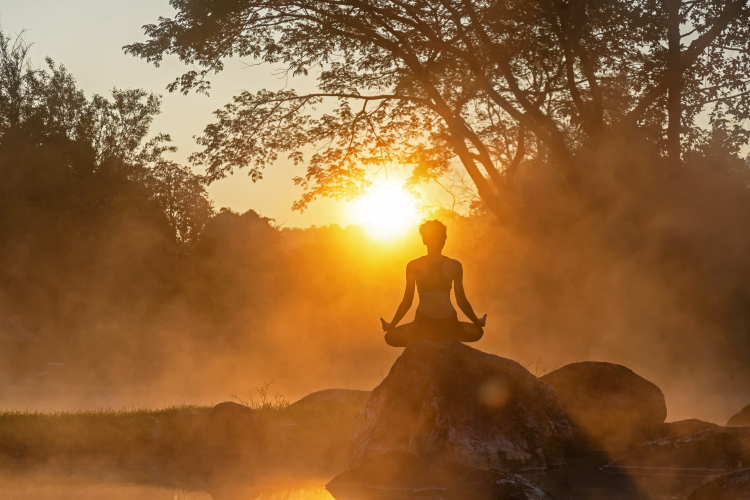
Albert Einstein reportedly once said, “If there is any religion that could correspond to the needs of modern science, it would be Buddhism.” Among the Eastern philosophers rising to that challenge today is the scientist-turned-monk Matthieu Ricard.
Thirty-five years ago, Ricard was a cellular geneticist mapping E. coli chromosomes in the Institut Pasteur lab of Nobel Laureate Francois Jacob. But at age 26, Ricard left Paris in pursuit of “a fulfilled human life” to study Buddhism in India. Today he lives at the Shechen Monastery in Nepal, where he works on humanitarian projects and participates in scientific research on the effects of meditation on the brain.
A study he conducted with scientists from the University of Wisconsin used electroencephalogram synchrony to observe the brain activity of long-time meditation practitioners. The paper describing their remarkable results, printed in PNAS in 2004, has become the fifth most-downloaded scientific publication in history.
Ricard lectured in New York this week at the 92nd Street Y and the New York State Psychiatric Institute about research described in his new book, “Happiness: A Guide to Developing Life’s Most Important Skill” (Little, Brown), which suggests that the regular, long-term practice of “mental training,” or meditation, significantly enhances the ability to concentrate, learn, empathize, manage stress, and enjoy life.
The Academy spoke with the infectiously happy Ricard while he was in New York last week.
It’s 9:30 a.m. How much time have you already spent meditating today?
I’ve done an hour of meditation and reading text and prayers. When I wake up I do a mixture of meditation and spiritual practice. Whether you do meditation or visualization or mantras, the effect is the same on your mind compared to ordinary activities.
Many in the American scientific community today are angered by the way some religious fundamentalists try to blur the lines between science and religion. But the Dalai Lama’s most recent book, “The Universe in a Single Atom,” compares Buddhist philosophy with quantum physics, and your book contrasts Buddhism with psychoanalysis. Do you consider Buddhism more science or religion?
Buddhism discusses the fabric of reality. Is it composed of separate discrete entities or is it a set of interdependent relationships?
There’s no dogma involved from the Buddhist side. It’s supposed to be discovery from investigation of reality in the sense of, “What could be reality in terms of its permanence, solidity?” It’s an investigation of mind. Whatever is true is true, whatever is false we have to give it up. There’s no clinging to some idea.
We say we should not cling to anything that is contrary to observed reality, inference, and then logic. The whole idea of intelligent design and the anthropic principle is refuted by philosophy. There is a whole set of logic to show that this cannot work. The idea of a beginningless universe — that is what Buddhist logic leads to.
You left science to practice Buddhism. Do you believe now that meditation would have made you a better scientist?
If you work on your mind, like if you work on your body, you get a tool that’s working better — a more flexible, usable mind that in many ways is functioning better for the benefit of yourself and others.
I left when I was 26. I’m certainly a happier and more fulfilled human being. Somehow there was something missing just mapping the genome of bacteria. Now I’ve made a partial return to science after 35 years. It’s not my full time job, but I do spend at least a full month a year and make four or five trips from the East to labs to collaborate on research and on the study of mind. The combination of both gives a unique way to approach things. I love details of investigation and can have a real discussion with the scientists about the protocols, the results and where to go next.
But it’s really important to identify what’s important in life. For those leading a scientific career who are interested in this approach, we created the Mind and Life Institute.
(The genesis for the studies conducted by Ricard and colleagues was a series of symposia hosted by the Mind and Life Institute, which is dedicated to fostering research partnerships between scientists and Buddhists. The Institute’s annual week-long conference for behavioral and clinical scientists, neuroscientists, biomedical researchers with Buddhist contemplative practitioners and scholars will take place this June in Garrison, New York.)
You noted in your lecture yesterday that it’s easier to meditate in a setting like the Himalayas, where you live, than in a place like Manhattan. What advice do you have for New Yorkers who want to improve their minds through meditation?
Of course it’s inspiring to be in the Himalayas, but the main thing is to take a little time wherever we might be to be with one’s mind. At least 20 minutes or half an hour to look at how the mind works, not just for the sake of becoming calm but because that little bit of quietness lets you see the mind. If you stop stirring a pool with mud on the bottom and let the mud settle down, then the water becomes transparent. I think anyone can do that. You don’t have to cross your legs, but it’s best to sit quietly in one’s room or somewhere.
Matthieu Ricard spoke at the New York State Psychiatric Institute this week at the joint invitation of the Richard and Hinda Rosenthal Center for Complementary and Alternative Medicine, and the Department of Psychiatry, Columbia University, College of Physicians and Surgeons, where there is growing interest in understanding the mind/body relationship, and in expanding science in this emerging area to achieve greater health and mental wellbeing.
Also read: Analyzing the Self: When Mind Meets Matter