Save2Serve
As global food waste continues despite widespread hunger, the winning team in the Fall 2025 Junior Academy Innovation Challenge focused on reducing post-harvest losses in Sub-Saharan Africa by designing an affordable cooling transport system to keep produce fresh longer.
Published May 8, 2026
By Nicole Pope

Winner of the Junior Academy Challenge – Fall 2025
“Food Waste”
Sponsored by Stevens Initiative
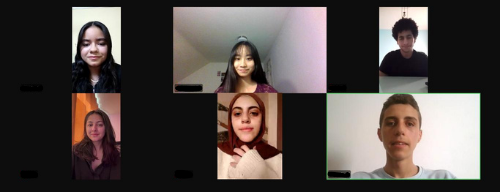
Team members: Jana H. (Team Lead) (Egypt), Louay C. (Tunisia), Tiffany G. (Massachusetts, United States), Neev H. (Virginia, United States), Adam A. (Egypt), Salwa A. (Egypt)
Mentor: Brisa Torres (Germany)
All over the world, up to one billion meals are wasted every day, according to a United Nations study. In fact, some estimates suggest that about one third of all food produced is wasted on the journey from farm to fork. At the same time, over 700 million people have limited access to nutritious meals and go hungry. Clearly, urgent action is needed to tackle food waste. The teams participating in the Fall 2025 Junior Academy Innovation Challenge sought to do just that by developing innovative approaches to prevent food from going bad before it can be consumed.
Members of the winning team, who called their project Save2Serve, explored the situation in Sub-Saharan Africa (SSA) where up to 50% of fruits and vegetables spoil before reaching markets. They found that, due to the lack of affordable cold-chain transport, post-harvest food loss is one of the major obstacles to food security and economic stability in many countries of the region.
“Learning about the communities in Sub-Saharan Africa changed my understanding of the problem. I knew food waste was a global issue, but I didn’t realize how often people lose food simply because they cannot keep it cold during transport,” admits team member Tiffany G. “Limited access to reliable refrigeration makes it hard for farmers and sellers to protect what they grow.”
Exploring All Aspects
While developing their solution, the team delved into all aspects of the problem. “This challenge has been such an incredible learning opportunity. I genuinely gained a lot of knowledge from not only researching solutions, but also connecting with my teammates,” says team member Neev H. “Having intellectual conversations with peers from around the world was eye-opening to me, and I’m extremely grateful to have had this opportunity.” In addition to impacting the lives of local communities and costing the countries of the region billions of dollars, food waste also accounts for around 9% of global greenhouse emissions and a third of the world’s agricultural land is used unproductively.
For the team, working on this project was eye-opening. “This experience has profoundly impacted my awareness of food waste and the many factors that contribute to it. I realized how often food is discarded not because it is inedible but due to aesthetic standards or logistical limitations like insufficient refrigerated transport,” explains Team Lead Jana H. “Ultimately, this reflection has deepened my commitment to addressing food waste and its broader implications. The experience was a reminder that meaningful change starts with awareness and determination to act.”
Farmers in SSA often transport their produce in poorly insulated or even open trucks, leaving the food exposed to high temperatures. Traditional refrigerated trucks are often too costly to purchase, their fuel consumption is high, and they require regular maintenance that many farmers can’t afford.
An Ingenious Solution
The students came up with an ingenious solution, which involves retrofitting trucks with solar panels and vacuum-insulated panels to provide cool transport at lower cost. “Working on our retrofit truck idea made me dive deep into things I never would’ve before. It also taught me a lot about how the food chain works,” says team member Salwa A. “Throughout the project, I learned a lot from my teammates and enjoyed working with them. When we had different perspectives, we discussed them and focused on what would make a difference for our community.”
Their innovative, hybrid cooling system involves fitting solar panels on the roof of the truck to power a DC compressor. They equipped the interior walls of the truck with phase change material (PCM) panels, which serve as thermal batteries filled with paraffin wax. The PCM panels freeze at a set temperature to store cold energy and keep the cargo cool for long periods without running the compressor. Humidity and temperature sensors enable close monitoring of the cargo bay, allowing the driver to start the compressor if needed to prevent food spoilage.
The Potential Impact
To measure the potential impact of their new design, the team used artificial intelligence (AI) to run a system simulation. Their analysis revealed that their retrofit system could reduce energy use by 35% and operational costs by 25% with an initial investment much lower than the cost of a traditional truck. In their retrofitted vehicle, sensitive crops like tomatoes could be transported to market at a stable temperature of around 13oC, thus significantly reducing spoilage rates.
Identifying the elements of their solution and working on their project presentation involved intense online collaboration between the members of this international team, under the supervision of their mentor. “This project helped me develop confidence in sharing my ideas, even when I wasn’t completely sure they were perfect,” explains team member Adam A. “Every meeting taught me something new — not just about our topic, but about teamwork, respect, and what it means to truly listen.”
To ensure their solution was practical and met local needs, the participants conducted community surveys, which showed that, overall, respondents found their approach realistic and workable. The team also contacted experts for feedback and suggestions for further refinement of their hybrid cooling system. “This balanced experience of tackling a pressing issue in the African continent made me more aware of how responsible youth can be,” says team member Louay C. “It showed me how people from completely different backgrounds and fields can unify around a single goal and a single problem to be solved.”