What Happens When Science Outpaces Policy?
Technological progress and national security are at odds in the new play ‘In the Matter of J. Robert Oppenheimer.’
Published June 3, 2006
By Adelle Caravanos
What happens when technology develops faster than government and legal policy can accommodate? How can a government’s scientists balance the rapid progress of research with issues of national security, especially during wartime?
These are relevant questions for today; from stem cell research to nuclear power, many laws and governmental policies have been unable to keep up with the pace of scientific discovery, and its varied consequences. And these were also imperative concerns more than half a century ago when the “father of the atomic bomb,” Manhattan Project scientific director J. Robert Oppenheimer, lost his security clearance at a McCarthy-era hearing in 1954.
The Keen Company’s revival of Heinar Kipphardt’s docu-drama, ‘In the Matter of J. Robert Oppenheimer,’ portrays the Los Alamos physicist (played by Thomas Jay Ryan) defending his loyalty and service to America against accusations of Communist leanings and the suggestion that he intentionally slowed the progress of the hydrogen bomb’s development due to personal reservations.
Rectifying scientific progress with policy has long been a subject of interest for Keen Company’s artistic director, Carl Forsman. Forsman remembers long conversations with his father who was closely involved in the 1975 right-to-die case of Karen Ann Quinlan in Morris County, NJ, and served on the medical ethics review board for drug testing protocols for Schering-Plough in the ’80s.
In preparing for the production, Forsman, who directed the nearly three-hour-long play, read close to 3,000 pages of research on Oppenheimer and the bomb, McCarthyism, Los Alamos and nuclear physics, and consulted with Martin Sherwin, co-author of the Pulitzer-winning biography of Oppenheimer, American Prometheus.
The Academy spoke with Forsman after opening night.
Oppenheimer’s hearing took place in 1954. How closely does the play, written in 1964 by German playwright Heinar Kipphardt, follow the actual hearing?
Kipphardt wrote the play at a time in Germany when fact-based plays were very popular. I would say it is “inspired” by the trial. He invents ways of getting information in quickly, of building tension. For instance, one of the three board members, Thomas A. Morgan, didn’t ask a single question at the actual trial. [This is] true, but not good theater. He’s added a number of monologues to give some sense of backstory for the characters, and they are completely invented. He also wrote a closing for Robb, the prosecutor, who offered no closing remarks.
Despite the fact that the hearing took place half a century ago, the issues the play raises are incredibly timely, considering today’s political climate.
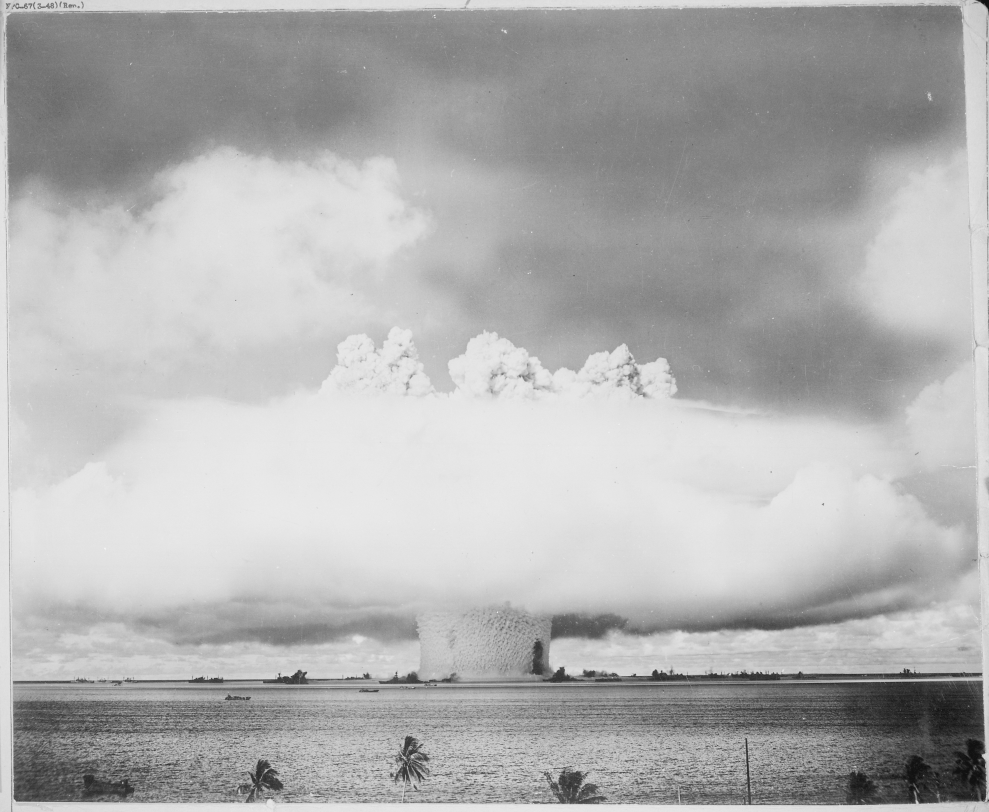
We talk about weapons of mass destruction, but no one — no terrorist, certainly — has anything that holds a candle to an H-bomb. When you talk about [detonating] an H-bomb, you’re talking about killing over a million people. We have the worst weapons of mass destruction ever invented. Or the best, if you think that way.
Also, there is a lot of talk about the need for openness, which is so desperately squeezed right now. Oppenheimer is a figure shouting to us from the past about our need to embrace a diversity of voices and opinions, about the need to understand that progress requires questioning. Dissent is patriotic.
The play examines the balance between national security and scientific discovery. Oppenheimer is accused of various disloyal actions against the American government, in introducing the question of where a scientist’s loyalty should lie — to his country, to the progress of science, to his conscience. Does the play suggest any way to reconcile these loyalties?
I believe, frankly, that it is impossible. One person cannot reconcile this contradiction, only a society can. So the scientist is probably doomed to be stuck doing things that are against his or her moral constitution, and they probably must be done. Edward Teller [a colleague of Oppenheimer, who testifies against him] is not all wrong when he says inventions are neither good nor evil — they just are, and it is up to us to be responsible.
If you think America is worth fighting for, then questions like ‘should we have guns?’ and ‘should we have tanks?’ are not so different from ‘should we have atomic bombs?’ Problem is, once you start talking about hydrogen bombs, then you are just talking about the genocide of the whole race, and that seems beyond the scope of any war we might fight.
What attracted you to Oppenheimer’s story?
Oppenheimer is a great one for busting stereotypes, because he is one of the most complicated, contradictory men ever to live. He is a great hero of mine and a source of great sadness to me — I often am glad it was he who ran Los Alamos, and I wish he had done better after the war in being a spokesman for the right kind of nuclear policy.
But, from doing this work, I learned that there are many stories that have yet to be told about the bomb, because it remains the biggest mystery of the 20th century. I could spend my entire life telling the extraordinary stories of the people who worked on it.
‘In the Matter of J. Robert Oppenheimer’ runs through June 25, at the Connelly Theater, 220 E. 4th St. between Avenue A & B.
Also read: Scientists and War: An Ethical Dilemma