From the Lab to the Classroom

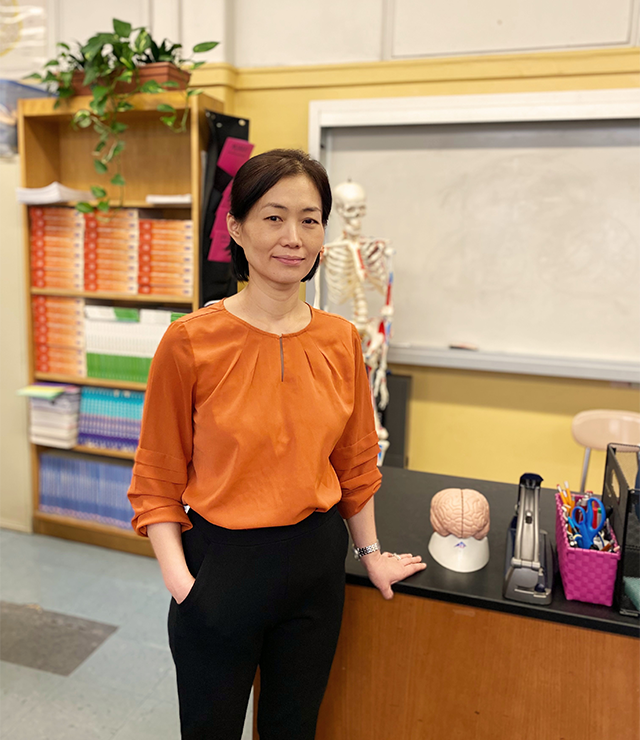
A high school teacher poses for the camera inside her science lab classroom.

Inspired by her father’s appreciation for education and giving back, Chuhyon Corwin became a high school science teacher.

Published February 17, 2023

By David Freeman
Neuroscience researcher and EnCorps Fellow, Chuhyon Corwin, traded her research lab for the classroom in a New York City public high school where she works as a science teacher.

Thanks to a partnership between The New York Academy of Sciences (NYAS) and the EnCorps STEM Teachers Program, Korean-born Corwin, an accomplished scientist, was able to explore her interest in teaching high school. For 10 weeks, with support from program staff, she was a volunteer guest teacher in the classroom of a skilled high school science teacher while, in parallel, exploring pedagogical techniques through the program’s online learning modules.

The EnCorps Program

Launched in 2007, EnCorps has already helped over 1,360 seasoned STEM professionals transition from industry or academia to public middle or high school education to ease the acute shortage of Science, Technology, Engineering, and Math (STEM) teachers across the United States.
NYAS teamed up with EnCorps to launch the program in New York City in 2022. Corwin was part of the first cohort of New York EnCorps Fellows who had an opportunity to explore becoming a STEM teacher before committing to a career change.

“During my 10-week guest teaching, I fell in love with the students,” explains Corwin. “The joy I experienced gave me the confidence that I was making the right decision in becoming a high school teacher as a long-term career choice.”

Although Corwin had taught university students, she found the work very different in high school. Teachers have to actively engage with their students and ensure they are paying attention. They also have to make sure that students who struggle get the assistance they need to prevent them from falling behind.

Effectively Engaging Students

Maintaining discipline among 30 teenagers and keeping them interested requires a great deal of creativity as well as solid classroom management methods.

“With lab activities, you have to be conscious of their safety and make sure they have enough materials,” says Corwin. “The class itself is short, only 43 minutes, so it has to run like clockwork.”.

While teaching STEM to high schoolers requires dedication and hard work, Corwin finds nurturing young people’s innate curiosity hugely rewarding. She has witnessed the amazement that lights up her students’ faces when their lab experiments succeed. Her own enthusiasm for science and discovery has never abated and she appreciates the opportunity to transmit her passion to the next generation.

“I hadn’t realized how much I would enjoy talking with these students. They come up with good questions,” says Corwin. “At that age, students are so frank. They let you know exactly what they think and I love that.”

After completing her volunteer guest teaching experience with the EnCorps program, with the support and guidance from EnCorps and NYAS, Corwin enrolled in an accelerated program to gain her teaching credentials.

She doesn’t see her move to teaching as a major break in her life.

“I’m simply redirecting my energy to continue my journey as a scientist to make a greater impact by raising more capable future scientists,” she says. “I think a teaching career is very appealing to people who love research. As a scientist, you explore different options, you try things out and reflect to find out what works best.”

Using science fiction novels to engage students with STEM subjects is one of the innovative approaches Corwin discovered while studying for her educational degree.

Inspired by her Father

Corwin sees her father in the students she teaches. While he never had the opportunity to finish high school, he greatly valued education and encouraged her to pursue her studies. He also instilled in her the importance of giving back.

“Hopefully, people who have been in the STEM industry will see the value of giving back,” Corwin says.

Today, Corwin is a science teacher at the High School for Health Professions & Human Services in Manhattan, where she completed her guest teaching as an EnCorps Fellow. Corwin recommends the EnCorps STEM Teachers Program to scientists exploring entering the teaching profession.

“They should try it. Even if in the end you decide not to become a teacher, it’s a valuable experience.”

Learn more about the Academy’s School & Community Programs.
New York Academy of Sciences Partners with Leon Levy Foundation to Expand Opportunities for Young Neuroscientists

Applications for postdoctoral researchers at New York City institutions will be accepted between October 5 and December 9, 2022.

New York, NY | September 29, 2022 — The New York Academy of Sciences and the Leon Levy Foundation announced today that the Academy will be accepting applications from October 5 through December 9, 2022 for the Leon Levy Scholarships in Neuroscience program. The program will support exceptional young researchers across the five boroughs of New York City as they pursue innovative investigations in neuroscience and advance in their careers toward becoming independent principal investigators.

Up to ten Scholars will be selected in the inaugural group, each receiving support for three years beginning September 1, 2023. The Scholars will receive stipends of 125% of the National Institutes of Health minimum salary for postdoctoral fellows.

Women and young scientists from groups historically underrepresented in the sciences are especially encouraged to apply. The program features self-nomination and is designed to broaden the field and to support researchers who might otherwise not have equal opportunity to secure postdoctoral funding.

Supporting Promising, Young Scholars

“Neuroscience has been a field of remarkable progress, and the Leon Levy Foundation has long been a leader in supporting research in this field,” said Shelby White, Founding Trustee of the Leon Levy Foundation. “To continue to make great strides in neuroscience, we need to make sure the most gifted young researchers have every opportunity to advance in their careers. Working with The New York Academy of Sciences, we can support talented postdoctoral scholars, and remove barriers to their success.”

“These Scholarships provide a unique level of autonomy and support for promising young scientists, to promote creativity and collaboration,” said Nicholas B. Dirks, the Academy’s President and CEO. “Working with the Leon Levy Foundation, we will use the Scholars Program to help young people from all backgrounds gain the skills and access to resources they need to succeed in competitive academic research. This will help diversify the community of successful, professional scientists in this field.”

“The Academy has significant experience supporting graduate students, postdoctoral fellows, and early career scientists,” said Amanda Sadacca, PhD, Director of Awards at the Academy. “And we will use our strength in these areas to provide significant additional training and career-building opportunities for Leon Levy Scholars.”

About the Program

The program features structured mentorship by distinguished senior scientists. Elective workshops will help Scholars with grant writing, and in developing leadership, communications, and management skills. The programs will enhance collaboration and partnerships, encourage mentorship and networking, foster data sharing, and advance team science.

“There are often many stresses in a young scientist’s life, and we want to remove as many early-career barriers as we can,” White said. “So in addition to the annual stipend, the scholarships also provide generous supplements for child or family care, an allowance for computer equipment, and other benefits to help ease financial burdens. We know that the strongest possible science will result.”

Applicants must hold a doctoral degree (PhD, DPhil, MD, DDS, DVM, or the equivalent) and possess no more than three years of cumulative postdoctoral experience as of September 1, 2023. Scholars will be funded for research in neuroscience or one of its sub-disciplines, including (but not limited to):

  • Cellular & Molecular Neuroscience
  • Systems Neuroscience
  • Cognitive & Behavioral Neuroscience
  • Computational Neuroscience
  • Translational & Clinical Neuroscience

Eligible Institutions

Applicants must be employed by one of the institutions listed below at the time the scholarships begin, and should have the support of their proposed research advisor at the time of application.

  • Adelphi University
  • Albert Einstein College of Medicine
  • Barnard College
  • City College of New York
  • CUNY Brooklyn College
  • CUNY College of Staten Island
  • CUNY Graduate Center
  • CUNY Hunter College
  • CUNY Lehman College
  • CUNY School of Medicine
  • CUNY Queens College
  • Columbia University
  • Columbia University Irving Medical Center
  • Cooper Union
  • Cornell Tech
  • The Feinstein Institute for Medical Research
  • Flatiron Institute
  • Fordham University
  • Icahn School of Medicine at Mount Sinai
  • Long Island University
  • Memorial Sloan Kettering Cancer Center
  • New York Blood Center
  • New York University
  • NYU Langone Health
  • Pace University
  • The Rockefeller University
  • SUNY Downstate Medical Center
  • Weill Cornell Medicine

The Leon Levy Scholarships in Neuroscience program is the continuation of an earlier fellowship program started by the Foundation in 2009. To date, the Foundation has supported 155 fellows in neuroscience. The new program broadens the list of eligible institutions, and will bring together both new Scholars and past program alumni into one group for networking, collaboration, and the dissemination of scientific research.

For complete information about The Leon Levy Scholarships in Neuroscience program, visit: https://www.nyas.org/shaping-science/fellowships/the-leon-levy-scholarships-in-neuroscience-llsn/

For additional information or to become an eligible employing institution, please contact: LeonLevy@nyas.org.

About the Leon Levy Foundation

The Leon Levy Foundation, founded in 2004, is a private, not-for-profit foundation created from Leon Levy’s estate by his wife and Founding Trustee, Shelby White. The Foundation continues Leon Levy’s philanthropic legacy and builds on his vision, supporting the preservation, understanding and expansion of knowledge in the ancient world, Arts and Humanities, Nature and Gardens, Neuroscience, Human Rights, and Jewish Culture. To learn more, visit: leonlevyfoundation.org