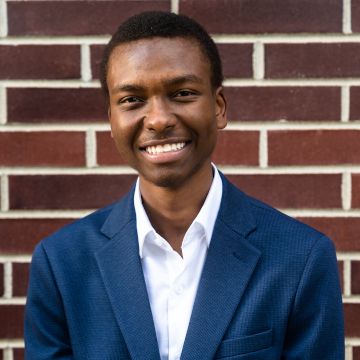
Some of the highlights of my membership in NYAS are being selected for Science Alliance Leadership fellowship, participating in Scientist-in-Residence to mentor middle schoolers and getting them excited about a career in science, and also gaining valuable mentorship through their mentor-mentee pairing program. It’s been an incredible experience!
The New York Academy of Sciences has provided a platform to engage younger voices who view science as a solution to the world’s challenges. It has been an opportunity to leverage on solid networks, collaborate, and demonstrate leadership through Science and Technology. The Academy has built my belief in the capacity of mentorship.
The greatest benefit in joining the Academy was meeting and befriending like-minded people from all around the globe. It has been inspirational to see how the peers I met and I have all grown over the years. I was initially invited to be a young member of the Academy and later chose to remain close because I identified with the academy’s ideals and appreciated the continued impact of its programs on aspiring scientists, problem-solvers, and tactful leaders.
Joining the Academy as a young member has truly been a remarkable experience. Through the mentoring platform, I was able to connect with students across the globe and meet amazing mentors who have played a huge part in my life! I am grateful for all the skills I picked up from doing the challenges like scientific reasoning and critical thinking, which will surely go a long way!
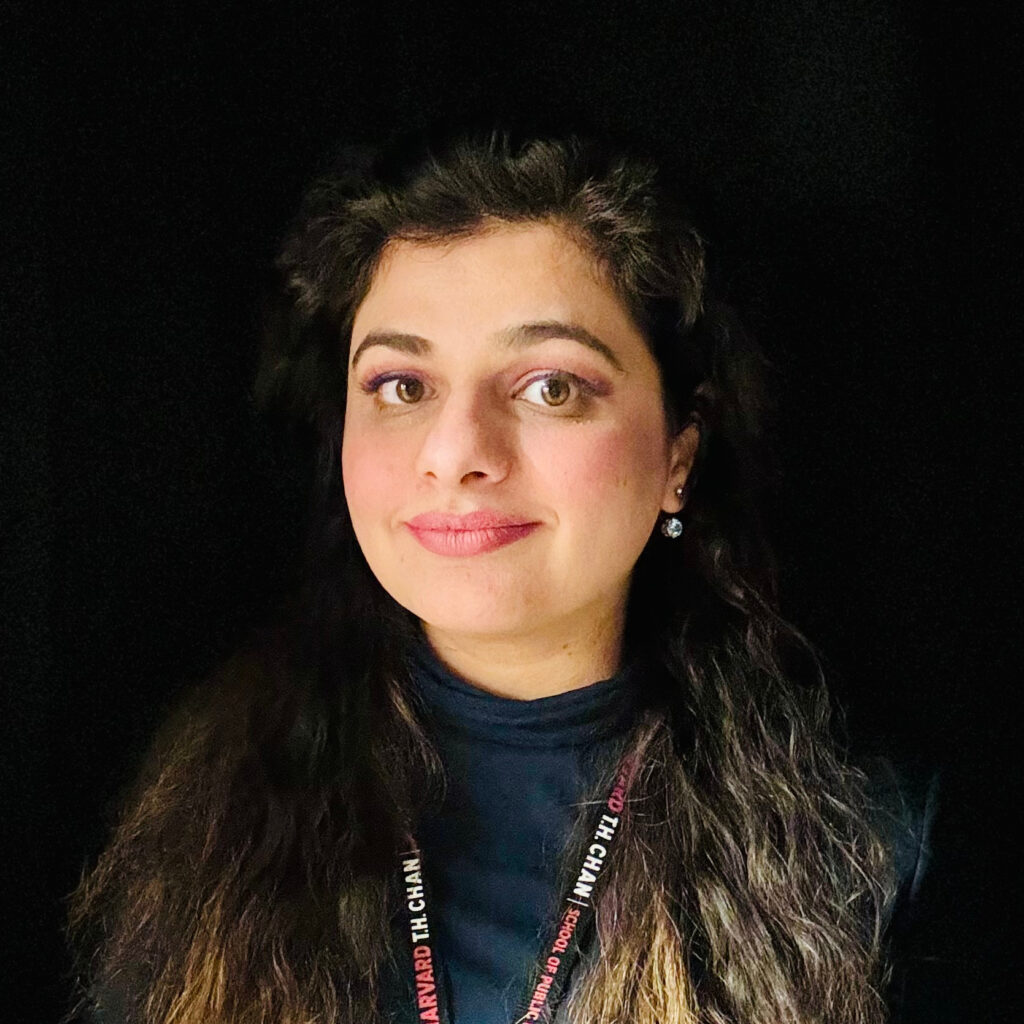
Postdoctoral Fellow Harvard T.H. Chan School of Public Health
I joined as a mentor in 2018 when I was a PhD student. I took part in academy’s mentoring programs, interacted with young students who wanted to learn more about STEM and in turn benefited by learning how to be a good mentor to young students.
In Fall 2022, 42 international teams of high school students participated in a Junior Academy Challenge. Their goal was to find innovative solutions for the multiple impacts of climate change on human health.
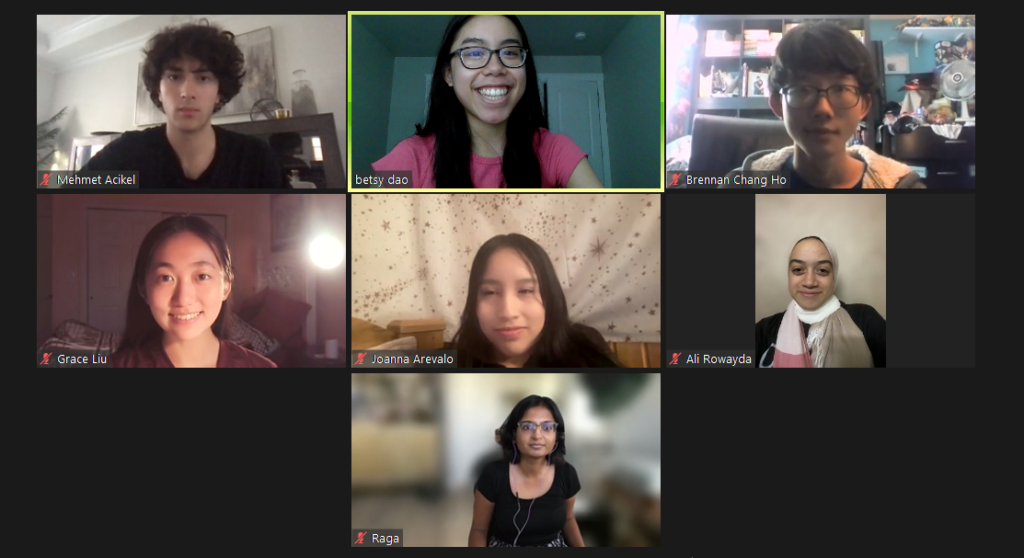
The winning team, MiHealth — comprised of Betsy D. (United States, Team Lead), Joanna A. (United States), Mehmet A. (United States), Grace Chenxin L. (United States), Brennan C. (United States), and Rowayda A. (Egypt) — opted to focus on the Miami area’s prolonged exposure to heatwaves, chosen because of Miami’s high level of poverty in underserved communities with limited access to quality healthcare. The team worked under the guidance of mentor Raga Krishnakumar (United States).
In particular, the team noted that in the South Florida area, where access to healthcare is acutely below state and national averages, African Americans and Latinos are among the most underserved communities. Southern U.S. states like Florida face a growing number of days in which temperatures reach above 100oF.
Miami Dade county, for example, currently endures 50 very hot days per year. This number is expected to rise to 91 within the next thirty years. According to the Center for Disease Control, exposure to extremely high temperatures increases risks for patients suffering from hypertension, heart disease, angina and stroke.
“I chose this challenge because I intend to pursue medicine and felt that it connected well with climate change,” explains Mehmet. The health risks caused by climate change also resonated with fellow team member Brennan, who was taking part in his third Junior Academy challenge. “I believe health and climate change are a huge problem in the world. Everyone is affected by it and finding solutions as quickly and efficiently as possible should be the world’s priority,” he says.
Developing an App for Underserved Communities
The team designed an ingenious, easy-to-use app called “MiHealth (Miami Health).” The app delivers telemedicine services to underserved communities. Specifically, it aims to serve rural, poor or crowded areas in southern Florida. Here access to quality healthcare is limited. Team Lead Betsy found the experience of cooperating remotely with other students very rewarding.
“I have always been researching and wanting to make a change in the world through science and medicine. These passions have led me to take on the challenge of solving public effects of climate change”, she explains.
Aside from limited access to medical professionals, the team also identified the lack of access to ambulances or air-conditioned transportation as a key issue. Stepping outside in the searing heat may pose a significant danger for vulnerable patients. Cost, too, is a major concern for socio-economically disadvantaged communities.
Developing the app required hard work and intense consultations among team members, supported by their mentor. The app offers pre-hospitalization diagnosis, information on preventative measures, and a telecardiology feature to monitor heat-induced heart disease.
Utility Beyond Southern Florida
It also monitors local temperature and links users to medical resources available in their vicinity. While their project focused on the Miami area, the team believes their innovative approach could be rolled out nationwide to help vulnerable populations gain access to healthcare resources.
“Working on the public health impacts of climate change has greatly expanded my knowledge, particularly about heat waves, their causes, and how they can affect the human body in Miami and other parts of the world,” says Rowayda.
“It’s been an insane journey,” says Joanna. “Through constant zoom meetings, coding sessions, and researching, I’ve not only fostered my current skills, but I’ve learned new ones and created new memories with such amazing people.”
MiHealth team members worked hard throughout the semester. The were delighted when their innovative solution was chosen as the winning project.
“I’m incredibly grateful to NYAS and the Junior Academy for offering a global platform for collaborating on such critical issues,” says Grace. “Knowing that we can change the world together is unbelievable, one-of-a-kind, and empowering!”
The Junior Academy was supported by the Stevens Initiative, which is sponsored by the U.S. Department of State, with funding provided by the U.S. Government, and is administered by the Aspen Institute.
The Junior Academy has been named a Finalist in the Education, Art, & Culture category in the Third Annual Anthem Awards, which recognizes mission-driven work.
New York, NY | December 5, 2023 – The New York Academy of Sciences announced today that its highly regarded Junior Academy has been named a Finalist in the Education, Art, & Culture category in the Third Annual Anthem Awards. The Anthem Awards, launched by The Webby Awards in 2021, honors the purpose and mission-driven work of people, companies, and organizations worldwide.
“The New York Academy of Sciences is thrilled that our esteemed Junior Academy was selected from the more than 2,000 entries from over 30 countries worldwide as a Finalist for the 2024 Anthem Awards,” said Nicholas Dirks, president and chief executive officer of The New York Academy of Sciences. “Since 2016, over 15,000 students from 100+ countries have participated in the Junior Academy, gaining knowledge but also learning to apply STEM to real-world challenges such as combatting climate change, breeches in cybersecurity, and identifying ways to reduce bias in AI successfully. We thank our sponsors for making the Junior Academy possible.”
As an Anthem Awards Finalist, the Junior Academy will be considered by the International Academy of Digital Arts and Sciences (IADAS) for the Gold, Silver, and Bronze Anthem Award and the Anthem Community Voice Award, supported by the online public vote. From December 5th to December 21st, fans can support the Junior Academy on the Anthem Awards’ public voting page HERE. The Third Annual Anthem Awards winners will be announced on Tuesday, January 30th, 2024.
The Relaunch of the Junior Academy
The New York Academy of Sciences Junior Academy was relaunched in 2016 as an online community and collaboration platform. It currently has over 2,500 members from over 80 countries. The platform is designed to directly address the opportunity gap between young people who love STEM but have limited opportunities to participate in work-ready programs such as research experiences and internships. The Junior Academy recruits thousands of high school students worldwide who self-assemble into virtual teams through a custom-designed virtual platform called Launchpad to solve real-world problems using STEM (science, technology, engineering, math).
Using technology to reach students traditionally shut out of science and STEM careers, ensures that any student with internet access can participate in this world-class science program. The goal is to identify and connect the students and give them the tools to solve growing local and global problems. By solving real-world problems, students will build both the technical and soft skills needed for the workforce of the future. These students have not only gained new content knowledge but applied it in a way that shows them the importance of STEM education. In addition to technical skills, they also learn critical work-ready skills such as collaboration, communication, and problem solving.
“Since launching the Anthem Awards in 2021, we’ve seen incredible change and growth in the impact sector,” said Anthem Awards General Manager, Patricia McLoughlin. “The work that we have received in the 3rd Annual Anthem Awards is game-changing. From innovative projects fighting climate change to impactful calls for equal rights across the globe and best-in-class CSR and ESG efforts – the Anthem Community is a bright light in our uncertain world.”
About The Anthem Awards
Launched in 2021 by The Webby Awards, The Anthem Awards honors the purpose and mission-driven work of people, companies and organizations worldwide. The Anthem Awards was launched in response to the prevalence social good has taken within the national conversation and cultural zeitgeist in recent years. By amplifying the voices that spark global change, we’re defining a new benchmark for impactful work that inspires others to take action in their own communities. The Anthem Awards honors work across seven core causes: Diversity; Equity & Inclusion; Education; Art & Culture; Health; Human & Civil Rights; Humanitarian Action & Services; Responsible Technology; and Sustainability, Environment & Climate. Founded in partnership with the Ad Council, Born This Way Foundation, Feeding America, Glaad, Mozilla, NAACP, NRDC, WWF, and XQ.
About The Webby Awards
Hailed as the “Internet’s highest honor” by The New York Times, The Webby Awards is the leading international awards organization honoring excellence on the Internet, including Websites; Video; Advertising, Media & PR; Apps, Mobile, and Voice; Social; Podcasts; and Games. Established in 1996, The Webby Awards received more than 13,500 entries from all 50 states and 70 countries worldwide this year. The Webby Awards are presented by the International Academy of Digital Arts and Sciences (IADAS). Sponsors and Partners of The Webby Awards include Verizon, WP Engine, YouGov, Brandlive, Canva, NAACP, KPMG, Fast Company, Wall Street Journal, MediaPost, Podcast Movement, and AIGA.
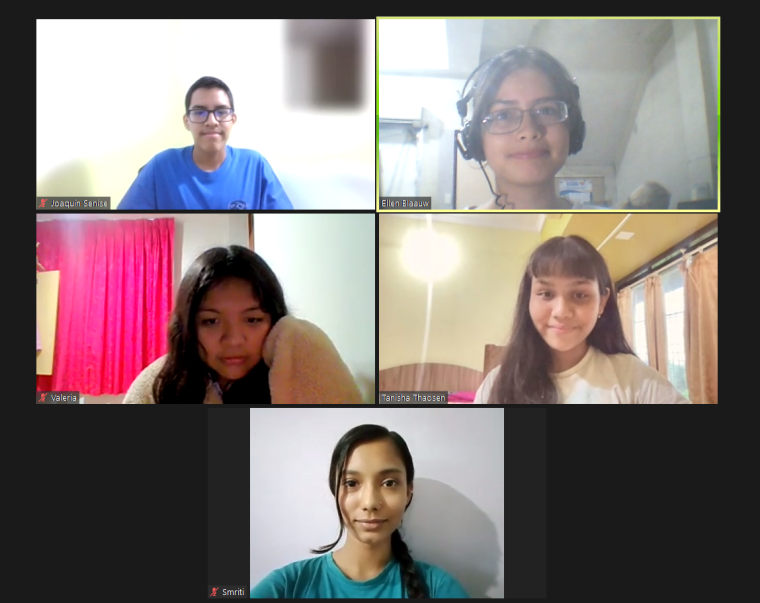
Team members: Ellen B. (Team Lead) (Philippines), Valeria S. (Peru), Joaquin S. (Peru), Smriti K. (Nepal), Tanisha T. (Indonesia)
Mentor: Jasmine P. (United States)
“Exploring the Extremes” required participating teams to offer new solutions to the major issues of our time.
The winning team, “Go Green Sea Blue”, took an ambitious, multi-pronged approach to tackling the complicated problem of oil spills, which pollute our oceans and threaten our marine ecosystems, our wildlife, and even our coastal environments.
“I loved the brainstorming sessions we had as a team and the passion each member showed for their part was transparent,” says Smirti. “As part of the research and game development team, I learned a lot about oil spills, and this strengthened my motivation for this project. Writing articles for our website helped me improve my writing.”
The team members identified key issues in the handling of oil spills, drawing on their diverse skills.
“Our team members came from diverse backgrounds and brought unique skills to the project,” explains Team Lead Ellen, who found the Challenge “an extremely rewarding experience.”
The Challenges
For example, tracking and locating oil spills, and containing their impact, is often difficult. Clean-up methods are insufficient to prevent long-term damage, and governments often struggle to identify those responsible and hold them accountable.
“This project has been a huge opportunity for me. It has changed my opinion on certain topics and made me realize the importance of having different points of view and of diversity,” says Valeria.
Building on the initial research they conducted, team members held long meetings online to develop a comprehensive approach that addresses several of these deficiencies. Jasmine, who mentored the team (and had supported teams in two previous Junior Academy Challenges), was impressed with their approach.
“I felt incredibly fortunate to work with such an organized team,” she explains. “At the first meeting, the team showed me their action plan for the whole challenge. The level of detail and organization from Go Green Sea Blue was absolutely remarkable.”
The students devised a five-point approach to address the devastating impact of oil spills on the oceans and the threat they pose to marine and human life. It wasn’t always easy.
“Though my team faced a lot of setbacks due to time differences and the tight schedule, we pulled together and figured out a way to make it work,” says Tanisha. “We made sure that we put quality over quantity and invested our efforts to do the best that we were able to do.”
The Team’s Process
As a first component of their solution, the high-schoolers proposed the creation of a machine-learning model that relies on satellite images to detect oil spills, using Radarsat Synthetic-Aperture Radar (SAR) technology and Automatic Identification System (AIS) to identify the most likely perpetrators.
Next, they suggested developing a mapping tool that would combine static and real-time data to create a centralized, interactive map for environmental disaster response, improving communication among environmental experts working on ocean pollution. To improve response time, they also proposed developing an eco-friendly mothership that incorporates early warning systems and GPS sensors to track and help clean up oil spills, using mini robots powered by photovoltaic cells that can operate for several weeks.
Raising awareness of the risks posed by oil spills, and the importance of maintaining ocean ecosystems among the population, especially for children, was the fourth element of the team’s extensive solution. To make learning fun and appealing, they devised an interactive game that tests the knowledge of users of all ages.
Finally, the team members proposed a new policy: the creation of a World Association for Marine Oil Spills which would work with existing marine institutions, such as the European Safety Maritime Agency and the Caspian Environmental Program, to improve international cooperation, raise funds for dedicated scientific research, and organize events– and also identify loopholes in existing legislation, and propose new laws.
“We had good times in the meetings– sometimes fun, sometimes just excited by the progress we made day by day,” says Joaquin. “Even though we worked until the late hours of the night and the early hours of the morning on some days, we are very satisfied with the results we have achieved.”
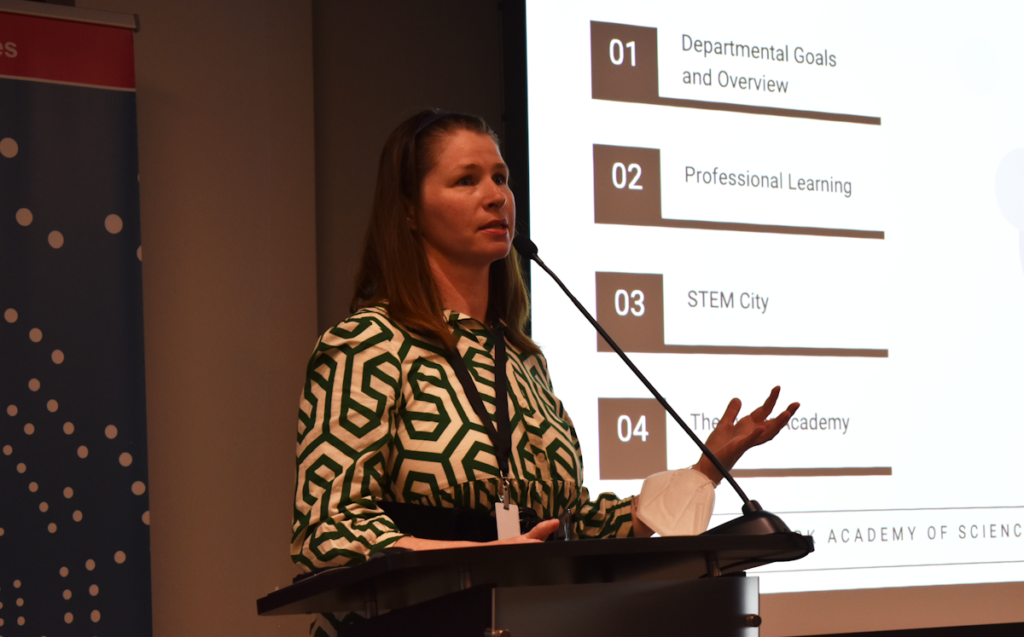
Dr. Groome presents during The New York Academy of Sciences’ 205th Annual Meeting.
Nearly 3000 students were inducted into the Junior Academy as part of its newest cohort.
Published November 14, 2023
By Meghan Groome, PhD
At its 205th Annual Member Meeting on November 14, 2023, The New York Academy of Sciences launched a new tradition: the induction of our Junior Academy members into our membership ranks.
The Junior Academy has been engaging students since its founding in 1948 when the Academy began hosting the City-wide science and engineering fair. The arrival of this research competition dramatically increased the need for mentored research experiences in labs around the City. Recognizing the opportunity gap, the Academy began hosting regular meetups. These conversations led to a match making program that eventually found a new home online with the creation of Launchpad in 2016. Through Launchpad, a matchmaking and collaboration platform designed to help students find research partners and mentors, Junior Academy programming became more accessible than ever before. Today, any student with a device and access to the internet can participate in a world-class mentored research program.
At the Junior Academy, we work with partners to build a community of students and mentors who work in teams to solve open innovation challenges. The challenges are real world problems scoped out by our sponsors and brought to life by our education team. Since moving online, we’ve served over 10,000 students from over 100 countries by administering over 50 open innovation challenges.
Working in a group presents a unique set of challenges, especially in STEM research – which is itself no easy task. However, we know that diverse teams produce better research and innovation. We believe – and the proof is in our evaluations – that great teamwork can be taught and mentored. Collaboration, communication, and creativity are essential components of teamwork and skills that will translate to overcoming obstacles in any setting. We at the Academy are proud to provide a space for students and mentors to come together to participate in engaging STEM programming that believes in science for the greater good.
The Junior Academy wouldn’t be possible without the mentorship that our members provide. Research has proved, time and time again, that mentors are often the difference between loving STEM and persisting in STEM. Their energy and enthusiasm have allowed us to make a generational impact both abroad and in New York. Our members have donated over 4.5 million hours of their time to mentor the next generation.
At our 205th Annual meeting, we inducted 2,834 students from around the world into the Academy. These students completed our rigorous semester-long research experience during the 2022-2023 School Year.
Last year, over 700 teams of students:
Designed ways to use 5G and the Internet of Things to improve energy efficiency;
Explored the extremes of space, underwater and the edges of scientific discovery;
Documented the impacts of climate change on public health;
Discovered the connection between forest management and a sustainable future;
Designed urban micro gardens to address malnutrition and hunger in their neighborhoods;
Led the way in understanding the connections between human rights and cybersecurity;
Uncovered decades of water mismanagement to design and retrofit new, safe drinking water systems;
Rose to the challenge of building green schools, homes and other community structures; and finally,
Made healthier snacks that balance taste and nutrition.
At the Academy, we like to say that we shape the future of science. And that’s very true, but it’s important to point out that our youngest members aren’t just the future. They’re doing incredible things right now.
Transcript
Thank you for welcoming us to the Annual Meeting. My name is Dr. Meghan Groome and I’m the Senior Vice President for Education at the Academy. I’m here to represent all of the people at the Academy who make our education programs so powerful including the program team of Kaitlin Green, Rosemary Puckett and Sabrina Debler. I’d also like to thank the entire education team, AV/ IT, communications, membership and marketing teams.
This is truly a cross organizational effort and I want to thank everyone from the executive office to HR for all their hard work to bring this program to life. I’d especially like to thank our Advancement team who raised the funds to allow this program to be completely free to our students. And with that, I’d like to thank our generous sponsors who support our work with not only their funding but also their guidance, insight, and expertise.
They include:
The Royal Academy of Engineering in Sweden
The J. Christopher Stevens Virtual Exchange Initiative i.e. Stevens Initiative sponsored by the US Department of State, with funding provided by the U.S. Government, and is administered by the Aspen Institute and supported by the Bezos Family Foundation and the governments of Morocco and the United Arab Emirates
Clifford Chance’s Cornerstone Initiative
Ericsson
The Ministry of Higher Education of Oman, and
NEOM
Foundation for the National Institutes of Health
S & P Global
I’d also like to thank our incredible on the ground partners including the Royal Health Awareness Society in Jordan, Mentor Arabia and AMU.
I’d also like to thank all the parents, teachers, siblings, friends and alumni who cheer on our students, encourage them to apply and help explain to worried parents that no, they really are up at 3am watching a live stream about the flexible use of electricity.
Lastly, we also would like to take a moment to thank our international cohort of Mentors who worked with student teams and guided them through The Junior Academy learning process. Our members are the engine of our programs, serving as mentors, judges and now, a generation of alumni. Their energy and enthusiasm have allowed us to make a generational impact both abroad and especially in New York. We are so grateful for your time and expertise.
It’s clear from the research that mentors are often the difference between loving STEM and persisting in STEM. If you have a moment, I’d like you to think about your own mentor. How they shaped you. How they gave you a critical boost. I’d personally like to thank my mentor, Ruth Cohen, and I encourage all of us to thank our mentors and pass their wisdom forward to the next generation.
With all of my thanks out of the way, I’d like to talk about the Junior Academy itself. Founded in 1948, the Academy began hosting the City-wide science and engineering fair. The arrival of this research competition dramatically increased the need for mentored research experiences in labs around the City. Recognizing the opportunity gap, the Academy began hosting regular meetups. These conversations led to a match making program that eventually found a new home online in 2016.
With the advent of a new online platform, mentored research experiences could be moved online and scaled to any student with a device and access to an internet connection. In today’s Junior Academy, we work with partners to build a community of students and mentors who work in teams to solve open innovation challenges. The challenges are real world problems scoped out by our sponsors and brought to life by our education team. Since we moved online, we’ve served over 10,000 students from over 100 countries by administering over 50 open innovation challenges.
Last year, nearly 700 teams:
Designed ways to use 5G and the Internet of Things to improve energy efficiency,
Explored the Extremes of Space, underwater and the edges of scientific discovery,
Documented the impacts of climate change on public health,
Discovered the connection between forest management and a sustainable future,
Designed urban micro gardens to address malnutrition and hunger in their neighborhoods,
led the way in understanding the connections between human rights and cybersecurity,
Uncovered decades of water mismanagement to design and retrofit new, safe drinking water systems
Rose to the challenge of building green schools, homes and other community structures, and finally, my favorite,
Made healthier snacks that balance taste and nutrition.
In addition to the Junior Academy, nearly 800 students participated in the 1000 Girls, 1000 Futures program. Students worked in close-knit teams with mentors to build core scientific and work ready skills that complement their research projects.
On its own, STEM research is hard. In a team, STEM reach can be even harder. But we know that diverse teams produce better research and innovation. We believe, and the proof is in our evaluations, that great teamwork can be taught and mentored. Collaboration, communication, and creativity are essential components of team work, and for that matter, overcoming obstacles in any setting. We at the Academy are proud to provide a space for students and mentors to come together to participate in engaging STEM programming that believes in science for the greater good.
Bringing together young people from around the globe in a STEM-enriched environment can open doors and prepare students for science paths otherwise unknown and we are so pleased to be a part of their STEM journey.
Today, we inducted 2,834 students from the Junior Academy and 1000 Girls 1000 Futures to join the New York Academy of Sciences as Young Members. We are so proud of you and pleased to connect you with the legacy of the Academy. At the Academy, we like to say that we shape the future of science. And that’s very true, but I always like to point out that our youngest members aren’t just the future, they’re doing incredible things right now.
Please join me in welcoming the Junior Academy Class of 2023 into the New York Academy of Sciences.
Team members: Al-Zahraa A. (Team Lead) (Oman), Tahra A. (Oman), Miaad A. (Oman), Taher A. (Oman)
Mentor: Venkatesan Subramaniyan (India)
The Middle Eastern Sultanate of Oman is vulnerable to extreme weather events like hurricanes and air depressions, which can cause severe damage and threaten lives.
In Spring 2022, the New York Academy of Sciences ran a Junior AcademyInnovation Challenge for high school students in Oman with a passion for science, focused on designing Smart Shelters to prevent loss of life. The challenge was won by four-member team “Our Life is Safer with Smart Shelter”.
“We chose to work on smart shelters because it is very important to protect people during wars or natural disasters,” explains Taher. “We researched and collaborated in meetings to get the best out of our project and raise our knowledge.”
The Team’s Process
Communicating over the Academy’s Launchpad platform, the students first considered the extensive needs of disaster survivors before coming up with solutions to improve shelters, noting that people seeking protection in adverse circumstances often need to spend lengthy periods of time in shelters before the risks subside.
Through online collaboration, and with guidance from their mentor, the students explored all aspects of life inside shelters and developed innovative approaches to enhance energy efficiency and improve the quality of life for residents. “Our team put a lot of effort in reading articles related to our topic, finding solutions to the problems facing us and creating new ideas, which can sometimes be strange,” says Team Lead Al-Zahraa.
The winning team’s submission focused on using data– in particular, the interconnected web of computing devices and digital machines known as the Internet of Things (IoT)– to monitor energy, water and air quality/air usage and improve the efficiency of service provision in the shelters automatically. They also highlighted the use of data to enhance security, register new residents, and to keep track of unsheltered people at risk in order to direct them to shelters with available space.
A Focus on Environmental Sustainability
To generate energy, the team suggested integrating solar panels on shelter roofs and using tidal power in coastal areas. They also recommended deploying nanotechnology water purifiers to remove microbes, chemicals and other contaminants and secure a steady supply of drinking water for shelter residents. Sensors could serve multiple functions in smart shelters: they could be fitted on smart faucets to prevent wasting limited water resources, or be used to enhance flood drainage systems.
From measuring air quality to using smart-cultivation farming to provide food, the winning team addressed many of the complexities involved in providing effective protection to victims of natural disaster or war. Their comprehensive solution also included the use of apps to monitor health and nutrition among shelter residents.
“This experience taught me a lot about Internet of Things (IoT) applications,” says Tahra. “I benefited greatly from the extensive research we did to reach the best possible solution and to fill the gaps as much as possible.”