New Treatments for Multiple Sclerosis

A logo with the text #IAmNYAS

The Academy community represents one of the most dynamic and diverse groups of STEM professionals and science enthusiasts and supporters around the world, with more than 16,000 Members across 100 countries.

Published May 1, 2016

By Diana Friedman

Academy Members are building STEM careers, overcoming the challenges associated with cutting-edge research, putting science into practice, influencing policy, and supporting future generations of science leaders.

We invite you to get to know your fellow Academy Members and learn about new opportunities to interact and get involved!

Yana Zorina

Yana Zorina, PhD, is currently working as a cell biologist at Acorda Therapeutics, a biotechnology company located just north of New York City that focuses on developing treatments for multiple sclerosis and spinal cord injury.

What’s the best piece of career advice you’ve received?

When I was in college, I entered the pre-med program with the assumption that if I was interested in science and biology, then the most logical place to go was medical school. My pre-med advisor at the time told me that science comes in three stages: scientists discover new knowledge, teachers disseminate the new knowledge, and doctors apply it to patients. At that point I realized that I wanted to be at the root of the process, and these words have stayed with me until the present day.

Did you ever compete in a science fair as a kid?

During high school I participated in the Intel Science Talent Search program and became a semi-finalist after performing a screen for iron-regulated promoters in mycobacterium tuberculosis. The Intel competition served as my springboard into the amazing world of scientific research.

Do you have any hobbies outside of science?

Ever since childhood I have always enjoyed intricate craft making. I particularly love making flowers out of fine beads. The patience and attention to detail required in such projects directly translates to the projects I now work on in the lab. The morphological beauty of neuronal and glial cells speaks directly to the artist in me, and I greatly enjoy imaging these cells via confocal microscopy.

Expand Your Network!

Inspired by the passion, expertise, and unique perspectives of your fellow Members? Tap in to the incredible network the Academy offers through our mentoring programs.

We’re thrilled to offer you access to a new opportunity to get involved and interact: Member-to-Member Mentoring. The program matches you with a mentor—or a mentee—who is a fellow STEM professional and Academy Member. Depending upon your experience level and needs, you can request a mentor, become a mentor, or both.

Interested in mentoring students? We also offer incredible mentorship opportunities through the Academy’s Global STEM Alliance, which delivers education programs that can help you develop your teaching and communication skills, while paying it forward to the next generation of scientific innovators.


Peruse our mentorship opportunities, and sign up today!
MicroRNA Biomarkers for Treating Schizophrenia

A logo with the text #IAmNYAS

The Academy community represents one of the most dynamic and diverse groups of STEM professionals and science enthusiasts and supporters around the world, with more than 16,000 Members across 100 countries.

Published May 1, 2016

By Diana Friedman

Academy Members are building STEM careers, overcoming the challenges associated with cutting-edge research, putting science into practice, influencing policy, and supporting future generations of science leaders.

We invite you to get to know your fellow Academy Members and learn about new opportunities to interact and get involved!

Juan A. Gallego

Award-winning scientist and multi-instrument musician Juan A. Gallego, MD, MS, is an assistant professor of Psychiatry at the Hofstra North Shore LIJ School of Medicine. He lives in Brooklyn, NY, where he can also be heard playing bass, guitar, drums, and more.

What project(s) are you currently working on?

I am performing lumbar punctures (spinal taps) in patients with schizophrenia and in healthy volunteers with the goal of studying the role of microRNAs in cerebrospinal fluid as prognostic and diagnostic biomarkers.

What is one of the biggest challenges you’re facing right now?

Recruiting subjects is always a challenge, especially for a study like mine. Therefore, recruiting enough subjects to be able to conduct meaningful and relevant analysis is my biggest challenge.

What is one thing you love to do outside the lab?

I’ve been playing music since age 16. I play the electric bass, guitar, some piano and drums, and I perform regularly in the New York area. I typically play with bands but also write some of my own music. I play regularly with a few artists such as Nilko Andreas and LaMar NYC (world music) and La Cumbiamba eNeYe (Colombian music). I also fly to perform in my home country, Colombia, with Estados Alterados (synth pop).

Expand Your Network!

Inspired by the passion, expertise, and unique perspectives of your fellow Members? Tap in to the incredible network the Academy offers through our mentoring programs.

We’re thrilled to offer you access to a new opportunity to get involved and interact: Member-to-Member Mentoring. The program matches you with a mentor—or a mentee—who is a fellow STEM professional and Academy Member. Depending upon your experience level and needs, you can request a mentor, become a mentor, or both.

Interested in mentoring students? We also offer incredible mentorship opportunities through the Academy’s Global STEM Alliance, which delivers education programs that can help you develop your teaching and communication skills, while paying it forward to the next generation of scientific innovators.


Peruse our mentorship opportunities, and sign up today!
Applying Entrepreneurship and Marketing Science

A logo with the text #IAmNYAS

The Academy community represents one of the most dynamic and diverse groups of STEM professionals and science enthusiasts and supporters around the world, with more than 16,000 Members across 100 countries.

Published May 1, 2016

By Diana Friedman

Academy Members are building STEM careers, overcoming the challenges associated with cutting-edge research, putting science into practice, influencing policy, and supporting future generations of science leaders.

We invite you to get to know your fellow Academy Members and learn about new opportunities to interact and get involved.

Mark Jackson

After spending a number of years working in theoretical physics at an array of prestigious institutions, including the Fermi National Accelerator Laboratory and the Lorentz Institute for Theoretical Physics, Mark Jackson, PhD, decided to change things up a bit in his career. In 2014, he harnessed his entrepreneurial spirit, years of experience as a researcher, and love of sharing science with the public to found Fiat Physica, a crowd funding platform specifically for physics, astronomy, and space exploration.

What is one of the biggest challenges you’re facing right now?

When I began Fiat Physica I believed that the challenge would be to convince the public that science was worth supporting. This turned out not to be a problem: the public loves science! The problem is that most researchers do a very poor job of communicating their work to the public. Much of Fiat Physica’s focus is now educating researchers on how to market their projects in a way that engages the public.

Who has been your biggest science inspiration?

Linus Pauling: the only person to have won two unshared Nobel Prizes (Chemistry and Peace), social and peace activist, and fellow Oregonian.

What’s the best piece of career advice you’ve received?

If you don’t want your supervisor’s job, you have the wrong job.

Expand Your Network!

Inspired by the passion, expertise, and unique perspectives of your fellow Members? Tap in to the incredible network the Academy offers through our mentoring programs.

We’re thrilled to offer you access to a new opportunity to get involved and interact: Member-to-Member Mentoring. The program matches you with a mentor—or a mentee—who is a fellow STEM professional and Academy Member. Depending upon your experience level and needs, you can request a mentor, become a mentor, or both.

Interested in mentoring students? We also offer incredible mentorship opportunities through the Academy’s Global STEM Alliance, which delivers education programs that can help you develop your teaching and communication skills, while paying it forward to the next generation of scientific innovators.


Peruse our mentorship opportunities and sign up today!

How Neural Circuits Process Information

A logo with the text #IAmNYAS

The Academy community represents one of the most dynamic and diverse groups of STEM professionals and science enthusiasts and supporters around the world, with more than 16,000 Members across 100 countries.

Published May 1, 2016

By Diana Friedman

Academy Members are building STEM careers, overcoming the challenges associated with cutting-edge research, putting science into practice, influencing policy, and supporting future generations of science leaders.

We invite you to get to know your fellow Academy Members and learn about new opportunities to interact and get involved!

Mirna Mihovilovic Skanata

Mirna Mihovilovic Skanata, PhD, got her degree in Physics from Brown University in Rhode Island. Originally hailing from the beautiful coastal city of Split, Croatia, she is currently based in New York City working as a Postdoctoral Research Associate at New York University and is relishing in the excitement that her adopted home has to offer.

What projects are you currently working on?

I am working on understanding how neural circuits process information—you can say I am “cracking neural circuits.” The human nervous system is extremely complex, so it is paradoxically more profitable to ask these big questions using small model organisms. My research project envisions developing a specialized microscope that can image neural activity in a freely behaving fruit fly larva, “reading its mind” as it makes decisions crucial to its survival.

What is one of the biggest challenges you’re facing right now?

My research now involves developing new technologies and utilizing electronics and optics in a novel way to build a very sophisticated microscope. It is a challenge, but also a great adventure.

How do you like to keep busy when you’re not in the lab?

Since I moved to New York City, I started ice-skating at Chelsea Piers and at the Central Park Wollman Rink, I sail on the Hudson, tap-dance in the West Village, and skateboard in the many parks in the City. I have one activity for each season! I find it exciting to start from scratch and pick up a new skill.

Expand Your Network!

Inspired by the passion, expertise, and unique perspectives of your fellow Members? Tap in to the incredible network the Academy offers through our mentoring programs.

We’re thrilled to offer you access to a new opportunity to get involved and interact: Member-to-Member Mentoring. The program matches you with a mentor—or a mentee—who is a fellow STEM professional and Academy Member. Depending upon your experience level and needs, you can request a mentor, become a mentor, or both.

Interested in mentoring students? We also offer incredible mentorship opportunities through the Academy’s Global STEM Alliance, which delivers education programs that can help you develop your teaching and communication skills, while paying it forward to the next generation of scientific innovators.


Peruse our mentorship opportunities, and sign up today!
Improving Clinical Trials through Mobile Technology

Mobile technology is emerging as a powerful tool for transforming the way clinical research is conducted now and in the future. Acquisition of real-time biometric data though the use of wireless medical sensors will allow for around-the-clock patient monitoring, reduce costly clinic visits, and streamline inefficient administrative processes. With the promise of this technology also comes challenges including digital data privacy concerns, patient compliance issues, and practical considerations such as continuous powering of these devices.  

This podcast provides an illuminating examination of both the promises and challenges that underpin the implementation of mobile technology into the clinical realm. 

Proof of Concept Centers: Energy Technology

It’s easier to find people to invest in a great new tech product if you can show that it will be profitable relatively quickly. Unfortunately, that’s not so easy to demonstrate. Learn how we’re working to change that.

The New York Academy of Sciences and NYSERDA (the New York State Energy Research and Development Authority) are teaming up to drive investment in the new technologies that will help revolutionize the way we produce and use energy by supporting Proof of Concept Centers – institutes that bridge the gap between academic laboratories and working companies. In this podcast we learn about Proof of Concept Centers: what they are and how they have the potential to create a sea change in the way new technologies are turned from ideas into realities.

Promoting Clean Energy in New York

A shot of solar panels and wind turbines, with a sunrise/sunset in the background.

Board members provide strategic advice to three clean energy proof-of-concept centers.

Published July 1, 2015

By Diana Friedman

The New York State Energy Research and Development Authority (NYSERDA) held the annual Advisory Board Meeting for its clean energy proof-of-concept centers (POCCs) on January 28 at the Academy.

Now in their third year of operation, the POCCs run programming to help inventors and scientists turn their high-tech, clean energy ideas into successful businesses by going through an immersive commercialization program that lasts for more than a year. The POCCs are led by Columbia University and the New York University Polytechnic School of Engineering, which have collaborated to form PowerBridgeNY, and High Tech Rochester, which has formed NEXUS-NY. The ultimate goal is to create more New York State-based businesses in clean technology.

Advising the POCCs

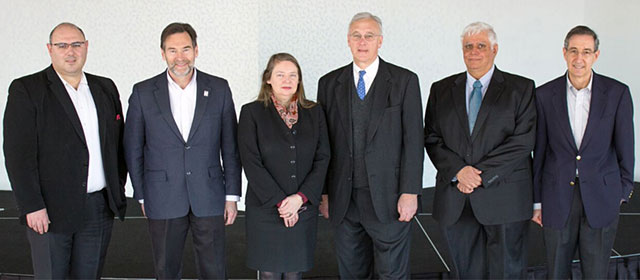
The Academy, which serves in an advisory capacity for the POCCs, in concert with NYSERDA, formed the Advisory Board (members listed below) to provide strategic advice to the POCCs, on topics such as refining program processes, timelines, and outcome reporting. In addition to discussing successes, challenges, and future plans with representatives from the POCCs, at this year’s meeting, the Board heard from three POCC program participants about their companies, technologies, and experience in the program, as well as from two POCC mentors, who shared both successes and ideas for improvement.

Board members were selected for their expertise in innovative technologies, commercialization, and start-ups, as well as their experience working across sectors, including academia, industry, government, and non-profits.

The Advisory Board is comprised of:

  • Richard Adams, Manager of the Innovation and Entrepreneurship Center (IEC) at the National Renewable Energy Laboratory (NREL)
  • David Audretsch, Distinguished Professor and SEPA Director of the SPEA Overseas Education Program, Ameritech Chair of Economic Development, and Director of the Institute for Development Strategies, Indiana University
  • Abigail Barrow, Founding Director, Massachusetts Technology Transfer Center
  • Bill Bonvillian, Director, MIT Washington Office, Massachusetts Institute of Technology
  • Michael Cassidy, President and CEO, Georgia Research Alliance
  • Jerome Engel, Founding Executive Director Emeritus, Lester Center for Entrepreneurship, University of California Berkeley
  • Ed Greer, Manager, Scouting and Exploration Network, Ventures and Business Development Group, The Dow Chemical Company
  • Jerry McGuire, Former Associate Vice Chancellor for Economic Development, University of North Carolina at Greensboro
  • Glen Merfeld, Platform Leader, Energy Storage Technology, GE Global Research – New York
  • Philip Mott, Technical Fellow, BorgWarner Corporation
  • Leon Sandler, Executive Director, MIT Deshpande Center for Technological Innovation
  • Robert Strom, Director of Research and Policy, The Kauffman Foundation
  • Dawn Tew, Program Director, Collaborative Research Initiatives, Global University Program, IBM

To learn more about the POCC model, download the Academy’s podcast, Proof of Concept Centers: Energy Technology.