West Niles Virus and Public Health

A close up shot of a mosquito sucking blood from human skin.

With the emergence of West Nile Virus, this international conference focused on the science of the virus and its implications for public heath.

Published June 1, 2001

By Fred Moreno and Jill Stolarik

Image courtesy of witsawat via stock.adobe.com.

Since the West Nile Virus first appeared in the United States in 1999, it has dispersed from its original hot zone in the Queens section of New York City to the mid-Atlantic states and as far south as North Carolina. The mosquito-borne disease, which can cause encephalitis (inflammation of the brain) or meningitis (inflammation of the lining of the brain and spinal cord), has infected humans, other mammals and birds worldwide. As the virus has leaped into public attention and concern, the scientific community has expanded its efforts to develop strategies for preventing and controlling future outbreaks

This spring, more than 200 medical, veterinary, laboratory and public health practitioners presented the latest research on the virus at an international conference sponsored by The New York Academy of Sciences (the Academy), the New York State Department of Health, the New York City Department of Health, and the Centers for Disease Control and Prevention. Representatives of ten nations discussed their work, which covered topics such as epidemiology, surveillance mechanisms, human and veterinary pathology, viral and vector biology, antiviral and vaccine interventions, and strategies for dealing with the virus.

Will West Nile Virus Spread This Year?

In 1999, the virus killed seven people in the New York metropolitan area and devastated the state’s bird population, especially crows. Birds are the natural hosts for this virus, which can be transmitted from infected birds to humans and other animals through bites of infected mosquitoes. While investigators believe that West Nile Virus (WNV) does not spread by person-to-person contact, or directly from birds to people, there is some evidence of bird-to-bird transmission.

Experts at the conference agree that the West Nile Virus is likely to continue to spread over a larger geographical area this year. Where the virus will appear next, however, is unknown. Migratory birds, suspected of being the natural hosts that introduced the virus to the U.S., may potentially disseminate the disease to other areas. “Infectious diseases know no boundaries. It is imperative that our efforts span the borders between states, countries and continents as we work toward the common goal of protecting public health,” said Dr. Antonia C. Novello, New York State Health Commissioner.

Weather conditions were cited as a factor in contributing to the spread of West Nile Virus. “Expect the unexpected,” commented Dr. Neil Cohen, Commissioner of New York State’s Department of Health. “Environmental changes may affect what happens this year as compared to the last. We need to be prepared.”

Recent research shows that mosquitoes successfully overwintered in New York City after 1999 and epizootic activity may continue to affect U.S. residents in the summer of 2001 and for many summers in the future. “If we have a hot and dry summer this year, it is possible we could get intense WNV activity in many areas,” predicted Dr. James Hadler from Connecticut’s Department of Public Health, Infectious Diseases Division.

Lessons from the Past

Dr. Thomas P. Monath, Vice President Research and Medical Affairs of Acambis, Inc., discussed the prospects for a West Nile vaccine on the second day of the conference.

According to Duane J. Gubler, Director of the Division of Vector-Borne Infectious Diseases at the Centers for Disease Control and Prevention, there has been a dramatic global resurgence of arboviruses in the last 20-30 years. He attributes this increase in virus transmission to “increased population growth, air travel, changing agricultural practices, changing lifestyles, and deterioration of public health infrastructure.”

West Nile Virus is a member of the flavivirus family and is related to other arthropod-borne viruses such as the St. Louis Encephalitis and Kunjin Virus. It was first isolated from a febrile woman in the West Nile District of Uganda in 1937. Historically, the virus hasn’t caused much human mortality.

Its ecology was characterized in Egypt in the 1950s and the virus caused severe huma meningoencephalitis (inflammation of the spinal cord and brain) in elderly patients during an outbreak in Israel in 1957. In the early 1960s, Egypt and France experienced outbreaks of West Nile Virus among horses. The NY outbreak represents the first cases of West Nile virus in the Western Hemisphere and the first arboviral infection in NYC since yellow fever in the 19th century.

International Studies of WNV

Outbreaks of WN virus encephalitis in humans are known to have occurred in Algeria in 1994, Romania in 1996-1997, the Czech Republic in 1997, the Democratic Republic of the Congo in 1998, Russia in 1999, the United States in 1999-2000, and Israel in 2000. Researchers from Romania, Russia, the Mediterranean Basin, Israel, South Africa and Australia discussed their experiences with the virus. Poor urban conditions in Romania exacerbated that nation’s 1996 epidemic, in which 17 people died and more than 400 cases of meningoencephalitis occurred. Romania is at risk for another outbreak, given its poor mosquito control programs.

In Russia, more than 600 people were infected and 46 died in 1999. Isolates from three regions affected by WN virus suggest that Russia’s outbreak is related to epidemics in New York, Romania, and Israel. In Israel, the virus infected geese and humans during the 1990s; last year, 29 people died of the disease. Weather conditions appeared to play a factor: in South Africa, Australia, Romania, Russia, and the U.S., outbreaks were preceded by unusually hot and dry weather conditions, or heavy rainfall.

A Vaccine for West Nile Virus

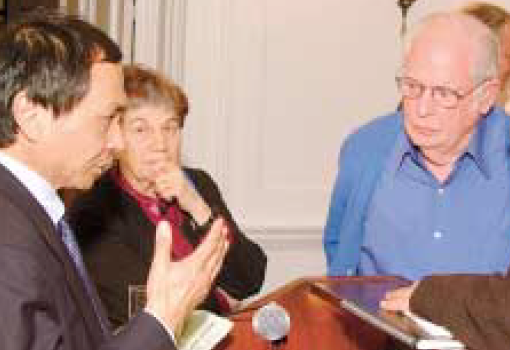
From left: Duane J. Gubler, Director of Division of Vector-Borne Infectious Diseases, Centers for Disease Control and Prevention; Dr. Dennis J. White, Conference Chair; and Dr. Alexander E. Platonov from Russia’s Central Research Institute of Epidemiology.

Two researchers reported on the development and production of safe and viable West Nile Virus vaccines. Dr. G. Jeffrey Chang from CDC’s Arbovirus Disease Branch, Division of Vector-Borne Infectious Diseases, discussed the potential of a DNA vaccine, citing advantages of this approach such as the low risk of infection, long term immunity, and its facility for “mixing and matching” individual vaccine components against geography-specific flaviviruses such as St. Louis Encephalitis virus as well as West Nile Virus.

Dr. Thomas P. Monath, Vice President Research and Medical Affairs at Acambis, Inc., compared the advantages and disadvantages of different approaches to developing a vaccine. He explained how the ChimeriVax vaccine offers an approach that is more effective and preferable to DNA vaccines and using a formal inactivated whole virus vaccine. The prototype live, attenuated vaccine (yellow fever 17 D), which has a long history of safe and efficacious use, is being used as a vector for genes encoding protective antigens of West Nile virus. To construct a vaccine, the envelope (prM and E) genes of yellow fever 17 D are replaced with the corresponding genes of West Nile Virus.

Dr. Monath said that a vaccine for horses would be ready later this year, while one for humans will be ready in 2002.

Strategies for Combating the Virus

Dr. Dale L. Morse and Dr. Dennis J. White from the New York State Department of Health organized the International West Nile Virus Conference.

To combat the virus this year, experts stress that expanding surveillance and mosquito control programs as well as increasing public education about the virus are crucial. Depending on a number of factors, two approaches to surveillance may be adopted: in “active” surveillance, public health departments solicit reports of West Nile Virus from doctors and in “passive’’ surveillance, physicians receive mailings to boost their awareness of the disease.

The density of dead crows sighted per square mile may provide an early warning of possible human cases to follow, as has happened in New York State. However, this will not be effective without a system in place to receive reports; if the public becomes complacent about West Nile Virus; or if crows are too few in number to serve as sentinels. There is also an additional concern regarding the development of immunity in the crow population.

Instead of widespread spraying in areas where mosquitoes have been found, experts now recommend extensive spraying only in areas that have been defined as high-risk to humans. “We now have in place a state-of-the art mosquito control program and we are now able to categorize the level of risk for humans,” said Dr. Cohen. Funding is needed for expanding larviciding efforts.

Public Participation

According to Dr. Stephen M. Ostroff, Associate Director for Epidemiologic Science at the Centers for Disease Control and Prevention, fewer human cases of WN encephalitis in 2000 (as compared with 1999) may be attributed to intense larviciding efforts by public health agencies in areas affected by WNV; the unusually mild summer weather in 2000; and the effectiveness of public education. “What we know about the virus can help the public protect themselves,” he said. “Our best defense against emerging infections is a robust scientific enterprise and a responsive infrastructure.”

Dr. Antonia C. Novello, New York State Health Commissioner and President and CEO Rodney W. Nichols of The New York Academy of Sciences.

Thus, the public’s participation and support for an effective mosquito control program is crucial. “We need the public’s assistance to report sightings of dead birds and potential mosquito breeding sites, such as areas with standing water,” noted Dr. James R. Miller of Vector-Borne Disease Surveillance and Control at New York City’s Department of Health.

“It does appear that adulticiding may be interrupting viral activity,” noted Dr. Millicent Eidson, of the Zoonoses Program at New York State’s Department of Health. “If spraying is stopped, viral activity may rebound.” Dr. David A. Dame, past President of the American Mosquito Control Association, said that six safe pesticides are currently on the market; he cautioned that public protest against spraying may end their manufacture. Several speakers emphasized, however, that public mistrust of pesticides must be addressed and is crucial to combating the West Nile Virus.

Dispelling Misinformation

Many of the speakers believe that misinformation by the media and the public’s negative perception of pesticide use can be addressed through publicizing scientific data showing the safety of pesticides and keeping the public informed on what the adverse health effects of pesticide use may be.

The conference was organized by Drs. Dennis J. White and Dale L. Morse of the New York State Department of Health.

Also read: The Rising Threat of Mosquito & Tick-Borne Illnesses

From Proteomics to Modern Medicine

An array of drugs in packaging.

Understanding the pathways of the next revolution in biotechnology. If you thought genomics was exciting, you’re gonna love proteomics!

Published January 31, 2001

By Fred Moreno

Image courtesy of producer via stock.adobe.com.

A relatively new area of science, proteomics is the study of proteins: how they are made, what is their structure, and how they function in the cell. Proteomics is the next step in the effort to uncover information about how genes are related to biological function and disease states. By understanding the structure and function of all proteins in the body, proteomics holds the promise of potentially lifesaving medical treatments aimed at the protein building blocks of every cell in every tissue.

The sequencing of the human genome-the total set of genes in the human body-was one of the greatest breakthroughs in scientific history. But genes only serve as a “template” for making proteins, which are more directly involved in nearly all biological processes within the cell.

Genes, Proteins, Tools

“Genes contain the information required for life, but proteins make things happen,” says John H. Richards, professor of Organic Chemistry and Biochemistry at the California Institute of Technology. “Proteomics rounds out genomic information by creating a comprehensive picture of genes’ ultimate effects. In essence, it gives us a better understanding of all the intricacies–and all the beauty–of biology.”

Prof. Richards explains that proteins are like “dynamic machines” that operate in very complex partnerships with each other and various constituents of the cell. Just like machines, “sometimes things go wrong.” He adds that such disfunctioning of the machine gives rise to disease.

Economical and Efficient

That’s also one reason that Dr. Denis Hochstrasser, associate vice dean, Faculty of Medicine, University of Geneva, Switzerland, believes that physicians need an understanding of proteomics: because of its ability to help them in a clinical setting.

“Clinical proteomics is important in the future development of biomarkers for diagnosis and drug development,” he says. “Just one type of protein floating in blood can help predict a disease.”

And Brian Chait, Camille and Henry Dreyfus Professor at Rockefeller University, notes that a central goal of proteomics is to devise tools for dissecting cellular function, which can lead to a better picture of normal processes as well as disease mechanisms.

“In a system as complicated as a cell, you have to be able to look at the entire system in an integrated way,” he says. “We need the tools to improve protein analysis, so that we can know what proteins are present in a cell, where they are located, how much of the protein there is, and how they function.

Chait also warns that protein analysis is a time-consuming and expensive process and scientists will need to develop new tools that are economical and efficient.

Also read: Merging Modern and Ancient Medicines

Infectious: The Return of Days Gone By?

The Ebola virus as seen under a microscope.

While medical science has made tremendous strides in recent years, some diseases and viruses are re-emerging and creating new challenges for public health professionals.

Published January 1, 2001

By Allison L. C. de Cerreño

Image courtesy of CDC.

With winter’s arrival in New York, much of the concern over the West Nile Virus has disappeared – at least among the general population. However, new infectious diseases have emerged in recent years, and there is concern that we may be entering a period in which such diseases, thought to be a bane of the past, may come back to haunt us again.

Annually, infectious diseases kill 13 million people, and together are the leading cause of global fatalities. During the past 20 years, 30 new infectious diseases have been identified. Among these are Hantavirus pulmonary syndrome which was identified in the United States in 1993, with an associated fatality rate of 50%; and Nipah virus which, in 1999, led to fatalities as a result of severe encephalitis in 40% of those infected in Malaysia.

If one were to extend the timeline back two more decades the deadly Marburg virus could be added to the list, having made its first appearance in Germany in 1967. Ten years later, the Ebola virus, an even more virulent cousin, appeared in what is now the Democratic Republic of the Congo. Also in 1977, Legionnaires’ disease was identified in the United States.

Is this New?

So, is this really something new? Some of the emerging diseases of recent years are not really “new,” but better described, more prevalent, or occurring in previously unaffected locales. AIDS, for instance, was practically unheard of worldwide until the early 1980s, but it existed in Africa for many years prior. Similarly, West Nile virus was isolated in Uganda in 1937 but made its appearance in the United States only last year. Others, like Escherichia coli O157:H7, which made its deadly debut in 1982, or the virulent strain of cholera (vibrio cholerae) that struck India in 1992 are new forms of previously well-known disease agents.

However, something is happening that is leading to emerging diseases and to reemerging diseases, either in different forms or in new locations, and human behavior patterns are an important factor. An increase in global travel, for example, has created new and more rapid pathways of exposure. In the case of Lyme disease (1982), economic development has led to loss of natural habitat, placing humans near an ever-increasing population of deer and the ticks that carry the disease. And, increased use and misuse of antibiotics has led to drug resistant strains of tuberculosis, gonorrhea, and meningitis, to name a few.

What can be done? Public health efforts can be stepped up around the world and more attention paid to these human factors. Certainly, more research is needed to understand these diseases and search for vaccines and cures. However, we should keep in mind that only in very recent history and only in some countries have infectious diseases been less prevalent over the past half century. We should be thankful for this respite even as we brace for a possible return of days gone by.

Also read: Unraveling the Mystery in the DRC’s Disease Outbreak—Is It Disease X?

Devastating: In the Eye of the Beholder

A graphical representation of chromosomes.

Exploring some of the ethical issues around medical science, recent breakthroughs in genetic discovery, and the broader impacts on society.

Published July 1, 2000

By Allison C. de Cerreño

Image courtesy of ustas via stock.adobe.com.

It seems that not a day goes by without hearing about some new advance in the area of genetics. Whether it is mapping a new chromosome or finding a new marker for disease, the pace of discovery is sometimes awe-inspiring.

Recently, I was reading an article in a well-known science magazine about the mapping of Chromosome 21. The gist of the article was that with the recent mapping of this chromosome, much more can now be learned about Down syndrome. This is exciting news indeed. However, one phrase in particular struck me—the use of “devastating disease” to describe Down syndrome. These two words have tremendous implications for how we move ahead in this age of genetics, what we choose to study, and how we perceive ourselves and those around us.

Having worked with Down syndrome children and other children and adults with various developmental delays and special needs, I immediately questioned: “devastating” to whom? To the child with Down syndrome, to the parents of that child, or to society? Along those same lines, who determines when something is “devastating”? And finally, who determines how we treat something, or whether we treat something, that others consider “devastating”?

Questions Left Unasked

Such questions have long been asked by groups working with adults and children with special needs. I am reminded, for example, of the debate regarding the use of cochlear implants to help certain hearing-impaired children experience sounds. But all too often the questions are left unasked by policymakers, or by the scientists making the discoveries.

The answers to these seemingly simple questions are not always clear-cut. What is devastating to one person may not be to another. What is perceived as devastating by one culture may not be seen the same by another.

However, it is important to make sure these questions are asked as we move forward making discoveries about our genetic makeup. Indeed, as more is learned and we are able to effect changes in people as a result, asking such questions will be critical. The way they are answered will prove even more so, for it will say much about how we perceive humanity.

Also read: Of Stereotypes and Scientists: STEM in Popular Media

The Journey of a Psychopharmacological Pioneer

Various colorful pills.

From escaping Nazi-occupied Czechoslovakia to pharmaceutical breakthroughs to rubbing elbows with Aldous Huxley, Frank Berger has seen a lot in his life and career.

Published May 1, 2000

By Merle Spiegel

Image courtesy of Artinun via stock.adobe.com.

Anti-anxiety medications represent a significant share of the vast number of pharmaceuticals in widespread use today. In 1955, however, when Frank Berger invented meprobamate, it was the first and only anti-anxiety tranquilizer on the market. Berger, an Academy member for 51 years and a member of its Lyceum Society and Darwin Associates, was a true pioneer in the field of psychopharmacology.

Born in Czechoslovakia, Berger received his MD degree from the University of Prague and worked as a microbiologist at the National Institute of Health in Prague. The day after Hitler occupied Czechoslovakia in 1939, he and his wife fled to England—with the assistance of the Quakers. After quickly learning to speak English, Berger first worked as a physician in a refugee camp. Two years later, he became a resident physician in an infectious diseases hospital and then a researcher in microbiology in the West Riding of Yorkshire Laboratories.

Berger looked back on his amazingly successful career in a recent interview.

How did you get started in pharmaceutical research?

I was looking for a preservative for penicillin and came up with a compound called mephenesin, which stabilized penicillin by killing contaminants in the air that broke it down. However, a more elegant preservative was discovered at the same time, making mephenesin unnecessary for this use. While studying the compound in animals, I had noticed that it produced remarkable relaxation of the voluntary muscles without affecting respiration, heartbeat, and other vital functions—and I realized that it might have applications in medicine. Mephenesin was first used to produce muscle relaxation along with anesthesia in surgery. It was effective but not practical—since it wasn’t very soluble, and large amounts had to be injected intravenously.

Did you try to develop a more soluble form?

No, at this point my work on mephenesin had become pretty well known, and I was offered a position at the University of Rochester Medical School in the U.S. I wanted to focus on producing relaxation in people with muscle spasms such as cerebral palsy and spastic paralysis. Soon, though, I realized that mephenesin was even more effective in reducing anxiety—which, in turn, reduced muscle tension. And it was clear to me that anxiety was one of the big unsolved problems in medicine at the time.

However, mephenesin had a short duration of action and didn’t remain effective for long. Nevertheless, Squibb decided to market mephenesin under the brand name Tolserol in 1948, and it became the company’s bestselling product that year.

Were you able to find a long-acting form of mephenesin?

I was recruited by Carter-Wallace to do just that. Carter-Wallace was a well-known manufacturer of over-the-counter products—Carter’s Little Liver Pills, for example— and wanted to expand into pharmaceuticals. I discovered a new compound called meprobamate, which was very effective in treating anxiety and was pretty long-acting as well. Meprobamate was patented in 1955 and marketed as Miltown by Carter-Wallace and as Equanil by Wyeth.

How successful was it?

Frank Berger at the podium addressing The New York Academy of Sciences’ 1956 conference on psychopharmacology. Novelist and philosopher Aldous Huxley is to the left of Berger. Harry Beckman, professor of pharmacology and author of the best-selling Treatment in General Practice, is second from right, and renowned scientist Julian Huxley is at far right.

It became popular very quickly and soon was the most widely used prescription drug in the U.S. Meprobamate and other tranquilizing drugs were the subject of a major conference at The New York Academy of Sciences (the Academy) in October 1956. In the keynote address, Aldous Huxley predicted that these drugs were capable of changing the quality of human consciousness—a development that he thought would be more revolutionary than achievements in nuclear physics.

What did you do next?

In addition to building Carter-Wallace’s pharmaceutical business, I spent the next few years developing a compound that could be used in place of aspirin and codeine for everyday treatment of muscle and back pain. The result, carisoprodol, provides pain relief to the skeletal muscles without affecting the mind. It was marketed as Soma by Carter-Wallace and as Rela by Schering .

Did you stay at Carter-Wallace until you retired?

No, I returned to academia as professor of psychiatry at the University of Louisville, and served as a consultant to several pharmaceutical companies. This gave me a wonderful opportunity to spend part of each year in Geneva, Paris, London, and Milan. Even now, at the age of 87, I haven’t really retired. I still go to the office early each morning and keep up with what’s going on in my field.

What do you think is the most exciting development in pharmacology today?

Viagra. Just as meprobamate was the first drug to treat anxiety, Viagra is the first drug to treat sexual dysfunction. It’s a major breakthrough.

Also read:The Origin of the Term “Psychedelic”

Making Healthcare More Affordable in the Tri-State

An artistic shot of a doctor's stethoscope.

Greater efficiency in the tri-state region’s medical facilities can lead to more affordable costs for patients. The region is currently nearly twice as expensive as neighboring Massachusetts.

Published January 1, 2000

By Frank B. Hicks, PhD, and Susan U. Raymond, PhD

Image courtesy of tippapatt via stock.adobe.com.

HMOs claim that it’s a matter of efficiency; hospitals say it’s a lack of revenue. But whether because they spend too much or are paid too little, the region’s medical institutions are in trouble. Both as employers of skilled workers and as provider of care for the region, health care and its costs affect all businesses.

Hospitals, which make up about half of health services, are hurting in New York and New Jersey. Total margins in both states—revenues outpace expenditures by 3.0% in New Jersey and by only 2.2% in New York—are lingering at the bottom of the nation. Fears are that these margins will drop even further as a result of the 1997 balanced budget legislation, which has limited Medicare payments to hospitals.

Connecticut, on the other hand, has become a regional bright spot. Between 1994 and 1997, the median hospital margin there more than quadrupled, from 1.0% to 4.2%. Connecticut leads the region and betters the national average in another, broader measure of hospital health, the Financial Flexibility Index. New York and New Jersey have been relatively static in this measure and again lurk near the very bottom of the nation.

Health Expenditures Rise, but Health Services Shrink

Total national health expenditures have been on the rise: from 8.9% of the Gross Domestic Product in 1980 to 13.5% in 1997. But over the same period, the health services share of the GDP (a subset of national health expenditures) has slipped from 6.7% to 5.2%. The same trend is evident in the Tri-State region. While a slow-growing health services sector may eventually contribute to containing health expenditures, it will also become a smaller driving force for the overall economy, a driving force often credited with helping lessen the impact of the last recession on the Tri-State region.

New York’s Academic Medical Centers: Academic Backbone

TREND: NYC Remains Academic Medical Stronghold

More than half of New York City’s hospital beds are housed in academic medical centers—hospitals whose work extends beyond patient care to include research and instruction for medical students and graduates. With only 2.8% of the total US population, the city trains more than 14% of the nation’s medical residents.

IMPACT: Tendency to More Expensive Care

While academic medical centers offer both patients and students access to cutting edge health care, research and teaching tend to boost their operating expenses as well. These differences traditionally have been shored up largely through Medicare, but this support was trimmed by the federal government’s Balanced Budget Act of 1997.

New York’s Academic Medical Centers: Economic Impact

TREND: Substantial Direct Spending

Direct spending by academic medical centers in New York State totaled $21.3 billion in 1996. Nearly half that spending was supported by out-of-state funding sources, the largest of which were Medicare and Medicaid, which provided $6.6 billion to the state.

IMPACT: Ripples Through the Economy

Academic medical centers paid $2.85 billion in city and state taxes in 1996, and the Greater New York Hospital Association estimates that the academic medical infrastructure accounted for $43.1 billion of total spending within New York State, 6.9% of the 1996 GSP.

New York’s Academic Medical Centers: Managed Care

TREND: Managed Care on the Rise

Since 1995, the fraction of New York State Medicare recipients enrolled in managed care plans has more than doubled, to 18.3%, and that fraction will continue to grow.

IMPACT: The Crux of the Crisis

Increasing enrollment in managed care (which tends to take patients away from the higher fees of teaching hospitals) and Medicare cuts from the Balanced Budget Act have hit academic medical centers on two fronts. While academic medical centers claim they are not receiving enough money to provide first rate care and cover indigent patients, managed care providers cite the centers’ high cost of treatment and argue the goal should be higher efficiency.

Healthcare Costs from the Consumer Perspective

Health insurance premiums for conventional and HMO plans are higher in the Northeast than in any other region of the country. What’s more, the rates in the Northeast have also shown the greatest growth from 1995 to 1998: rates for HMO family coverage rose nearly 13% over that period, compared to a national rise of only 4%. In the South and West, rates even fell over the same period.

The high northeastern rates are no wonder, since the insurance companies themselves are also hardest hit in the Northeast, particularly in the Tri-State region. A hospital stay for an elderly patient suffering from pneumonia costs nearly twice as much in New York as it does in Massachusetts. These cost differences fuel the claim that there is room for improvement in the efficiency of the Tri-State region’s hospitals.

Also read: The Economics of Health Services Employment

Sources

  • William O. Cleverly, The Center for Healthcare Industry Performance Studies, The 1998-99 Almanac of Hospital Financial & Operating Indicators.
  • Health Care Financing Administration; U.S. Department of Labor.
  • American Hospital Association; Greater New York Hospital Association and Amos Ilan and Associates; Health Care Financing Administration.

Health Sector is Imperative to NYC’s Strong Economy

A doctor's stethoscope in the foreground, while a doctor types on their computer in the background.

The largest growth in the near future is expected in middle-skilled workers for healthcare professionals in the tri-state (New York, New Jersey, Connecticut) region.

Published January 1, 2000

By Frank B. Hicks, Ph.D. and Susan U. Raymond, Ph.D.

In the Tri-State region, the health services sector provides over 1.25 million jobs, or more than 9% of the workforce. About 40% of those jobs are in offices and clinics, another 40% in hospitals, and the remaining 20% in labs, outpatient facilities, and home health. While smaller than the retail trade and manufacturing sectors, health services weighs in larger than the finance, insurance, and real estate (F.I.R.E) sector.

Growth in health services employment boomed in the eighties and early nineties, mostly due to growth in home care, but has cooled since then. Wage growth has also cooled since the early nineties, but the average health service wage is still about 8% higher than the average wage for the entire service sector.

Growing Middle-Skill Workers

About three-fifths of the Tri-State region’s health services work- force are trained as health practitioners, making health care a key employer of high and mid-skill personnel. Within the care-giving fraction of the workforce, assistants and aides hold the largest share of jobs, at about 38%. Not as mobile as more highly trained workers, these workers, who make up the bulk of health services, will be strongly affected by strains on the region’s health institutions.

Projected growth will only tend to reinforce the present profile. Half of the 1996-2006 job growth in health services is expected to occur in assistants and aides, while physicians and dentists are expected to contribute to about 6% of the growth.

The health services workforce also represents a comparatively highly-paid sector of the economy. A licensed practical nurse pulls in about $30,000 per year in the region and a nursing aide about $21,000 each year. That compares to an average of $19,000 a year for a retail sales clerk. The region’s middle-skill health workers also typically earn more than their counterparts around the nation. Registered nurses make about 10-15% more and nursing aides as high as 20-40% more than the national average.

Preparing for Future Research

One gauge of the future (and present) state of medical R&D in the region is the number of fellowships the region attracts from the National Institutes of Health (NIH) each year. These grants support many recent graduates and students pursuing scientific degrees in fields related to health care.

While New York, the NIH funding leader in the region, receives more than 10% of the total NIH national funding, it is home to only 7.7% of NIH fellows. Massachusetts, which receives nearly the same NIH funding as New York, has almost twice as many. Connecticut and New Jersey, on the other hand, fare better and attract a slightly greater share of fellows than funding.

These talented fellows contribute to current research and are the grant writers of the future—NIH funding is likely to follow them wherever they go.

Also read: Regardless of Causes, Region’s Hospitals Take a Hit

Source

New York, New Jersey, Connecticut, and U.S. Departments of Labor; National Institutes of Health.