Devastating: In the Eye of the Beholder

A graphical representation of chromosomes.

Exploring some of the ethical issues around medical science, recent breakthroughs in genetic discovery, and the broader impacts on society.

Published July 1, 2000

By Allison C. de Cerreño

Image courtesy of ustas via stock.adobe.com.

It seems that not a day goes by without hearing about some new advance in the area of genetics. Whether it is mapping a new chromosome or finding a new marker for disease, the pace of discovery is sometimes awe-inspiring.

Recently, I was reading an article in a well-known science magazine about the mapping of Chromosome 21. The gist of the article was that with the recent mapping of this chromosome, much more can now be learned about Down syndrome. This is exciting news indeed. However, one phrase in particular struck me—the use of “devastating disease” to describe Down syndrome. These two words have tremendous implications for how we move ahead in this age of genetics, what we choose to study, and how we perceive ourselves and those around us.

Having worked with Down syndrome children and other children and adults with various developmental delays and special needs, I immediately questioned: “devastating” to whom? To the child with Down syndrome, to the parents of that child, or to society? Along those same lines, who determines when something is “devastating”? And finally, who determines how we treat something, or whether we treat something, that others consider “devastating”?

Questions Left Unasked

Such questions have long been asked by groups working with adults and children with special needs. I am reminded, for example, of the debate regarding the use of cochlear implants to help certain hearing-impaired children experience sounds. But all too often the questions are left unasked by policymakers, or by the scientists making the discoveries.

The answers to these seemingly simple questions are not always clear-cut. What is devastating to one person may not be to another. What is perceived as devastating by one culture may not be seen the same by another.

However, it is important to make sure these questions are asked as we move forward making discoveries about our genetic makeup. Indeed, as more is learned and we are able to effect changes in people as a result, asking such questions will be critical. The way they are answered will prove even more so, for it will say much about how we perceive humanity.

Also read: Of Stereotypes and Scientists: STEM in Popular Media

The Journey of a Psychopharmacological Pioneer

Various colorful pills.

From escaping Nazi-occupied Czechoslovakia to pharmaceutical breakthroughs to rubbing elbows with Aldous Huxley, Frank Berger has seen a lot in his life and career.

Published May 1, 2000

By Merle Spiegel

Image courtesy of Artinun via stock.adobe.com.

Anti-anxiety medications represent a significant share of the vast number of pharmaceuticals in widespread use today. In 1955, however, when Frank Berger invented meprobamate, it was the first and only anti-anxiety tranquilizer on the market. Berger, an Academy member for 51 years and a member of its Lyceum Society and Darwin Associates, was a true pioneer in the field of psychopharmacology.

Born in Czechoslovakia, Berger received his MD degree from the University of Prague and worked as a microbiologist at the National Institute of Health in Prague. The day after Hitler occupied Czechoslovakia in 1939, he and his wife fled to England—with the assistance of the Quakers. After quickly learning to speak English, Berger first worked as a physician in a refugee camp. Two years later, he became a resident physician in an infectious diseases hospital and then a researcher in microbiology in the West Riding of Yorkshire Laboratories.

Berger looked back on his amazingly successful career in a recent interview.

How did you get started in pharmaceutical research?

I was looking for a preservative for penicillin and came up with a compound called mephenesin, which stabilized penicillin by killing contaminants in the air that broke it down. However, a more elegant preservative was discovered at the same time, making mephenesin unnecessary for this use. While studying the compound in animals, I had noticed that it produced remarkable relaxation of the voluntary muscles without affecting respiration, heartbeat, and other vital functions—and I realized that it might have applications in medicine. Mephenesin was first used to produce muscle relaxation along with anesthesia in surgery. It was effective but not practical—since it wasn’t very soluble, and large amounts had to be injected intravenously.

Did you try to develop a more soluble form?

No, at this point my work on mephenesin had become pretty well known, and I was offered a position at the University of Rochester Medical School in the U.S. I wanted to focus on producing relaxation in people with muscle spasms such as cerebral palsy and spastic paralysis. Soon, though, I realized that mephenesin was even more effective in reducing anxiety—which, in turn, reduced muscle tension. And it was clear to me that anxiety was one of the big unsolved problems in medicine at the time.

However, mephenesin had a short duration of action and didn’t remain effective for long. Nevertheless, Squibb decided to market mephenesin under the brand name Tolserol in 1948, and it became the company’s bestselling product that year.

Were you able to find a long-acting form of mephenesin?

I was recruited by Carter-Wallace to do just that. Carter-Wallace was a well-known manufacturer of over-the-counter products—Carter’s Little Liver Pills, for example— and wanted to expand into pharmaceuticals. I discovered a new compound called meprobamate, which was very effective in treating anxiety and was pretty long-acting as well. Meprobamate was patented in 1955 and marketed as Miltown by Carter-Wallace and as Equanil by Wyeth.

How successful was it?

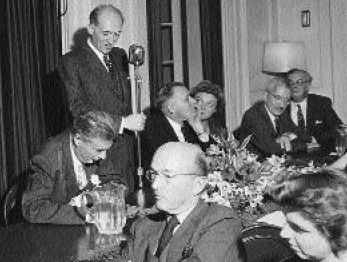
Frank Berger at the podium addressing The New York Academy of Sciences’ 1956 conference on psychopharmacology. Novelist and philosopher Aldous Huxley is to the left of Berger. Harry Beckman, professor of pharmacology and author of the best-selling Treatment in General Practice, is second from right, and renowned scientist Julian Huxley is at far right.

It became popular very quickly and soon was the most widely used prescription drug in the U.S. Meprobamate and other tranquilizing drugs were the subject of a major conference at The New York Academy of Sciences (the Academy) in October 1956. In the keynote address, Aldous Huxley predicted that these drugs were capable of changing the quality of human consciousness—a development that he thought would be more revolutionary than achievements in nuclear physics.

What did you do next?

In addition to building Carter-Wallace’s pharmaceutical business, I spent the next few years developing a compound that could be used in place of aspirin and codeine for everyday treatment of muscle and back pain. The result, carisoprodol, provides pain relief to the skeletal muscles without affecting the mind. It was marketed as Soma by Carter-Wallace and as Rela by Schering .

Did you stay at Carter-Wallace until you retired?

No, I returned to academia as professor of psychiatry at the University of Louisville, and served as a consultant to several pharmaceutical companies. This gave me a wonderful opportunity to spend part of each year in Geneva, Paris, London, and Milan. Even now, at the age of 87, I haven’t really retired. I still go to the office early each morning and keep up with what’s going on in my field.

What do you think is the most exciting development in pharmacology today?

Viagra. Just as meprobamate was the first drug to treat anxiety, Viagra is the first drug to treat sexual dysfunction. It’s a major breakthrough.

Also read:The Origin of the Term “Psychedelic”

Making Healthcare More Affordable in the Tri-State

An artistic shot of a doctor's stethoscope.

Greater efficiency in the tri-state region’s medical facilities can lead to more affordable costs for patients. The region is currently nearly twice as expensive as neighboring Massachusetts.

Published January 1, 2000

By Frank B. Hicks, PhD, and Susan U. Raymond, PhD

Image courtesy of tippapatt via stock.adobe.com.

HMOs claim that it’s a matter of efficiency; hospitals say it’s a lack of revenue. But whether because they spend too much or are paid too little, the region’s medical institutions are in trouble. Both as employers of skilled workers and as provider of care for the region, health care and its costs affect all businesses.

Hospitals, which make up about half of health services, are hurting in New York and New Jersey. Total margins in both states—revenues outpace expenditures by 3.0% in New Jersey and by only 2.2% in New York—are lingering at the bottom of the nation. Fears are that these margins will drop even further as a result of the 1997 balanced budget legislation, which has limited Medicare payments to hospitals.

Connecticut, on the other hand, has become a regional bright spot. Between 1994 and 1997, the median hospital margin there more than quadrupled, from 1.0% to 4.2%. Connecticut leads the region and betters the national average in another, broader measure of hospital health, the Financial Flexibility Index. New York and New Jersey have been relatively static in this measure and again lurk near the very bottom of the nation.

Health Expenditures Rise, but Health Services Shrink

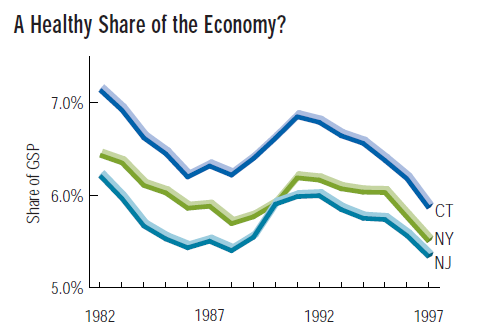
Total national health expenditures have been on the rise: from 8.9% of the Gross Domestic Product in 1980 to 13.5% in 1997. But over the same period, the health services share of the GDP (a subset of national health expenditures) has slipped from 6.7% to 5.2%. The same trend is evident in the Tri-State region. While a slow-growing health services sector may eventually contribute to containing health expenditures, it will also become a smaller driving force for the overall economy, a driving force often credited with helping lessen the impact of the last recession on the Tri-State region.

New York’s Academic Medical Centers: Academic Backbone

TREND: NYC Remains Academic Medical Stronghold

More than half of New York City’s hospital beds are housed in academic medical centers—hospitals whose work extends beyond patient care to include research and instruction for medical students and graduates. With only 2.8% of the total US population, the city trains more than 14% of the nation’s medical residents.

IMPACT: Tendency to More Expensive Care

While academic medical centers offer both patients and students access to cutting edge health care, research and teaching tend to boost their operating expenses as well. These differences traditionally have been shored up largely through Medicare, but this support was trimmed by the federal government’s Balanced Budget Act of 1997.

New York’s Academic Medical Centers: Economic Impact

TREND: Substantial Direct Spending

Direct spending by academic medical centers in New York State totaled $21.3 billion in 1996. Nearly half that spending was supported by out-of-state funding sources, the largest of which were Medicare and Medicaid, which provided $6.6 billion to the state.

IMPACT: Ripples Through the Economy

Academic medical centers paid $2.85 billion in city and state taxes in 1996, and the Greater New York Hospital Association estimates that the academic medical infrastructure accounted for $43.1 billion of total spending within New York State, 6.9% of the 1996 GSP.

New York’s Academic Medical Centers: Managed Care

TREND: Managed Care on the Rise

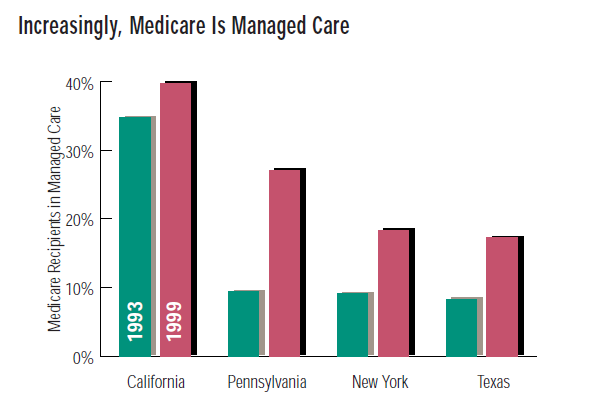
Since 1995, the fraction of New York State Medicare recipients enrolled in managed care plans has more than doubled, to 18.3%, and that fraction will continue to grow.

IMPACT: The Crux of the Crisis

Increasing enrollment in managed care (which tends to take patients away from the higher fees of teaching hospitals) and Medicare cuts from the Balanced Budget Act have hit academic medical centers on two fronts. While academic medical centers claim they are not receiving enough money to provide first rate care and cover indigent patients, managed care providers cite the centers’ high cost of treatment and argue the goal should be higher efficiency.

Healthcare Costs from the Consumer Perspective

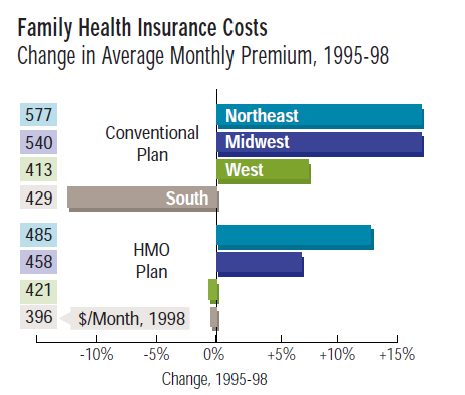
Health insurance premiums for conventional and HMO plans are higher in the Northeast than in any other region of the country. What’s more, the rates in the Northeast have also shown the greatest growth from 1995 to 1998: rates for HMO family coverage rose nearly 13% over that period, compared to a national rise of only 4%. In the South and West, rates even fell over the same period.

The high northeastern rates are no wonder, since the insurance companies themselves are also hardest hit in the Northeast, particularly in the Tri-State region. A hospital stay for an elderly patient suffering from pneumonia costs nearly twice as much in New York as it does in Massachusetts. These cost differences fuel the claim that there is room for improvement in the efficiency of the Tri-State region’s hospitals.

Also read: The Economics of Health Services Employment

Sources

  • William O. Cleverly, The Center for Healthcare Industry Performance Studies, The 1998-99 Almanac of Hospital Financial & Operating Indicators.
  • Health Care Financing Administration; U.S. Department of Labor.
  • American Hospital Association; Greater New York Hospital Association and Amos Ilan and Associates; Health Care Financing Administration.


Health Sector is Imperative to NYC’s Strong Economy

A doctor's stethoscope in the foreground, while a doctor types on their computer in the background.

The largest growth in the near future is expected in middle-skilled workers for healthcare professionals in the tri-state (New York, New Jersey, Connecticut) region.

Published January 1, 2000

By Frank B. Hicks, Ph.D. and Susan U. Raymond, Ph.D.

In the Tri-State region, the health services sector provides over 1.25 million jobs, or more than 9% of the workforce. About 40% of those jobs are in offices and clinics, another 40% in hospitals, and the remaining 20% in labs, outpatient facilities, and home health. While smaller than the retail trade and manufacturing sectors, health services weighs in larger than the finance, insurance, and real estate (F.I.R.E) sector.

Growth in health services employment boomed in the eighties and early nineties, mostly due to growth in home care, but has cooled since then. Wage growth has also cooled since the early nineties, but the average health service wage is still about 8% higher than the average wage for the entire service sector.

Growing Middle-Skill Workers

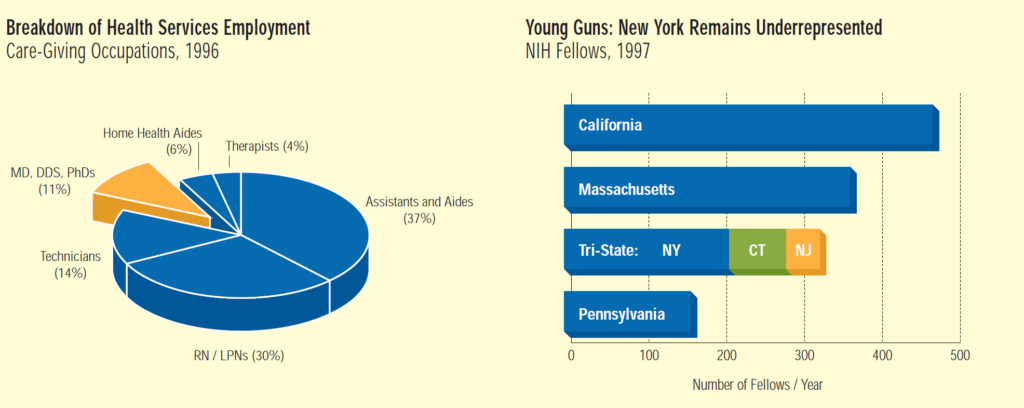
About three-fifths of the Tri-State region’s health services work- force are trained as health practitioners, making health care a key employer of high and mid-skill personnel. Within the care-giving fraction of the workforce, assistants and aides hold the largest share of jobs, at about 38%. Not as mobile as more highly trained workers, these workers, who make up the bulk of health services, will be strongly affected by strains on the region’s health institutions.

Projected growth will only tend to reinforce the present profile. Half of the 1996-2006 job growth in health services is expected to occur in assistants and aides, while physicians and dentists are expected to contribute to about 6% of the growth.

The health services workforce also represents a comparatively highly-paid sector of the economy. A licensed practical nurse pulls in about $30,000 per year in the region and a nursing aide about $21,000 each year. That compares to an average of $19,000 a year for a retail sales clerk. The region’s middle-skill health workers also typically earn more than their counterparts around the nation. Registered nurses make about 10-15% more and nursing aides as high as 20-40% more than the national average.

Preparing for Future Research

One gauge of the future (and present) state of medical R&D in the region is the number of fellowships the region attracts from the National Institutes of Health (NIH) each year. These grants support many recent graduates and students pursuing scientific degrees in fields related to health care.

While New York, the NIH funding leader in the region, receives more than 10% of the total NIH national funding, it is home to only 7.7% of NIH fellows. Massachusetts, which receives nearly the same NIH funding as New York, has almost twice as many. Connecticut and New Jersey, on the other hand, fare better and attract a slightly greater share of fellows than funding.

These talented fellows contribute to current research and are the grant writers of the future—NIH funding is likely to follow them wherever they go.

Also read: Regardless of Causes, Region’s Hospitals Take a Hit

Source

New York, New Jersey, Connecticut, and U.S. Departments of Labor; National Institutes of Health.