Filling in the Gaps Left by Artificial Intelligence

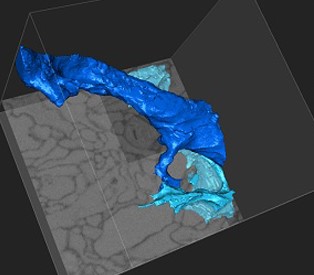
A graphic rendering from a science experiment.

Learn how human gamers are helping scientists and computers draw more accurate maps of the human retina. How do human stack up against artificial intelligence?

Published February 2, 2016

By Diana Friedman
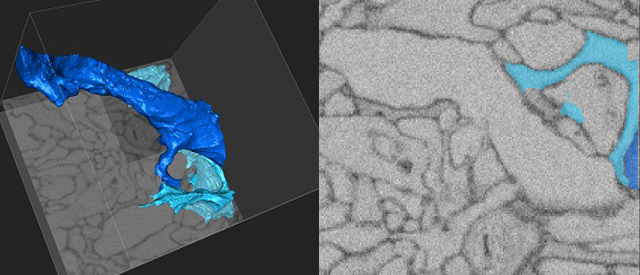
The average human brain is estimated to contain between 86-100 billion neurons and 10,000 times as many synapses. In the retina, the layer of tissue at the back of the eye that receives and sends visual signals to the brain, scientists don’t yet know the number and type of neurons that are connected. Even with advances in software technology for neuron reconstruction, it would take a team of 100 people working non-stop for 500,000 years to map the neurons in one human brain. However, researchers devised a novel solution to this obstacle-using a browser-based computer game, anyone can help in neural mapping and contribute to neuroscience research.

Created by Sebastian Seung’s research lab, the computer game EyeWire uses crowdsourcing to study the trillions of connections between neurons (which Seung calls “the connectome”) that are hypothesized to store memories, personality, and perhaps even intellect. The game is similar to a puzzle, in which players are assigned a high-resolution picture of a partially reconstructed neuron branch from a retina; on the right side of the screen, players “color” the parts of the image that are neurons.

The goal of the game is to select the areas that artificial intelligence (AI) has missed, improving the outline of the neuron and helping neuroscientists more accurately map neurons in the retina. The researchers hope that by gaining a greater understanding of the neurons in the retina, they can then apply these techniques to assessing neurons and synapses in the human brain.

Humans vs AI

Why recruit humans to complete this task, rather than rely on AI alone? Humans are actually more proficient at spotting neuronal connections than most AI, so the data from the game is being used to help the machines learn how to better perform the task. Player data is also submitted to Seung’s lab, where a computer reassembles the colored sections and produces a 3-D image of the connected neurons. Anywhere from 5 to 25 game participants trace the same set of connected neurons before it’s determined to be valid.

The game offers performance-based badges, chat, and weekly challenges, but some players received an unexpected bonus for playing the game – co-authorship credit in a published study. The research, published in Nature, sought to evaluate how mammalian retina detect motion by reconstructing Off-type starburst amacrine cells and bipolar cells (BC).

To map these neurons, the research team designed a special “Starburst Challenge” and recruited over 2,000 of the top-performing users to complete the activity. In the analysis of the mapping, the researchers found evidence that one bipolar cell type prefers to wire with an Off-type SAC dendrite near the SAC soma, while another BC type prefers to wire far from the soma and with faster visual response time. All players were included as co-authors on the paper.

Soon EyeWire will be expanding beyond the computer browser, as the company plans to develop a mobile version of the game. EyeWire will also be debuting EyeWire VR, a virtual-reality version of the game with hand motion-tracking sensors at this year’s Tribeca Film Festival in New York City. Regardless of the platform, the essence of EyeWire is simple: anyone can help neuroscience research in a fun and interactive way.

Also read: High Temps Call for High-Tech Edutainment

Improving Clinical Trials through Mobile Technology

An illustration of a smartwatch with healthcare/medical elements.

Mobile technology is emerging as a powerful tool for transforming the way clinical research is conducted now and in the future. Acquisition of real-time biometric data though the use of wireless medical sensors will allow for around-the-clock patient monitoring, reduce costly clinic visits, and streamline inefficient administrative processes. With the promise of this technology also comes challenges including digital data privacy concerns, patient compliance issues, and practical considerations such as continuous powering of these devices.  

This podcast provides an illuminating examination of both the promises and challenges that underpin the implementation of mobile technology into the clinical realm. 

Our Solar System Can Still Surprise Us!

A shot of stars and galaxies.

Astronomers this week announced two exciting discoveries that demonstrate how much we still have to learn about our own solar system.

Published March 30, 2014

By Diana Friedman

Solar system, in perspective. Image courtesy of NASA.

This has been a fun week in unusual news about our neck of the galaxy! Astronomers announced not one but two discoveries: a new object at the distant edge of our solar system and beautiful, never-before-seen rings on an asteroid that orbits between Saturn and Uranus.

The far-flung new object has been dubbed 2012 VP113 for now and is located in the Oort Cloud, a hypothesized layer of icy objects orbiting our sun way out beyond Neptune. At the most remote point in its orbit, VP113 is 70 billion kilometers (44 billion miles) away from the sun.

“Our known solar system consists of the rocky planets like Earth, which are close to the sun; the gas giant planets, which are further out; and the frozen objects of the Kuiper belt, which lie just beyond Neptune’s orbit. Beyond this, there appears to be an edge to the solar system where only one object somewhat smaller than Pluto, Sedna, was previously known to inhabit for its entire orbit. But the newly found 2012 VP113 has an orbit that stays even beyond Sedna, making it the furthest known in the solar system,” explains NASA.

A Source of Comets

The Oort Cloud is hypothesized to be a source of comets encasing the very outer limit of the solar system, beyond which our sun’s gravitational influence loses out to others stars’. It has remained somewhat theoretical because the bodies comprising it, when in their normal orbits, are simply too far away to be seen with today’s technology. VP113 was discovered near its perihelion (an object’s closest approach to the sun) by astronomers Chad Trujillo and Scott Sheppard using the new Dark Energy Camera on the NOAO 4 meter telescope in Chile.

The existence of 2012 VP113 implies that there might be many more objects out there (potentially trillions!) and provides valuable fodder for continued research. “Not only that, but [VP113’s and Sedna’s] orbits hint at the possibility of another even larger object out there; perhaps even something as big as Earth! That’s speculative, to be clear, but very interesting,” comments Phil Plait at Bad Astronomy. He adds, “In some ways, this discovery was inevitable! But it’s important nonetheless; we are peering into a region of the solar system that is ancient, but new to us. It’s a window into the past, as well as a peek into an up-to-now invisible population of objects.”

Still So Much to Learn

The ringed asteroid is called Chariklo, and nobody has ever seen anything like it. Every other known ringed object (Jupiter, Neptune, Uranus, and-of course-Saturn) is a planet. “The finding is a complete surprise to planetary scientists, who are yet unsure exactly how such rings could have formed,” according to Adam Mann at Wired.  

The discovery and an assessment of the rings’ possible causes are published in Nature by an international team of scientists. “Rings are natural laboratories in which to study dynamical processes analogous to those that take place during the formation of planetary systems and galaxies,” explains the paper. “Their presence also tells us about the origin and evolution of the body they encircle.”

Even as physicists are reporting the staggering, game-changing find of gravitational waves from the Cosmic Microwave Background, it’s exciting to think that our own cosmic corner also holds yet-unknown marvels. As Plait summarizes keenly, “We have an amazing grasp of how [the solar system] formed, evolved, and became the bustling place we see today. But there is still much to learn, and I can guarantee two things: We will learn more, and we’ll find far more surprises as we do.”

Also read: What Happened to the Comet of the Century?

New Findings in our Knowledge of the Universe

A shot of bright lights in the galaxy.

The newly-discovered supernova provides astronomers an opportunity to hone our knowledge of the universe, and you can help!

Published January 23, 2014

By Diana Friedman

Image courtesy of muratart via stock.adobe.com.

Astrophysicist and science blogger @CatherineQ summed it up beautifully:

@CatherineQ Great thing about Type 1a #supernova is that they all have similar characteristics and that enables us to use them to determine distances.

@CatherineQ But here we are – 12 million years later – perfectly poised in time to view this amazing exploding death of a star. How cool!

Indeed! About 12 million years ago in the M82 galaxy, also known as the Cigar Galaxy, a white dwarf star in a binary system (in which two stars orbit one center of mass) exploded into a supernova. Light from the event recently arrived on earth and was first observed by a University College of London astronomy observation workshop led by Dr. Steve Fossey.

“We were expecting a standard quick look through the telescope and a chance to use the camera for the first time before the clouds moved in, that’s all. When we started looking and Steve began getting more excited none of us could really believe what was going on. I can’t wait to get back on a telescope next week now,” says UCL student Matt Wilde.

M82 is a “mere” 12 million light years away from earth—pretty close by astronomy standards. Originally dubbed PSN J09554214+6940260 and now assigned the catchier name 2014J, the supernova will likely be visible through binoculars in the coming weeks. You can watch a video on locating M82 and 2014J here.

For professional astronomers this is an opportunity to calibrate our maps of space and better understand dark energy, the mysterious accelerator of universal expansion. This is because 2014J is a Type 1a supernova, and all Type 1a supernovae are the same (well, mostly, but more on that soon…).

More Detailed Knowledge about the Expansion of the Universe

They occur when the mass of white dwarf stars, super-dense remnants of “dead” stars, exceeds a mass limit of about 1.4 solar masses. In a binary system, the dense white dwarf’s extreme gravity pulls matter from the sister star, eventually crossing the mass threshold—called the Chandrasekhar limit after discoverer Subrahmanyan Chandrasekhar—igniting the nuclear chain reaction of supernovae.

The mass threshold is the same for any white dwarf star due to the processes of stellar evolution and principles of nuclear physics. This means that the progenitor conditions and resultant luminosity are homogenous throughout this class of supernova. National Geographic breaks it down nicely here. For a more detailed explanation, the University of Michigan offers helpful notes online.

Objects of uniform brightness appear brighter or dimmer depending on distance from the observer, following the inverse square law. A Type 1a supernova that appears a quarter as bright as another Type 1a supernova is twice as far away from us, allowing the supernovae to be used as yardsticks—standard candles in astro-jargon. They can thus be used to refine measurements of galactic distances, helping to understand how the universe is laid out and how the layout is changing over time. More detailed knowledge about the expansion of the universe may offer clues about the dark energy hurrying that expansion.

But here’s the thing: standard candles lack standardization, and the variation leads to some yet-unanswered questions. Younger stars form under more metallic conditions than older stars, because older generations of stars create and expel heavy elements.

A Call to Amateur Astronomers

“This means the stars that are forming today are forming out of materials that were just a twinkle in a young giant star’s eye some day in the past. The first stars were almost pure hydrogen and helium. Those stars have very different physics from today’s stars. Metals moderate the formation of stars, making stars form smaller and burn in a more controlled way. When white dwarf stars first started forming, they had fewer metals than modern white dwarfs and that could have effected how supernovae explode, causing supernovae to vary as a function of time in ways that we don’t know about,” explains astronomer Dr. Pamela L. Gay.

Importantly, the (to us) newness of 2014J means that astronomers can compare the star’s before and after supernova data, which will help suss out information about the components of its spectrum. And you can help! Phil Plait writes how and why:

“If you are an amateur astronomer, get images! And if you observed M82 recently, you may have ‘pre-discovery’ images of it, taken before it was officially discovered. Those are critical for understanding the behavior of the supernova. If you do, report it to the CBAT (but make sure you read the instructions first; they don’t want images, just reports of magnitudes and so on). Given the fact that it’s nearby, up high for so many observers, and caught so early, this may become one of the best-observed supernovae in modern times.”

Also read: What Caused the Big Bang?

What Happened to the Comet of the Century?

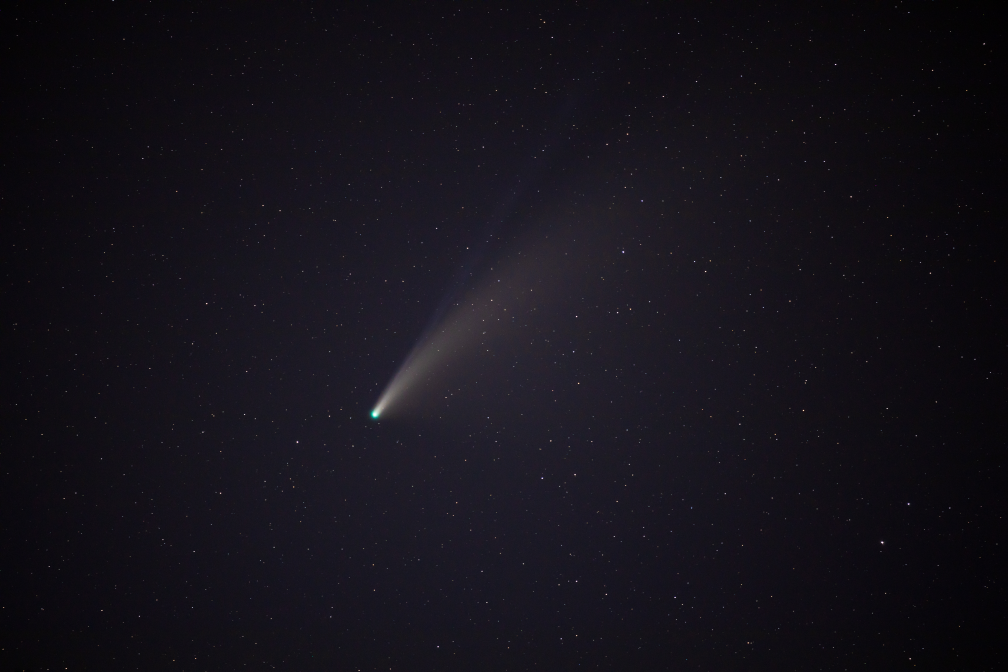
A comet flies through the night sky.

ISON, also known as the “Comet of the Century,” has been in the headlines recently. But did ISON survive its trip around the sun?

Published December 1, 2013

By Diana Friedman

Comet ISON is only “mostly dead,” maybe.

ISON has been touted as the “Comet of the Century.”

“There’s great interest in comet ISON for a couple of reasons. First of all, it’s coming from the very edge of our solar system so it still retains the primordial ices from which it formed four-and-a-half billion years ago. It’s been traveling from the outer edge of the solar system for about five-and-a-half million years to reach us in the inner solar system, and it’s going to make an extremely close approach to the sun and hence could become very bright and possibly a very easy naked-eye object in early December,” explains Don Yeomans, manager of NASA’s Near-Earth Object Program Office at the Jet Propulsion Laboratory.

So, what happened when ISON approached the Sun on November 28? The comet’s fate remains unclear, though astronomers were mostly pessimistic about its survival. Images from NASA/ESA spacecraft SOHO showed ISON approaching the sun, and then nothing came out on the other side. …until, finally, something did! According to NASA, “The question remains whether it is merely debris from the comet, or if some portion of the comet’s nucleus survived, but late-night analysis from scientists with NASA’s Comet ISON Observing Campaign suggest that there is at least a small nucleus intact.”

Ongoing Analysis Will Reveal More

We might be able to see the remnants of ISON without telescopes later this month. Whatever’s left, “its closest approach to Earth at the end of December, when it will be 60 million kilometers away. A few weeks later, it’s possible that we’ll pass through the debris trail from ISON, and see some meteors from it,” says astronomer and blogger Phil Plait.

Fascinatingly, ISON’s suspenseful and unexpected dimming and intensifying will teach scientists a lot. NASA explains, “Such brightness changes usually occur in response to material boiling off the comet, and different material will do so at different temperatures thus providing clues as to what the comet is made of. Analyzing this pattern will help scientists understand the composition of ISON, which contains material assembled during the very formation of the solar system some 4.5 billion years ago.”

Also read: A Scientific Explanation to the Demise of Dinosaurs

Launching the New Era of Space Exploration

A shot of a rocket preparing to launch, with a sunrise in the background.

The successful launch of Orbital Sciences’ Antares rocket and Cygnus cargo spacecraft heats up the commercial space race.

Published September 22, 2013

By Diana Friedman

The Orbital Sciences Corporation Antares rocket is seen during sunrise on the Mid-Atlantic Regional Spaceport (MARS) Pad-0A at the NASA Wallops Flight Facility in Virginia, Sunday, April 21, 2013. NASA’s commercial space partner, Orbital Sciences Corporation, is scheduled to test launch its first Antares later in the day. Photo Credit: (NASA/Bill Ingalls)

“If we needed more tangible proof that this is a new era of [space] exploration, it’s right here, right now,” said Robert Lightfoot, NASA Associate Administrator, at a briefing following the successful launch of Orbital Sciences’ Antares rocket and Cygnus cargo spacecraft.

“With this launch, the private space race is now heating up as we now have competition for cargo transports to the International Space Station,” writes Alex Knapp in Forbes. “In the coming months, expect the competition to heat up more as SpaceX sends its third cargo launch to the ISS and plans its first manned launch to the Space Station, Orbital Sciences prepares for its second trip to the ISS, and Sierra Nevada Corporation prepares to finish its milestones for its Dream Chaser spacecraft.”

NASA has been working with commercial space science partners since 2006 to nurture a US-based private space transportation industry. Through the Commercial Crew Program and Commercial Orbital Transportation Services program, NASA aims to decrease American reliance on Russian spacecraft since the retirement of the US space shuttle and to free up resources to tackle grand(er) challenges, such as the (politically controversial) asteroid initiative.’

Tracking and Understanding Asteroids

Cygnus was scheduled to rendezvous with the International Space Station today, carrying 1,300 pounds of supplies. However, the docking attempt has been delayed 48 hours due to a glitch. NASA reports, “This morning, at around 1:30 a.m. EDT, Cygnus established direct data contact with the ISS and found that some of the data received had values that it did not expect, causing Cygnus to reject the data,” noted Orbital. “This mandated an interruption of the approach sequence. Orbital has subsequently found the causes of this discrepancy and is developing a software fix.”

Relatedly, NASA Chief Technologist Mason Peck is at the World Maker Faire at the New York Hall of Science this weekend to discuss how Makers can contribute to the future of space science and the asteroid initiative. “NASA will offer makers a chance to program science hardware and learn how small, do-it-yourself projects might be used to help track and understand asteroids, using their own personal computers.” said Peck.

Astronaut Dr. Charlie Camarda discusses the future of spaces exploration, the asteroid initiative, and the value of involving as broad a spectrum of people and ideas as possible in space science. “With a more diverse group of minds inspired to think and dream about space, we’ll start to see really great stuff happen,” he says.

Also read: There’s A Star Man Waiting in the Sky

New Perspectives on the Physics of Black Holes

A colorful graphic illustration of a black hole.

The extreme properties of black holes make them ideal laboratories for thought experiments, allowing us to test our best theories against the edge of what we know. Paradoxes thus brought to light are shaking up the world of theoretical physics in exciting ways.

Published August 15, 2013

By Diana Friedman

The New York Times recently ran a fascinating article on the black hole firewall paradox. The puzzle and the contradictions it seems to imply are being debated this week at UC Santa Barbara’s Kavli Institute for Theoretical Physics.

The crux of the issue is a conflict between central tenets of general relativity theory and quantum mechanics. Basically, either the equivalence principle (a foundational concept for general relativity) doesn’t hold, entangled particles can “cheat” on each other, or information can be lost. The latter two are both forbidden by quantum mechanics.

This probably needs some explanation! Joseph Polchinksi, a theoretical physicist at the Kavli Institute and one of the authors of the paper that pointed out the firewall paradox, describes the conundrum in a guest blog for Cosmic Variance.

Briefly, in 1974, Stephen Hawking showed that, contrary to the nomenclature, black holes are not black. In fact, they radiate a constant stream of particles known now as Hawking radiation. When virtual particle pairs pop into existence near an event horizon, one can fall into the black hole, leaving the other to radiate away from the black hole rather than annihilate with its twin.

Problematically, Hawking said, the radiation would be totally random, containing no information about the states of its composite particles and their anti-twins, which is anathema to quantum mechanics. “There is strong evidence that [the conservation of quantum information] is an inviolable principle of physics, and we don’t really know how to make sense of quantum mechanics without it,” says Cal Tech theoretical physicist John Preskill in this Quantum Frontiers post.

Different Conditions, Different Outcomes

Juan Maldacena, a theoretical physicist now with the Institute for Advanced Study, explains, “In quantum mechanics (as in classical mechanics) the information about a system is not lost. Different initial conditions lead to different outcomes…The radiation coming out of black holes would be completely thermal and devoid of the information of what fell into black holes. Thus, black holes appear to be sinks of information, perverse monsters that threaten the fundamental laws of quantum mechanics.”

Maldacena implied a solution with the anti-de Sitter/conformal field theory correspondence (AdS/CFT for short), which offers elegant mathematical demonstrations of the holographic principle. The idea is that everything occurring in 3D space is actually a projection of things happening on a 2D boundary, and you can translate between the two using the AdS/CFT. If that sounds conceptually bizarre and unconvincing, fair enough! But the math is so compelling as to have been near-universally accepted in the theoretical physics community.

“This meant that even 3D black-hole evaporation could be described in the 2D world, where there is no gravity, where quantum laws reign supreme and where information can never be lost. And if information is preserved there, then it must also be preserved in the 3D world. Somehow, information must be escaping from the black holes,” explains Zeeya Merali in Nature.

The “how” turned out to be less straightforward. (I know: Straightforward?! Bah!) Stanford physicist Leonard Susskind proposed that information could be salvaged from black holes via quantum entanglement between radiated particles. But this ends up violating another core concept of quantum mechanics, monogamous entanglement. A radiating particle can’t be entangled with another, earlier radiated particle, because it was born entangled with its anti-twin (remember, the one that fell into the black hole?). Preskill explains the monogamous entanglement issue in more detail here. (H/T Jennifer Ouellette)

Some Revolutionary Implications for Cosmology

Polchinski—along with colleagues Ahmed Almheiri, Donald Marolf, and James Sully—published a paper stating that, in order to preserve information, the entanglement between the virtual particles formed near the event horizon has to be severed. This is where the challenge to relativity comes in. Merali elaborates, “‘It’s a violent process, like breaking the bonds of a molecule, and it releases energy,’ says Polchinski.

The energy generated by severing lots of twins would be enormous. ‘The event horizon would literally be a ring of fire that burns anyone falling through,’ he says. And that, in turn, violates the equivalence principle and its assertion that free-fall should feel the same as floating in empty space—impossible when the former ends in incineration.”

A possible solution to the puzzle lies in the idea, formulated by Susskind and Maldacena, that wormholes connect particles on either side of an event horizon. “The conjecture seems to allow us to view the early radiation with which the black hole is entangled as a complementary description of the black hole interior,” explains Preskill. This would mean that one particle could be faithfully entangled with two joined particles on either side of the event horizon, because the connected particles would actually be the same.

This could have some revolutionary implications for cosmology—the wormholes connecting all these entangled units of information might turn out to be the very stuff of space! “If true, this insight would be a step toward a longtime dream of theorists of explaining how space and time emerge from some more basic property of reality, in this case, bits of quantum information,” explains NYT author Dennis Overbye.

Also read: The Anthropic View of the Universe

New Scientific Explorations on the Red Planet

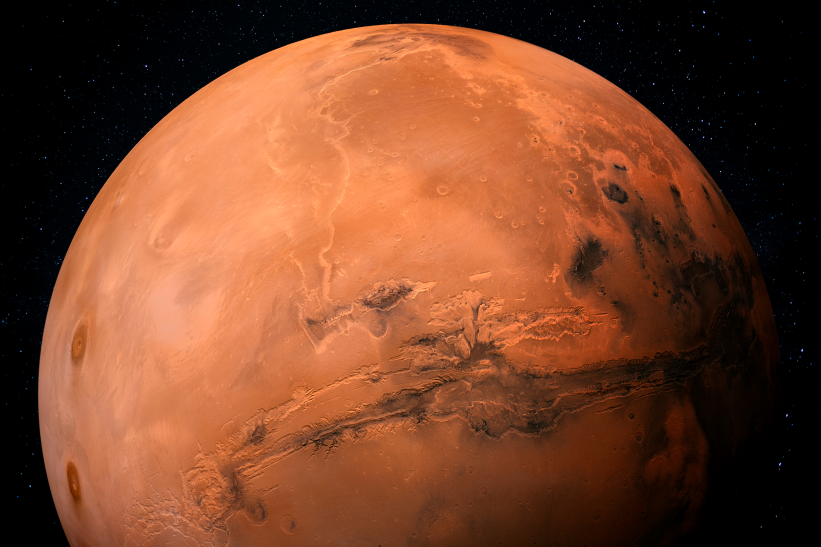
A photo of the planet Mars.

The Curiosity rover just celebrated its first Martian anniversary. Between Curiosity’s especially public mission and Commander Chris Hadfield’s amazing updates from the International Space Station, it’s been a great year for engagement with space science!

Published August 08, 2013

By Diana Friedman

Last week was the one-year anniversary of the Curiosity rover’s landing on Mars. To celebrate, NASA and the Jet Propulsion Lab released this video (H/T Phil Plait, who’s written great posts on the rover’s activities), providing a glimpse into another world and sharing Red Planet highlights from the last year. In that time, Curiosity has already found evidence of an ancient riverbed that may have been capable of supporting life and provided clues about the thinning of the Martian atmosphere.

For more on the rover’s current and future work, see this New Scientist article. You can also watch Dr. Ashwin R. Vasavada, Deputy Project Scientist at the Mars Science Laboratory, reveal some of Curiosity’s recent results and discuss upcoming Martian science via webcast Thursday, August 15.

Dustyn Roberts, a roboticist who helped design and build Curiosity, talks about the engineering involved and more in this podcast. Curiosity’s landing on Mars was fraught, as explained awesomely in NASA’s 7 Minutes of Terror video. It takes signals about a quarter of an hour to transmit from Mars to Earth. That’s a seriously tense window of uncertainty while you wait to find out whether something you made is successfully on another planet or a smoldering wreck! The elation that erupted at NASA headquarters upon confirmation of Curiosity’s smooth descent is contagiously exciting.

“Hitch a Ride to Mars”

If you want to experience that rush for yourself, it’s just gotten a little easier. Tiny DIY satellites called CubeSats (just 10 cubic centimeters) are opening up new avenues for citizen scientists to participate in space research. NASA recently partnered with over 100 international government agencies and NGOs to sponsor the International Space Apps Challenge. The challenge “Hitch a Ride to Mars” invites teams to design a Martian mission using DIY CubeSats.

As Congress stymies plans to lasso an asteroid for research, it’s encouraging to think about the various new ways in which innovation allows people to engage with space science. 

“All the commercial and private endeavors are great. The competition sparks innovation, and that’s what we need. NASA should be supporting these projects and also doing great basic research. Should we go to Mars? Definitely! Start working on asteroids? Yes!” Says astronaut Dr. Charlie Camarda.

“The more people we have up there and the more ideas and challenges we think about, the more inspired people will be to come up with even more ideas and solutions—students and NASA scientists alike. It used to be that only test pilots could go up, but now it’s getting more popular. It’s still really expensive, but I hope soon it will be a more accessible experience. With a more diverse group of minds inspired to think and dream about space, we’ll start to see really great stuff happen.”

To conclude on an inspiring video note, here’s Commander Chris Hadfield’s Space Oddity!

Also read: There’s a Star Man Waiting in the Sky

How Does New York City Prepare for Flooding?

A shot of the lower Manhattan skyline taken from the New Jersey side of the river.

Mayor Bloomberg recently released a report detailing plans to make NYC more resilient in the face of rising sea levels and climate change. Philip Orton, PhD, a research scientist at Stevens Institute of Technology who studies physical oceanography and storm surges, consulted on the report. Here he shares his perspective on the science behind the protection and adaptation strategy.

Published June 23, 2013

By Diana Friedman

Image courtesy of Rawf8 via stock.adobe.com.

Mayor Bloomberg recently released a plan to make NYC better prepared for, and adaptive to, rising sea level and extreme weather threats. The report, titled “A Stronger, More Resilient New York,” is based on input from scientists with diverse areas of expertise as well as community organizations. Dr. Philip Orton, a research scientist at Stevens Institute of Technology who studies physical oceanography and storm surges, describes the report as solidly grounded in science and quantitative methods.

The report takes climate change as an unequivocal given that demands acknowledgement and adaptive action. At a press conference, Mayor Bloomberg explained, “Our city will be much more vulnerable to flooding in the decades ahead…We expect that by mid-century up to one-quarter of all of New York City’s land area, where 800,000 residents live today, will be in the floodplain,” he said.

“If we do nothing, more than 40 miles of our waterfront could see flooding on a regular basis, just during normal high tides…[Hurricane] Sandy cost our City $19 billion in damages and lost economic activity. And we now forecast that a storm like Sandy could cost nearly five times that much by mid-century—around $90 billion.”

“We wish that everyone had agreed that there was this threat from storm surges before Sandy,” says Dr. Orton, “but putting up the protections that we should have put up before is a huge step in the right direction. Just having that attitude that yes, we do get hit by hurricanes, is impactful. Considering sea level rise on top of that, as the Mayor’s plan does, can help protect us from future storm surges.”

Localized Measures

The Coastal Protection chapter of the report outlines the strategies to fortify and defend NYC’s diverse coast areas. The recommendations focus mainly on local projects (such as restoring and widening sand dune systems, cultivating oyster reefs and wetland areas, and installing tide gates) rather than harbor-wide, in-sea barrier structures. Such large-scale projects, it is estimated, would cost between $20 and $25 billion and take decades to construct. Harbor barrier structures would also have hydrodynamical consequences that would deflect damaging storm surges to vulnerable areas.

Dr. Orton explains, “The fluid dynamics is a definite reason for not building barriers in the harbor. Any barrier raises the flood level somewhere else some amount. At Stevens Institute, we’ve run models and quantified the storm surge increase off of hypothetical barriers due to the reflection of the storm surge back out to sea. Since we’re right next to the open ocean, the extra water radiates out to sea and the storm surge increase is not actually that large. But even a decimeter is still too much for some high-risk, low-lying neighborhoods to find it palatable.”

What Does Such Research Entail?

Will localized measures prove adequate for the task of protecting coastal neighborhoods? According to Dr. Orton, sand dune expansion “is a proven method of effectively reducing flooding. It had a huge positive influence on areas along open shores during Sandy.” Other recommended measures, such as wetland expansion and oyster bed growth, require more research before the degree of their efficacy can be fully understood. Current models indicate that, in larger areas such as Jamaica Bay and New York Harbor, such systems are indeed likely to be vast enough to reduce flooding as well as waves. More quantitative research on natural shorelines and their influence on flooding remains necessary. “The operative word being ‘quantitative,'” Dr. Orton emphasizes.

Dr. Orton elaborates, “It’s hugely interesting that we have the tools to study this now. The same models that are used for storm surge forecasting can be used for testing the effects of adaptation strategies, and the modeling techniques have improved dramatically over recent years, especially as computing power increases. This has been the same with climate modeling. We apply conservation principals for water velocity, momentum, mass, heat, and other variables. Storm surge doesn’t involve biology, carbon cycles, or chemistry, so it’s a simpler problem than climate and these are easier predictions to make,” he said.

“It’s just about the physics of the movement of water and it’s very reliable, given good weather forecasts (though those have a lot of uncertainty). In the fluid dynamics models, you input values for factors like water depths and land elevation, and you add in obstructions to test your adaptation strategies. You can put in barriers or frictional elements in places to simplistically represent wetlands or oysters or whatever, and observe the outcomes.”

Adaptation Versus Retreat

Reeva Dua at Columbia’s Center for Climate Change Law Blog and Eric Goldstein at the Natural Resource Defense Council Blog point out that there is some controversy over climate change response strategies based on adaptation versus retreat. Some predictions place certain low-lying areas underneath six feet of water by the end of the century. Governor Cuomo has proposed an alternative floodplain buy-out program to acquire property within flood zones and convert it to natural buffers.

“With the accelerated sea level rise that we expect to kick in really rapidly in the next century, eventually there will need to be more plans,” says Dr. Orton.  A 500-year coastal flood (a flood with a height expected with a 0.2 percent probability of occurring at a given location in a given year) in the next century could overwhelm the protections being devised now.

There’s likely to be ongoing debate on this point. In the meantime, refusing to cede ground “gives a really strong message of support for all low-lying, high risk neighborhoods,” says Dr. Orton. “Some of those areas are very high-value, like lower Manhattan, and some of them are sparsely populated or have lower property values, like the shore of Staten Island. Insisting on defending all these areas sends a strong message of solidarity.”

Also read: When Waters Rise: Cross-Border Science for Global Flood Response

The Biological and Legal Implications of Gene Patents

A logo representing gene patenting.

The Supreme Court rules that genes cannot be patented, though cDNA can be. Biologist and lawyer Dr. John Murray discusses the issues involved and the ruling’s ramifications.

Published June 13, 2013

By Diana Friedman

The Supreme Court ruled last week that genes cannot be patented, but cDNA can be. This website provides some background on the case, ASSOCIATION FOR MOLECULAR PATHOLOGY ET AL.v. MYRIAD GENETICS, INC ET AL. Myriad identified and isolated two genes that are associated with high risk for breast cancer, BRCA1 and BRCA2, and sought patents for the isolated genes. The case hinged largely on a debate over the relation of patents to progress.

The Association for Molecular Pathology and the American Civil Liberties Union argued that granting exclusive claims to genes would stymie further research, limiting what scientists unaffiliated with Myriad would be able to do. On the other hand, such exclusivity incentivizes research and development, the costs of which could be otherwise untenable.

“There have been mixed reactions, everything from ‘Armageddon!’ to ‘meh,'” says Dr. John Murray. Dr. Murray has a PhD in genetics and practices intellectual property law. “I think the truth is somewhere in the middle.”

What Observers Expected

Based on the arguments, the ruling matched what observers expected. It overturns thirty years of patent office decisions in which gene claims were granted, and concern has been expressed that thousands of prior patents might now be endangered. However, points out Daniel Fischer in this Forbes article, many of those patents are old and near expiration.

Dr. Murray elaborates, “The stuff about it being a disaster for biotech is just overwrought. We’re in a post-Human Genome Project and Encode Project world. In the early 90s, you could just ride out into the frontier of the human genome, stake your claim, and they’d give you a patent on it. How many biotech companies are dedicating their resources to isolating individual human genes now? I would guess none or very few, because at this point it’s mostly already been done.

Now it’s more about developing ways of using these genes, diagnostic techniques, or ways of manipulating the DNA. To get a patent, you have to be able to demonstrate that your invention is non-obvious. But when it comes to isolated gene sequences, these days I can just go on my computer and get those, so it’s not at all non-obvious. The kind of research this might have killed has already been done.”

The Impact of the Ruling

The Court was careful to explicitly circumscribe the impact of the ruling. The Opinion states, “It is important to note what is not implicated by this decision. First, there are no method claims before this Court. Had Myriad created an innovative method of manipulating genes while searching for the BRCA1 and BRCA2 genes, it could possibly have sought a method patent…Similarly, this case does not involve patents on new applications of knowledge about the BRCA1 and BRCA2 genes…Nor do we consider the patentability of DNA in which the order of the naturally occurring nucleotides has been altered.”

The compromise seems unlikely to devastate biotech companies. While some companies will take a hit, says Dr. Murray, it won’t be a fatal one. “Any smart biotech company, including Myriad, will have claims on their ‘killer apps’ every which way from Sunday. Moving forward, there will be a real premium in drafting methods claims, identifying what you’re doing differently from other people.”

A Lack of Scientific Understanding

Unless you work for a biotech company with an ossified business model, the most depressing element of this case might be the lack of scientific understanding on display throughout the case. According to Justice Thomas, cDNA is patentable because “the lab technician unquestionably creates something new when cDNA is made.” Dr. Murray calls the ruling “scientifically and intellectually incoherent.” The debated claims cover the information expressed in the exons.

“When exons are separated from introns naturally, it’s unpatentable. If the information is separated in a lab to make cDNA, it’s mysteriously patentable, even though it’s the same information. So you could certainly apply better science, which the Court didn’t do. They were clearly just trying to make sure they didn’t blow up the biotech industry by invalidating cDNA,” says Dr. Murray.

Dalila Argaez Wendlandt, a partner with Ropes & Gray, points out that DNA/cDNA distinction could allow for technical loopholes. “What if you took that same cDNA sequence and added non-functional introns?” she asks in Fisher’s piece.

Dr. Steven Salzberg, Professor of Medicine and Biostatistics at the Institute of Genetic Medicine at the Johns Hopkins University School of Medicine, highlights some of the Court’s basic errors in this article. “It’s troubling that the highest court in the land can’t get even the basic facts of molecular biology right when writing a decision that has such fundamental importance to genetic testing, the biotechnology industry, and health care,” he says.

On the plus side, screening for the BRCA genes is likely to become much more affordable, says John Wilbanks, chief commons officer at Sage Bionetworks, in this Wired article. “By making that data free, there is a lot of room for public good and public and private innovation.”

Also read: Law Experts Give Advice for Scientific Research