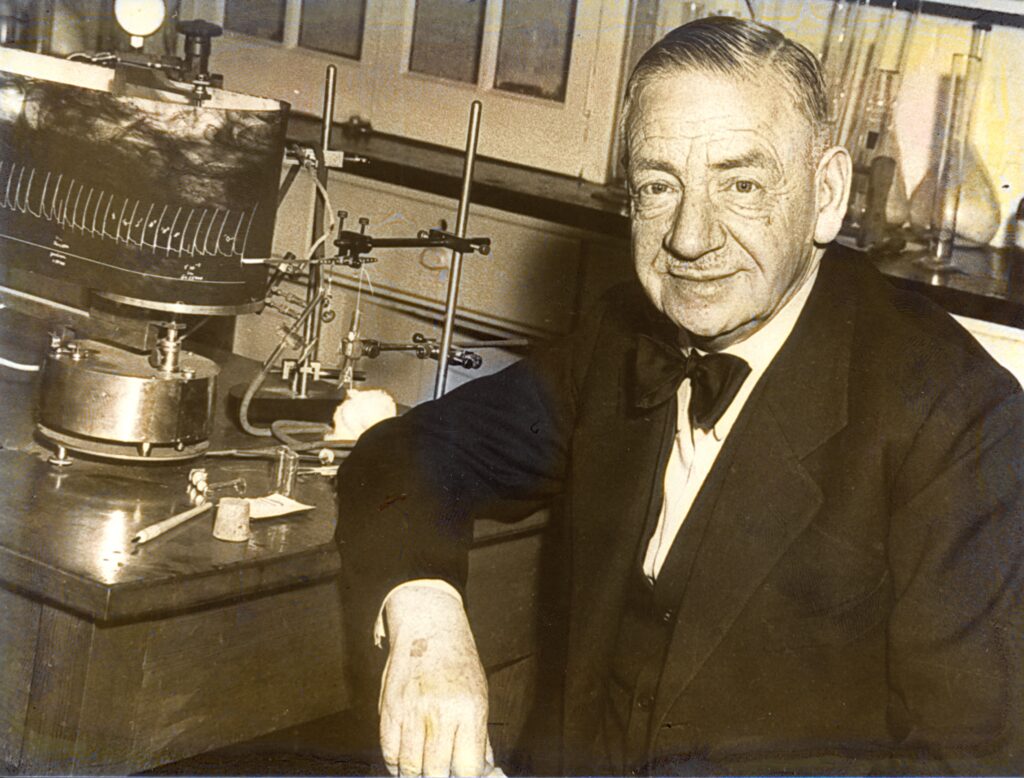
Despite a promising career advancing health research at Rockefeller University, Seth Berkley made a surprising mid-career move when he went all-in to develop an AIDS vaccine.
In 1996, Seth Berkley, MD, threw away a promising career. The Ivy-League-trained physician was the Associate Director of the Health Sciences Division at the Rockefeller Foundation, a rising star in infectious disease and epidemiology, when he hatched a plan that many experts considered absurd. He wanted to establish an unprecedented public-private collaboration, then gamble its money on an impossible long shot: an AIDS vaccine.
“There certainly was a lot of skepticism” that a non-governmental organization would have a role to play, says Berkley. Nonetheless, his nascent not-for-profit, the International AIDS Vaccine Initiative (IAVI), persisted.
It’s too early for gloating—there is still no effective vaccine against HIV, the cause of AIDS. But there also is no doubt that IAVI has redefined the discussion about AIDS vaccines.
Rather than placing the burden of vaccine development entirely on pharmaceutical companies, IAVI helped pioneer the use of public-private partnerships and collaboration between rich and poor countries. In hindsight, the advantages of its strategy seem obvious.
IAVI’s approach is to take promising preclinical leads into small-scale human trials in developed countries first, then move the successful candidates to large-scale trials in developing countries. That keeps the tests for human safety under the watchful eyes of first-world regulators, but ensures that efficacy trials take place in third-world populations who need the vaccine most.
For a group that runs complex scientific collaborations around the world, New York was an obvious place to settle. “We are a global organization, and you need a city that is global in its nature,” says Berkley, citing New York’s position as an international scientific, transportation, media, and finance hub.
Based in NYC, Global Impact
After setting up in borrowed space at Rockefeller University, IAVI soon moved to a shared office for nonprofit groups in Midtown. Its move to Lower Manhattan was driven by a factor New Yorkers know all too well: expensive real estate.
“The rates in Midtown were $60 a square foot, and as a nonprofit we couldn’t really justify that,” says Berkley. A new office in a renovated building on William Street had the needed transportation options and high-speed Internet service, so IAVI moved downtown in 2001.
Not long after, Berkley saw the jets fly into the Twin Towers. After the attacks, IAVI operated temporarily out of its original home, Rockefeller University, and it was nearly a month before the team’s Internet servers were back online. Much of the organization’s work could be done from any office with a broadband connection, but the group decided to stay in the city.
“There’s only so much you can do virtually,” says Berkley. “In the end, there has to be the pressing of flesh.” IAVI has already expanded its office space in Lower Manhattan. It is also participating in on-going discussions with the Mayor’s Office about the fate of Governors Island, the former U.S. Army and Coast Guard base in New York Harbor. Berkley advocates turning part of the island into a campus for global health research and meetings.
As much as IAVI loves New York, most of the Initiative’s work takes place away from headquarters at sites scattered around the world. IAVI currently has no laboratory space of its own. Instead, it funds research in established academic laboratories and clinics.
Searching for the “Holy Grail”
At the preclinical end of the pipeline, IAVI now runs two research consortia focused on different HIV vaccine strategies. The Neutralizing Antibody Consortium is searching for what Berkley calls the “Holy Grail” of AIDS vaccines: antibodies that can neutralize multiple strains of the rapidly mutating virus.
The Live Attenuated Consortium is taking an entirely different approach, trying to identify the biological markers that correlate with HIV immunity in monkeys vaccinated with a live, weakened strain of the virus. A live attenuated vaccine works well in monkeys, but without a clear understanding of how it works, researchers are reluctant to try it in humans.
Preclinical projects like the consortia are critical, but comparatively cheap. The bulk of IAVI’s budget funds clinical trials, ranging from small phase 1 safety tests to large-scale phase 3 efficacy trials, the latter often involving thousands of volunteers and hundreds of medical professionals. To fund its research and trials, the organization has raised nearly $500 million to date, from a combination of philanthropic foundations, governments, and pharmaceutical companies.
Several IAVI-sponsored vaccine trials have already failed, underscoring the high risks that have kept many pharmaceutical companies from trying to develop an AIDS vaccine on their own. Undeterred, the Initiative is now conducting 20 clinical trials worldwide on newer vaccine candidates, and more await at the preclinical stage.
Today, the 49-year-old Berkley says IAVI’s persistence continues to rest on the same reasoning he used on donors in 1996: There’s no guarantee that giving will result in a vaccine, but it’s guaranteed that there will be no vaccine without giving.
While building codes do not require wind tunnel testing for new skyscrapers, engineers and architects conduct the testing anyway to ensure precision and efficiency during construction.
Before glass, steel, and concrete, there were plastic, plywood, and pressure sensors. And even in this age of computer-aided design and analysis, engineers still build scale models of buildings to see if the full-sized real ones can withstand strong winds.
That explains why in 2002, researchers at the Alan G. Davenport Wind Engineering Group at the University of Western Ontario (UWO) built a 1-to-500 scale replica of 7 World Trade Center and the surrounding neighborhood, measuring about a foot and a half tall. They placed the model carefully inside a boundary-layer wind tunnel, a 128-foot long, 11-foot wide, and 8-foot high apparatus equipped with a wind machine that can simulate everything from gentle breezes to gusts of hurricane intensity. Then, as the wind blew, sensors attached to and around the model logged thousands of readings of pressures, speeds, and deflections. Later, researchers analyzed the data to spot potential wind-related problems, and compared them to computer-model predictions.
Such a study is a common practice in the design of a tall building to ensure its safety and the comfort of occupants and pedestrians. The studies guarantee that skyscrapers are flexible enough to withstand high winds without toppling over (all tall buildings are designed to sway slightly), and that strong gusts won’t rip off or break the cladding (I.M. Pei’s John Hancock Tower in Boston notoriously suffered falling and broken windows during its construction in the 1970s). As for comfort, engineers aim to prevent occupants from detecting the building’s motion by making sure it moves slowly and gently. Wind speeds at the base of the building are monitored so that pedestrians won’t have to endure strong gusts.
Wind Tunnel Testing Not Required
Although building codes don’t require wind tunnel testing, they usually permit architects and engineers to base their designs on test conclusions. This typically results in buildings that are engineered precisely and efficiently—and therefore less expensively—than what is mandated by conservative building codes.
The architects and engineers for 7 WTC, Skidmore, Owings & Merrill (SOM) and WSP Cantor Seinuk, respectively, had access to data on many similar tall, existing buildings. But the timing presented a challenge, because there was then no master plan yet in place for Ground Zero. Researchers tested three models: one of 7 WTC with no structures at Ground Zero (which is what exists today), and two that included surrounding buildings at various heights and orientations, which affect the wind speed and direction around 7 WTC. “We had to make some assumptions about what might get built there, so we made them conservatively,” says Silvian Marcus, chief executive officer of WSP Cantor Seinuk.
In the last decade or so, emerging analytical methods such as computational fluid dynamics (CFD) have allowed designers to study the complex behavior of air movement around buildings without the use of scale models or wind tunnels. But by all accounts, it will be years before computer-only wind studies become the norm.
Immensely Complicated and Computationally Intensive
One reason is that wind tunnel facilities—there are just a few in North America—have given designers the ability to look not only at the effects of wind, but also at other weather-related effects like snow and at the perfomance of other systems such as air in-takes and exhaust fans. These are “all things that are critical to building performance,” says SOM partner Carl Galioto.
More fundamentally, calculating airflow around buildings is both immensely complicated and computationally intensive. At this stage, CFD software for buildings requires a high level of expertise, produces results that are highly dependent on assumptions, and tends to be used only by wind-tunnel facilities themselves.
Change will come when the software and processing power improve. “I’d like to be able to use CFD analysis to spot check parts of buildings that tend to be problem areas for wind pressure, like corners and parapets, and then confirm the CFD predictions with a physical test prior to construction,” says Nicholas Holt, SOM’s senior technical architect for the project. “Eventually, with enough data corroborated by physical models, codes will likely begin to accept CFD analysis in lieu of wind tunnel testing.”
In the meantime, though, engineers will keep the plastic, plywood, and pressure sensors handy.
A convergence of real estate development, infrastructure improvements, and diverse cultural offerings is redefining Lower Manhattan, harkening back to the city’s colonial days.
The block of Front Street just north of the South Street Seaport in Lower Manhattan was a sad sight for most of the last 30 years. Vintage commercial buildings built by prosperous merchants at the end of the 18th century stood derelict and nearly empty.
But today, life is stirring on Front Street. Real estate developers, helped by low-cost public financing, recently renovated 11 old buildings and built three new ones, creating 96 chic apartments that were all quickly snapped up by renters. On a recent sunny spring afternoon, entrepreneur Sandra Tedesco was unpacking bottles at her new wine bar, Bin No. 220, the first retail business to open on the block. A coffee bar, a dry cleaner, a sushi place, and a gourmet grocer—those basic upscale urban amenities—are also on the way.
Sandra and her business partner, Calli Lerner, both pioneering residents in the Financial District, are engines of the change that is sweeping Lower Manhattan. “We had nowhere we could walk to have a nice glass of wine and relax,” says Tedesco. So, both experienced in the restaurant trade, the partners are remedying the situation by opening a cozy neighborhood place.
A Neighborhood on the Move
If all you know about downtown is the seemingly endless squabbling about what will be built at Ground Zero, you are missing the big picture. Lower Manhattan is not only being rebuilt, it is morphing into a much more diverse and lively neighborhood. No longer is finance the only employer, nor do the streets echo emptily at 7 p.m. “This is definitely not the Downtown we once knew,” says Mary Ann Tighe, CEO of the New York Tri-State Region at real estate firm CB Richard Ellis. Baby strollers roll right by bankers’ limousines and green parks are sprouting amidst the concrete canyons.
Two powerful forces—the free market and the government—are working in tandem to improve life downtown. Rentals and condos are less expensive below Chambers Street than in many spots elsewhere in Manhattan, luring singles and families. That relative value is even greater for office space, attracting many nonprofit organizations and firms in everything from biometrics to publishing.
As for the public sector, it is spending billions to make Downtown an architectural and cultural showplace as a moral victory over terrorism. “Despite wishing terribly that 9/11 never happened, it does present us with a chance to look at Lower Manhattan from top to bottom, to evaluate its assets and see how it can be improved,” says Stefan Pryor, president of the Lower Manhattan Development Corp (LMDC).
Transportation Projects
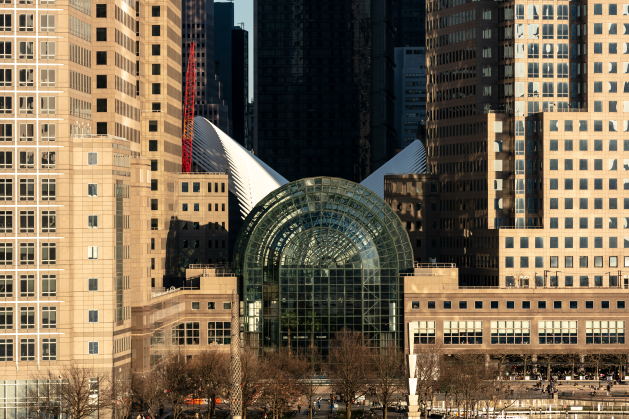
The really big-ticket items are transportation projects that will make Downtown easier and more pleasant to travel to and move around. A new Fulton Street Transit Center, with an expected completion in 2008, will untangle the maze of ramps and passageways that connect a dozen subway lines. Its dramatic glass- and-steel pavilion entry at the corner of Fulton Street and Broadway, designed by prominent British architect Nicholas Grimshaw, will let natural light filter down to below street level.
The Port Authority hired an even better-known international “starchitect,” Santiago Calatrava, to design a new PATH Terminal at the World Trade Center, also currently under construction. A pedestrian underground concourse will be built to connect the Fulton Street Transit Center to the PATH terminal and to the World Financial Center further west. A proposed rail link to JFK airport, requiring a new tunnel under the East River, would make travel much faster between Downtown and anywhere on Long Island. It is not a done deal, but already funding is in place for more than half its $6 billion cost.
Arts and Leisure
Public spending is also revving up the cultural life Downtown. This spring 63 Lower Manhattan arts organizations and projects received a total of $27 million in grants that are expected to spur private donations of many times that sum. The Flea Theater, an award-winning Off-Off-Broadway theater known for nurturing innovative playwrights, is hoping to upgrade its building and create more rehearsal space.
The Poets House, which offers lectures and readings, and houses the nation’s largest collection of poetry books and media open to the public, will be moving next year to a beautiful river-view home in Battery Park City, just a short walk from The New York Academy of Sciences (the Academy).
The River to River Festival presents over 500 performances downtown from June through September, including a diverse range of music that includes pioneering rappers, The Sugar Hill Gang, and the lush-sounding indie rockers, Belle & Sebastian. And music is just part of the happenings: On a Sunday afternoon, for instance, a family can see a tap dance demonstration and then take part in a marathon reading of Walt Whitman’s “Song of Myself” aboard a tall ship.
Downtown nature lovers can celebrate, too. Government money is improving and creating more than a dozen parks and open spaces. At the foot of Broadway, Bowling Green, the nation’s oldest park, has been relandscaped, creating an oasis of green. Kiosks serving sandwiches and salads will open this summer in Battery Park; patrons can sit at café tables set amidst 57,000 square feet of newly planted perennial gardens and enjoy the views of New York harbor.
Governors Island
Governors Island, that 172-acre gem located just 800 yards off the southern tip of Manhattan, is a magnificent wildcard in the future of Lower Manhattan. In 2003, the federal government transferred control of most of the island to the State and City of New York. The public entity created to decide the island’s future has sketched out varied possibilities for redevelopment, ranging from entertainment park to innovation center. This spring more than two dozen proposals for development flooded in to meet a May deadline.
Live, Work, Visit, Enjoy
Meanwhile, the boom in residential population in Lower Manhattan—more than doubling in the past 15 years to 36,000—is also a boon for workers and visitors. As is the case with Bin No. 220 on Front Street, many of the businesses that are opening to serve residents also make it a nicer place to visit.
Lower Manhattan is now the fastest growing residential neighborhood in New York City, and not only in the traditional residential area of Battery Park City. Wall Street has been synonymous with finance for hundreds of years, but many of the older office buildings there can’t accommodate the high-tech wiring needed for modern trading.
So every building on the south side of that famous row from Broad Street to Water Street has been or is being converted to condos or rentals. “At 6 p.m. I now see people coming out of the sub- way on Wall Street on their way home,” says real estate broker Vanessa Low Mendelson, who not only sells luxury condos downtown, but also lives there with her husband and 18-month-old baby.
The Sound of Hope and Renewal
Of course, all these changes can’t happen without disruption. There’s a huge amount of construction going on downtown, bringing with it noise, blocked streets and sidewalks, and weekend subway station closures. “What’s going on in Lower Manhattan is like having open heart surgery while running a marathon,” says Eric Deutsch, president of the neighborhood business group Downtown Alliance.
But many people find in the commotion the sound of hope and renewal. In a 2002 speech, Mayor Bloomberg outlined his vision of Lower Manhattan as a bustling global hub of culture and commerce, and a live-work-and-visit community for the world. “If you study New York history,” he said, “you realize that it is often at the moments when New York has faced its greatest challenges that we’ve had our biggest achievements.”
With an alumni association reads like a dream science team from Fantasy University, Stuyvesant High School proves itself as one of the best in the nation.
Published July 1, 2006
By David Cohn
Image courtesy of Emi Suzuki
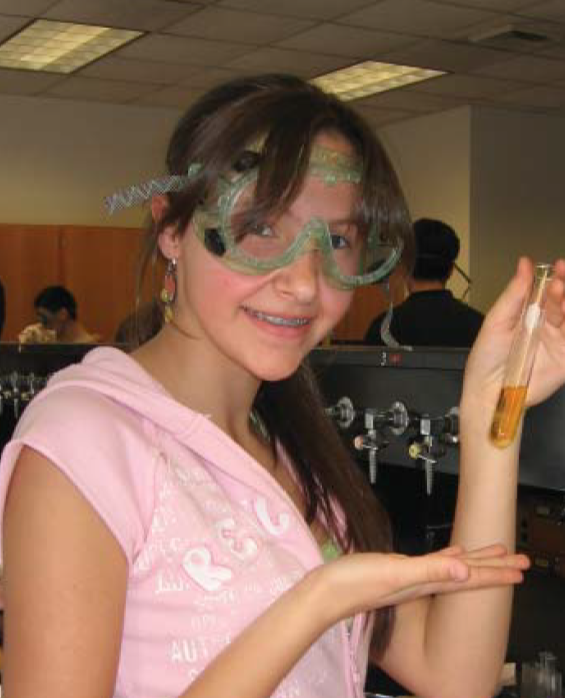
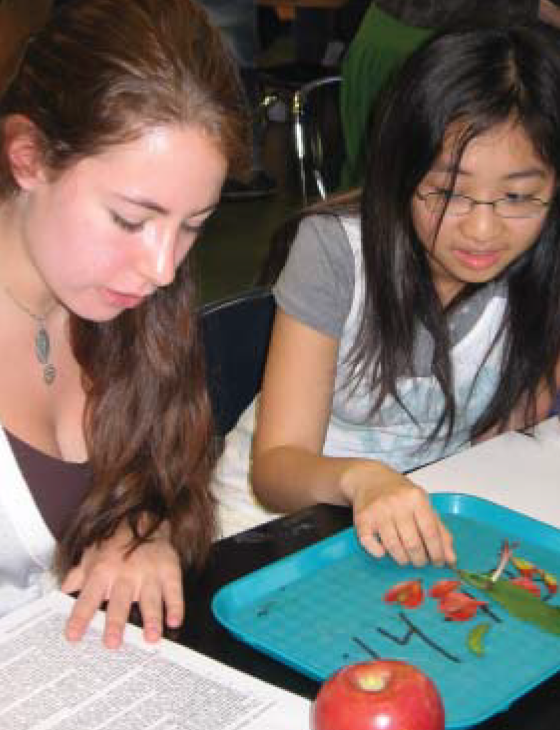
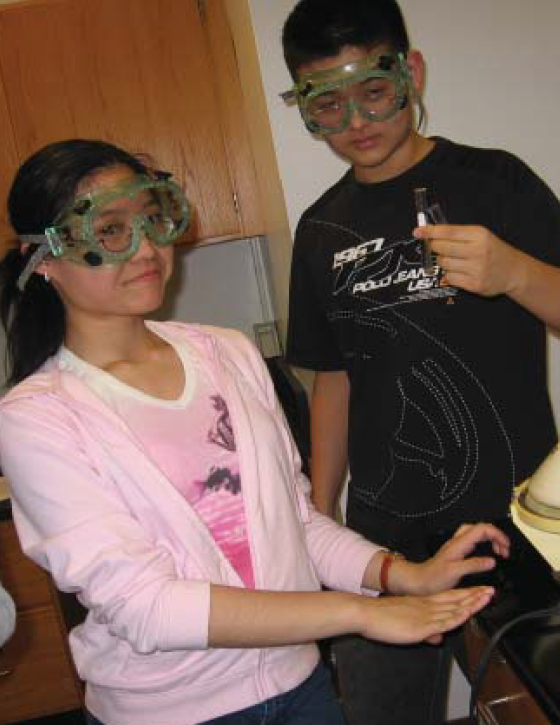
The principal’s office at Stuyvesant High School is lined with trophies of many shapes, but only one size: big. A few of the prizes are for sports, such as swimming, but most are for cerebral pursuits such as science, math, and chess. In one corner of the room looms a giant check from the Intel Science Talent Search, which awards $1000 to a school when its student is chosen as one of 300 semifinalists in the annual nationwide contest. Stuyvesant’s check for this year is made out for $8000, but that’s nothing unusual.
With a strong focus in math and science, Stuyvesant, located on the Hudson River at Chambers Street in Battery Park City, is recognized as one of the best public high schools in the country. The school has produced four Nobel laureates, and the membership of the 30,000-strong alumni association reads like a dream science team for a game of Fantasy University.
Members of The New York Academy of Sciences (the Academy) who are Stuyvesant grads are too numerous to list here, but they include Brian Greene of Columbia University, a leading authority on superstring theory; Eric Lander of MIT, the genomics pioneer; and physicist Nicholas Samios, director of the Brookhaven National Laboratory. Joshua Lederberg, who won the Nobel Prize for Medicine in 1958 for discovering the mechanisms of genetic recombination in bacteria, is a Stuyvesant grad, class of 1941. He recalls bright young students bouncing ideas off each other and “arguing the merits of going into science,” an atmosphere not too different from today’s.
The Top Achievers
Image courtesy of Emi Suzuki
Stuyvesant’s 800 incoming students represent the top achievers from the 25,000 children who take the Specialized High School Admissions Test, the SAT-like exam that determines who can attend one of New York’s special science and technology public high schools. “If I walked into the 9th grade assembly and said ‘Will everyone who was valedictorian and salutatorian last year in their junior high please stand up,’ about two-thirds would stand,” says principal Stanley Teitel.
Once accepted, students can choose from a varied curriculum that includes ten language choices, tough basic science classes, and advanced science courses in fields including oceanography, molecular biology, and psychology. Students leave Stuyvesant “prepared for the next level,” says Teitel, which is often a top-tier college or Ivy League university. In fact, Stuyvesant has limited the number of colleges to which students can apply to seven, to reduce overlap.
From All-Male to All-Star
The formerly all-male school became coed in 1969, and moved in 1992 from East 15th St. to its new campus in Lower Manhattan, a stone’s throw away from Rockefeller and other Battery Park City parks where students go to relax, eat, and take in majestic Hudson River views. The school’s remarkable labs, which specialize in everything from earth sciences to robotics engineering, “really capture the energy and enthusiasm of the school,” says Robert Sherwood, president of the Alumni Association, which donates most of the money to fund the facilities.
Image courtesy of Emi Suzuki
The location, only a few blocks from most major subway lines, makes it convenient for students who come from all five boroughs. The location also opens young minds. “Coming from Queens, I didn’t have much interaction with Manhattan,” says Emi Suzuki, president of ARISTA, a national honors society and Stuyvesant’s largest club. “So when I started at Stuyvesant, commuting really exposed me to all kinds of different people.”
Suzuki, like many of her classmates, has already had time in a professional lab. With the help of an internship advisor, she was able to spend last summer at the Memorial Sloan-Kettering Cancer Center under the mentorship of Dr. Harold Varmus, 1989 recipient of the Nobel Prize. Suzuki cultured cells, and produced and purified immunoadhesion-marker proteins. Others in her class interned at prestigious laboratories at Columbia, NYU, or Cornell.
“Stuyvesant absolutely does not give us internships on a silver platter,” Suzuki says, “but I do think that our school’s reputation helps.”
In his first completed project in New York, the Spanish-born architect Santiago Calatrava designed a time capsule meant to be opened in the year 3000. Calatrava’s bulbous, polished metal box, which stands outside the American Museum of Natural History, was clearly inspired by nature. But it would take experts from several departments of the museum to pin down all the referents. Some observers see a seashell; others, a flower or a seedpod; still others, an elaborate crystal. Animal, vegetable, or mineral?
In a world where most buildings are simply containers, their forms influenced only by other buildings, Calatrava’s blatantly biomorphic structures have made him, at 54, the most accessible of the current generation of superstar architects.
Most of Calatrava’s structures— bridges, airports, train stations, and museums—are in Europe, but as many as three more could arrive on the Lower Manhattan skyline by the end of the decade. The largest (and the one most certain to be built) is the $2.2 billion PATH terminal at Ground Zero, scheduled to open in 2009.
Hands in Prayer? Or Birds in Flight?
The terminal, just east of where the Twin Towers stood, will be topped by a pair of curved canopies of glass and steel that reach high into the sky as decoration. A hydraulic system will allow the canopies to rise, creating an opening about 35 feet wide at its center, bathing the huge concourse in sunlight.
Some visitors will see the canopies as hands interlocked in prayer; others will see birds in flight (to heighten the allusion, Calatrava released a dove into the air when he unveiled his design). Or perhaps it isn’t the bird but the birdcage, opening to the sky in a symbol of freedom. The building has been particularly welcome news at Ground Zero, where architectural squabbles—some growing out of forced collaborations— continue to make headlines.
Calatrava collaborates with no one, and it’s just as well, since he has too many ideas already. Born in Valencia, he speaks nearly a dozen languages and sometimes uses all of them—citing the works of philosophers, composers, poets, and painters—in a single sentence. He has no compunction about mixing metaphors in his buildings; how else can he hope to get a fraction of his ideas built in just one short lifetime?
Thirty years ago, after receiving an undergraduate degree in architecture, Calatrava moved to Switzerland to study engineering. He quickly developed a style all his own. His student work resembled the streamlined forms of one of his idols, Robert Maillart, an early 20th-century designer of bridges in the Swiss cantons. Maillart’s goal was to remove excess material, which resulted in concrete bridges so thin, they appeared to be stretched almost to breaking.
Bridging Twist and Turn for Decorative Effect
But unlike Maillart’s strictly economical structures, Calatrava’s bridges twist and turn for decorative effect. Not surprisingly, the great Catalan architect, Antonio Gaudi, who rarely used right angles and whose buildings ornament Barcelona, is another one of Calatrava’s idols.
Since the advent of modernism, architects have almost universally tried to explain form as the direct result of function, as if anything less rational were suspect. But Calatrava has joyfully shaken off that stricture. His design for a music school in Switzerland uses five exposed steel cables. Calatrava has said “I chose five, even knowing that I could have used only two, because music is read over five lines.”
More recently, he designed an opera house for Tenerife, in the Canary Islands, with a vast curved wing that resembles a crescent moon, a wave, an orchid, or about half a dozen other forms from nature. Asked about the origins of the wing, which significantly increased the cost of the building, Calatrava didn’t pretend that it served any practical purpose—except the purpose to inspire.
Lately, the architect has been creating buildings that don’t just look ready to move; they do move. Shortlisted to redesign the Reichstag in Berlin, Calatrava proposed a glass dome that would open when the Bundestag was in session, symbolizing openness in government. That design was never built. But in 2001 his ideas took flight in an entry pavilion at the Milwaukee Art Museum. There, a roof that resembles a bird’s wings opens to the sky in good weather. Getting the wings built was tricky—after long delays and huge cost overruns, Calatrava had the pieces assembled in Spain and flown across the Atlantic in a giant Soviet transport plane. Even then, there were minor problems with the mechanism.
A Secular Version of Gothic Cathedrals
In the end, Milwaukee garnered an important civic symbol—and even skeptics find the building’s now-reliable daily displays irresistible. The expense is of little concern to Calatrava’s fans, who see his buildings as the modern, secular version of Gothic cathedrals: uplifting symbols of humankind’s highest aspirations.
Private developers in the U.S. are just beginning to see whether Calatrava’s panache can produce profits. If completed in Chicago, his Fordham Spire, a mixed-use tower that twists a few degrees with every floor, would be the tallest building in the United States. For South Street in Lower Manhattan, Calatrava has designed a tower of 45-foot cubes hanging from cables—a plan the architect worked out with blocks of wood and marble.
Each cube would contain a single “apartment” priced at $30 million or more. He has also designed a gondola that could bring visitors from Manhattan to Governors Island—a pro bono project that he accepted at the request of city and state officials hoping to spark interest in the island’s redevelopment.
There’s only one problem with a Calatrava gondola: There had better be a very special building at the other end, or the trip will be an anticlimax.
According to Leonard Susskind, the universe we know might be just one crude but carefully balanced case among a host of different universes, each with its own physical laws.
Published June 9, 2006
By Sheri Fink, MD, PhD
Sponsored by: The New York Academy of Sciences and Little, Brown & Co.
Stanford University professor Leonard Susskind has had an illustrious career in theoretical physics. He is known as a “father of string theory”—the idea that everything, at its most minute scale, is made of combinations of vibrating strings. String theory began as a search for a unified theory capable of reconciling quantum field theory with general relativity, but has expanded in recent years and has caused a major shift in theoretical and experimental physics.
In his recent popular science book, The Cosmic Landscape: String Theory and the Illusion of Intelligent Design, Susskind addresses some startling recent developments in string theory, and on April 10, 2006 he took the podium as a part of the Academy’s Readers & Writers series to discuss why these ideas are making such waves in the physics community.
Susskind’s book deals with the meeting of two controversial ideas. One is the anthropic principle, which suggests that our corner of the universe is perfectly tailored to our existence—otherwise we would not be here to observe it. The other is string theory’s prediction of the “multiverse,” a giant, diverse universe with a rich landscape of “pocket universes,” each governed by its own laws of physics. The expansive possibilities of the multiverse provide a plausible explanation for the unlikely perfection of our own, relatively small, universe.
The Not-So-Elegant Universe
The array of elementary particles that determine the properties of atoms has grown in recent years. Electrons, photons, quarks, gluons, Z bosons, and neutrinos are just a few of the many elementary particles thought to exist. “It’s a rather large list,” said Susskind. “It’s hardly the kind of list that a minimalist would have invented.”
There is no particular reason known for the existence of these particles. Some of them, however, are requisites for life. For example, atoms need to contain electrons, which are held in the nucleus by the force of photons jumping back and forth from the electron to the nucleus. The nucleus, in turn, is held together by gluons jumping back and forth between quarks.
“To me the whole thing does not look like the product of an elegant mathematical theory,” said Susskind. “It doesn’t look like beautiful numbers like e or pi or √2; instead, it looks like a Rube Goldberg machine! It looks like something that was designed by a rather poor engineer for some purpose. While it works, it’s hardly elegant.”
Aside from particles, the existence of certain forces has allowed life to evolve. Some seem finely tuned such that if the values were slightly bigger, life could not exist. Take gravity, for example—a force 42 orders of magnitude weaker than the electrical force. If it were even one order of magnitude stronger, “the universe would expand and recontract in a much shorter time than it would take for evolution,” said Susskind. “Instead of being filled with galaxies, the universe would be filled with black holes. Even if an earth did form, it would not last very long. It would just have been sucked right into a black hole.”
The Puzzle of the Cosmological Constant
The weakness of gravity, the existence of just the right motley set of particles to form the building blocks of life—are these facts enough to cause physicists to abandon their quest for mathematical elegance and shift to embrace the anthropic principle? No, said Susskind, there is still the possibility that they arose by chance. “But there is one fine-tuning of nature, one accident, one conspiracy we might call it, which is so extraordinary that nobody thinks it’s an accident.”
Even the greatest of scientists have been prone to second-guessing. Einstein was not immune. He posited the existence of the “cosmological constant”—the energy density of empty space, which, if positive, gives rise to a repulsive pressure that counteracts gravity. While he later abandoned the concept, it did not disappear completely. “This is a case of Pandora’s Box,” said Susskind—once the lid had been raised on the idea, scientists could never explain it away.
The cosmological constant is also known as vacuum energy. In quantum theory, the continuous agitation of a vacuum creates energy, leading to the outward pressure that the cosmological constant describes. However, when physicists combine the theory of elementary particles with the theory of gravity and use quantum field theory to calculate the cosmological constant, they derive a gigantic value; if it existed, such a large amount of energy would conflict with astronomical observations and would be disastrous. “It would be enough not only to shatter the earth, it would be enough to shatter every atom and molecule,” said Susskind. “Every nucleus, every quark would go flying apart.”
More Mystery Around the Cosmological Constant
Nothing in known physics explains why the cosmological constant is not the size that quantum field theory predicts it to be. Physicists at first surmised that other particles and constants contributing to the calculation of vacuum energy must cancel out the large value, leading to a cosmological constant that is exactly zero.
In 1987, physicist Steven Weinberg proposed another idea. Physicists believe that gravity forced the bland early universe to differentiate into planets and galaxies by squeezing and contracting slightly denser regions of matter and sucking mass out of less dense regions. Weinberg showed that the cosmological constant must be extremely small—on the order of 10−120 units (joules/cm3)—to prevent a repulsive force from counteracting this process.
“A cosmological constant even ten times bigger than this would have been destructive and deadly to life,” says Susskind. “It would have prevented the creation of the home of life—stars, galaxies, and especially planets.” Using the anthropic principle, Weinberg made a prediction. While life depends on the cosmological constant being smaller than 10−120 units, the value does not need to be very much smaller than that. So, he predicted, if the value of the cosmological constant is determined by the existence of life, then its 121st digit will be a number other than zero.
Several years ago, the 121st decimal place of the cosmological constant was measured through cosmological observation; its value appears to be 2 instead of 0. To Weinberg and to Susskind, this confirmation of the earlier prediction is the best support for the anthropic contention that “some features of our own existence determine certain things about the laws of nature.”
Explaining the Appearance of Design
What else, besides an intelligent designer, could have tailored the universe to fit the needs of planets and people, including unlikely features that defy current mathematical prediction? Susskind’s answer lies in string theory—a mathematical model of nature to which many, if not most, physicists now subscribe.
String theory makes sense in 10 dimensions of space, not our usual three. The extra six-dimensional spaces are known as Calabi Yau or CY spaces. “These spaces control all the properties of the world in a large scale,” said Susskind.
“The (elementary) particles have to be able to fit into these spaces. If they fit, then they’re allowable particles. If they don’t, they’re not allowable. All the laws of nature and string theory are controlled by these features of these CY spaces.” There are about a million different CY spaces, or “manifolds.” Each one can be decorated with “little lines of flux that can wind around them in many, many ways,” said Susskind. “When you start counting up all the possible ways the CY manifolds can be decorated with these fluxes, the numbers are humongous.”
Thus, string theory allows for a landscape of possible universes “so rich that it appears there may be as many as 10500 different environments that can be described.” The number of possibilities is so large that it can compensate for the incredible unlikelihood of the cosmological constant being so exceptionally small.
Do these alternate universes actually exist outside of the realm of possibility, or is the universe everywhere the same as it is here, in all the places we can measure it? Nobody knows the answer yet. What is known is that the universe is far wider than the 10 billion light years across that it was once assumed to be.
Inflationary Cosmology
The school of inflationary cosmology holds that the universe is expanding at an increasing rate. An exponential and perpetual expansion would be possible if, as the universe expanded, new bits of space formed to fill interstitial spaces. The theory of eternal inflation suggests that as the universe grows, bubbles of alternate types of space appear.
“If a bubble is too small, it will melt back into the environment,” said Susskind. “If it happens to grow a little bit, it will then start to really expand.” Within that expanding bubble, more bubbles will form. “It creates this enormous diversity of different properties and in some tiny, tiny fraction of it, perhaps a comfortable little green neighborhood appears where life can exist. That’s where we are.”
Because physics has long posited a world controlled by elegant mathematics, the anthropic principle and the multiverse represent a fundamental shift in the way that many physicists and cosmologists view their fields. In fact, Susskind’s theories have drawn the ire of some prominent scientists. Stanford professor Burton Richter, winner of the 1976 Nobel Prize in Physics, has accused Susskind of having “given up” on the effort to find a theory that explains all the properties of fundamental particles and forces, bringing to an end the “reductionist voyage that has taken physics so far.”
Creationism
Religious figures, on the other hand, abhor Susskind’s views because they contradict the idea that God created the universe. The Roman Catholic cardinal archbishop of Vienna, Cardinal Christof Schonborn, wrote in The New York Times that the multiverse hypothesis was “invented to avoid the overwhelming evidence for purpose and design found in modern science.”
Susskind, for his part, seems to relish the controversy. “Paradigm shifts, serious ones, raise people’s anger, raise people’s passion. They are threatening,” he said. “The anger, the passion, the fighting spirit that goes with these questions is extremely intense.” The fact that Susskind’s ideas have aroused such emotion reflects the great attention that is being paid to this new way of looking at the universe.
About the Speaker
Leonard Susskind, PhD, grew up in the South Bronx, where he worked as a plumber and steam fitter during his early adult years. As an engineering student at the City College of New York, he discovered that physics was more to his liking than either plumbing or engineering. He later earned a PhD in theoretical physics at Cornell University.
Susskind has been a professor of physics at the Belfer Graduate School in New York City and at the Tel Aviv University in Israel. He has also been the Felix Bloch Professor in theoretical physics at Stanford University since 1978. During the past forty years he has made contributions to every area of theoretical physics, including quantum optics, elementary-particle physics, condensed-matter physics, cosmology, and gravitation.
In 1969 Susskind and Yoichiro Nambu independently discovered string theory. Later on, Susskind developed the theory of quark confinement (why quarks are stuck inside the nucleus and can never escape), the theory of baryogenesis (why the universe is full of matter but no antimatter), the Principle of Black Hole Complementarity, the Holographic Principle, and numerous other concepts of modern physics. He is a member of the National Academy of Sciences and the American Academy of Arts and Sciences.
Sheri Fink is the author of War Hospital: A True Story of Surgery and Survival (PublicAffairs, 2003). Fink obtained her MD and PhD in neurosciences at Stanford University and now, based in New York, writes about medicine, public health, and science for a range of publications.
Author and former scientist Ellen Daniell discussed how participating in a small problem-solving group can lead to success in academic and other careers.
Published May 25, 2006
By Leslie Knowlton
Sponsored by: The New York Academy of Sciences and Yale University Press.
Almost 30 years ago, Ellen Daniell, then an assistant professor of molecular biology at the University of California, Berkeley and the first woman in her department, joined a small bimonthly group of faculty, staff, and postdocs formed to reduce isolation and foster solutions to professional and other problems, including gender equity issues.
Today she credits the seven-member “Group” of high-achieving women, several of whom are well-known scientists, for seeing her through several difficult transitions, including being denied tenure at Berkeley, establishing herself in another career in business, and retiring from that to be a writer and enjoy her own interests.
In her book, Every Other Thursday: Stories and Strategies from Successful Women Scientists, Daniell tells the story of her experience with Group in an effort to help others form similar alliances. In her March 14, 2006, talk at The New York Academy of Sciences (the Academy), she explained the effect of Group on her life, saying, “I strongly believe I have made more satisfactory decisions and choices because I’ve talked out the possibilities, as well as the frequently apparent impossibilities, with Group.”
She also recommends this kind of organization to others not only in academia but also in a variety of professions, activities, and stages of life.
Common Concerns
Reading from her book’s preface, Daniell gave representative perceptions expressed by Group members, ingrained ideas and feelings that inhibit many women in many professions from achieving their full potential. They include
Maybe having a fulfilling personal life is incompatible with a successful career.
I feel like I’m an emotional cafeteria responding to what others want.
I feel responsible for everything but have no power to change anything.
Women also have trouble with recognizing personal achievements and taking credit for them. “It starts with forgiving mistakes … and moves from self-acceptance to self-appreciation and then to celebrating accomplishments.” This process requires developing a sense of entitlement. Group jokes that sometimes you have to say, “Maybe I AM the Queen of Sheba.”
After they learn to give themselves credit, it is important for women to take credit publicly when credit is due to them. This is important because in most pursuits, advancement and job satisfaction are affected by the image one presents to others. “We’ve worked long and hard on this while in the phase of careers when struggling to succeed and be recognized, and then found another puzzle—that of how to act as successful as we really are, without being dismissive of others.”
Another problem seen frequently in Group has been being able to make choices with a belief in the right to make them. “Change is stressful, no matter how desirable it is, and many support groups function primarily to help members through times of change and turmoil,” Daniell said. Some efforts are of the “egging-on” variety, giving encouragement to get on with a choice that’s already made. But most of the focus is on helping each other recognize when there are choices that can be made and figuring out how to make them.
How Group Works
Meetings are held evenings at homes of Group members, with the host of each session acting as facilitator. Group keeps a fixed bimonthly schedule, regardless of who can attend a particular session, and follows a set framework to ensure that everyone has an opportunity to speak, work, and listen.
First, the facilitator asks who wants to work on particular issues and how much time each person needs. The facilitator keeps track of the time requested and when that time is up, she asks if the person working wants more time. “Thinking about what you want to discuss and how long you think it might take both to describe the issue and to get feedback that you want is pretty good practice for assessing and asking for what you want outside of Group,” said Daniell.
While members, after becoming very good friends, now discuss personal issues, such as retirement, health, grandchildren, and aging parents, professional concerns still predominate. Members listen very closely, saying nothing until the speaker requests feedback, at which time other members give an honest appraisal of both the issue presented and solutions to it. “We try very hard not to make nice and not to say what it is that we think the person working wants to hear,” Daniell explained.
Eliminating Negative Self Perceptions
To help identify problems, Group raises “pig alerts” in response to certain kinds of statements. A pig is a “negative self-perception, an external judgment that you lay upon yourself and then use to defeat practically anything that you’re trying to accomplish.” They are frequently identified by the words always or never or by personal characteristics, such as being lazy or disorganized. Members attempt to replace pigs with a positive view.
For example, instead of saying, “I have so many papers lined up to be written because I’m lazy or disorganized,” one might change one’s perception by saying, “There are papers lined up because I’ve gotten so many interesting research results from my hard work.” This allows the person with the pig to overcome the negative characterization and address the problem.
After identifying a problem, Group creates a strategy to solve it. Members often make a contract, which includes a concise formulation of objectives, either immediate or long-range, to solve a problem or reach a goal. The contract should be “doable,” recognizing that it is often necessary to break large problems into the many small ones of which they are composed. A benefit of contracts is that often an apparently new issue may relate back to a previous contract. “By using this mode of thinking about something in terms of a contract,” Daniell advised, “you may find connections among various issues that at first didn’t seem connected.”
After work is done, members have refreshments and give each other strokes, positive statements about someone else. Stroke etiquette requires that in receiving a stroke one try to absorb and believe it, or just say you believe it. “It’s easier to give strokes than to get them at first, but once you get into it, they are really quite delicious.”
The Membership
Daniell noted that her book was written with the review and approval of all members, including Christine Guthrie, Carol Gross, Judith Klinman, Mimi Koehl, Suzanne McKee, and Helen Wittmer, each of whom let her struggles and fears be presented to motivate and help others. Women frequently cite isolation and marginalization as reasons that they avoid or get out of science and engineering at major research institutions, she said. They are also underrepresented relative to men in top faculty positions. Daniell sees her book as a way to help those women realize their potential.
Concluding her talk, Daniell said Group helps “alleviate the sense that you’re swimming with sharks and does so in an atmosphere of complete confidentiality—a place where everybody is truly on your side.” Along with practical support comes compassion and humor. In her experience with Group, pig images have become humorous symbols of struggles. All members have collections of ceramic, wood, and glass pigs displayed in their homes, along with pig bookends, plush stuffed pigs, pig earrings, and pig socks. “In contrast to the mental pigs that threaten our well-being, these little tangible pigs are a benign species that remind us to treat ourselves with compassion.”
About the Speaker
Ellen Daniell is a writer and consultant. She graduated from Swarthmore College in 1969 with high honors in chemistry and received her PhD, also in chemistry, from the University of California, San Diego. She was assistant professor of molecular biology at the University of California, Berkeley, and has held management positions in human resources and patent licensing in the biotechnology industry.
Memory allows us to do more than just store telephone numbers and directions to the post office. It is a repository for lost worlds, which we can recreate years later. The Nobel Prize-winning neuroscientist Eric Kandel did just that during his lecture at The New York Academy of Sciences on March 2, 2006, as part of the Readers & Writers lecture series. Kandel, now 76, drew his audience back to his youth in Vienna in the 1930s. To convey the trauma of being a Jewish boy during the Nazi occupation of Austria, he recalled his ninth birthday.
“I’d gotten a number of toys, the most magical was a little shiny car I could control remotely,” Kandel said. But that joy turned to terror. It was 1938, the year the Nazis had invaded Austria. “Two days later, Nazi police officers came and told us we had to leave the house,” Kandel recalled. “They sent us to live with another family. When we came back, the apartment had been essentially emptied out. Everything was gone.”
Part Memoir, Part Intellectual History
Today Kandel understands a great deal about how he can manage to hold memories such as these. He escaped from Austria to the United States, where he trained as a neuroscientist. He went on to have a spectacular career probing the biological basis of the mind, winning the Nobel Prize in Physiology or Medicine in 2000. Kandel has woven together recollections of his life, his research, and the evolution of modern neuroscience into a memoir and intellectual history, In Search of Memory: The Emergence of a New Science of Mind.
Kandel attended Harvard, where he discovered psychoanalysis. He became convinced that it would allow him to understand both the rational and irrational sides of mankind. “This was the royal road to understanding the mind,” he said.
He entered medical school to be a psychoanalyst, but he had an unconventional idea about what his training should include. “I thought to be a psychoanalyst, it would be useful to know something about the brain,” he said. In the 1950s, most psychiatrists paid little heed to the actual structure and function of the brain. And neuroscience itself hardly existed as a unified discipline.
Eventually, Kandel ended up at the laboratory of Harry Grundfest at Columbia University. At first Kandel had the wild ambitions of someone who has not yet actually tried to study the brain. “I said, ‘I’d like to see if I can help localize where the ego, the superego, and the id are localized in the brain,'” Kandel recalled, laughing. “Grundfest looked at me like I was out of my mind. But rather than kicking me out, he said, ‘This is beyond the grasp of neuroscience today.'”
Cellular Psychoanalysis
Grundfest directed Kandel to more manageable experiments. In Grundfest’s lab he began recording the activity of neurons in crayfish. “In those days the output of the amplifier was hooked up to a loud speaker so you could hear each action potential. Boom, boom, boom!” Kandel said. “It was fantastic. Here I was listening to the signals coming from the brain of the crayfish. This was true psychoanalysis at the cellular level.”
In place of his dream of finding Freud in the brain, Kandel decided to chase a dream that was only a little less grand. He would find the biological basis of memory. In the mid-1950s, neuroscientists recognized two different kinds of memory: short-term and long-term. Damage to the brain could harm short-term memory without affecting long-term memory. One small region of the brain, known as the hippocampus, appeared to be one of the key regions for allowing us to remember.
Kandel set out to investigate the hippocampus, hoping to find something distinctive about its cells. But nothing earthshattering emerged. It was possible that what was important for memory was not individual neurons, but how they were arranged in a network and communicated with one another. The millions of neurons in the hippocampus would be too complex to analyze. So he needed to find a simpler system. “I thought, the way you solve a problem in biology is you solve its simplest representation.”
Aplysia‘s 20,000 Neurons
The ideal system turned out to be the marine snail Aplysia. It had only 20,000 neurons, as opposed to the 100 billion neurons in the human brain. And its neurons were big—the biggest of any animal, in fact. Kandel was able to study memories in Aplysia by training it. He would nudge the snail before applying a jolt, and it would learn to associate the two sensations. Kandel could then compare the biochemistry of the neurons before and after it had recorded memories of this uncomfortable experience.
Working with Aplysia, Kandel and his colleagues demonstrated that short-term memory formed through the strengthening of connections between neurons. They even identified some of the molecules that made that strengthening possible. For long-term memories, it was necessary to switch on genes in neurons in order to make new proteins, and to make new connections. Once Kandel began to feel confident that he had figured out Aplysia, he moved back to the hippocampus in mice, discovering that many of the same genes and proteins also played an important role in their memories—and, by extension, human memories.
Kandel was recognized for this pioneering work with a Nobel Prize in 2000, but the award hasn’t slowed him down. He is writing a flurry of books, including the newest edition of his doorstop-sized textbook on neuroscience. While studying mice in the 1990s, Kandel began to investigate the molecular changes that occur as the animals get old. Insights from these experiences led to the founding of Memory Pharmaceuticals. The company is now conducting clinical trials on drugs that may boost the cognitive skills of people suffering Alzheimer’s disease and age-related memory loss.
Rogue Proteins
Meanwhile, Kandel and his postdoctoral fellow, Kausik Si, have opened up an entirely new front in the search for memory: the possibility that it shares something in common with mad cow disease. Researchers have shown that mad cow disease is caused by rogue proteins that fold into abnormal shapes, known as prions. Once prions form, they acquire the ability to force other proteins to assume the same shape. Under some circumstances, this runaway shape-change can cause devastating diseases.
But prions may play a helpful role in organisms. Collaborating with Susan Lindquist at the Whitehead Institute for Biomedical Research, Kandel and Si have found that some of the molecules involved in forming long-term memories show signs of behaving like prions in yeast cells. Kandel and Si propose that memories may be stabilized by self-perpetuating proteins. Individual proteins in neurons may be short-lived, but prions might be able to pass on their functional state to other molecules for years.
It’s a hypothesis that demands more experiments, a prospect that delights Kandel. “This gives me unending pleasure,” said Kandel, “because I can’t think of anything else I’d rather do.”
About the Speaker
Eric Kandel, MD, is University Professor at Columbia University, Kavli Professor and director of the Kavli Institute for Brain Sciences, and senior investigator at the Howard Hughes Medical Institute. He received the Nobel Prize in Physiology or Medicine in 2000 and is a member of the President’s Council of the Academy. He is also the author of In Search of Memory: The Emergence of a New Science of Mind (W. W. Norton).
From the boilers that heat water in our homes to the engines in our vehicles that allow us to travel with ease, thermodynamics are an often-invisible part of our everyday lives.
The president of France, Sadi Carnot, was stabbed by an anarchist on June 24, 1894. The vein to his liver was severed, and he bled to death in the hospital. This touches our story in two ways:
First, the darkness of venous blood was one of the “tells” that led people to accept the idea of energy conservation, the first law of thermodynamics. Questions about how blood manages human body temperatures had helped people to see that our bodies achieve both work and heating from the chemical energy of food.
Second, President Carnot’s uncle, also Sadi Carnot, and his grandfather, Lazare Carnot, were key players in the struggle to understand the rules that govern heat and work. Their efforts led to what we call the second law of thermodynamics, the idea that no engine can ever be 100 percent efficient, and that all natural processes degrade energy. Yet neither senior Carnot accepted the first law of thermodynamics – the idea of energy conservation.
Black and Phlogiston
Many towns in France have a square, avenue, or street named Carnot but it is hard to tell which Carnot it honors: Lazare, best known as the “organizer of victory” during the revolutionary wars of the 1790s; his son, Sadi, who died at 36 having published just one work, yet whose name is inextricably linked to the origins of thermodynamics; or Sadi’s nephew who presided over the French Republic from 1887 until his assassination.
The story of the thermodynamical Carnots best begins about the time of Lazare Carnot’s birth, in 1753. Heat was then regarded as the “subtle fluid” phlogiston – the “substance” released during combustion. The young Scottish chemist Joseph Black was still thinking of heat as wedded to chemical change, but was asking just how much phlogiston it took to increase a material’s temperature one degree.
The Kindred Concept of Latent Heat
Black recognized that the amount must vary from material to material. By this time, both Fahrenheit and Celsius had provided excellent means for measuring the intensity of heat – its temperature. But should one not also have means for measuring its extent – its quantity? Black realized that he could heat a mass of water by transferring energy to it from another material. Since the heat leaving one mass is the same as that entering another, he could determine the heat capacity of any material by heating or cooling a known amount of water.
He also took an interest in the kindred concept of latent heat. At the transition points where a liquid boils or condenses (or a solid melts or freezes) it does so with no change in temperature. To measure the latent heat transferred in, say, melting, Black surrounded a known mass of ice with a known mass of hot water; then he measured how much the water temperature fell as the ice melted away.
These experiments led naturally to the British thermal unit or Btu (the energy needed to raise the temperature of a pound of cold water one degree Fahrenheit).
The Rise of Caloric
Black at first thought he was manipulating chemical changes in matter, but he began to see that heat was not some component of matter, as phlogiston was imagined to be. Rather, it flowed in and out of matter. Phlogiston was about to be displaced by the new term caloric. Caloric gained its full definition in 1779 when Black’s student, William Cleghorn, set down rules for its behavior. Cleghorn’s rules helped to make a useful tool of caloric, but they also helped expose its eventual failings.
Cleghorn determined that caloric had to be a subtle invisible fluid. He explained thermal expansion by imagining caloric to be elastic, with particles that repelled each other. Cool bodies attracted caloric to different extents. That explained heat conduction and specific heats. Caloric had to take a latent form as water boiled at 212° F. It was “sensible” when it raised a material’s temperature. Caloric had to have weight because metals gained weight when they were heated.
Today we know that bodies expand as they are heated because their molecules repel one another. We recognize the gain in weight in metals as a chemical change, oxidation.
Not the Whole Story
Black knew Cleghorn’s rules were not the whole story, but he allowed that they correctly explained the experiments of Benjamin Franklin and others. He cautiously called the caloric theory, “the most probable of any that I know.” Antoine Lavoisier, the French chemist, also liked the idea and coined the term calorique.
So the caloric theory remained for about seventy years. Not until atoms were far better understood would we realize that heat merely reflected atomic motion. However, in everyday life, we still speak of heat flow, or of bodies holding their heat, as if heat were behaving like a caloric fluid.
In our bones (or more accurately, in our muscles) we have always known that we can create heat by doing work. But how could frictional heating be reconciled with heat as a fluid? Caloric theorists tried to resolve that with increasingly tenuous arguments about how friction or deformation “released” caloric. They looked at frictional heating and saw, not a contradiction, but a phenomenon to be explained in terms of caloric. All the while, it was perfectly clear to everyone that the amount of caloric they could create was limited only by their own stamina.
A New Science of Thermodynamics
So the stage was set for the last act in the drama of writing a new science of thermodynamics. What had to be digested was the fact that thermal energy and mechanical work can be traded back and forth (the essence of the first law of thermodynamics).
Which takes the story back to venous blood. Natural philosophers were beginning to suspect that chemical reactions turned blood from red to dark. But estimates of the extent of chemical heating were too low to account fully for the heat.
Eighteenth-century physiologists had attributed blood heat to friction despite the caloric theory, and they continued to think that friction accounted for blood heat, well into the 19th century. Not until 1843, did French chemist Pierre Dulong have accurate enough data to show that chemical heating accounted for virtually all of blood heat. In an ironic twist, Dulong effectively bolstered the lingering caloric theory when he removed frictional heating from physiology.
Everyone who has ever studied the history of heat has struggled with the obviousness of mechanical friction. Yet even the idea that blood is heated by friction had failed to animate an anti-caloric movement. The recognition of friction as an instance of the convertibility of heat and work replaced caloric as a competing theory only in the 19th century, after cannon-boring experiments made in Bavaria by American expatriate Benjamin Thompson/Count Rumford. Thompson had become Count Rumford in Bavaria after a rapid and convoluted series of moves that began when he had to flee colonials who learned he was spying for the British.
Count Rumford’s Canon
As a result of tests in which he generated unlimited caloric by boring cannon with blunt bits under water, Rumford was able to state quite plainly, Anything which an insulated body, or system of bodies, can continue to furnish without limitation cannot possibly be a material substance; and it appears to me to be extremely difficult, if not quite impossible, to form any distinct idea of any thing, capable of being excited and communicated in the manner the Heat was excited and communicated in these experiments, except it be MOTION.
Rumford continued his advocacy of a mechanical theory of heat after he left Bavaria and returned to England and France. At that point he took up a four-year relationship with Lavoisier’s widow, Marie, which ended in a short and disastrous marriage. It’s quite possible that the scientifically savvy Marie Lavoisier egged him on in his attack on caloric. In any case, before the marriage Rumford crowed: “I think I shall live to drive caloric off the stage as the late M. Lavoisier drove away Phlogiston. What a singular destiny for the wife of two Philosophers!!”
With that kind of rhetoric, we can hardly be surprised that the marriage failed. Rumford did indeed help drive caloric “off the stage” by setting a foundation for the first law of thermodynamics. But that would not happen yet.
An anti-caloric faction failed to arise, even after Rumford, for this is where Lazare and Sadi Carnot enter the story.
Lazare Carnot, Revolutionary Leader
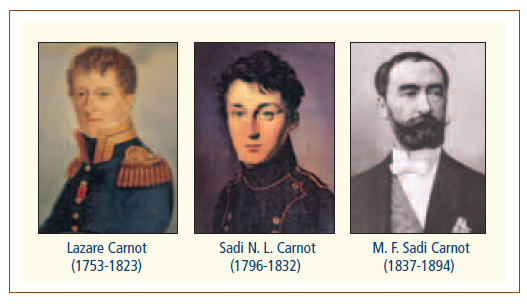
From left: Lazare Carnot (1753-1823), Sadi N. L. Carnot (1796-1832), and M. F. Sadi Carnot (1837-1894).
Lazare Carnot was a remarkable figure. He was born in 1753 – the same year as Benjamin Thompson – and was educated in mathematics and military engineering. During his military service, he competed for mathematics prizes, and also had political dealings with the infamous Robespierre. While he was on garrison duty in the 1780s, Lazare Carnot began an intense affair with an aristocrat’s daughter.
Unbeknownst to Carnot, her father arranged her marriage to another aristocrat. Carnot, furious, went to the fiancé and revealed the affair. That broke up the marriage plans, but the father had Carnot thrown in jail for conduct unbecoming an officer and gentleman. This was 1789. The first events of the French Revolution were just taking place, and they led to Carnot being retrieved from prison after only two months.
His life had been pretty static up to that point. Now it began moving very rapidly. He was soon married (to someone else) and was elected to the Assembly. His skills in administering military missions led to his selection in 1793 as one of the 12 men on the Committee of Public Safety and, in 1796, as a member of France’s five-man ruling group, The Directory. They reorganized the government and ran it until Napoleon took power. Carnot served longer than any revolutionary leader except Napoleon.
A Mathematician and Technocrat
Carnot also started the Little Corporal on his rapid ascent to power by appointing him head of the Army of Italy, and Carnot would rally to Napoleon as his Minister of Interior when he returned from Elba. However, after Napoleon’s fall, the returning monarchy remembered Carnot’s vote to behead Louis XVI and he spent the rest of his life exiled to Germany.
Lazare Carnot was first a mathematician, yet strongly interested in technology. Also, he advocated active defense in fortification design, including what became known as Carnot walls – the high, heavy, detached walls built in front of forts, with loopholes for the exchange of fire. He befriended the Montgolfier Brothers, and Robert Fulton, who showed up in France trying to sell submarine designs. Carnot was an excellent violinist, but he thought like a technocrat. He once remarked: If real mathematicians were to take up economics and apply experimental methods, a new science would be created – a science which would only need to be animated by the love of humanity in order to transform government.
From Waterwheel to Steam Engine
Lazare Carnot’s attention naturally turned to power production. Imagine a perfect waterwheel, he said, in which no energy is wasted or dissipated. Water is stationary before it enters and stationary at the exit. Then he reached a very important insight: all motions would be completely reversible. Run the perfect waterwheel backward, and it would become the perfect pump.
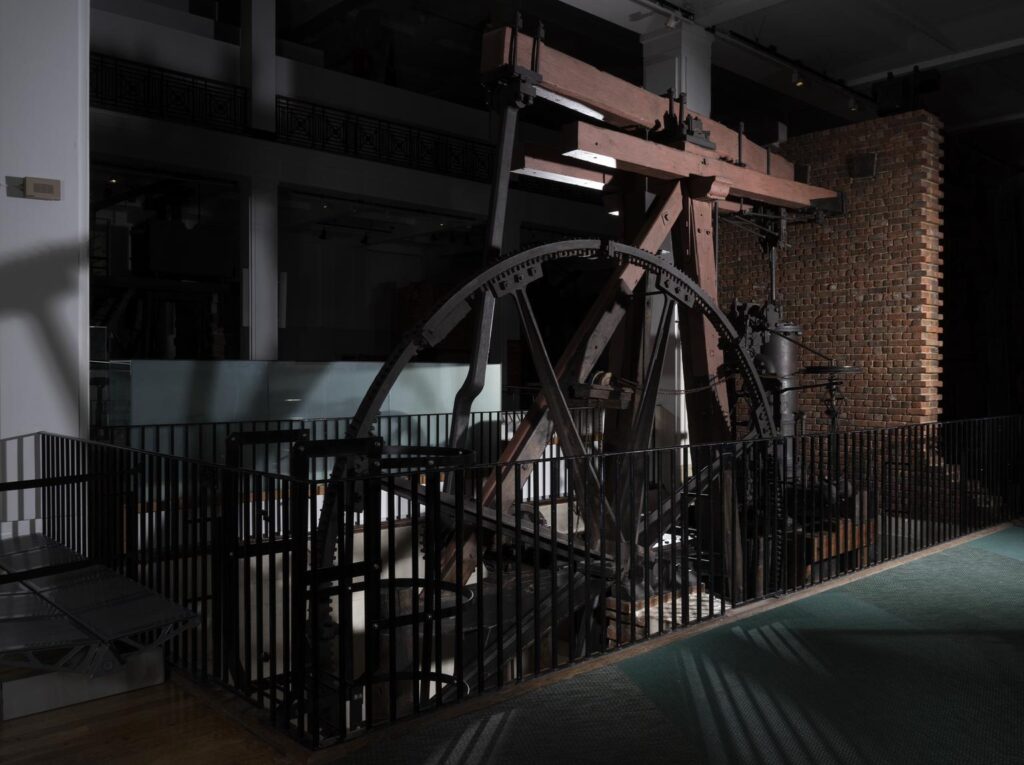
Here Lazare’s son, Sadi, claimed his inheritance. In 1824, one year after his father died, 28-year-old Sadi Carnot wrote his sole monograph, Reflections on the Motive Power of Heat. In it, he asks us to conceive a perfectly reversible steam engine. If we could build such a machine, we could run it in reverse and pump heat from a low-temperature condenser to a high-temperature boiler. When the first refrigerators appeared 36 years later, they were exactly the reversed heat engines that Sadi Carnot had described.
Sadi “operated” his perfect engine in a thought experiment. In his mental engine, he used an ideal gas instead of steam. When he assumed the not-yet-fully-accepted fact that no engine can possibly act as a perpetual motion machine, he was able to show that the work of one kilogram of air in such an engine depends only upon the temperatures at which the air is heated and cooled.
The Basis for Carnot’s Theorem
That was the basis for Carnot’s Theorem: The motive force of a perfectly reversible engine depends solely upon the high and the low operating temperatures. (Those would be the boiler and condenser temperatures in a steam engine.) This sole dependence on temperature was the first step toward the second law of thermodynamics.
Carnot’s theorem would be true whether the engine used steam, air, or any other fluid. His ideal engine mirrored his father’s perfect waterwheel – a waterwheel that depends solely upon how far water falls through it. Yet neither father nor son accepted the conversion of work into heat or vice versa. (I can find no evidence that Lazare Carnot and his contemporary, Count Rumford, ever communicated.)
Sadi Carnot assumed that caloric was conserved as it passed through an engine, just as water passing through a waterwheel is conserved. Today we know that only part of the heat flowing into a boiler turns into useful work. A good fraction of the heat passes into the condenser. But since Carnot had couched his work in terms of indestructible caloric, the validity of what he said about steam engine performance seemed to bolster the caloric theory.
Clausius and Entropy
This strange turn of affairs meant that the demise of caloric had to await a new generation. Rudolf Clausius, born in 1822, finally synthesized our science of thermodynamics from these seemingly contradictory parts. Clausius showed how Carnot’s theorem and the conservation of energy complemented one another. Energy conservation said that less heat left a steam engine than entered it – the difference being converted into useful work. While that contradicted Carnot, it left Carnot’s theorem intact.
Clausius saw that something was being conserved in Carnot’s perfectly reversible engine – but something other than heat. He called it entropy, and defined it as the heat flow from a body divided by its absolute temperature. Entropy changes in a perfectly reversible engine balance out. As heat flows from the boiler to the steam, the boiler’s entropy is reduced. As it flows into the condenser coolant, the coolant’s entropy increases by the same amount.
No heat flows as steam expands in the cylinder or as condensed water is compressed back to the boiler pressure. Therefore, the entropy of the water or steam changes only when heat flows to and from the condenser and the boiler. The net entropy change is zero in that perfectly reversible engine and its surroundings. Under Clausius’s definition of entropy he was able to show that everything Sadi Carnot had claimed was true – except the part about heat or caloric being conserved.
Carnot’s Single Error
Once he corrected Carnot’s single error, Clausius could conclude that the efficiency of a perfectly reversible heat engine did indeed depend upon nothing other than the temperatures of the boiler and the condenser, just as Carnot had said it must. Carnot’s belief in caloric denied him the specific use of the word efficiency, but his central deduction remained intact.
Sadi Carnot died of cholera in 1832 and the image of his fevered blood brings to mind the dark venous blood of his nephew, Lazare’s grandson, its life-giving energy spent. What bizarre convergences these three generations offer – contradiction and resolution, terrorist politics and idealism, maddening complexity and elegant simplicity – and a crucial path along the road to understanding how things work.
1. Brown, S. C. 1981. Benjamin Thompson, Count Rumford, MIT Press, Cambridge, MA.
2. Carnot, S. 1897. Réflexions sur la Puissance Motrice du Feu (Reflections on the Motive Power of Heat), R. H. Thurston, Ed. John Wiley, New York.
3. Gillespie, C. C. 1970-1979. The Dictionary of Scientific Biography, Charles Scribner’s Sons, New York.
4. Lienhard, J. H. June 2006. How Invention Begins: Echoes of Old Voices in the Rise of New Machines, Oxford University Press, Oxford, New York. Much of the material in this article, and all the resources used in its making, are in this book.
5. Lienhard, J. H. Engines of Our Ingenuity radio program Web site. www.uh.edu/engines. Short essays on many of the themes of this article can be found and heard here.
About the Author
John H. Lienhard is M. D. Anderson Professor Emeritus of Mechanical Engineering and of History at the University of Houston, and the author and voice of The Engines of Our Ingenuity, a radio program heard nationally on Public Radio. His latest book is the forthcoming, How Invention Begins: Echoes of Old Voices in the Rise of New Machines. (Oxford University Press)
For author Alan Lightman, reading landmark scientific papers provides a window into the lives and intellectual adventures of the men and women behind the 20th century’s most influential ideas.
The key experiment came to him in a dream. It was 1921 and Otto Loewi, a German pharmacologist, was looking for a way to determine how nerve cells communicate. Was the signal conveyed from one neuron to the next—or from a neuron to a muscle or organ—electrical? Or was it chemical?
The scientist awoke, jotted down his musings on a slip of paper, and went back to sleep. “It occurred to me at six o’clock in the morning that during the night I had written down something most important,” he later recalled, “but I was unable to decipher the scrawl.”
From Dream to Nobel Prize
Fortunately, the idea returned the following night. That time, Loewi must have written more legibly, because he was able to carry out his Nobel Prize-winning experiment that day. He dissected the hearts from two frogs and placed them, still beating, into separate dishes of saline solution. Loewi then stimulated the vagus nerve he’d left attached to the first heart. As expected, the heart slowed its beating.
Now here’s the elegant part. Loewi took some of the solution bathing the first heart and poured it over the second heart, from which he’d stripped the vagus nerve. This heart, too, slowed, proving that the message transmitted by the vagus nerve was chemical in nature. The compound, which Loewi called “Vagusstuff,” turned out to be acetylcholine, a neurotransmitter found widely throughout the nervous system.
For Loewi, the experience suggested that “we should sometimes trust a sudden intuition without too much skepticism.” And for Alan Lightman, physicist and author of The Discoveries: Great Breakthroughs in 20th Century Science, the story illustrates how scientists think, and reminds us that science is a process of exploration carried out by human beings.
Hearing the Scientist’s Voice
Over the years, Lightman has come to realize that scientists rarely read original research papers, perhaps because they view science as being all about the bottom line. “If science is an explanation of the way that the world behaves, then you don’t need to know how you got to that understanding,” says Lightman. “You just need to know the facts, ma’am. And that’s all that matters.”
That view, although valid, is limited, Lightman told an audience at The New York Academy of Sciences (the Academy) on January 31, 2006. “You can read a textbook on the theory of relativity and you can understand relativity,” he says. “But you don’t understand the mind of Einstein. You don’t hear his voice.”
To remedy that loss, Lightman assembled The Discoveries, a handpicked collection of 22 of the greatest ideas and experiments in 20th century science. Lightman asked his scientist pals—physicists, chemists, astronomers, biologists—for recommendations and then winnowed down the resulting list to the two dozen stories he presents in the book. For each discovery—from Werner Heisenberg’s enumeration of the uncertainty principle to Barbara McClintock’s revelation that genes can jump from one chromosome to another—Lightman provides a guided tour to the original paper along with an essay on the life and times of the scientists involved.
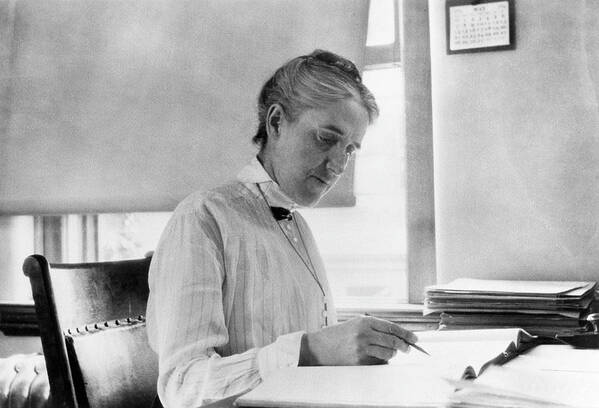
Among Lightman’s favorite tales is that of Henrietta Leavitt’s development of a method for measuring the distance to the stars. Leavitt was hired in the late 1800s by Edward Pickering, director of the Harvard College Observatory, to pore over photographic plates and calculate the positions and brightness of thousands of stars. As one of the cadre of women that formed Pickering’s low-paid battalion of human “computers,” Leavitt was expected to “work, not think,” says Lightman. “But some of the women disobeyed him, and Henrietta Leavitt was one of those.”
Through painstaking measurements, Leavitt uncovered a relationship between the periodicity and luminosity of the Cepheids, a group of stars that brighten and dim in predictable cycles that vary between three and 50 days. Leavitt found that the longer a star’s period, the greater its intrinsic luminosity, and that knowing how bright a star is allows one to calculate how far away from Earth it lies. Thus the Cepheids, which are scattered throughout the night sky, could serve as cosmic beacons by which astronomers could gauge distances in space.
Leavitt’s work laid the foundation for many of the astronomical discoveries that would follow, including Hubble’s determination that the universe is expanding. Yet the scientist remained uncelebrated in her lifetime. “Even today there are very few people who’ve heard of her,” notes Lightman. In 1925, a representative of the Swedish Academy of Sciences wrote to Leavitt to propose nominating her for a Nobel Prize. Unfortunately, Leavitt had been dead for three years by then, rendering her ineligible for the honor.
Passion and Obsession
The most satisfying stories, Lightman says, are the ones in which the researchers’ personalities drive the discovery. Take, for example, Arno Penzias and Robert Wilson’s detection of the cosmic background radiation—the persistent hum left over from the Big Bang. “Both men were incredibly meticulous experimentalists,” says Lightman. “If they hadn’t been so anal compulsive about the details then they wouldn’t have been so certain that this residual hiss in their antenna was something worth investigating.”
But, he adds, “they were so fastidious, so picky, and so careful” that they methodically chased after the source of the noise. And after they eliminated every possible thing they could think of, Penzias and Wilson concluded “this was something worth writing about,” says Lightman. Indeed, their almost comically understated paper, entitled “A measurement of excess antenna temperature at 4080 Mc/s,” formed the basis of their 1978 Nobel Prize.
In the end, Lightman himself discovered a thing or two in putting together the book. Although he did not uncover any particular scientific temperament—scientists’ personalities run the regular human gamut—Lightman did find that, regardless of the field in which they worked or how they came to their discoveries, all the scientists he profiled “were really passionate about what they do. All loved to solve puzzles. They all loved to challenge authority. All were independent thinkers. And all were really obsessed with science.”
And though all didn’t necessarily dream about their work, they did labor tirelessly to solve their favorite puzzles, leaving behind them tales that are certainly worth telling.
About the Speaker
Alan Lightman, PhD, is adjunct professor of humanities at the Massachusetts Institute of Technology. As a novelist, essayist, physicist, and lecturer, Lightman is committed to making science accessible and understandable to a wide audience. His writings cover a range of topics dealing with science and the humanities, particularly the relationship between science, art, and literature. Lightman’s short fiction, essays, and reviews have appeared in numerous popular magazines and publications, including Discover, Harper’s, Nature, and The New Yorker.
He is the author of four novels, including the international bestseller Einstein’s Dreams, which was runner-up for the 1994 PEN New England/Boston Globe Winship Award, has been translated into 30 languages, and is the basis for more than two dozen independent theatrical and musical productions. In addition to his novels, Lightman is the author of several science books, drawing on his research in the areas of gravitational theory, accretion disks, stellar dynamics, radiative processes, and relativistic plasmas.
Lightman holds a PhD in theoretical physics from the California Institute of Technology, and an Honorary Doctorate of Letters from Bowdoin College. He served a postdoctoral fellowship at Cornell University before becoming assistant professor of astronomy at Harvard University and research scientist at the Harvard-Smithsonian Center for Astrophysics. In 1989 Lightman joined the faculty of MIT, and in 1995 was appointed John E. Burchard Professor of Humanities, a position he resigned in 2001 to allow more time for his writing.
For his contributions to physics, Lightman was elected fellow of the American Physical Society and the American Association for the Advancement of Science, both in 1989. In 1996 he was elected fellow of the American Academy of Arts and Sciences, and that same year, was recipient of the American Institute of Physics Andrew Gemant Award for linking science to the humanities.