International Community of Students Tackles Pressing Challenges with Junior Academy
At the 2026 Virtual Junior Academy Student Symposia, the five winning teams presented their innovative solutions to real-world problems to an audience of peers, mentors, and international STEM leaders.
Published July 16, 2026
By Agata Regula
The New York Academy of Sciences’ Junior Academy celebrated the diverse and innovative solutions developed by students during the 2025–2026 academic year at its annual Virtual Student Symposium on June 25, 2026. Since transitioning to its current Launchpad platform in 2016, the Junior Academy has fostered scientific collaboration across cultures, borders, and time zones, empowering young scientists to design solutions to some of the world’s most pressing challenges. Through the five innovation challenges offered this past academic year, students ages 13–17 collaborated with international peers and received guidance from STEM professionals, cultivating the next generation of innovators, changemakers, and leaders.
A total of 2,625 students from 81 countries successfully completed an Innovation Challenge from the Fall 2025 and Spring 2026 cohorts. Across each virtual Innovation Challenge, 10 projects of distinction are selected for external judging. Two are recognized as finalists, and one is chosen as the winning solution based on multiple criteria, including innovation and design, scientific quality, and team collaboration.
STEM experts, leaders, and educators joined the June 25 symposium to celebrate the young scientists’ creative and innovative solutions. They shared remarks about their own STEM journeys, the importance of science communication, openness to diverse perspectives, and embracing lifelong learning, themes strongly reflected in the closing advice of June Zhang, PhD, when addressing the participants: “Stay curious, and have the courage to explore what you love, because science is not just about knowledge, it’s about how you use it to improve people’s lives.” All speakers included:
- Zamara Choudhary, Program Manager, Professional Learning Fellowships and Internships, The New York Academy of Sciences
- Mel Jackman, Vice President of Education, The New York Academy of Sciences
- Chris Symons, PhD, Strategic Partnerships and Communications, IF/THEN Initiative
- June Zhang, PhD, Scientific Affairs Lead, Gold Bond Co. Sanofi
Fall 2025: Sustainability by Design
The three Fall 2025 innovation challenges invited students to design solutions to minimize food waste, sustain marine biodiversity while supporting offshore wind farms, and to encourage transition from fossil fuels to solar power by improving panel infrastructure. All three challenges focused on designing sustainable solutions to minimize anthropogenic environmental impacts.
Innovation Challenge: Energy Infrastructure: Solar Power
Challenge Finalists:
- SunRise (Solar Energy) | India, Kazakhstan, United States
- Algency (Bioenergetics Solar Energy) | United States
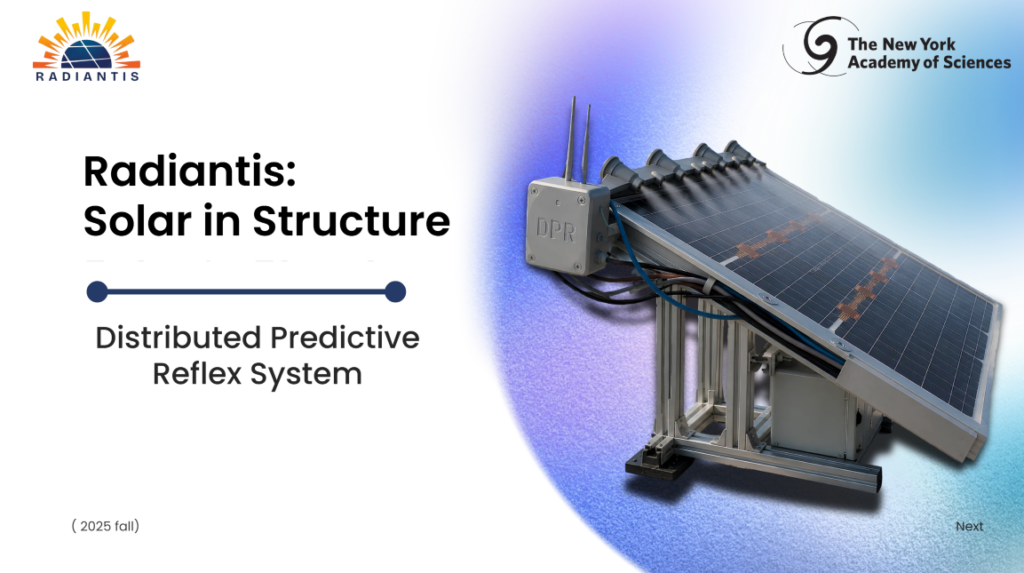
Winning Team: Radiantis: Solar in Structure
For the Energy Infrastructure: Solar Power challenge, a team of six students from Azerbaijan, China, Egypt, the United Kingdom, and Uzbekistan aimed to combat the near-immediate deterioration and reduction in productivity of solar panels, especially in arid regions, caused by dust buildup, a problem which causes $10 billion in annual losses. To solve this issue, the team designed an automated Distributed Predictive Reflex System, an air-based dust removal method which runs on a local network to minimize points of failure. This solution aims to optimize the lifespan and output of each solar panel unit and maximize recovered profit and energy, while minimizing resources needs to increase accessibility for regions with limited means. The team estimates a six-month payback period with 300 kWh of annually recovered energy per panel. Although the innovation challenge is over, team “Radiantis: Solar in Structure” plans to continue developing their prototype, with the aim of soon bringing it to market.
Innovation Challenge: Food Waste
Challenge Finalists:
- EcoCycle | Egypt, United States
- TRASHFORMERS (Converting Food Waste to Biofuel) | Algeria, United Arab Emirates, United States
Winning Team: Save2Serve
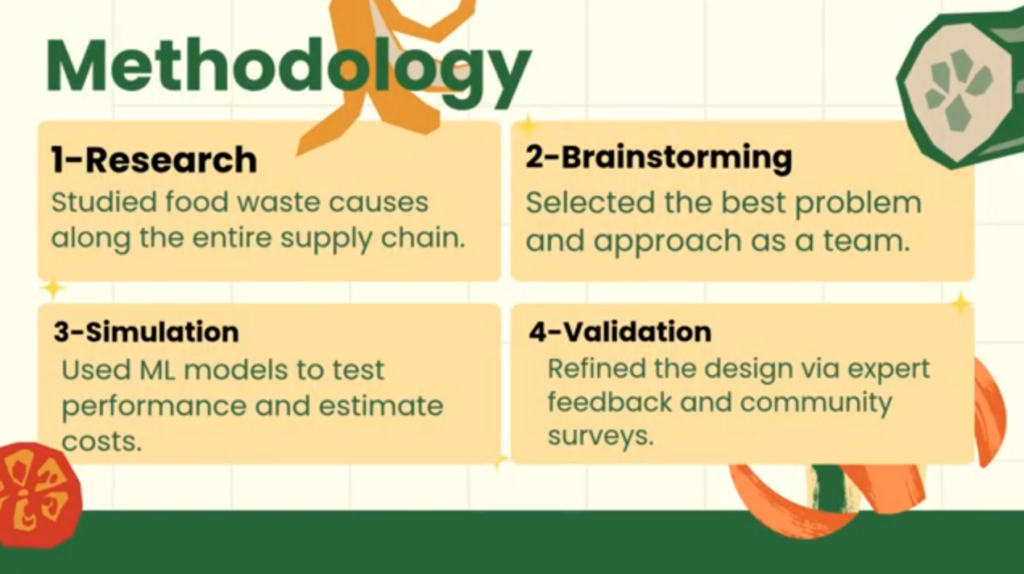
For the Food Waste challenge, a team of six students from Egypt, Tunisia, and the United States aimed to mitigate food waste in Sub-Saharan Africa, with a specific focus on Kenyan farming communities. In this region, almost 50% of produce is wasted, in large part due to lack of access to affordable temperature-controlled produce transport post-harvest. To help minimize food waste, team “Save2Serve” redesigned a refrigerated truck with a hybrid Phase Change Material (PCM)-DC compressor system with solar panels on the roof. To test their solution, the team aimed to use open-source data to train an artificial intelligence (AI) model. To their disappointment, they were unable to find publicly accessible data on food transport in Kenya, but they took initiative to create their own AI-generated dataset, which they used to accurately predict the possible benefits and downsides of their design. Next, they solicited community input on their design, and 93% of respondents expressed a willingness to adapt to the new mode of transport.
Innovation Challenge: Marine Biodiversity
Challenge Finalists:
- GreenCrete (NYC Marine Biodiversity) | United States
- EcoMariners | United States
Winning Team: BioTurbine Collective
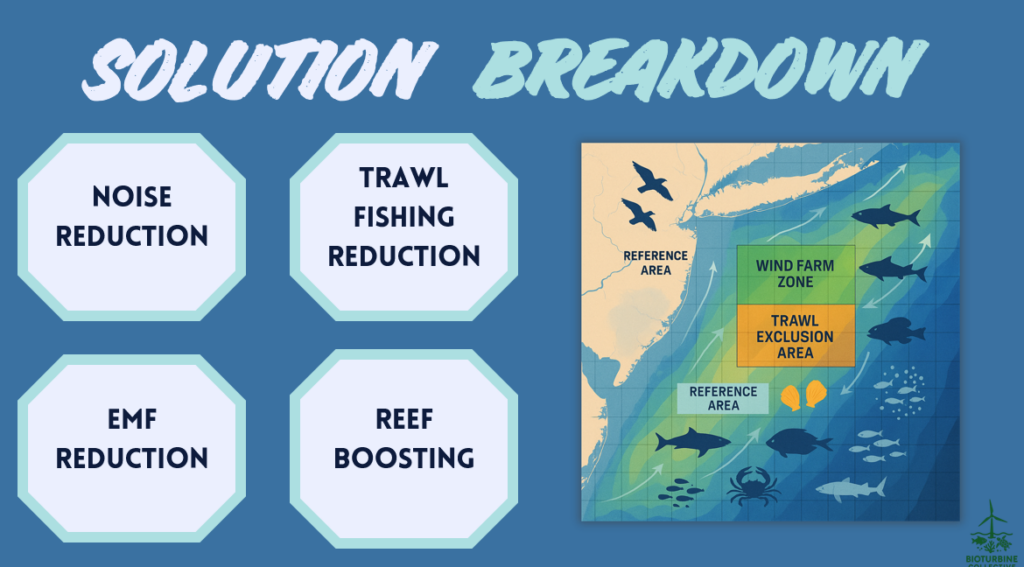
For the Marine Biodiversity challenge, a team of six students from New York City set out to address the impact of offshore wind power infrastructure on marine ecosystems using innovative design elements. Although wind farm construction is the most disruptive to marine ecosystems, the noise and rotating turbines can continue to harm biodiversity as the wind farm operates. To minimize the impact of continued renewable energy infrastructure construction, team “BioTurbine Collective” designed a marine life sustaining wind farm, utilizing eco-friendly construction materials and natural elements like kelp forests and shellfish reefs to create healthy and safe homes for marine life around wind farms. Using an environment simulation model, the team found that implementing their designs would lead to large increases in populations of reef fish and bivalves around wind farms. The problem was personal for each of the students—as New York increases offshore wind farm construction to achieve its goal of a zero-emissions electrical system by 2040; these solutions are critical to mitigate harm to marine biodiversity.
Spring 2026: Human-Centered Solutions
Innovation Challenge: Mental Well-Being
Challenge Finalists:
- SleepSmart: Preventive Mental Health Through Sleep Science | Egypt, United States
- Hobbily | Egypt, Jordan, United States
Winning Team: Kindness Ripple
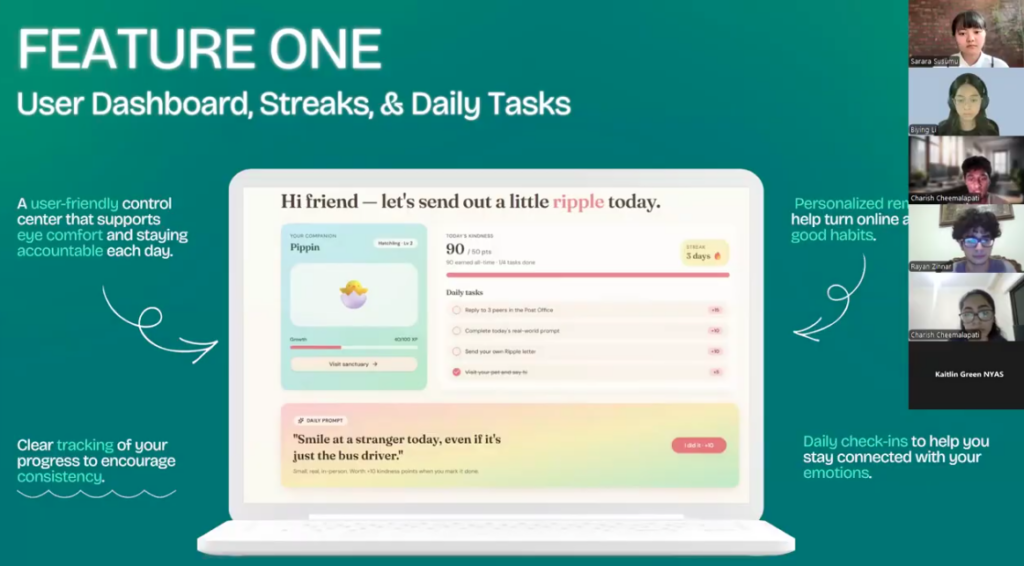
For the Mental Well-Being challenge, five students from Jordan, Lebanon, and the United States sought to address the mental health and loneliness epidemics affecting millions of teenagers despite unprecedented connectivity through social media. Many young people facing depression and anxiety deal with a lack of accessible therapeutic and clinical support, leaving them without the help they need. To address this disconnect, team “Kindness Ripple” leveraged digital connectivity to provide peer-to-peer support through an app that allows teens to anonymously share their concerns and receive supportive messages from others. To design their app, the team researched how teens prefer to interact with social media and incorporated a positive feedback loop: for every act of kindness, users can unlock new items in the in-app pet customization store. This gamified, anonymous system supports teens’ mental health by encouraging altruistic behavior, which is shown to improve the actor’s own well-being. Like their international team, “Kindness Ripple” aims to build cross-border connections by incorporating multiple languages into their app, making it accessible to youth across the globe.
Innovation Challenge: Human Centered AI
Challenge Finalists:
- EduPilot: Enabling Neurodivergent Learners | Egypt, Saudi Arabia, United Kingdom, United States
- Green Technology Institute | Egypt, India, United States
Winning Team: Tether
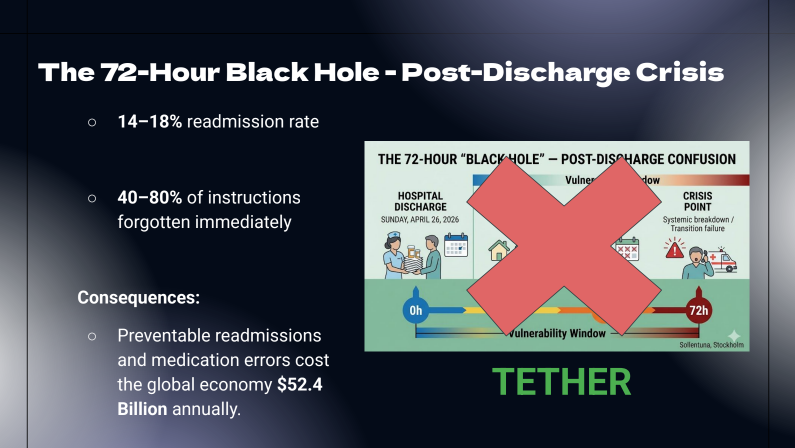
For the Human Centered AI challenge, six students from Sweden, the United Arab Emirates, and the United States set out to design an artificial intelligence (AI) system that supports human roles rather than replacing them. Combining their interests and areas of expertise, team “Tether, The Bio-Acoustic Sentinel” chose to focus on the 72-hour black hole, a critical period after a patient is discharged from the hospital when it is most likely that they will be readmitted or affected by medication errors, a preventable phenomenon with an annual cost of over $50 billion. To minimize these preventable outcomes, the team designed an AI-powered, voice monitoring system which detects early warning signs and notifies the patient’s healthcare provider. The software, which is available in 26 languages, addresses accessibility concerns by utilizing jargon-free explanations and visual representations of symptoms, minimizing technology requirements. The team is committed to bringing their software out of the lab and into public healthcare; after trials and tests, their company, Avlynor, is planning for an official clinical rollout in early 2027.
Over the past 11 years, the Junior Academy has hosted 65 Innovation Challenges and is looking forward to building further connections through the upcoming Fall 2026 Innovation Challenges: misinformation in public health, brain technology, and green energy. Thank you to all our Junior Academy sponsors for yet another successful and inspiring year filled with global connections and real-world solutions.