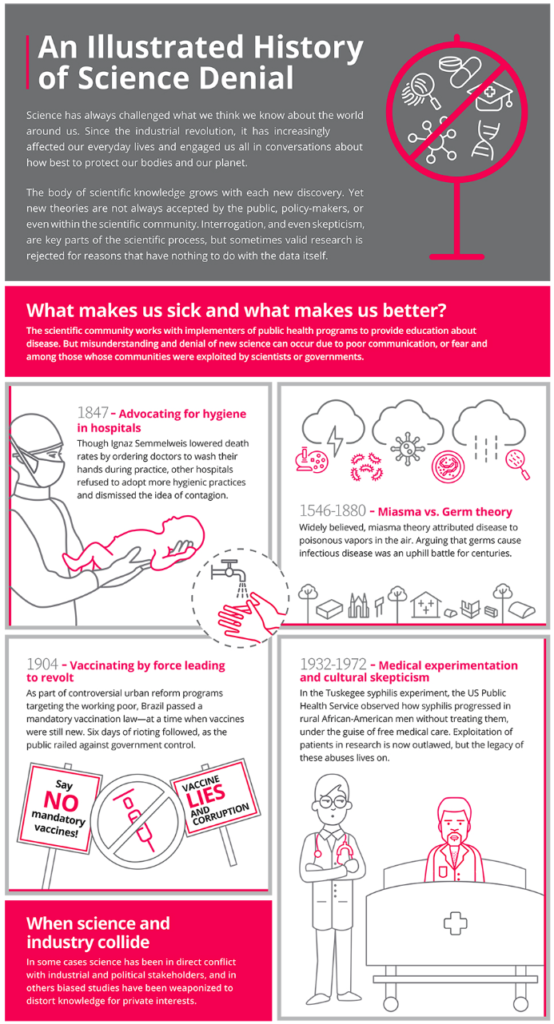
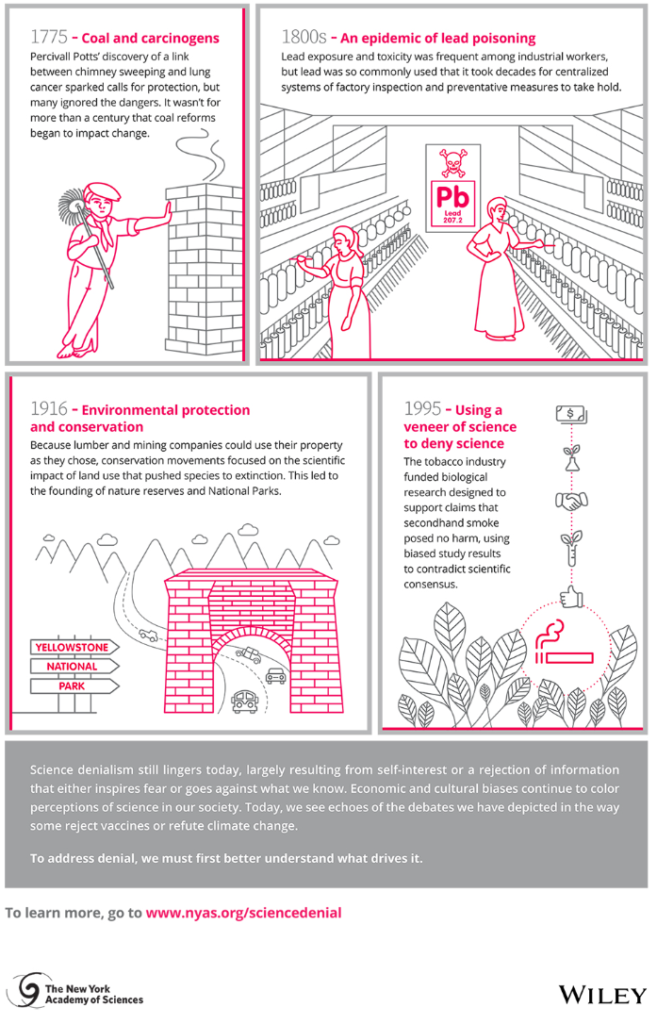
In an age where instant communication can immediately spread misinformation, the consequences of scientific denialism are more serious than ever.
Published June 06, 2018
By Marie Gentile, Mandy Carr, and Richard Birchard
Still, it’s important to maintain perspective and remember that scientific denialism is not a new phenomenon. For as long as scientists have challenged our understanding of the world, there have been science denialists who oppose new consensus. Below is a brief illustrated history of some of the most notable instances of science denial.
Scientists, ethicists, and other experts gather to discuss the promises and potential consequences of advances in biotechnology and artificial intelligence aimed at improving human performance.
New York, NY | May 10, 2018 — From eyeglasses that restore sight to robotic prosthetics to replace limbs, people throughout history have sought to overcome the limitations of the human body. New advancements in such technologies and their implications will be explored at “The Enhanced Human: Risks and Opportunities,” presented by the Aspen Brain Institute, The Hastings Center, and The New York Academy of Sciences at the Academy’s headquarters on Monday, May 21 at 6:00pm.
This evening event will include short presentations and a panel discussion examining the scientific and ethical implications of existing and rapidly emerging technologies with applications for human enhancement. Special emphasis will be placed on CRISPR/Cas9 gene editing technology and artificial intelligence. Experts from multidisciplinary fields will provide historical perspective and scientific background before discussing the vast opportunities of these cutting edge technologies and delving into the complex ethical and social questions still to be addressed.
The program will begin with introductory sessions on “The History and Science of Human Enhancement” and “Present and Future Bioethical Considerations,” featuring brief talks from renowned geneticist George Church (Wyss Institute at Harvard University), biomedical ethics and policy expert Josephine Johnston (The Hastings Center), technology futurist Jamie Metzl (Atlantic Council), and artificial intelligence specialist Meredith Whittaker (AI Now Institute at NYU).
These introductory sessions will be followed by a lengthy panel discussion moderated by Mildred Z. Solomon, distinguished health care and science policy expert and president of The Hastings Center. The panel is comprised of the aforementioned speakers and Glenda Greenwald, president and founder of the Aspen Brain Institute. A speaker networking reception will close the event. For those unable to attend the event in person, the event will be available via Livestream.
This event was made possible, in part, through the support of a grant from the John Templeton Foundation. The opinions expressed are those of the presenters and do not necessarily reflect the views of the John Templeton Foundation.
About the Aspen Brain Institute
The Aspen Brain Institute convened its first meeting co-presented with The New York Academy of Sciences in 2010 focused on Neurotechnology: Building Better Brains. Since 2010, the Aspen Brain Institute has partnered with the Academy on six symposia and a social impact challenge. As a 501(c)(3) non-profit organization, the Aspen Brain Forum Foundation supports and produces scientific meetings covering topics ranging from neuroprosthetics to the developing human brain. The Foundation’s mission is to:
Organize, produce, and host an annual high-level meeting of international brain researchers, in partnership with The New York Academy of Sciences, leading to global collaborations and breakthroughs in world brain science.
Present and disseminate the most cutting-edge innovations in brain science.
Ally with large new initiatives, such as the American Brain Coalition, the American Brain Foundation, and One Mind for Research, to prevent and cure brain disorders such as Alzheimer’s, Parkinson’s, autism, and depression, within a decade.
About The Hastings Center
The Hastings Center addresses fundamental ethical and social issues in health care, life sciences research, and biomedical technologies. The Center’s goal is to promote compassionate and just health care and the wise use of emerging technologies. Through its scholars’ writing and speaking, and through the work of the many people from around the world who participate in its projects or submit articles to its two journals, The Hastings Center shapes ideas that influence key opinion leaders, including health policymakers, regulators, lawyers, legislators, and judges, as well as health care executives, physicians and nurses. Founded in 1969 by philosopher Daniel Callahan and psychoanalyst Willard Gaylin, The Hastings Center is the oldest independent, nonpartisan, interdisciplinary research institute of its kind in the world. In addition to producing original research, it accomplishes its mission through public engagement and service to the field of bioethics. To learn more, please visit www.thehastingscenter.org.
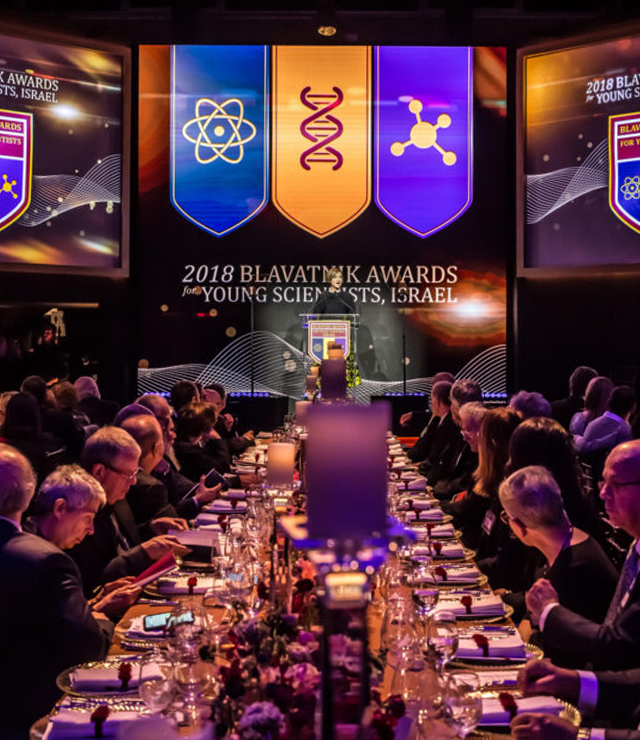
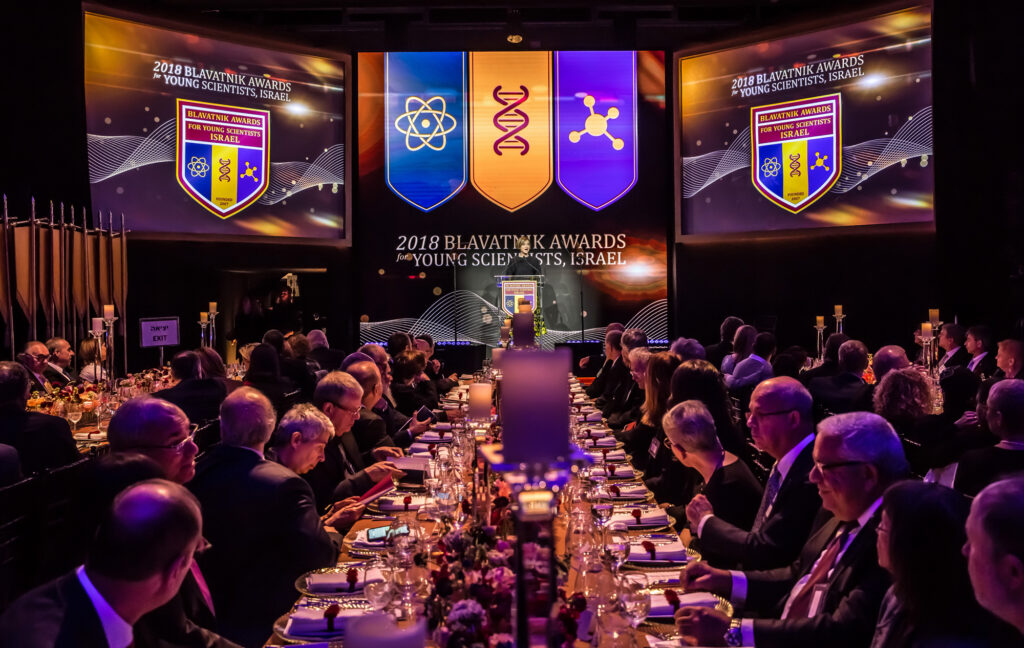
The Blavatnik Family Foundation hosts the first Blavatnik Awards Ceremony in Israel in collaboration with The New York Academy of Sciences and the Israel Academy of Sciences and Humanities. Take a look at the spectacular occasion.
Published May 1, 2018
By Kamala Murthy
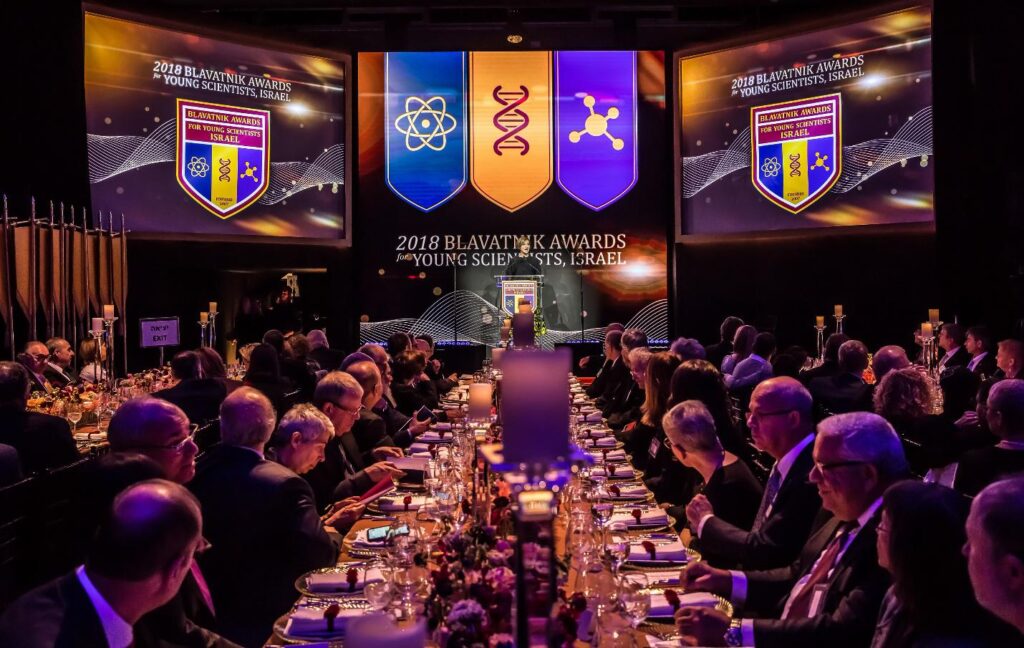
The Blavatnik Family Foundation in collaboration with The New York Academy of Sciences and the Israel Academy of Sciences and Humanities, hosted the Inaugural Ceremony and Gala for the Blavatnik Awards in Israel at the Israel Museum in Jerusalem on February 4, 2018.
This spectacular occasion marked the Blavatnik Awards’ first year in Israel. Prominent leaders across Israel, including from academia, business and philanthropy, attended this remarkable event. Dana Weiss, Chief Political Analyst and host of Israel’s “Saturday Night with Dana Weiss,” presented the Blavatnik Awards as Ceremonial emcee.
The evening began with a vocal performance by one of Israel’s most celebrated singer/songwriters, Ronan Kenan. A short opening film entitled “Start-up nation” was shown. The film highlighted Israel’s entrepreneurial spirit that drives innovation and discovery in the country. Both President Nili Cohen of the Israel Academy of Sciences and Humanities and President Ellis Rubinstein of the New York Academy of Sciences gave opening remarks for the inaugural ceremony.
Honoring Israel’s Leading Young Scientists
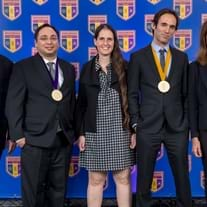
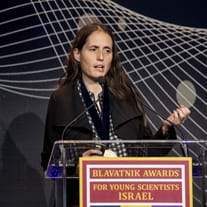
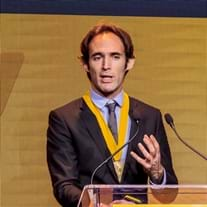
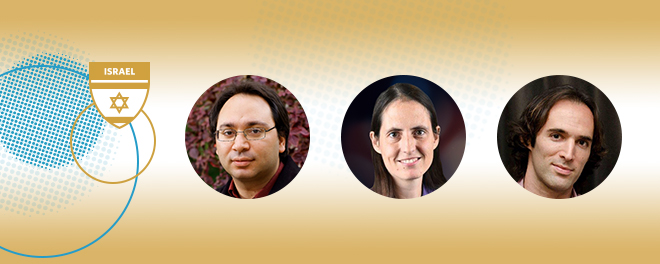
The evening honored three of Israel’s leading young scientists: Dr. Charles Diesendruck, a chemist reviving the field of “Mechanochemistry” from the Technion – Israel Institute of Technology; Prof. Anat Levin, a computer scientist working in the field of computational photography who is also from the Technion; and Dr. Oded Rechavi, a geneticist from Tel Aviv University studying non-DNA-based inheritance.
These three Laureates were chosen by a distinguished panel of judges from across Israel and selected from 47 nominations that were submitted by eight of Israel’s top universities and independent research institutions. Before each Laureate was announced, a short film introducing each scientist and the significance of their particular research areas were shown:
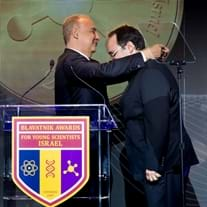
Blavatnik Family Foundation Founder and Chairman Mr. Len Blavatnik awarded each scientist with their personalized medal. The scientists were given the opportunity to present in-depth overviews of their current research to the audience. Nobel Laureate, Israel Prize Winner, and Distinguished Research Professor of the Faculty of Medicine at Technion – Israel Institute of Technology, Prof. Aaron Ciechanover, was the keynote speaker for the evening. The Anchor Choir of the Jerusalem Academy of Music and Dance concluded the ceremony with a vocal performance.
Three outstanding Israeli Scientists win the 2018 Blavatnik Awards for Young Scientists in Israel during its inaugural year.
Published May 1, 2018
By Kamala Murthy
For over a decade in the United States, the Blavatnik Awards have honored exceptional young scientists and engineers. The award highlights their extraordinary achievements, recognizing their remarkable promise for future discoveries, and accelerating innovation in their research.
Established in 2007, the Blavatnik Awards are a signature program of the Blavatnik Family Foundation that are administered by the New York Academy of Sciences. Awarded in Israel for the first time – in collaboration with the Israel Academy of Sciences and Humanities – three of the country’s most outstanding young scientists and engineers will receive $100,000 each, one of the largest unrestricted prizes ever created for early-career researchers in Israel.
From 47 nominees, encompassing Israel’s most promising scientific researchers aged 42 years and younger and nominated by Israeli research universities, a distinguished national jury selected three outstanding laureates, one each from the disciplines of Life Sciences, Chemistry, and Physical Sciences & Engineering:
Dr. Oded Rechavi Senior Lecturer, Department of Neurobiology, Tel Aviv University
Dr. Charles Diesendruck Assistant Professor of Chemistry, Schulich Faculty of Chemistry, Technion – Israel Institute of Technology
Prof. Anat Levin Associate Professor, The Andrew & Erna Viterbi Faculty of Electrical Engineering, Technion – Israel Institute of Technology
The inaugural Blavatnik Awards for Young Scientists in Israel will be honored at a formal ceremony in Jerusalem on February 4, 2018. The Laureates will join a network of their peers as members of the Blavatnik Science Scholars community. The net work is currently comprised of over 220 Blavatnik Award honorees from the decade-old U.S. program. Laureates will also be invited to attend the annual Blavatnik Science Symposium at the Academy each summer. Here the Scholars come together to exchange new ideas and build cross-disciplinary research collaborations.
To learn more about this year’s Blavatnik Laureates and other honorees, please visit the Blavatnik website here and follow us on Twitter: @BlavatnikAwards.
The inaugural Blavatnik Awards for Young Scientists in the United Kingdom Ceremony was attended by many of the UK’s leaders in science, business, and philanthropy.
Published March 7, 2018
By Kamala Murthy
The Blavatnik Family Foundation hosted the inaugural Blavatnik Awards for Young Scientists in the United Kingdom Ceremony on March 7, 2018 at the Victoria and Albert Museum in London.
Distinguished guests that attended the ceremony included Chief Medical Officer for England, Professor Dame Sally Davies; evolutionary biologist and author, Richard Dawkins; Chief Executive of the British Association for the Advancement of Science, Katherine Mathieson; 2014 Nobel Laureate Professor John O’Keefe, and 2017 Nobel Laureate Professor Richard Henderson.
Ellis Rubinstein, President and CEO of the New York Academy of Sciences, which administers the Awards, served as the Master of Ceremonies. In addition, as part of the ceremony, a procession of students from the Southbank International School carried flags into the banquet hall representing the honorees’ academic and research institutions.
In each scientific category (Chemistry, Physical Sciences & Engineering, Life Sciences), two Finalists were each awarded prizes of US$30,000, and one Laureate in each category was awarded US$100,000. The Awards’ founder, Sir Leonard Blavatnik, presented medals to the three Laureates and six Finalists.
Chemistry
In the Chemistry category, geochemist Professor Robert Hilton of Durham University and physical chemist Professor Philipp Kukura of University of Oxford were both recognized as Finalists. Professor Clare Gray, of University of Cambridge, introduced the 2018 Laureate in Chemistry, Professor Andrew L. Goodwin of University of Oxford: “Andrew is without a doubt already regarded as a world leader and a pioneer in the study of structural disorder and mechanical flexibility and its role in controlling the chemistry, physics, and geophysics of functional materials.”
Physical Sciences & Engineering
In the category of Physical Sciences & Engineering, theoretical physicist Professor Claudia de Rham of Imperial College London and astrophysicist Professor Andrew Levan of the University of Warwick were honored as Finalists. Professor Sir Richard Friend, from University of Cambridge, introduced the 2018 Laureate in Physical Sciences & Engineering, Professor Henry Snaith, from University of Oxford, and highlighted his research in developing new, low-cost and high-efficiency solar cells based on metal halide perovskite materials. Sir Richard said “Henry’s work, I am certain, will help propel human society to a sustainable future.”
Life Sciences
In the category of Life Sciences, computational neuroscientist Professor Timothy Behrens of University of Oxford and University College London (UCL), and structural biologist Dr. John Briggs of Medical Research Council (MRC) Laboratory of Molecular Biology were honored as Finalists. Professor Veronica van Heyningen of UCL introduced the 2018 Laureate in Life Sciences, Dr. M. Madan Babu of MRC Laboratory of Molecular Biology, with the Award given for his insights into the structural biology and molecular logic of key proteins and protein motifs, including GPCRs [G-protein–coupled receptors] and intrinsically disordered protein regions.
Professor van Heyningen remarked that Dr. Babu is “at the forefront of a new breed of biologist” and that he is “a big data information scientist with additional expertise in structural biology, with a deep knowledge of the molecular logic of proteins.”
Prominent leaders across Israel from academia, business and philanthropy attended the inaugural Blavatnik Awards in Israel Ceremony.
Published February 4, 2018
By Kamala Murthy
On the evening of February 4, 2018 the Blavatnik Family Foundation, in collaboration with The New York Academy of Sciences and The Israel Academy of Sciences and Humanities (IASH), hosted the Inaugural Ceremony and Gala for the Blavatnik Awards for Young Scientists in Israel at the Israel Museum in Jerusalem.
The celebration began earlier that day with a private reception hosted by the President of Israel, Reuven Rivlin and his wife Nechama Rivlin, in honor of the three Blavatnik Award Laureates at the official residence of the President of Israel. The Laureates’ families, the Awards’ founder Mr. Len Blavatnik, and leadership from IASH and The New York Academy of Sciences, were also invited by the President to participate in this reception.
Later in the evening, festivities at the Israel Museum began. Guests entering the cocktail area enjoyed live performance art from the Batsheva Dance Company. Dana Weiss, Chief Political Analyst and host of Israel’s “Saturday Night with Dana Weiss,” served as the Master of Ceremonies. One of Israel’s most celebrated singer/songwriters, Rona Kenan, performed an opening song. This was followed by a short opening film highlighting Israel’s entrepreneurial spirit that has led to the country becoming a world leader in innovation, technology and business.
Motivating Young Scientists
The Israel Academy of Sciences and Humanities’ President Nili Cohen gave a speech where she remarked that “the idea to motivate young scientists is a breakthrough in the prize-awarding culture.” She added that The Israel Academy of Sciences and Humanities is proud to partner with The New York Academy of Sciences and the Blavatnik Family Foundation. President Ellis Rubinstein of The New York Academy of Sciences also gave remarks. He credited Israel as having the most amazing talent pool per capita in the world. He closed by saying “thank you Israel for welcoming us to the latest start-up in your incredible ‘Start-Up Nation.’”
The evening honored three of Israel’s leading young scientists:
Professor Charles Diesendruck, a chemist reviving the field of mechanochemistry from the Technion – Israel Institute of Technology
Professor Anat Levin, a computer scientist working in the field of computational photography who is also from the Technion
Professor Oded Rechavi, a geneticist from Tel Aviv University studying non–DNA-based inheritance
These three Laureates were chosen by a distinguished panel of judges from across Israel and selected from 47 nominations that were submitted by eight of Israel’s top universities and independent research institutions. Before each Laureate was announced, a short film introducing each scientist and the significance of their research was shown.
Blavatnik Family Foundation Founder and Chairman, Sir Len Blavatnik, awarded each scientist with their personalized medal. The scientists were each given an opportunity to present their latest research findings to the audience. Nobel Laureate, Israel Prize Winner, and Distinguished Research Professor of the Faculty of Medicine at Technion – Israel Institute of Technology, Professor Aaron Ciechanover, was the keynote speaker for the evening. The Ankor Choir of the Jerusalem Academy of Music and Dance concluded the ceremony with a vocal performance.
Dr. Lucianne Walkowicz is determining the ethics of exploring Mars.
Published January 19, 2018
By Marie Gentile, Mandy Carr, and Richard Birchard
Lucianne Walkowicz, PhD
While generations of stargazers have dreamt of the fantastic possibilities inherent in space exploration and colonization, few have concerned themselves with the ethics of such endeavors.
Dr. Walkowicz is adamant that space exploration has much to learn from the spread of humanity. Past mistakes should not be repeated.
“When we look at how we’ve explored this planet and, for example, our treatment of either indigenous people or indigenous species in places that we have explored, we haven’t exactly been exemplars in our treatment of those people or species. That’s resulted in damage to our relationships in new lands, and also to the lands themselves.”
Without current evidence for life on Mars, some view it as open territory, and therefore unencumbered by these considerations. Dr. Walkowicz disagrees, and advocates for the protection of Mars’ environment, living or not.
“In Mars’ case, we know that it used to be a habitable planet in the past, and that doesn’t mean that it had life, but it certainly means that there could’ve been a history of life there, and it is an environment that is sovereign in and of itself,” she said. “I think we can look at some of the behaviors that we have engaged in on Earth, and some of the choices we’ve made in the past that have, for example, compromised the environment, and ask ourselves how we can do that differently on Mars?”
Preserving Other Planets
We can start by ensuring that environments like Mars remain intact, and Dr. Walkowicz clarified who exactly is the “we” in this context, “This is complicated by the changing nature of exploration, which will no longer solely consist of nations, but companies within those nations.” Ensuring that both public and private interests are performing responsibly will be difficult to regulate.
As an example Dr. Walkowicz offered, “We have to determine how we might clean our spacecraft to explore Mars without contaminating it and extending that to not just organizations like NASA, but also private spaceflight companies that are engaging in their own activities on Mars … how do we protect Mars from ourselves?” She added, “If we want to send humans to Mars, then that’s an entirely different and more challenging problem than sending just spacecraft.”
The question of sending humans to other planets is so complex that Dr. Walkowicz believes it should not be left exclusively to members of the scientific community.
“That’s fine if what you’re talking about doing is science experiments on other worlds. But if actually what we are talking about is becoming humans that live on another world, we have to take into account that we have a human culture. And in order for us to think about how we might do that correctly, that requires us to think about how we choose our lives on Earth and what that might mean in its space iteration.” She finished, “Certainly, the history of Earth is full of a lot of mistakes and intentional actions that resulted in the massive inequality and some of the social problems we have today. If we want to live in space, how can we do that without necessarily reproducing a lot of the inequalities and injustices off Earth as well?”
Keeping the Public Engaged
The need for public input is a two-way street and Dr. Walkowicz wants scientists to keep the greater public engaged. Outside of the fact that the public has a right to know about the research they fund,.
“Science is a human undertaking in the same way that literature or art or music is a human undertaking. And I think we have a responsibility to share those scientific discoveries and the benefits that are created by them … People should be able to enjoy [these benefits] and it shouldn’t require being an actual scientist to do so. We certainly don’t tell people they can only enjoy music if they’re musicians. Science is a product of human activity that should be shared with all humanity.”
Whatever we find, and share, from our travels beyond Earth, Dr. Walkowicz sees planetary exploration as an opportunity to move beyond our relatively narrow breadth of experience.
“When we study astrobiology, I think one of the things we’re really limited by is that we only have one example of a planet that has life on it, so being able to study life in other environments is incredibly important scientifically, but can also help us understand what our greater relationship is to the universe,” she said.
The New York Academy of Sciences believes that the future of American economic growth is inexorably linked to a vibrant and dynamic higher education system and a STEM literate workforce.
Published December 08, 2017
By The New York Academy of Sciences
The following is a statement from The New York Academy of Sciences (the Academy) on the tax reform bill currently before Congress.
America’s achievements in science and technology—the envy of the world, and the basis of much of our economic growth—are largely attributable to US research universities, which can legitimately lay claim to innovations that have created millions of well-paying jobs. For the past 25 years, a concerted effort has been made by both the public and private sectors to encourage students to earn STEM degrees—both graduate and undergraduate—in order to build the necessary talent pipeline for the 21st century job market.
Indeed, many companies now routinely require advanced degrees as part of their hiring requirements. The 2017 Tax Cut and Jobs Act, recently passed by the House and Senate and currently in the reconciliation process, puts our STEM pipeline in jeopardy at a time when American industry is already concerned about the lack of qualified candidates to fill the many jobs that are available.
The final outcome of the Bill is yet to be determined, but given that America’s future workforce will require a deep bench of talent—with profound expertise in STEM fields—the elimination of the graduate student tuition waiver, student loan interest deductions, employee tuition waivers, and the Lifetime Learning Credit, as well as proposed restructuring of the American Opportunity Tax Credit, is not in the nation’s best interest for future economic and job growth.
Consequences for the American Economy, Civil Society, and the World
The New York Academy of Sciences is proud to claim more than 8,000 graduate/postdoc Members, representing over 100 universities, research institutions, and teaching hospitals. These early career investigators are already working on important research that will maintain America’s leadership in discovery and innovation in the decades to come. It is crucial that our world-class university system continue to fulfill its nonprofit educational and research roles, and that the opportunity to earn an advanced degree remain open to individuals from diverse backgrounds, not simply the independently wealthy.
As an organization whose mission is to drive innovation by advancing scientific research, education and policy, The New York Academy of Sciences believes that the future of American economic growth is inexorably linked to a vibrant and dynamic higher education system and a STEM literate workforce.
As it currently stands, this Bill has the potential to put the prospect of higher education permanently out of reach for a vast section of the population—resulting in far-reaching consequences for the American economy, civil society, and the world.
Nine outstanding scientists from six U.K. academic institutions receive a total of $480,000.
Published December 8, 2017
By Marie Gentile and Richard Birchard
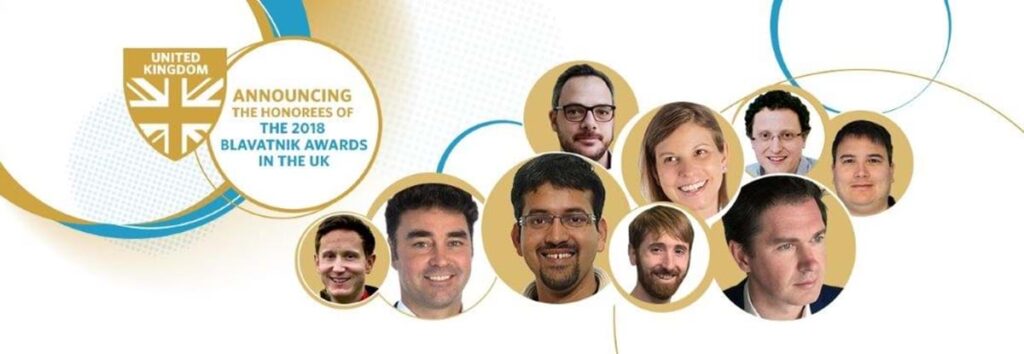
The New York Academy of Sciences and the Blavatnik Family Foundation announced the first Honorees of the Blavatnik Awards in the United Kingdom.
Three Laureates, in the categories of Life Sciences, Physical Sciences & Engineering, and Chemistry, will each receive an unrestricted prize of $100,000. In addition, two Finalists in each category will each receive an unrestricted prize of $30,000. To date, the Blavatnik Awards in the U.K. are the largest unrestricted cash awards available exclusively to young scientists.
The Blavatnik Awards, administered by the New York Academy of Sciences, were established by the Blavatnik Family Foundation in 2007. The awards honor and support exceptional early-career scientists and engineers under the age of 42 across the United States. In 2017, the Awards were launched in the U.K. and Israel. This recognized the first cohort of international Blavatnik Award recipients. To date, the Blavatnik Awards have conferred prizes totaling U.S. $5 million, honoring 220 outstanding young scientists and engineers.
In this inaugural year of the Blavatnik Awards in the U.K., 124 nominations were received from 67 academic and research institutions across England, Scotland, Wales, and Northern Ireland. A distinguished jury of leading senior scientists and engineers selected the Laureates and Finalists. The 2018 Laureates are:
These inaugural Blavatnik Awards Laureates and Finalists in the U.K. will be honored at a gala dinner and ceremony at London’s Victoria and Albert Museum on March 7, 2018. In addition, the Award recipients will be invited to attend the annual Blavatnik Science Symposium at the New York Academy of Sciences this summer, which is an opportunity for former and current Blavatnik Awardees to exchange ideas and build cross-disciplinary research collaborations.
The Blavatnik U.K. honorees will become members of the Blavatnik Science Scholars community, currently comprising over 220 Blavatnik Award honorees from the decade-old U.S. program and three inaugural 2018 Laureates from Israel. Honorees will also receive Membership to The New York Academy of Sciences.
The annual Blavatnik Science Symposium brings together current and previous honorees of the Blavatnik Awards for Young Scientists to drive the next generation of scientific innovation.
Published October 26, 2017
By Kamala Murthy
By inspiring the Scholars with talks about cutting-edge research and by fostering networking and collaboration between these brilliant scientists and engineers the symposium hopes to further push the boundaries of scientific progress.
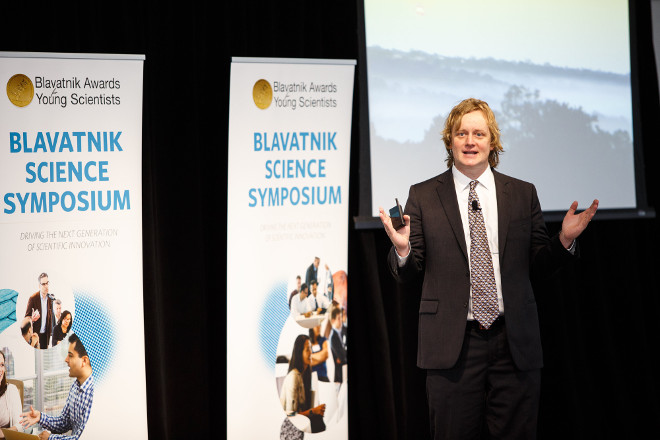
The 2017 Blavatnik Science Symposium took place on Monday, July 17 and Tuesday, July 18, 2017 at The New York Academy of Sciences. The annual two-day event has been hosted for the past four years by the Blavatnik Family Foundation and the Academy. This exciting symposium convened Blavatnik Awards honorees from around the world in the fields of Life Sciences, Chemistry and Physical Sciences & Engineering—the three Blavatnik Award disciplines. Representatives from the Blavatnik Family Foundation, Harvard Business School’s Blavatnik Fellowship in Life Science Entrepreneurship and Harvard University’s Blavatnik Biomedical Accelerator also attended, along with academic luminaries and New York Academy of Sciences Council Members.
Over 150 distinguished scientists, business entrepreneurs and industry professionals from diverse disciplines were treated to two days of the latest research from Blavatnik honorees and interacted with panel participants. Scholars were invited to network between presentations, step out of the comfort zone of their scientific discipline and discuss ideas, challenges and successes in their research and areas of study. By approaching their work from the perspective of another’s disciplinary area, scientists have begun to brainstorm new ideas and problem-solve in entirely new ways, resulting in some highly productive collaborations between scientists who have met through the Blavatnik Awards program.
“Be Bold. Think Big.”
Ellis Rubinstein, President and CEO of the Academy, opened the Symposium with an overview of the development of the Blavatnik Awards for Young Scientists in 2007 as a regional program in the New York metropolitan area and the addition of the Blavatnik National Awards program in 2014. The thriving community of past honorees now numbers over 200 Scientists at the top of their respective disciplines. The benefactor of the awards program, Len Blavatnik, gave the audience some brief words including “Be Bold. Think Big.”
The first keynote presentation was given by 2017 Blavatnik National Laureate in Life Sciences Feng Zhang, PhD of the Broad Institute of MIT and Harvard. Dr. Zhang spoke about his groundbreaking work on the gene-editing technology CRISPR-Cas9. This was followed by 2017 Blavatnik National Laureate in Physical Sciences and Engineering Yi Cui, PhD from Stanford University who talked about his latest research in energy storage and the density and storage capacity of next generation lithium-ion batteries. A special Alumni Keynote presentation was given by Samie Jaffrey, MD, PhD from Weill Cornell Medical College who focused on his ground-breaking work surrounding mutations in gene regulation in neurological disorders such as autism and Fragile X syndrome.
The Global Economic Value of Scientific Progress
Other sessions covered topics as wide-ranging as climate change, novel polymers and their applications, approaches to mapping the Ebola and Zika virus in the Americas and West Africa, quantum computers, modeling biological systems, and the formation of stars and black holes.
Vicki Sato, PhD of Harvard Business School delivered a thought-provoking dinner keynote address on the “The Intersection of Science and Business.” She encouraged the audience to challenge the traditional uneasy relationship between science and business. “If we are going to move forward in a different way we need to build a more trusting and constructive relationship between science and business,” she explained.
Prof. Sato stressed the impact that science and business can have on society when they work symbiotically: “Scientific progress drives more economic value, globally, than any other advance. Science has the power to change the planet, maybe change the universe. Science has the potential to change how the world works so fast that continued investment in science is what is going to shape continued economic progress not just in our country but for countries globally.”