In his book Mind Wars, bioethicist Jonathan Moreno tells why the defense industry is interested in new discoveries in neuroscience. He explores why the defense department funds brain research, and what scientists should do about it.
Jonathan Moreno was first exposed to brain research as a child. He was 10 when two dozen subjects arrived at the 20-acre sanitorium run by his father, a distinguished psychiatrist, who would observe the effects of LSD on the group.
Little wonder that Moreno has spent a career thinking about the ethics of medical research. As a Professor of Biomedical Ethics at the University of Virginia, and Director of the Center for Biomedical Ethics there, Moreno has penned books including In the Wake of Terror: Medicine and Morality in a Time of Crisis; Undue Risk: Secret State Experiments on Humans; Ethical and Regulatory Aspects of Clinical Research; and Deciding Together: Bioethics and Moral Consensus.
Lately, his curiosity has been piqued by the attention that the defense department pays to brain research. His new book, Mind Wars: Brain Research and National Defense, explores the possible national security implications that stem from high-tech neuroscience, and reveals how much of it is funded by defense dollars.
Moreno urges neuroscientists to consider all of the possible applications and misapplications of their work, and to engage in the policymaking process.
The Academy spoke with Moreno in advance of his November 28, 2006 lecture.
You say that in 2006, most Defense Advanced Research Projects Agency (DARPA) funding has gone to brain-related work.
Much, I wouldn’t say most, but much. It’s clear that DARPA has an interest in neuroscience, which they should.
As you point out, DARPA funding has resulted in great technologies for the public good. What are the problems, risks, or ethical dilemmas with having neuroscience research funded by a defense agency?
One of the biggest problems is that there is so much anxiety—and in many cases paranoia—about the whole notion of mind-control or mind-reading. And I can tell you from this work and from previous work that I’ve done that there are a lot of people who think that they are the victims of mind-control experiments by the CIA. And this is actually cross-cultural; it is not confined to the United States. I was in Pakistan last year and I had a long conversation with the chairman of the Clinical Research department at Karachi University and I asked if he encountered patients who believed that [they were victims of mind control experiments]. He said, “oh yeah, it’s everywhere.”
So one problem of talking about this is just the conspiracy theory that so many people have already—which I want to disassociate myself from. But, if we put aside those conspiracy theories, there are nonetheless reasons to be interested in how information about the brain is going to be used in the future.
For example, evidence suggests that certain chemicals are released by the brain when people are in trusting relationships with one another. So, think now about interrogating detainees in Guantanamo. What if it were feasible to introduce this chemical, this neurotransmitter, artificially, so that instead of waterboarding people or playing good cop/ bad cop, you could chemically induce trusting feelings on the part of the subject of an interrogation? Some people will obviously say that that is a good thing, particularly if innocent people are at risk and this individual might have some information. Other people will say, well, this is a slippery slope here.
What might happen if the same chemical is used against our security agents, for example?
Precisely, or even domestically. If it becomes a useful intervention, then will domestic authorities be given the opportunity to use the stuff? And how does this rub up against our constitutional rights? So, that’s just one example of why we need to be concerned.
[And yet] so many of [the technologies discovered by defense-funded neuroscience] are good for people, which makes them much harder to talk about than nuclear weapons technology or biological weapons.
For example, there’s evidence that beta blockers, which are used for people with heart disease, can be used to treat people with post-traumatic stress disorder. There are some people who believe that not only are they useful after someone has been in a stressful situation, but it might even be plausible to give somebody a beta blocker before they go into a stressful situation, because the drug seems to inhibit the association of experiences with emotions and their consolidation into long-term memory.
Imagine if you were to give a beta blocker to a soldier before he or she went into a combat situation. On the one hand you might prevent or at least ameliorate the terrible emotional feelings that could come from what they see and do in combat, but, to put it in a single phrase, do we want an army of guilt-free soldiers?
So again the more we learn about the possibility of managing if not reading the brain, the more we’ll have to confront these questions. And because they are dual-use, they can be used in both military and civilian contexts, and they can be used both to heal and to harm they become all the more complicated.
All of the issues I talk about in Mind Wars about national security and the brain are part of a bigger conversation, which I think is maybe the most important thing we will talk about in the 21st century: How are we going to enter into changing what we are? What ought the limits be?
But in the end, you don’t advocate separating military from civilian science.
That’s right. Generally if you prohibit scientific research on what could ultimately be important national security technologies, you’re just going to force them underground. Especially in a society like ours, we need to maintain and enhance the relationships between our academic science institutions and the military, because if we tell our government that they can’t give grants to university scientists because we’re afraid that it will be bad for the university, we’re just going to force government to do it on its own, and secretly.
So I advocate continued and even increased funding for DARPA and finding ways to ensure that academia and the security establishment remain in contact with one another. I think it’s bad for democracy to do it any other way.
About the Author
Dr. Moreno is the Emily Davie and Joseph S. Kornfeld Professor of Biomedical Ethics at the University of Virginia; Director of the Center for Biomedical Ethics; and Senior Fellow at the Center for American Progress, Washington, DC.
He is an elected member of the Institute of Medicine of the National Academies and serves on the Institute’s Board on Health Sciences Policy. Moreno is also a member of the Council on Accreditation of the Association for the Accreditation of Human Research Protection Programs, and a past president of the American Society for Bioethics and Humanities. He is a bioethics advisor for the Howard Hughes Medical Institute, a Faculty Affiliate of the Kennedy Institute of Ethics at Georgetown University, and a Fellow of the Hastings Center and the New York Academy of Medicine.
“I have called this principle, by which each slight variation, if useful, is preserved, by the term of Natural Selection, in order to mark its relation to man’s power of selection.” -Charles Darwin, The Origin of Species, First edition
The past year has certainly been a banner year for evolution. Research in genome sequencing that shed light on the inner workings of evolution was chosen by Science magazine as the top science achievement of the year. Charles Darwin graced the cover of Newsweek magazine to mark the opening of a large exhibit on his life and work at New York’s American Museum of Natural History.
The fossil of a 375-million-year-old fish found in the Arctic was reported to be the missing link in the evolution from fish to land animals. And widespread fear of the potential for the deadly avian flu to evolve into a pandemic-ready human form brought evolution’s less desirable potential to the front pages of newspapers and the front seat of lab benches seeking a vaccine.
Ironically, however, the year also featured a courtroom skirmish over the teaching of evolution between high school parents and proponents of intelligent design (ID), who hold that the natural world is too complex to have been developed by natural selection. U.S. District Judge John E. Jones III, a Republican, ruled for the parents, calling intelligent design “thinly veiled creationism” that is “breathtaking in its inanity.”
As Hessy Taft, an associate professor of chemistry at St. John’s University, explains, “With the publication of his Origin of Species in 1859, Charles Darwin forever changed the way we view the natural world.” Yet the ongoing assault on the teaching of evolution, and of science in general, by proponents of ID convinced her and a team of other scientists and science educators of the need to organize a recent conference of The New York Academy of Sciences (the Academy).
A Boot Camp for Those on the Front lines
Entitled “Teaching Evolution and the Nature of Science,” and held at the City University of New York’s John Jay College of Criminal Justice on April 21-22, 2006, the event—a sort of boot camp for those on the front lines—brought together researchers, philosophers, and teachers to review the nature of science and evolution, how it should be taught, and what strategies are required to keep creationism out of public schools.
The timing for such an event couldn’t be better. The state of the teaching of science in the nation is indeed poor. According to the State of State Science Standards 2005—the first comprehensive study of science academic standards in primary and secondary schools conducted since 2000—22 states received grades of “D” or “F,” and nine states plus the District of Columbia received a “C.”
Conference presenters Gerald Skoog, director of the Center for the Integration of Science Education and Research, Glenn Branch, the deputy director of the National Center for Science Education, and Gerald F. Wheeler, executive director of the National Science Teachers Association, outlined several strategies to raise the quality of science teaching—and the teaching of evolution—in the nation’s schools.
How to teach evolution has become a front line in the American culture war. Nearly two-thirds of Americans say that creationism should be taught along with evolution in public schools, and 42% of Americans are strict creationists who believe that “living things have existed in their present form since the beginning of time,” according to a recent poll by the Pew Forum on Religion and Public Life and the Pew Research Center for the People.
Teaching Intelligent Design Alongside Evolution
On August 2, 2005, President Bush said that intelligent design should be taught along with evolution in schools “so people can understand what the debate is about.” A few weeks later, Senate Majority Leader Bill Frist, a Tennessee Republican said to be considering a 2008 White House run, agreed with the President.
Intelligent design is, indeed, intelligently designed—but as a strategy to derail teaching of true science, not as a true scientific theory. Developed in the wake of a 1987 Supreme Court ruling that teaching creationism in schools violates the separation of church and state, ID veils its creationist roots by avoiding the mention of God. Since 1996, it has been carefully crafted and disseminated by the Discovery Institute, a conservative think tank located in Seattle, whose Center for Science and Culture has been at the forefront of a movement promoting ID and its teaching in schools. “Teach the controversy” is the rallying call that the Institute promotes, which the President seems to endorse.
However, there is no bona fide controversy and the issue cannot be framed as a debate over evolution, because ID is not a competing scientific theory. The definition of a theory in science is that it must be based on observable facts, and it must be testable. Evolution is an example of a theory, as are gravity, relativity, the existence of the atom, and countless other scientific concepts. Over time, of course, as new evidence is obtained, a theory can be either reinforced or modified, or overturned, and debate over theories is at the heart of science.
The Test of Time
Evolution has stood the test of time by countless confirming observations. Put simply, the theory is that natural selection— the process by which individuals (or genes) compete for limited resources—favors those that are best suited to survive and reproduce in a particular environment. Random genetic mutations could either be detrimental or beneficial for an organism, but the latter are those that enhance the organism’s reproductive success. Over eons, such mutations lead certain features in a species to persist—and certain species to proliferate, while others die out.
Uncovering the genetic code has also shown the remarkable commonality of the human genome with those of other mammals and even of yeast, lending further support to the evolutionary premise that living things share a common ancestry. At the conference a host of distinguished scholars—Bruce Alberts, former president of the National Academy of Sciences, Leslie C. Aiello, president of the Wenner-Gren Foundation for Anthropological Research, and Sydel Silverman, professor emerita at the Graduate Center at The City University of New York and a conference organizer—offered detailed presentations on how their work on protein machines, primate fossils, and the culture factor in human evolution demonstrated scientific support for the theory of natural selection.
Intelligent design fails on both basic tenets of a scientific theory: design cannot be observed, and it cannot be tested. Hence, it falls into the realm of philosophy or folklore—no more deserving of attention than the Flat Earth Society. “There is no place for a discussion of intelligent design in a science class,” says Taft. “It’s as ludicrous as it would be to discuss it in gym [class]—it has no relevance to the subject. The only place it might belong would be in a philosophy class.”
Human Life as an Engineering Wonder
ID proponents hold that human life is an engineering wonder that could not possibly have developed in accordance with the accidental, gene-by-gene fits and starts of evolution, hence pointing to a more intelligent “designer.” A common example they offer is the human eye.
In fact, even this prototypical example fails under minimal scientific scrutiny, as conference speaker Wen-Hsiung Li, James Watson professor in the department of ecology and evolution at the University of Chicago, explained in a talk on gene duplication as a force of evolution. The necessary differentiation and fine-tuning of cellular processes required for species to evolve makes absolute sense in light of gene duplication, Li explained.
For example, genetic science traces predecessor ocular genes all the way back to the sightless bacteria at the base of the evolutionary tree. Various intermediate forms of “eyes” can be found in the fossil record and through comparative biology. Gene duplication—“a major force in evolution,” according to Li—is responsible for the development of the highly complex mammalian visual and olfactory senses from a common ancestor.
Philosophy—as well as theology—offers some interesting perspectives on how evolution and divinity need not negate each other—or default to ID. According to John F. Haught, distinguished research professor in the department of theology at Georgetown University, the question “why does life exhibit complex ‘design’?” can be answered in a number of distinct yet correct ways: “Life exhibits complex design because of natural selection. Or, life exhibits complex design because of divine wisdom, love, and humility that endow nature with self-creative capacities essential for the world to become itself,” said Haught.
A Triumph of Education
In this way, evolution and God can coexist. Expanding on evolutionary biologist Theodosius Dobzhansky’s famed aphorism, Haught concluded, “Nothing in theology makes sense except in the light of evolution.”
In summer 2005, The New York Times editorialist Verlyn Klinkenborg wrote:
Accepting the fact of evolution does not necessarily mean discarding a personal faith in God. But accepting intelligent design means discarding science. Much has been made of a 2004 poll showing that some 45 percent of Americans believe that the Earth—and humans with it –was created as described in the book of Genesis, and within the past 10,000 years. This isn’t a triumph of faith. It’s a failure of education.
By contrast, the presenters at “Teaching Evolution and the Nature of Science” provided educators with a veritable arsenal of arguments, tactics, and ideas to take back into their classrooms and rationally discuss with their students and the community what science is and how evolution is a part of it. In an arena that has shaped up to be a pedagogical struggle for survival, Klinkenborg might well agree that this conference was a triumph of education.
Mary Crowley is a New-York-based writer specializing in medicine, policy, and science. She has contributed many of The New York Academy of Sciences’ eBriefings, particularly in ethics, genomic medicine, neuroscience, and psychology.
From fast growth and profitable sales to research improprieties and legal trouble: the story behind ImClone.
Published July 1, 2006
By Pamela Sherrid and Sibyl Shalo
Boosters of the biotech industry in New York City face a conundrum when it comes to ImClone Systems, Inc. On the one hand, the company should be a poster child for why New York is a great place for biotech. Founded by local scientific talent and located at 180 Varick Street in Lower Manhattan, ImClone beat the longshot odds that face all drug developers and launched a cancer drug that last year had sales of $413 million.
On the other hand, it’s hard to think of a biotech company with more notoriety. The approval process for its lead drug hit a massive pothole in late 2001 because the company misguidedly relied on data from just one small clinical trial. Its founding CEO, Samuel Waksal, is in prison for securities fraud, and Martha Stewart famously served time for lying to investigators about the sale of her ImClone stock.
Today, the company has valuable assets, but it faces huge uncertainties. At the top of the list of assets is Erbitux, a monoclonal antibody that binds specifically to the epidermal growth factor receptor (EGFR). After its setback in 2001, the drug was approved by the FDA in 2004 for use in combination with irinotecan in the treatment of patients with EGFR-expressing, metastatic colorectal cancer who were refractory to irinotecan-based chemotherapy, and as a first-line treatment for patients who cannot tolerate irinotecan.
ImClone received a huge boost this March when Erbitux was approved by the FDA for use in a second indication, head and neck cancer. It opens up a whole new market for ImClone, and triggered a milestone payment of $250 million from ImClone’s corporate partner, drugmaker Bristol-Myers Squibb.
Early-Intervention Research
For ImClone to grow its revenue even further in colon cancer applications, it needs to get patients on the drug sooner and remain on treatment longer. To that end, ImClone has plenty of early-intervention research going on in both its current indications. For instance, David Pfister, MD, a medical oncologist and head and neck cancer specialist at Memorial Sloan-Kettering Cancer Center, is watching “with great interest” the development of a large, randomized study on the combination of Erbitux, cisplatin, and radiation being conducted by a multicenter research consortium that includes MSKCC. The potential for a synergistic effect, he says, is capturing the attention of the oncology community.
ImClone is also trying to win approval of Erbitux for other indications such as lung and pancreatic cancer. At the annual meeting of the American Society of Clinical Oncology in early June, one of the most well-attended cancer research conferences of the year, dozens of papers were presented on Erbitux and other drugs in ImClone’s pipeline. Research data will decide the future, says Mehta Partners biotechnology analyst Max Jacobs, for both Erbitux and ImClone.
Despite the turmoil during Waksal’s downfall, ImClone held on to most of its 900 employees. The company manufactures Erbitux in New Jersey, but its preclinical biology research facility remains on the sixth and seventh floors of the Varick Street building, which also houses ImClone’s corporate headquarters. When he founded the company in 1984, Waksal, who lived in lower Manhattan, wanted to work there, too. In 1986 he negotiated a cheap, long-term lease for 40,000 square feet in a building that was once a shoe factory. Michael Howerton, the company’s chief financial officer, says the company’s scientists, including the 120 in New York, are the “visionaries” of the company.
An Array of Daunting Challenges
With all the uncertainty and the taint of Waksal’s conviction, does ImClone have trouble filling scientific jobs? “Quite the opposite,” says CFO Howerton, “we never have a problem with recruiting top talent.” But ImClone and its employees face an array of daunting challenges. To start, there’s the threat of new competition. Amgen’s panitumumab, another antibody targeting the EGFR receptor, is awaiting FDA approval, and promises to be a worthy challenger to ImClone in the colorectal cancer market. ImClone is also facing a patent challenge regarding Erbitux from MIT and Repligen Corp.
In January, the company announced it had hired investment bank Lazard to review strategic alternatives for the company. Such an announcement can mean a company is putting itself up for sale. Indeed, a high-profile investor has taken an interest. Carl Icahn, who made his name as a corporate raider in the 1980s and more recently backed away from a proxy fight at Time Warner, owns nearly 10% of ImClone stock, second only to Bristol-Myers Squibb’s 17% ownership. Some speculate that ImClone’s January announcement might have been a way to force Icahn’s hand.
Meanwhile, NYC biotech boosters have found there is truth to the public-relations adage that even bad news is good news. Maria Mitchell, CEO and president of AMDeC, a consortium of New York biomedical research centers, says she sees an advantage to having ImClone in Manhattan. “It’s a high profile company,” she says, “which makes it easier to attract smaller companies to the city.”
Slavery, landfill and brothels: Archeologists are learning more about the history of New York City after recent discoveries in downtown Manhattan that date back to the city’s pre-colonial days.
New York is unique among American seaboard cities like Boston, Philadelphia, and Charleston in that it is regarded as a city with a present and a future, but not with a past. Recent archeological excavations in downtown New York, however, give the lie to that notion. In this oldest part of the city, archeologists have discovered sites dating from the early 17th century until the end of the 19th century, yielding artifacts left by Dutch and English settlers, enslaved Africans, and working-class and middle-class families. Digs have also yielded many secrets about the infrastructure of the old city: how people claimed land from the rivers and how they built on newly made land.
Fruits of Development
Urban archeology in New York itself dates only from around 1980, when preservation regulations, based on local, state, and federal legislation, first took hold. The regulations state, in effect, that any construction project that has government involvement (which might range from federal money to a local zoning variance) requires an environmental review, including an archeological study.
The developer hires archeologists to see if an important find might be preserved in the proposed construction site. In most cases, these studies conclude either that there was never anything of archeological interest, or that (as is usually the case in Lower Manhattan) any remains were destroyed by recent development, such as the construction of a 20th-century building with a very deep basement.
However, if an intact site could be present, the regulations require that archeologists conduct test excavations. If those tests are positive—to the archeologist’s joy and the developer’s agony—the impact of construction on the site has to be “mitigated.” Mitigation can occur in several ways: by moving the construction project, by modifying its plans so that it will not harm the archeological site, or by excavating the site. In Lower Manhattan, where real estate is so valuable, development projects are never canceled and get modified very, very rarely. But there are relatively frequent excavations. In fact, over a dozen large-scale excavations have taken place.
From the perspective of archeologists, these government-mandated Downtown projects are double-edged. On the one hand, archeologists do not choose the sites they get to dig; instead, the sites are chosen, for better or worse, by the vagaries of development. But on the other hand, if there were no development and no government regulations, there would be no archeological excavations in Lower Manhattan at all.
Beneath the Kitchen Floor
Once archeologists are in the field, they are particularly eager to excavate “features,” such as the pits from outhouses and the basements from long demolished houses which might survive under modern basement floors. Features often contain treasure troves of artifacts that were deposited in the ground at a single time and can often be linked with a particular household or business. Archeologists use artifacts to date the layers of soil inside these features, and then use that date to find out who was living or working in the building at that time by consulting historical documents like city directories and tax and census records.
Archeologists have excavated two sites that date to the 17th-century Dutch and early English colonial periods, both on Pearl Street, which was once the East River shoreline. At the Broad Financial Center site, just south of Broad Street, archeologists led by Joel Grossman unearthed the cobble-paved basement floor of a warehouse that Augustine Heermans built in the late 1640s, just next to the Dutch West India Company’s warehouse.
Heermans, a Bohemian, had come to New Amsterdam as an agent for a Dutch mercantile company. He dealt in tobacco, wines, and provisions, and was also involved in the trade in enslaved Africans. There on the floor of the warehouse, the Grossman team discovered a token that had been issued by Prince Maurice of the House of Orange to commemorate his election as a Stadtholder of the City of Utrecht in 1590.
The First Large-scale Excavation in Lower Manhattan
The Stadt Huys Block dig excavated over three tons of artifacts from a slightly later period. Nan Rothschild and I led this first large-scale excavation to take place in Lower Manhattan. Our team found the foundation walls and cellar deposits from the King’s House, the tavern that the English provincial governor Francis Lovelace had had built in 1670. Thousands of clay tobacco pipes, pieces of dark green liquor bottles, and shards from glasses all evoked 17th-century revelers.
The charred basement floor revealed that the tavern had burned—a fact that was not in the historical records. In addition, the archeologists found a barrel buried under the kitchen floor. Inside the barrel were about a dozen whole liquor bottles as well as some whole clay tobacco pipes—the only intact pipes and 17th-century bottles that were found. The barrel and its contents seem to have been a cache, perhaps left by the tavern keeper or by an enslaved African who worked in the kitchen when the tavern burned.
Dozens of features dating to the late 18th and 19th centuries are associated with middle-class households whose members both lived and worked in the same buildings—households like that of Daniel van Voorhis, a silversmith, who, with his family, journeymen, and apprentices, both lived and had his workshop on Hanover Square in the 1780s. Another excavation took place in the Five Points District, the Irish working-class neighborhood which was located to the northeast of City Hall Park. Martin Scorsese recently immortalized this notorious slum in Gangs of New York. Charles Dickens described it after a visit in 1842 as “reeking everywhere with dirt and filth… Debauchery has made the very houses prematurely old.”
A Hard Life in the Slums
Life could be extremely hard in the slums. In one of the privy pits, excavators discovered an unusual array of artifacts: ornate dishes; implements used for fancy sewing, such as embroidery; an unusually high number of chamber pots (almost 40); glass bed pans, all designed for women; and a ceramic pot inscribed with “AMAILLE, s.d. Vinaigrier.” The privy also contained the skeletons of three infants—two newborns and a fetus.
Rebecca Yamin, the director of the interpretive phase of the project, discovered historical records that confirmed that there had in fact been a brothel on the site which had been shut down by the police in 1843. The artifacts had presumably been discarded into the privy when the brothel was closed. The bedpans spoke of the illnesses that the young women suffered as occupational hazards, and the vinegar container perhaps of attempts at birth control. Whether the infants died of natural or unnatural causes (we shall never know the answer), their remains also speak of tragedy—they were discarded into the privy rather than accorded proper burials.
Filling in the Blanks
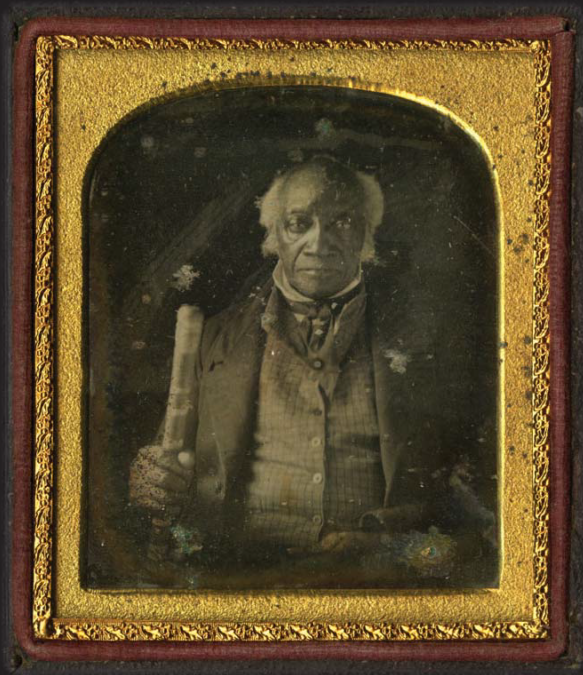
Discoveries at the African Burial Ground have put the spotlight on slavery in the North. This slave, named Caesar, outlived three masters on the Nicoll estate in Bethlehem, outside Albany, until his death at age 115. Daguerreotype, 1851, reproduced collection of the New York Historical Society.
In addition to revealing aspects of daily life, archeological excavations have also uncovered secrets of the city’s infrastructure. Many New Yorkers are not aware that much of Lower Manhattan is made up of landfill—land claimed from the East and Hudson Rivers, as well as low-lying inland areas filled to the height of the surrounding grade. Three blocks of new land were added along the East River shore, from the late 17th through the early 19th century. And four new blocks were added along the Hudson, beginning in the early 19th and continuing into the late 20th century. Excavating in landfill lets us learn about the landfill process itself and also find out what has been buried beneath it.
Some of the landfill came from the river bottom, and was probably dredged up from slips or alongside piers. Other fills are made up of clean soil, probably from grading down hills and excavating cellars. Others contain garbage that was probably picked up by local cartmen and then dumped into the landfill.
Although archeologists cannot link this trash to particular households or businesses in the city, it can reveal details about the city as a whole. During the yellow fever epidemics in the early 19th century, the city government passed regulations outlawing the dumping of organic material into the landfill. But then, as now, illegal dumping was prevalent—an excavation along the Hudson River revealed offal from butchering when such dumping was illegal.
Landfills and Bulkheads
New Yorkers used many different techniques to hold the landfill in place. Most common were bulkheads made out of planks or logs. But archeologists led by Joan Geismar working at 175 Water Street, a mid-18th-century landfill block, discovered an unusual form of bulkhead. There, an 18th-century merchant ship had been scuttled and sunk to form part of the bulkhead line. Another ship, apparently sunk for the same purpose, has been uncovered in the basement of two of the Water Street buildings owned by the South Street Seaport Museum.
This spring, archeologists working with the MTA on the expansion of the South Ferry subway station in Battery Park discovered part of a seawall. This wall, which also served as a battery and was mounted with cannon to protect the city in case of attack, was put into place between 1730 and 1766. Later, after the Revolutionary War, it was buried in the landfill that was added to the shoreline to create Battery Park. Archeologists uncovered around 600 feet of this seawall in four different areas; the wall is made of stone and is 8 to 10 feet wide. There are plans afoot for reconstructing parts of the wall as an exhibit in Battery Park.
Building on a Landfill
Archeologists have also discovered the different ways that people have dealt with the problem of building on landfill. If buildings are constructed on landfill before it has had a chance to settle, the buildings shift and crack due to the settling. One solution when building in shallow water involves resting the footing stones of the foundation walls directly on the natural river bottom.
Another technique consists of using spread footers—wooden structures laid on top of the landfill and made up of large beams placed on rows of planks set perpendicularly to the beams along the line of the building’s foundation wall. Builders then lay the stone foundation wall on top of the beams. This results in spreading the load of the building so that it in effect “floats” on top of the landfill. This was the most common technique in the 18th and early 19th centuries, when people were building structures out in what had been deep water in the East and Hudson Rivers.
The final technique (a variation of which we still use today) involves driving pilings down through the landfill to the underlying river bottom along the outline of the footprint of the building and placing large beams on top of the pilings. Builders then lay the stone footings of the foundation wall on top of these beams. This technique, which has only been discovered at one site in New York City, required an enormous amount of energy to execute before the invention of the steam-driven pile driver.
A Hidden History
Landfill also helped preserve what many consider the most remarkable site not only in Lower Manhattan but in the whole nation: the African Burial Ground, which was excavated in 1991-1992. This project began when the Federal government was about to build an office tower at 290 Broadway, a block north of City Hall Park.
Archeologists began this project as they always do—by studying the history of the site. They learned that during the 18th century, part of the Negros Burial Ground had been located on part of the parcel that the government was developing. But buildings on that part of the site in the late 19th and 20th centuries had had deep basements, so deep that archeologists assumed that the burial ground had been destroyed, except in the area of an old alley.
Archeologists checked the alley and found something completely unexpected: In the 18th century, the ground surface in the area of the Burial Ground was much lower than it is today. In the early 19th century, developers had added 20 to 25 feet of landfill that served as a blanket and protected most of the burials from being destroyed by subsequent development.
Over the next year, archeologists disinterred over 400 burials. The human remains were taken to Howard University, where they were studied by a team led by Michael Blakey, a physical anthropologist. A decade later, in 2003, the remains were returned to New York, and amidst great ceremony were reinterred in vaults right next to the office tower where they had originally been buried and had lain for over 200 years.
Important in Many Ways
The African Burial Ground is important in many ways. First of all, the presence of slavery in early New York City, and even in the north as a whole, has been denied in modern popular history. But 18th-century New York City had a higher population of enslaved Africans than any other city in the British-American colonies except for Charleston, South Carolina.
Throughout the English colonial period in the 18th century, enslaved Africans constituted from 14% to almost 21% of the city’s population, and in 1703 (the only year for which a detailed census survives for the period), 40% of the city’s households included slaves. The discovery of the burial ground brought home in no uncertain terms to today’s New Yorkers that Africans have had a deep historical presence in New York City from the time of the first European arrivals.
Secondly, because Africans and other members of the disenfranchised tend to have been ignored in written historical records, archeological study is the best way that we have to find out about their lives. The people whose remains were disinterred at the African Burial Ground constitute the largest sample of people of African descent from the colonial period that has ever been studied in the United States. Although we will probably never know the names of any of those whose remains were unearthed—we know them only by the numbers that were assigned to them as they were disinterred—the Blakey team has been able to write their biographies.
Burial 101
Several women were buried with infants resting in the crooks of their arms, presumably mothers who, along with their babies, died during or shortly after childbirth. And there was “Burial 101.” His coffin was unusual in that it was decorated with a design formed by brass tacks. The excavators initially thought that the design represented a heart, but as Blakey discovered, it might also be a Sankofa bird symbol used by the Akan people of Ghana and the Ivory Coast to mean “turn to the past in order to build the future.”
Unlike many of the other burials, Burial 101’s remains showed no signs of stress suffered during childhood. This suggested to the Blakey team that he had been born in Africa and spent his childhood in freedom. His front teeth had been filed into an hourglass shape, an African custom apparently not practiced in the Americas, more evidence suggesting an African past.
But, as Blakey put it, his vertebrae showed fractures that indicate that after his capture and removal to North America as an adult, “his forced labors were backbreaking in the most literal sense.” However, his burial in the decorated coffin—one of only four decorated ones found at the site—indicates that he enjoyed prestige in his community despite his forced labors.
A Spotlight on the Ignored
Many modern-day African-American New Yorkers have been guiding the direction of the African Burial Ground Project. Earlier this year President Bush designated the site a National Monument, and construction is underway on an African-inspired memorial that includes an ancestral libation court and chamber. An interpretive center is planned. Meanwhile, the New York Historical Society has opened a small permanent exhibit on slavery in New York, a smaller spin-off of an earlier landmark exhibit spurred by the Burial Ground discoveries.
As we all know, history is written by the victors. But as digs in New York have demonstrated, archeology can shine a spotlight on individuals and groups whose presence in the past is often ignored or even denied.
Diana Wall, professor of Anthropology at the City College of New York, is co-author (with Anne-Marie Cantwell) of Unearthing Gotham: The Archeology of New York City (Yale, 2001) and Touring Gotham’s Archeological Past (Yale, 2004).
A pitiless creditor, arson, and rivalry between medical schools: All play a role in the history of the Academy’s real estate. Learn about the Academy’s history, dating back to 1817.
Published July 1, 2006
By Simon Baatz
The New York Institution on Chambers Street, home to several intellectual societies, housed the Academy in the early 19th century.
In a pleasant twist of fate, its move Downtown returns The New York Academy of Sciences (the Academy) to a location just blocks away from where it was founded nearly 200 years ago. On January 29, 1817, a group of 21 men, almost all recent graduates or professors of the College of Physicians and Surgeons, met for the first time in a room of that institution, then located on Barclay Street near Broadway, close to City Hall.
Known (until 1876) as the Lyceum of Natural History, the group was open to anyone with an interest in natural knowledge. By contrast, the two leading scientific societies of the prior century, Philadelphia’s American Philosophical Society and Boston’s American Academy of Arts and Sciences, were limited to the socially prominent.
A Link to the Medical School
The Lyceum’s link to a medical school was no coincidence: In the early 19th century, science was not part of the college curriculum and there was no career structure for science per se, so medicine was the logical profession for young men with scientific curiosity.
With the aim of hosting public lectures on science and establishing a museum of natural history, the Lyceum needed more capacious quarters, a situation that sounds familiar today. And so, in April 1817, the Lyceum moved to a set of rooms in the New York Institution on the south side of Chambers Street directly opposite City Hall. The New York Institution was a cultural and intellectual mecca; the three-story building, on loan to New York’s literary societies from the City, housed the New York Historical Society, the New York Literary and Philosophical Society, the American Academy of the Fine Arts, and the Lyceum of Natural History.
Rapid Expansion
The Lyceum of Natural History was able to take good advantage of the City’s generosity; over the next two decades, the membership and activities of the society expanded rapidly. The growth of the Lyceum caused the members to imagine that they might own their own building, thus ending their dependence on a loan that could be revoked at any moment. In 1831 the Lyceum did eventually move from the New York Institution into a temporary home provided by the New York Dispensary at the corner of White and Centre Streets. But this also was unsatisfactory and in 1834 the members initiated a subscription campaign to raise the funds to construct a new building.
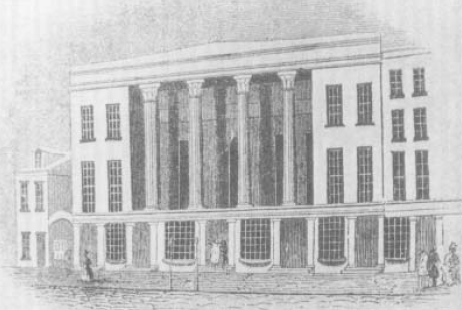
A safe harbor with NYU at the Stuyvesant Institute on Broadway.
Their efforts seemed successful; two years later the Lyceum moved into its handsome new home on Broadway between Houston and Prince Streets. It was a notable accomplishment for scientific endeavor in New York City. There was a large lecture room on the first floor and on the second floor, a spacious gallery for the Lyceum’s collections in natural history. The members set aside rooms for a library at the rear of the building and several small meeting rooms on the third floor.
But it was all too good to last. To buy the land and build, the Lyceum incurred debt, hoping to pay it off through ongoing donations. Then came the severe economic recession of 1837. That stalled fund-raising and soon the Lyceum had to take on more debt, for a total of $35,000. The members struggled valiantly to hold onto their building but to no avail; a creditor threatened legal action and in 1843 the Lyceum sold its home at auction for $37,000.
A Serious Blow
The loss of the Broadway building was a serious blow. For a while, a small group of dispirited devotees met in the home of the Lyceum’s president. But then the Lyceum found shelter under the wing of a successful upstart, the newly founded medical school at New York University. That school felt that a tie to the Lyceum would bring it prestige in its competition with the well-established College of Physicians and Surgeons, later to be part of Columbia University.
Less than a year after their own building was sold, the Lyceum, along with its magnificent natural history collection and its superb library of books, moved to the NYU medical school’s home at the Stuyvesant Institute on Broadway between Bleecker and Bond Streets. In 1851 the Lyceum moved with the medical school to a new building on the outskirts of the city at 14th Street close to Third Avenue.
But 15 years later, disaster struck. The NYU medical school was adjacent to the Academy of Music, a large opera house on the corner of 14th Street. On the night of Monday, May 21, 1866, an arsonist set a fire to the rear of the Academy of Music. The flames quickly spread and soon the entire block on 14th Street between Irving Place and Third Avenue was ablaze.
The NYU medical school, along with the Mott Surgical Museum and the collections of the Lyceum of Natural History, burned to the ground despite the best efforts of New York City firemen. A collection of birds donated to the Lyceum by John James Audubon, a mineralogical collection from the New York State Geological Survey, and the ichthyological specimens of Samuel Latham Mitchill, an energetic founder of the Lyceum—all vanished in the flames.
Another Severe Setback
The loss of the Lyceum’s collections was a severe setback to the cause of science in New York; it was not certain that they would ever be replaced. But ironically, the loss cleared the way for the creation of a new institution, the American Museum of Natural History (AMNH). Thanks to the generosity of New York City and State, and of the city’s wealthiest citizens, the AMNH opened on Central Park West in 1874.
Its establishment meant a circumscribed role for the Lyceum of Natural History—it would no longer attempt to rebuild its own museum. But the creation of the AMNH had its blessings; renamed the New York Academy of Sciences, the former Lyceum moved into rooms in the museum’s capacious building on Central Park West and assumed a modest, yet significant, role as a spokesperson for the scientific community in New York City.
In the early decades of the 20th century, the Academy organized a comprehensive survey of the natural history of Puerto Rico, a project that coincided with the research of such notable members as Franz Boas and Nathaniel Lord Britton.
Rising from the Ashes
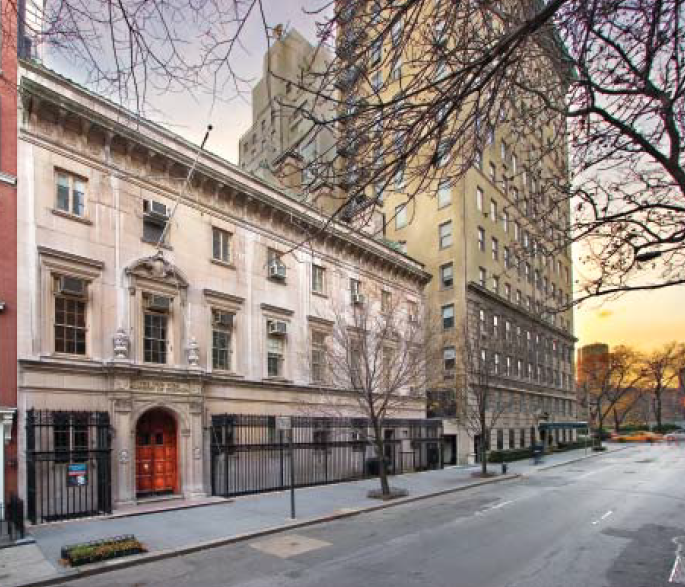
Farewell to the magnificent Woolworth Mansion on East 63rd Street. Courtesy CBRE.
But it was Eunice Miner, a former researcher at the AMNH who was executive secretary of the Academy from 1939 through 1968, who did more than any other member to revitalize the Academy and to secure it a permanent home. In her rounds of New York philanthropists, Miner attracted the attention of Norman Woolworth, scion of the family that owned a network of chain stores. Woolworth was so impressed that, on learning of the Academy’s search for a new home, he donated his own ornate five-story mansion on East 63rd with the sole requirement that the Academy pay all the necessary legal fees.
It was a spectacular gift. The Academy, the oldest science organization in New York City, could now boast a magnificent home—and a permanent measure of independence and self-sufficiency. After many happy years, and after much careful consideration, Academy members voted to sell the mansion in 2005. But in the other whimsical twist of fate, the Academy’s new home looks down upon the magnificent Gothic spire of the landmark Woolworth Building, which housed the Woolworth company for 80 years and is now being converted into residential apartments. And, of course, the proceeds from the sale of the mansion have resulted in an endowment that will be the bulwark of the Academy for years to come, back Downtown.
Simon Baatz, who teaches American history at George Mason University, is the author of Knowledge, Culture, and Science in the Metropolis: The New York Academy of Sciences 1817-1970 (1990). His most recent book, For the Thrill of It: The Murder that Shocked Chicago, a history of the Leopold-Loeb case, will be published by HarperCollins in 2007.
In his first completed project in New York, the Spanish-born architect Santiago Calatrava designed a time capsule meant to be opened in the year 3000. Calatrava’s bulbous, polished metal box, which stands outside the American Museum of Natural History, was clearly inspired by nature. But it would take experts from several departments of the museum to pin down all the referents. Some observers see a seashell; others, a flower or a seedpod; still others, an elaborate crystal. Animal, vegetable, or mineral?
In a world where most buildings are simply containers, their forms influenced only by other buildings, Calatrava’s blatantly biomorphic structures have made him, at 54, the most accessible of the current generation of superstar architects.
Most of Calatrava’s structures— bridges, airports, train stations, and museums—are in Europe, but as many as three more could arrive on the Lower Manhattan skyline by the end of the decade. The largest (and the one most certain to be built) is the $2.2 billion PATH terminal at Ground Zero, scheduled to open in 2009.
Hands in Prayer? Or Birds in Flight?
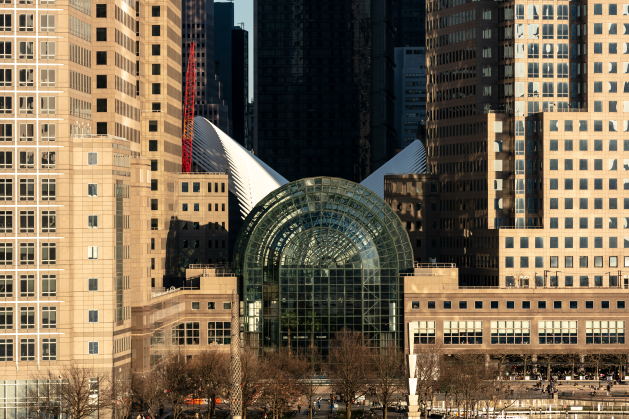
The terminal, just east of where the Twin Towers stood, will be topped by a pair of curved canopies of glass and steel that reach high into the sky as decoration. A hydraulic system will allow the canopies to rise, creating an opening about 35 feet wide at its center, bathing the huge concourse in sunlight.
Some visitors will see the canopies as hands interlocked in prayer; others will see birds in flight (to heighten the allusion, Calatrava released a dove into the air when he unveiled his design). Or perhaps it isn’t the bird but the birdcage, opening to the sky in a symbol of freedom. The building has been particularly welcome news at Ground Zero, where architectural squabbles—some growing out of forced collaborations— continue to make headlines.
Calatrava collaborates with no one, and it’s just as well, since he has too many ideas already. Born in Valencia, he speaks nearly a dozen languages and sometimes uses all of them—citing the works of philosophers, composers, poets, and painters—in a single sentence. He has no compunction about mixing metaphors in his buildings; how else can he hope to get a fraction of his ideas built in just one short lifetime?
Thirty years ago, after receiving an undergraduate degree in architecture, Calatrava moved to Switzerland to study engineering. He quickly developed a style all his own. His student work resembled the streamlined forms of one of his idols, Robert Maillart, an early 20th-century designer of bridges in the Swiss cantons. Maillart’s goal was to remove excess material, which resulted in concrete bridges so thin, they appeared to be stretched almost to breaking.
Bridging Twist and Turn for Decorative Effect
But unlike Maillart’s strictly economical structures, Calatrava’s bridges twist and turn for decorative effect. Not surprisingly, the great Catalan architect, Antonio Gaudi, who rarely used right angles and whose buildings ornament Barcelona, is another one of Calatrava’s idols.
Since the advent of modernism, architects have almost universally tried to explain form as the direct result of function, as if anything less rational were suspect. But Calatrava has joyfully shaken off that stricture. His design for a music school in Switzerland uses five exposed steel cables. Calatrava has said “I chose five, even knowing that I could have used only two, because music is read over five lines.”
More recently, he designed an opera house for Tenerife, in the Canary Islands, with a vast curved wing that resembles a crescent moon, a wave, an orchid, or about half a dozen other forms from nature. Asked about the origins of the wing, which significantly increased the cost of the building, Calatrava didn’t pretend that it served any practical purpose—except the purpose to inspire.
Lately, the architect has been creating buildings that don’t just look ready to move; they do move. Shortlisted to redesign the Reichstag in Berlin, Calatrava proposed a glass dome that would open when the Bundestag was in session, symbolizing openness in government. That design was never built. But in 2001 his ideas took flight in an entry pavilion at the Milwaukee Art Museum. There, a roof that resembles a bird’s wings opens to the sky in good weather. Getting the wings built was tricky—after long delays and huge cost overruns, Calatrava had the pieces assembled in Spain and flown across the Atlantic in a giant Soviet transport plane. Even then, there were minor problems with the mechanism.
A Secular Version of Gothic Cathedrals
In the end, Milwaukee garnered an important civic symbol—and even skeptics find the building’s now-reliable daily displays irresistible. The expense is of little concern to Calatrava’s fans, who see his buildings as the modern, secular version of Gothic cathedrals: uplifting symbols of humankind’s highest aspirations.
Private developers in the U.S. are just beginning to see whether Calatrava’s panache can produce profits. If completed in Chicago, his Fordham Spire, a mixed-use tower that twists a few degrees with every floor, would be the tallest building in the United States. For South Street in Lower Manhattan, Calatrava has designed a tower of 45-foot cubes hanging from cables—a plan the architect worked out with blocks of wood and marble.
Each cube would contain a single “apartment” priced at $30 million or more. He has also designed a gondola that could bring visitors from Manhattan to Governors Island—a pro bono project that he accepted at the request of city and state officials hoping to spark interest in the island’s redevelopment.
There’s only one problem with a Calatrava gondola: There had better be a very special building at the other end, or the trip will be an anticlimax.
An intrepid neuroscience postdoc at Cold Spring Harbor Laboratory heads downtown for museums, fine dining, and rock ‘n roll.
Published July 1, 2006
By Linda Wilbrecht
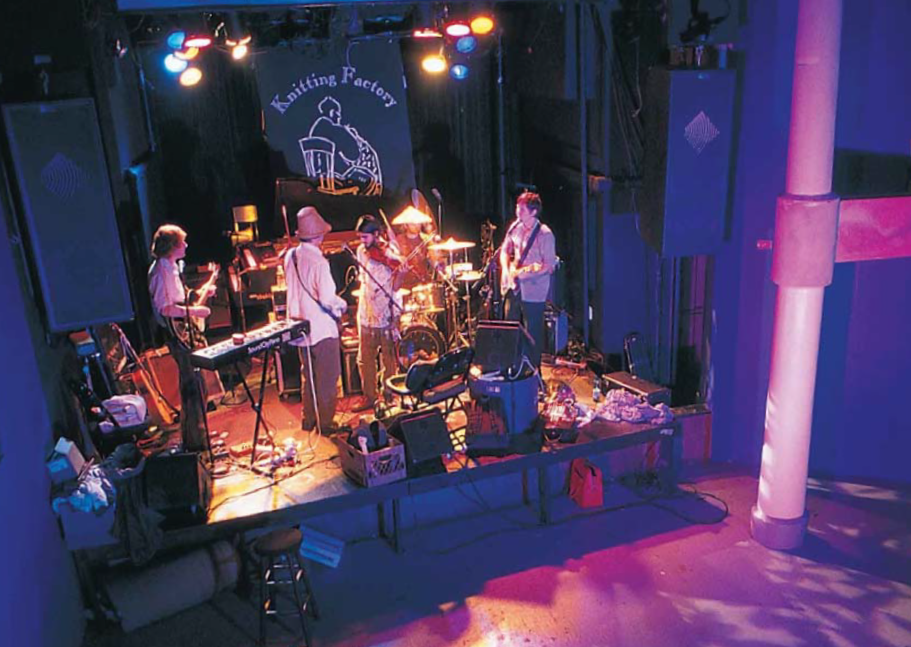
Nighttime fun at the Knitting Factory. Image courtesy of Update magazine.
To me “going downtown” has always meant “good food.” This is especially true in Manhattan, where some of the best restaurants in New York City are concentrated below Canal Street.
I asked two friends to join me at the Financier Patisserie, near Hanover Square, ready for a day of exploration downtown. Pouring rain made the cobblestones and pubs outside on Stone Street look more like London than New York. The Financier probably gets noisy at lunchtime on weekdays with its green and white tiled walls and floors, but this Sunday morning it was blissfully quiet, every customer sitting on a French brasserie chair rapt in a news- paper with a bowl of cappuccino resting on a saucer.
Each saucer also held a small golden cake, the traditional French financier made with almonds and egg whites. I scanned the pastry case, trying to decide between éclairs, tarts, and crème brûlées. I settled on the raspberry éclair, its pastry lid held aloft by fresh and perfect berries sitting in cream. Not my usual breakfast, but this felt like a special occasion.
Properly sugared and caffeinated, we moved on to the National Museum of the American Indian. I was surprised I had never noticed it before, installed inside the ornate U.S. Custom House at Bowling Green. I was pleased to find admission was free; the museum is part of the Smithsonian.
From Museums to Shopping
The collection represents a vast number of tribes from the Americas, and includes clothing, pottery, basketry, carvings, even saddlery. I was struck by a model tipi, perhaps a planning model, perhaps a toy. It is made of deer hide, and painted riders dance across its surface with all the lightness of a Chagall. The Born of Clay exhibit showcases pots, jars, and storage vessels spanning 5000 years.
Several water jugs are decorated with paintings of deer with arrows running from their mouths to their bellies. Others are in the shape of trophy heads and maize gods. Contemporary potters are also well represented. On a simple gray basin made in 1986 by Peter Jones, an Iroquois potter, three clay singers emerge from the lip, looking like Edvard Munch figures beating a drum.
By the time we were back out on Bowling Green, the clouds had cleared. My friends were planning a trip to Hawaii, so they needed sandals and a new camera. We were in the perfect neighborhood to shop for both. At Century 21, New York’s most famous discount warehouse (located at 22 Cortland Street), we went elbow to elbow with young women pawing metallic purple Manolo Blahnik stilettos, marked down from $400 to $200. We found our sandals for a more reasonable price.
Passing quickly through the rest of the store, we petted 400 thread-count sheets and racks of silk ties, some garish, some at- tractive. Then we headed just a few blocks away to J&R, the computer and electronic superstore at Park Row (between Beekman and Ann Streets), to scope out cameras. I priced some wireless software, but we all decided to order online, in order not to burden ourselves with more packages for the rest of the day.
Beers and Parks
Now quite hungry, we wandered a few blocks north to Duane and West Broadway where we found Blaue Gans, a festive and relaxed Austrian and German restaurant decorated by a hundred or more colorful art posters. The sunlight poured through the windows onto tall glasses of slightly cloudy lemon-colored hefe weisse, a wheat beer we used to wash down our starters of brown bread and burenwurst.
For lunch we shared a superb Wiener schnitzel with lingonberries, as well as a salty goulash with buttery spaetzle. Although we were full, our curiosity led us to the dessert menu and we were thrilled to discover the best apple strudel any of us had ever tasted: crispy crust and perfectly cooked apples, not too cloyingly sweet or runny.
We decided to walk off our lunch along the promenade at Hudson River Park. Then, we ducked into the World Financial Center Winter Garden and had a look at the palm trees and the display Recovery to Renewal, showcasing plans for the Freedom Tower and 9/11 memorial at the World Trade Center site. We admired models of the winning designs and debated their superiority to the alternatives, also shown, a discussion rendered more relevant by the fact that cost overruns are now forcing a rethinking of the memorial design.
The Museum of Jewish Heritage
Further south on the river path we came to the Museum of Jewish Heritage at 36 Battery Place. From the outside I had always thought this museum was quite small, but today I realized the rotunda is connected to the new and much larger Morgenthau wing that juts from the waterfront off into Battery Park City. If you want to see the whole exhibit you should schedule at least three hours.
The Museum aims to honor the victims of the Holocaust by celebrating their lives, and affirming today’s vibrant world-wide Jewish community. Everything in the museum is unusually personal, often bearing the original owner’s name and country of origin. I was particularly struck by the dented trumpet of Louis Bannet, “the Dutch Louis Armstrong,” who managed to survive for three years as a musician at the Auschwitz- Birkenau concentration camp.
Above the instrument hangs a quote from Bannet: “This wonderful horn kept me alive.” On the lower level is a large exhibit on Jewish culture, illustrated by videos of synagogues around the world and religious, ceremonial, and everyday objects. A modern Sukkah, or harvest shelter, painted by Aryeh Steinberger with scenes of Budapest and Israel, caught my eye with its rainbow of colors.
The City’s Nightlife
For dinner we wanted to eat outside with a water view. Our options included Steamers Landing, Liberty View, and Southwest NY up near the World Financial Center, but we settled on the elegant Gigino at 20 Battery Place. We sat under a brick archway on the terrace with a direct view of the Statue of Liberty.
As we sipped Italian wine, the sun was setting over the skyscrapers of Jersey City and an enormous cruise ship floated by like an iceberg silently headed out to sea. It dwarfed the little orange Staten Island Ferry as they crossed paths far in the eastern reach of the harbor. I eyed the osso buco di pollo, but decided instead on the duck breast over arugula with pineapple carpaccio.
A day in New York also needs nightlife. We saw singles sitting outside flirting at Merchants NY (90 Washington Street). On Greenwich Street, women in stylish designer clothes were chatting intensely at Yaffa’s outdoor tables (353 Greenwich). We decided we wanted music, so cut east to Leonard Street, near Church, to the Knitting Factory, which has three different performance spaces. It used to offer jazz and experimental music, but now tends to cater to a younger rock and pop audience.
The street outside was lined with young men with shaved heads and Mohawks. We were carded. The band in the main room tonight was the Horrorpops, led by an upbeat young woman in a strapless dress who enthusiastically swayed with an electric double bass. The whole room “pogo-ed” up and down very happily and we joined in until our feet hurt and it was time to go home.
Lower Manhattan was once notorious for its lack of parks and greenery. As the oldest part of New York, it was built up when most of Manhattan Island was still countryside and wilderness. Who needed open spaces when all around was one big open space? As the years went by, the countryside was developed, Downtown’s buildings grew ever larger and its streets ever more congested.
Fortunately for us, the twenty-first century is shaping up as a golden age for open space Downtown. From government-funded baseball fields to the re-landscaped riverside public plaza at privately owned 55 Water Street, a multitude of scenic options beckon those who wish to catch some fresh air and sunshine before or after a meeting. The recently opened 7 World Trade Center, new home of The New York Academy of Sciences (the Academy), is an excellent starting point for a stroll through some of Downtown’s finest outdoor attractions.
Battery Park City and Hudson River Park
Two blocks to the west is Battery Park City, a mixed-use complex under development since the 1980s on Hudson River landfill. (Please bear in mind that this is “Battery Park City,” while “Battery Park” refers to a separate park, which we will visit later, at the very bottom of Manhattan Island.)
It’s a good thing Battery Park City wasn’t built in the 1970s, as was first planned. It would have looked like any gigantic, sterile high-rise housing complex built under the ill-conceived “urban renewal” rubric. In the years of waiting, architects and planners changed their approach to development. They started to stress recreating the charms of traditional cityscapes, with buildings of modulated scale and warm materials along real streets, together with ample outdoor space for recreation and relaxation.
Combining Utility and Aesthetics
New Yorkers are much taken with the waterfront parks and two-mile-long esplanades of Battery Park City, which anchor the southern end of Hudson River Park (and will eventually stretch unbroken all the way north to 59th Street). As you enter from Vesey Street, turn right to see Battery Park City’s northernmost jewel. Nelson A. Rockefeller Park is named for the New York governor (and U.S. vice president) who first conceived of Battery Park City.
This park was designed by a leading landscape architecture firm, Carr, Lynch, Hack & Sandell, as a park for active sports and recreation that was also pleasing to look at—a rare combination. At the northern end a children’s playground sports whimsical bronze sculptures by the popular Tom Otterness. “In this smallish utopia,” says one critic, “safety regs and aesthetics can coexist.” One also sees a gazebo inspired by Greek temples, designed with great care by Demetri Porphyrios, one of the leading classical architects in the world today. Broad lawns slope westward. The park is used for basketball, volleyball, frisbee, and handball, as well as running and biking.
The World Financial Center
Continuing south, one comes to the World Financial Center office complex, at the heart of Battery Park City. Headquarters of American Express, Merrill Lynch, and Dow Jones cluster around the greenhouse-like Winter Garden. Within is a space as big as Grand Central Terminal’s concourse. With its sixteen giant palm trees, benches, and sunlight, the Winter Garden is by day a reposeful haven for office workers.
On nights and weekends, it offers year-round cultural programming and performances. Before September 11, 2001, the grand stairway at the east end led to an aerial bridge over West Street to Six World Trade Center. Not only was that bridge destroyed on that terrible day, so too was the Winter Garden itself. That it was rebuilt and reopened within a year was indescribably heartening to New Yorkers. Today the east end has been redesigned as a viewing platform from which one may look directly down upon Ground Zero.
To the west outside the Winter Garden is World Financial Center Plaza, looking out on a boat basin and the Hudson River. Designed by landscape architect M. Paul Friedberg with artists Scott Burton and Siah Armajani, the plaza overflows with cafe tables and a variety of seating for eating take-out food, making it one of Manhattan’s most pleasant spots for weekday lunch in fine weather.
Beyond Battery Park City
Farther south, beyond Battery Park City’s streets of apartment houses opening off the esplanade, is the unusual South Cove Park, a collaboration of architect Stanton Eckstut, landscape architect Susan Child, and environmental artist Mary Miss. It is in part a recreation of the original 17th- and 18th-century Hudson River shoreline, replete with the rocks, plants, and wooden piers that one might have then encountered. In addition, the artful assemblage of rocks and exotic plantings screens a rear section of the park that is deliciously secluded. It in turn leads south to a curious, freestanding, elevated platform of steel, shaped like the crown of Lady Liberty. From this platform, one can look directly out at the iconic statue itself.
Continue south, past the Museum of Jewish Heritage, which opened in 1997 and was expanded in 2003. Within the museum is an outdoor, contemplative “Garden of Stones” by artist Andy Goldsworthy. Beyond the museum is the southernmost of Battery Park City’s parks, Robert F. Wagner, Jr. Park, named for a three-term mayor of New York. Here are expansive lawns that on warm afternoons are as dense with sunbathers as any spot in Manhattan.
Set among the lawns are granite-rimmed “container gardens” of lavish floral displays created by renowned public gardener Lynden B. Miller, whose designs evoke the shimmering foliage in French impressionist paintings. The large arched structure at the southeast corner of the park has, in its base, a cafe and rest rooms. Climb to the top for splendid views of the gardens, the sunbathers, and the water.
Battery Park
Behind the Wagner Park structure one may follow the sidewalk to the south and east to enter Battery Park. Over the last couple of years, this city park has undergone extensive renovations overseen by the Battery Park Conservancy, a group dedicated to reestablishing it as one of the outdoor treasures of New York. The park has several interesting features. Leading from its northeast entrance (off of Broadway) on a southwest diagonal to the park center is a formal, tree- and bench-lined allée of a kind one seldom sees in New York, where our landscape architecture stems from the British 18th- and 19th-century romantic tradition that hated straight lines.
The French, on the other hand, loved their “Cartesian” straightaways, as did New York master builder Robert Moses when he redesigned Battery Park after World War II. The allée leads to a circular stone structure, Castle Clinton, that was built as a fort just before the War of 1812 to protect the city from a British attack (which never came). When built, the fort was on an island in the water; later the space between it and the Manhattan shoreline was filled in. The fort served for many years as the New York Aquarium, now located in Brooklyn’s Coney Island. Today Castle Clinton serves as the ticket booth for trips to Ellis Island and the Statue of Liberty.
Also at the southwest end of the allée stands the great bronze sphere that sculptor Fritz Koenig designed for the plaza of the World Trade Center in the 1970s. Though badly dam- aged in the terrorist attacks, the sculpture nonetheless was reinstalled in Battery Park, serving as an unofficial 9/11 memo- rial until the memorial park on the World Trade Center site is completed.
The Southern Tip of the Park
At the southern tip of the park, along the water, sprout new fascinating gardens designed by the Dutch gardener Piet Oudolf. Oudolf eschews commonly used flowers like roses and favors a wild and natural look incorporating flowering plants such as sea holly, anemones, and astilbes, as well as wild grasses.
Along the sea wall, a long ribbon of flora is a “Garden of Remembrance”—a tribute to the survivors of 9/11 and a place of solace for all who seek renewal. Wider swirling flower beds surround sitting areas that also include snack kiosks. Oudolf is as famous as a rock star in his native country and, with works by him, Miller, and Child, this stroll showcases some of today’s foremost landscape gardening talent.
Continuing south and east round the waterfront railings, one comes to an austere octet of large granite slabs inscribed with names. Dedicated by President Kennedy in 1963 (his last public speech in New York), the East Coast Memorial honors U.S. servicemen who perished in the Atlantic during World War II.
From Worst to Best
The northeast corner of Battery Park leads to Broadway and Battery Place. A block west on Battery Place, at Greenwich Street, is a noisy, polluting, ugly set of facilities built in the 1950s to serve the Brooklyn-Battery Tunnel: a big ventilation building, a big garage, and a great gash of car access ramps repellent to any walker. That’s why the Lower Manhattan Development Corporation and the New York City Department of City Planning, working with some of the nation’s best designers, plan a complete overhaul of this southernmost part of Greenwich Street—once, unbelievably, the ritziest residential thoroughfare in the city.
Among much else, the gash will be decked over—much as the train yards to the north of Grand Central Terminal were once decked over to create lower Park Avenue. Atop the deck will go a new, two-and-a-half-acre park that promises to transform one of downtown’s worst spots into one of its best. The timetable is uncertain, but will soon come into focus as construction proceeds on other big downtown projects such as the World Trade Center site and the Fulton transit hub.
Up Broadway to City Hall
Broadway is New York’s main street. At its foot stands the majestic edifice of the former U.S. Custom House that in turn faces the city’s oldest public open space, Bowling Green. The compact oval, once the focal point of a neighborhood of mansions and now loomed over by several of the city’s handsomest old office buildings, got its name from the games of lawn bowling that were played on the spot in Dutch colonial times.
In 1776 a mob of New Yorkers, fired with revolutionary zeal, broke through a protective iron fence to topple the equestrian statue of King George III that stood in the center of the green. Our city’s most remarkable relic of revolutionary times is that iron fence, the very one still surrounding Bowling Green. This park itself has also had a recent overhaul that has added to its charm.
Walk north on Broadway to Wall Street. To one’s left is Trinity Church. The church of today, a lovely Gothic revival edifice from the 1840s, is the third Trinity Church on this site. One may step inside at any time during the day for quiet meditation. The surrounding churchyard, with its picturesque gravestones, dates to the 17th century. On the southern end a granite obelisk marks the burial site of Alexander Hamilton.
St. Paul’s Chapel and City Hall Park
Farther north, at Fulton Street, is St. Paul’s Chapel and its surrounding churchyard. Built in the 1760s, it is Manhattan’s oldest standing church. St. Paul’s miraculously survived the Great Fire of 1776, was George Washington’s church when he resided in New York as the first president of the United States, and miraculously survived the destruction of the World Trade Center, which stood directly across Church Street.
In the days after September 11, 2001, the chapel served as a place where rescue workers could take a break, get something to eat, and listen to soothing live chamber music. The chapel then became the magnet for impromptu outpourings of grief and love in the form of banners, signs, flowers, and objects of all kinds, many of them now preserved in exhibits throughout the chapel interior.
City Hall Park is diagonally across Broadway from St. Paul’s. At the park’s north end is the beautiful Louis XV-style City Hall completed in 1811. Prior to its construction, this park was known as the Commons. In the 1990s it was extensively refurbished, with new pavings, plantings, and benches, and the return of an extravagant Victorian 1870s fountain, original to the park, which had spent sixty years in Crotona Park in the Bronx. In addition to being a fine place to relax, the park is a good spot for politician-spotting, as it is a frequent backdrop to Mayor Bloomberg’s photo ops.
After taking in these sights, one may walk west on Vesey Street to the starting point at 7 World Trade Center. Central Park may be more famous, but Downtown’s open spaces are among the most varied and interesting urban spots anywhere.
Francis Morrone, an art critic and architectural historian, is the author of five books including An Architectural Guidebook to Brooklyn (Gibbs Smith, 2001).
According to Leonard Susskind, the universe we know might be just one crude but carefully balanced case among a host of different universes, each with its own physical laws.
Published June 9, 2006
By Sheri Fink, MD, PhD
Sponsored by: The New York Academy of Sciences and Little, Brown & Co.
Stanford University professor Leonard Susskind has had an illustrious career in theoretical physics. He is known as a “father of string theory”—the idea that everything, at its most minute scale, is made of combinations of vibrating strings. String theory began as a search for a unified theory capable of reconciling quantum field theory with general relativity, but has expanded in recent years and has caused a major shift in theoretical and experimental physics.
In his recent popular science book, The Cosmic Landscape: String Theory and the Illusion of Intelligent Design, Susskind addresses some startling recent developments in string theory, and on April 10, 2006 he took the podium as a part of the Academy’s Readers & Writers series to discuss why these ideas are making such waves in the physics community.
Susskind’s book deals with the meeting of two controversial ideas. One is the anthropic principle, which suggests that our corner of the universe is perfectly tailored to our existence—otherwise we would not be here to observe it. The other is string theory’s prediction of the “multiverse,” a giant, diverse universe with a rich landscape of “pocket universes,” each governed by its own laws of physics. The expansive possibilities of the multiverse provide a plausible explanation for the unlikely perfection of our own, relatively small, universe.
The Not-So-Elegant Universe
The array of elementary particles that determine the properties of atoms has grown in recent years. Electrons, photons, quarks, gluons, Z bosons, and neutrinos are just a few of the many elementary particles thought to exist. “It’s a rather large list,” said Susskind. “It’s hardly the kind of list that a minimalist would have invented.”
There is no particular reason known for the existence of these particles. Some of them, however, are requisites for life. For example, atoms need to contain electrons, which are held in the nucleus by the force of photons jumping back and forth from the electron to the nucleus. The nucleus, in turn, is held together by gluons jumping back and forth between quarks.
“To me the whole thing does not look like the product of an elegant mathematical theory,” said Susskind. “It doesn’t look like beautiful numbers like e or pi or √2; instead, it looks like a Rube Goldberg machine! It looks like something that was designed by a rather poor engineer for some purpose. While it works, it’s hardly elegant.”
Aside from particles, the existence of certain forces has allowed life to evolve. Some seem finely tuned such that if the values were slightly bigger, life could not exist. Take gravity, for example—a force 42 orders of magnitude weaker than the electrical force. If it were even one order of magnitude stronger, “the universe would expand and recontract in a much shorter time than it would take for evolution,” said Susskind. “Instead of being filled with galaxies, the universe would be filled with black holes. Even if an earth did form, it would not last very long. It would just have been sucked right into a black hole.”
The Puzzle of the Cosmological Constant
The weakness of gravity, the existence of just the right motley set of particles to form the building blocks of life—are these facts enough to cause physicists to abandon their quest for mathematical elegance and shift to embrace the anthropic principle? No, said Susskind, there is still the possibility that they arose by chance. “But there is one fine-tuning of nature, one accident, one conspiracy we might call it, which is so extraordinary that nobody thinks it’s an accident.”
Even the greatest of scientists have been prone to second-guessing. Einstein was not immune. He posited the existence of the “cosmological constant”—the energy density of empty space, which, if positive, gives rise to a repulsive pressure that counteracts gravity. While he later abandoned the concept, it did not disappear completely. “This is a case of Pandora’s Box,” said Susskind—once the lid had been raised on the idea, scientists could never explain it away.
The cosmological constant is also known as vacuum energy. In quantum theory, the continuous agitation of a vacuum creates energy, leading to the outward pressure that the cosmological constant describes. However, when physicists combine the theory of elementary particles with the theory of gravity and use quantum field theory to calculate the cosmological constant, they derive a gigantic value; if it existed, such a large amount of energy would conflict with astronomical observations and would be disastrous. “It would be enough not only to shatter the earth, it would be enough to shatter every atom and molecule,” said Susskind. “Every nucleus, every quark would go flying apart.”
More Mystery Around the Cosmological Constant
Nothing in known physics explains why the cosmological constant is not the size that quantum field theory predicts it to be. Physicists at first surmised that other particles and constants contributing to the calculation of vacuum energy must cancel out the large value, leading to a cosmological constant that is exactly zero.
In 1987, physicist Steven Weinberg proposed another idea. Physicists believe that gravity forced the bland early universe to differentiate into planets and galaxies by squeezing and contracting slightly denser regions of matter and sucking mass out of less dense regions. Weinberg showed that the cosmological constant must be extremely small—on the order of 10−120 units (joules/cm3)—to prevent a repulsive force from counteracting this process.
“A cosmological constant even ten times bigger than this would have been destructive and deadly to life,” says Susskind. “It would have prevented the creation of the home of life—stars, galaxies, and especially planets.” Using the anthropic principle, Weinberg made a prediction. While life depends on the cosmological constant being smaller than 10−120 units, the value does not need to be very much smaller than that. So, he predicted, if the value of the cosmological constant is determined by the existence of life, then its 121st digit will be a number other than zero.
Several years ago, the 121st decimal place of the cosmological constant was measured through cosmological observation; its value appears to be 2 instead of 0. To Weinberg and to Susskind, this confirmation of the earlier prediction is the best support for the anthropic contention that “some features of our own existence determine certain things about the laws of nature.”
Explaining the Appearance of Design
What else, besides an intelligent designer, could have tailored the universe to fit the needs of planets and people, including unlikely features that defy current mathematical prediction? Susskind’s answer lies in string theory—a mathematical model of nature to which many, if not most, physicists now subscribe.
String theory makes sense in 10 dimensions of space, not our usual three. The extra six-dimensional spaces are known as Calabi Yau or CY spaces. “These spaces control all the properties of the world in a large scale,” said Susskind.
“The (elementary) particles have to be able to fit into these spaces. If they fit, then they’re allowable particles. If they don’t, they’re not allowable. All the laws of nature and string theory are controlled by these features of these CY spaces.” There are about a million different CY spaces, or “manifolds.” Each one can be decorated with “little lines of flux that can wind around them in many, many ways,” said Susskind. “When you start counting up all the possible ways the CY manifolds can be decorated with these fluxes, the numbers are humongous.”
Thus, string theory allows for a landscape of possible universes “so rich that it appears there may be as many as 10500 different environments that can be described.” The number of possibilities is so large that it can compensate for the incredible unlikelihood of the cosmological constant being so exceptionally small.
Do these alternate universes actually exist outside of the realm of possibility, or is the universe everywhere the same as it is here, in all the places we can measure it? Nobody knows the answer yet. What is known is that the universe is far wider than the 10 billion light years across that it was once assumed to be.
Inflationary Cosmology
The school of inflationary cosmology holds that the universe is expanding at an increasing rate. An exponential and perpetual expansion would be possible if, as the universe expanded, new bits of space formed to fill interstitial spaces. The theory of eternal inflation suggests that as the universe grows, bubbles of alternate types of space appear.
“If a bubble is too small, it will melt back into the environment,” said Susskind. “If it happens to grow a little bit, it will then start to really expand.” Within that expanding bubble, more bubbles will form. “It creates this enormous diversity of different properties and in some tiny, tiny fraction of it, perhaps a comfortable little green neighborhood appears where life can exist. That’s where we are.”
Because physics has long posited a world controlled by elegant mathematics, the anthropic principle and the multiverse represent a fundamental shift in the way that many physicists and cosmologists view their fields. In fact, Susskind’s theories have drawn the ire of some prominent scientists. Stanford professor Burton Richter, winner of the 1976 Nobel Prize in Physics, has accused Susskind of having “given up” on the effort to find a theory that explains all the properties of fundamental particles and forces, bringing to an end the “reductionist voyage that has taken physics so far.”
Creationism
Religious figures, on the other hand, abhor Susskind’s views because they contradict the idea that God created the universe. The Roman Catholic cardinal archbishop of Vienna, Cardinal Christof Schonborn, wrote in The New York Times that the multiverse hypothesis was “invented to avoid the overwhelming evidence for purpose and design found in modern science.”
Susskind, for his part, seems to relish the controversy. “Paradigm shifts, serious ones, raise people’s anger, raise people’s passion. They are threatening,” he said. “The anger, the passion, the fighting spirit that goes with these questions is extremely intense.” The fact that Susskind’s ideas have aroused such emotion reflects the great attention that is being paid to this new way of looking at the universe.
About the Speaker
Leonard Susskind, PhD, grew up in the South Bronx, where he worked as a plumber and steam fitter during his early adult years. As an engineering student at the City College of New York, he discovered that physics was more to his liking than either plumbing or engineering. He later earned a PhD in theoretical physics at Cornell University.
Susskind has been a professor of physics at the Belfer Graduate School in New York City and at the Tel Aviv University in Israel. He has also been the Felix Bloch Professor in theoretical physics at Stanford University since 1978. During the past forty years he has made contributions to every area of theoretical physics, including quantum optics, elementary-particle physics, condensed-matter physics, cosmology, and gravitation.
In 1969 Susskind and Yoichiro Nambu independently discovered string theory. Later on, Susskind developed the theory of quark confinement (why quarks are stuck inside the nucleus and can never escape), the theory of baryogenesis (why the universe is full of matter but no antimatter), the Principle of Black Hole Complementarity, the Holographic Principle, and numerous other concepts of modern physics. He is a member of the National Academy of Sciences and the American Academy of Arts and Sciences.
Sheri Fink is the author of War Hospital: A True Story of Surgery and Survival (PublicAffairs, 2003). Fink obtained her MD and PhD in neurosciences at Stanford University and now, based in New York, writes about medicine, public health, and science for a range of publications.
Author and former scientist Ellen Daniell discussed how participating in a small problem-solving group can lead to success in academic and other careers.
Published May 25, 2006
By Leslie Knowlton
Sponsored by: The New York Academy of Sciences and Yale University Press.
Almost 30 years ago, Ellen Daniell, then an assistant professor of molecular biology at the University of California, Berkeley and the first woman in her department, joined a small bimonthly group of faculty, staff, and postdocs formed to reduce isolation and foster solutions to professional and other problems, including gender equity issues.
Today she credits the seven-member “Group” of high-achieving women, several of whom are well-known scientists, for seeing her through several difficult transitions, including being denied tenure at Berkeley, establishing herself in another career in business, and retiring from that to be a writer and enjoy her own interests.
In her book, Every Other Thursday: Stories and Strategies from Successful Women Scientists, Daniell tells the story of her experience with Group in an effort to help others form similar alliances. In her March 14, 2006, talk at The New York Academy of Sciences (the Academy), she explained the effect of Group on her life, saying, “I strongly believe I have made more satisfactory decisions and choices because I’ve talked out the possibilities, as well as the frequently apparent impossibilities, with Group.”
She also recommends this kind of organization to others not only in academia but also in a variety of professions, activities, and stages of life.
Common Concerns
Reading from her book’s preface, Daniell gave representative perceptions expressed by Group members, ingrained ideas and feelings that inhibit many women in many professions from achieving their full potential. They include
Maybe having a fulfilling personal life is incompatible with a successful career.
I feel like I’m an emotional cafeteria responding to what others want.
I feel responsible for everything but have no power to change anything.
Women also have trouble with recognizing personal achievements and taking credit for them. “It starts with forgiving mistakes … and moves from self-acceptance to self-appreciation and then to celebrating accomplishments.” This process requires developing a sense of entitlement. Group jokes that sometimes you have to say, “Maybe I AM the Queen of Sheba.”
After they learn to give themselves credit, it is important for women to take credit publicly when credit is due to them. This is important because in most pursuits, advancement and job satisfaction are affected by the image one presents to others. “We’ve worked long and hard on this while in the phase of careers when struggling to succeed and be recognized, and then found another puzzle—that of how to act as successful as we really are, without being dismissive of others.”
Another problem seen frequently in Group has been being able to make choices with a belief in the right to make them. “Change is stressful, no matter how desirable it is, and many support groups function primarily to help members through times of change and turmoil,” Daniell said. Some efforts are of the “egging-on” variety, giving encouragement to get on with a choice that’s already made. But most of the focus is on helping each other recognize when there are choices that can be made and figuring out how to make them.
How Group Works
Meetings are held evenings at homes of Group members, with the host of each session acting as facilitator. Group keeps a fixed bimonthly schedule, regardless of who can attend a particular session, and follows a set framework to ensure that everyone has an opportunity to speak, work, and listen.
First, the facilitator asks who wants to work on particular issues and how much time each person needs. The facilitator keeps track of the time requested and when that time is up, she asks if the person working wants more time. “Thinking about what you want to discuss and how long you think it might take both to describe the issue and to get feedback that you want is pretty good practice for assessing and asking for what you want outside of Group,” said Daniell.
While members, after becoming very good friends, now discuss personal issues, such as retirement, health, grandchildren, and aging parents, professional concerns still predominate. Members listen very closely, saying nothing until the speaker requests feedback, at which time other members give an honest appraisal of both the issue presented and solutions to it. “We try very hard not to make nice and not to say what it is that we think the person working wants to hear,” Daniell explained.
Eliminating Negative Self Perceptions
To help identify problems, Group raises “pig alerts” in response to certain kinds of statements. A pig is a “negative self-perception, an external judgment that you lay upon yourself and then use to defeat practically anything that you’re trying to accomplish.” They are frequently identified by the words always or never or by personal characteristics, such as being lazy or disorganized. Members attempt to replace pigs with a positive view.
For example, instead of saying, “I have so many papers lined up to be written because I’m lazy or disorganized,” one might change one’s perception by saying, “There are papers lined up because I’ve gotten so many interesting research results from my hard work.” This allows the person with the pig to overcome the negative characterization and address the problem.
After identifying a problem, Group creates a strategy to solve it. Members often make a contract, which includes a concise formulation of objectives, either immediate or long-range, to solve a problem or reach a goal. The contract should be “doable,” recognizing that it is often necessary to break large problems into the many small ones of which they are composed. A benefit of contracts is that often an apparently new issue may relate back to a previous contract. “By using this mode of thinking about something in terms of a contract,” Daniell advised, “you may find connections among various issues that at first didn’t seem connected.”
After work is done, members have refreshments and give each other strokes, positive statements about someone else. Stroke etiquette requires that in receiving a stroke one try to absorb and believe it, or just say you believe it. “It’s easier to give strokes than to get them at first, but once you get into it, they are really quite delicious.”
The Membership
Daniell noted that her book was written with the review and approval of all members, including Christine Guthrie, Carol Gross, Judith Klinman, Mimi Koehl, Suzanne McKee, and Helen Wittmer, each of whom let her struggles and fears be presented to motivate and help others. Women frequently cite isolation and marginalization as reasons that they avoid or get out of science and engineering at major research institutions, she said. They are also underrepresented relative to men in top faculty positions. Daniell sees her book as a way to help those women realize their potential.
Concluding her talk, Daniell said Group helps “alleviate the sense that you’re swimming with sharks and does so in an atmosphere of complete confidentiality—a place where everybody is truly on your side.” Along with practical support comes compassion and humor. In her experience with Group, pig images have become humorous symbols of struggles. All members have collections of ceramic, wood, and glass pigs displayed in their homes, along with pig bookends, plush stuffed pigs, pig earrings, and pig socks. “In contrast to the mental pigs that threaten our well-being, these little tangible pigs are a benign species that remind us to treat ourselves with compassion.”
About the Speaker
Ellen Daniell is a writer and consultant. She graduated from Swarthmore College in 1969 with high honors in chemistry and received her PhD, also in chemistry, from the University of California, San Diego. She was assistant professor of molecular biology at the University of California, Berkeley, and has held management positions in human resources and patent licensing in the biotechnology industry.