New Advances in Algorithmic Trading Strategies

A hand points to bar graphs on a printed document.

From “dark pools” to “algorithmic trading”, Wall Street is adapting to meet the needs of the 21st century finance world. But what does this mean for investors?

Posted June 30, 2009

By Alan Dove, PhD

Image courtesy of wutzkoh via stock.adobe.com.

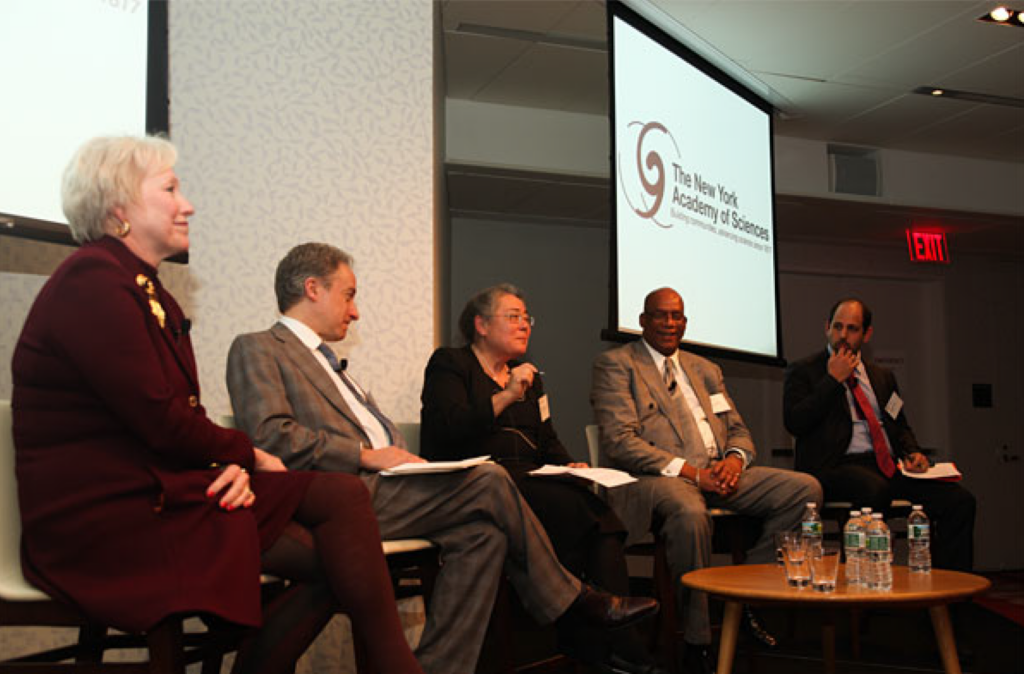
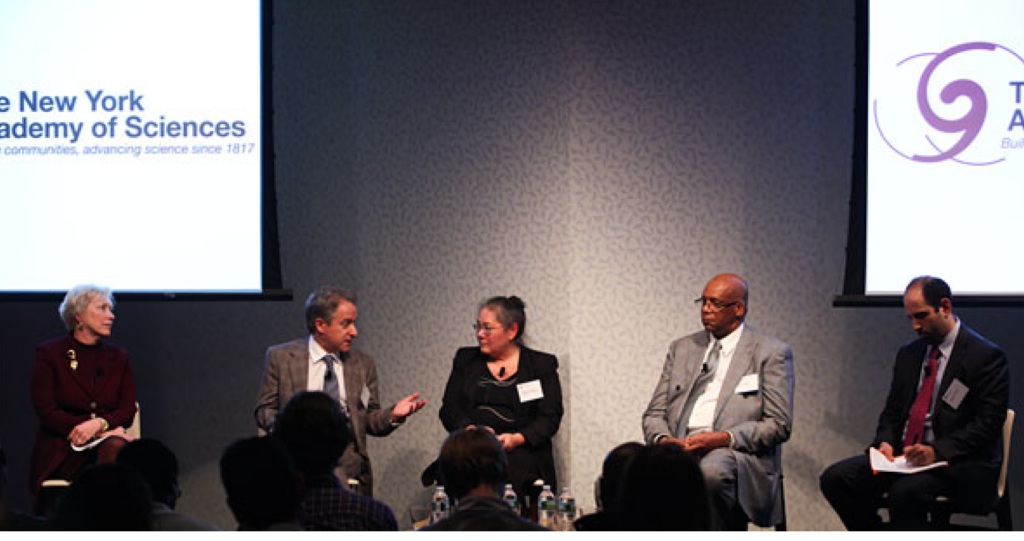
Algorithmic trading is a complex undertaking that isn’t always optimally employed. One area in which the strategy can go awry is when it is used in dark pools. Dark pools of liquidity are a type of trading venue designed to minimize the market impact of large trades. On April 16, 2009, members of the Academy’s Quantitative Finance Discussion group met to talk about the trading in dark pools as well as other areas. The event was sponsored by the Moody’s Foundation.

Ian Domowitz of the Investment Technology Group explained that algorithms that trade in multiple dark pools may leak information concerning the trade, making it riskier. Lee Maclin of the Courant Institute of Mathematical Sciences outlined the use of algorithms beyond dark pool trading. He explained that traders and portfolio managers pursue slightly different agendas, often resulting in suboptimal strategies. Portfolios that are managed “passively” should instead adopt a continuous trading approach.

The Chips are Down

The argot of Wall Street is thick with technical jargon. Behind the talk of options, alpha, and basis points, though, lies an enterprise strikingly similar to gambling. Traders constantly calculate odds and place bets, trying to beat the market the way a Vegas high-roller wagers against the house.

In this high-stakes game, the developers of quantitative trading algorithms are the card counters, closely watching and analyzing the market’s behavior to pick the best bets. At first glance, the problem looks straightforward: trades on the open market are a matter of public record, and powerful computers capable of analyzing those data are relatively cheap. However, the market’s players can hide some trades, making the game as subtle and risky as a hand of Texas hold ’em. On April 16, 2009, members of the Academy’s Quantitative Finance Discussion group met to talk about the science of uncovering the market’s hidden cards.

Probing the Dark Pools

Ian Domowitz of the Investment Technology Group explained, “Texas hold ’em…is a game where most cards are actually displayed, and a few cards are hidden, and so everybody gets to figure out what’s going on with the other people’s hands.” The key to winning in this popular poker variant is to understand the odds on other players’ cards, and to place bets without revealing information about your own hand.

A similar challenge confronts traders who deal with dark pools. Despite their sinister sounding name, dark pools are a simple financial tool for solving a basic economic problem. If a trader needs to sell a large number of shares of a stock, the act of selling them will increase the market’s supply of that stock, driving the price down. The trader could try to solve this by selling the stock off very slowly, or in very small increments, but holding a volatile stock too long can also be costly.

Minimizing the Market Impact of Large Trades

Dark pools, first developed in the 1980s, offer a better solution. “A dark pool is a venue for executing trades off the exchange in a completely anonymous and confidential manner,” said Domowitz. Because the supply and demand in a dark pool are completely hidden from the broader market, selling a large quantity of stock in such an exchange should not cause its price to drop. Automated systems match sellers’ offer prices with buyers’ bids, without revealing the outcome of the trades to anyone else. Once shares have been traded in a dark pool, the buyer can hold onto them, sell them on the open market, or trade them in another dark pool transaction.

Until very recently, there were only a few dark pools in existence. The concept was profitable, and not patented or particularly difficult to understand, but starting a successful dark pool required an enormous amount of liquidity. Smaller pools were worthless, because traders could not trade large orders in them.

That all changed about two years ago, when a new crop of dark pools suddenly appeared. “The reason for the explosion was algorithmic trading,” said Domowitz. Using new algorithms, traders can now take a large block of stock and move it through different dark pools, selling off chunks of the order in each pool. The algorithms can find a pool of liquidity very quickly, then sell as much of the order as possible there before moving on.

Gauging Productivity

To determine whether this new landscape of dark pool trading is actually productive, Domowitz and his colleagues analyzed 12.6 million orders that were placed over the course of 2007. For some parts of the analysis, they also supplemented the data with another 8 million recorded orders, providing a robust statistical base.

The data reveal that dark pool trading decreases transaction costs compared to other strategies, even in highly volatile markets. That result was both timely and surprising. “The news is full of the fact that we are high volatility these days, and actually it is conventional wisdom that you don’t use these algorithms to access dark pools in high volatility environments,” said Domowitz, but he added that “the evidence suggests otherwise.”

There are some pitfalls to using algorithms to trade in dark pools, though. Looking at the distribution of outcomes across many order executions, the team found that the algorithmic approach sometimes risked large losses. “That gain you get from using an algorithm to access these pools, although overall it’s beneficial, has introduced risk into the equation that you didn’t have before,” said Domowitz.

The risk appears to come from slippage, or accidentally revealing one’s hidden cards. Because the algorithms shop through multiple dark pools to complete an order, the strategy leaves tracks in the market that sharp-witted competitors could detect. Knowing that someone else is trying to push a large quantity of a stock onto the market, another trader could exploit that information and make money at the seller’s expense.

Revealing Information About a Trade

Traders themselves may exacerbate the problem by failing to understand how the algorithms work. For example, Domowitz says that traders may send part of a big order into a dark pool algorithm, and another part into the public market, without realizing that this compromises the algorithm. “It’s almost like they took one of their hole cards and put it up with the displayed cards in Texas hold ’em, and then they wonder why there’s information leakage,” said Domowitz.

The team also compared the individual dark pools to each other, and found that different pools vary widely in execution quality. Large, deep pools can move orders of magnitude more shares in a given period of time than small, shallow pools, so by constantly moving through different pools, modern algorithms may actually do worse than traditional dark pool strategies. “No matter what time period I look at, no matter what order duration, I get very distinct differences in execution quality across pools, all of which are being touched by the same algorithm,” said Domowitz, adding that “aggregation of crossing system liquidity through algorithms is not a panacea.”

The Portfolio That Never Sleeps

Lee Maclin of the Courant Institute of Mathematical Sciences broadened the discussion to cover the use of algorithms beyond dark pool trading. In a persuasive introduction, he outlined how algorithmic strategies have come to dominate everything from portfolio theory to market making. “Virtually everything that we know about modern finance is in fact related to algorithmic trading and optimal execution,” said Maclin.

In an idealized model, a marketable buy (sell) order will disrupt the equilibrium of the market, causing the value of the traded stock to rise (fall). Once the trade is done, the market slowly recovers to a new equilibrium, which will inevitably be higher (lower) than the pre-trade price. Splitting the trade into two separate orders, and waiting for the market to stabilize between them, will instead cause two smaller price changes. The final impact on the market is still the same—the stock equilibrates at the same price after all of the trades are done—but the trader’s average loss due to market impact are lower.

The Theoretical Market Impact

Modern trading algorithms elaborate on that concept, allowing traders to parcel their orders in sophisticated ways to minimize their market impact. Meanwhile, portfolio managers can optimize their strategies with similar algorithms. Unfortunately, no algorithm can account for the conflicts that arise between the portfolio manager and trader.

“Traders don’t see risk and reward the same way as portfolio managers do, meaning they’re separate desks in many firms,” said Maclin. Typically, a trader gets an order from the portfolio manager, but doesn’t know anything about the portfolio it comes from. The trader’s priority is simply to execute the order. “They just feel risk in having that order on their desk, and they want to reduce that risk over time, whereas the portfolio manager of course sees the risk to the entire portfolio, which is different,” said Maclin.

Worse, firms generally provide incentives for traders to reduce their risk and for portfolio managers to maximize their returns; for either one, accommodating the other’s needs could mean taking a pay cut. That raises a major barrier to adopting the optimum set of algorithms. “If you force people into this new framework, you’re not going to be able to hire good traders or portfolio managers. Portfolio managers will not be willing to share risk, traders will not be willing to be benchmarked on someone else’s performance on that trade,” said Maclin.

Fewer Hedge Funds Means More Passive Strategies

Overcoming that problem will be hard, but firms can still learn important lessons about portfolio management from the underlying theory. That will be especially important in the aftermath of a major shakedown in the money management field. “Recently we’ve witnessed a collapse of the hedge fund industry,” said Maclin, adding that “in fact what we saw was that there weren’t a thousand different strategies, there were only half a dozen different strategies, and when they lost money, they all lost money together.”

One result has been a new appreciation for “passive,” or low-return portfolios. In these strategies, managers allocate their assets in a particular way, then wait for some period of time, usually measured in days or weeks, then reallocate. According to Maclin’s analysis, though, that’s a bad approach: “You should be trading all the time—what you’re doing by holding your positions constant is taking on more risk.” Furthermore, the expected deltas of the portfolio—the changes required to move the portfolio from its current holdings to its new optimal risk/reward state—grow over time, eventually necessitating large, compressed, impact-heavy executions. Therefore, it can be said that these lazy portfolios ultimately increase both risk and costs.

A more insidious problem is that alpha, or expectation of a return, decays throughout the holding period. By holding stocks as alpha decays, passive portfolio managers are losing money. Instead, Maclin argues, managers should trade constantly. “The biggest gain to come out of the new framework is going to be when people take a realistic assessment of investment management returns and start applying the principles of…continuous trading.”

Also read: Bringing a Scientific Perspective to Wall Street

A “New Economy” for Scientific Innovation

Three men engage in a conversation.

Gov. David Paterson announced a new multiyear program to support science-based innovation in the Empire State.

Published June 12, 2009

By Adrienne J. Burke

Gov. Patterson (left) shares remarks at The New York Academy of Sciences.

New York Governor David Paterson chose The New York Academy of Sciences as a backdrop for his announcement of a new multiyear program to support science-based innovation in the state.

Paterson said the state will commit up to $100 million to the “Innovation Economy Matching Grants” program, one of several initiatives he offered under the general theme of spurring development of a “new economy” in New York. The Governor said the state also will provide 10 cents in matching funds for every federal stimulus dollar awarded to New York research facilities.

Paterson cited clean energy as the industry likely to be the biggest beneficiary of the “new economy” effort. What is clear, he said, is that the state can no longer rely on manufacturing and the financial industry as the engines that once supported much of its economic base.

Academy Board Chair John Sexton (left) confers with Gov. Paterson and Academy President Ellis Rubinstein (right) during Paterson’s “new economy” announcement at the Academy

A New Economy

“A new economy is emerging,” Paterson said. “It is knowledge-based, it is tech-based and it is based on innovation.”

Academy President Ellis Rubinstein introduced Paterson. Rubinstein said he was “delighted” Paterson chose to make his announcement at the Academy.

“We are thrilled to work with the Governor and the Governor’s team to connect the best of global science and technology to our State institutions and to enrich the economies not just of New York City but also Upstate New York and Eastern Long Island.”

Also read: A Science State of Mind in the Empire State and Celebrating New York as a World Science Center

The Culture Crosser: The Sciences and Humanities

A historic painting: Raffaello Sanzio, The School of Athens, 1511.

The Academy’s symposium “The Two Cultures in the 21st Century” considers a now 50-year-old lament that a divide between the sciences and the humanities impedes social progress. Chris Mooney and Sheril Kirshenbaum put C.P. Snow’s famous University of Cambridge Rede Lecture into context.

Published May 1, 2009

By Chris Mooney and Sheril Kirshenbaum

Raffaello Sanzio, The School of Athens, 1511

Born in 1905 in Leicester, Charles Percy Snow grew up in a family that barely clung to the British middle class. His father taught piano lessons and clerked in a shoe factory. The family home didn’t even have a real bathroom.

But Snow would pull himself up through education: A prestigious science scholarship took him to Cambridge and gave him the opportunity to study physics at the famed Cavendish Laboratory alongside Ernest Rutherford, who pioneered our understanding of the atomic nucleus.

Soon Snow launched what would become a highly successful career as a novelist, and then began to serve Her Majesty’s government in a variety of science-related capacities. By 1959 he had already become Sir Charles and was en route to Lord Snow. Soon to leave government service, he began to punditize and pronounce in nonfiction format—to say what he really thought.

And so late in the day on May 7, 1959, Snow rose to a Cambridge lectern to deliver the yearly Rede lecture, a centuries-old affair, and an invitation to pontificate for someone deemed to have earned it.

He was 53 years old and, as a contemporary put it, “a kindly looking, avuncular figure, who beams at the world out of a round face through round glasses in a way which in-spires a belief in man’s better nature and the benevolence of the universe.”

Snow had spent his life up to that point moving among two separate and atomized groups of very smart people: literary intellectuals on the one hand, and scientists on the other. Now he seized the occasion to address a problem that had been “on my mind for some time…a problem I could not avoid just because of the circumstances of my life…By training I was a scientist: by vocation I was a writer.”

This pedigree gave Snow a natural credibility as he went on to describe a disturbing “gulf of mutual incomprehension” between these two intellectual groups. Soon he illustrated the point with a canonical example:

A good many times I have been present at gatherings of people who, by the standards of the traditional culture, are thought highly educated and who have with considerable gusto been expressing their incredulity at the illiteracy of scientists. Once or twice I have been provoked and have asked the company how many of them could describe the Second Law of Thermodynamics. The response was cold: it was also negative. Yet I was asking something which is about the scientific equivalent of: Have you read a work of Shakespeare’s?

This tends to be how we think of Snow today: A man at a cocktail party, trying to broker a peace between warring tribes of eggheads. It’s also how we tend to think about the “two cultures”: A divide between people who do equations, and people who do Shakespeare.

Such interpretations aren’t wrong, they’re merely simplistic. They don’t help us understand why Snow would later express the wish that he had titled his lecture “The Rich and the Poor,” and suggest many had missed its central point. Snow cared a great deal about breakdowns between scientists and writers, but the reasons he cared are what ought to most concern us, because they still resonate across the 50-year remove that separates us from Snow’s immediate circumstances.

Above all, Snow feared a world in which science could grow divorced from politics and culture. Science, he recognized, was becoming too powerful and too important; a society living disconnected from it couldn’t be healthy. You had cause to worry about that society’s future—about its handling of the future.

For this lament about two estranged cultures came from a man who had not only studied physics and written novels, but who had spent much of his life, including the terrifying period of World War II, working to ensure that the British government received the best scientific advice possible.

That included the secret wartime recruitment of physicists and other scientists to work on weapons and defenses, activities which put Snow high up on the Gestapo’s Black List. So, no: Snow’s words weren’t merely about communication breakdowns between humanists and scientists. They were considerably more ambitious than that—and considerably more urgent, and poignant, and pained.

It helps to think of Snow as an early theorist on a critical modern problem: How can we best translate highly complex information, stored in the minds of often eccentric (if well-meaning) scientists, into the process of political decision-making at all levels and in all aspects of government, from military to medical? At best that’s a difficult quandary; there are many ways in which the translation can go wrong, and few in which it can go right. Yet World War II had demonstrated beyond question that the nations that best marshal their scientific resources have the best chance of survival and success, making sound science policy an essential component of modern, advanced democracies.

The oft-told story of the atomic bomb, in which a letter from none other than Albert Einstein helped alert President Roosevelt to the danger, makes this point most profoundly. But in a lecture delivered at Harvard little more than a year after his “Two Cultures” address and entitled “Science and Government,” Snow illustrated the same dilemma through the example of radar.

He argued that if a small group of British government science advisers, operating in conditions of high wartime secrecy, had not spearheaded the development and deployment of this technology in close conjunction with the Air Ministry, the pivotal 1940 Battle of Britain—fought in the skies over his nation—would have gone very differently. And Snow went further, identifying a bad guy in the story: Winston Churchill’s science adviser and ally F.A. Lindemann, who Snow described as having succumbed to the “euphoria of gadgets.”

Rather than recognizing radar as the only hope to bolster British air defenses, Lindemann favored the fantastical idea of dropping parachute bombs and mines in front of enemy aircraft, and tried (unsuccessfully) to derail the other, pro-radar science advisers. Churchill’s rise to power was an extremely good thing for Britain and the world, but as Snow noted, it’s also fortunate that the radar decision came about before Churchill could empower Lindemann as his science czar.

So, no wonder Snow opposed any force that might blunt the beneficial influence of science upon high-level decision-making. That force might be a “solitary scientific overlord”—Snow’s term for Lindemann—or it might be something more nebulous and diffuse, such as an overarching culture that disregards science on anything but the most superficial of levels, and so fails to comprehend how the advancement of knowledge and the progress of technology simultaneously threaten us and yet also offer great hope.

Such a culture is what Snow detected in Great Britain in 1959; such a culture is also, to a great extent, what we find in the United States today—albeit for very different reasons.

With this background in place, we can begin to understand and translate one of the more seemingly antiquated parts of Snow’s lecture: His particular beef with literary intellectuals, who come in for by far the greatest thrashing in the speech. Nowadays, when the profession of academic literary criticism is “losing its will to live” (as one Yale English prof recently put it), it’s hard to imagine a period when literary intellects virtually ran things. Yet that is what Snow claimed to observe around him, and what he was reacting to.

It’s not that bookworms were directly controlling the British government. But Snow felt that his country’s “traditional culture” strongly privileged training in literature and the classics, rather than in the sciences; the assumptions of this traditional culture then greatly influenced society and its institutions. As a consequence, much of the British intelligentsia failed to comprehend science and seemed to abhor its extension in the form of industrialization, technological advancement, and economic growth. For Snow, such an attitude was wrong-headed: Technological advancement held great hope for improving the health and welfare of the poor people of the world.

In a nod toward even-handedness, Snow delineated the faults of both intellectual groups treated in his lecture. But any-one could see he did not regard those faults as entirely equal. His scientists come off as can-do men of great sympathy and optimism, albeit “self-impoverished” because of their inability to see the relevance of literature to their lives. But as for the other camp, the literati who fail to comprehend science, but enjoy sneering at it?

They are impoverished too—perhaps more seriously, because they are vainer about it.” Snow even observed that while scientists have “the future in their bones,” literary types respond “by wishing the future did not exist.” They were, in Snow’s words, “natural Luddites.” Such a quality did not recommend itself at a time when science had begun to transform the world far more rapidly than ever before.

To the “two cultures” problem, Snow saw just one solution. England had the most specialized educational system in the world—one that separated students with scientific talent from those with humanistic leanings at an early age, and then funneled them in different directions—and for Snow it simply had to change.

Otherwise, his country would remain ill-equipped to tackle the leading political problems of the day, especially the gap between the industrialized and developing world—an issue Snow thought the scientists understood best, and could best address by working to spread the benefits of technology abroad. Or as he put it:

For the sake of the intellectual life, for the sake of this country’s special danger, for the sake of the western society living precariously rich among the poor, for the sake of the poor who needn’t be poor if there is intelligence in the world, it is obligatory for us and the Americans and the whole West to look at our education with fresh eyes.

Seen through an adequate lens, then, Snow’s “Two Cultures” lecture, his “Science and Government” speech, and in fact all of his other major addresses reduce to the same point: Let’s align our intellectual resources so science can achieve its full world-changing potential. Let’s not let anything get in the way of the translation of scientific knowledge into social relevance and action—not petty rivalries and egos, not scientific overlords and their pet theories and gadgets, and not disciplinary divides or cultural disconnects. Because it’s simply too important.

Today, Snow’s point is more poignant than ever. Innovative scientific and technological solutions are the key to meet the 21st century’s economic, environmental, public health, and security challenges that transcend political borders. Just 50 years ago, Snow probably could not have foreseen global threats such as climate change, bird flu, or bioterrorism. But his vision of the need to unify the disparate intellectual camps in order to achieve the world-changing potential of science was prescient.

Also read: Building Bridges in the Humanities and Sciences


About the Authors

Chris Mooney is a science and political journalist. Sheril Kirshenbaum is a marine biologist and author at Duke University. Mooney and Kirshenbaum’s forthcoming book, Unscientific America: How Scientific Illiteracy Threatens Our Future, will be published in the summer of 2009.

From New York City to Washington D.C.

A bronze bust of Charles Darwin.

A replica of The New York Academy of Sciences’ (the Academy’s) icon will stand in the National Academy of Sciences’ Great Hall in Washington.

Published April 4, 2009

By Attila Szász

In honor of the bicentennial of Charles Darwin’s birth, the Academy’s bust of its legendary member is being replicated for display in the Great Hall of the National Academy of Sciences in Washington.

The replica is being produced using a state-of-the-art digital scanning and computer-controlled milling process. The original bronze, one of very few known to exist of Darwin, was commissioned by The New York Academy of Sciences in 1909 for the centennial of his birth and the 50th anniversary of the publication of Darwin’s On the Origin of Species.

Working from a photograph, sculptor William Couper produced a remarkable likeness of the scientist in his later years. After admiring the sculpture on a recent visit to the Academy, NAS President Ralph Cicerone became interested in having a duplicate made for his organization.

Touched Only by Light

Not long ago, such a venture would have put the original at risk of damage during transportation to and from a studio and during the casting of a new mold. But today’s technology leaves the original touched only by light. Direct Dimensions, a company enlisted to make a digital model of the bust, used a portable coordinate-measuring machine consisting of a laser scanner attached to an articulated measuring arm to collect the three-dimensional data. Technicians moved a structured laser line along the surface of the sculpture while a camera sensor mounted in the laser scanner captured the data. The cloud of data points was transferred to a software program that translated it into a digital polygonal model.

The whole process took only five hours and the bust never left its home in the Academy lobby at 7 World Trade Center. To begin the journey back to bronze, the restoration preservation company John Milner Associates next made a foam base using a computer-controlled milling machine driven by the digital information. An artist then applied a very thin clay coating to smooth out the tool marks. This “clay-up” was sent to the foundry, for the creation of a silicon mold. The rest of the process follows an age-old casting technique, from which a new Darwin will be born.

Also read: From the Annals Archive: How Darwin Upended the World

Darwin’s Descendants: Reflecting on his Impact

A black and white photo of Charles Darwin dressed formally.

Six leading scholars reflect on the enduring influence of Charles Darwin and demonstrate how his work continues to inspire scientists across disciplines.

Charles Darwin circa 1854. Image courtesy of Wikimedia Commons.

Published March 1, 2009

By Janet Browne, Paul Ekman, Stuart Kauffman, Robert May, Massimo Pigliucci, and Charles Raison

The theory of natural selection that Charles Darwin first articulated in print in 1859 is still the fundamental idea on which all modern biological studies are based today. But Darwin’s observations of evolution and sexual selection among humans and other species have reached far beyond the field of biology, to influence, inspire, and inform nearly every scientific discipline.

Six leading scholars—historian Janet Browne, psychologist Paul Ekman, astronomist-physicist-biochemist Stuart Kauffman, theoretical physicist-environmental scientist Lord Robert May, geneticist-botanist-philosopher and “evo-devo” pioneer Massimo Pigliucci, and physician-behavioral scientist Charles Raison—write about how Darwin’s observations influenced their own work or field of research. Their respective comments illuminate the wide and varying influence Darwin continues to have on science and on humanity.

Documenting the Life of the Enigmatic 19th C. Scientist

By Janet Browne

Over the years Darwin has become a real person to me. As a historian of science and as one of his several biographers, I have spent some 15 years in his company, often on a daily basis. Through his letters I accompanied him on his Beagle adventures, followed the development of his theories, observed his anxieties about marriage, watched his family grow up, worried with him about illness, and felt heartbroken at the death of his daughter Annie.

Darwin was a traveler, a family man, a thinker, a much-loved husband, father, friend, and neighbor—a likeable and genial figure, as expressive in his letters as he must have been in life. Although his theories were first conceived in the smoky atmosphere of London, just after his return from the Beagle in 1836, his major books and articles were all researched and constructed in the domestic setting of his home at Down House in Kent.

An International Celebrity

There he lived for 40 years with his wife Emma Wedgwood and 10 children, of whom only seven survived to adulthood. The house still exists and is now a museum restored to show how it was in Darwin’s time. It is an inspiring place to visit, quiet and rural, and one can almost imagine Darwin stepping in through a doorway. Visitors used to record how he would greet them with an outstretched hand.

So, behind that large white Victorian beard, there existed a friendly, stimulating, often enigmatic personality, who still intrigues all those who come into contact with him. How could such a modest and retiring figure come up with the theory that made the modern world?

Writing about the famous has many advantages. Darwin was an eager and regular correspondent with a wide variety of people, and left a copious record of his activities, both personal and scientific. By the time of his death, he had become an international celebrity and many manuscripts were preserved by friends and family. Encountering this rich and varied archive—now primarily located in Cambridge University Library—was a major influence on the way that I began to reconceptualize the role that biography might play in the history of science.

The Circulation and Accreditation of Ideas

For too long, scientific biographies have been regarded as the lighter end of history, suitable mostly for bedtime reading. Instead, biography can also tell us much about the actual creation of science, from the first stirrings of new concepts in an individual’s mind, followed by the careful documentation and experiment that usually supports a scientific claim, on to the eventual publication and public response to fresh ideas. Biography can, in fact, illuminate what historians are beginning to call the circulation and accreditation of ideas.

It seemed to me that this modern rethink provided a good opportunity to explore the movement of Darwin’s evolutionary ideas from the privacy of his own mind, as expressed in letters and notebooks during his most creative years on the Beagle voyage and immediately afterwards, to the extraordinary public controversy that erupted after he published the Origin of Species. From private to public, from the Beagle years to the Origin of Species: Darwin’s intellectual trajectory provided me with a way to investigate the generation and acceptance of new ideas.

Janet Browne is Aramont Professor of the History of Science at Harvard University, and author of the highly acclaimed two-volume biographical study, Charles Darwin: Voyaging, published in 1995, and Charles Darwin: The Power of Place, published in 2002, which won the James Tait Black award for non-fiction in 2004, the W.H. Heinemann Prize from the Royal Literary Society, and the Pfizer Prize from the History of Science Society. She was also associate editor of the early volumes of The Correspondence of Charles Darwin.

Charles Darwin, the Dalai Lama, and Sentient Beings

By Paul Ekman

A few years ago, I had a series of conversations with the Dalai Lama about the nature of emotion and compassion reported in our book Emotional Awareness. [1] I explained recent research in which a monkey could get food only by delivering a shock to another monkey. If it was a familiar monkey, the hungry monkey did not attempt to get food for many days. The amount of delayed gratification decreased if it was an unfamiliar monkey, and even more if it was a monkey from a different species. [2] Nevertheless, even when the monkey who would suffer was unfamiliar and from another species, there was still some delay in responding to hunger.

This is consistent with Darwin’s report of such compassionate actions: “Many animals, however, certainly sympathize with each other’s distress or danger. … I have myself, seen a dog who never passed a great friend of his, a cat, without giving her a few licks with his tongue, a sure sign of a kind feeling in a dog. For with those animals which were benefited by living in close association, the individuals which took the greatest pleasure in society would best escape dangers. Whilst those that cared least for their comrades and lived solitarily would perish in great numbers.” [3]

Importantly Darwin draws our attention to the benefits of compassionate behavior, what de Waals calls reciprocity. [2]

Darwin and the Dalai Lama

The Dalai Lama responded to these examples saying: “I fully agree … in those animals, like turtles, [that do not interact] with the mother, I do not think they have the capacity to show affection. … Affection [between mother and offspring] brings them together. Without affection, there is no force to develop … [the necessary] willpower to face difficulties.” [1]

Darwin explained the origin of compassionate actions as follows: “The sight of another person enduring hunger, cold, fatigue revives in us some recollection of these states, which are painful even in the idea. And we are thus impelled to relieve the suffering of another in order that our own painful feelings may be at the same time relieved.” [1] The Dalai Lama completely agreed, pointing out that when he acts compassionately it helps him at least as much as he helps the person suffering.

Darwin also expressed exactly the same ethic that can be found in Buddhism scripts from centuries earlier: “As man advances in civilization, and small tribes are united into larger communities, the simplest reason would tell each individual that he ought to extend his social instincts and sympathies to all the members of the same nation, though personally unknown to him…there is only an artificial barrier to prevent his sympathies extending to the men of all nations and races.

The Dalai Lama a Darwinian

If indeed such men are separated from him by great differences in appearance or habits, experience, unfortunately, shows us how long it is before we look at them as our fellow creatures. Sympathy beyond the confines of man, that is, humanity to the lower animals seems to be one of the latest moral acquisitions. This virtue, one of the noblest with which man is endowed, seems to arise incidentally from our sympathies, becoming more tender and widely diffused, until they are extended to all sentient beings.” [1]

Hearing this, the Dalai Lama pronounced himself a Darwinian!

Paul Ekman is Professor Emeritus of Psychology at the University of California, San Francisco, Medical School and director of the Paul Ekman Group, a small company that produces training devices relevant to emotional skills and is initiating new research relevant to national security and law enforcement. Ekman is author and co-author of numerous books on the evolution of human facial expression, and was editor of Darwin and Facial Expression (1973), of the third edition of Darwin’s The Expression of the Emotions in Man and Animals (1998), and of the Annals of the New York Academy of Sciences, Vol. 1000, Dec. 2003, Emotions Inside Out: 130 Years after Darwin’s The Expression of the Emotions in Man and Animals.

Two Deep Issues in Evolutionary Theory

By Stuart Kauffman

Charles Darwin made what may be the greatest change in Western thinking. With him, history and historical processes emerge as a central focus for scientific thought. With Darwin, heritable variation, and natural selection, we have for the first time a start for understanding the becoming of the biosphere. In this short article I want to discuss two features of evolution that remain largely outside mainstream discussion of evolution yet are of central importance to the evolution of the biosphere.

First, Darwin did not know of self-organization. Today, in part due to the sciences of complexity and the computer as a kind of “macroscope,” we begin to see such self-organization. Does it play a role in evolution? If so, how does it mingle with selection as interwoven sources of order in organisms down the evolutionary pathways?

Second, what is the physical basis of the historical processes of which Darwin made us aware? We shall see that we are led to issues of the “open universe.”

Self-Organization

Darwin did not know about self-organization. Physicists do, of course, as in Benard cells and the Zhabotinski reaction. Snowflakes show six-fold exquisite symmetry without benefit of natural selection. Cholesterol dissolved in water forms liposomes, bi-lipid-layered vesicles that must be the origins of cell membranes but arise without selection. For many years I have studied models of genetic regulatory networks, where I have modeled genes as binary, on/off devices and studied random Boolean nets.

More than 40 years of work shows that such networks behave in either an ordered or a chaotic regime, separated by a critical phase transition. The ordered regime and the critical phase transition demonstrate astonishing order. I will not describe it here, other than to say that our intuitions about the requirements for dynamical order have been drastically wrong. And I add two thoughts. Such networks have dynamical attractors. I have long thought that cell types correspond to attractors. I have also hoped that cells are dynamically critical, poised at the edge of chaos. Some recent evidence suggests this may be true.

The Marriage of Self-Organization and Selection

If cells are critical, then we have before us an example of the marriage of self-organization and selection. In a parameter space concerning features such as the mean number of inputs per gene, the input distribution, biases on Boolean functions used in the network and so forth, critical networks are extremely rare, occurring on a critical surface in parameter space separating ordered from chaotic behavior. But if cells are critical, this suggests both that the generic self-organized behavior of complex non-linear dynamical systems such as genetic regulatory networks may readily afford “ordered” and critical dynamics without much selection, but that substantial selection is required to achieve and maintain critical behavior.

This means that we must rethink evolution. Selection is not the sole source of order in organisms. Neither is self-organization. We must understand both and their marriage. Somehow I think Darwin would have been delighted.

The Open Universe

Consider first the set of all possible proteins with a length of 200 amino acids. Since there are 20 kinds of amino acids, there are 20,200 such proteins. We can easily now synthesize any one of them.

Now consider that the universe is 1017 seconds old and has about 1080 particles in it. It is easy to calculate that, were the universe doing nothing on the Planck time scale of 10-43 seconds but making proteins length 200, it would take 1039 times the current lifetime of the universe to make all these proteins just once.

This means that once we are above the level of complexity of atoms, where all possible atoms exist in the universe, the universe is on a unique trajectory. We will never make all possible proteins, complex molecules, organs, organisms, social systems. The universe is indefinitely open “upward” in complexity. More, when the space of the possible is vastly larger than the space of the actual, history enters. Here is the root of Darwin’s historicity.

Reductionism

Now, suppose reductionism were right. Suppose that, when the science shall have been done, there really is some final theory as Nobel Laureate Steven Weinberg hoped, and perhaps still hopes, despite 10,500 string theories. Then all that exists in the universe would be entailed by that final theory, and the existence of all that exists would be explained.

What if reductionism fails? What if the becoming of the biosphere is partially lawless? Then the very existence of many things becomes a matter to conjure upon. Consider a hummingbird and a field of flowers. The hummingbird puts her beak into one flower to eat the nectar, some pollen rubs onto her beak and sticks to it. She flies to the next flower, eats some nectar, and the pollen from the first flower rubs off on the stamen of the second flower. The hummingbird pollinates the flower.

A Vast Mutualism

Suppose before the hummingbird left the first flower, all the pollen fell off her beak, or she regularly flew to a nearby tree to eat the nectar. Pollenization would not occur.

Thus it is by the quixotic fact of the stickiness of the hummingbird’s beak that both the hummingbird and the flowers exist and, with insects, have co-evolved for millions of years. They are conditions of one another’s physical existence in the universe by virtue of a mutualism. But the biosphere as a whole is a vast mutualism in the sense that all in it exist with only sunshine and a few minerals, making natural games by which all live and evolve. The ground of our existence, then, is not to be found in physics alone, but also in the partially lawless becoming of the biosphere, econosphere, culture that we self-consistently co-construct. (See Reinventing the Sacred, Kauffman, 2008.)

Darwin, it appears, started us down a path now beyond his stunning dreams.

Stuart Kauffman is Professor in the Department of Biological Sciences and Physics and Astronomy at the University of Calgary. He is also Director of the Institute for Biocomplexity and Informatics, as well as an Emeritus Professor of Biochemistry at the University of Pennsylvania, a MacArthur Fellow, and an external professor at the Santa Fe Institute. Originally a medical doctor, Kauff man’s primary work has been as a theoretical biologist studying the origin of life and molecular organization. He is the author of The Origins of Order, At Home in the Universe: The Search for the Laws of Self-Organization, Investigations, and Reinventing the Sacred: A New View of Science, Reason, and Religion.

Cooperation Among Nations in A Crowded & Changing World

By Robert May

In his own time, Darwin’s theory of evolution had serious scientific difficulties. For one thing, the physics of his day put a limit of a few million years both on the life of the sun, and for planet Earth to have cooled from a molten ball to a frozen mass. For another, prevailing ideas about “blending inheritance” were irreconcilable with preserving variability within populations, upon which his theory was based. Happily, the former difficulty was resolved by our discovery of nuclear forces (which fuel the sun and warm the earth by radioactive decays within its core) and the latter by rediscovery of Mendel (and consequent understanding of particulate inheritance by Hardy and Weinberg).

Darwin, however, arguably saw his most important unsolved problem as explaining how cooperative behavior among animals evolved. At first glance, the answer seems easy. You pay some small cost to gather a much larger cooperative benefit. For example, a prairie dog takes a personal risk in giving an alarm call, but all the colony benefits and, by taking turns as alarm giver, each individual’s group benefit exceeds the occasional risk.

But any such arrangement is immediately vulnerable to cheats who enjoy the benefits without paying the risk-taking dues. In evolutionary terms, such cheats have a selective advantage (today we would say their survivorship advantage means their genes are more represented in the next generation). So, it is unclear how such observed cooperative phenomena can arise or be maintained.

“Kin Selection”

Following work on “kin selection” by Hamilton and others a century after Darwin, we now understand how such cooperative associations can evolve and persist in relatively small groups of sufficiently closely related individuals. Moreover, these conditions could apply to humans when we were small bands of hunter-gatherers. But for large aggregations of essentially unrelated individuals, as developed once agriculture appeared and cities began, the origin of cooperative associations—with group benefits which exceed the “cost of membership”—remains as puzzling today as it was for Darwin.

Nor is this some abstract, academic problem. The past 150 years had seen the human population increase sevenfold, and the ecological footprint of the average individual also increase sevenfold, for an overall 50-fold rise in our impacts on the planet. And still these impacts are increasing. There are consequently huge and global problems—climate change, loss of biological diversity, pressure on water supplies, and much else—which demand globally cooperative solutions. These problems are further compounded by the fact that nations must cooperate, but in equitable proportions.

These problems have recently received much attention in the scholarly literature, employing a variety of metaphors: the Tragedy of the Commons; the Free-Rider problem; the Prisoner’s Dilemma; and others. These metaphors are allied to artificial games in which the subjects (usually undergraduates) trade small sums of money to test limits to altruism and tolerance of cheating. Incidentally, essentially none of this work involves the costs and benefits varying among the players, as it usually does in the real world.

A “Stabilization Matrix”

My own speculation about how cooperative human societies evolved is both less academic and analytic, and more gloomy. Once we move out of the mists of pre-history, we find stories of dreamtime, creation myths, ceremonies and initiation rites, spirits and gods, with a unifying theme that all seek simultaneously to help explain the external world and also to provide a “stabilization matrix” for a cohesive society.

There are, moreover, some striking and unexplained similarities in belief systems and rituals from different times and places. Conscience, a simple word for a complex concept which helps foster behaviour in accord with society’s professed norms, has been memorably defined by H. L. Mencken as “the inner voice which warns us that somebody might be looking.” And how helpful it is if that somebody is an all-seeing, all-knowing supernatural entity.

Common to these conjectured “stabilizing forces” in essentially all earlier societies are hierarchical structures, serving and interpreting the divine being or pantheon, along with unquestioning respect for authority. In such systems, faith trumps evidence.

But if indeed this is broadly the explanation for how cooperative behaviour has evolved and been maintained in human society, it could be Bad News. That is because, although such authoritarian systems seem to be good at preserving social coherence and an orderly society, they are, by the same token, not good at adapting to change. Diamond’s book, Collapse: How Societies Choose to Fail or Survive, provides striking examples.

A fundamental principle emerging from the Neo-Darwinian Revolution of around a century ago is Fisher’s Fundamental Theorem, which states that a population’s potential rate of change of gene frequency (which measures its ability to adapt to changing circumstances) is proportional to the variance in gene frequency, which will be small if essentially all individuals are well-adapted to their current environment.

An Inherent Tension Between Adaptedness and Adaptability

That is, there is an inherent tension between adaptedness and adaptability. If there is any substance in my speculations about the answer to Darwin’s problem in explaining cooperation in human societies, we again have a fundamental tension—at the level of the entire society—between, on the one hand, “ties that bind” and permit stably cooperative aggregations, and, on the other hand, ability to respond effectively to changing environmental circumstances.

It could even be argued that the recent rise of fundamentalism, in both East and West, is an illustration of this meta-level version of Fisher’s Fundamental Theorem, as complex faiths are reduced to intolerant ideologies to resist the challenge of societal change. It is a pity that Darwin is not here to help us.

Robert, Lord May of Oxford, holds a Professorship jointly at Ox-ford University and Imperial College, London, and is a Fellow of Merton College, Oxford. He was President of The Royal Society (2000-2005), and Chief Scientific Adviser to the UK Government and Head of the UK Office of Science and Technology (1995-2000). Prof. May has also served as a Personal Chair in Physics at Sydney University, Professor of Zoology and Chairman of the Research Board at Princeton, and Royal Society Research Professor at Oxford and Imperial College. He is recognized for his research into how populations are structured and respond to change, particularly with respect to infectious diseases and biodiversity.

Darwin, Evolution, Development

By Massimo Pigliucci

Charles Darwin had a difficult job in 1859: although a few people before him had floated the idea that living organisms evolve, no known mechanism for their alleged change over time was known, and little compelling evidence was available in favor of it. Indeed, the dominant paradigm among naturalists was William Paley’s inference from biological complexity to supernatural intelligent design.

Darwin met the challenge by amassing an impressive amount of observations that pointed to two conclusions: all living organisms share common ancestors, and the chief mechanism responsible for the appearance of a “fit” between organisms and their environment is natural selection. Part of the evidence brought into play by Darwin and other early evolutionary biologists in favor of the view of evolution came from developmental biology and consisted in showing that organisms of the same type (say, vertebrates) have very similar stages of development before they differentiate into the variety of adult forms that distinguish birds from reptiles and from mammals. This similarity in development was the result of their evolution from a common ancestor.

Despite its early central role in evolutionary biology, developmental biology remained a separate field of inquiry for most of the 20th century, especially during the 1940s, which brought us the mature version of evolutionary theory known as the Modern Synthesis.

Developmental Biology vs Evolutionary Biology

For decades biologists drew a sharp distinction between proximate and ultimate causes of the phenomena they studied: proximate causes deal with how living organisms are built (e.g., the molecules and developmental mechanisms that form the eye), while ultimate causes inquire into why they are built in a particular way (e.g., the eye’s function to capture information about the environment aids survival and reproduction). Developmental biology (as well as genetics and molecular biology) was thought to address the first type of question, while evolutionary biology remained focused on the second one.

This neat distinction between types of causes would have seemed strange to Darwin, and it is being rejected by modern evolutionary developmental biologists, who are inspired by Darwin’s comprehensive approach to understanding life’s history and diversity. During the 1990s a new field of research, nicknamed “evo-devo” for “evolution of development” emerged with the declared goal of once again joining the two disciplines. The fundamental idea was that knowing how organisms develop also gives us invaluable clues to how they evolved: the “how” question informs the “why” question.

My own interest in this area has been spurred by the possibility that taking development seriously will usher in an expanded version of evolutionary theory, one where new phenomena—unknown to Darwin and to 20th century biologists—play an hitherto unexpected role. Take for instance the idea of “evolvability.” The term refers to the fact that the ability of different lineages of organisms to evolve itself changes over time; that is, the very capacity for evolution evolves!

The Evolution of Particular Molecules

We have known for some time that populations of organisms with different amounts of genetic variation respond at different rates to natural selection, some evolving faster than others because they harbor more genetic variants that can be selected. But recent discoveries in developmental biology have presented us with the intriguing possibility that natural selection may favor the evolution of particular molecules (called “capacitors” of evolution), or arrangements of gene networks, that make it easier for a population to evolve in response to new environmental challenges.

The implications of these views are still being worked out, and both theoretical and empirical biologists feel the excitement of the opening up of new vistas on the process of evolution, a prospect that would have delighted Darwin. As he famously put it: “There is grandeur in this view of life … that, whilst this planet has gone cycling on according to the fixed law of gravity, from so simple a beginning endless forms most beautiful and most wonderful have been, and are being evolved.”

Massimo Pigliucci is a Professor of Ecology and Evolution and of Philosophy at Stony Brook University in New York. He holds doctorate degrees in genetics, botany, and philosophy, and is known as an outspoken opponent of creationism and staunch supporter of science education. In 1997, he received the Dobzhansky Prize from the Society for the Study of Evolution, which recognizes the accomplishments and future promise of an outstanding young evolutionary biologist.

An Evolutionary View of the Anti-Inflammatory, Compassion 

By Charles Raison

During recent lectures, I’ve found myself invoking the old saying “all roads lead to Rome” as a way of embarking on discussions of the multiple ways in which innate immune, autonomic, and neuroendocrine pathways converge to promote depression in response to stress and sickness. This old chestnut about Rome is also profoundly true in regards to evolution. The great Roman edifices of evolution are survival and reproduction: as long as the road a species is on eventually passes through these portals, that road is a viable path, regardless of the length of the journey or the variety of scenery on the way.

An immediate implication of this truth is that all things not prohibited by the twin mandates of survival and reproduction are allowed. Indeed, some theoreticians suggest that all things not prohibited must be manifested somewhere across the vast reaches of universal space and time. [4] Whether this is true or not, even a cursory look at the manifold pathways walked by life on earth makes the head spin.

As I type this I am sitting in the Arizona-Sonora Desert Museum, and just from the last hour of wandering I have seen species that have survived by being aggressive or being peaceful, by being solitary or being highly social, by killing other beings to eat or eating sunlight directly. Evolution is not mandatorily about egregious selfishness. It is about anything that works, and even our one fragile planet testifies to the fact that almost anything—done well—can represent a viable strategy through the vast labyrinth of evolutionary design space.

Increasingly, evolutionary scientists are recognizing that cooperation, connection, and reciprocity represent one such strategy, giving the lie to older simplistic ideas that evolution mandates a natural order that is unremittingly “red in tooth and claw”. [5]

Darwin’s Dangerous Idea

My realization of this truth while reading Darwin’s Dangerous Idea, by Daniel Dennett, permanently altered the direction of my research. [6] Prior to this realization, my professional work on inflammatory processes and psychiatric symptoms seemed unrelated to my hobbyist’s interest in the health benefits of psychosocial connectivity. [7] After the realization, I began to wonder whether social integration and inflammation might not be intimately locked in a struggle for the soul of humanity. Fueled by a hunger to bring evolutionary causality into my work with proximal mechanisms, I retooled my life’s work.

My idea of an unsuspected evolutionary link between love and immunity seems odd at first blush, but makes much more sense when seen against the backdrop of our phylogeny, in which natural selection has favored robust brain-body danger response pathways (including inflammation) to protect individuals against predators and pathogens—whether encountered through killing, being killed, or being infected. [8]

The Old Biology Persists

In the modern world, however, with its laws, medical expertise, and sanitary practices, our need for such hair-trigger inflammatory pathways has waned, because civilization has become an extended phenotype for battling pathogens against which our one reliable defense used to be inflammation. Nonetheless, the old biology persists, with nothing better to do most of the time than fire off in response to all sorts of novel situations against which it is of little use. Hence the contribution of stress-induced inflammation to all the major modern maladies—and the potential for social embeddedness to shoulder at least some of its burden.

This line of reasoning made me begin to wonder whether training people to re-envision their social surround in more positive terms might enhance health by attenuating inflammatory responses to psychosocial stress—a thought I never would have had without an evolutionary perspective. But we reasoned that if people could be encouraged to see the social world as being less threatening and more supportive, they would be less likely to activate danger pathways that trigger inflammatory responses, resulting in reduced wear and tear on the body and brain over time.

Tibetan Buddhist Compassion Meditation

To test this idea my colleagues and I selected what appears to me to be the most radical program ever designed to change how we view our social connections—Tibetan Buddhist compassion meditation. And indeed, data from our group do suggest that when people learn through compassion meditation to see the world more realistically (i.e. as a safer, more nurturing place) than our old danger pathways would advise, inflammatory responses are reduced and people become less upset in the face of the types of social stressors that provide such rich fodder for illness in the modern world. [9]

Of course, to tolerate reduced inflammation safely we must keep civilization intact, which in turn links compassion to odd bed partners like waste disposal and vaccines. But I am far over my word limit and these realities, alas, represent other roads to Rome.

Charles Raison is Assistant Professor in the Department of Psychiatry and Behavioral Sciences and Co-Director of Collaborative for Contemplative Studies at Emory University in Atlanta. He is a physician whose research ranges from immune system effects on central nervous system functioning to the application of compassion meditation as a strategy to prevent depressive symptoms in college students via reduction in stress-related inflammatory activity. He is also internationally recognized for his expertise in the diagnosis and treatment of interferon-alpha-induced depression and anxiety.

Works Cited

1. Emotional Awareness, Dalai Lama & Paul Ekman, New York: Henry Holt, 2008.

2. Primates and Philosophers, Frans B.M. de Waal, Princeton, NJ: Princeton University Press, 2006.

3. The Descent of Man, Charles Darwin, New York: Appleton and Company, 1871.

4. Deutsch D. The Fabric of Reality. New York: Penguin; 1997.

5. Wilson DL. Evolution for Everyone. New York: Delacorte Press; 2007.

6. Dennett DD. Darwin’s Dangerous Idea: Evolution and the Meanings of Life New York: Penguin Science; 1995.

7. Cacioppo JT. Loneliness: Human Nature and the Need for Social Connection. New York: W.W. Norton; 2008.

8. Raison CL, Capuron L, Miller AH. Cytokines sing the blues: inflammation and the pathogenesis of major depression. Trends in Immunology 2006;27(1):24-31.

9. Pace TWW, Negi LT, Adame DD, Cole SP, Sivilli TS, Brown T, Issa MJ, Raison CL. Effect of compassion meditation on neuroendocrine, innate immune and behavioral responses to psychosocial stress. Psychoneuroendocrinology 2008; Epub.

The Role of Government in Advancing Science

An artistic illustration of the White House with prominent figures like Barack Obama.

As President Obama takes steps to “restore science to its rightful place,” Washington insiders and Academy members weigh in on his challenges and priorities.

Published March 1, 2009

By Adrienne J. Burke

President Obama and his science team, from left, NOAA Chief Jane Lubchenco; President’s Council of Advisers on Science and Technology Co-Chairs Harold Varmus and Eric Lander, Presidential Science Adviser and Director of the White House Office of Science and Technology Policy John Holdren; and Secretary of Energy Steven Chu. Illustration by David Simonds.

It’s no exaggeration to say that applause rang out in the halls of science on January 20 when President Barack Obama pledged during his inaugural address to “restore science to its rightful place.”

“If you heard a faint cheer about 30 rows back when he said those words, that was me,” says physicist and Congressman Rush Holt (D-NJ).

President Obama’s pledge was consistent with his appointments, announced a month earlier, of several distinguished career scientists, including two Nobel Laureates and three members of The New York Academy of Sciences (the Academy), to the top government science posts. And in his first two months in office, he took several more steps toward upholding it.

In February, the President signed off on an unprecedented $24 billion in new funding for science and technology research and development, including more than $10 billion for the National Institutes of Health (NIH) and $3 billion for the National Science Foundation (NSF), as part of the American Recovery and Reinvestment Act. Days later, in his first address to Congress, the President acknowledged the importance of science to an economic recovery, saying that the solutions to America’s recession reside “in our laboratories and our universities.”

Making Good on Campaign Promises

In March, he made good on campaign promises to reverse the Bush administration’s restrictions on federal funding for embryonic stem cell research by directing the NIH to develop new rules within four months. And when Congress, days later, confirmed Harvard physicist John Holdren as Presidential Science Adviser and Director of the White House Office of Science and Technology Policy, Obama had already assigned him the task of developing “a strategy for restoring scientific integrity to government decision making.”

Though it remains to be seen if the federal support for science will be sustained beyond the Administration’s jobs-creation program, to many, the new President’s announcements mark a refreshing departure from eight years of neglect and even rejection of sound science on critical issues by the White House. Some scientists and science advocates see Obama’s recent moves as their payoff for months of hard work aimed at bringing the country’s science crisis to his attention before he took office, or while he was still on the campaign trail.

Shawn Otto, a Minnesota-based screenwriter with a bachelor’s degree in physics and a passion for science policy, began during the November 2007 Hollywood writers’ strike to advocate for discussion of the scientific issues among the contenders for the US presidency. With the help of five other volunteers, Otto established ScienceDebate 2008 with a website and a petition calling for a presidential science policy debate. The movement gained momentum as the American Association for the Advancement of Science (AAAS), National Academies, and Council on Competitiveness became ScienceDebate cosponsors and 38,000 scientists, engineers, and other concerned citizens, including the presidents of more than 100 universities, signed the petition.

Candidates Addressing Science

Although no debate took place, ScienceDebate did succeed in getting the Obama and McCain campaigns to provide written answers to 14 science policy questions on topics including climate change, energy, science education, biosecurity, stem cells, genetics research, and US competitiveness. Says Otto, “It’s the first time we are aware that the endorsed candidates for president have laid out their science policies in advance of the election.”

The Washington-based Union of Concerned Scientists (UCS) also urged the president to take up the cause of science. With input from thousands of scientists, current and former government science advisors, congressional aides, reporters, and public interest organizations, in January the UCS submitted a set of detailed recommendations to President-elect Obama and Congress for restoring scientific integrity to federal policymaking. UCS senior scientist Francesca Grifo saw the Scientific Integrity Presidential Memorandum that Obama issued in March as “proof that the administration had heard the cry” of almost 15,000 scientists who had signed a statement denouncing the politicization of science.

Other groups including the National Academies and the Woodrow Wilson International Center for Scholars issued reports urging the new president to quickly appoint a nationally respected scientist to the position of Presidential Science Adviser. John Edward Porter, a former Republican congressman from Illinois and chair of the committee that wrote the National Academies’ report, says, “The Bush administration largely ignored science and wouldn’t provide ongoing funding increases even at the level of inflation. I believe [the new] president understands the importance of science.” He and others are gratified by the early appointment of Holdren.

Science As Jobs Program

Observers are also pleased to see science being recognized as a crucial contributor to economic growth—in Obama’s speeches and especially in the Recovery and Reinvestment Act. Columbia University Professor and Academy President’s Council member Eric Kandel led 49 Nobel Laureates and several other top American scientists in penning a January 9, 2009, letter to the then President-elect urging him to “consider an immediate increase in funding for scientific research” as part of the economic stimulus package.

“Increased science funding is an ideal stimulus: it creates good jobs across the economy; there is large pent-up need so that money can be spent immediately; and it represents an investment in the infrastructure of scientific research and higher education that are vital to the future,” Kandel and his colleagues wrote in the open letter published as an op-ed in the New York Daily News and the Financial Times in January.

The massive funding for science and technology included in the final bill is “an acknowledgement of the importance of science to economic health,” says Kandel.

A Science-Intensive Approach

Former House Speaker Newt Gingrich says he is “very much in favor of a science-intensive approach to how we think about the future of the country.” Over the next 25 years, he warns, “waves of new knowledge will affect our economy, the environment, health, national security.” Although he considers the bulk of the $787 billion Recovery Act to be “a remarkable waste,” Gingrich says he is pleased with how it treats science.

“Most scientists have been reluctant to present science as a jobs program because it cheapens it,” says Congressman Holt. “But if you get an NIH or NSF grant, that money goes to hire $50,000-a-year lab techs and electricians who will wire the labs. Science funding does indeed make jobs.” In a speech on the House floor in February, Holt urged colleagues to consider that for every $1 billion invested in science, 20,000 US jobs are created.

Nevertheless, many politicians still don’t buy into the importance of investing in science as economic stimulus. Congressman Vernon Ehlers (R-MI), an atomic physicist who sits on the House Science & Technology Committee, says, “I can’t say that the mood toward science in Congress has changed because of the current recession. Very few individuals relate science with stimulus.”

Holt concurs. At the recent annual meeting of the AAAS in Chicago he told an audience, “Most members of Congress avoid science at all costs.”

“It’s really amazing,” says Kandel. “The whole Internet era has exploded and every aspect of industry came out of a few technical institutes throughout the country, yet science has been seen as the underpinning of the intellectual enterprise but not the economic enterprise.”

A Science-Friendly Point of View

Truth be told, even Obama and his team of economic advisors had to be coached to adopt their science-friendly point of view. ScienceDebate CEO Otto says science was simply not on either Obama or McCain’s campaign agenda before the grass roots organization gained critical mass. “I think Obama came to understand through our efforts and the efforts of others during the campaign how passionately people felt that science had been abandoned by the previous administration and substituted with ideology.”

Still, Holt told The New York Times in January that the President’s economic advisors “don’t have a deep appreciation of the role of research and development as a short-term, mid-term, and long-term economic engine.” Holt suggested that the billions contained in the stimulus package for energy research are not enough.

For now, the money is beginning to flow back into the country’s labs. Kandel says the effect of the stimulus bill has been immediate: “I’m speaking to a project officer now to get about $100,000. Everybody and his uncle is doing this, and within four to eight weeks I will be able to create some jobs.”

From agriculture, energy, and IT to oceans, medicine, and space, research of all kinds will indeed benefit from the Recovery and Reinvestment Act. The bill contains at least $24 billion for science and technology research and development. NSF Director Arden Bement announced in March that his organization is working on a plan for quickly disbursing the $3 billion it was awarded. Bement said NSF would award the majority of the $2 billion available for “Research and Related Activities” before September 30 to proposals that were already under review or had been declined since October 2008.

Researching Health, Space, Weather, Energy and More

The NIH, awarded more than $10 billion to be allocated by September 2010, will direct $1 billion to institutions seeking to construct, renovate, or repair biomedical or behavioral research facilities; about $100 million to Biomedical Research Core Centers for multidisciplinary research; and another $200 million for “Research and Research Infrastructure Grand Opportunities.” Acting Director Raynard Kingston told The New York Times in February that the agency would also quickly act to fund some of the 14,000 applications with scientific merit that have been turned down lately due to insufficient funds.

The legislation also includes $1 billion in funding for NASA, of which $400 million will go for science missions; more than $800 million for the National Oceanic and Atmospheric Administration; $1.6 billion for physical sciences research funded  through the Department of Energy (DOE) Office of Science; and another $400 million for the Advanced Research  Project Agency-Energy to support high-risk, high-payoff research into energy sources and energy efficiency in collaboration with private industry and universities. Energy Secretary and Academy member Steven Chu announced that nearly $1.2 billion would go “for major construction, laboratory infrastructure, and research efforts sponsored across the nation by the DOE Office of Science.”

Despite the bounty, scientists and supporters warn that a stimulus package and a presidential memo alone won’t restore science to its “rightful place.”

Maintaining Adequate Funding

Many worry that the jobs-creation funding, much of which must be distributed within two years, will not be sustained. “You can’t support science for two years,” says Kandel. “Science goes on in perpetuity. To solve problems of health and environment, science has to be supported long-term. Obama is aware of this, but he has made no statement about how long [this level of funding] will last.”

“I’m not being critical of the stimulus package, but it’s not clear that things in it will ever see another dime,” says Lewis Shepherd, chief technology officer of the Microsoft Institute for Advanced Technology in Governments and a former senior technology officer at the Defense Intelligence Agency. “It’s not as easy as telling Los Alamos National Laboratory, ‘we’re going to give you a 60 percent budget increase for one year only.’ That’s just not the way science works.”

Congressman Bart Gordon (D-TN), chair of the House Committee on Science & Technology, says it’s legitimate to be concerned that the boost for science will be a flash in the pan. “With difficult economic times you could see how that could happen,” says Gordon. “But when the President called me before his swearing in he said he was a science guy, and when Speaker Pelosi talks to any group about our future and our competitiveness she says there are four things we have to do and that’s ‘science, science, science, and science’.”

Bring Back the OTA

One way some are suggesting that Congress can be kept apprised of the importance of science funding would be to re-establish the Office of Technology Assessment (OTA), the congressional scientific advisory body that was shut down by the 1995 “Contract with America.” With a $22 million annual budget and a staff of 143, the office was known for generating high-level reports on bleeding-edge science and technology issues. Shepherd says, “There’s been a gaping void for 15 years since OTA was disestablished. I suspect, as others do, that much of the last decade’s decline in R&D and scientific programs have occurred at a time when Congress disarmed itself from getting advice.”

Speaking at the AAAS meeting, Holt said, “When OTA was disbanded, Congress gave itself a lobotomy. Our national policies have suffered ever since. The issues have grown more complex, but our tools to evaluate and understand them have not.” Holt intends to submit a formal request for funding and to argue the case for reopening the OTA before the full Appropriations Committee in May.

Pay Attention to P-CAST

How else to ensure that scientists and scientific research get the respect they need from government to contribute to a renewed economy of innovation? The President should consult frequently with Presidential Science Adviser Holdren and the President’s Council of Advisors on Science and Technology (P-CAST), say many observers.

Gingrich notes that “presidential advisers matter as much as presidents listen to them.” P-CAST has been truly influential only three times in history, he says: “When it was created under Eisenhower, when it was a part of the Apollo program under Kennedy, and when the science adviser was indispensable under Reagan in preparing a Strategic Defense Initiative.”

But most agree that the scientists Obama selected to co-chair P-CAST—Nobel Laureate and former NIH director Harold Varmus and Broad Institute Director Eric Lander (both Academy members)—are not the types to go unheard. Further, Porter says he is optimistic that Holdren will not be “ignored” the way he says President Bush’s science adviser John Marburger was. “I hope that Holdren is put at the table for cabinet meetings whenever a matter involving science comes up, that the president will go to him regularly for science advice.”

There’s an urgency for more scientists to involve themselves in policymaking, he says. “In the US, scientists have been aloof from the political process. We need them in policymaking positions where they’re part of the decision-making process.”

The Perfect Climate for Scientists to Get Involved

Porter suggests that scientists call up the campaign of their favorite candidate and ask to join their science advisory committee. “Most of them will say, ‘We don’t have one,’” says Porter. “So, say, ‘OK, I will start one for you!’ Campaigns aren’t in the business of refusing people who want to work for them. We have scientists all across the country who could step up.”

Rush Holt says this is the perfect climate for scientists to get involved. “The essence of science is to ask questions so they can be answered empirically and verifiably, always with the understanding that you may be proven wrong,” he says. “That’s an essential underpinning of science. Obama seems to operate that way.”

Otto, the ScienceDebate CEO, is cautiously optimistic. “We don’t think with one election the world has changed. In order for the president to get some of his aggressive initiatives through, he’s going to need the support of Congress and they of the American people. So, this discussion of science’s role in America is going to have to be ongoing.”

Also read: Isolationism Will Make Science Less Effective

From the Annals Archive: How Darwin Upended the World

A black and white photo of Charles Darwin.

From the archive of Annals of the New York Academy of Sciences, the 1909 address of Academy President Charles Finney Cox recalls the chilly reception to Darwin’s Origin of Species 50 years earlier.

Published March 1, 2009

Adapted from works by Charles Finney Cox
Academy President (1908-1909)

From the March 1909 issue of Annals of the New York Academy of Sciences.

… It was only when The Origin appeared, in November 1859, that the world awaked to a realization of the fact that the evolution theory had to be reckoned with, and the scientific part of the world aroused itself no more quickly than the rest. August Weismann says, “We who were then the younger men, studying in the fifties, had no idea that a theory of evolution had ever been put forward, for no one spoke of it to us, and it was never mentioned in a lecture.”

He also declares that “Darwin’s book fell like a bolt from the blue; it was eagerly devoured, and while it excited in the minds of the younger students delight and enthusiasm, it aroused among the older naturalists anything from cool aversion to violent opposition.” [1]

Darwin knew that when he should publish his denial of the separate and definitive creation of each particular species, he would have to face a nearly unanimous adverse judgment, among the learned and the unlearned alike.

His feeling in this matter was shown by his half-humorous remark, when announcing to Joseph Hooker, in 1844, his conviction as to the transformation of species, that he felt as if he were confessing to a murder! … It is indicated also by his writing to Asa Gray, in 1856, “As an honest man I must tell you that I have come to the heterodox conclusion that there are no such things as independently created species, that species are only strongly defined varieties. I know this will make you despise me.” [2]

Darwin’s Challengers

Darwin underestimated Gray’s preparedness to receive the new doctrine, but he showed that he did not expect a respectful hearing for his novel ideas by men of science generally, and in this unfavorable prognostication he proved to be right. Hooker, Gray, and Wallace were his only staunch allies at first; Huxley joined the little band soon after the opening of the war, although he never gladdened Darwin’s heart by unreservedly accepting natural selection.

Charles Darwin in 1868. Image courtesy of Wikimedia Commons.

Lyell, of all Darwin’s personal friends, gave him the greatest grief by his hesitation, especially because he seemed in private more favorable than he was willing to appear in public. Worst of all, he confessed to Huxley that he was held back more by his feelings than by his judgment. His final surrender was made in the tenth edition of his Principles of Geology, published in 1869.

For fully 10 years then, Darwin was obliged to plead with his scientific acquaintances to come even a little way with him, assuring them that if they would only admit the mutability of species, he would not urge them to go the length of accepting natural selection, thus proving that the scientific world had by no means been led up to a recognition of the fact of transmutation, much less to the reception of any particular theory of its causation.

Even as late as 1880 we find Huxley apologizing to Darwin for having slighted or ignored natural selection in his lecture, The Coming of Age of the Origin of Species, because, as he argued, it was still essential “to drive the fact of evolution into people’s heads” leaving the exposition of its cause, or modus operandi, to come later.

“Germany took time to consider”

But English men of science were not alone in their reluctance to adopt the evolution theory. As Huxley said, “Germany took time to consider.” Bronn produced a poor translation of The Origin in 1860, but omitted from it, out of deference to popular opinion, numerous supposedly offensive passages (as, for example, the sentence near the end concerning the light likely to be thrown upon the origin of man) and added a critical appendix intended to expose Darwin’s weak points and to soften the effect of some of his scientific heresies.

Although Ernst Krause attributes considerable influence to Häckel’s advocacy of evolution in his Radiolaria published in 1862, he says it was really in 1863, when Häckel championed the cause at the “Versammlung” of naturalists at Stettin, that the Darwinian question could be considered as having been placed “for the first time publicly before the forum of German science.” In France, according to Huxley, the ill-will of powerful members of the Institute “produced for a long time the effect of a conspiracy of silence,” and it was only in 1869 that Hooker was able to say, “the evolution of species must at last be spreading in France.”

Looking at the whole situation a year after the publication of The Origin, Huxley says that the supporters of Mr. Darwin’s views were numerically extremely insignificant and that “there is not the slightest doubt that, if a general council of the Church scientific had been held at that time, we should have been condemned by an overwhelming majority.” [3]

Works Cited

1. The Evolution Theory.” Thomson’s translation, p. 28. 1904

2. “Life and Letters of Charles Darwin.” Vol. 11, p. 79. 1887.

3. On the reception of Origin of Species in “Life and Letters of Charles Darwin.” Vol. 11, p. 186. 1887.

Charles Finney Cox (1846-1912), served as Academy President in 1908 and 1909. A life-long collector of Darwiniana, Cox amassed a nearly complete collection of the great naturalist’s books, papers, photographs, drawings, and other artifacts. This essay is excerpted from his address to the Academy’s Annual Meeting, December 20, 1909. Read more from the Annals of the New York Academy of Sciences archive.

An Academy Member’s Work in Prime Time

A man shoots video of another man talking to the video camera.

For Academy member Paul Eckman, art imitates life as he lends his psychological expertise to a popular television show focused on snuffing out liars.

Published March 1, 2009

By Adrienne J. Burke

Image courtesy of kanpisut via stock.adobe.com.

Decades into a distinguished psychology career researching and decoding the facial expressions of people from California to Papua New Guinea, Paul Ekman, a member of The New York Academy of Sciences (the Academy), now finds himself dedicating half his time to a Fox Network television show.

A new series, Lie To Me, is based on the life work of the scientist known for developing the Facial Action Coding System to read the meaning in human expression. The show’s protagonist, Cal Lightman, is “the world’s leading deception expert” who assists law enforcement and government agencies by studying facial expressions and involuntary body language to discover whether and why someone is lying.

Ekman, who had attained celebrity scientist status over the years as he appeared on numerous outlets including Larry King, Oprah, Johnny Carson, and the Bill Moyers’ special The Truth About Lying, says the new Fox program “is an unusual role for a scientist in a television program, and an unusual television program to rely on science.”

The show’s genesis was a 2002 New Yorker article that described Ekman’s work. It caught the eye of Brian Grazer, head of Imagine Television and producer of the shows 24 and House and blockbuster movies such as The Titanic and Ghostbusters. “Brian contacted me and said ‘I love your work and I want to get it on TV and I want to get the right writer’,” says Ekman. Two years later, Ekman began collaborating with writer Samuel Baum and now has a contract with 20th Century Fox to critically review each script for scientific accuracy and plausibility.

Art Imitates Life

Paul Eckman. Photo by Michael Ian.

Ekman loans the show’s producers his private collection of materials depicting liars and truth tellers, and provides the show’s actors with video clips of him demonstrating some of the most difficult-to-perform facial expressions and gestures. Ekman also writes a weekly column, The Truth about Lie to Me, in which he elaborates on parts of that week’s episode that are based on science and explains which parts shouldn’t be taken seriously. For fans who want even more detail, Ekman pens a bimonthly newsletter about the nature of lying called Reading Between the Lies.

Ekman says that while many cases on the show draw on his own experiences, Fox’s writers are barred from basing personal aspects of Lightman’s character on him. For instance, Ekman says, “Cal Lightman is young, divorced, British, and has a strained relationship with his one child while I have a 30-year marriage and good relationships with my two children.”

Ekman says there are also some striking professional differences between him and the television version of the lie expert: “Lightman is always more certain than I am about everything. He solves in 24 hours what sometimes takes me six months. He has a better equipped, better looking lab than me. And I do work with a number of government agencies, but not as many as he’s working with. Clearly more branches are impressed with the usefulness of his work than the usefulness of mine!”

Nevertheless, Ekman says each case mimics work he is either doing at the moment or has undertaken in the past. “They haven’t done anything that I haven’t already done, but they’re doing more of it because they’re better funded and he’s younger than me!”

Also read: The Fraught and Fruitful Future of Fungi

How Science Can Keep America Globally Competitive

A headshot of a woman and man side by side.

A Nobel Laureate, a Blavatnik Award winner, and a major industry scientist chat about what it will take to keep the US science talent pipeline pumping out quality, competitive professionals.

Published March 1, 2009

By Adrienne J. Burke

Toni Hoover, and Garrick Utley

On February 25, The New York Academy of Sciences (the Academy) hosted a screening of the new film, Naturally Obsessed: The Making of a Scientist. The hour-long documentary, directed and produced by Academy President Emeritus Richard Rifkind and his wife Carole, an author and filmmaker, takes viewers inside the protein crystallography laboratory of Larry Shapiro at Columbia University and follows the trials and triumphs of three PhD candidates there. After the screening, broadcast journalist Garrick Utley moderated a conversation among Academy members James Watson, Toni Hoover, and Andrey Pisarev to address the question “What does it take to produce the scientists we need to keep America competitive?”

Watson is a molecular biologist and Nobel Laureate known for solving the structure of DNA with Frances Crick. He is chancellor emeritus at Cold Spring Harbor Laboratory, and has authored several books, most recently Avoid Boring People: Lessons from a Life in Science.

Toni Hoover is Senior Vice President Global Research & Development, and Director of the Groton/New London Laboratories of Pfizer. She received her BA, MA, and PhD degrees in psychology from Harvard University where she trained in experimental psychopathology and neuropsychological assessment.

Andrey Pisarev and James Watson

Andrey Pisarev is a postdoctoral fellow in the Department of Microbiology and Immunology at SUNY Downstate Medical Center.

Utley’s 40-year journalism career has included posts as news anchor for NBC, ABC, and CNN. What follows is an abridged transcript of their conversation.

Garrick Utley

We want to talk about science, about what’s happening or what will be happening to the pipeline. The quality, the quantity of young scientists. How are we going to develop them, nurture them? Where are they going to be coming from? Where is the support for them going to be coming from?

What are you seeing, from your various perspectives, in the younger generation of scientists that are coming through the pipeline, coming into the field? Is this film an accurate reflection of what you are seeing? And what does that mean for the future of the scientific community?

James Watson

I thought it was a very good film. Today, the main question is whether you can get a job after [you earn your PhD] and, always my worry was, was I bright enough? Would I be able to really solve a problem? I worried whether I would ever have an idea. This was my chief concern, and then I was with people who said that if you don’t do anything by 25, your career is over. I was 20, so I had about five years, but crystallography is a pretty scary field because sometimes you just don’t get crystals. It’s very clear when you’ve got a result. In many fields you can sort of fudge it, but you can’t fudge this one.

Garrick Utley

When you look at the young scientists coming today, do you see anything different?

James Watson

My own impression is they are not as bright because the problems are much harder. People are really trying to do much more difficult things and to do them in the face of this unknown competition. When I was there you knew all your competition. Now someone you’ve never heard of could publish a paper. And, you know, there are 500 graduate students in Beijing solving crystal structures. People are scared for different reasons now than we were. We were scared about whether we would rank with the great people. Now it’s much more about “can I get a job?”

Toni Hoover

In our laboratories we go from individuals who are late baby boomers all the way to millennials, so it is a laboratory of various types of scientists in how they do business, how they engage in scientific pursuits, and what types of questions are they asking. I am extremely hopeful about the types of solutions that we are going to be able to come up with through the constant cross-fertilization of the more experienced scientists with the young scientists. Often, I see them asking different types of questions, and working in different ways, with different methods that increase the diversity of the underlying scientific pursuits that we’re embarking upon.

I almost jumped out of my chair last night as I was watching President Obama’s first address to Congress, because about three minutes into his address, he said, “The solutions reside in our laboratories and in our universities.” And he was speaking to the grave challenges that we face, not only in our country but around the world in that the source of those solutions is going to be in science.

And so I continue to be extremely hopeful about our ability to continue to dream big dreams because of the fact that we have the capabilities. We have the greatest educational institutions in the world that can produce the best scientists in the world and we also have a way to link with science all over the world. So we are doing science in a very different type of way. Science has become a very global kind of pursuit. I believe that our scientists today, all over the world, are capable of climbing new heights because of the way that we continue to evolve the way that we embark upon our scientific pursuits.

Garrick Utley

I’d like to come back to the title of the film tonight, “Naturally Obsessed.” In any field you have to have a certain obsession with what you are doing. Do you see any weakening of this obsession in science? Is the supply going to be there of quality scientists? With the choices in the world or the concern over jobs, as Dr. Watson was saying, is there something changing here or are you confident the human supply is going to be there?

Toni Hoover

I would submit to you that there are certain types of scientists and scientific competencies that we probably need more of now, and potentially will in the future. I’m not sure if we’ve identified a way to say, okay, this is where we are going in the future and so we are going to need these types of skill sets and these types of people answering these types of questions.

In the bio-pharmaceutical industry, where we rely upon a great deal of science, collaborations externally as well as within our own walls, you might not be able to find the scientific talent for a specific area. However, what we need to do more of is help to grow the type of scientific talent that we think is required, and that starts very early on.

You have to nurture that type of passion very early on. That passion that you saw in Rob didn’t just start when he was on that ship in the Navy. I would imagine it started very early on and it had to be nurtured. What are we doing to help build that infrastructure, that foundation where the passion for science is embedded in a much larger pool of students?

Garrick Utley

Andrey, you are of a slightly younger generation, maybe a few years closer to the kind of students we saw in the film tonight. What are you seeing in the talent pool that you are working with or in the students coming through?

Andrey Pisarev

What do I think about my generation of young scientists? I think that there is enough supply of good, educated young scientists, and you will find a lot of smart people leave academic science to go to business. Science is under-financed. I am trying to find my own position right now and I have not succeeded yet. I have been selected as one of the best young scientists in the tri-state area, so, what can I say about other people? There are a lot of smart people around!

Garrick Utley

Let’s come back and pick up on something that Dr. Watson mentioned: the globalization impact. In the scientific community and workforce, whether it is 10,000 scientists in China studying crystals or what have you, what is going to be the impact of this? What is the impact on the sheer quantity as well as quality of scientific research? And what is the impact on how information is being shared?

Toni Hoover

We are not building laboratories. Instead, we are working much more virtually and linking up with research institutions and leasing laboratory space, for example, in Shanghai. We have laboratories in Sandwich, UK, outside of London, and then we have our major R&D laboratory in Groton/New London, Connecticut. And we have major laboratories in St. Louis and in La Jolla, California. But we are doing a lot more collaboration with academic institutions and not building a lot of new laboratories. We are a global organization so we go where the science is.

We continue to go after the best talent wherever they are in the world, and when we have to, we bring them to our research centers in the US and UK or wherever. I don’t know specifically what percentage of our researchers are non-US, because we consider ourselves a global organization and we are in a war for talent with our competitors.

Garrick Utley

What do you think the Obama administration needs to do to maintain this competitive advantage the United States has long enjoyed, as well as to continue to be the place where people come for training and hopefully stay on? How much of this is a function of money and funding? And how much of this is something in the culture or just the changing nature in the dynamics of the world we live in today? And why don’t we start with you Andrey. When you talk to the people who are training in the US, and then going back to their home countries, would money solve it?

Andrey Pisarev

I’m sure the money is one thing. But not only the money. I can share with you the story of my country. In the time of the Soviet Union, scientists lived as the most prestigious professionals in the country. They had modern salaries as well as very high, very great respect from society. They had support from government and many advantages. And that really stimulates you to work.

The situation in Russia right now [is that] if you are a scientist, people laugh at you because you have a very, very low salary. You cannot support your family and you struggle with your life. Furthermore, you cannot support your kids, your wife, your parents. You have all these obligations. You stop thinking about science at all.

Garrick Utley

Toni, what do you see happening under the current administration with the people that the President has brought in as his scientific advisors?

Toni Hoover

He obviously has a scientific advisory board, but I think the most important thing he is doing right now is talking about the fact that science is at the core of solving many of the challenges that we are facing. Also in his speech last night, [President Obama said] that he is “committing to the largest investment in research in history.” Well, we obviously have to wait to see how that manifests itself, but just the fact that he’s talking about it is encouraging.

You asked, is it a question of money or culture in terms of where we need to go? I think it’s a combination. Obviously we need to be supporting the scientific enterprise, the NIH. We also recognize that science with government support can partner with other organizations that can provide sources of funding. That will help to continue to provide possible revenue streams and opportunities for funding research within the academic institutions.

But also, we have to create the sense of respect that Andrey talked about in our culture, about the fact that it’s cool to be a scientist, and that this is a noble pursuit, and that you can have a huge impact on society. We have a generation of students growing up in our society who are looking to have big impacts on society. And one way that you can have an impact on society is through science.

Also read: The Role of Government in Advancing Science

Building the Knowledge Capitals of the Future

An artistic rendering of a futuristic building in the middle east.

Cities worldwide are in a race to transform themselves into hubs of science and technology expertise. Here’s a look at how a few plan to achieve that goal—some with help from the Academy.

Published November 1, 2008

By Adrienne J. Burke

If you made a list today of the world’s innovation hotbeds, Mexico City wouldn’t be on it. Sure, the city has become known since the 1980s as an international hub of financial services. And it’s long been seen as a center of manufacturing. But if Mayor Marcelo Ebrard Casaubón has his way, that image will soon change. Not only will Mexico’s capital become known as the Knowledge Capital of Latin America, but it will, in the near future, be respected as a global hub of scientific and technological excellence.

Ebrard, who took office two years ago and recently joined The New York Academy of Sciences President’s Council, aims to trade in the smog-ridden region’s dependence on “old economy” industries for a so-called “knowledge economy” by incubating a sci-tech cluster in the sprawling city.

Toward that end, Ebrard has commissioned the new Institute for Science and Technology to prompt collaborations between academia and industry. He has established a government-funded company, Capital En Crecimiento (City in Growth), to bolster technology infrastructure and improve the skills of the metro-area’s 22 million residents. And he has retained the US-based RAND Corporation to identify Mexico City’s strengths in science and technology development.

Ebrard has also entered a multi-year partnership with the Academy, the first product of which was a week-long innovation conference in September organized by the Academy and local officials. Jorge de los Santos, an Academy member and former director of business development and technology transfer at Columbia University whom Ebrard recruited to run Capital En Crecimiento, says he saw the Academy as a neutral body that could help the Mayor “to have the private sector working with universities on a common strategy and vision.” He adds that the Mayor’s team is “working to create a knowledge hub because our city needs to be good at something that is higher value-added than a service economy.”

“A knowledge-based economy will empower people,” says Ebrard. “It’s people producing and absorbing knowledge and people creating and using technology that will add value to Mexico City’s economy.”

Nurturing a Knowledge Economy

Many economists share Ebrard’s anticipation of a future in which scientific prowess is the key to superpower—or at least super-city—status. Their predictions are at the root of a trend among urban areas worldwide to ramp up capacity to compete for the unofficial title of “Global Knowledge Capital.” Leaders in China, India, and the United Arab Emirates are among those who believe that economic vitality in the 21st century hinges on the ability to generate and deliver scientific solutions to problems such as climate change, energy, healthcare, housing, and transportation.

Juan Enriquez, author of the 2001 book As the Future Catches You: How Genomics & Other Forces Are Changing Your Life, Work, Health & Wealth, advises a dozen national governments on sci-tech economics. He describes a worldwide movement to excel in scientific innovation. “There’s absolutely a race on to be the capital of ideas, to get the best entrepreneurs and the smartest people,” Enriquez says.

“In the past, you had competition for raw material, then for money and resources,” says Mexico City’s De los Santos. “Now the competition is for the human mind. All the cities are trying to attract the best and brightest in the world.” The same way US high-tech hotbeds like Boston and San Francisco have attracted sharp minds from around the world in recent decades, top talent from the US and elsewhere will migrate to cities that emerge as leaders of the knowledge economy, he and others predict.

Ideas about how to nurture a knowledge economy have been percolating since at least 1969, when management guru Peter Drucker used the phrase in his book The Age of Discontinuity: Guidelines to Our Changing Society. The concept is now widespread enough to have its own Wikipedia entry. Contributors define a knowledge economy as “strongly interdisciplinary, involving economists, computer scientists, software engineers, mathematicians, chemists, physicists, as well as cognitivists, psychologists, and sociologists.” A knowledge employee, they say, “works with his or her head not hands, and produces ideas, knowledge, and information.”

A “cluster”—a concept popularized by Harvard Business School Professor Michael Porter in his 1990 book, The Competitive Advantage of Nations—is at the heart of a knowledge economy. According to theories about clusters, whether they be business clusters, industry clusters, or science clusters, when information flows openly among stakeholders pursuing solutions in the same field in a concentrated geographic area, innovation happens sooner. Investors and talent move to the region, and the economy thrives.

What It Takes to Make a Cluster

Left to right: Juan Enriquez advises governments on sci-tech development; Sam Pitroda chairs India’s National Knowledge Commission; Russell Jones, founding president, Masdar Institute; Esther Orozco, general director, Mexico City’s Institute for Science & Technology

Silicon Valley—where an industry cropped up around a research university, lured venture capital, and grew wildly as entrepreneurs flooded the area—is commonly invoked as a model of a cluster. But Silicon Valley’s tech roots go back to the 1956 choice of inventor William Shockley to locate his semiconductor company near his ailing mother. Clusters emerging around the world today are by deliberate design. In the view of New York University President and Academy Board Chair John Sexton, few US cities today are pursuing knowledge economies with the “purposefulness” of places like Mexico City.

Experts list several features crucial to knowledge economy success: commitment by the government; a major research university anchor; a critical mass of skilled employees; a technology infrastructure; business, labor, and intellectual property policies that facilitate rapid growth; and an easy flow of knowledge among and between sectors. Mexico City is just one of many regions following that formula.

In China, the State Council in 2006 approved a 20-year “out-line” for science and technology expansion. It calls for a near doubling of R&D investment, banking policies and fiscal incentives to support sci-tech startups and venture capitalists, a system for evaluating researchers and research institutes, intellectual property rights strategy, improved government support of industry, and “an enhanced capacity to build creative personnel.”

Mao Zhong Ying, science and technology counselor for China’s Consulate General in New York, says China will focus its cluster building efforts on four scientific subjects: protein research, nanoscience, growth and reproduction, and quantum modulation research. “In those technologies, we are at the same point as Western countries,” Mao says, explaining one of the principles that economists say will enable cities in lesser developed countries to compete with US and European cities: “These are brand new technologies, so we need to focus on these to realize the benefits of leapfrog development.”

Still, Mao concedes, China has a long way to go training its young people to be innovative and bridging private and public sector researchers.

Beijing, Shanghai, Tianjin, Jiangsu, and Guangdong are presently the country’s most promising centers of knowledge, Mao says. All five have strengths in biotechnology. And local government policies in those cities support R&D investment, enable industry access to academic research, and promote quality science and engineering university education. They’re policies support a shift from a “made in China” period to an “innovated in China” period, he says.

Three years ago in India, Prime Minister Manmohan Singh formed a National Knowledge Commission to identify strategies for transforming his country into a knowledge society. The high-level, seven-person team’s recommendation to improve access to education will result in a $65 billion expenditure on education in the next four years.

Telecommunications inventor and entrepreneur Sam Pitroda, who chairs the commission, considers human capital the key to a knowledge economy. In the 1980s, the telecom revolution he launched in India succeeded only because thousands of Indians were trained to work on network management and fiber optics. “Knowledge,” he says, “will be the next driver for India. The first challenge is to expand the knowledge base, improve access to knowledge, and improve the quality of knowledge. We have 200,000 students appearing for entrance exams, and only 2,000 get into good technology colleges. So, we need more engineering or biomedical colleges.”

Pitroda argues that turning manufacturing or service-based economies into knowledge capitals also requires a complete re-thinking of urban infrastructures. “In the past we built cities and suburbs based on the idea of manufacturing plants,” he says. “The idea now is to focus on knowledge as the key driver to re-structure everything.”

Indian cities Bangalore and Hyderabad have become famous for their IT booms but aren’t knowledge economy models.

“The cities haven’t transformed,” Pitroda says. “They’re crowded and the infrastructure is not in tune because nobody thought it through.” True knowledge capitals must be designed with a sustainable plan, he says. “Start from scratch and go vertical.” He advocates building clusters that “bring large numbers of people together in a setting where they live, work, and innovate together.”

Start from Scratch

Masdar City in Abu Dhabi could be a utopian version of what Pitroda describes. The $22 billion, eight-year project launched in 2006 by Crown Prince Sheikh Mohammed bin Zayed Al Nahyan is constructing an entire town focused on engineering solutions to problems in energy, security, climate change, and sustainable human development. The “green” city, designed by Foster + Partners to be entirely solar- and wind-powered with zero carbon emissions, will be anchored by a major new scientific engineering university, the Masdar Institute, to welcome its first students in September 2009.

The institute’s founding president, Russell Jones, former president of the University of Delaware, says three things persuaded him to move with his wife to Abu Dhabi to take the helm: A strategic decision had been made by the government to build a cluster; the graduate-level-only university is being staffed through a partnership with MIT; and research there will focus on solving one of the world’s most important problems—alternative energy.

Jones says the state-funded Masdar Initiative has a $15 billion seed fund (projected to increase to $80 billion) to bring alternative energy companies to the region. His university “is the human capital piece” of the knowledge economy equation, training the scientists and engineers who will staff and startup the alternative energy companies that will fuel the Masdar City economy.

Clusters of Scientists. Science and technology clusters are emerging in some surprising spots around the world. Clusters of scientists exist in some unexpected places too. This map shows the 20 countries outside of the US with the largest numbers of NYAS members.

Identifying Ways to Win

As host to some 20,000 scientists conducting three-quarters of the nation’s research, Mexico City has a leg up on Abu Dhabi in the human capital department. Mexico City is already “a hub for producing human capital,” says Mayor Ebrard. “Graduate students flock to our many universities and research institutes.”

But unlike Abu Dhabi, Mexico City doesn’t have the wealth to build a knowledge city from the ground up. The Mayor’s various initiatives are directed instead at improving upon what exists.

As General Director of the Mayor’s new Institute for Science & Technology, Esther Orozco has dedicated a $17 million budget to five distinct programs for improving Mexico City’s infrastructure and assets. Teams from the institute evaluate the region’s needs in water, energy, and food; sexual, nutritional, and mental health, including addiction; digital connectivity; small business incubation and competitiveness; and science and technology education.

Orozco says the teams address those issues in partnership with experts from government, industry, and academia. In just over a year, their work has resulted in the installation of an optical fiber network throughout the metropolitan area, which she says will “close the digital gap” between Mexico City and more developed cities by providing free internet to all residents.

Orozco’s education team has brought scientists to the city’s street fairs to teach citizens how cell phones and other modern technologies work. An interactive exhibit to educate kids about the effects of drug use will soon open. And a team of scientists and engineers working on the water program has mapped a system to automate the handling of Mexico City’s deep sewage.

Meanwhile, another of the Mayor’s initiatives, Capital En Crecimiento, is looking at additional infrastructure challenges. Jorge de los Santos, CEO of the government-owned company, says, “We’re like the Port Authority. We build tunnels, roads, transportation hubs—anything we need to in order to enhance the competitiveness and productivity of Mexico City.”

De los Santos is also working with the RAND Corporation to identify the sectors Mexico City can dominate. “What sectors should we be targeting to be the best in the world?” he asks. Whether it be personalized medicine, digital design, financial IT, or healthcare informatics, Capital En Crecimiento will build communities within the city with R&D campuses, parks, and housing where technology-focused clusters can grow. “Here you would be able to live, work, study, research, and shop,” says De los Santos, who predicts it will be three years before the first such development is inhabitable.

Mayor Ebrard is nothing but optimistic for his city’s chance to contend as a Global Knowledge Capital. “The East Asian tigers of the 1980s, like Singapore and South Korea, and the rising giants of this century’s first decade, India and China, all had economies smaller than Mexico’s not too long ago,” he says. “India’s mastery of software technology has transformed its economy and raised its global competitiveness. They’ve made tremendous leaps and we think we can too.”

Also read: From New York City to the Rest of the World