Bioelectronic Medicine Stimulates New Research

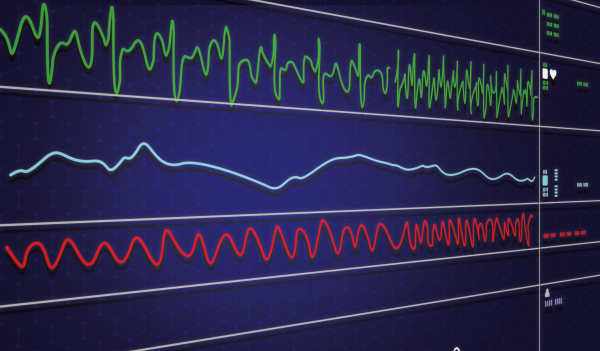
A line graph that shows heartbeat metrics.

It’s more than just “hacking health”—bioelectronic medicine has the potential to transform how we treat a range of conditions and disorders.

Published June 21, 2016

By Attila Szász

Image courtesy of teerapon via stock.adobe.com.

The term “bioelectronic medicine” may seem to be more science fiction than medical reality, but this field of science has recently made significant strides in translating research from the lab to the clinic with promising results. From implantable devices to treat autoimmune diseases without medication to microchips to help quadriplegics regain movement, bioelectronic medicine is quickly moving into the forefront of scientific applications.

The premise of bioelectronic medicine is that nearly all cells in the human body are in some way regulated via information communicated from electrical signals from the nervous system. Similar to how implantable artificial pacemakers emit electrical impulses to regulate a heartbeat, various technologies have been developed to block, stimulate, or regulate the body’s neural signals to control the underlying molecular targets of many diseases.

Bioelectronic Medicine: A Viable Therapeutic Field

Bioelectronic medicine would not have emerged as a viable therapeutic field without the work of Kevin J. Tracey, MD, President and CEO of The Feinstein Institute for Medical Research-specifically, a key discovery in May of 1998. At the time it was believed that there was no communication between the nervous system and the immune system, but Tracey devised an experiment to test his own hypothesis on a link between the two systems.

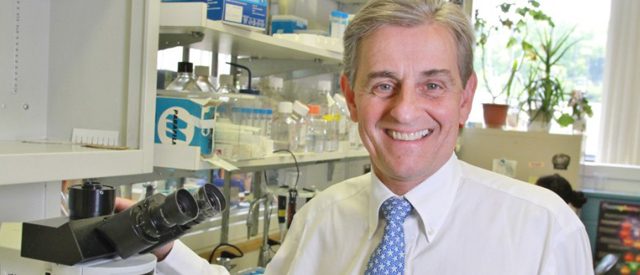
Kevin J. Tracey, MD

Tracey predicted that stimulation of the vagus nerve with electrical impulses would reduce production of tumor necrosis factor (TNF), a cell signaling protein linked to inflammation. Electrical impulses were delivered to an exposed vagus nerve in a rat and after the cut was closed, Tracey administered endotoxin to trigger inflammation.

Seventy-five percent of TNF production was blocked, through activation of what Tracey coined as “the inflammatory reflex.” Since these research findings were published in Nature in 2000, Tracey has co-founded SetPoint Medical to develop an implantable device to stimulate the vagus nerve as a treatment for rheumatoid arthritis (RA) that is intended to last for 10 years. Results from a pilot study reported that patients with this implant experienced symptom improvements comparable to those taking medications for RA and a long-term study is currently underway.

A Chip Implanted in the Brain

Chad Bouton, also from The Feinstein Institute for Medical Research, was recently the lead author in a landmark study appearing in Nature on a neuroprosthetic device that, for the first time in a 24-year-old man with quadriplegia, allowed a paralyzed man to move his hand using only his brain. First, functional magnetic resonance imaging (fMRI) scans of Ian Burkhart’s brain were taken while he attempted to complete a range of hand movements; once Bouton and his team identified from the fMRI the areas of the motor cortex associated with the movement attempts, a chip was implanted in Burkhart’s brain.

This chip is designed to note the electrical activity from the motor cortex that is linked to movement and to transmit this information to a computer, which eventually translates these signals and sends them to a flexible sleeve on Burkhart’s arm. The result? Burkhart’s muscles were stimulated, and over time with training he has been able to make isolated finger movements and complete six different wrist and hand motions. There are limitations to the technology, as it can currently only be used in a laboratory for a limited amount of time and requires recalibration before each use.

Regardless, Burkhart sees great value in bioelectronic medicine. “Even if it’s something that I can never take home in my lifetime, I’m glad I’ve had the opportunity to take part in this study. I’ve had lots of fun with it. I know that I’ve done a lot of work to help other people as well,” Burkhart told Nature.

Also read: Merging Modern and Ancient Medicines

Scientists: The Best Job in the World

Women scientists on determination, success, and the secret they wish everyone knew.

Published June 1, 2016

By Hallie Kapner

There is no better time to be a woman in the sciences. Generations of advocacy and effort have helped usher more women into diverse scientific fields than ever before, and despite the challenges that remain, today’s women scientists are the largest and most influential cohort in history, their voices louder by the minute.

Ask any of the 34 women who are winners and finalists of the Blavatnik Awards for Young Scientists and they will readily volunteer that they have the best job in the world. The long years of schooling, competitive atmosphere, tight faculty job market, and difficult juggling act between work and family never diminish the joy and excitement that comes through in discussions of their work. For many in the group, becoming a scientist was the dream of a lifetime, even before they had the words to describe it.

Many Paths

For Kathryn Uhrich, it began with questions. “Even though, I didn’t know I wanted to be a scientist, but I knew I was curious,” the dean of natural and agricultural sciences at Rutgers University recalled of her childhood self. “I wanted to know how everything worked. I took everything apart.” A similar early curiosity found a young Laura Landweber parked at her family’s kitchen table on snow days, immersed in an anatomy coloring book or busy building models. One winter, without a hint of prescience, she painted a model of a paramecium—a ciliate from the same group as the organism on which her groundbreaking work in molecular evolution is based.

The notion that questioning, probing, assembling, and even destroying are all central to the scientific endeavor did not register for these women until later, most often when elementary or middle school science teachers noticed an aptitude for the subject. By the time particle physicist Mariangela Lisanti was in the eighth grade, she knew where her interests lay, even if she was still honing her experimental skills.

Laura Landweber

“My science fair project that year was an investigation of whether microwaves killed or damaged corn seeds,” she remembers fondly. “I knew they did, but I was trying to find out how much they could take before their growth was stunted, and at what point they died. I grew all these corn seeds and literally covered my parents’ dining room table with petri dishes.” With a reassuring laugh, she adds that the following year’s project investigated how to protect the seeds.

A Knack for Science

Sometimes a knack for science exists among other talents, and while it’s hard to imagine microbiologist Christine Jacobs-Wagner as anything but a scientist, science was not her first career choice. At a university open house during her final year of high school, she made a beeline for the law department. “I sat through exactly one class and that was it—I didn’t want to be a lawyer,” she says. “I had to pick a major, and even though I was really interested in business, I picked science because my favorite high school classes were biology and chemistry. I’m a scientist because of those teachers. They really had a tremendous influence on me.”

Discovering a love of science and a natural gift for the academic skills it requires, whether in math, biology, statistics, or chemistry, is only the first step. Even before the long road of advanced degrees, there is a choice: which field beckons loudest? Daphne Bavelier, a cognitive neuroscientist whose work on brain plasticity has upended conventional views of how learning takes place, started out pursuing molecular biology.

At an internship in her third year of undergraduate work, during some of her first hands-on molecular biology experiments, she had what she describes as “a real halt, a moment of ‘Wait, what am I doing?’” She was surprised that a field that thrilled her in books felt less exciting in real life. “I discovered it was more fun to read about Western blots than to do them,” she remembers. “And thankfully this all happened at a time when there was a revolution in our understanding of brain science. I was fascinated by that, and even though my field didn’t exist yet, that all changed quickly.”

The Road Ahead

Bavelier was fortunate to land in the lab of trailblazing psychologist Molly Potter, who had in the 1960s been one of the first women to join the faculty at the Massachusetts Institute of Technology, at a time when many of the school’s buildings had no women’s restrooms. Potter was not just one of Bavelier’s most influential scientific mentors; she epitomized a quality crucial to the success of any scientist: determination.

Today’s academic climate insists that faculty scientists wear many hats: grant writer, teacher, researcher, and sometimes even politician. Add the pressure to “publish or perish” and it is not hard to see why biological engineer Antje Baeumner tells her students, “If you want the easy route, don’t get a PhD.”

Choosing a life in academia means following the work you love into an environment that tests even the brightest and most confident, with the specter of rejection never far from mind. Whether it involves being turned down for a grant or having a paper rejected for publication, a life in science means learning to accept no for an answer. What separates the highest achievers seems to be the ability to balance the short-term difficulties with the promise of big-picture goals.

“We just had a grant rejected last night and a paper rejected this morning,” says Uhrich. “But that’s just 5 percent of the time. The other 95 percent of the time I’m thrilled. No matter what you do or how you do it, there will be difficulties, so you may as well do what you enjoy.”

Handling Rejection

The subject of rejection brings up a particular set of issues for women in science, many of whom approach the topic, and the perceived differences in how men and women process the experience, with an analytical precision befitting their occupation. Many have acknowledged that for women, who represent less than 25 percent of science faculty in the country, being rejected or overlooked can have larger resonance, and the effects can be more detrimental.

Carmala Garzione

“If you look at the culture of promotion and tenure, it really preys on insecurity,” says geologist Carmala Garzione. “You feel like your work is being evaluated until someone gives you the final nod and says ‘You’re good enough, you can stay.’” Garzione suspects that many women are hampered by notions of how they should behave in a tough competitive environment. “These perceptions feed women’s doubts in their ability to succeed,” she says. “I tell my students to worry less—keep their heads down, get their work done, and do what they love.”

Jacobs-Wagner posits that men in science may be able to push past insecurities and setbacks more easily than she and her female colleagues seem to do early in their careers because societal norms present men with more opportunities to face rejection early in life. She cites the typical roles of courtship, explaining, “This has been going on forever—both men and women flirt, but the men propose. The norm is the man in control, and men experience a ton of rejection in this area. If that’s what builds confidence, then maybe we can learn more from being rejected, maybe it can’t be such a big deal.”

The Role of Gender Roles

Gender roles never entered into Daniela Schiller’s process of becoming a neuroscientist. As a child growing up in Israel, she knew she would someday serve in the army. “Over the years I played the drums and parachuted and did a lot of things typically considered masculine,” she explains. “At one point, I wondered why. But I realized it’s not about male or female ability, it’s about choosing the human experience you wish to have. For me, I think it helps to not consider gender, and to just do it, no matter how hard it is.”

Refrains of just do it, keep trying, never give up, take it as far as you can are constant mantras for this group of elite women, and it’s advice that they never hesitate to share with peers and students. Cell biologist Agnel Sfeir’s passion for her field survived the difficulties of growing up amid the Lebanese Civil War, and her determination remains undiminished today.

“If you love science, you have to take it all the way to the end. There’s nothing more rewarding than having your own lab. This is the ultimate. It’s tough, but it’s doable, and there are plenty of women doing it,” she says.

The Best Life

Elza Erkip

For electrical engineer Elza Erkip, the best job in the world is one that allows her to pursue her passion—these days, much of her research is in wireless networking—and to have the flexibility to make her own hours, spend time with her two young daughters, present her research at major conferences, and mentor her students. It’s the job she has, and she cannot imagine any other life.

“Some women decide that the juggle of life after a PhD is just too much. But a faculty position is actually the best job for a woman to have a career and a family. Why is this still a secret?” she exclaimed. “I’m so flexible, and there’s nothing else like it. The hard part is getting here, but once you’re here, it’s the best,” says Erkip, who also serves as a mentor for The Junior Academy.

“Getting here” is unquestionably a different journey for men and women—if it were not, perhaps the stubbornly low rate of women scientists applying for faculty positions would rise. The simple, and at times frustrating, math that causes two major paths in the lives of many women in science—their childbearing years and their work toward tenure—to intersect, is a major factor that lures some away from academia.

Erkip does not deny the challenges, but she is determined to be living proof that they can be overcome. “Part of the problem is perception, and part of it is having more role models. One of my students got pregnant just as she was about to finish her PhD, and she told me that she looked at me and my family and knew that she could do it too.”

A Marketing Problem

But the dream career for Erkip and many of her peers still suffers from a marketing problem. Uhrich sees most of her doctoral students accept industry jobs, and she and others at her level find themselves working harder to promote the best aspects of faculty science to the next generation.

“I try to share my excitement—who wouldn’t want a job where you get paid to play detective, to try to figure out how nature works. Often, I can’t imagine a better job and I tell that to my students,” says Jacobs-Wagner. “I tell them that we all get rejected—I get slapped in the face all the time—and if we take it a little bit personally, which is natural, it only makes the quality of our science better.”

Bavelier echoes similar sentiments with the students she mentors, striving to show that the benefits of a career in science are too rich to ignore. “It doesn’t matter where you work, balancing work and family is never simple. But the flexibility and the rewards of committing to science are so great, I have to show them it’s worth accepting the difficult parts.”

Certainly institutional change will help, and many universities boast growing rosters of women in faculty positions, particularly at untenured ranks. Established senior scientists acknowledge that further systemic change will take a generation. “As a tenured woman in science, I’m definitely a role model for my students,” says Landweber. “But especially as a full professor at a small place like Princeton, with few senior women in science relative to competitor institutions, you might find yourself the only woman at that rank in your department. And then there’s another gender imbalance if the leaders in the department have had their PhDs for 50 years and you’ve had yours for 15.”

A Mid-Career Move

Landweber, who will soon move to Columbia University after more than two decades at Princeton, adds that “a mid-career move can bring refreshing and exhilarating change. Plus, the opportunity to be recruited as a senior colleague means that there is no more glass ceiling.”

Emily Hodges

The postdocs and new faculty who will become the deans and department heads of the future seem to be taking the messages of their mentors to heart, and many new faculty are experiencing refreshingly positive early days on the job. After just six months at Vanderbilt University, biochemist Emily Hodges reports that she is already taking on leadership roles. “I have to give my colleagues a lot of credit—it’s been very encouraging and I’m already being put on committees,” she says. “You’d have to be blind not to see that there are fewer women, but I’m finding opportunities to become a leader.”

Hodges and her contemporaries, just like the generations of women scientists that preceded them, are shattering misconceptions and creating new paradigms for women in science. They are also benefitting from cultural shifts that they hope will bring greater equality to their work. They’re fearless boundary-breakers, agents of change. They are living the best advice Erkip gives to her young students. “We cannot be afraid of what’s hard,” she says. “Love what you’re doing and you will succeed.”


About the Author

Hallie Kapner is a freelance writer in New York.

Providing the Best Role Models for STEM Students

A mentor works with two young students.

A new grant will help expand the Academy’s Afterschool STEM Mentoring Program, enabling members to have a greater impact on the next generation of scientists.

Published April 13, 2016

By Diana Friedman

As Ellis Rubinstein, President and CEO of The New York Academy of Sciences, said in his keynote earlier this week at the World Strategic Forum, “If all of us work together, we can better prepare today’s students to become tomorrow’s STEM innovators.”

In addition to bringing industry, academia, government, and philanthropy together, one of the key strategies that the Academy has focused on in its STEM education programs is bringing science professionals and students together. By providing young people with the chance to meet role models face-to-face and learn directly from those working in STEM, students get the chance to imagine new possibilities for pursuing lifelong careers in science, technology, engineering and math. This is particularly important for young people living in some of the poorest areas of New York, who particularly benefit from meeting younger scientists who look like them and with whom they can build friendships.

That’s why the Academy is so excited to announce the expansion of the Afterschool STEM Mentoring Program thanks to a grant from the Corporation for National and Community Service (CNCS). This grant, mentioned today in the White House’s annual Science Fair Fact Sheet, will build the capacity of our afterschool programming in New York and Newark, New Jersey.

A Flood of Applications

When the Academy first put out a call for mentors to members, the applications flooded in. And in the six years since the program started, interest has only grown. Many members have returned to the program year after year, demonstrating their deep desire to have an impact beyond their research by volunteering to serve as afterschool mentors.

“We would like to thank the Corporation for National and Community Service and are excited to be part of the AmeriCorps VISTA expansion,” said Rubinstein. “Over 1,000 Academy members have already volunteered to teach and mentor kids through the Afterschool STEM Mentoring Program. This generous grant from CNCS will build our capacity to bring this experience to thousands more.”

Learn more about our Afterschool STEM Mentoring Program:

Improving Survival Rates of Neuroblastoma

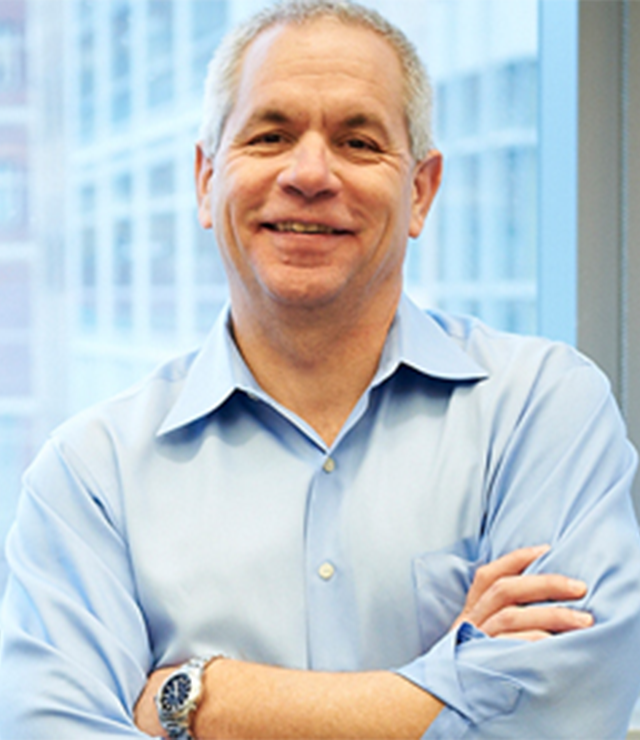
A man with his arms folded poses for the camera.

How John Maris, MD, got to the heart of the (genetic) matter through his research.

Published February 27, 2016

By Diana Friedman

Persistence paid off for John Maris, MD. Fifteen years after he began searching for genetic abnormalities linked to neuroblastoma during his post-doctoral fellowship, his research team discovered that mutations of the anaplastic lymphoma kinase (ALK) gene are associated with many neuroblastomas. Today, Maris’s work at The Children’s Hospital of Philadelphia (CHOP) continues to strive to translate basic and clinical research into improved therapies for patients.

Currently, neuroblastoma is the most common extracranial solid tumor in childhood, with an incidence rate of about 10.54 cases per 1 million per year in children younger than 15 years. Although overall incidence of pediatric cancer has declined since 1975, survival rates for children with neuroblastoma vary significantly based on age of diagnosis and risk classification. The five-year survival rates for patients range from 90% for those younger than 1 year to 66% for those age 10- 14 years; children in the low-risk group have a five-year survival rate at more than 95%, but the survival rates for children in the high-risk group are between 40- 50%.

Influenced to Study Neuroblastoma

These statistics, plus a research opportunity prior to attending medical school, played a significant role in shaping Maris’ career path in medicine. Working in the laboratories of noted pediatric oncologist Audrey Evans and biophysicist Britton Chance prior to attending the University of Pennsylvania School of Medicine, influenced his decision to study neuroblastoma.

“I was introduced to the disease, including patients and families, while a technician before medical school,” Maris told us. “I had great mentors and have stuck ever since to trying to solve the many enigmas associated with the disease.”

During his postdoctoral fellowship, Maris’s research was focused on determining genetic mutations associated with familial neuroblastoma—he didn’t discover it then, but fifteen years later his team found that the primary cause of familial neuroblastoma is a germline mutation in the ALK gene. Yael Mossé, MD was the post-doctoral trainee who made the actual discovery, and now she is an internationally recognized expert in translating ALK inhibition strategies to patients.

A Multifaceted Approach

For Maris, improving survival rates of neuroblastoma is promising when a multifaceted approach is applied.

Bridging the fields of genomics and immunotherapy together is our greatest hope,” he noted. “We will be increasingly individualizing therapy based on the unique features of the patients and their heritable genome and the evolving cancer genome/proteome. The road to translating research findings into novel therapies is long, but we’re working on it.”

Also read: The Quest to Find a Cure for Pediatric Cancer

Important Role of Communication in Advancing Science

The actor, writer, and science advocate educates scientists in the elusive art of communication.

Published August 1, 2015

By Kellie M. Walsh

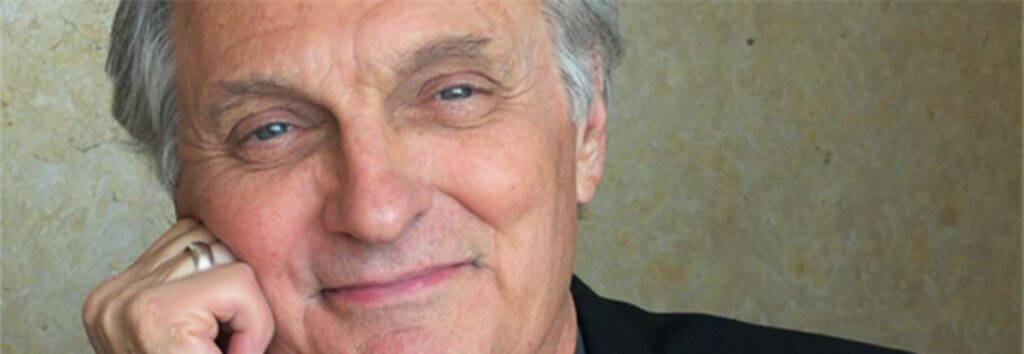
A headshot of a man smiling.

All he’d said was “Oh,” but I could hear in the shape of the vowel that the smile on his face was evaporating. I’d given Alan Alda a terrible answer, exactly the type of answer he has worked so hard to train out of others.

For more than 20 years, Alda, like The New York Academy of Sciences, has been on a mission to get people talking to one another. While the Academy brings scientists and non-scientists from different disciplines, sectors, and communities together through common goals and initiatives, Alda focuses on bringing them together through a common language.

As Visiting Professor at the Alan Alda Center for Communicating Science at Stony Brook University, he uses improvisational techniques and theater games to train scientists to distill and translate their work into language that officials, media, funders, the public, and scientists of other disciplines can all understand. This interest in aiding the sciences through the arts, in fact, inspired the founding of the Center for Communicating Science in 2009; it was renamed in his honor in 2013.

Alda’s objective is to transform scientists not into actors but rather into comfortable, empathetic conversationalists able to clearly express their work to anyone and everyone—and, consequently, help advance it forward. He has also hosted several notable science documentary series for public television; is an award-winning actor, writer, and director; and has received numerous science communications awards, including the National Science Board’s Public Service Award (2006), the Scientific American Lifetime Achievement Award (2013), the AAAS Kavli Science Journalism Award for The Human Spark (2010), and the Council of Scientific Society Presidents’ Carl Sagan Award for Public Understanding of Science (1998).

Talking Shop about Communications

In anticipation of our phone call, I’d prepared to talk about Alda’s long and credentialed career. I’d prepared to talk shop about communications. I’d even prepared a two-sentence introduction that I’d practiced reading aloud, hoping to convey to Alda that his communications work and mine paralleled in notable ways. I wanted to show that we spoke the same language.

I hadn’t prepared for him to actually be interested.

I’d just finished my introduction, explaining I was the then Associate Director of Web Content and Development for the Academy, which was a long way of saying that I helped people communicate online. Alda jumped on my last word so quickly I almost didn’t hear him ask, “How?” As in, how in my work do I help people communicate online?

It was a reasonable question; one I’d opened the door to even. Yet I bumbled. I stammered out a staccato of half-sentences, then topped them off with jargon. Rather than speaking his language, I found myself talking straight over his head. Without meaning to, I’d answered his interest and curiosity by shutting the door in his face.

Mine wasn’t the first disappointing answer Alda had ever encountered, however: during his 11-year tenure as host of Scientific American Frontiers, for one, Alda had interviewed hundreds of scientists, many whose thoughts he’d found stuck inside their own minds. But rather than allow his interview subjects to deflect, obfuscate, or drone through a rote script, he discovered that the way to break through this obstacle was to keep tapping interviewees with questions until their shells finally cracked.

Effective Interview Tactics

Image courtesy of wellphoto via stock.adobe.com.

“In most interviews,” explains Alda, “you already know the answer to the questions. I didn’t know what the questions were; nor did I know what the answers were. I just wanted to understand what their work was. And if I didn’t understand it, I’d badger them until I did.”

Alda’s persistence and desire to learn often helped his interviewees overcome both their nerves and their “curse of knowledge,” the cognitive bias that makes it difficult to think or talk about a familiar subject as if from a position of unfamiliarity. “They lost all interest in talking to the camera,” he says, “and really wanted me, personally, to understand it. It was just me and them. Their humor came out, their curiosity. It was an intimate interaction. That’s what we want and what we work hard to get scientists to do when they communicate. We invite them to tell stories, to let themselves be in the stories. Because that’s what audiences will respond to.”

Of course, that’s easy for Alda to say: he’s a famous, quick-witted raconteur with a smile you can hear through a phone line. Yet he says he, too, must consciously work at interaction, especially in unfamiliar social settings. “We often shrink from human contact because we feel naked out there sometimes,” he says. “I mean, I’m not comfortable with cocktail parties. I have to use what I’ve learned in communication to be comfortable, to realize that the person I’m talking to has probably the same uncertainty about the situation that I do.”

Making that Connection

That consideration of his audience’s state–that empathy–is how Alda transforms superficial small talk into meaningful communication. The key, he says, is to make an active effort “to connect with the people you’re talking to or writing for. What are they thinking when you say the first thing you’re saying? Who are they? What do they know already? That old thing of knowing your audience–it’s not just knowing your audience; it’s connecting to your audience. To be there with them in the same room.”

Alda means that last bit both literally and figuratively: to connect, we must recognize–relish even–that we are all allies, social animals with an innate desire to understand and to be understood. In this way, he says, art informs life. “You can’t achieve what you’re going onstage for unless you can make real contact with the fellow players,” he says.

“That’s the essence of what we’ve found about communication: that connection, that awareness of the other person, immediately relaxes you. When you address the audience directly, they become your fellow players. And there’s a big difference between thinking of them as your fellow players and thinking of them as people who are judging you…I’ve had so many young scientists say, ‘I overcome my fear by looking over the heads of the audience.’”

“[But] once you get used to the fact that they’re your playmates and not your adversaries, you overcome your fear by looking them in the eye. By enjoying their company. Then you actually can develop–it seems hard to believe–but you actually can develop a personal relationship with a group of strangers.”

An Experiential Learning Process

Breaking through our natural aversions to vulnerability to develop such relationships, however, takes practice. “It’s not an intellectual understanding,” says Alda. “It’s an experiential learning process,” one he says often requires fighting against lessons most scientists have had drilled into them.

To facilitate objectivity, he explains, “you have emotion trained out of you when you’re writing science for other scientists in your field.” But communicating science to broader audiences requires the opposite approach because, as he says, “people like me, ordinary people, rely on story and emotion.” Thus, the Alda Center aims to redesign the way scientists are educated, placing special emphasis on training science and healthcare graduate students while they’re still learning their fields of study so “when they leave as professional scientists, they’ll be good communicators as a matter of course.”

Alda cites Nobel Prize-winning physicist Richard Feynman, whom he played in QED on Broadway, as the preeminent example of a successful science communicator. “He didn’t wave his arms and get crazy about it,” he says, “[yet] he could talk in the most loving way about nature in all its complexity, and you could really follow him.” Alda wants the same for his workshop students: for them to leave able to use “everyday terms for complex things” in a way that is both compelling and easy to understand. So compelling and easy, perhaps, that even a child could understand.

The Flame Challenge

Since 2012, Alda and the Alda Center have posed to scientists an annual challenge: to explain (in words, graphics, or video) a common but complex scientific phenomenon in a manner acceptable to the average 11-year-old. Inspired by a disappointing childhood experience in which a teacher answered a young Alda’s curiosity with cool jargon, the challenge (called The Flame Challenge, for its first-year topic) requires scientists to think deeply about how best to engage this unique, likely unfamiliar audience.

This year’s challenge question: What is sleep? “The Flame Challenge is a great exercise for scientists because it is all about focusing on the people you’re talking to–in this case, 11-year-olds,” says Elizabeth Bass, Director of the Alda Center, via email. “What do they know? What do they care about? How can I express something important and complex in ways that will connect with them?”

That Bass’ questions echo Alda’s is unsurprising: their individual and collective goals are one and the same. “Connecting with your audience–trying to read their minds, in a sense–is at the heart of communication for Alan Alda and for the Alda Center at Stony Brook,” she says. “So the Flame Challenge fits perfectly with our approach.”

Challenge submissions are vetted, then released for judging to an international pool of tens of thousands of middle-school students. Winning entries are announced at the World Science Festival in New York City, which occurred in late May.

The challenge fosters the development not only of current scientists but of potential future scientists and science enthusiasts as well.

An Unconventional Approach

“The Flame Challenge was aimed at scientists,” Bass says, “but kids and teachers loved the contest right from the start. The kids get to judge the work of adults, and that doesn’t happen very often. They really appreciate being taken seriously. Also, kids get to hear different attempts at answering the same question. It’s a good way to learn. It helps them see that science isn’t a stock set of known facts: it’s a way of trying to know things.”

This unconventional approach to trying to know things underlies both the Alda Center’s mission and Alda’s vast successes as an actor, writer, director, teacher, and science and communications advocate.

And, it comes as no surprise, as a conversationalist. In our phone call, Alda was friendly, familiar, and disarmingly charming; the discussion flowed, with one exception, smoothly. Yet, as I put down my script to listen, I couldn’t help but feel quietly mortified. I’d allowed my nerves to trip me into curse-of-knowledge jargon and deflection, forcing me to work twice as hard to re-build the easy rapport I had disrupted. My one comfort was knowing, or at least hoping, that he was working as hard to make a connection as I was.

Also read: From Successful Actor to Impactful Science Advocate


About the Author

Kellie M. Walsh is a freelance writer, web producer, and content strategist in New Jersey.

A New Report On the “Global STEM Paradox”

This comprehensive report answers the recent paradoxical question: if we’re graduating record numbers of STEM students, why are STEM jobs still unfilled?

Published January 26, 2015

By Stacy-Ann Ashley

Today the New York Academy of Sciences (the Academy) released a new report, “The Global STEM Paradox,” in an effort to better define the state of science, technology, engineering and math (STEM) education and careers worldwide.

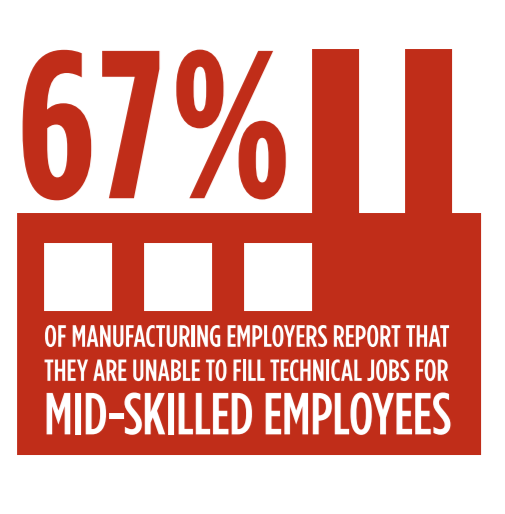
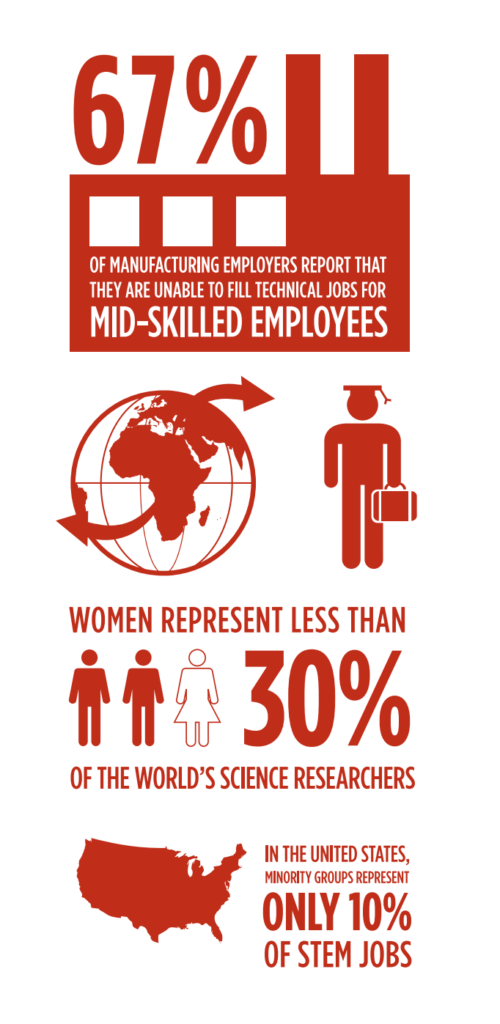
The report paints a shocking picture of the state of STEM education across the world: 67% of manufacturing employers in the United States report that they are unable to fill technical jobs for mid-skilled employees, while women represent less than 30% of the world’s science researchers. Furthermore, in the United States, people of color represent only 10% of STEM employees.

The Academy’s report demonstrates that while there are sufficient numbers of graduates in STEM, employers still report difficulty in filling STEM jobs – the global STEM paradox. The report identifies areas of concern that contribute to employers’ challenges: low numbers of graduates who have the skills needed to match actual job requirements, “brain drain” from developing countries, and the lack of women and people of color in STEM fields. The report also highlights a global disconnect between the developed and developing worlds, with mid and high-skill STEM jobs available in the Global South, but most of the candidates available to fill them living in the West.

“If we want to solve the global STEM paradox, we need to change the way we think about STEM education and careers worldwide, ” says Meghan Groome, PhD, Executive Director of Education at the Academy. “It’s not enough to churn out a small army of PhDs from our top institutions. We need a new class of skilled technicians, we need home-grown scientists in the developing world, and we need to make women and people of color feel welcome in STEM fields.”

Combatting the STEM Paradox

To combat the STEM paradox, the Academy recently launched the Global STEM Alliance of The New York Academy of Sciences (GSA), a worldwide partnership with governments, companies, NGOs, universities and schools to improve student access to STEM mentors and tools. At the UN in September, the GSA announced that it is investing millions of dollars in order to inspire over 1,000,000 children worldwide to become STEM leaders in more than 100 countries by 2020.

At the UN event, members of the Alliance proposed a solution to the STEM paradox: an ecosystem of government policies, strategic business incentives, and innovative Web-based and one-to-one and one-to-many mentoring approaches that, together, create the necessary incentives for students to seek, acquire, and employ STEM skills.

“In order to place STEM graduates in areas where they’ll be most effective, we need a global STEM ecosystem that can educate the next generation of STEM leaders to confront the biggest challenges of our time-climate change, malnutrition, global epidemics-through cross-generational, transnational collaboration,” says Groome.

The GSA launched with several Founding Partners: ARM, Cisco, and the Global Sustainability Foundation, as well as a group of Founding Nations and Regions, including Barcelona, Benin, Croatia, Malaysia, New York State, Rwanda, and the United States.

“We’re proud to have the support of esteemed dignitaries and business leaders on board with the Global STEM Alliance,” says Celina Morgan-Standard, Senior Vice President, Global Business Development, Global STEM Alliance. “With a ready and willing base of partners dedicated to building STEM skills and supporting global economic development, I have no doubt we can achieve our goals and solve the STEM paradox.”

Learn more about educational programming at the Academy.

Imparting the Value of Wonder on Aspiring Scientists

Teaching an afterschool forensics course was about more than imparting knowledge of DNA; we aimed to teach students the value of asking questions and seeking answers.

Published August 1, 2014

By Giovanna Collu and Jonathan Isaac Schneiderman

Image courtesy of Verin via stock.adobe.com.

Training for our afterschool “forensic science” course flew by: fingerprints, shoeprints, crime scene sketches, hair and fabric samples, and an encouraging “You’ll do great!” Not specializing in forensics, we scribbled down notes and were certainly a little nervous as the slow trickle of students came into the classroom that first day. “Is this ‘MAD SCIENCE’ class?” someone popped their head in and asked. We both looked at each other puzzled, until one of the teachers in the room replied, “Yes, yes it is. Now sit down already.”

Unlike past longer-term mentoring opportunities that we’d had, our afterschool class only ran for one semester. Given that we had a different mix of kids attending each week, it was clear that the brief and sporadic nature of our interaction with each student would require a different mentoring game plan. We needed to quickly establish a relationship of mutual respect, generate and maintain enthusiasm, and most importantly, seed a lasting change in the kids’ relationship with science. Piece of cake, right?

“So, does anyone know what ‘forensic’ means?” we asked a silent classroom. “It’s like on TV, when there’s a crime that needs to be solved,” we explained. But the truth was that we weren’t there to teach them forensics at all. We were there to show them that scientists don’t have to be crazy-haired, old white men—because we aren’t. We were there to be relatable adults who happened to be scientists and were taking the time to teach them something interesting.

A Fun Break from the Classroom Routine

With 90 minutes per session, we knew that time would always be limited. Still, the mission was clear: provide a fun break from the classroom routine. Once the kids were engaged with hands-on activities, we could get them excited about solving problems using an evidence-based approach. Sure, we were “investigating crimes,” but asking questions and critically assessing answers are also important for understanding science as well as the world at large.

We raised the stakes a few sessions into the semester when we planned a fieldtrip to the Harlem DNA Lab, a short train ride away. Tucked away in an area far-removed from our research facilities, the center is a division of Cold Spring Harbor Laboratory, an organization home to numerous Nobel laureates. The trip gave us an exciting opportunity to share a small part of our day-to-day lives with the students.

So there we were, 12 kids, two teachers and the two of us, on the New York City subway during rush hour, on our way to see how DNA is analyzed in a lab. Our mantra-like counting of heads to ensure no child was left behind was all but drowned out by a stream of questions from the group: “Are we going to a real crime lab?” “Will we be wearing white coats?” “Are there going to be dead bodies there?”

After a short refresher about DNA, our instructor, Melissa Lee, quickly split us into groups, each equipped with a gel-box and colored tubes. Once all the kids tried their luck loading samples, the gang was teeming with excitement and huddled in the dark around an illuminated gel. “Wow! Does DNA really glow green?” one of them asked. “Well, not exactly…we use a fluorescent dye to see it,” Melissa replied with a smile.

Exciting for Students and Teachers

On our way back, the chatter had a new topic, and now the teachers were in on the conversation, too. Apparently, seeing DNA was pretty cool and warranted further discussion, and that was the whole point. We wanted to use the little time we had to get everyone excited; not just the kids, but the teachers as well. After all, the teachers’ continuous reinforcement would ultimately ensure none of these children would be left behind.

Time will tell whether we succeeded in making a lasting change. However, we knew that we’d achieved one of our goals. When asked how a “real scientist” would dress, one student quickly replied, “She can wear whatever she wants.” Although we weren’t there to convince them all to become lab scientists, conveying that they were fully capable of doing so was certainly a good use of our time.

So, what worked well with our group? Like most things in life, it all came down to striking a balance. We had to enter the classroom with a clear teaching objective, but at the same time be flexible enough to let the kids follow up with tangential questions so that they felt engaged. We also learned to include a variety of activities and not be too didactic. Overall, though, the key to this mentoring experience was to be ourselves, have fun solving crimes, and let our love of science speak for itself.

Also read: Good Mentors are Key to Student Interest in STEM


About the Authors

Giovanna Collu, PhD, is a postdoctoral fellow in the Mlodzik Lab at the Icahn School of Medicine at Mount Sinai.

Jonathan Isaac Schneiderman, PhD, is associate director of science at McCANN RCW.

Challenging Young Innovators to Think Big and Bold

Middle school students tackle “Nature’s Fury” through teamwork, persistence, and robots at an Academy event.

Published August 1, 2014

By Caitlin Johnson

For a moment, 12-year-old Gabriella Ryan was distracted by the sweeping view of the Hudson River from The New York Academy of Science’s (the Academy’s) fortieth-floor conference space at 7 World Trade Center.

“This is the first time my team has competed in the city this year and it’s really cool to be in this atmosphere,” Ryan said, admiring the spring sun reflecting off the buildings below. “It’s like, so real because we’re here. I’m really excited to see all the different teams. And of course, all the robots.”

Ryan, a seventh grader at the St. Clare School on Staten Island came with her team, the Transformers 2, and 10 other middle school teams for the Academy’s fourth annual Family Engineering Challenge Day this spring.

In all, more than 100 students from schools across New York City took part in the daylong celebration of science and engineering. Students worked together to problem-solve, learn, and have some serious fun with science.

Teams came prepared to compete in three activities: a LEGO® Robotics Gameboard Challenge, a research project—both of which are part of a global series of events sponsored by LEGO and the nonprofit science mentoring program, FIRST®—and a networking challenge where students collected stickers for successfully interacting with scientists and engineers.

The National Geographic Explorers’ Engineering Challenge

This year, a fourth challenge was announced the day of the event: the National Geographic Explorers’ Engineering Challenge, which asks students to tackle a problem that a National Geographic photographer might encounter in the field: how to lift a camera 10 feet in the air for an aerial shot while the photographer’s feet remain firmly on solid ground.

Each of the challenges picks up on the theme of this year’s event, “Nature’s Fury.” It’s a theme that hit close to home, especially for those who live in areas of the Northeastern U.S. hit hard by Superstorm Sandy just over a year ago.

In addition to the students, their families, and coaches, more than 30 adult volunteers—most of them graduate students or professionals in STEM fields—volunteered to spend their Saturday serving as mentors or judges for the research projects.

For Bridget Huang, a biochemistry PhD student at Columbia University and volunteer mentor for the day, it’s all about demystifying science and helping kids see that it’s not boring, scary, or foreign.

“It’s not necessarily about making everyone here become a scientist,” Huang said. “My goal is that I don’t want any of them to be afraid of science. I want them to have interest, which will help them in any case. Even if they work in business, they should to be able to talk to scientists.”

Tinkering & Teamwork

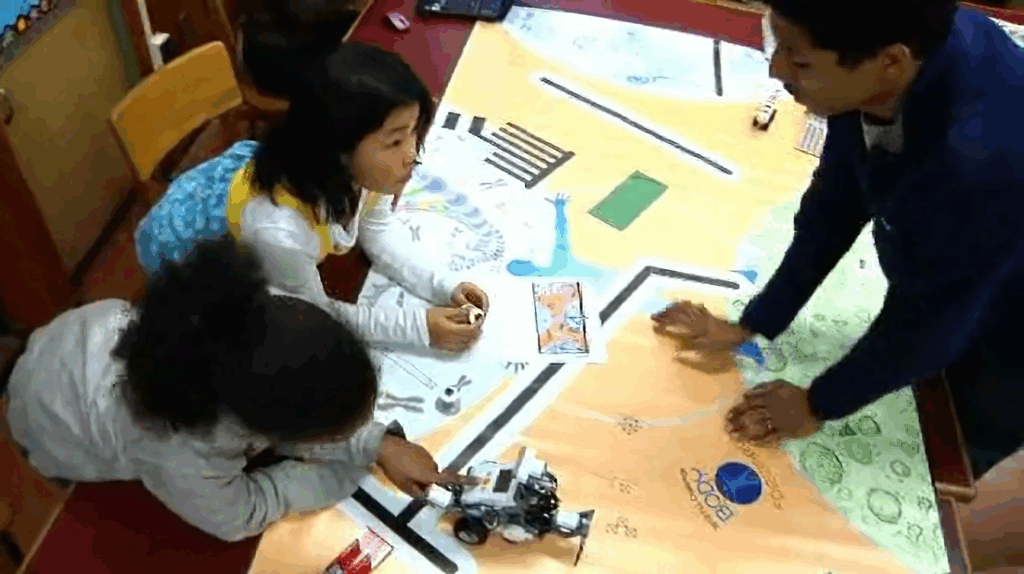
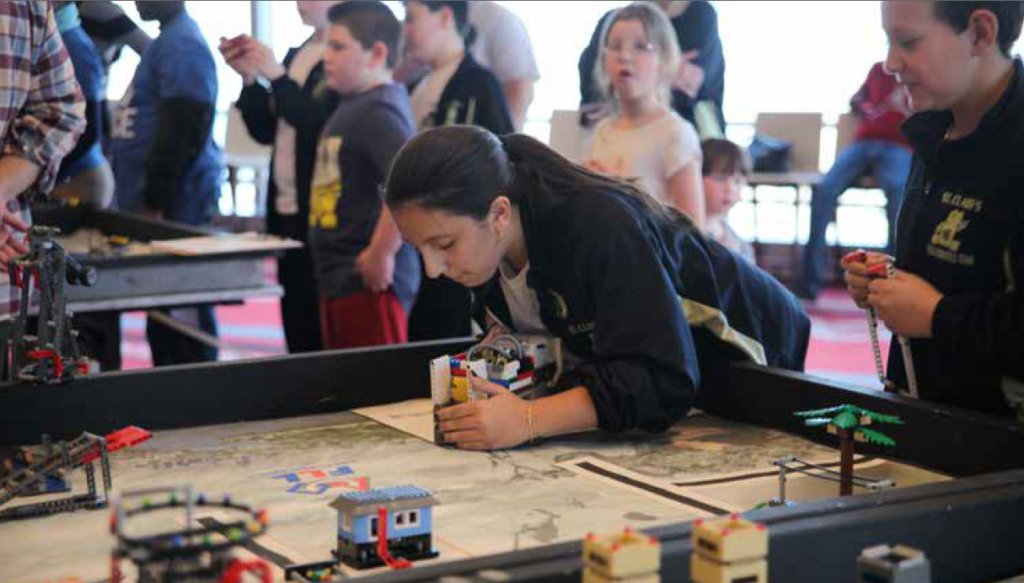
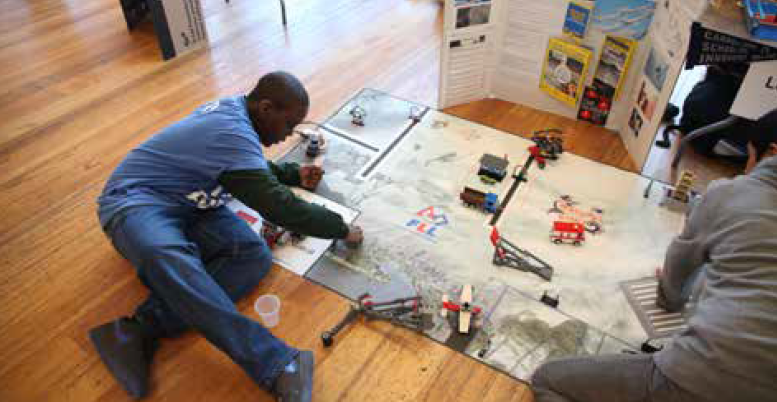
The centerpiece of the day was the tabletop LEGO® Robotics scrimmage, where teams design and program a LEGO robot to navigate an 8-foot by 4-foot game board in two-and-a-half minutes. The layout of the board simulated the aftermath of a natural disaster. Teams earned points for each task their robot completed—for example, clearing debris, avoiding obstacles, and picking up and moving pieces from one spot on the board to another.

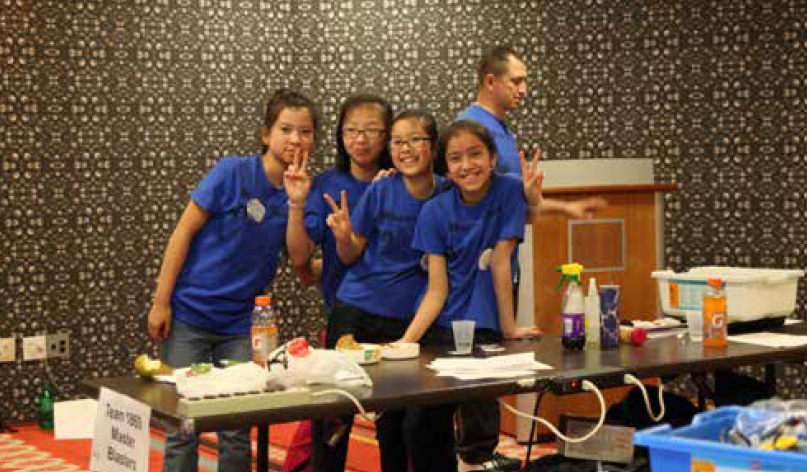
Many of the students said they were especially excited about learning computer programming to “teach” their robots what to do, and about incorporating high-tech components into their LEGO creations. “The coolest thing was the ultrasonic sensor we put on our robot. We could program the distance from barriers and surfaces and it could avoid them,” said Ariel Sanchez, 9, with PS 94K’s Master Blaster team.

His teammate Eric Velasquez, also 9, said that they first learned about the sensor by watching others use it and “we decided to learn how to use it for the missions. The sensor makes me feel like, ‘How can we learn and use new things?’”

That spirit of collaborative learning—borrowing and building on what works—is a big part of what this annual event is designed to foster.

Because this was a scrimmage, not an official FIRST LEGO League (FLL) competition, it was open to teams who didn’t qualify for the FLL finals taking place later in the spring at the Javitz Center in New York. And while the scrimmage mimicked the competition format—with four tables of teams competing at the same time—each robot was going for its personal best rather than trying to beat the others.

Collaboration and Problem Solving

Each team got three runs on the scrimmage tables; in between, they could take their boards back to their “base camps” and tweak things. “As with all good engineering, there’s iteration that happens and the teams learn a lot about what happens with the robots as they watch them perform,” said Stephanie Wortel, Academy Education Program Manager. “They work together to problem-solve and make their robots even better.”

That’s what members of team Flash from Genesis Middle School at Xavarian High School in Brooklyn did after their first run. Huddled over their gameboard, Ryan Clark, 11, and teammates CJ Ruiz, Michael Cuddy, and Chris McElhinney, all 12, were replacing their robot’s treads and swapping out some of the parts.

“This wasn’t planned, it was more like a last-minute thing,” Cuddy admitted. “The referees told us we could use more accuracy and speed.”

Teammate Alexander Ayoub, 13, stopped tinkering long enough to reflect: “The thing about this, it’s just a great experience because many other people don’t do this kind of stuff and it really makes us a lot smarter. But it takes a lot of things, like building and programming, and you need strategies. That helps you with practically everything in life, not just if you want to become an engineer or a programmer.”

Nearby, David Cadunzi, 13, with St. Clare Transformers, said that’s what he likes most about this annual Academy event: “It’s about having fun, and the trial and error that helps you succeed. When my team and I don’t get a program we want to get, we don’t back down. We keep trying it even though we mess up a lot.”

“Gameifying” Science and Mathematics

John Steib, 12, with Team LEGO Force agreed: “That’s a good thing you have to learn in life, too. You can’t just fix everything by doing it one way or with the push of a button.”

“It’s easier working together with a team because if you’re doing one thing and it’s hard for you, your friends are there and you can learn from them,” Shameekah Gray, 13, said.

Some pretty grownup lessons were being learned through “gameifying” science and mathematics.

The Robotics Challenge may have been the main event, but students were equally excited about the research project. In September 2013, teams were given an assignment: identify a real community and a nature-related problem it faces, and come up with an innovative solution that will prevent damage or help the community recover from the natural disaster.

And innovate they did.

Projects ranged from a waterproof coating to prevent generators from exploding (developed by students in Bay Ridge and Breezy Point, Brooklyn, which was plagued by fires after Sandy) to an inflatable “SnapAlert” life vest that includes supplies and a homing device to alert rescuers, to a full-body suit to keep wearers safe and warm in dirty flood waters. A more fanciful project, Hurricane Fighters, centered on large flying robots that emit countervailing winds to disrupt hurricanes.

At the Academy, each team got 20 minutes to pitch their ideas and field questions from a panel of judges, all of them STEM professionals from Tata Consultancy Services, Moody’s, Goldman Sachs, and InfoSys.

“It felt so real because we were in a conference room and the judges were actual engineers and people in the field,” said Thomas Drennan, a member of St. Clare’s Transformers.

Special Recognition

Judges gave special recognition to several stand-out projects, including those designed by the two St. Clare Transformers teams from Staten Island.

“Sandy was definitely a big motivator for us because we lived it,” said Mary Lee, coach of both Transformers teams. “We were out of school for a week with no electricity, and we had kids whose families lost homes.”

“We considered a lot of ideas and decided on the ones we thought would be the most effective and would help our community the most,” St. Clare student Daniella Gomes said.

Transformers 1 designed “Pack N’ Track,” a waterproof box that keeps valuable papers safe and has a transponder so it can be tracked at a distance of 35 feet (in version two, the team plans to boost the distance).

Transformers 2 built “The Window Seal,” a window that automatically seals itself during a flood. They used a typical basement window and lined it with a bicycle tire tube that inflates when water activates a pressure sensor, indicating that flood waters are nearing the window.

Not all teams designed research projects to solve hurricane and flood-related problems. Team LEGOForce from MS 442 in Brooklyn chose Boston as their community, and blizzard-related power outages as their problem to solve.

“During a blizzard, it’s really important [to keep power on] because you can get hypothermia and that can be deadly,” said Ivan Sanchez, 13.

After talking to an Office of Emergency Management employee and one of the team member’s landlords, an electrician, they came up with the idea for a cover for electric power lines made from a flexible series of connected casings “like the shell of a millipede.”

A Little Scary, A Lot Cool

That way, “it’s a little bouncy so when a tree or a branch lands on it, it will bounce off a little. It reinforces the wire,” Yosmai Bielma, 13, said.

“The quality of the presentations and the ideas and the access the kids have to information continues to amaze me,” said Paul Walker, a physicist by training who leads technology for Goldman Sachs and is also an Academy Board Member. He volunteered to judge the presentations, as he has done each year of the event.

Walker noted that this year, the networking component was integrated throughout the event. “In so many science programs, formal communication and science are emphasized but informal communication or networking—which is really the difference between success and failure in many of these fields—is not part of the program.”

Bronx Taskforce coach Oscar Lemus said the Academy scrimmage “gives kids a career awareness that other tournaments can’t offer. They have unlimited questions, and this is a place where they can ask real scientists.”

For Enxon Zheng, from PS 94 in Brooklyn, the networking was both “scary and cool. Today, I learned how to be braver and have courage to talk with others and learn and know about them. I’m usually kind of shy.”

Meeting Real Scientists

“That’s my favorite part,” said Darius Gravely with team LEGOForce. “I get to meet people who are actually, like, from science and ask how they work with science.”

This year, that included a visit from real-life astronauts, including Charlie Camarda and Rick Linnehan. Throughout the event, they visited with teams and fielded questions from excited students.

A Queens native and graduate of Brooklyn Polytech, Camarda praised the Academy for teaching teamwork, communication, and the importance of failing and trying again.

“The older these kids get, the more they’re going to be told what works and what doesn’t work. We have to make sure that they stay critical thinkers and lifelong learners and [don’t] just take at face value what someone says but figure it out for themselves and stay creative,” he said.

Check out the Innovation Challenges sponsored by The New York Academy of Sciences!


About the Author

Caitlin Johnson is the co-founder and managing editor of www.sparkaction.org, a website that covers a range of child and youth issues.
40 Years of Advancing Science for the Public Good

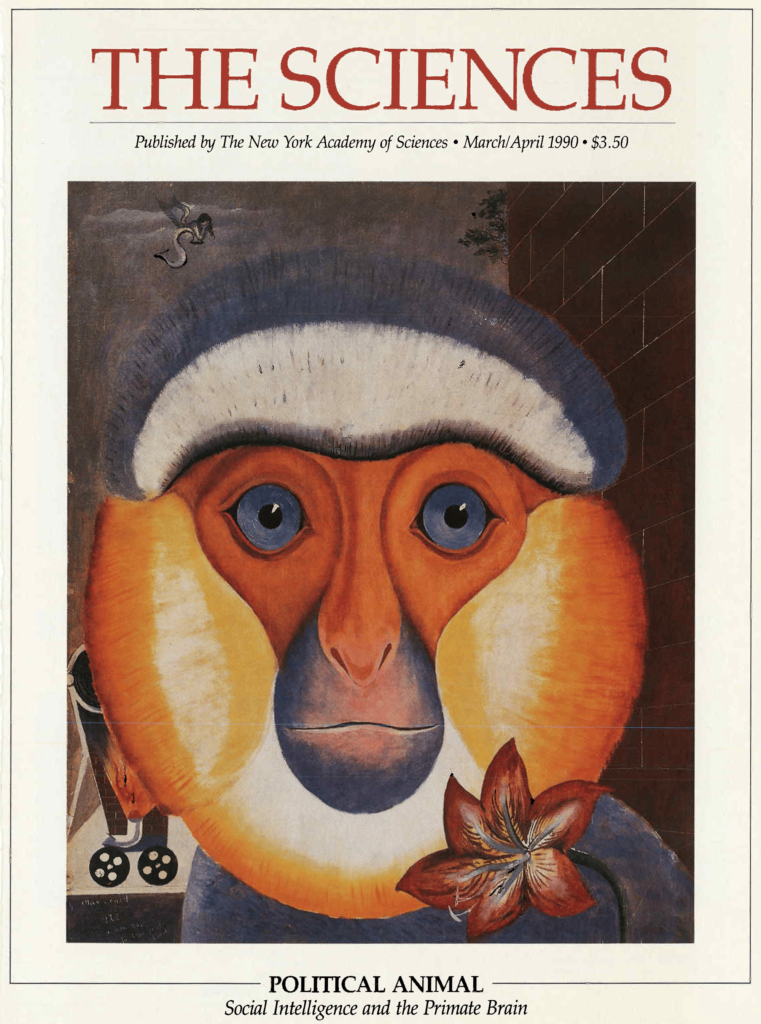
A cover shot of the publication The Sciences.

The Sciences, published by the Academy for 40 years, became one of the most honored science magazines in America. The contents of the entire run of issues are now available for members to enjoy online.

Published August 1, 2014

By Peter G. Brown

A cover shot of the publication The Sciences.

In 1961, the year The Sciences was born, the Russian cosmonaut Yuri Gagarin became the first man launched into space. Roger Maris hit 61 home runs, breaking Babe Ruth’s record. Catch 22 was published. JFK and Nikita Khrushchev were in office, and one night in August the Berlin Wall was put up.

1961 was a banner year in science, too. Sydney Brenner and Francis Crick showed that the code for making the building blocks of any protein is a series of three consecutive DNA base pairs. Murray Gell-Mann and Yuval Ne’eman developed a scheme they called the eightfold way (later reformulated as the quark model) for classifying “elementary” particles. Louis and Mary Leakey discovered Homo habilis in Tanzania’s Olduvai Gorge.

In those early days, The Sciences was a modest undertaking. The first issues amounted to little more than pamphlets, four sheets of letter-size paper folded once and stapled along the spine. But The New York Academy of Sciences nurtured the project through its fledgling years, and soon major scientists realized they could communicate with the public as well as their peers by contributing to its pages. The magazine gained a reputation as a small voice of reason and authority in the world of science writing for the general public.

Early Days

My initial contact with The Sciences was a fairly typical first encounter. In 1980, fresh out of grad school, I landed in New York, where I decided to “become a science journalist.” I contacted every science magazine I could think of about “writing something.” Susan Hassler of The Sciences was the only editor kind enough to respond to my naïveté, and she took the chance of assigning me to do a brief story for the magazine’s news section. After some editorial back-and-forth, my piece was published, unsigned, but in a form still recognizable to its author. I was on my way.

Like most magazines, The Sciences developed its own “stable” of scientist-authors, artists, freelance journalists, and, of course, staff writers such as Jonathan Weiner and Robert Wright who made regular or semi-regular appearances. Among the “outsiders” (i.e., nonstaff), the most important were designated “contributing editors”—a list that included the cartoonist Roz Chast, Stephen Jay Gould, Brian Hayes, Horace Freeland Judson, Laurence Marschall, Ashley Montagu, and Hans Christian von Baeyer. Artists were drawn from every style, every era, and every culture, but favorites, at least in my day, included those who might be described as neo-surrealists, such as Fanny Brennan, Alfredo Castañeda, Odd Nerdrum, Mark Tansey, and Kit Williams.

The magazine, through the Academy, also attracted its share of noteworthy scientist-authors, among them the Nobel laureates Hans Bethe, Francis Crick, Christian de Duve, John C. Eccles, Roald Hoffmann, Leon Lederman, Peter Medawar, Norman Ramsey, Andrei Sakharov, Richard E. Smalley, and Frank Wilczek, along with such luminaries as Enrico Bombieri, Freeman Dyson, Sir Fred Hoyle, Alan Lightman, Lynn Margulis, Heinz Pagels, Oliver Sacks, Albert Sabin, Robert Sapolsky, and Edmund O. Wilson.

Assembling Eminent Scientists

Perhaps the most amazing assembly of eminent scientists associated with The Sciences gathered in fall 1996 at the Academy for a celebration of the magazine’s 35th anniversary. They included von Baeyer, the biologist and Nobel laureate Günter Blobel, the biologist Tom Eisner, the chemist and Nobel laureate Dudley Herschbach, Margulis, and the physicist/mathematician (and Fields medalist) Edward Witten. We invited these and 20 other leading scientists to list the three most important achievements of the preceding 35 years, the three advances they most expected in the next 35 years—and at least one example of their discipline’s worst mistakes.

Some responses were serious, some not so much. But what we had not expected—and what made the lists so readable—was the playful approach and sparkling wit from some of the world’s smartest people, having a very good time. You can read their responses in “A Billion Seconds of The Sciences” (November/December 1996).

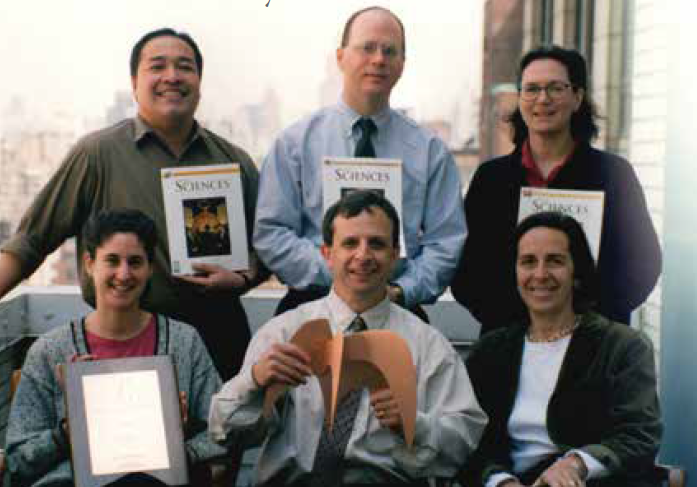
The Sciences staff celebrates a National Magazine Award. Front Row, Left to Right: Emily Laber, Peter Brown, Elizabeth Meryman. Back Row, Left to Right: Levin Santos, Jeffrey Winters, Mary Beth Aberlin. Photo taken May 2000.

Amidst all the scientific royalty, the one feature for which The Sciences was perhaps best known was its use of fine art. Successful offspring have many fathers, and several former chief editors have claimed major roles in inventing or advancing what became the most brilliant design decision of the magazine’s history. In truth, though, fine art was introduced primarily to save money, not to enhance design. Commissioning original oil paintings or airbrush illustrations, as commercial magazines of the day were doing, was out of the question. Even original photography was quite expensive if it was any good. Rental fees for reproductions of paintings and sculpture, however, were quite reasonable.

Art in The Sciences

Reproductions of fine art were appearing in The Sciences by August 1966, under Samuel Burger, the first chief editor of record. Burger’s successor, Peter D. Albertson (editor, 1966–1968), introduced more sophisticated layouts, which he continued decorating with art. Subsequent editors gave an increasingly prominent role to art, until Paul T. Libassi (editor, 1981–1989)—who once held the title Fine Arts Consultant—insisted that all images come from the arts. (Even Libassi, however, found, on rare occasions, that he had to admit a diagram.) The role of art had morphed into a signature feature, chosen to complement the scientific articles rather than simply to illustrate them.      

Sometimes the interplay of science and art is straightforward yet striking, as in Rembrandt’s self-portraits from young artist to old man that accompany an article on aging in 1991 (“On Growing Old,” by Robert M. Sapolsky and Caleb E. Finch, March/April 1991). More often, though, placing artwork next to scientific text adds depth and reveals interpretive possibilities that neither the art nor the science could do alone.

The abstract patterns woven into textiles by “Anonymous,” which complement a 1996 article on the origins of the Internet (“Casting the Net,” by Katie Hafner and Matthew Lyon, September/October 1996), or Yves Tanguy’s paintings mashed up with an article on prime numbers,(“Prime Territory,” by Enrico Bombieri, September/October 1992), are two good examples of a synthesis greater than its parts.

Battle for the Bottom Line

But art, introduced as an economy, was beginning to have a substantial indirect impact on cost. Paper quality had been enhanced almost monotonically since the earliest days of The Sciences, until, by the Libassi era, the presses were running Cadillac-quality “body stock.” The paper was a fine, bright, opaque and glossy sheet, the best possible medium for reproducing art. But fine paper is costly, and it weighs more per sheet than lesser stock, which drove up postage and shipping costs as well. By the time I became editor, in late 1989, these high production values, coupled with a “book size” (the page count per issue) pushing 80, were raising red flags for the Academy’s management.

As things turned out, it was quite possible to produce a high-quality magazine with fewer pages and less luxurious materials. After a series of cuts, the issues settled in at around 48 pages each. A blue-ribbon panel of top editors and publishers, including Jacqueline Leo (at the time, the group editorial director for women’s magazines of The New York Times), the late Charles Ramond (a financial whiz with a background in advertising research), and Dick Stolley (a Time-Life wunderkind who was the founding editor of People Weekly magazine), managed to stabilize matters for several years.

But the eventual demise of the magazine never seemed in doubt. Things came to a head in early 2001, when Academy CEO Rodney W. Nichols, ever skeptical about the membership value of the magazine, cut the frequency from bimonthly to quarterly. In the end, as we now know, that lasted one issue. After nearly 40 years of publishing, the Spring 2001 issue of The Sciences rolled off the presses—with a cover story on climate change intentionally titled to convey a double meaning: “Climate of Doubt.”

There would be no summer.

More Info about The Sciences

The success of The Sciences in garnering the most prestigious awards in magazine journalism was so out of proportion to its size or budget that a year without winning or placing among the top five finalists at the National Magazine Awards was the rare exception. In the period 1985–2000 the magazine was either a finalist or a winner in the category “General Excellence (under 100,000 circulation)” in every year except 1992, 1994 and 1997. At the time of its closure in 2001, its lifetime record of seven wins put it in a four-way tie (with Business Week, Outside, and Sports Illustrated) for 11th place among all U.S. magazines

Access to ‘The Sciences’ archive is just one perk of being an Academy member. Not a member? Sign up today.


About the Author

Peter G. Brown was the editor of The Sciences from 1989 until its closure in 2001.

The Caped Crusader for Better Mental Health Outcomes

An illustration of a superhero overlooking a city skyline as his cape blows in the wind.

Andrea Letamendi, PhD, discusses the value of addressing mental health issues through the lens of beloved fictional narratives.

Published July 24, 2014

By Diana Friedman

Image courtesy of rudall30 via stock.adobe.com.

In honor of Batman’s 75th anniversary, DC Entertainment declared July 23 Batman Day. What does this have to do with science? More than you might expect, with a little imagination. For psychologist Andrea Letamendi, PhD, the Batman world, with its roster of criminally insane villains, is a fictional window onto very real issues. Her podcast series, The Arkham Sessions (named for the asylum where Batman’s enemies usually wind up after the hero thwarts their plots) analyzes characters and interactions from Batman: The Animated Series to explore subjects such as coping with trauma, mental disorders, patient treatment, and stigmatization of people with mental illnesses.

According to National Library of Medicine historian Dr. Michael Sappol, “It’s a powerful technology for forming public opinion. It [doesn’t] just reason with the audience, it recruit[s] the audience’s emotions.”  Dr. Letamendi leverages a balance between that emotional resonance and the relative security of fiction to engage her audience in consideration of challenging themes. “It’s a way to educate people about psychological science and address important topics in a way that feels safe—less threatening or less personal,” she says. “At the same time, many people feel very connected to these fictional narratives and the stories actually help us to tune in.”

Dr. Letamendi spoke with The New York Academy of Sciences (the Academy) from Comic-Con in San Diego about superheroes and psychology.

Why apply psychological analysis to fictional characters?

As a psychologist, I’m invested in broadening public knowledge about the psychological sciences. I find that one way I can do that is to speak to my passion and the passion of many others: comic books, science fiction, and fantasy. I’ve had wonderful opportunities to speak at universities and at Comic-Con and other cultural conventions to utilize these narratives that people can really relate to—the stories, heroes, and villains that people already know—to examine important health issues. It’s fun but it’s also an educational advantage.

Are there useful parallels between cartoon characters and real people?

Yes! For example, my first experience speaking on a panel was talking about how comic book heroes are actually really similar to real life heroes, specifically soldiers who have experienced combat-related trauma. I used to practice at a veterans hospital and have a lot of experience working with soldiers and veterans returning from Iraq and Afghanistan with physical and psychological injuries.

The panel was a chance to talk openly about the impact of recent wars on the people who fight in them, and how the field of psychology is struggling with how to meet the needs of the men and women coming back from those conflicts. It’s a really serious topic, but we can draw upon these fictional narratives that simulate and evoke real tensions and interests in a way that feels safe and remains relatable.

How does your series, named for the Arkham Asylum for the Criminally Insane, avoid associations between mental illness and criminal behavior?

It’s really important to us to always make that distinction. When we started the show we knew we’d be examining the psychology of a lot of villains, but we’re not just trying to come up with labels or diagnoses for them. Every episode of the Batman series has a lot of psychological elements to it. We end up talking about such a wide range of subjects—memory loss, substance abuse, anxiety, family issues, patient care and hospitalization, childhood trauma.

We speak about these issues in a way that deliberately doesn’t stigmatize, but rather helps to normalize these experiences. The result is that we’re very inclusive in a way that let’s everyone relate. We include Batman in our analyses, not just villains, and he’s a character with a lot of issues as well. My hope is that it combats the idea that people with mental health problems are villains or criminals.

Do you have a favorite character?

I like the villains who are overlooked because they’re just seen as being big and burly, like Killer Croc or Clayface. They’re like onions. When you unravel them you realize there’s a deep psychological history and trajectory there that got them to where they are [by the time you meet them in the series].

Are there lessons from Gotham City that might apply to real cities’ policies on mental health care?

There are real barriers to appropriate, evidence-based care. In big cities with diverse populations, we deal with issues of underserved populations that don’t have access to care. There are groups of people with structural and psychosocial barriers to getting care. Sometimes we struggle to provide care that’s culturally or linguistically appropriate. We need to think about all of these psychosocial elements to ensure that people have opportunities to heal.

Any parting thoughts?

It is Comic-Con week! If you’re coming, please keep in mind that you can put together a curriculum of educational panels on really interesting topics like psychology, underrepresentation, and gender equality. Comic-Con is fun and a celebration of superheroes, but it’s also an opportunity for education and to demystify and reduce some of the myth around science.

Also read: From Imagination to Reality: Art and Science Fiction