Education, humility, laughter, faith, and baseball are just some of the guiding principles in the life of scholar and leader John E. Sexton.
Published May 4, 2026
By Nick Fetty
An already accomplished legal scholar and education leader, John E. Sexton, PhD, has yet another award for his trophy case.
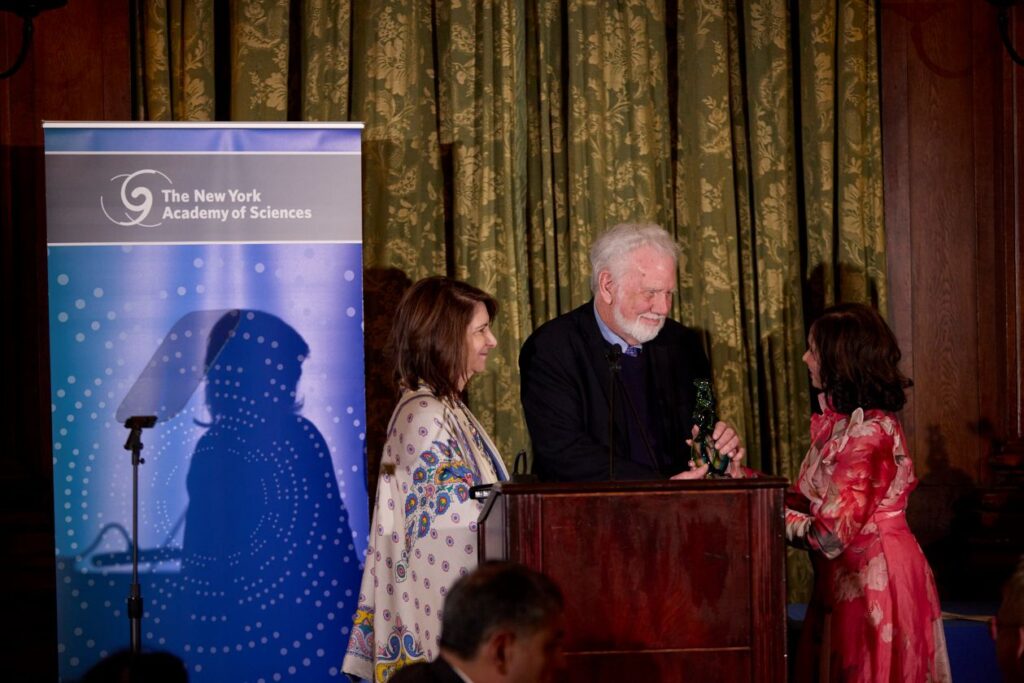
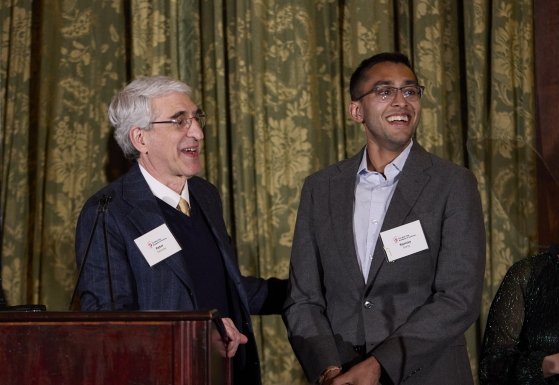
John Sexton, PhD, (center) is flanked by Linda G. Mills, PhD, (left) and Seema Kumar.
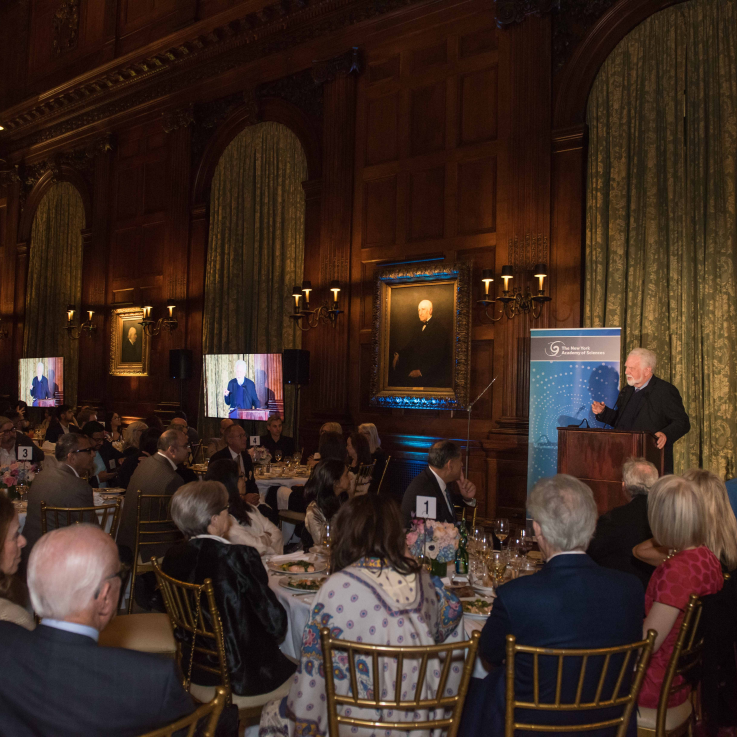
The New York Academy of Sciences honored Prof. Sexton with its 2026 Trailblazer Award during the second annual Spring Soirée, hosted on April 21st at the University Club in New York City. Linda G. Mills, PhD, current President of NYU, took to the stage to introduce Prof. Sexton and the award. NYU was an Academic Patron-level sponsor for the event.
“There are leaders who steer institutions, and then there are those who chart entirely new paths. Tonight, as we honor my dear friend and colleague John Sexton, we celebrate someone who didn’t just follow the trajectory of higher education, he redrew the map,” Prof. Mills said. “John has left an indelible mark on every corner of our beloved New York University.”
Sanctitas, Scientia, Sanitas
Prof. Sexton then took to the stage to accept the award. He recalled a commencement address he gave to his high school alma mater more than six decades ago. The address was about the Latin motto of the now-defunct Brooklyn Preparatory School in Crown Heights: Sanctitas, Scientia, Sanitas. He translated this to “Take care of the mind, the body, and the soul.”
“In those days we believed in a common. We believed in institutions. We believed in leaders. And we believed that it was worth sacrificing for that commonweal,” said Prof. Sexton. “We live in times when all of those things that we took for granted back when I gave those speeches, are under attack. [These are no longer] axioms of our society.”
During his five-year stint as Chair of the Academy’s Board of Governors, he said it was the intelligent and passionate individuals who made the extraordinary happen. He called the Academy’s current leadership, President Nicholas Dirks and Board Chair Peter Salovey, PhD, a “one-two punch.”
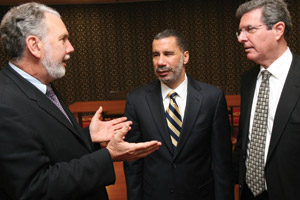
Academy Board Chair John Sexton (left) confers with Gov. Paterson and Academy President Ellis Rubinstein (right) during Paterson’s “new economy” announcement at the Academy in 2009.
Early in his career, Prof. Sexton served as a professor of religion at Saint Francis College in Brooklyn, which included chairing the department for six years. After completing his PhD in the History of American Religion from Fordham University, and a JD magna cum laude from Harvard Law School, he served as a Law Clerk to Chief Justice Warren Burger of the United States Supreme Court.
Much of his professional career has straddled law scholarship and academic administration. He joined the faculty of NYU’s Law School in 1981 and ascended to the rank of Dean in 1988. Prof. Sexton became the 15th president of NYU in 2002 and served in that role until 2015. He also served as Chair of the Academy’s Board of Governors between 2007 and 2011.
Baseball and Religion
Prof. Sexton remains committed to his Catholic faith, even though his late wife and children were raised Jewish. He is also a baseball fan and a devotee of the Yankees, though he was a Dodgers fan prior to the team leaving Brooklyn for Los Angeles in 1957. He combined his love of the game with his theological scholarship in an NYU course he taught called “Baseball as a Road to God.” He borrowed this title for a book he published in 2014.
“The real idea of the course,” he told The New York Times in 2012, “is to develop heightened sensitivity and a noticing capacity. So baseball’s not ‘the’ road to God. For most of us, it isn’t ‘a’ road to God. But it’s a way to notice, to cause us to live more slowly and to watch more keenly and thereby to discover the specialness of our life and our being, and, for some of us, something more than our being.”
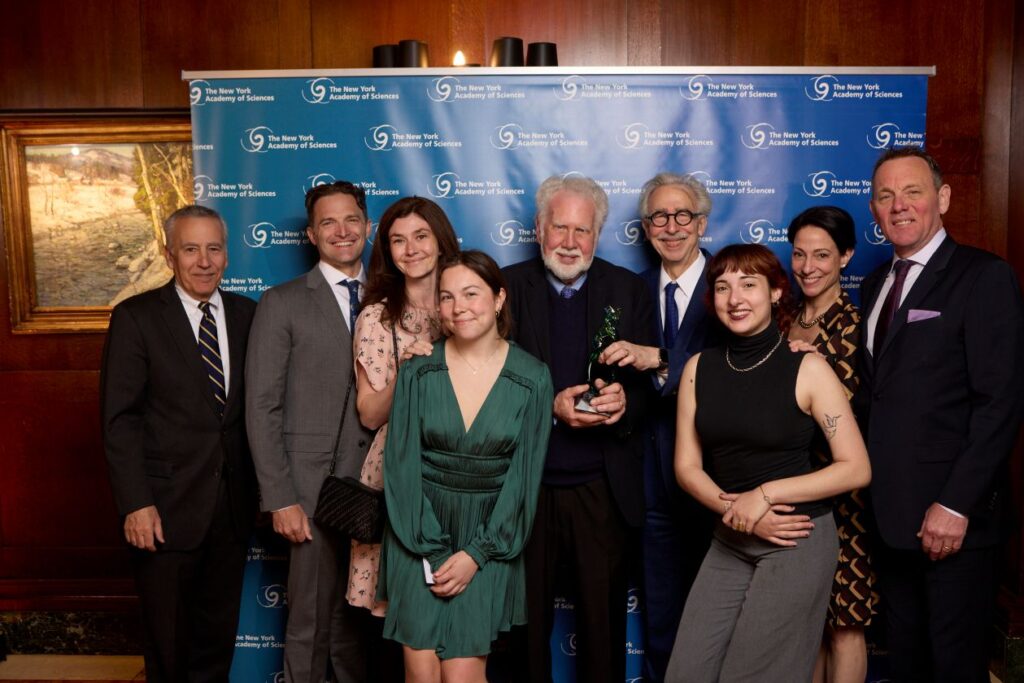
John Sexton (center) poses with his trophy.
Prof. Sexton’s humility came through throughout the night at the Soirée. In his closing remarks, he joked that he receiving such an honor was like the classic Sesame Street segment One of These Things (Is Not Like the Others).
“It’s kind of fun not being the one that belongs with the others because I get to watch you people do miraculous things,” Prof. Sexton concluded. “There’s never been a time when thought has been more under challenge. And there’s never been a time when gathering as a community of thought has been more important.”
Rocheli Apilan and Samay Garg, PhD, are the recipients of the 2026 Cognizant STEM Teacher of the Year and the Cognizant STEM Mentor of the Year.
Published April 30, 2026
By Nick Fetty
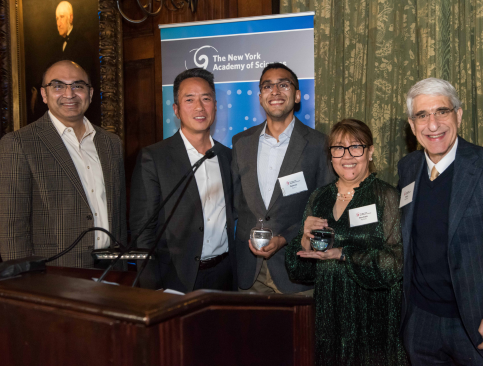
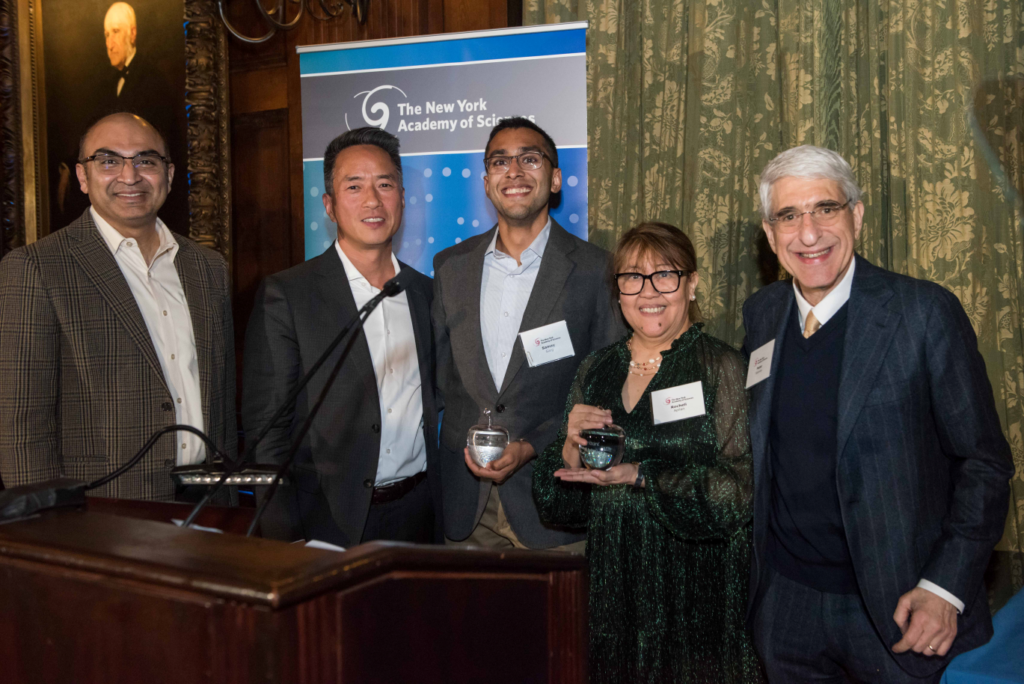
From left: Jatin Dalal, Cognizant CFO; John Kim, Cognizant CLO; Samay Garg, PhD, 2026 Cognizant STEM Mentor of the Year; Rocheli Apilan, 2026 Cognizant STEM Teacher of the Year; and Peter Salovey, PhD, Chair of the Academy’s Board of Governors.
The New York Academy of Sciences’ STEM education initiatives are a foundational pillar of the Academy’s mission to advance science for the benefit of society.
Two inspiring participants in the Academy’s STEM programs were recently recognized for their achievements during the Academy’s second annual Spring Soirée, held at the University Club in New York City.
Rocheli Apilan, a teacher at the High School for Health Professions & Human Services, was the 2026 recipient of the Cognizant STEM Teacher of the Year, while the 2026 Cognizant STEM Mentor of the Year award went to Samay Garg, PhD, a mentor at P.S./M.S. 37 Children’s Arts & Science Workshop in the Bronx.
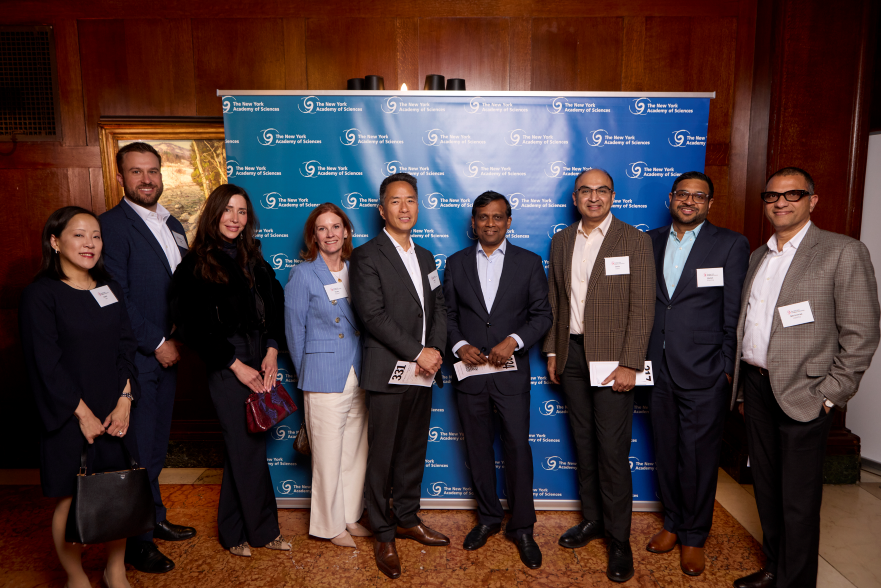
Cognizant executive team attending the Soirée.
This year’s awards are sponsored by Cognizant, which also served as Mission Partner for the Soirée. Cognizant aims to “[engineer] modern business to improve everyday lives” through work that transforms experiences, reimagines processes, and modernizes technology. Over the past 30 years, the company has generated more than $21 billion in revenue and has grown to more than 350,000 employees across the globe. Ravi Kumar S, a member of the Academy’s Board of Governors, has served as Cognizant’s CEO since 2023.
“We know how essential it is to grow the talent pipeline and forge new pathways for the next generation of scientists for the good of humanity,” said Peter Salovey, PhD, Chair of the Academy’s Board of Governors, when introducing the awardees. “This year we’re delighted and grateful that Cognizant is playing a leadership role in supporting these awards.”
Jatin Dalal, Cognizant CFO, and John Kim, Cognizant CLO, both joined Prof. Salovey on stage to congratulate the winners. This marks the second time the Academy has bestowed this recognition. Last year’s recipients were teacher Brittany Beck and mentor Megan C. Henriquez. Beck was in attendance at the 2026 event.
The 2026 Cognizant STEM Teacher of the Year
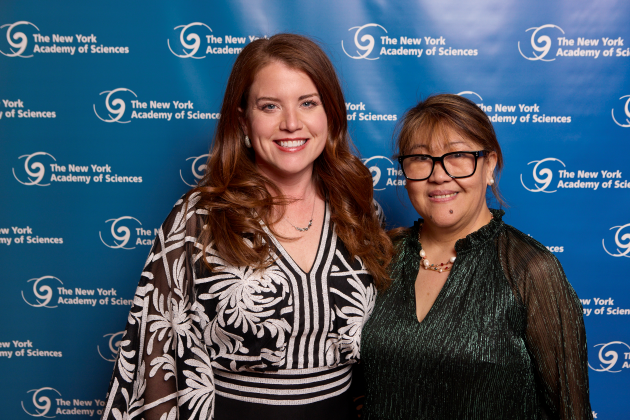
Rocheli Apilan (right), 2026 Cognizant STEM Teacher of the Year poses with Brittany Beck, recipient of the 2025 prize.
For Apilan, one of the most rewarding parts of her job is watching the students “shift from memorizing facts to genuinely thinking like scientists, asking questions, challenging ideas, and making sense of the world around them.” Once a concept “clicks” with her students she can see the boost in their confidence.
“My job isn’t to teach students what to think, but to help them think like scientists long after they leave my classroom,” she said.
She was “shocked” when she heard the news and had to read the email multiple times before she truly processed it. While the award was personally enriching, she acknowledged it was a strong support system around her that made it happen. The award “reflects the hard work and curiosity of [her] students and the support of [her] colleagues, school, and the Scientist-in-Residence program.”
“It was a humbling reminder that the work we do in the classroom truly matters and is being seen and recognized,” she said. “Ultimately, this award motivates me to keep growing, innovating, and advocating for meaningful STEM education for all students.”
The 2026 Cognizant STEM Mentor of the Year
Samay Garg, PhD (left), is recognized by Peter Salovey, PhD, on stage at the Soirée.
Dr. Garg, a recipient of the NSF Graduate Research Fellowship, holds a BS in chemical engineering from the University of California, Berkeley where he studied water electrolysis and fuel cells at the Lawrence Berkeley National Laboratory. He also holds an MS and PhD in chemical engineering from Columbia University. His work in the Chen Research Group focused on developing electrocatalytic processes for chemical synthesis. He was recently a co-first author on a paper published in the journal Nature Chemical Engineering focused on converting CO2 into carbon nanomaterials.
This spring he worked with a 5th grade class on their marble runs curriculum. He’s been a part of the Academy’s Afterschool STEM Mentoring Program (ASMP) since 2023. Much like Apilan, Dr. Garg said one of the most rewarding parts of this work is when students truly grasp a science or engineering concept for the first time.
“Even if it’s something like friction or gravity that I would consider very basic, seeing them develop an understanding of how these forces work through hands-on experiments reminds me why I love being a scientist and why I wanted to pursue a career in research,” said Dr. Garg, adding that the opportunity has allowed him to develop critical skills in teaching, mentoring, and communication.
Small Actions, Outsized Impact
Dr. Garg, who’s an active runner and cyclist in his free time, will now join the Tarpeh Research Group at Stanford University for postdoctoral research focused on electrocatalytic wastewater remediation. While his west coast move means he will no longer formally be involved with the Academy’s ASMP program, he reiterated that these programs are enriching for all involved.
“I just want to encourage other PhD students to engage in STEM outreach programs,” he said. “The activation barrier is relatively small, but this award is a reminder that even small actions can have an outsized impact on the students we work with.”
The New York Academy of Sciences is proud to recognize the Tata Sons Chairman as its most recent Life Governor.
Published December 5, 2025
By Nick Fetty
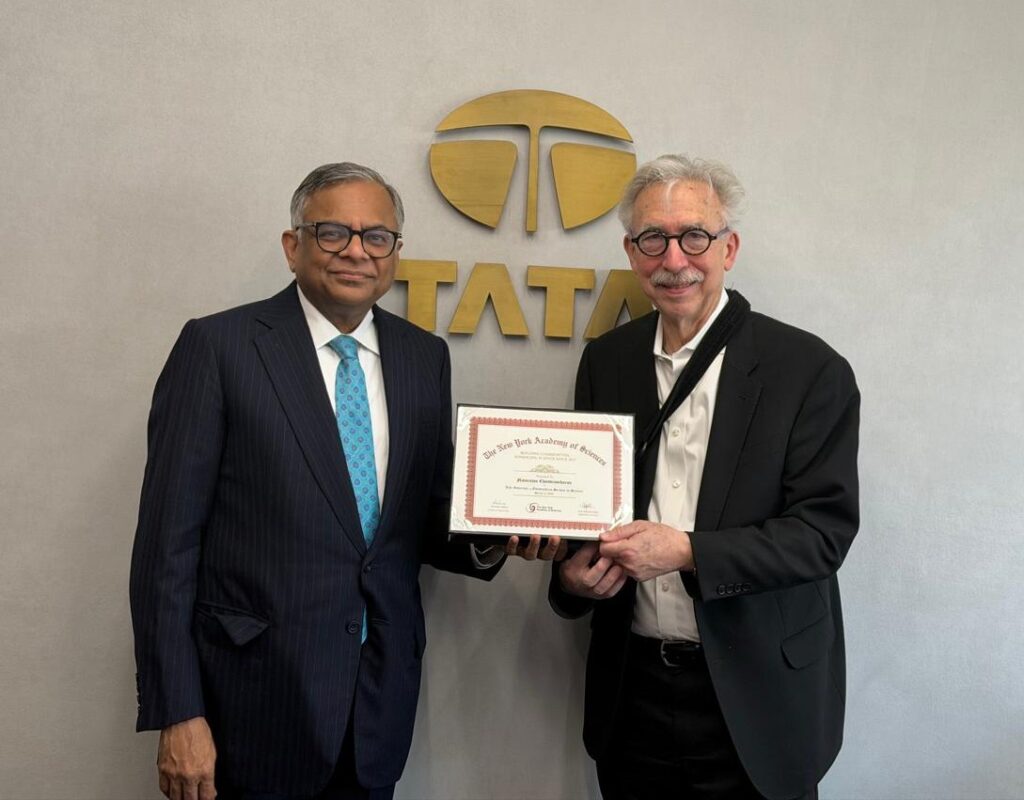
Nicholas B. Dirks (right), President and CEO of The New York Academy of Sciences, presents a Life Governor certificate to Natarajan Chandrasekaran, Chairman of Tata Sons, during the Tata Transformation Prize ceremony in India on Dec. 5.
Natarajan Chandrasekaran (Chandra), Chairman of India-based Tata Sons, joins a distinguished group of changemakers who serve as Life Governors for the Academy.
The Academy’s Board of Governors approved Chandra’s appointment earlier this year. He was presented with a certificate recognizing the honor by Academy President and CEO Nicholas B. Dirks during a ceremony in Mumbai, India on December 5.
Prior to his appointment as a Life Governor, Chandra served on the Academy’s Board of Governors where he lent his expertise to help guide the Academy on strategic and business matters. With more than three decades of science and leadership experience, he’s overseen revenues that have exceeded $100 billion across more than 100 Tata operating companies. He promotes the “One Tata” strategy, which focuses on themes like simplification, scale, synergy, and sustainability.
This recognition adds to a long list of accolades for Chandra which also include:
In collaboration with Tata Sons, the Academy launched the Tata Transformation Prize in 2023. The Prize recognizes and supports the implementation at scale of high-impact research that drives innovation in scientific disciplines of importance to India’s societal needs and economic competitiveness. Tata Sons also support the Academy’s Shaping Science podcast.
Learn more about the Tata Transformation Prize and check back for more updates from the 2025 ceremony!
Engaging young people in the scientific method—observing, building models, testing ideas—helps them gain knowledge, and that excites me most about the Academy.
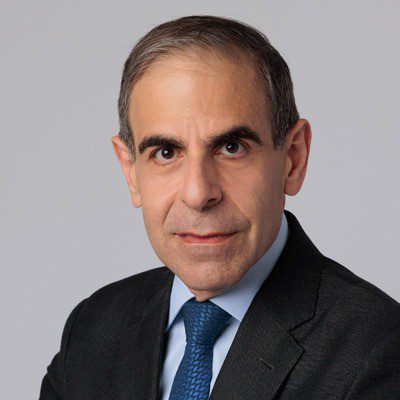
Armen Avanessians is the former Head and Chief Investment Officer, Goldman Sachs Asset Management’s (GSAM) Quantitative Investment Strategies Group and is currently a member of the Board of Governors for The New York Academy of Sciences. With an educational background in electrical engineering, and extensive professional experience in finance, he brings a valuable perspective to the Board. We interviewed him to learn more about his background, how engineering principles can be applied to the world of finance, and why he chose to get involved with the Academy.
Published February 4, 2025
By Nick Fetty
*some quotes have been edited for length and clarity
What does being a member of the Academy’s board mean to you?
The highest value I can find is being useful — offering my support in ways that inspire and bring value to others.
How did you first become interested in the Academy’s work?
Several colleagues of mine have served on the Board. I became more engaged when Nick Dirks, who knew me from Columbia University, joined the Board. He brought me in to help reimagine the Academy. Given my engineering background and experience on other boards like Columbia, MIT, the National Museum of Mathematics, and FIRST robotics, Nick felt I could add value, and I joined with that intent.
How does your personal or professional background inform your involvement or your commitment to the Academy?
I started as an electrical engineer at Bell Laboratories in the early eighties, working on chip design. Bell Labs had a unique model: research work, even theoretical, could be capitalized by AT&T. After the divestiture, that model broke, and AT&T shifted to focusing on making money more directly. This shift led me to be interested in understanding money itself, which ultimately led me to Goldman Sachs. Finance, at its core, is the study of money, and I saw an opportunity to apply my quantitative skills to this field, helping create what became known as “strats”.
Strats brought the scientific method—making observations to build models that explain the past and testing their ability to predict the future—into finance.
Which is the one Academy program or initiative that excites you the most. And why?
Education. My focus across philanthropic efforts, from MIT to the Fund for Armenian Relief, has always been on science education—at all levels. Whether it’s inspiring children in grade school or engaging university students, I believe science is more than subjects like physics or chemistry. It’s a mindset, a method for understanding the world.
Engaging young people in the scientific method—observing, building models, testing ideas—helps them gain knowledge, and that excites me most about the Academy.
Tom Franco is a Senior Advisor with Clayton, Dubilier & Rice, LLC and is also a member of the Board of Governors for The New York Academy of Sciences. With an extensive background in law, business, entrepreneurship, and teaching, he brings a valuable perspective to the Board. We spoke with him to learn more about his background, what motivates him, and why he chose to get involved with the Academy.
Published January 30, 2025
By Nick Fetty
*some quotes have been edited for length and clarity
What does being a member of the Academy’s Board mean to you?
It means a great deal because The New York Academy of Sciences is involved in really important initiatives advancing technology, innovation, scientific knowledge in society, and even in politics, which are central issues of our time. So having a front row seat on that is intellectually stimulating. But it’s also gratifying to be part of shaping the future through the network of thought leaders that The New York Academy of Sciences convenes and assembles.
How did you first come to be interested in the Academy’s work?
The New York Academy of Sciences is a legendary organization with a storied past. It has included some of the most important figures in science and related disciplines, such as Margaret Mead and Thomas Jefferson. It is definitely an organization that people know about. In particular, the appointment of Nick Dirks as Chief Executive Officer was the magnet for me. I know Nick, and was so pleased to see him take the reins of leadership given his eclectic background. He is a Renaissance man, and I think that the Academy appeals to Renaissance people.
How does your personal and professional background inform your work with and commitment to the Academy?
I come from an eclectic background. I have experience teaching and being an entrepreneur, which includes successfully starting several businesses. Additionally, I have been in the investment business and have supported big, innovative, change-the-world types of investments. I am also a divinity school student, and so I’m very interested in the linkage between science and faith and the shared sense of truth.
So, all of these personal experiences and professional experiences create a stew which is, I think, relevant to what the Academy is trying to accomplish in the largest sense, especially that shared sense of truth. The Academy provides complementary perspectives on what is changing the world, what is likely to change the world, and promoting what I might describe as human flourishing. Going to the Science Salons or other Academy events or even sitting around the Board of Governors table with the people that you interact with, you cannot help but be filled with wonder and awe. This is much like how science often leads to such inspiring results.
Is there one particular academy program or initiative gets you especially excited? What would that be? And why?
I love the recognition of the young scientists as exemplified by the Blavatnik Awards for Young Scientists. These awards recognize professors that are hitting their prime. They’re all academically brilliant, and they’re laboring away. Everybody likes to be recognized, and I think they deserve a chance at the limelight.
I’m also impressed with the Academy’s educational initiatives. These efforts effectively inspire younger people. Bringing the magic of science and the secret power of science to school-aged kids is really worthwhile as well.
Is there anything else you’d like to add?
The Academy’s mission has never been more important, particularly during a time when trust in science can no longer be taken for granted.
“The Academy’s mission has never been more important, particularly during a time when trust in science can no longer be taken for granted.”
TOM FRANCO SENIOR ADVISOR, CLAYTON, DUBILIER & RICE, LLC BOARD MEMBER, THE NEW YORK ACADEMY OF SCIENCES
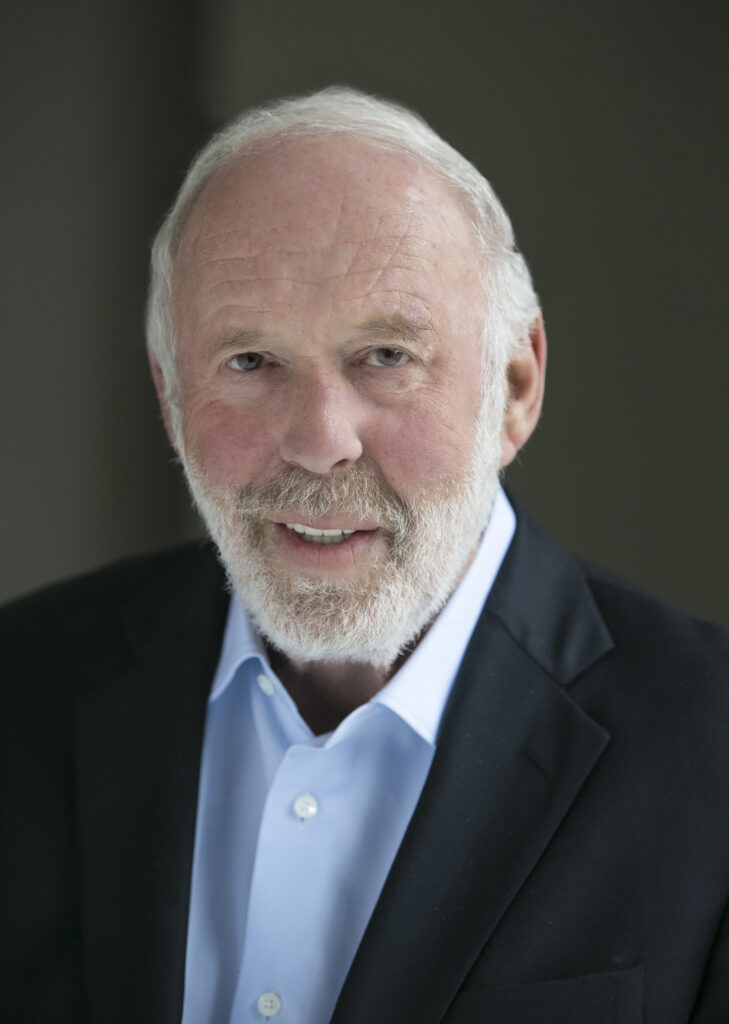
The Academy is saddened to learn about the passing of former Board member James “Jim” Simons.
Published May 10, 2024
By Nick Fetty
The New York Academy of Sciences is saddened to learn about the passing of James “Jim” Simons, a former Board member and longtime supporter of the Academy.
Simons was an award-winning mathematician, a legend in quantitative investing, and an inspired and generous philanthropist. He and his wife established the Simons Foundation to promote scientific and mathematical research. Their support led to breakthroughs in our understanding of autism, the origins of the universe, cellular biology and computational science.
Earlier in his career he founded Renaissance Technologies, a hedge fund that pioneered quantitative trading and became one of the most profitable investment firms in history. He also previously chaired the math department at Stony Brook University in New York.
He served on the Academy’s Board of Governors from 1998 to 2001 and was a longtime benefactor of the Academy’s efforts to promote science for the public good. Simons was 86 years old.
From the future of higher education to regulating artificial intelligence (AI), Reid Hoffman and Nicholas Dirks had a wide-ranging discussion during the first installment of the Authors at the Academy series.
Published April 12, 2024
By Nick Fetty
Photo by Nick Fetty/The New York Academy of Sciences
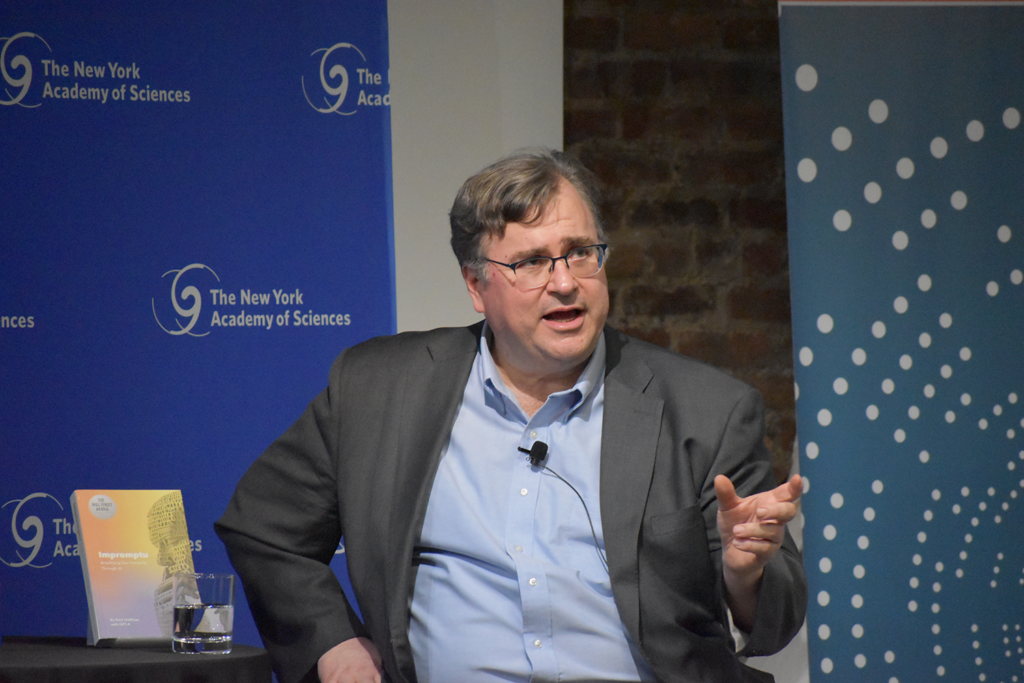
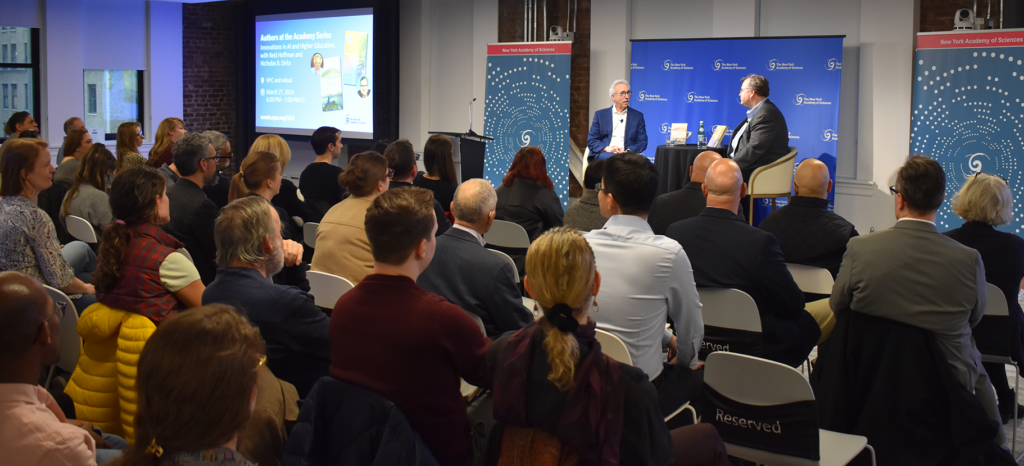
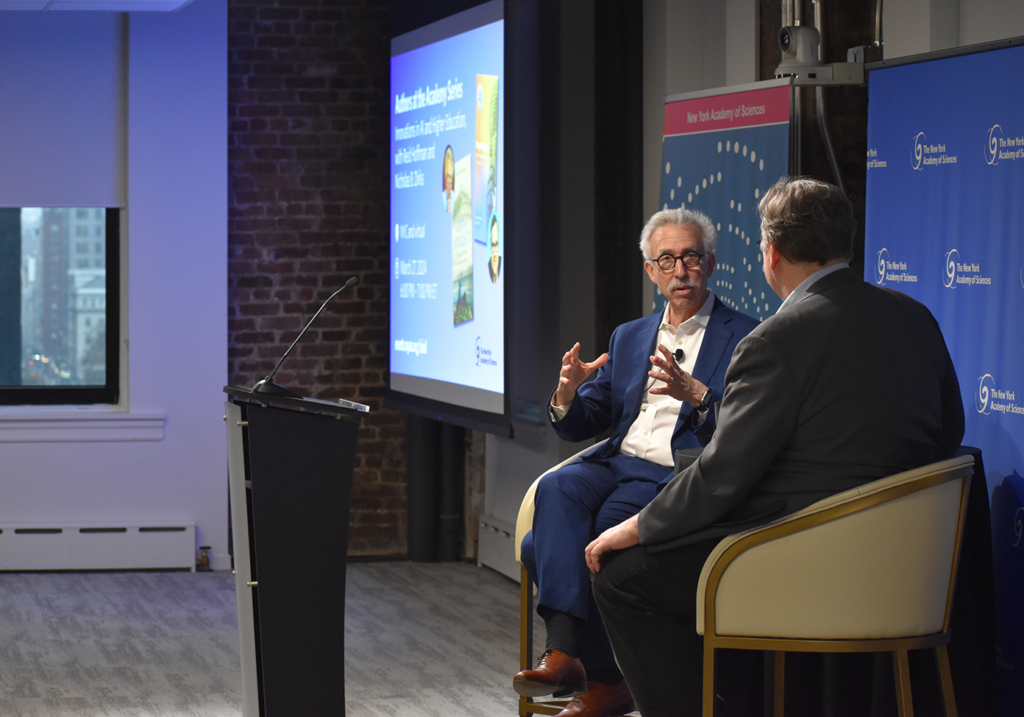
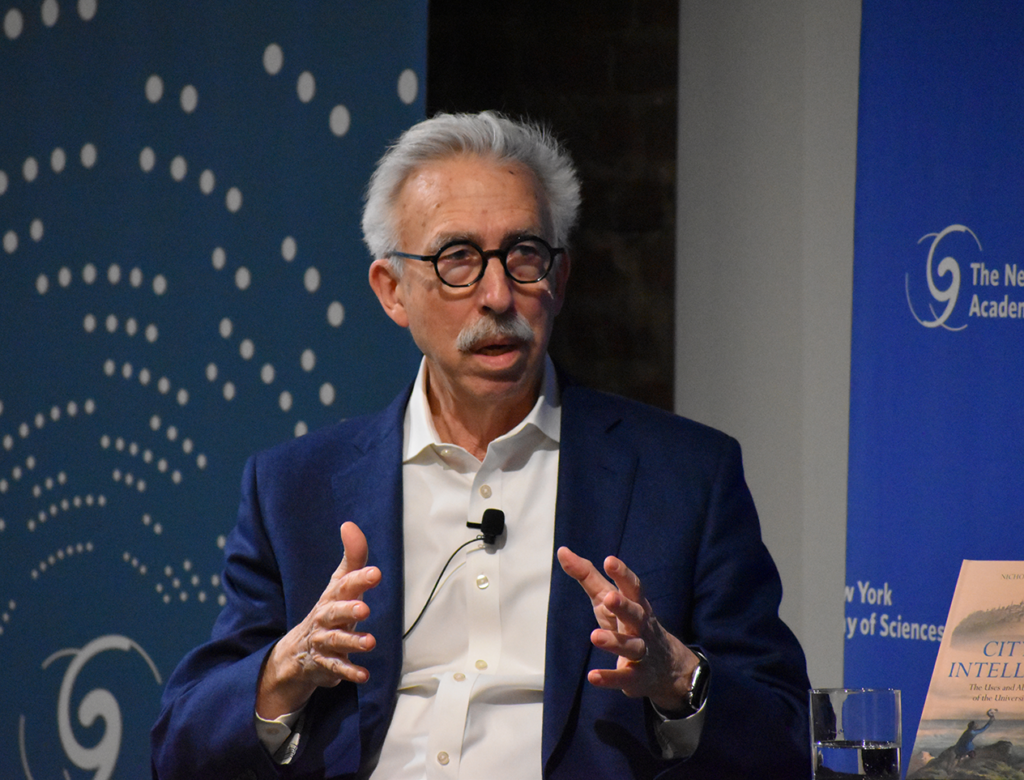
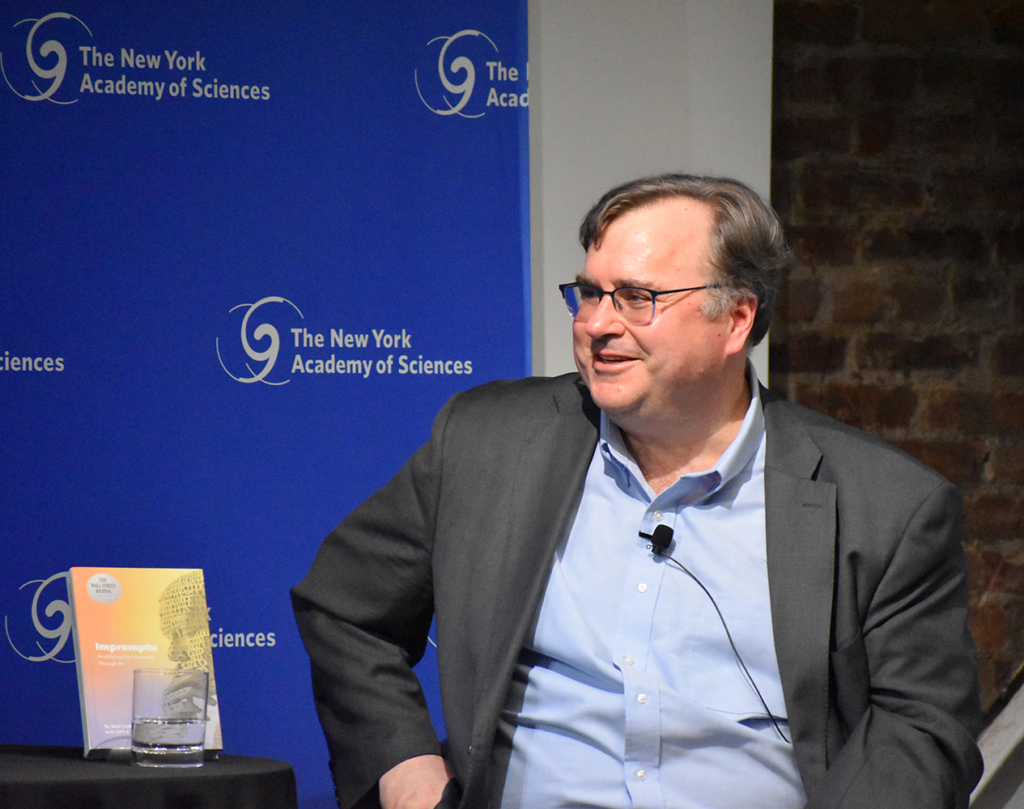
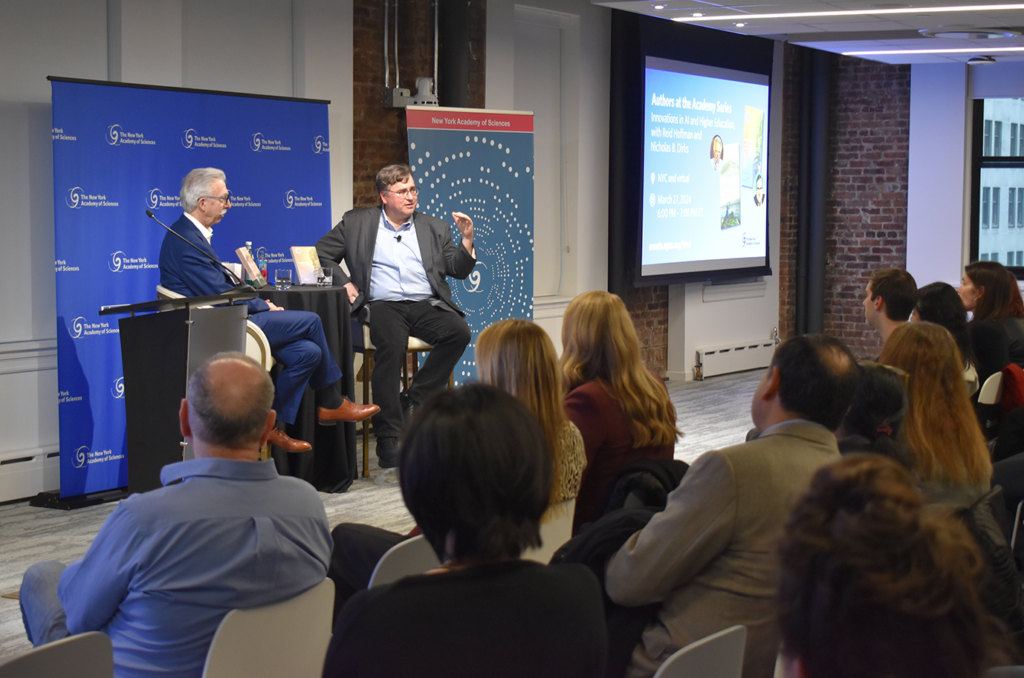
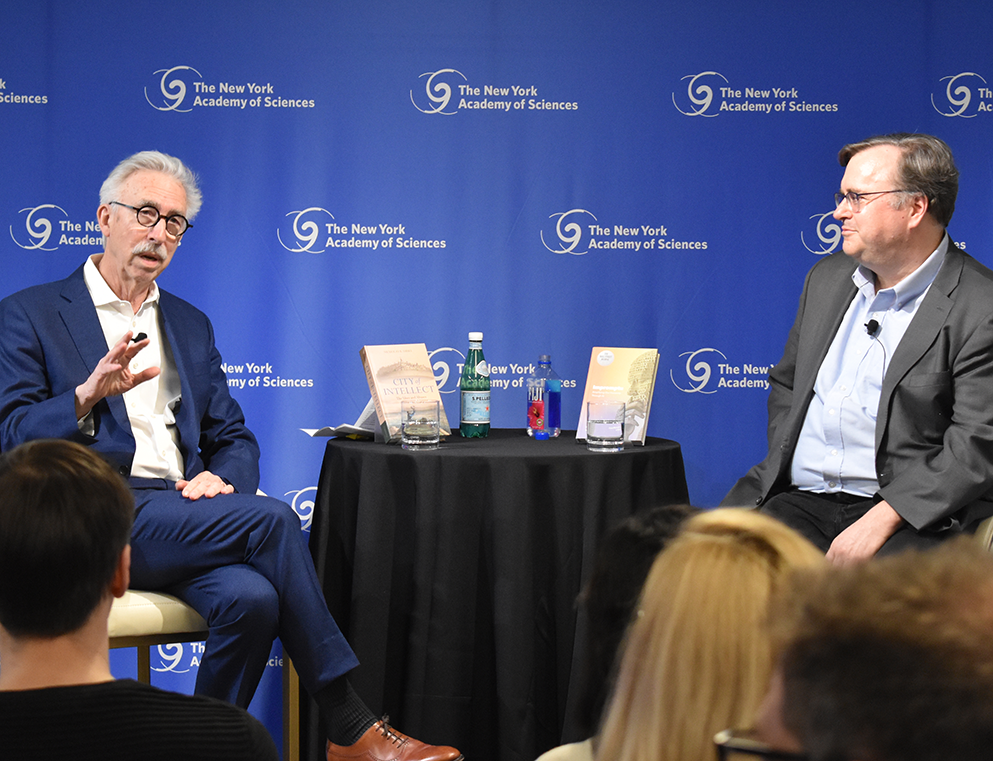
It was nearly a full house when authors Nicholas Dirks and Reid Hoffman discussed their respective books during an event at The New York Academy of Sciences on March 27, 2024.
Hoffman, who co-founded LinkedIn as well as Inflection AI and currently serves as a partner at Greylock, discussed his book Impromptu: Amplifying Our Humanity Through AI. Dirks, who spent a career in academia before becoming President and CEO of the Academy, focused on his recently published book City of Intellect: The Uses and Abuses of the University. Their discussion, the first installment in the Authors at the Academy series, was largely centered on artificial intelligence (AI) and how it will impact education, business and creativity moving forward.
The Role of Philosophy
Photo by Nick Fetty/The New York Academy of Sciences
The talk kicked off with the duo joking about the century-old rivalry between the University of California-Berkeley, where Dirks serves on the faculty and formerly served as chancellor, and Stanford University, where Hoffman earned his undergraduate degree in symbolic systems and currently serves on the board for the university’s Institute for Human-Centered AI. From Stanford, Hoffman went to Oxford University as a Marshall Scholar to study philosophy. He began by discussing the role that his background in philosophy has played throughout his career.
“One of my conclusions about artificial intelligence back in the day, which is by the way still true, is that we don’t really understand what thinking is,” said Hoffman, who also serves on the Board of Governors for the Academy. “I thought maybe philosophers understand what thinking is, they’ve been at it a little longer, so that’s part of the reason I went to Oxford to study philosophy. It was extremely helpful in sharpening my mind toolset.”
Public Intellectual Discourse
He encouraged entrepreneurs to think about the theory of human nature in the work they’re doing. He said it’s important to think about what they want for the future, how to get there, and then to articulate that with precision. Another advantage of a philosophical focus is that it can strengthen public intellectual discourse, both nationally and globally, according to Hoffman.
“It’s [focused on] who are we and who do we want to be as individuals and as a society,” said Hoffman.
Photo by Nick Fetty/The New York Academy of Sciences
Early in his career, Hoffman concluded that working as a software entrepreneur would be the most effective way he could contribute to the public intellectual conversation. He dedicated a chapter in his book to “Public Intellectuals” and said that the best way to elevate humanity is through enlightened discourse and education, which was the focus of a separate chapter in his book.
Rethinking Networks in Academia
The topic of education was an opportunity for Hoffman to turn the tables and ask Dirks about his book. Hoffman asked Dirks how institutions of higher education need to think about themselves as nodes of networks and how they might reinvent themselves to be less siloed.
Dirks mentioned how throughout his life he’s experienced various campus structures and cultures from private liberal arts institutions like Wesleyan University, where Dirks earned his undergraduate degree, and STEM-focused research universities like Cal Tech to private universities in urban centers (University of Chicago, Columbia University) and public, state universities (University of Michigan, University of California-Berkeley).
While on the faculty at Cal Tech, Dirks recalled he was encouraged to attend roundtables where faculty from different disciplines would come together to discuss their research. He remembered hearing from prominent academics such as Max Delbrück, Richard Feynman, and Murray Gell-Mann. Dirks, with a smile, pointed out the meeting location for these roundtables was featured in the 1984 film Beverly Hills Cop.
Photo by Nick Fetty/The New York Academy of Sciences
An Emphasis on Collaboration in Higher Education
Dirks said that he thinks the collaborative culture at Cal Tech enabled these academics to achieve a distinctive kind of greatness.
“I began to see this is kind of interesting. It’s very different from the way I’ve been trained, and indeed anyone who has been trained in a PhD program,” said Dirks, adding that he often thinks about a quote from a colleague at Columbia who said, “you’re trained to learn more and more about less and less.”
Dirks said that the problem with this model is that the incentive structures and networks of one’s life at the university are largely organized around disciplines and individual departments. As Dirks rose through the ranks from faculty to administration (both as a dean at Columbia and as chancellor at Berkeley), he began gaining a bigger picture view of the entire university and how all the individual units can fit together. Additionally, Dirks challenged academic institutions to work more collaboratively with the off-campus world.
“A Combination of Competition and Cooperation”
Dirks then asked Hoffman how networks operate within the context of artificial intelligence and Silicon Valley. Hoffman described the network within the Valley as “an intense learning machine.”
“It’s a combination of competition and cooperation that is kind of a fierce generator of not just companies and products, but ideas about how to do startups, ideas about how to scale them, ideas of which technology is going to make a difference, ideas about which things allow you to build a large-scale company, ideas about business models,” said Hoffman.
Photo by Nick Fetty/The New York Academy of Sciences
During a recent talk with business students at Columbia University, Hoffman said he was asked about the kinds of jobs the students should pursue upon graduation. His advice was that instead of pinpointing specific companies, jobseekers should choose “networks of vibrant industries.” Instead of striving for a specific job title, they should instead focus on finding a network that inspires ingenuity.
“Being a disciplinarian within a scholarly, or in some case scholastic, discipline is less important than [thinking about] which networks of tools and ideas are best for solving this particular problem and this particular thing in the world,” said Hoffman. “That’s the thing you should really be focused on.”
The Role of Language in Artificial Intelligence
Much of Hoffman’s book includes exchanges between him and ChatGPT-4, an example of a large language model (LLM). Dirks points out that Hoffman uses GPT-4 not just an example, but as an interlocutor throughout the book. By the end of the book, Dirks observed that the system had grown because of Hoffman’s inputs.
In the future, Hoffman said he sees LLMs being applied to a diverse array of industries. He used the example of the steel industry, in areas like sales, marketing, communications, financial analysis, and management.
“LLMs are going to have a transformative impact on steel manufacturing, and not necessarily because they’re going to invent new steel manufacturing processes, but [even then] that’s not beyond the pale. It’s still possible,” Hoffman said.
AI Understanding What Is Human
Photo by Nick Fetty/The New York Academy of Sciences
Hoffman said part of the reason he articulates the positives of AI is because he views the general discourse as so negative. One example of a positive application of AI would be having a medical assistant on smartphones and other devices, which can improve medical access in areas where it may be limited. He pointed out that AI can also be programmed as a tutor to teach “any subject to any age.”
“[AI] is the most creative thing we’ve done that also seems to have potential autonomy and agency and so forth, and that causes a bunch of very good philosophical questions, very good risk questions,” said Hoffman. “But part of the reason I articulate this so positively is because…[of] the possibility of making things enormously better for humanity.”
Hoffman compared the societal acceptance of AI to automobiles more than a century ago. At the outset, automobiles didn’t have many regulations, but as they grew in scale, laws around seatbelts, speed limits, and driver’s licenses were established. Similarly, he pointed to weavers who were initially wary of the loom before understanding its utility to their work and the resulting benefit to broader society.
“AI can be part of the solution,” said Hoffman. “What are the specific worries in navigation toward the good things and what are the ways that we can navigate that in good ways. That’s the right place for a critical dialogue to happen.”
Regulation of AI
Photo by Nick Fetty/The New York Academy of Sciences
Hoffman said because of the speedy rate of development of new AI technologies, it can make effective regulation difficult. He said it can be helpful to pinpoint the two or three most important risks to focus on during the navigation process, and if feasible to fix those issues down the road.
Carbon emissions from automobiles was an example Hoffman used, pointing out that emissions weren’t necessarily on the minds of engineers and scientists when the automobile was being developed, but once research started pointing to the detrimental environmental impacts of carbon in the atmosphere, governments and companies took action to regulate and reduce emissions.
“[While] technology can help to create a problem, technologies can also help solve those problems,” Hoffman said. “We won’t know they’re problems until we’re into them and obviously we adjust as we know them.”
Hoffman is currently working on another book about AI and was invited to return to the Academy to discuss it once published.
For on-demand video access to the full event, click here.
Check out the other events from our 2024 Authors at the Academy Series
Peter Thorén is Executive Vice President of Access Industries, Head of Access Family Office, and a member of the Board of Governors for The New York Academy of Sciences. With an extensive background in law and business, he brings a valuable perspective to the Board. We interviewed him to learn more about his background, what he’s learned from working with scientists, and why he chose to get involved with the Academy.
Published April 3, 2024
By Nick Fetty
*some quotes have been edited for length and clarity
What does being a member of the Board of the Academy mean to you?
First and foremost, I’m extremely proud to be a member of the Board for The New York Academy of Sciences. I am not a scientist by training, but I have great respect and admiration for what talented scientists can do. The brilliance of science is producing solutions to problems and making the world better. Being a Board member for the Academy enables me to assist in that process in any way I can. This is both a privilege and an honor, and I appreciate the opportunity.
How did you first become interested in the Academy’s work?
I first became involved around 2004, when the Academy was still located up on East 63rd Street, on the Upper East Side, and Ellis Rubinstein was the President. At that time, the Academy was going through a bit of a financial issue and was considering selling their building.
Access Industries ended up buying the Academy building and, through the process of negotiating the deal, we got to know Ellis and the Academy well. Ellis, in turn, got to know Len Blavatnik, the Founder of Access Industries. In 2005, Ellis, Len, and I attended the Nobel Prize Ceremony in Stockholm with our wives. From there, the relationship with the Academy and the growth of the Blavatnik Awards for Young Scientists took off. So that’s the genesis of my relationship with the Academy and I have been on the Board ever since. I marvel at the Academy’s growth and expansion over that time.
How does your personal and professional background inform your commitment to the Academy?
I’m a lawyer and a businessman by training and it’s what I’ve done for the last 45 years. Over the years, I’ve learned that the more interested you are in the world around you, the more creative you become, the more innovative you are in your thought process and the more successful you are in your career and life in general. This process applies to the way the Academy, and the many talented individuals we associate with at the Academy, think. It defines how they look at problems and identify solutions to seemingly insurmountable issues. This creative approach benefits everyone but particularly those of us who are on the periphery of science and who benefit from what is being done within the Academy and other scientific institutions.
Which is the one Academy program or initiative that excites you the most. And why?
Well, there are many wonderful initiatives and programs at the Academy. But clearly, the one nearest to my heart, given the fact that I was there from the beginning in 2007 and have watched it grow over the years, is the Blavatnik Awards for Young Scientists. We started with the regional awards for postdocs in the tri-state area, then that grew into the national award for faculty-ranked scientists and engineers throughout the entire United States. Then, in 2017, we expanded the awards further to honor faculty-ranked researchers in Israel and the United Kingdom.
By the end of 2024, we’ll have recognized 470 young scientists from more than 35 different scientific and engineering disciplines and have provided over $17 million in unrestricted awards. Being able to support young scientists early in their career, and to give them the confidence, the recognition, and an extra push forward to do even greater things, is wonderful. Of all the different things I do on a philanthropic side as head of the Blavatnik Family Foundation, being part of the Blavatnik Awards for Young Scientists is the most fun, the most interesting, and the most rewarding. I’m proud and honored to work alongside Len Blavatnik and the talented and enthusiastic people at the Academy who make this possible.
“I have great respect and admiration for what talented scientists can do. The brilliance of science is producing solutions to problems and making the world better. Being a Board member for the Academy enables me to assist in that process in any way I can.”
-Peter Thorén EXECUTIVE VICE PRESIDENT, ACCESS INDUSTRIES BOARD MEMBER, THE NEW YORK ACADEMY OF SCIENCES