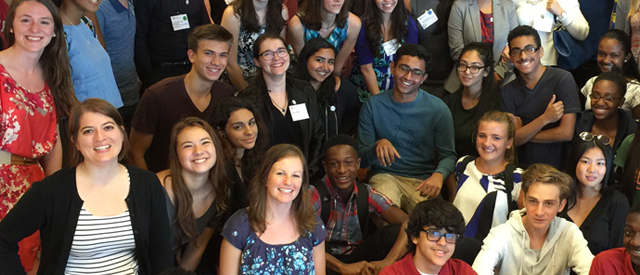
For over a decade, the Academy has worked with partners across industry, academia, and government to offer Innovation Challenges, virtual competitions that engage student innovators to apply their curiosity and creativity to solve real-world problems. Using the Academy’s unique online platform, Launchpad, participants collaborate on project-based activities while spanning time zones and cultures. Browse our current Innovation Challenges as well as past Challenges below.
An inside look at our innovation challenges teams and their impressive accomplishments.
[{"id":34082,"link":"https:\/\/www.nyas.org\/ideas-insights\/blog\/marine-life-sustaining-wind-farms\/","name":"marine-life-sustaining-wind-farms","thumbnail":{"url":"https:\/\/www.nyas.org\/wp-content\/uploads\/2025\/09\/marine-biodiversity-innovation-challenge-1024x682.jpg","alt":"An underwater shot."},"title":"Marine Life Sustaining Wind Farms","author":{"name":"The New York Academy of Sciences","link":"https:\/\/www.nyas.org\/author\/nickfetty\/"},"date":"May 8, 2026","dateGMT":"2026-05-08 15:40:19","modifiedDate":"2026-05-11 13:18:09","modifiedDateGMT":"2026-05-11 13:18:09","commentCount":"0","commentStatus":"closed","categories":{"coma":"Uncategorized","space":"Uncategorized"},"taxonomies":{"blog-highlight":"","blog-category":"<a href='https:\/\/www.nyas.org\/blog-category\/research-summaries\/' rel='blog-category'>Research Summaries<\/a>","feature":"<a href='https:\/\/www.nyas.org\/feature\/program-participant\/' rel='feature'>Program Participant<\/a>","program-category":"<a href='https:\/\/www.nyas.org\/program-category\/innovation-challenge\/' rel='program-category'>Innovation Challenge<\/a><a href='https:\/\/www.nyas.org\/program-category\/junior-academy\/' rel='program-category'>Junior Academy<\/a>","scientific-theme":"<a href='https:\/\/www.nyas.org\/scientific-theme\/sustainable-planet\/' rel='scientific-theme'>Sustainable Planet<\/a>","speaker-name":""},"readTime":{"min":4,"sec":58},"status":"publish","excerpt":"The winning team proposed transforming wind turbines into reef-like living ecosystems."},{"id":34078,"link":"https:\/\/www.nyas.org\/ideas-insights\/blog\/save2serve\/","name":"save2serve","thumbnail":{"url":"https:\/\/www.nyas.org\/wp-content\/uploads\/2025\/09\/food-waste-innovation-challenge-1024x684.jpg","alt":"Organic composting."},"title":"Save2Serve","author":{"name":"The New York Academy of Sciences","link":"https:\/\/www.nyas.org\/author\/nickfetty\/"},"date":"May 8, 2026","dateGMT":"2026-05-08 15:32:05","modifiedDate":"2026-05-11 13:16:44","modifiedDateGMT":"2026-05-11 13:16:44","commentCount":"0","commentStatus":"closed","categories":{"coma":"Uncategorized","space":"Uncategorized"},"taxonomies":{"blog-highlight":"","blog-category":"<a href='https:\/\/www.nyas.org\/blog-category\/research-summaries\/' rel='blog-category'>Research Summaries<\/a>","feature":"<a href='https:\/\/www.nyas.org\/feature\/program-participant\/' rel='feature'>Program Participant<\/a>","program-category":"<a href='https:\/\/www.nyas.org\/program-category\/innovation-challenge\/' rel='program-category'>Innovation Challenge<\/a><a href='https:\/\/www.nyas.org\/program-category\/junior-academy\/' rel='program-category'>Junior Academy<\/a>","scientific-theme":"<a href='https:\/\/www.nyas.org\/scientific-theme\/health-disease\/' rel='scientific-theme'>Health & Disease<\/a>","speaker-name":""},"readTime":{"min":4,"sec":57},"status":"publish","excerpt":"The winning team designed an affordable cooling transport system to keep produce fresh longer."},{"id":34067,"link":"https:\/\/www.nyas.org\/ideas-insights\/blog\/radiantis-solar-in-structure\/","name":"radiantis-solar-in-structure","thumbnail":{"url":"https:\/\/www.nyas.org\/wp-content\/uploads\/2025\/09\/energy-infrastructure-innovation-challenge-1024x673.jpg","alt":"Solar panels."},"title":"Radiantis: Solar in Structure","author":{"name":"The New York Academy of Sciences","link":"https:\/\/www.nyas.org\/author\/nickfetty\/"},"date":"May 8, 2026","dateGMT":"2026-05-08 15:23:55","modifiedDate":"2026-05-11 13:17:10","modifiedDateGMT":"2026-05-11 13:17:10","commentCount":"0","commentStatus":"closed","categories":{"coma":"<a href=\"https:\/\/www.nyas.org\/category\/energy\/\" rel=\"category tag\">Energy<\/a>","space":"<a href=\"https:\/\/www.nyas.org\/category\/energy\/\" rel=\"category tag\">Energy<\/a>"},"taxonomies":{"blog-highlight":"","blog-category":"<a href='https:\/\/www.nyas.org\/blog-category\/research-summaries\/' rel='blog-category'>Research Summaries<\/a>","feature":"<a href='https:\/\/www.nyas.org\/feature\/program-participant\/' rel='feature'>Program Participant<\/a>","program-category":"<a href='https:\/\/www.nyas.org\/program-category\/innovation-challenge\/' rel='program-category'>Innovation Challenge<\/a><a href='https:\/\/www.nyas.org\/program-category\/junior-academy\/' rel='program-category'>Junior Academy<\/a>","scientific-theme":"<a href='https:\/\/www.nyas.org\/scientific-theme\/sustainable-planet\/' rel='scientific-theme'>Sustainable Planet<\/a>","speaker-name":""},"readTime":{"min":4,"sec":47},"status":"publish","excerpt":"The winning team developed an automated system to keep solar panels clean and operating efficiently."},{"id":28728,"link":"https:\/\/www.nyas.org\/ideas-insights\/blog\/combating-extreme-heat-environments-through-technology-architecture-infrastructure-and-urbanization\/","name":"combating-extreme-heat-environments-through-technology-architecture-infrastructure-and-urbanization","thumbnail":{"url":"https:\/\/www.nyas.org\/wp-content\/uploads\/2025\/02\/ja-living-in-the-extremes-1024x683.jpg","alt":"A woman hiking, looking at a series of structures that appear to be from an old civilization."},"title":"Combating Extreme Heat Environments through Technology Architecture Infrastructure and Urbanization","author":{"name":"The New York Academy of Sciences","link":"https:\/\/www.nyas.org\/author\/nickfetty\/"},"date":"Aug 5, 2025","dateGMT":"2025-08-05 17:00:07","modifiedDate":"2025-10-31 19:43:32","modifiedDateGMT":"2025-10-31 19:43:32","commentCount":"0","commentStatus":"closed","categories":{"coma":"<a href=\"https:\/\/www.nyas.org\/category\/climate\/\" rel=\"category tag\">Climate<\/a>, <a href=\"https:\/\/www.nyas.org\/category\/education\/\" rel=\"category tag\">Education<\/a>","space":"<a href=\"https:\/\/www.nyas.org\/category\/climate\/\" rel=\"category tag\">Climate<\/a> <a href=\"https:\/\/www.nyas.org\/category\/education\/\" rel=\"category tag\">Education<\/a>"},"taxonomies":{"blog-highlight":"","blog-category":"<a href='https:\/\/www.nyas.org\/blog-category\/program-wrap-up\/' rel='blog-category'>Program Wrap-Up<\/a>","feature":"<a href='https:\/\/www.nyas.org\/feature\/program-participant\/' rel='feature'>Program Participant<\/a>","program-category":"<a href='https:\/\/www.nyas.org\/program-category\/innovation-challenge\/' rel='program-category'>Innovation Challenge<\/a><a href='https:\/\/www.nyas.org\/program-category\/junior-academy\/' rel='program-category'>Junior Academy<\/a><a href='https:\/\/www.nyas.org\/program-category\/learning\/' rel='program-category'>Learning<\/a>","scientific-theme":"<a href='https:\/\/www.nyas.org\/scientific-theme\/health-disease\/' rel='scientific-theme'>Health & Disease<\/a><a href='https:\/\/www.nyas.org\/scientific-theme\/sustainable-planet\/' rel='scientific-theme'>Sustainable Planet<\/a>","speaker-name":""},"readTime":{"min":4,"sec":15},"status":"publish","excerpt":"Finding an innovative approach to improve the housing and living environment for communities living in scorching heat."},{"id":28724,"link":"https:\/\/www.nyas.org\/ideas-insights\/blog\/eco-twisters\/","name":"eco-twisters","thumbnail":{"url":"https:\/\/www.nyas.org\/wp-content\/uploads\/2025\/02\/ja-air-quality-health-1024x536.jpg","alt":"A woman wearing a facemask looks out from her balcony to a hazy, air polluted city skyline."},"title":"Eco-twisters","author":{"name":"The New York Academy of Sciences","link":"https:\/\/www.nyas.org\/author\/nickfetty\/"},"date":"Aug 5, 2025","dateGMT":"2025-08-05 16:55:52","modifiedDate":"2025-10-31 19:43:26","modifiedDateGMT":"2025-10-31 19:43:26","commentCount":"0","commentStatus":"closed","categories":{"coma":"<a href=\"https:\/\/www.nyas.org\/category\/climate\/\" rel=\"category tag\">Climate<\/a>, <a href=\"https:\/\/www.nyas.org\/category\/education\/\" rel=\"category tag\">Education<\/a>","space":"<a href=\"https:\/\/www.nyas.org\/category\/climate\/\" rel=\"category tag\">Climate<\/a> <a href=\"https:\/\/www.nyas.org\/category\/education\/\" rel=\"category tag\">Education<\/a>"},"taxonomies":{"blog-highlight":"","blog-category":"<a href='https:\/\/www.nyas.org\/blog-category\/program-wrap-up\/' rel='blog-category'>Program Wrap-Up<\/a>","feature":"<a href='https:\/\/www.nyas.org\/feature\/program-participant\/' rel='feature'>Program Participant<\/a>","program-category":"<a href='https:\/\/www.nyas.org\/program-category\/innovation-challenge\/' rel='program-category'>Innovation Challenge<\/a><a href='https:\/\/www.nyas.org\/program-category\/junior-academy\/' rel='program-category'>Junior Academy<\/a><a href='https:\/\/www.nyas.org\/program-category\/learning\/' rel='program-category'>Learning<\/a>","scientific-theme":"<a href='https:\/\/www.nyas.org\/scientific-theme\/health-disease\/' rel='scientific-theme'>Health & Disease<\/a><a href='https:\/\/www.nyas.org\/scientific-theme\/sustainable-planet\/' rel='scientific-theme'>Sustainable Planet<\/a>","speaker-name":""},"readTime":{"min":4,"sec":12},"status":"publish","excerpt":"\u201cWhen redesigning our solution, we prioritized accessibility and eco-friendliness and ended up reducing the size.\u201d"},{"id":26483,"link":"https:\/\/www.nyas.org\/ideas-insights\/blog\/the-last-strand\/","name":"the-last-strand","thumbnail":{"url":"https:\/\/www.nyas.org\/wp-content\/uploads\/2025\/05\/Upcycling-and-Waste-Management-Challenge-Image.png","alt":"Public artwork to bring attention to waste management."},"title":"The Last Strand","author":{"name":"The New York Academy of Sciences","link":"https:\/\/www.nyas.org\/author\/nickfetty\/"},"date":"May 16, 2025","dateGMT":"2025-05-16 12:29:49","modifiedDate":"2025-10-31 19:39:16","modifiedDateGMT":"2025-10-31 19:39:16","commentCount":"0","commentStatus":"closed","categories":{"coma":"Uncategorized","space":"Uncategorized"},"taxonomies":{"blog-highlight":"","blog-category":"<a href='https:\/\/www.nyas.org\/blog-category\/story-of-impact\/' rel='blog-category'>Story of Impact<\/a>","feature":"","program-category":"<a href='https:\/\/www.nyas.org\/program-category\/innovation-challenge\/' rel='program-category'>Innovation Challenge<\/a><a href='https:\/\/www.nyas.org\/program-category\/junior-academy\/' rel='program-category'>Junior Academy<\/a><a href='https:\/\/www.nyas.org\/program-category\/learning\/' rel='program-category'>Learning<\/a>","scientific-theme":"<a href='https:\/\/www.nyas.org\/scientific-theme\/sustainable-planet\/' rel='scientific-theme'>Sustainable Planet<\/a>","speaker-name":""},"readTime":{"min":4,"sec":38},"status":"publish","excerpt":"Winners of the Fall 2024 Junior Academy Challenge: \"Upcycling & Waste Management\""},{"id":26476,"link":"https:\/\/www.nyas.org\/ideas-insights\/blog\/upgrading-the-hydraulic-system\/","name":"upgrading-the-hydraulic-system","thumbnail":{"url":"https:\/\/www.nyas.org\/wp-content\/uploads\/2025\/05\/Remediation-in-South-Brooklyn-Challenge-Image.png","alt":"Offshore wind turbines."},"title":"Upgrading the Hydraulic System","author":{"name":"The New York Academy of Sciences","link":"https:\/\/www.nyas.org\/author\/nickfetty\/"},"date":"May 16, 2025","dateGMT":"2025-05-16 12:24:01","modifiedDate":"2025-10-31 19:39:08","modifiedDateGMT":"2025-10-31 19:39:08","commentCount":"0","commentStatus":"closed","categories":{"coma":"<a href=\"https:\/\/www.nyas.org\/category\/climate\/\" rel=\"category tag\">Climate<\/a>, <a href=\"https:\/\/www.nyas.org\/category\/new-york-city\/\" rel=\"category tag\">New York City<\/a>","space":"<a href=\"https:\/\/www.nyas.org\/category\/climate\/\" rel=\"category tag\">Climate<\/a> <a href=\"https:\/\/www.nyas.org\/category\/new-york-city\/\" rel=\"category tag\">New York City<\/a>"},"taxonomies":{"blog-highlight":"","blog-category":"<a href='https:\/\/www.nyas.org\/blog-category\/story-of-impact\/' rel='blog-category'>Story of Impact<\/a>","feature":"","program-category":"<a href='https:\/\/www.nyas.org\/program-category\/innovation-challenge\/' rel='program-category'>Innovation Challenge<\/a><a href='https:\/\/www.nyas.org\/program-category\/junior-academy\/' rel='program-category'>Junior Academy<\/a><a href='https:\/\/www.nyas.org\/program-category\/learning\/' rel='program-category'>Learning<\/a>","scientific-theme":"<a href='https:\/\/www.nyas.org\/scientific-theme\/sustainable-planet\/' rel='scientific-theme'>Sustainable Planet<\/a>","speaker-name":""},"readTime":{"min":4,"sec":51},"status":"publish","excerpt":"Winners of the Fall 2024 Junior Academy Challenge: \" Remediation in South Brooklyn\""},{"id":26472,"link":"https:\/\/www.nyas.org\/ideas-insights\/blog\/fairify-reducing-bias-in-ai-models\/","name":"fairify-reducing-bias-in-ai-models","thumbnail":{"url":"https:\/\/www.nyas.org\/wp-content\/uploads\/2025\/05\/Ethical-AI-Challenge-Image.png","alt":""},"title":"fAIrify - Reducing BIAS in AI Models","author":{"name":"The New York Academy of Sciences","link":"https:\/\/www.nyas.org\/author\/nickfetty\/"},"date":"May 16, 2025","dateGMT":"2025-05-16 12:19:43","modifiedDate":"2025-10-31 19:38:59","modifiedDateGMT":"2025-10-31 19:38:59","commentCount":"0","commentStatus":"closed","categories":{"coma":"<a href=\"https:\/\/www.nyas.org\/category\/architecture-and-infrastructure\/\" rel=\"category tag\">Architecture and Infrastructure<\/a>","space":"<a href=\"https:\/\/www.nyas.org\/category\/architecture-and-infrastructure\/\" rel=\"category tag\">Architecture and Infrastructure<\/a>"},"taxonomies":{"blog-highlight":"","blog-category":"<a href='https:\/\/www.nyas.org\/blog-category\/story-of-impact\/' rel='blog-category'>Story of Impact<\/a>","feature":"","program-category":"<a href='https:\/\/www.nyas.org\/program-category\/innovation-challenge\/' rel='program-category'>Innovation Challenge<\/a><a href='https:\/\/www.nyas.org\/program-category\/junior-academy\/' rel='program-category'>Junior Academy<\/a><a href='https:\/\/www.nyas.org\/program-category\/learning\/' rel='program-category'>Learning<\/a>","scientific-theme":"<a href='https:\/\/www.nyas.org\/scientific-theme\/technology-innovation\/' rel='scientific-theme'>Technology & Innovation<\/a>","speaker-name":""},"readTime":{"min":4,"sec":17},"status":"publish","excerpt":"Winners of the Fall 2024 Junior Academy Challenge: \"Ethical AI\""},{"id":17463,"link":"https:\/\/www.nyas.org\/ideas-insights\/blog\/using-artificial-intelligence-and-augmented-reality-to-assist-dementia-patients\/","name":"using-artificial-intelligence-and-augmented-reality-to-assist-dementia-patients","thumbnail":{"url":"https:\/\/www.nyas.org\/wp-content\/uploads\/2024\/08\/Using-Artificial-Intelligence-and-Augmented-Reality-to-Assist-Dementia-Patients-1024x752.jpg","alt":"A photo of a man checking his smartwatch, with AI graphics over-imposed."},"title":"Assisting Dementia Patients with AI and AR","author":{"name":"The New York Academy of Sciences","link":"https:\/\/www.nyas.org\/author\/nickfetty\/"},"date":"Aug 14, 2024","dateGMT":"2024-08-14 15:02:39","modifiedDate":"2025-11-05 20:55:25","modifiedDateGMT":"2025-11-05 20:55:25","commentCount":"0","commentStatus":"closed","categories":{"coma":"<a href=\"https:\/\/www.nyas.org\/category\/ai\/\" rel=\"category tag\">Artificial Intelligence<\/a>","space":"<a href=\"https:\/\/www.nyas.org\/category\/ai\/\" rel=\"category tag\">Artificial Intelligence<\/a>"},"taxonomies":{"blog-highlight":"","blog-category":"<a href='https:\/\/www.nyas.org\/blog-category\/story-of-impact\/' rel='blog-category'>Story of Impact<\/a>","feature":"<a href='https:\/\/www.nyas.org\/feature\/program-participant\/' rel='feature'>Program Participant<\/a>","program-category":"<a href='https:\/\/www.nyas.org\/program-category\/innovation-challenge\/' rel='program-category'>Innovation Challenge<\/a><a href='https:\/\/www.nyas.org\/program-category\/junior-academy\/' rel='program-category'>Junior Academy<\/a><a href='https:\/\/www.nyas.org\/program-category\/learning\/' rel='program-category'>Learning<\/a>","scientific-theme":"<a href='https:\/\/www.nyas.org\/scientific-theme\/health-disease\/' rel='scientific-theme'>Health & Disease<\/a><a href='https:\/\/www.nyas.org\/scientific-theme\/stem-pathways\/' rel='scientific-theme'>STEM Pathways<\/a>","speaker-name":""},"readTime":{"min":4,"sec":7},"status":"publish","excerpt":"Winners of the Junior Academy Innovation Challenge Spring 2024: \u201cWearables\u201d"},{"id":17461,"link":"https:\/\/www.nyas.org\/ideas-insights\/blog\/developing-circular-textile-practices-through-recyclable-fabrics-and-reducing-color-dye-pollution\/","name":"developing-circular-textile-practices-through-recyclable-fabrics-and-reducing-color-dye-pollution","thumbnail":{"url":"https:\/\/www.nyas.org\/wp-content\/uploads\/2024\/08\/Developing-Circular-Textile-Practices-Through-Recyclable-Fabrics-and-Reducing-Color-Dye-Pollution-1024x683.jpg","alt":"Sustainable textiles hanged up on a tree outside."},"title":"Students Make Sustainable Fashion Statement","author":{"name":"The New York Academy of Sciences","link":"https:\/\/www.nyas.org\/author\/nickfetty\/"},"date":"Aug 14, 2024","dateGMT":"2024-08-14 14:57:00","modifiedDate":"2025-10-31 19:46:48","modifiedDateGMT":"2025-10-31 19:46:48","commentCount":"0","commentStatus":"closed","categories":{"coma":"<a href=\"https:\/\/www.nyas.org\/category\/fashion\/\" rel=\"category tag\">Fashion<\/a>","space":"<a href=\"https:\/\/www.nyas.org\/category\/fashion\/\" rel=\"category tag\">Fashion<\/a>"},"taxonomies":{"blog-highlight":"","blog-category":"<a href='https:\/\/www.nyas.org\/blog-category\/story-of-impact\/' rel='blog-category'>Story of Impact<\/a>","feature":"<a href='https:\/\/www.nyas.org\/feature\/program-participant\/' rel='feature'>Program Participant<\/a>","program-category":"<a href='https:\/\/www.nyas.org\/program-category\/innovation-challenge\/' rel='program-category'>Innovation Challenge<\/a><a href='https:\/\/www.nyas.org\/program-category\/junior-academy\/' rel='program-category'>Junior Academy<\/a><a href='https:\/\/www.nyas.org\/program-category\/learning\/' rel='program-category'>Learning<\/a>","scientific-theme":"<a href='https:\/\/www.nyas.org\/scientific-theme\/stem-pathways\/' rel='scientific-theme'>STEM Pathways<\/a><a href='https:\/\/www.nyas.org\/scientific-theme\/sustainable-planet\/' rel='scientific-theme'>Sustainable Planet<\/a>","speaker-name":""},"readTime":{"min":4,"sec":11},"status":"publish","excerpt":"Winners of the Junior Academy Innovation Challenge Spring 2024: \u201cCircular Textiles\u201d"},{"id":17452,"link":"https:\/\/www.nyas.org\/ideas-insights\/blog\/using-artificial-intelligence-to-redefine-accessible-classrooms\/","name":"using-artificial-intelligence-to-redefine-accessible-classrooms","thumbnail":{"url":"https:\/\/www.nyas.org\/wp-content\/uploads\/2024\/08\/Using-Artificial-Intelligence-to-Redefine-Accessible-Classrooms.jpg","alt":"A photo of a city skyline with an over-imposed graphic denoting different AI applications."},"title":"Improving Classroom Accessibility with AI","author":{"name":"The New York Academy of Sciences","link":"https:\/\/www.nyas.org\/author\/nickfetty\/"},"date":"Aug 14, 2024","dateGMT":"2024-08-14 14:26:11","modifiedDate":"2025-10-31 19:46:42","modifiedDateGMT":"2025-10-31 19:46:42","commentCount":"0","commentStatus":"closed","categories":{"coma":"<a href=\"https:\/\/www.nyas.org\/category\/ai\/\" rel=\"category tag\">Artificial Intelligence<\/a>, <a href=\"https:\/\/www.nyas.org\/category\/dei\/\" rel=\"category tag\">Diversity, Equity, and Inclusion<\/a>, <a href=\"https:\/\/www.nyas.org\/category\/education\/\" rel=\"category tag\">Education<\/a>","space":"<a href=\"https:\/\/www.nyas.org\/category\/ai\/\" rel=\"category tag\">Artificial Intelligence<\/a> <a href=\"https:\/\/www.nyas.org\/category\/dei\/\" rel=\"category tag\">Diversity, Equity, and Inclusion<\/a> <a href=\"https:\/\/www.nyas.org\/category\/education\/\" rel=\"category tag\">Education<\/a>"},"taxonomies":{"blog-highlight":"","blog-category":"<a href='https:\/\/www.nyas.org\/blog-category\/story-of-impact\/' rel='blog-category'>Story of Impact<\/a>","feature":"<a href='https:\/\/www.nyas.org\/feature\/program-participant\/' rel='feature'>Program Participant<\/a>","program-category":"<a href='https:\/\/www.nyas.org\/program-category\/innovation-challenge\/' rel='program-category'>Innovation Challenge<\/a><a href='https:\/\/www.nyas.org\/program-category\/junior-academy\/' rel='program-category'>Junior Academy<\/a><a href='https:\/\/www.nyas.org\/program-category\/learning\/' rel='program-category'>Learning<\/a>","scientific-theme":"<a href='https:\/\/www.nyas.org\/scientific-theme\/stem-pathways\/' rel='scientific-theme'>STEM Pathways<\/a><a href='https:\/\/www.nyas.org\/scientific-theme\/technology-innovation\/' rel='scientific-theme'>Technology & Innovation<\/a>","speaker-name":""},"readTime":{"min":3,"sec":37},"status":"publish","excerpt":"Winners of the Junior Academy Innovation Challenge Fall 2023: \u201cCognitive Classrooms\u201d"},{"id":17443,"link":"https:\/\/www.nyas.org\/ideas-insights\/blog\/creating-alternative-mineral-mining-practices-in-space\/","name":"creating-alternative-mineral-mining-practices-in-space","thumbnail":{"url":"https:\/\/www.nyas.org\/wp-content\/uploads\/2024\/08\/Creating-Alternative-Mineral-Mining-Practices-in-Space-1024x576.jpg","alt":"A shot of Lithium from the periodic table of elements."},"title":"Alternatives To Mineral Space Mining","author":{"name":"The New York Academy of Sciences","link":"https:\/\/www.nyas.org\/author\/nickfetty\/"},"date":"Aug 14, 2024","dateGMT":"2024-08-14 14:03:08","modifiedDate":"2025-10-31 19:46:32","modifiedDateGMT":"2025-10-31 19:46:32","commentCount":"0","commentStatus":"closed","categories":{"coma":"<a href=\"https:\/\/www.nyas.org\/category\/space-exploration\/\" rel=\"category tag\">Space Exploration<\/a>","space":"<a href=\"https:\/\/www.nyas.org\/category\/space-exploration\/\" rel=\"category tag\">Space Exploration<\/a>"},"taxonomies":{"blog-highlight":"","blog-category":"<a href='https:\/\/www.nyas.org\/blog-category\/story-of-impact\/' rel='blog-category'>Story of Impact<\/a>","feature":"<a href='https:\/\/www.nyas.org\/feature\/program-participant\/' rel='feature'>Program Participant<\/a>","program-category":"<a href='https:\/\/www.nyas.org\/program-category\/innovation-challenge\/' rel='program-category'>Innovation Challenge<\/a><a href='https:\/\/www.nyas.org\/program-category\/junior-academy\/' rel='program-category'>Junior Academy<\/a><a href='https:\/\/www.nyas.org\/program-category\/learning\/' rel='program-category'>Learning<\/a>","scientific-theme":"<a href='https:\/\/www.nyas.org\/scientific-theme\/stem-pathways\/' rel='scientific-theme'>STEM Pathways<\/a><a href='https:\/\/www.nyas.org\/scientific-theme\/sustainable-planet\/' rel='scientific-theme'>Sustainable Planet<\/a>","speaker-name":""},"readTime":{"min":3,"sec":42},"status":"publish","excerpt":"Winners of the Junior Academy Innovation Challenge Fall 2023: \u201cMinerals of Technology\u201d"},{"id":17434,"link":"https:\/\/www.nyas.org\/ideas-insights\/blog\/combating-climate-change-through-vertical-farming-in-urban-environments\/","name":"combating-climate-change-through-vertical-farming-in-urban-environments","thumbnail":{"url":"https:\/\/www.nyas.org\/wp-content\/uploads\/2024\/08\/Combating-Climate-Change-Through-Vertical-Farming-in-Urban-Environments-1024x520.png","alt":"A shot of people picking up litter at an outdoor park."},"title":"The Environmental Benefits of Vertical Farming","author":{"name":"The New York Academy of Sciences","link":"https:\/\/www.nyas.org\/author\/nickfetty\/"},"date":"Aug 14, 2024","dateGMT":"2024-08-14 13:41:28","modifiedDate":"2025-10-31 19:46:25","modifiedDateGMT":"2025-10-31 19:46:25","commentCount":"0","commentStatus":"closed","categories":{"coma":"<a href=\"https:\/\/www.nyas.org\/category\/agriculture\/\" rel=\"category tag\">Agriculture<\/a>","space":"<a href=\"https:\/\/www.nyas.org\/category\/agriculture\/\" rel=\"category tag\">Agriculture<\/a>"},"taxonomies":{"blog-highlight":"","blog-category":"<a href='https:\/\/www.nyas.org\/blog-category\/story-of-impact\/' rel='blog-category'>Story of Impact<\/a>","feature":"<a href='https:\/\/www.nyas.org\/feature\/program-participant\/' rel='feature'>Program Participant<\/a>","program-category":"<a href='https:\/\/www.nyas.org\/program-category\/innovation-challenge\/' rel='program-category'>Innovation Challenge<\/a><a href='https:\/\/www.nyas.org\/program-category\/junior-academy\/' rel='program-category'>Junior Academy<\/a><a href='https:\/\/www.nyas.org\/program-category\/learning\/' rel='program-category'>Learning<\/a>","scientific-theme":"<a href='https:\/\/www.nyas.org\/scientific-theme\/stem-pathways\/' rel='scientific-theme'>STEM Pathways<\/a><a href='https:\/\/www.nyas.org\/scientific-theme\/sustainable-planet\/' rel='scientific-theme'>Sustainable Planet<\/a>","speaker-name":""},"readTime":{"min":3,"sec":48},"status":"publish","excerpt":"Winners of the Fall 2023 Junior Academy Innovation Challenge: \"Green Homes, Green Schools, Green Communities\""},{"id":11659,"link":"https:\/\/www.nyas.org\/ideas-insights\/blog\/the-adventures-of-the-nutritional-kingdom-project\/","name":"the-adventures-of-the-nutritional-kingdom-project","thumbnail":{"url":"https:\/\/www.nyas.org\/wp-content\/uploads\/2024\/02\/healthy-snacks-challenge-1024x683.jpg","alt":"Bowls containing fruits, nuts, and other super foods."},"title":"The Adventures of the Nutritional Kingdom Project","author":{"name":"The New York Academy of Sciences","link":"https:\/\/www.nyas.org\/author\/nickfetty\/"},"date":"Feb 27, 2024","dateGMT":"2024-02-27 20:16:18","modifiedDate":"2025-11-04 19:51:28","modifiedDateGMT":"2025-11-04 19:51:28","commentCount":"0","commentStatus":"closed","categories":{"coma":"<a href=\"https:\/\/www.nyas.org\/category\/public-health\/\" rel=\"category tag\">Public Health<\/a>","space":"<a href=\"https:\/\/www.nyas.org\/category\/public-health\/\" rel=\"category tag\">Public Health<\/a>"},"taxonomies":{"blog-highlight":"","blog-category":"<a href='https:\/\/www.nyas.org\/blog-category\/story-of-impact\/' rel='blog-category'>Story of Impact<\/a>","feature":"<a href='https:\/\/www.nyas.org\/feature\/program-participant\/' rel='feature'>Program Participant<\/a>","program-category":"<a href='https:\/\/www.nyas.org\/program-category\/innovation-challenge\/' rel='program-category'>Innovation Challenge<\/a><a href='https:\/\/www.nyas.org\/program-category\/junior-academy\/' rel='program-category'>Junior Academy<\/a><a href='https:\/\/www.nyas.org\/program-category\/learning\/' rel='program-category'>Learning<\/a>","scientific-theme":"<a href='https:\/\/www.nyas.org\/scientific-theme\/health-disease\/' rel='scientific-theme'>Health & Disease<\/a>","speaker-name":""},"readTime":{"min":3,"sec":18},"status":"publish","excerpt":"Winners of the Junior Academy Innovation Challenge Spring 2023: \"Healthy Snacks\""},{"id":4545,"link":"https:\/\/www.nyas.org\/ideas-insights\/blog\/cybersafe-team\/","name":"cybersafe-team","thumbnail":{"url":"https:\/\/www.nyas.org\/wp-content\/uploads\/2024\/01\/cybersecurity-challenge-banner-1024x554.jpg","alt":"An abstract graphic representing cybersecurity."},"title":"Improving Cyber Security through Research and Policy","author":{"name":"The New York Academy of Sciences","link":"https:\/\/www.nyas.org\/author\/nyas_dev_admin\/"},"date":"Jan 11, 2024","dateGMT":"2024-01-11 21:18:00","modifiedDate":"2025-11-04 19:52:51","modifiedDateGMT":"2025-11-04 19:52:51","commentCount":"0","commentStatus":"closed","categories":{"coma":"<a href=\"https:\/\/www.nyas.org\/category\/government-and-policy\/\" rel=\"category tag\">Government and Policy<\/a>","space":"<a href=\"https:\/\/www.nyas.org\/category\/government-and-policy\/\" rel=\"category tag\">Government and Policy<\/a>"},"taxonomies":{"blog-highlight":"","blog-category":"","feature":"<a href='https:\/\/www.nyas.org\/feature\/program-participant\/' rel='feature'>Program Participant<\/a>","program-category":"<a href='https:\/\/www.nyas.org\/program-category\/innovation-challenge\/' rel='program-category'>Innovation Challenge<\/a><a href='https:\/\/www.nyas.org\/program-category\/junior-academy\/' rel='program-category'>Junior Academy<\/a><a href='https:\/\/www.nyas.org\/program-category\/learning\/' rel='program-category'>Learning<\/a>","scientific-theme":"<a href='https:\/\/www.nyas.org\/scientific-theme\/technology-innovation\/' rel='scientific-theme'>Technology & Innovation<\/a>","speaker-name":""},"readTime":{"min":3,"sec":46},"status":"publish","excerpt":"Winners of the Junior Academy Innovation Challenge Spring 2023: \u201cCybersecurity\u201d"},{"id":2945,"link":"https:\/\/www.nyas.org\/ideas-insights\/blog\/mihealth-miami-health-team\/","name":"mihealth-miami-health-team","thumbnail":{"url":"https:\/\/www.nyas.org\/wp-content\/uploads\/2023\/12\/MiHealth-Miami-Health-Team.png","alt":"A person sits in a boat in a dried lakebed."},"title":"A Telemedicine App for Rural Communities","author":{"name":"The New York Academy of Sciences","link":"https:\/\/www.nyas.org\/author\/nyas_dev_admin\/"},"date":"Dec 21, 2023","dateGMT":"2023-12-21 14:53:25","modifiedDate":"2025-11-04 19:54:07","modifiedDateGMT":"2025-11-04 19:54:07","commentCount":"0","commentStatus":"closed","categories":{"coma":"<a href=\"https:\/\/www.nyas.org\/category\/medicine-and-healthcare\/\" rel=\"category tag\">Medicine and Healthcare<\/a>, <a href=\"https:\/\/www.nyas.org\/category\/public-health\/\" rel=\"category tag\">Public Health<\/a>","space":"<a href=\"https:\/\/www.nyas.org\/category\/medicine-and-healthcare\/\" rel=\"category tag\">Medicine and Healthcare<\/a> <a href=\"https:\/\/www.nyas.org\/category\/public-health\/\" rel=\"category tag\">Public Health<\/a>"},"taxonomies":{"blog-highlight":"","blog-category":"<a href='https:\/\/www.nyas.org\/blog-category\/story-of-impact\/' rel='blog-category'>Story of Impact<\/a>","feature":"<a href='https:\/\/www.nyas.org\/feature\/program-participant\/' rel='feature'>Program Participant<\/a>","program-category":"<a href='https:\/\/www.nyas.org\/program-category\/innovation-challenge\/' rel='program-category'>Innovation Challenge<\/a><a href='https:\/\/www.nyas.org\/program-category\/junior-academy\/' rel='program-category'>Junior Academy<\/a><a href='https:\/\/www.nyas.org\/program-category\/learning\/' rel='program-category'>Learning<\/a>","scientific-theme":"<a href='https:\/\/www.nyas.org\/scientific-theme\/health-disease\/' rel='scientific-theme'>Health & Disease<\/a><a href='https:\/\/www.nyas.org\/scientific-theme\/stem-pathways\/' rel='scientific-theme'>STEM Pathways<\/a>","speaker-name":""},"readTime":{"min":3,"sec":28},"status":"publish","excerpt":"Winners of the Junior Academy Innovation Challenge Fall 2022: \u201cPublic Health Impacts of Climate Change.\u201d"},{"id":2968,"link":"https:\/\/www.nyas.org\/ideas-insights\/blog\/go-green-sea-blue-team\/","name":"go-green-sea-blue-team","thumbnail":{"url":"https:\/\/www.nyas.org\/wp-content\/uploads\/2023\/11\/Exploring-the-Impact-of-Oil-Spills.png","alt":"A shot of fish swimming in the ocean."},"title":"A New Approach to Dealing with Oil Spills","author":{"name":"The New York Academy of Sciences","link":"https:\/\/www.nyas.org\/author\/nyas_dev_admin\/"},"date":"Nov 16, 2023","dateGMT":"2023-11-16 15:19:26","modifiedDate":"2025-11-04 19:55:00","modifiedDateGMT":"2025-11-04 19:55:00","commentCount":"0","commentStatus":"closed","categories":{"coma":"<a href=\"https:\/\/www.nyas.org\/category\/public-health\/\" rel=\"category tag\">Public Health<\/a>","space":"<a href=\"https:\/\/www.nyas.org\/category\/public-health\/\" rel=\"category tag\">Public Health<\/a>"},"taxonomies":{"blog-highlight":"","blog-category":"<a href='https:\/\/www.nyas.org\/blog-category\/story-of-impact\/' rel='blog-category'>Story of Impact<\/a>","feature":"<a href='https:\/\/www.nyas.org\/feature\/program-participant\/' rel='feature'>Program Participant<\/a>","program-category":"<a href='https:\/\/www.nyas.org\/program-category\/innovation-challenge\/' rel='program-category'>Innovation Challenge<\/a><a href='https:\/\/www.nyas.org\/program-category\/junior-academy\/' rel='program-category'>Junior Academy<\/a><a href='https:\/\/www.nyas.org\/program-category\/learning\/' rel='program-category'>Learning<\/a>","scientific-theme":"<a href='https:\/\/www.nyas.org\/scientific-theme\/stem-pathways\/' rel='scientific-theme'>STEM Pathways<\/a>","speaker-name":""},"readTime":{"min":3,"sec":37},"status":"publish","excerpt":"Winners of the Junior Academy Innovation Challenge Fall 2022: \"Exploring the Extremes\""},{"id":2970,"link":"https:\/\/www.nyas.org\/ideas-insights\/blog\/our-life-is-safer-with-smart-shelter-team\/","name":"our-life-is-safer-with-smart-shelter-team","thumbnail":{"url":"https:\/\/www.nyas.org\/wp-content\/uploads\/2023\/11\/Our-Life-is-Safer-with-Smart-Shelter-Team.png","alt":"A graphic illustration showing a depiction of the Internet of Things within a women's home."},"title":"Our Life is Safer with Smart Shelter Team","author":{"name":"The New York Academy of Sciences","link":"https:\/\/www.nyas.org\/author\/nyas_dev_admin\/"},"date":"Nov 2, 2023","dateGMT":"2023-11-02 15:27:03","modifiedDate":"2025-11-04 19:55:36","modifiedDateGMT":"2025-11-04 19:55:36","commentCount":"0","commentStatus":"closed","categories":{"coma":"Uncategorized","space":"Uncategorized"},"taxonomies":{"blog-highlight":"","blog-category":"<a href='https:\/\/www.nyas.org\/blog-category\/story-of-impact\/' rel='blog-category'>Story of Impact<\/a>","feature":"<a href='https:\/\/www.nyas.org\/feature\/program-participant\/' rel='feature'>Program Participant<\/a>","program-category":"<a href='https:\/\/www.nyas.org\/program-category\/innovation-challenge\/' rel='program-category'>Innovation Challenge<\/a><a href='https:\/\/www.nyas.org\/program-category\/junior-academy\/' rel='program-category'>Junior Academy<\/a><a href='https:\/\/www.nyas.org\/program-category\/learning\/' rel='program-category'>Learning<\/a>","scientific-theme":"<a href='https:\/\/www.nyas.org\/scientific-theme\/stem-pathways\/' rel='scientific-theme'>STEM Pathways<\/a>","speaker-name":""},"readTime":{"min":2,"sec":36},"status":"publish","excerpt":"Winners of the Junior Academy Innovation Challenge Spring 2022: \u201cInternet of Things (IoT) Smart Homes\u201d"},{"id":2164,"link":"https:\/\/www.nyas.org\/ideas-insights\/blog\/young-women-in-stem-combat-public-health-misinformation\/","name":"young-women-in-stem-combat-public-health-misinformation","thumbnail":{"url":"https:\/\/www.nyas.org\/wp-content\/uploads\/2023\/10\/Getting-Out-the-Facts-on-Public-Health.jpg","alt":"A tablet with a medical application pulled up on the screen."},"title":"Getting Out the Facts on Public Health","author":{"name":"The New York Academy of Sciences","link":"https:\/\/www.nyas.org\/author\/cdadmin\/"},"date":"Oct 5, 2023","dateGMT":"2023-10-05 15:46:00","modifiedDate":"2025-11-04 19:57:16","modifiedDateGMT":"2025-11-04 19:57:16","commentCount":"0","commentStatus":"closed","categories":{"coma":"<a href=\"https:\/\/www.nyas.org\/category\/public-health\/\" rel=\"category tag\">Public Health<\/a>","space":"<a href=\"https:\/\/www.nyas.org\/category\/public-health\/\" rel=\"category tag\">Public Health<\/a>"},"taxonomies":{"blog-highlight":"","blog-category":"<a href='https:\/\/www.nyas.org\/blog-category\/story-of-impact\/' rel='blog-category'>Story of Impact<\/a>","feature":"<a href='https:\/\/www.nyas.org\/feature\/program-participant\/' rel='feature'>Program Participant<\/a>","program-category":"<a href='https:\/\/www.nyas.org\/program-category\/innovation-challenge\/' rel='program-category'>Innovation Challenge<\/a><a href='https:\/\/www.nyas.org\/program-category\/junior-academy\/' rel='program-category'>Junior Academy<\/a><a href='https:\/\/www.nyas.org\/program-category\/learning\/' rel='program-category'>Learning<\/a>","scientific-theme":"<a href='https:\/\/www.nyas.org\/scientific-theme\/health-disease\/' rel='scientific-theme'>Health & Disease<\/a>","speaker-name":""},"readTime":{"min":4,"sec":56},"status":"publish","excerpt":"Using text messages to dispel inaccurate science and public health."},{"id":2817,"link":"https:\/\/www.nyas.org\/ideas-insights\/blog\/alzheimers-open-inclusive-solution-alois-project\/","name":"alzheimers-open-inclusive-solution-alois-project","thumbnail":{"url":"https:\/\/www.nyas.org\/wp-content\/uploads\/2023\/12\/Alzheimers-Open-Inclusive-Solution-ALOIS-Project.png","alt":"An illustrated graphic depicting various medical components."},"title":"The Impact of Social Isolation on Alzheimer's Disease","author":{"name":"The New York Academy of Sciences","link":"https:\/\/www.nyas.org\/author\/nyas_dev_admin\/"},"date":"Sep 20, 2023","dateGMT":"2023-09-20 16:38:00","modifiedDate":"2025-11-04 19:57:30","modifiedDateGMT":"2025-11-04 19:57:30","commentCount":"0","commentStatus":"closed","categories":{"coma":"<a href=\"https:\/\/www.nyas.org\/category\/neuroscience\/\" rel=\"category tag\">Neuroscience<\/a>","space":"<a href=\"https:\/\/www.nyas.org\/category\/neuroscience\/\" rel=\"category tag\">Neuroscience<\/a>"},"taxonomies":{"blog-highlight":"","blog-category":"<a href='https:\/\/www.nyas.org\/blog-category\/story-of-impact\/' rel='blog-category'>Story of Impact<\/a>","feature":"<a href='https:\/\/www.nyas.org\/feature\/program-participant\/' rel='feature'>Program Participant<\/a>","program-category":"<a href='https:\/\/www.nyas.org\/program-category\/innovation-challenge\/' rel='program-category'>Innovation Challenge<\/a><a href='https:\/\/www.nyas.org\/program-category\/learning\/' rel='program-category'>Learning<\/a>","scientific-theme":"<a href='https:\/\/www.nyas.org\/scientific-theme\/health-disease\/' rel='scientific-theme'>Health & Disease<\/a>","speaker-name":""},"readTime":{"min":3,"sec":26},"status":"publish","excerpt":"Winners of the Junior Academy Innovation Challenge Fall 2021: \u201cThe Impact of COVID-19 on Non-Communicable Diseases.\u201d"},{"id":2815,"link":"https:\/\/www.nyas.org\/ideas-insights\/blog\/alumni-success-story-sebsa\/","name":"alumni-success-story-sebsa","thumbnail":{"url":"https:\/\/www.nyas.org\/wp-content\/uploads\/2023\/12\/Alumni-Success-Story-Sebsa.png","alt":"A young woman wearing a green dress poses for the camera."},"title":"Combining Science and Entrepreneurship to Help Others","author":{"name":"The New York Academy of Sciences","link":"https:\/\/www.nyas.org\/author\/nyas_dev_admin\/"},"date":"Sep 7, 2023","dateGMT":"2023-09-07 20:19:00","modifiedDate":"2025-11-04 19:58:08","modifiedDateGMT":"2025-11-04 19:58:08","commentCount":"0","commentStatus":"closed","categories":{"coma":"<a href=\"https:\/\/www.nyas.org\/category\/covid\/\" rel=\"category tag\">COVID<\/a>, <a href=\"https:\/\/www.nyas.org\/category\/entrepreneurship-innovation\/\" rel=\"category tag\">Entrepreneurship and Innovation<\/a>","space":"<a href=\"https:\/\/www.nyas.org\/category\/covid\/\" rel=\"category tag\">COVID<\/a> <a href=\"https:\/\/www.nyas.org\/category\/entrepreneurship-innovation\/\" rel=\"category tag\">Entrepreneurship and Innovation<\/a>"},"taxonomies":{"blog-highlight":"","blog-category":"<a href='https:\/\/www.nyas.org\/blog-category\/story-of-impact\/' rel='blog-category'>Story of Impact<\/a>","feature":"<a href='https:\/\/www.nyas.org\/feature\/program-participant\/' rel='feature'>Program Participant<\/a>","program-category":"<a href='https:\/\/www.nyas.org\/program-category\/innovation-challenge\/' rel='program-category'>Innovation Challenge<\/a><a href='https:\/\/www.nyas.org\/program-category\/junior-academy\/' rel='program-category'>Junior Academy<\/a><a href='https:\/\/www.nyas.org\/program-category\/learning\/' rel='program-category'>Learning<\/a>","scientific-theme":"<a href='https:\/\/www.nyas.org\/scientific-theme\/science-in-society\/' rel='scientific-theme'>Science in Society<\/a>","speaker-name":""},"readTime":{"min":3,"sec":21},"status":"publish","excerpt":"For Sebsa, it all began with an ad on social media."},{"id":2826,"link":"https:\/\/www.nyas.org\/ideas-insights\/blog\/nutribona-team\/","name":"nutribona-team","thumbnail":{"url":"https:\/\/www.nyas.org\/wp-content\/uploads\/2023\/12\/Nutribona-Team.png","alt":"Students interact between a piece of clear plastic during the COVID-19 era."},"title":"Better Diets Mean Better Mental Health","author":{"name":"The New York Academy of Sciences","link":"https:\/\/www.nyas.org\/author\/nyas_dev_admin\/"},"date":"Aug 21, 2023","dateGMT":"2023-08-21 15:47:00","modifiedDate":"2025-11-04 19:58:41","modifiedDateGMT":"2025-11-04 19:58:41","commentCount":"0","commentStatus":"closed","categories":{"coma":"<a href=\"https:\/\/www.nyas.org\/category\/public-health\/\" rel=\"category tag\">Public Health<\/a>","space":"<a href=\"https:\/\/www.nyas.org\/category\/public-health\/\" rel=\"category tag\">Public Health<\/a>"},"taxonomies":{"blog-highlight":"","blog-category":"<a href='https:\/\/www.nyas.org\/blog-category\/story-of-impact\/' rel='blog-category'>Story of Impact<\/a>","feature":"<a href='https:\/\/www.nyas.org\/feature\/program-participant\/' rel='feature'>Program Participant<\/a>","program-category":"<a href='https:\/\/www.nyas.org\/program-category\/innovation-challenge\/' rel='program-category'>Innovation Challenge<\/a><a href='https:\/\/www.nyas.org\/program-category\/junior-academy\/' rel='program-category'>Junior Academy<\/a><a href='https:\/\/www.nyas.org\/program-category\/learning\/' rel='program-category'>Learning<\/a>","scientific-theme":"<a href='https:\/\/www.nyas.org\/scientific-theme\/health-disease\/' rel='scientific-theme'>Health & Disease<\/a><a href='https:\/\/www.nyas.org\/scientific-theme\/stem-pathways\/' rel='scientific-theme'>STEM Pathways<\/a>","speaker-name":""},"readTime":{"min":3,"sec":9},"status":"publish","excerpt":"Winners of the Junior Academy Innovation Challenge Spring 2022: \u2013 \u201cBuilding Community to Support Student Mental Health\""},{"id":11613,"link":"https:\/\/www.nyas.org\/ideas-insights\/blog\/cleaners-of-warm-water-air-to-water-to-healthcare-team\/","name":"cleaners-of-warm-water-air-to-water-to-healthcare-team","thumbnail":{"url":"https:\/\/www.nyas.org\/wp-content\/uploads\/2024\/02\/water-sustainability-challenge-1024x683.jpg","alt":"A drop of water splashes into a large puddle."},"title":"Fresh New Methods for Clean Air and Water","author":{"name":"The New York Academy of Sciences","link":"https:\/\/www.nyas.org\/author\/nickfetty\/"},"date":"Jul 1, 2023","dateGMT":"2023-07-01 18:53:00","modifiedDate":"2025-11-04 19:59:56","modifiedDateGMT":"2025-11-04 19:59:56","commentCount":"0","commentStatus":"closed","categories":{"coma":"<a href=\"https:\/\/www.nyas.org\/category\/climate\/\" rel=\"category tag\">Climate<\/a>","space":"<a href=\"https:\/\/www.nyas.org\/category\/climate\/\" rel=\"category tag\">Climate<\/a>"},"taxonomies":{"blog-highlight":"","blog-category":"<a href='https:\/\/www.nyas.org\/blog-category\/story-of-impact\/' rel='blog-category'>Story of Impact<\/a>","feature":"<a href='https:\/\/www.nyas.org\/feature\/program-participant\/' rel='feature'>Program Participant<\/a>","program-category":"<a href='https:\/\/www.nyas.org\/program-category\/innovation-challenge\/' rel='program-category'>Innovation Challenge<\/a><a href='https:\/\/www.nyas.org\/program-category\/junior-academy\/' rel='program-category'>Junior Academy<\/a><a href='https:\/\/www.nyas.org\/program-category\/learning\/' rel='program-category'>Learning<\/a>","scientific-theme":"<a href='https:\/\/www.nyas.org\/scientific-theme\/stem-pathways\/' rel='scientific-theme'>STEM Pathways<\/a>","speaker-name":""},"readTime":{"min":4,"sec":17},"status":"publish","excerpt":"Winners of the Junior Academy Innovation Challenge Spring 2023: \u201cWater Sustainability\u201d"},{"id":11609,"link":"https:\/\/www.nyas.org\/ideas-insights\/blog\/family-farming-the-ultimate-planting-companion-team\/","name":"family-farming-the-ultimate-planting-companion-team","thumbnail":{"url":"https:\/\/www.nyas.org\/wp-content\/uploads\/2024\/02\/urban-gardens-challenge-1024x734.jpg","alt":"An urban garden."},"title":"Developing a New App to Empower Urban Farmers","author":{"name":"The New York Academy of Sciences","link":"https:\/\/www.nyas.org\/author\/nickfetty\/"},"date":"Jul 1, 2023","dateGMT":"2023-07-01 18:46:00","modifiedDate":"2025-11-04 20:00:04","modifiedDateGMT":"2025-11-04 20:00:04","commentCount":"0","commentStatus":"closed","categories":{"coma":"<a href=\"https:\/\/www.nyas.org\/category\/agriculture\/\" rel=\"category tag\">Agriculture<\/a>","space":"<a href=\"https:\/\/www.nyas.org\/category\/agriculture\/\" rel=\"category tag\">Agriculture<\/a>"},"taxonomies":{"blog-highlight":"","blog-category":"<a href='https:\/\/www.nyas.org\/blog-category\/story-of-impact\/' rel='blog-category'>Story of Impact<\/a>","feature":"<a href='https:\/\/www.nyas.org\/feature\/program-participant\/' rel='feature'>Program Participant<\/a>","program-category":"<a href='https:\/\/www.nyas.org\/program-category\/innovation-challenge\/' rel='program-category'>Innovation Challenge<\/a><a href='https:\/\/www.nyas.org\/program-category\/junior-academy\/' rel='program-category'>Junior Academy<\/a><a href='https:\/\/www.nyas.org\/program-category\/learning\/' rel='program-category'>Learning<\/a>","scientific-theme":"<a href='https:\/\/www.nyas.org\/scientific-theme\/stem-pathways\/' rel='scientific-theme'>STEM Pathways<\/a><a href='https:\/\/www.nyas.org\/scientific-theme\/sustainable-planet\/' rel='scientific-theme'>Sustainable Planet<\/a>","speaker-name":""},"readTime":{"min":3,"sec":4},"status":"publish","excerpt":"Winners of the Junior Academy Innovation Challenge \u2013 Spring 2023 \u201cUrban Gardens\u201d"},{"id":2961,"link":"https:\/\/www.nyas.org\/ideas-insights\/blog\/greetopia-team\/","name":"greetopia-team","thumbnail":{"url":"https:\/\/www.nyas.org\/wp-content\/uploads\/2023\/11\/Greetopia.png","alt":"Agricultural workers in a farm field."},"title":"Technology for More Sustainable Agriculture","author":{"name":"The New York Academy of Sciences","link":"https:\/\/www.nyas.org\/author\/nyas_dev_admin\/"},"date":"Dec 1, 2022","dateGMT":"2022-12-01 15:12:00","modifiedDate":"2025-11-04 20:05:22","modifiedDateGMT":"2025-11-04 20:05:22","commentCount":"0","commentStatus":"closed","categories":{"coma":"<a href=\"https:\/\/www.nyas.org\/category\/agriculture\/\" rel=\"category tag\">Agriculture<\/a>, <a href=\"https:\/\/www.nyas.org\/category\/ai\/\" rel=\"category tag\">Artificial Intelligence<\/a>","space":"<a href=\"https:\/\/www.nyas.org\/category\/agriculture\/\" rel=\"category tag\">Agriculture<\/a> <a href=\"https:\/\/www.nyas.org\/category\/ai\/\" rel=\"category tag\">Artificial Intelligence<\/a>"},"taxonomies":{"blog-highlight":"","blog-category":"<a href='https:\/\/www.nyas.org\/blog-category\/story-of-impact\/' rel='blog-category'>Story of Impact<\/a>","feature":"<a href='https:\/\/www.nyas.org\/feature\/program-participant\/' rel='feature'>Program Participant<\/a>","program-category":"<a href='https:\/\/www.nyas.org\/program-category\/innovation-challenge\/' rel='program-category'>Innovation Challenge<\/a><a href='https:\/\/www.nyas.org\/program-category\/junior-academy\/' rel='program-category'>Junior Academy<\/a><a href='https:\/\/www.nyas.org\/program-category\/learning\/' rel='program-category'>Learning<\/a>","scientific-theme":"<a href='https:\/\/www.nyas.org\/scientific-theme\/stem-pathways\/' rel='scientific-theme'>STEM Pathways<\/a><a href='https:\/\/www.nyas.org\/scientific-theme\/sustainable-planet\/' rel='scientific-theme'>Sustainable Planet<\/a>","speaker-name":""},"readTime":{"min":3,"sec":38},"status":"publish","excerpt":"Winners of the Junior Academy Innovation Challenge Fall 2022: \"The Green Redesign\""},{"id":2948,"link":"https:\/\/www.nyas.org\/ideas-insights\/blog\/intelligent-forests-team\/","name":"intelligent-forests-team","thumbnail":{"url":"https:\/\/www.nyas.org\/wp-content\/uploads\/2023\/12\/Developing-Skills-and-Improving-Lives.png","alt":"A firefighter combats a wildfire."},"title":"An Innovative Approach to Predicting Forest Fires","author":{"name":"The New York Academy of Sciences","link":"https:\/\/www.nyas.org\/author\/nyas_dev_admin\/"},"date":"Dec 1, 2022","dateGMT":"2022-12-01 14:55:00","modifiedDate":"2025-11-04 20:05:38","modifiedDateGMT":"2025-11-04 20:05:38","commentCount":"0","commentStatus":"closed","categories":{"coma":"<a href=\"https:\/\/www.nyas.org\/category\/climate\/\" rel=\"category tag\">Climate<\/a>","space":"<a href=\"https:\/\/www.nyas.org\/category\/climate\/\" rel=\"category tag\">Climate<\/a>"},"taxonomies":{"blog-highlight":"","blog-category":"<a href='https:\/\/www.nyas.org\/blog-category\/story-of-impact\/' rel='blog-category'>Story of Impact<\/a>","feature":"<a href='https:\/\/www.nyas.org\/feature\/program-participant\/' rel='feature'>Program Participant<\/a>","program-category":"<a href='https:\/\/www.nyas.org\/program-category\/innovation-challenge\/' rel='program-category'>Innovation Challenge<\/a><a href='https:\/\/www.nyas.org\/program-category\/junior-academy\/' rel='program-category'>Junior Academy<\/a><a href='https:\/\/www.nyas.org\/program-category\/learning\/' rel='program-category'>Learning<\/a>","scientific-theme":"<a href='https:\/\/www.nyas.org\/scientific-theme\/stem-pathways\/' rel='scientific-theme'>STEM Pathways<\/a><a href='https:\/\/www.nyas.org\/scientific-theme\/sustainable-planet\/' rel='scientific-theme'>Sustainable Planet<\/a>","speaker-name":""},"readTime":{"min":3,"sec":23},"status":"publish","excerpt":"Winners of the Junior Academy Innovation Challenge Fall 2022: \u201cForestry for a Sustainable Future\u201d"},{"id":2766,"link":"https:\/\/www.nyas.org\/ideas-insights\/blog\/power-on\/","name":"power-on","thumbnail":{"url":"https:\/\/www.nyas.org\/wp-content\/uploads\/2023\/12\/Power-On.png","alt":"A shot of planet Earth taken from space."},"title":"Meeting Electricity Needs in the Philippines","author":{"name":"The New York Academy of Sciences","link":"https:\/\/www.nyas.org\/author\/nyas_dev_admin\/"},"date":"Jul 1, 2022","dateGMT":"2022-07-01 15:36:00","modifiedDate":"2025-11-04 20:09:53","modifiedDateGMT":"2025-11-04 20:09:53","commentCount":"0","commentStatus":"closed","categories":{"coma":"<a href=\"https:\/\/www.nyas.org\/category\/energy\/\" rel=\"category tag\">Energy<\/a>","space":"<a href=\"https:\/\/www.nyas.org\/category\/energy\/\" rel=\"category tag\">Energy<\/a>"},"taxonomies":{"blog-highlight":"","blog-category":"<a href='https:\/\/www.nyas.org\/blog-category\/story-of-impact\/' rel='blog-category'>Story of Impact<\/a>","feature":"<a href='https:\/\/www.nyas.org\/feature\/program-participant\/' rel='feature'>Program Participant<\/a>","program-category":"<a href='https:\/\/www.nyas.org\/program-category\/innovation-challenge\/' rel='program-category'>Innovation Challenge<\/a><a href='https:\/\/www.nyas.org\/program-category\/junior-academy\/' rel='program-category'>Junior Academy<\/a><a href='https:\/\/www.nyas.org\/program-category\/learning\/' rel='program-category'>Learning<\/a>","scientific-theme":"<a href='https:\/\/www.nyas.org\/scientific-theme\/stem-pathways\/' rel='scientific-theme'>STEM Pathways<\/a><a href='https:\/\/www.nyas.org\/scientific-theme\/sustainable-planet\/' rel='scientific-theme'>Sustainable Planet<\/a>","speaker-name":""},"readTime":{"min":3,"sec":21},"status":"publish","excerpt":"Winners of the Junior Academy Innovation Challenge Spring 2022: \u201cFlexible Use of Electricity\u201d"},{"id":2782,"link":"https:\/\/www.nyas.org\/ideas-insights\/blog\/sea-saviors\/","name":"sea-saviors","thumbnail":{"url":"https:\/\/www.nyas.org\/wp-content\/uploads\/2023\/12\/Sea-Saviors.png","alt":"A photo of a polluted body of water."},"title":"Raising Awareness about Water Quality in Ukraine","author":{"name":"The New York Academy of Sciences","link":"https:\/\/www.nyas.org\/author\/nyas_dev_admin\/"},"date":"Dec 15, 2021","dateGMT":"2021-12-15 16:09:00","modifiedDate":"2025-11-04 20:15:18","modifiedDateGMT":"2025-11-04 20:15:18","commentCount":"0","commentStatus":"closed","categories":{"coma":"<a href=\"https:\/\/www.nyas.org\/category\/public-health\/\" rel=\"category tag\">Public Health<\/a>","space":"<a href=\"https:\/\/www.nyas.org\/category\/public-health\/\" rel=\"category tag\">Public Health<\/a>"},"taxonomies":{"blog-highlight":"","blog-category":"<a href='https:\/\/www.nyas.org\/blog-category\/story-of-impact\/' rel='blog-category'>Story of Impact<\/a>","feature":"<a href='https:\/\/www.nyas.org\/feature\/program-participant\/' rel='feature'>Program Participant<\/a>","program-category":"<a href='https:\/\/www.nyas.org\/program-category\/innovation-challenge\/' rel='program-category'>Innovation Challenge<\/a><a href='https:\/\/www.nyas.org\/program-category\/junior-academy\/' rel='program-category'>Junior Academy<\/a><a href='https:\/\/www.nyas.org\/program-category\/learning\/' rel='program-category'>Learning<\/a>","scientific-theme":"<a href='https:\/\/www.nyas.org\/scientific-theme\/stem-pathways\/' rel='scientific-theme'>STEM Pathways<\/a><a href='https:\/\/www.nyas.org\/scientific-theme\/sustainable-planet\/' rel='scientific-theme'>Sustainable Planet<\/a>","speaker-name":""},"readTime":{"min":3,"sec":9},"status":"publish","excerpt":"Winners of the Junior Academy Innovation Challenge Fall 2021: \u201cRestoration of Aquatic Ecosystems\u201d"},{"id":9784,"link":"https:\/\/www.nyas.org\/ideas-insights\/blog\/students-team-up-to-solve-global-stem-alliance-challenges\/","name":"students-team-up-to-solve-global-stem-alliance-challenges","thumbnail":{"url":"https:\/\/www.nyas.org\/wp-content\/uploads\/2024\/02\/hands-1024x354.jpg","alt":"A shot of various hands coming together in unity."},"title":"Advancing Science of the Global Public Good","author":{"name":"The New York Academy of Sciences","link":"https:\/\/www.nyas.org\/author\/nyas_dev_admin\/"},"date":"Aug 12, 2020","dateGMT":"2020-08-12 17:55:08","modifiedDate":"2025-11-04 20:30:11","modifiedDateGMT":"2025-11-04 20:30:11","commentCount":"0","commentStatus":"closed","categories":{"coma":"<a href=\"https:\/\/www.nyas.org\/category\/covid\/\" rel=\"category tag\">COVID<\/a>, <a href=\"https:\/\/www.nyas.org\/category\/dei\/\" rel=\"category tag\">Diversity, Equity, and Inclusion<\/a>","space":"<a href=\"https:\/\/www.nyas.org\/category\/covid\/\" rel=\"category tag\">COVID<\/a> <a href=\"https:\/\/www.nyas.org\/category\/dei\/\" rel=\"category tag\">Diversity, Equity, and Inclusion<\/a>"},"taxonomies":{"blog-highlight":"","blog-category":"","feature":"<a href='https:\/\/www.nyas.org\/feature\/program-participant\/' rel='feature'>Program Participant<\/a>","program-category":"<a href='https:\/\/www.nyas.org\/program-category\/innovation-challenge\/' rel='program-category'>Innovation Challenge<\/a><a href='https:\/\/www.nyas.org\/program-category\/junior-academy\/' rel='program-category'>Junior Academy<\/a><a href='https:\/\/www.nyas.org\/program-category\/learning\/' rel='program-category'>Learning<\/a>","scientific-theme":"<a href='https:\/\/www.nyas.org\/scientific-theme\/sustainable-planet\/' rel='scientific-theme'>Sustainable Planet<\/a><a href='https:\/\/www.nyas.org\/scientific-theme\/technology-innovation\/' rel='scientific-theme'>Technology & Innovation<\/a>","speaker-name":""},"readTime":{"min":7,"sec":58},"status":"publish","excerpt":"Teams made up of 28 students from 11 countries win international challenges in various categories."},{"id":2927,"link":"https:\/\/www.nyas.org\/ideas-insights\/blog\/can-these-high-school-students-improve-the-diagnosis-of-rare-diseases\/","name":"can-these-high-school-students-improve-the-diagnosis-of-rare-diseases","thumbnail":{"url":"https:\/\/www.nyas.org\/wp-content\/uploads\/2019\/10\/Can-These-High-School-Students-Improve-the-Diagnosis-of-Rare-Diseases.png","alt":"Five high school students pose for the camera."},"title":"Improving the Diagnosis of Rare Diseases","author":{"name":"The New York Academy of Sciences","link":"https:\/\/www.nyas.org\/author\/nyas_dev_admin\/"},"date":"Oct 18, 2019","dateGMT":"2019-10-18 12:55:31","modifiedDate":"2025-11-04 20:38:13","modifiedDateGMT":"2025-11-04 20:38:13","commentCount":"0","commentStatus":"closed","categories":{"coma":"<a href=\"https:\/\/www.nyas.org\/category\/neuroscience\/\" rel=\"category tag\">Neuroscience<\/a>","space":"<a href=\"https:\/\/www.nyas.org\/category\/neuroscience\/\" rel=\"category tag\">Neuroscience<\/a>"},"taxonomies":{"blog-highlight":"","blog-category":"<a href='https:\/\/www.nyas.org\/blog-category\/story-of-impact\/' rel='blog-category'>Story of Impact<\/a>","feature":"<a href='https:\/\/www.nyas.org\/feature\/program-participant\/' rel='feature'>Program Participant<\/a>","program-category":"<a href='https:\/\/www.nyas.org\/program-category\/innovation-challenge\/' rel='program-category'>Innovation Challenge<\/a><a href='https:\/\/www.nyas.org\/program-category\/junior-academy\/' rel='program-category'>Junior Academy<\/a><a href='https:\/\/www.nyas.org\/program-category\/learning\/' rel='program-category'>Learning<\/a>","scientific-theme":"<a href='https:\/\/www.nyas.org\/scientific-theme\/health-disease\/' rel='scientific-theme'>Health & Disease<\/a>","speaker-name":""},"readTime":{"min":3,"sec":41},"status":"publish","excerpt":"Winners of the Junior Academy Innovation Challenge 2019: \u201cGenomics Challenge\u201d"},{"id":2433,"link":"https:\/\/www.nyas.org\/ideas-insights\/blog\/students-envision-a-neural-network-to-build-a-better-greener-future\/","name":"students-envision-a-neural-network-to-build-a-better-greener-future","thumbnail":{"url":"https:\/\/www.nyas.org\/wp-content\/uploads\/2018\/05\/Intellicity-1024x989.jpg","alt":"A shot of the NYC skyline"},"title":"A Need for Sustainable Urban Ecosystems in the Future","author":{"name":"The New York Academy of Sciences","link":"https:\/\/www.nyas.org\/author\/nyas_dev_admin\/"},"date":"May 1, 2018","dateGMT":"2018-05-01 21:47:10","modifiedDate":"2025-11-06 14:41:58","modifiedDateGMT":"2025-11-06 14:41:58","commentCount":"0","commentStatus":"closed","categories":{"coma":"<a href=\"https:\/\/www.nyas.org\/category\/energy\/\" rel=\"category tag\">Energy<\/a>","space":"<a href=\"https:\/\/www.nyas.org\/category\/energy\/\" rel=\"category tag\">Energy<\/a>"},"taxonomies":{"blog-highlight":"","blog-category":"<a href='https:\/\/www.nyas.org\/blog-category\/story-of-impact\/' rel='blog-category'>Story of Impact<\/a>","feature":"<a href='https:\/\/www.nyas.org\/feature\/n-a\/' rel='feature'>N\/A<\/a>","program-category":"<a href='https:\/\/www.nyas.org\/program-category\/innovation-challenge\/' rel='program-category'>Innovation Challenge<\/a><a href='https:\/\/www.nyas.org\/program-category\/learning\/' rel='program-category'>Learning<\/a>","scientific-theme":"<a href='https:\/\/www.nyas.org\/scientific-theme\/sustainable-planet\/' rel='scientific-theme'>Sustainable Planet<\/a><a href='https:\/\/www.nyas.org\/scientific-theme\/technology-innovation\/' rel='scientific-theme'>Technology & Innovation<\/a>","speaker-name":""},"readTime":{"min":2,"sec":31},"status":"publish","excerpt":"Winners of the Junior Academy Innovation Challenge Fall 2017: \u201cUTC Future Buildings and Cities\u201d"}]