This collection of papers explores the potential applications of animal biomechanics through a series of experiments, reviews, and perspectives. These papers include a wide range of species ranging from snakes to insects and how they can inspire the creation of robots and other devices. The novel experimental findings, timely reviews, and unique perspectives will provide important contributions to advance the field of applied animal biomechanics. The virtual issue is edited by David Hu (Georgia Institute of Technology) and Frank Fish (West Chester University).
Blog Archives
Prehistoric Sloth-Like Creatures May Have Roamed the US
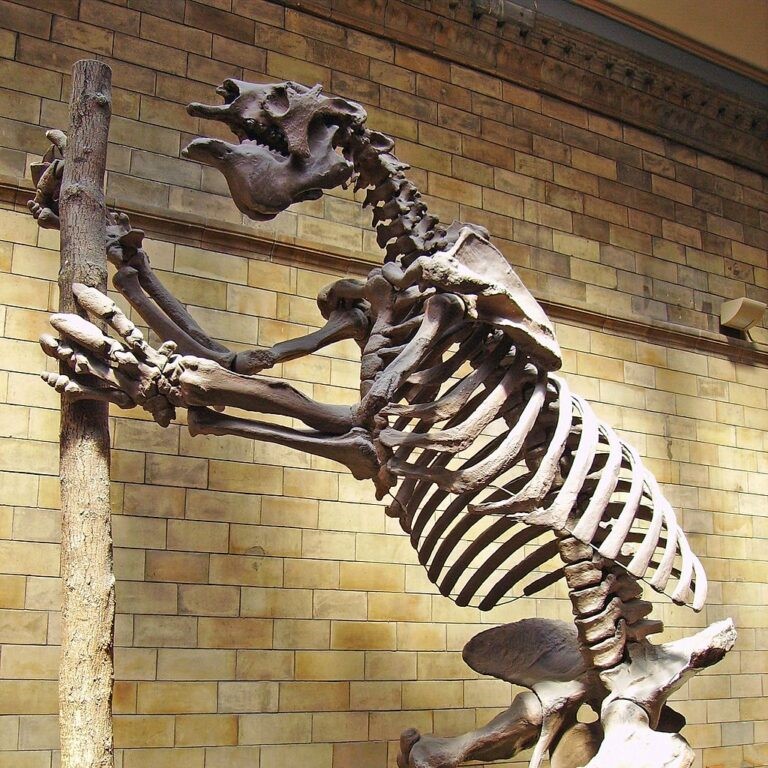
An Annals article and lecture given by Samuel L. Mitchill in 1823 presented paleolithic research suggesting that the territory of the Megatherium americanum may have extended farther north than scientists had previously thought.
Published November 28, 2023
By Nick Fetty
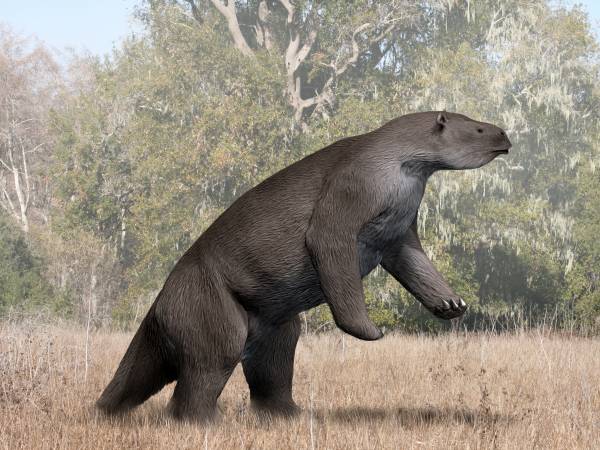
Image by Nobu Tamura. Licensed via CC BY-SA 4.0.
No changes were made to the original work.
Massive sloth-like creatures may have been roaming the land that we now call the United States during the Pleistocene Epoch (between 2.6 million and 11,700 years ago), according to research presented by The New York Academy of Sciences’ first president two hundred years ago this month.
Samuel L. Mitchell, a prominent physician, scientist, politician, and founding member of the Academy (then known as the “Lyceum of Natural History in the City of New York”) gave a talk at the Lyceum on November 17, 1823, entitled “Observations on the teeth of the MEGATHERIUM recently discovered in the United States.”
This was followed by an article by the same name published in the inaugural issue of Annals of the New York Academy of Sciences in 1824. The article and lecture covered findings from Mitchell’s paleolithic research which suggested that the territory of the Megatherium (Megatherium americanum), a now-extinct species of giant ground sloth, may have extended farther north than scientists previously thought. This marked the first such recorded discovery north of the equator.
A Noteworthy Discovery
Mitchell received a set of fossil teeth that were discovered on Skidaway Island, just south of Savannah, Georgia. Mitchell noted that the teeth marked a noteworthy scientific discovery at that time, but bones that were discovered alongside the teeth were not able to be studied because of improper handling.
“These teeth are very remarkable, and differ much from any hitherto discovered in North America,” Mitchell wrote, adding “…there can be no doubt that the teeth in question belong to that extinct species, [known as] the Megaterium.”
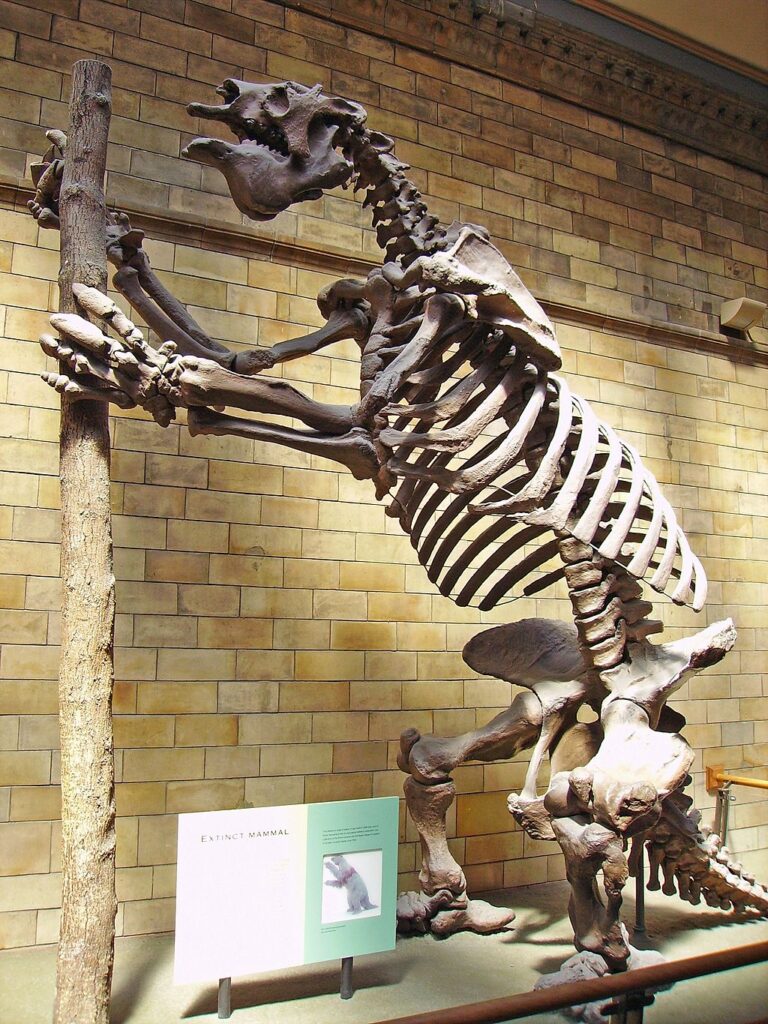
Photo by Ballista.
Licensed via CC BY-SA 3.0 DEED.
No changes were made to the original work.
Built Upon Previous Findings
This discovery built upon similar findings from the late 18th century (about fifty years prior) when a near-perfect skeleton of the Megaterium was discovered near Buenos Aires, Argentina. Years later, another specimen was discovered in Paraguay. The full skeleton was on display at the Royal Cabinet of Madrid (Spain) at the time Mitchell published his findings. Charles Darwin, another prominent member in the early history of the Lyceum, would go on to discover remains from another Megatherium in Argentina between 1832 and 1833.
The Megatherium was described as similar in size to a rhinoceros or elephant. Biologically, the furry creature occupied a space between a sloth (Bradypus Lin.) and an ant eater (Myrmecophaga Lin.), though it shared more characteristics with the former. Based on the form of the teeth and the structure of the claws, researchers hypothesized that the creature subsisted on vegetables, predominately roots.
5 1/2 Inches in Length
Mitchell described the fossils in his possession as “one tooth entire, with the exception of the fang which is broken transversely off, and the half of another, with the fang separated.” Each sample was square in shape, with rounded edges. Their approximate length of five and a half inches matched the description provided by previous researchers, indicating to Mitchell that these teeth were, in fact, likely those of a Megatherium. The teeth were black in color and the cutting edges were well-worn, indicating the animal’s likely advanced age at the time of its demise.
Mitchell, who arranged the Lyceum’s first formal meeting in 1817, concluded his paper by reemphasizing the importance of this discovery within the context of the natural history of the United States.
“Although, from the circumstances previously mentioned, it is hardly possible that a complete skeleton will be found, yet enough has been discovered to satisfy us, that the United States, which contains so many relics of huge animals, may add to her ‘giant brood,’ the Megatherium.”
About Annals

Overview
Journal Citation Reports® Science Edition (Clarivate Analytics, 2022) Impact Factor: 5.2
ISI Journal Citation Reports© Ranking 2022: 17/73 (Multidisciplinary Sciences)
Annals of the New York Academy of Sciences is an international science journal published monthly in many areas of science, though predominantly the biological sciences. Each issue presents original research articles and/or commissioned reviews, commentaries, and perspectives. Articles published online before print can be found here. In 2022, Ann NY Acad Sci began publishing a new front-half section of essays, book reviews/excerpts, commentaries, and perspectives in the spirit of The New York Academy of Sciences’ venerable general science magazine The Sciences (published 1960-2001). Ann NY Acad Sci is a hybrid (open access–subscription) journal available in 80+ countries worldwide, rigorously peer-reviewed, and ranked among the top multidisciplinary journals worldwide. Current journal metrics can be found here.
Aims and Scope
Published on behalf of The New York Academy of Sciences, Ann NY Acad Sci provides multidisciplinary perspectives on research of current scientific interest with far-reaching implications for the wider scientific community and society at large. Each issue assembles top research and ideas by contributors to various fields of investigation at times of emerging developments and the possibility of new insight. Ann NY Acad Sci issues stimulate new ways to think about science by providing a neutral forum for discourse—within and across institutions and fields. Learn more about our aims and scope here.
Related Links
- Annals of the New York Academy of Sciences on the Wiley online content platform
- Author guidelines
- Request permission to use published material
Editorial Staff & Contact Information
Douglas Braaten, PhD, EMBA
Chief Scientific Officer
Editor-in-Chief
dbraaten@nyas.org
Patrick C.H. Lo, PhD
Senior Scientific Editor
plo@nyas.org
Benjamin Ragen, PhD
Senior Scientific Editor
bragen@nyas.org
Liang Dong, PhD
Senior Scientific Editor
ldong@nyas.org
Contact Information
Annals of the New York Academy of Sciences
New York, NY
annals@nyas.org
212-298-8634
Access & Ordering
Full text articles are available online through the Wiley online content platform, and subscribing libraries, and on a pay-per-view basis to others. Tables of contents and abstracts may be viewed by all.
Member Orders & Discounts
- All Academy Members receive free unlimited digital access to Annals of the New York Academy of Sciences. To explore Ann NY Acad Sci online, first log in via the Account page, then browse through the online catalog to find volumes and/or individual papers of interest to you
- Ann NY Acad Sci volumes dating to 1823 have been digitized to provide an online archive available through institutions that have purchased access and to Academy members with Annals benefits who have logged in on The New York Academy of Sciences Web site.
- Ann NY Acad Sci volumes are available in print format at a special discounted price for Members. To order, log in via the Account page, select the volume of your choice from the online catalog, then click the PURCHASE button associated with the volume(s) you wish to order.
- Ann NY Acad Sci is published by Wiley. Academy Members may order any book offered on the Wiley bookstore at 25% off the list price.
Non-Member Orders & institutional subscriptions
Inquiries for institutional print and/or online access to Annals should be made directly through Wiley.
The previous year volumes or a single-issue purchase may be available from Wiley, subject to stock availability. To request a quotation for back issues please contact Wiley Help and Support with the journal, volume, issue, and mailing address details.
Earlier volumes can be purchased from Periodicals Service Company.
For bulk sales of volumes and/or commercial reprints of individual articles, please contact:
Douglas Braaten, PhD, EMBA
dbraaten@nyas.org
Bat Biology and Ecology
Annals of the New York Academy of Sciences has a long and rich history of publishing papers on bat research. With guest editor Sonja Vernes (University of St. Andrews), we are growing this collection which will include all of our bat-related papers that consist of a wide range of topics including echolocation, ecology, flight mechanics, social behavior, immunology, physiology, and more. This collection will not only expand our knowledge on bat biology and ecology, but also give insight into human health and conservation methods.
See https://nyaspubs.onlinelibrary.wiley.com/doi/toc/10.1111/(ISSN)1749-6632.bat-biology-ecology.
Annals Virtual Issues
Annals Virtual Issues
New in Annals
October 01, 2026 ·
Structure of Musical Dislikes: Findings From Multiple Genres and Countries
Contributors: Julia Merrill| Klaus Frieler| Amanda E. Krause|
Read More
September 24, 2026 ·
Dynamic Adaptation Responses to Auditory Perturbations During Walking in Multiple Sclerosis With Progressive Subtypes
Contributors: Lousin Moumdjian| Joeri R. Verbiest| Nele Vanbilsen| Bart Moens| Mattia Rosso| Daphne Kos| Bart Van Wijmeersch| Peter Feys|
Read More
September 24, 2026 ·
Initial Evidence of Mathematics Interpretation Bias Intervention Effects on College Students’ Mathematics Anxiety
Contributors: Connie Barroso| Xiaotong Yi| Zhe Wang|
Read More
September 22, 2026 ·
A Theory of Planned Behavior–Based Cluster Randomized Trial to Improve Health Literacy Among Rural Adults in China
Contributors: Ran Dai| Dingjie Zhou| Xue Wan| Xiaoxuan Xu| Wenhui He| Xiaoxu Guo| Hongyan Tang| Hua You|
Read More
September 22, 2026 ·
Infant Imitation and Rhythmic Movement in Response to Music and Speech
Contributors: Haley E. Kragness|
Read More From the Blog
Annals
NOT A REAL PAGE – ONLY A FORWARD TO “NEW IN ANNALS” – PM
Biology of Social Behavior
This collection of papers explores the biological underpinnings of social behavior through a series of experiments, reviews, and perspectives. These papers include a wide range of species ranging from ants to monkeys and analyzes the biology of social behavior in relation to their epigenetic, ecological, evolutionary, and neuromolecular mechanisms and influences. The novel experimental findings, timely reviews, and unique perspectives will provide important contributions to advance the field of the biology of social behavior. The virtual issue is edited by Karen L. Bales (University of California, Davis) and Sara M. Freeman (Utah State University).
See https://nyaspubs.onlinelibrary.wiley.com/doi/toc/10.1111/(ISSN)1749-6632.biology-of-social-behavior.
Cooley’s Anemia
The papers in this virtual issue were invited from speakers of the Eleventh Cooley’s Anemia Symposium, held at the New York Academy of Sciences on October 17-20, 2022. The symposium brought together basic scientists, clinical investigators, and clinicians to review and discuss recent research for thalassemia syndromes. Several previous Annals issues have presented papers from past Cooley’s Anemia Symposia, all in collaboration with the New York Academy of Sciences.
See https://nyaspubs.onlinelibrary.wiley.com/doi/toc/10.1111/(ISSN)1749-6632.cooleys-anemia.
Adolescent Women Nutrition in Colombia and Vietnam
Adolescent and young women face grave nutritional challenges, but limited evidence exists on solutions to improve their diets. Supported by Fondation Botnar, Action-Research was done over three years (2020-2022) in secondary cities of Colombia (Medellin) and Vietnam (Thai Nguyen) to identify nutrient deficits in the diets of adolescent and young women; elaborate food-based recommendations to improve their nutritional status using Optifood linear programming; and engage respondents in incorporating suggested recommendations in their diet using a social innovation challenge approach. This virtual issue reports the findings of this research.