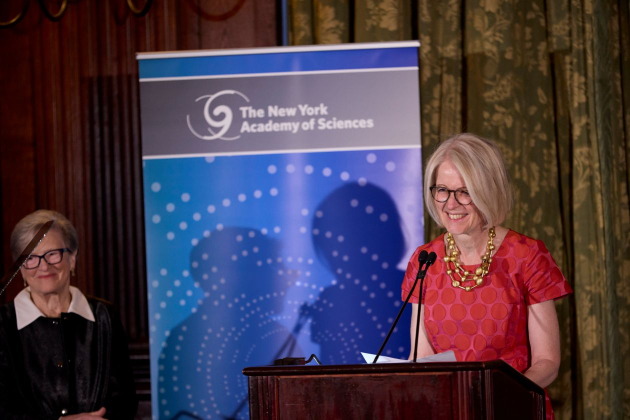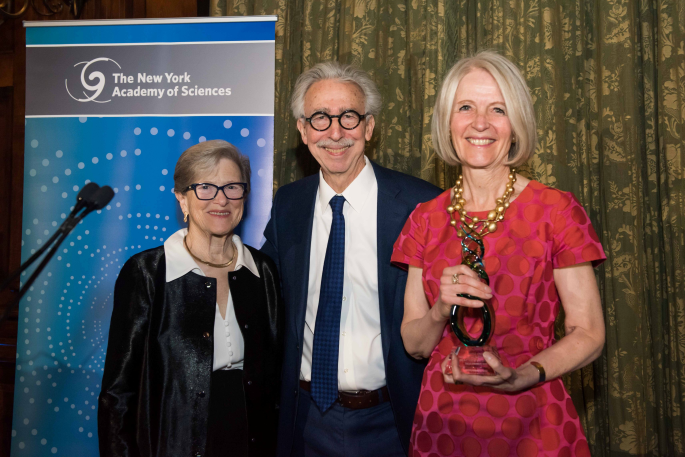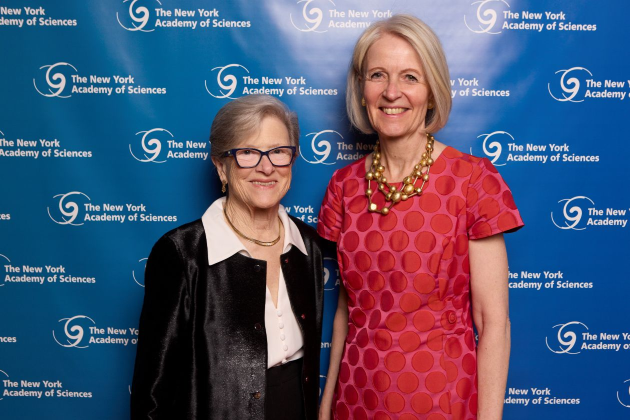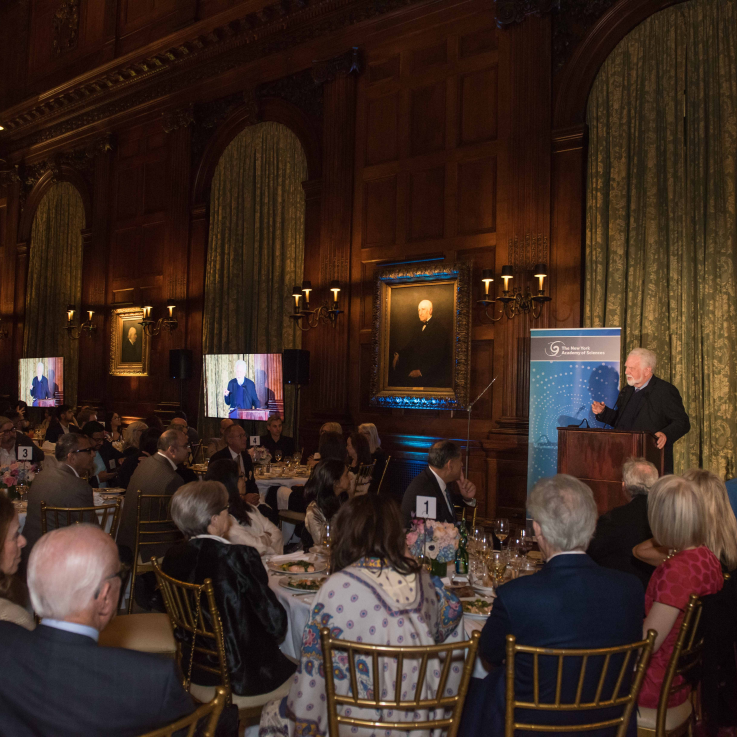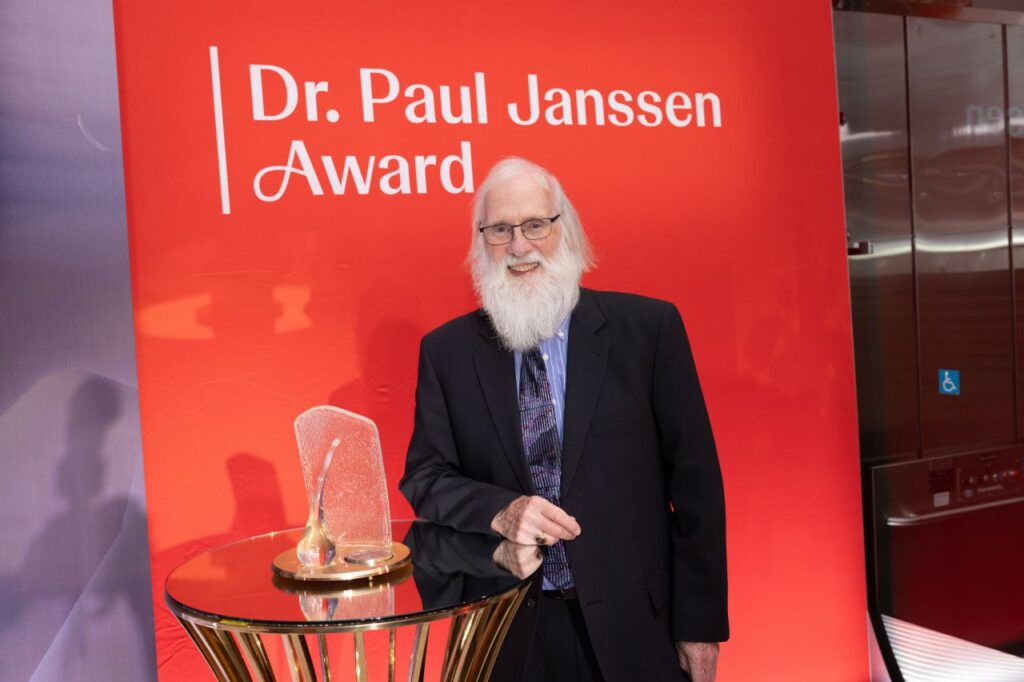
The New York Academy of Sciences is proud to recognize the Tata Sons Chairman as its most recent Life Governor.
Published December 5, 2025
By Nick Fetty
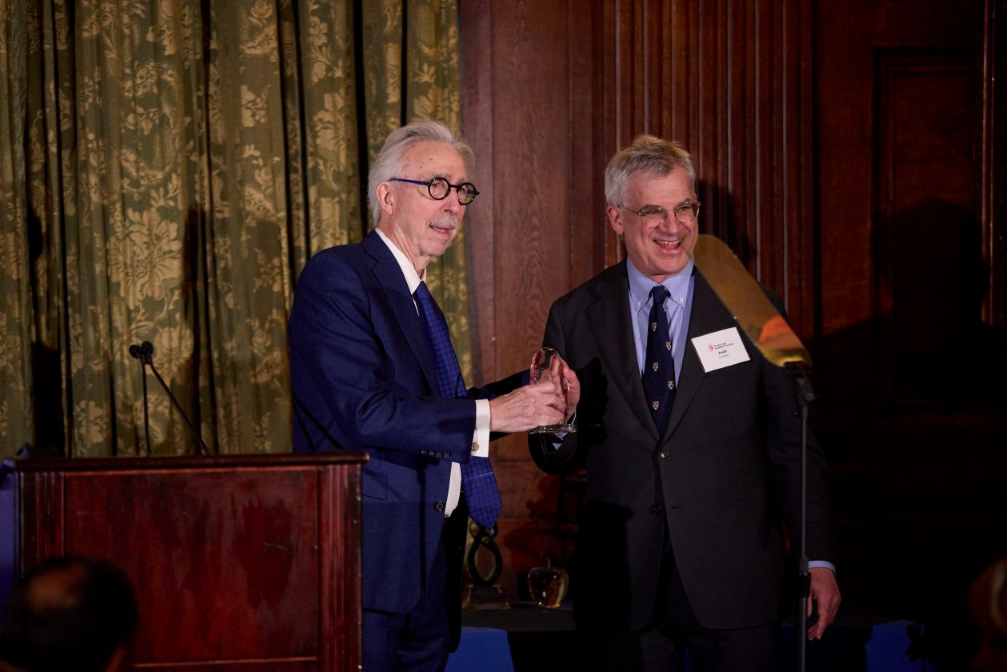
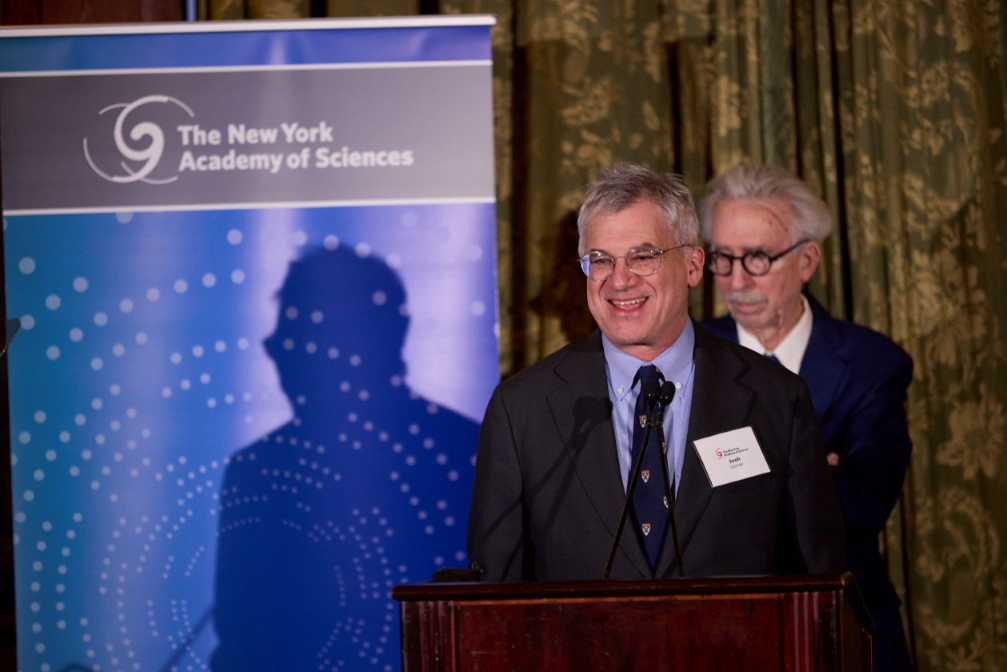
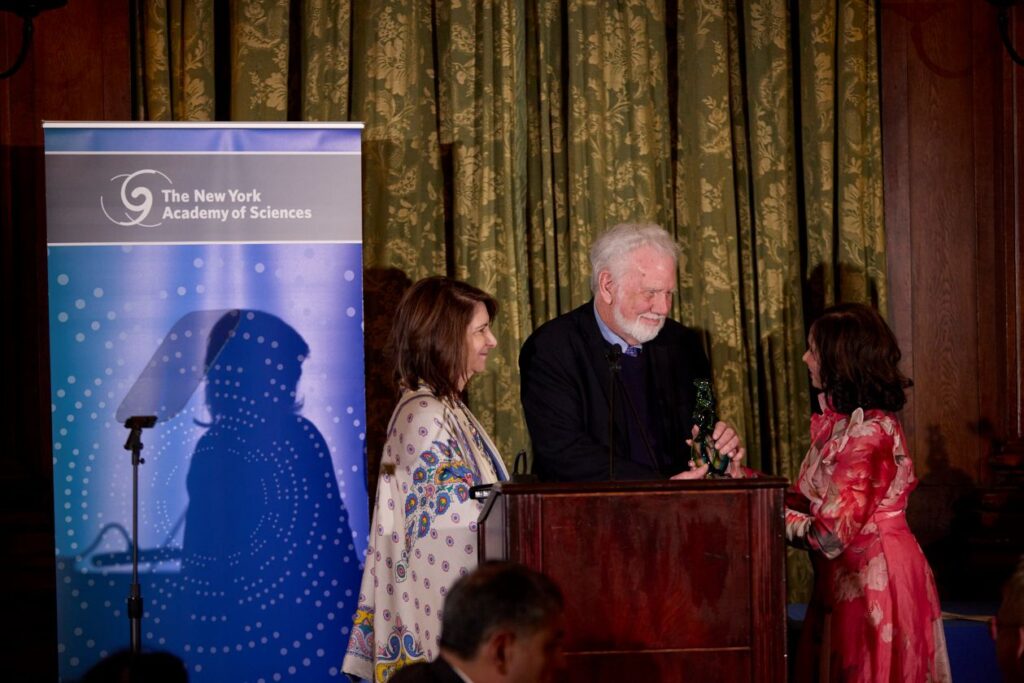
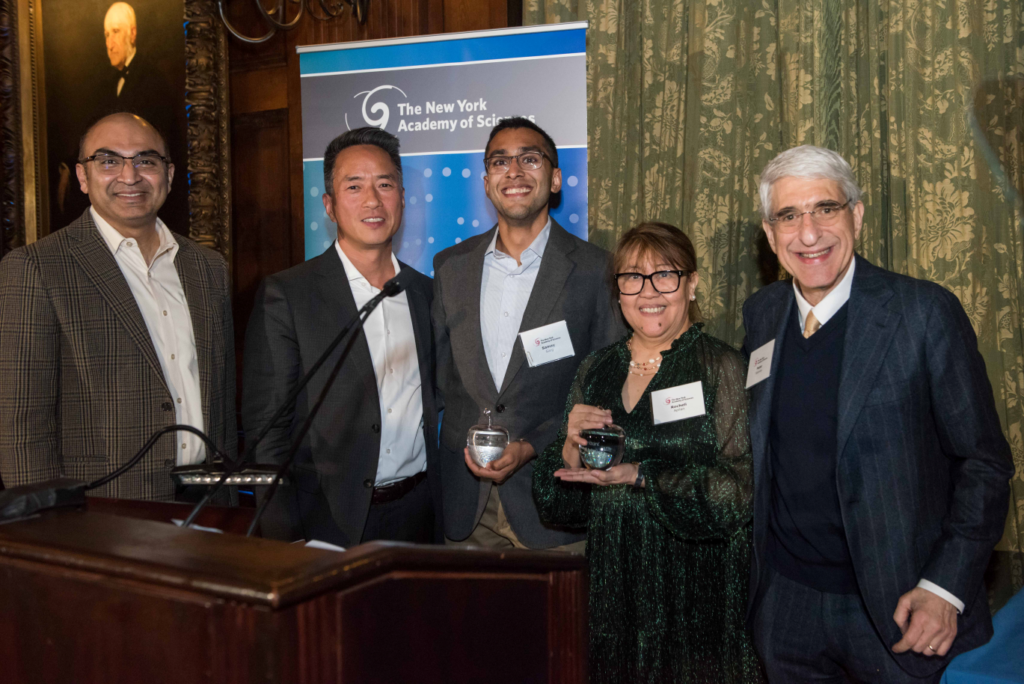
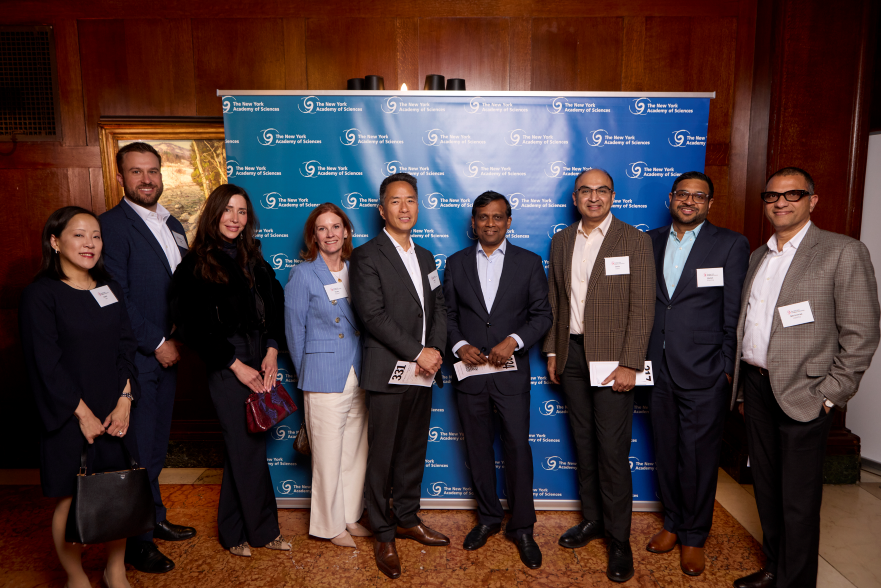
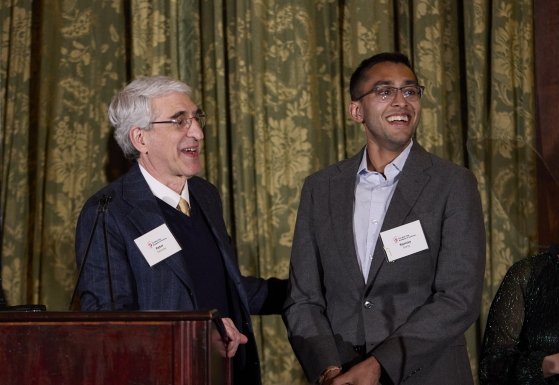
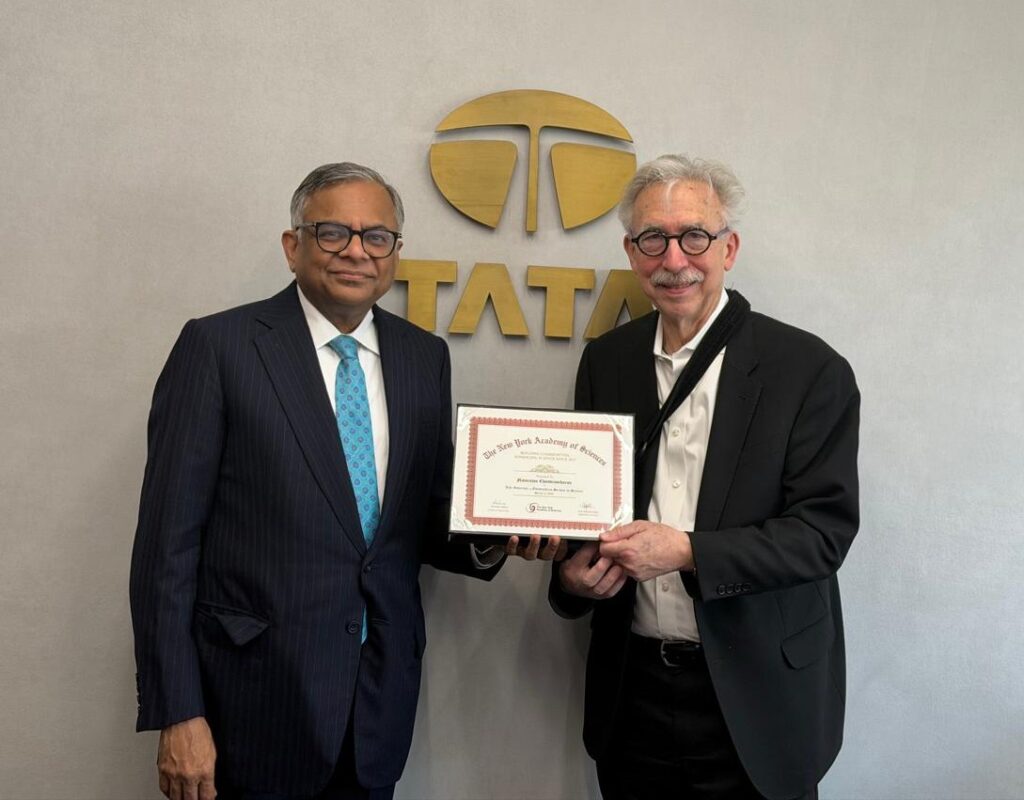
Nicholas B. Dirks (right), President and CEO of The New York Academy of Sciences, presents a Life Governor certificate to Natarajan Chandrasekaran, Chairman of Tata Sons, during the Tata Transformation Prize ceremony in India on Dec. 5.
Natarajan Chandrasekaran (Chandra), Chairman of India-based Tata Sons, joins a distinguished group of changemakers who serve as Life Governors for the Academy.
The Academy’s Board of Governors approved Chandra’s appointment earlier this year. He was presented with a certificate recognizing the honor by Academy President and CEO Nicholas B. Dirks during a ceremony in Mumbai, India on December 5.
Prior to his appointment as a Life Governor, Chandra served on the Academy’s Board of Governors where he lent his expertise to help guide the Academy on strategic and business matters. With more than three decades of science and leadership experience, he’s overseen revenues that have exceeded $100 billion across more than 100 Tata operating companies. He promotes the “One Tata” strategy, which focuses on themes like simplification, scale, synergy, and sustainability.
This recognition adds to a long list of accolades for Chandra which also include:
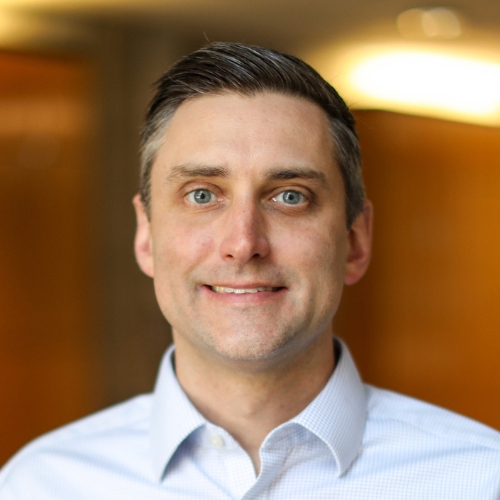
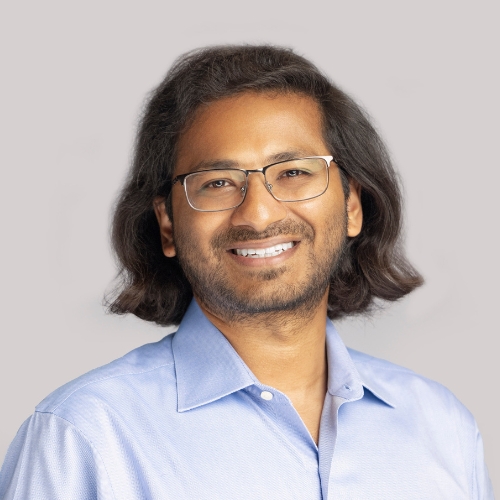
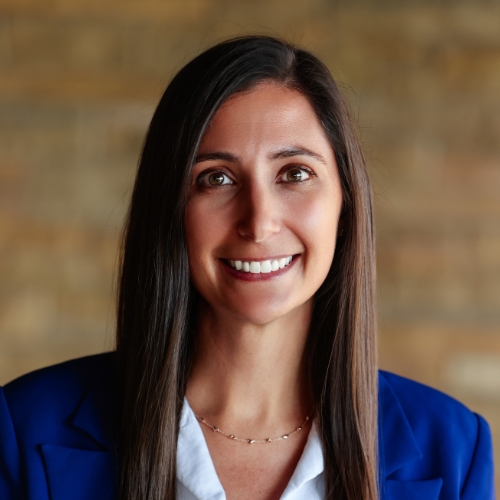
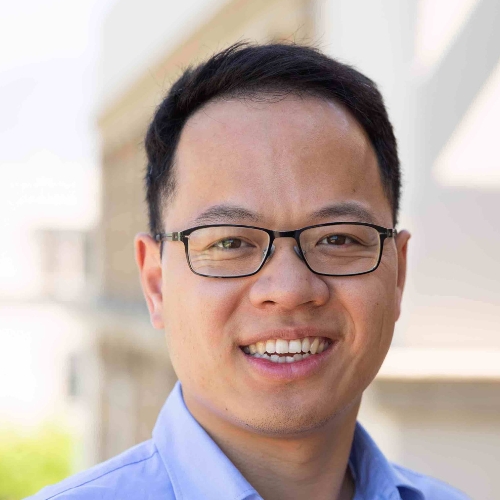
In collaboration with Tata Sons, the Academy launched the Tata Transformation Prize in 2023. The Prize recognizes and supports the implementation at scale of high-impact research that drives innovation in scientific disciplines of importance to India’s societal needs and economic competitiveness. Tata Sons also support the Academy’s Shaping Science podcast.
Learn more about the Tata Transformation Prize and check back for more updates from the 2025 ceremony!
From cancer-targeting nanorobots to sustainable biomanufacturing and climate-smart rice, this year’s Winners embody India’s transformational scientific spirit.
Mumbai, India | November 18, 2025 –The New York Academy of Sciences and Tata Sons today announced the Winners of the 2025 Tata Transformation Prize. Established to advance innovation and support visionary scientists in India developing breakthrough technologies to address India’s most significant societal challenges in Food Security, Sustainability, and Healthcare, the Tata Transformation Prize aims to generate improved quality-of-life outcomes and scale up the implementation of high-reward research for India and beyond.
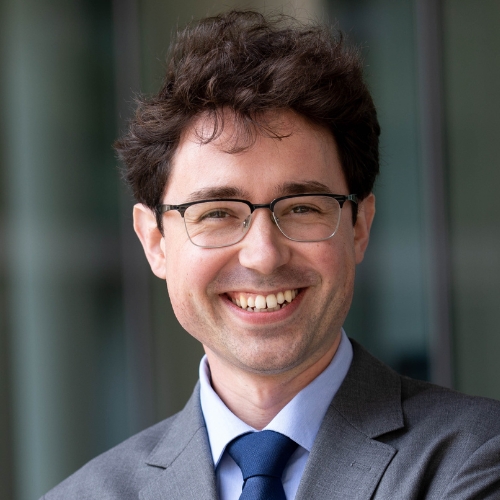
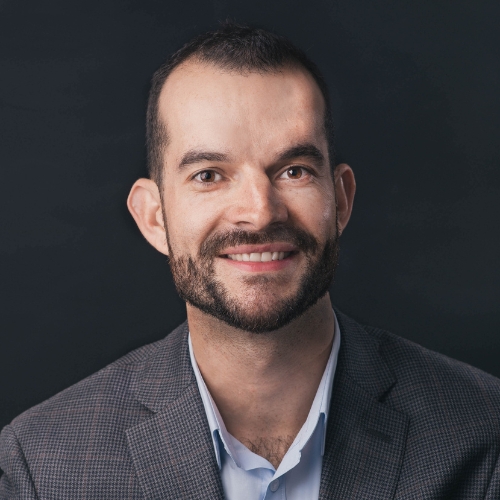
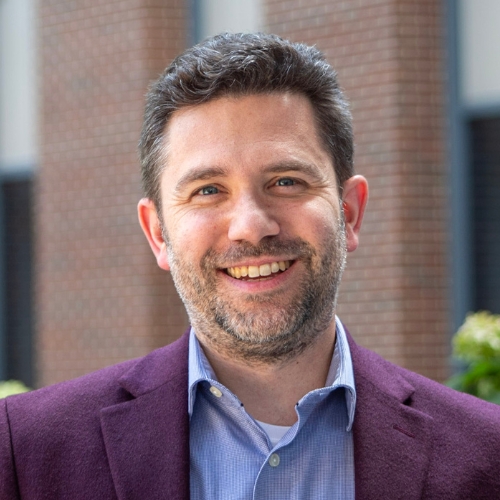
Selected from a competitive pool of 212 nominations spanning 27 Indian states, the three Winners were chosen by an international jury of eminent scientists, clinicians, technologists, and engineers. Each Winner will receive INR 2 crores (approximately USD 228,000) to advance their research and scale its real-world impact. The Winners will be celebrated at an awards ceremony in Mumbai in December 2025. The jury, consisting of experts from leading academic, industrial, and governmental institutions across India, the U.S., Europe, Asia, and Australia, included representatives from IBM Research, Biocon, the Bill & Melinda Gates Foundation, the University of Messina (Italy), Murdoch University (Australia), the Indian Institute of Management Bangalore, the National Institute of Advanced Studies, and the CSIR – Central Drug Research Institute.
Padubidri V. Shivaprasad, PhD, addresses one of India’s greatest challenges: feeding a population projected to reach 1.5 billion by 2050 amid shrinking farmland and worsening climate stress. His groundbreaking work uses epigenetic engineering and small RNA–based modifications in rice, India’s primary staple crop, to enhance stress tolerance and nutritional quality. By precisely altering the expression of key genes, Prof. Shivaprasad’s approach surpasses the limits of conventional plant breeding, which can be slow and unpredictable. His engineered rice varieties promise to reduce fertilizer and pesticide dependence, lower production costs, and improve nutrition for millions. Beyond India, this innovation offers a sustainable blueprint for staple crops worldwide in the face of global climate change.
India’s growing biomanufacturing sector urgently needs cleaner, cost-effective alternatives to traditional energy-intensive chemical synthesis methods. Balasubramanian Gopal, PhD, has developed a green chemistry platform that harnesses bioengineered E. coli bacteria to produce key chemicals used in pharmaceuticals, cosmetics, and agriculture. Integrating artificial intelligence with experimental biology, his lab rapidly designs efficient enzymes and optimizes microbial strains for high yields, without antibiotics or harmful additives. This sustainable technology can replace traditional chemical manufacturing, thus reducing pollution, enhancing domestic production, and positioning India as a global leader in environmentally responsible biomanufacturing.
Ambarish Ghosh, PhD, is pioneering a breakthrough in cancer treatment using magnetic nanorobots – tiny, helical devices that can be safely guided through the body using magnetic fields. These nanorobots are designed to navigate complex biological environments, deliver drugs directly to tumors, and distinguish cancerous tissue from healthy cells. His team is also creating real-time imaging tools to track and steer the nanorobots during treatment. This technology promises more precise, less invasive cancer therapies with fewer side effects, with the potential to revolutionize cancer care worldwide and make advanced treatments more accessible and affordable in India and other low- and middle-income countries.
“The scientific advancements achieved by this year’s winners—creating climate-resistant crops, sustainable bio-manufacturing, and targeting cancer with fewer side effects—are the result of years of dedication and sacrifice. Their work is significant for India, and for humanity at large,” said N. Chandrasekaran, Chairman of Tata Sons. “The Tata Group has long believed that science and technology pave the way for larger human progress, and we are proud to support this year’s winners in their endeavour to push the frontiers of excellence.”
“The Tata Transformation Prize celebrates scientific breakthroughs with the power to address pressing societal challenges while fostering economic progress and global impact. The 2025 Winners exemplify the power of Indian science to drive meaningful global change,” said Nicholas B. Dirks, President and CEO of The New York Academy of Sciences. “Their innovations span biology, engineering, and sustainability, reflecting the spirit of creativity and social purpose that this prize was designed to honour.”
About the Tata Transformation Prize
The Tata Transformation Prize was established in 2022 by Tata Sons, powered by The New York Academy of Sciences, to support breakthrough, innovative technologies that address India’s most significant challenges. By recognizing and supporting the implementation at scale of high-risk, high-reward research, the Prize will drive impactful innovation in scientific disciplines of importance to India’s societal needs and economic competitiveness. The Prize will leverage the exceptional potential of scientists in India to address critical national challenges in three categories—Food Security, Sustainability, and Healthcare—and generate improved life quality outcomes across India and beyond. The Tata Transformation Prize recognizes one Winner in each category, with INR 2 crores (approximately USD 228,000) for each Winner. Click here for more information about the Tata Transformation Prize.
About the Tata Group
Founded by Jamsetji Tata in 1868, the Tata Group is a global enterprise, headquartered in India, comprising 31 companies across multiple verticals. The group operates in more than 100 countries across six continents, with a mission ‘To improve the quality of life of the communities we serve globally, through long-term stakeholder value creation based on Leadership with Trust’.
Tata Sons is the principal investment holding company and promoter of Tata companies. Sixty-six percent of the equity share capital of Tata Sons is held by philanthropic trusts, which support education, health, livelihood generation and art and culture.
In 2024-25, the aggregate revenue of Tata companies was more than $180 billion. These companies collectively employ over 1 million people.
Each Tata company or enterprise operates independently under the guidance and supervision of its own board of directors. There are 26 publicly listed Tata companies with an aggregate market capitalisation of more than $328 billion as on March 31, 2025.
Three will be named Laureates and receive a $250,000 prize at a Gala Ceremony in New York City on October 7, 2025.
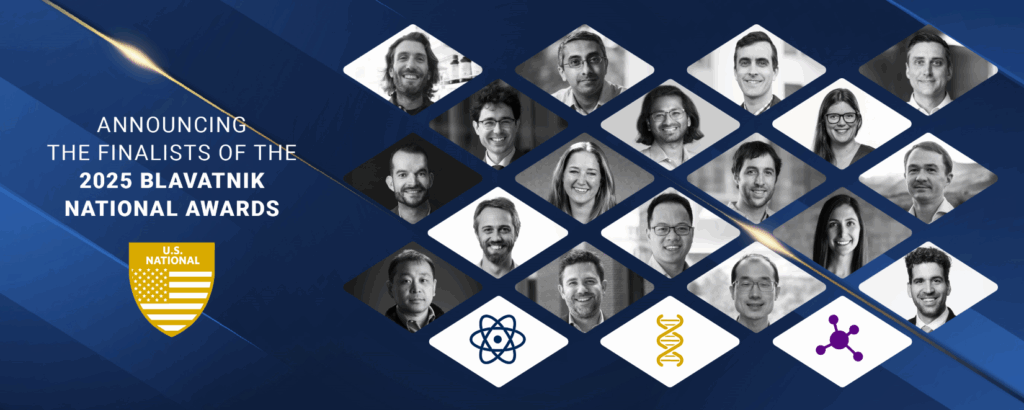
September 9, 2025 – New York – The Blavatnik Family Foundation and The New York Academy of Sciences today announced the Finalists for the 2025 Blavatnik National Awards for Young Scientists. The Awards recognize scientific advances made by researchers in the United States across the following disciplines: Life Sciences, Chemical Sciences, and Physical Sciences & Engineering.
Subra Suresh, ScD, Former Director of the National Science Foundation and current President of the Global Learning Council in Switzerland, will announce the three 2025 Laureates at an October 7th awards ceremony at the American Museum of Natural History.
Each Laureate will receive an unrestricted award of $250,000, the world’s largest unrestricted science prize, available for early-career scientists in the U.S. The remaining 15 Finalists will each receive $15,000.
An independent jury of expert scientists selected this year’s Finalists from a pool of 310 nominees representing 161 academic and research institutions across 42 U.S. states. The 2025 Finalists are:
LIFE SCIENCES
Daniele Canzio, PhD, University of California, San Francisco (Neuroscience) – Recognized for uncovering how 3D genome folding generates unique identities for neurons, revealing new principles of brain wiring, and advancing our understanding of neurodevelopmental disorders.
Kaiyu Guan, University of Illinois Urbana-Champaign (Agriculture & Animal Sciences) – Recognized for developing breakthrough technologies of remote sensing, modeling, and AI to drive sustainable farming, shape national policies, and power industry decarbonization in agriculture.
Philip J. Kranzusch, PhD,Dana-Farber Cancer Institute; Harvard Medical School (Microbiology) – Recognized for discovering that human innate immunity evolved from ancient pathways in bacteria, explaining the molecular basis for how human cells defend against infections and cancer.
Elizabeth Nance, PhD, University of Washington (Biomedical Engineering & Biotechnology) – Recognized for engineering nanoparticles for brain delivery, pioneering living brain tissue models, and defining design principles to develop targeted, safe therapies for newborn and pediatric brain injury.
Tomasz Nowakowski, PhD, University of California, San Francisco (Neuroscience) – Recognized for mapping how human brain cells grow and specialize during development, offering critical insights into early brain formation and the origins of neurological disease.
Samuel H. Sternberg, PhD, Columbia University/Howard Hughes Medical Institute (Molecular & Cellular Biology) – Recognized for discovering programmable, RNA-guided enzymes from mobile genetic elements and pioneering their use in genome editing, gene regulation, and synthetic biology across diverse organisms.
CHEMICAL SCIENCES
Song Lin, PhD, Cornell University (Organic Chemistry) – Recognized for advancing electrochemical techniques that enable efficient, sustainable synthesis of complex organic molecules, accelerating drug development, and materials innovation.
Joseph Cotruvo, Jr., PhD, The Pennsylvania State University (Biochemistry & Structural Biology) – Recognized for discovering and engineering proteins that selectively extract rare earth elements, enabling sustainable recycling and purification of metals critical to technology supply chains.
Frank Leibfarth, PhD, The University of North Carolina at Chapel Hill (Polymer Chemistry) – Recognized for pioneering approaches to upcycle plastic waste and remove toxic ‘forever chemicals’ from water by developing reactions and catalysts that selectively control the structure and function of polymers.
Ryan Lively, PhD, Georgia Institute of Technology (Chemical Engineering) – Recognized for pioneering scalable membrane and separation technologies that will reduce industrial carbon emissions and energy use, transforming carbon capture and chemical purification worldwide.
Leslie M. Schoop, PhD, Princeton University (Inorganic & Solid-State Chemistry) – Recognized for pioneering quantum materials discovery by linking chemical bonding to unique electronic and magnetic behaviors, enabling breakthroughs in energy-efficient electronics, data storage, and quantum technology.
Yogesh Surendranath, PhD, Massachusetts Institute of Technology (Inorganic & Solid-State Chemistry) – Recognized for pioneering molecular-level control of catalyst surfaces and electrostatic environments to revolutionize chemical reactions, enabling sustainable fuel production and significant reductions in carbon emissions.
PHYSICAL SCIENCES & ENGINEERING
Charlie Conroy, PhD, Harvard University (Astrophysics & Cosmology) – Recognized for advancing our understanding of the history of our galaxy’s formation, providing insight into how the Milky Way’s dark matter distribution is linked to its early history.
Nathaniel Craig, PhD, University of California, Santa Barbara (Theoretical Physics) – Recognized for deepening our understanding of what gives particles mass, and for paving the way forward for next-generation particle colliders.
Matthew McDowell, PhD, Georgia Institute of Technology (Materials Science & Nanotechnology) – Recognized for transformative developments in the understanding of solid-state battery internal interfaces, enabling key innovations and addressing challenges in their design.
Prateek Mittal, PhD, Princeton University (Computer Science) – Recognized for pioneering work powering the security and privacy of the internet, generating over 2.5 billion cryptographic certificates and securing more than 350 million websites.
Elaina J. Sutley, PhD, University of Kansas (Civil Engineering) – Recognized for comprehensive, systematic computer modeling and engineering to address disaster mitigation and recovery, informing building codes and disaster readiness policies across the country. This is the first year the Blavatnik Awards Finalists include a researcher from the University of Kansas.
Zhongwen Zhan, PhD, California Institute of Technology (Physical Earth Sciences) – Recognized for revolutionizing observational seismology through a unique utilization of fiber optic cables, enabling studies of tectonic, volcanic, glacial, and oceanic processes at unprecedented resolution.
Internationally recognized by the scientific community, the Blavatnik Awards for Young Scientists have been instrumental in expanding the engagement and recognition of young scientists and providing the support and encouragement needed to drive scientific innovation for the next generation. By the close of 2025, the Blavatnik Awards will have recognized over 500 scientists from 120 international research institutions and awarded prizes totaling nearly $20 million.
“The goal of the Blavatnik Awards is to recognize early-career scientists conducting bold and creative work, support their professional growth and development, and accelerate scientific discovery to improve lives and drive innovation,” said Len Blavatnik, Founder of Access Industries and Head of the Blavatnik Family Foundation.
Nicholas B. Dirks, President and CEO of The New York Academy of Sciences and Chair of the Awards’ Scientific Advisory Council, noted, “Congratulations to these 18 exceptional Finalists. From new tools and technologies for environmental sustainability and climate resiliency to novel therapies to cure disease and insights into the fundamental physics underpinning the world around us, their research is advancing science and protecting our planet.”
Since launching in 2014, scientists honored by the Blavatnik National Awards have received over $9 million in prize money.
Blavatnik scholars are driving economic growth globally by embarking on new scientific trajectories to pursue high-risk, high-reward scientific research. To date, Blavatnik Awards honorees have founded 50 companies after receiving the award, six of which are publicly traded and collectively valued at over $10 billion.
About the Blavatnik Awards for Young Scientists The Blavatnik Awards for Young Scientists, established by the Blavatnik Family Foundation in 2007 and independently administered by The New York Academy of Sciences, began by identifying outstanding post-doctoral scientists in New York, New Jersey and Connecticut. In 2014, the Blavatnik National Awards were created to recognize faculty-rank scientists throughout the United States. In 2017, the Awards were further expanded to honor faculty-rank scientists in the UK and Israel.
For updates about the Blavatnik Awards for Young Scientists, please visit blavatnikawards.org or follow us on X and Facebook @BlavatnikAwards.
About the Blavatnik Family Foundation The Blavatnik Family Foundation provides many of the world’s best researchers, scientists and future leaders with the support and funding needed to solve humankind’s greatest challenges. Led by Len Blavatnik, founder of Access Industries, the Foundation advances and promotes innovation, discovery and creativity to benefit the whole of society. Over the past decade, the Foundation has contributed over US$1.3 billion to more than 250 organizations. See more at blavatnikfoundation.org.
A former Blavatnik National Awards Laureate has paid it forward with a prize recognizing scientific excellence in his home country.
Published August 6, 2025
By Kamala Murthy
2014 Blavatnik National Awards Laureate, Marin Soljačić congratulates Pia Pilipović, winner of the 2025 Soljačić Prize. Credit: https://mzom.gov.hr/vijesti/7141
Massachusetts Institute of Technology physicist and 2014 Blavatnik National Awards Laureate Marin Soljačić established the Soljačić Prize in his home country of Croatia. He used part of his $250,000 unrestricted prize money from the Blavatnik Award to create a prize that recognizes exceptional Croatian high school graduates in mathematics and physics, awarding $5,000 annually to outstanding students.
“When I established this prize, there were few such award programs in Croatia, especially for young students – in the USA they are much more common,” said Prof. Soljačić. “The Blavatnik Awards and other prizes played an important, encouraging role in my growth as a scientist, and I wanted to establish something like that for Croatian students. I also wanted to inspire other institutions and individuals to establish similar prizes in Croatia.”
The 2025 Soljačić Prize was awarded to Pia Pilipović, a graduating student from the XV Gymnasium, a school in Zagreb. The school has now produced seven Soljačić winners in the 11-year history of the award. Soljačić is also a graduate of the XV Gymnasium.
Pia interviewed for Croatian Television. Credit: DNEVNIK.HR (Croatia)
Pia delivered extraordinary results on the Croatian national high‑school exit exams (državna matura). She scored a perfect score on the physics and mathematics (A‑level) exams, while also achieving 91.82 % in Croatian language and 85.5 % in English. Her flawless performance in the most complex quantitative subjects earned her the Soljačić Prize.
The prize was formally presented during an award ceremony held at the Ministry of Science, Education and Youth in Zagreb on July 29, 2025. Pia stood among other top graduates receiving various honors.
From left: Len Blavatnik, Founder of the Blavatnik Family Foundation; Marin Soljačić, 2014 Blavatnik National Awards Laureate; Rachel Wilson, 2014 Blavatnik National Awards Laureate; Adam Cohen, 2014 Blavatnik National Awards Laureate; and Ellis Rubinstein, President Emeritus of The New York Academy of Sciences.
The 2025 Blavatnik Science Symposium, hosted by The New York Academy of Sciences, convened an extraordinary group of past and present Blavatnik Awards for Young Scientists honorees for two days of cross-disciplinary exchange and forward-looking discussion on science with real-world impact.
Published July 28, 2025
By Kamala Murthy
A group photo of the attendees at the 2025 Blavatnik Science Symposium. Photo by Nick Fetty/The New York Academy of Sciences.
Held at the Academy on July 14–15, the event spotlighted pioneering research in neuroscience, quantum computing, genetics, AI, immunology, materials science, and sustainability while also serving as a vibrant forum for forging new scientific collaborations.
A Welcome Return to In-Person Dialogue
Opening the symposium, Academy President and CEO Nicholas B. Dirks reflected on the power of community:
“This symposium is more than just presentations — it’s a chance to connect across disciplines and geographies,” he said. “Many creative collaborations have had their beginnings right here, sparked by informal conversations over coffee or during meals, and continued well beyond these two days.”
Dirks underscored the remarkable achievements of the Blavatnik Awards community, which now includes more than 500 scientists from 120 institutions. Collectively, they have secured over 7,300 patents and launched more than 50 companies.
Exploring the Frontiers of Science
(Left to Right) Markita Landry (UC Berkeley) and Moran Shalev-Benami (Weizmann Institute). Photo by Nick Fetty/The New York Academy of Sciences.
The symposium’s first day began with Session I: Insights Engineered from the Molecular World, where Markita Landry (UC Berkeley) introduced nanoscale fluorescent sensors for real-time imaging of neurotransmitters. She was followed by Moran Shalev-Benami (Weizmann Institute), who unveiled a new type of light-sensing protein discovered in Antarctic algae. Speaking virtually, Nieng Yan (Tsinghua University and Shenzhen Bay Laboratory) presented groundbreaking research from her lab on sodium channels that has provided the structural blueprint for non-addictive, non-opioid pain therapies, such as the FDA-approved Journavx.
Session II: Building the Future: Materials for a Sustainable Planet featured keynote talks from two innovators in materials science. Yi Cui (Stanford University), founder of Amprius Technologies, discussed advances in lithium battery chemistry that could quadruple energy density. Geoffrey Coates (Cornell University) shared real-world case studies where polymer science led to startups addressing plastic recycling and green hydrogen production.
The Entangled Realities session panel (left to right) Shruti Puri (Yale), Danna Freedman (MIT), Vinod Vaikuntanathan (MIT), and Ana Maria Rey (CU Boulder) answer questions from the audience. Photo by Nick Fetty/The New York Academy of Sciences.
Quantum science took center stage in Session III: Entangled Realities: How Quantum Ideas Are Reshaping Science, beginning with Danna Freedman (MIT), who presented her work designing molecular qubits. Shruti Puri (Yale University) followed with insights into how entanglement enables quantum fault-tolerance. Vinod Vaikuntanathan (MIT) explored lattice-based cryptography designed to resist quantum attacks, and Ana Maria Rey (University of Colorado) examined how photon-mediated atomic interactions can power next-generation quantum sensors.
In Session IV: Evolutionary Code Underlying Immunity and Inheritance, Harmit Malik (Fred Hutchinson Cancer Center /HHMI) explained how evolutionary “scars” reveal key antiviral defense mechanisms. Sohini Ramachandran (Brown University) addressed the ethical misuse of genetic research and advocated for emphasizing human genetic diversity. Ruslan Medzhitov (Yale/HHMI) offered an evolutionary lens to reframe our understanding of allergies.
A Community of Change-Makers
Day 2 opened with remarks from Sonya Dougal the Academy’s Senior Vice President of Awards & Scientific Programs, who spoke to the lasting connections fostered through the Blavatnik Awards:
“When you become a Blavatnik honoree, you become part of this distinguished and enduring community,” she said. “The ideas celebrated here often gain traction well beyond the lab, attracting investors, crossing into the commercial realm, and generating meaningful societal impact.”
Innovations Across the Brain, AI, and Planetary Science
The “Beyond the Breakthrough: Translating Innovation into Real-World Impact” panel (Left to Right) Edward Chang (UCSF), Viviana Gradinaru (Caltech), Yi Cui (Stanford University), Geoffrey Coates (Cornell University), and Chris Bregler (Google DeepMind). Photo by Nick Fetty/The New York Academy of Sciences.
Session V: Tuning the Brain with Microbes, Molecules, and Machines kicked off the second day’s talks. Edward Chang (UCSF), renowned for developing a brain implant that enabled a paralyzed man to speak, presented new work decoding the neural code of speech. Christoph Thaiss (Stanford/Arc Institute) examined how the brain integrates signals from both the body and the external environment. Viviana Gradinaru (Caltech) shared her lab’s decade-long efforts to engineer viral vectors that cross the blood-brain barrier—a technology now moving into human trials via her company, Capsida Biotherapeutics.
Keynote speaker Chris Bregler (Google DeepMind), a pioneer in AI-generated media and Academy Award winner for visual effects, reflected on the promises and perils of deepfakes. He then moderated a panel, Beyond the Breakthrough: Translating Innovation into Real-World Impact, featuring Edward Chang, Geoffrey Coates, Yi Cui, and Viviana Gradinaru. The panelists shared candid reflections on launching startups, consulting with venture capitalists, and turning research breakthroughs into scalable tools and treatments.
The final session, Observing the Universe: From Earth to the Stars, expanded the symposium’s view to planetary and environmental systems. Kaiyu Guan (University of Illinois at Urbana-Champaign) described how AI and satellite imaging are transforming agriculture and enabling the decarbonization of global supply chains. Rebecca Oppenheimer (American Museum of Natural History) highlighted recent discoveries of new, exotic extrasolar planetary systems. Britney Schmidt (Cornell University) detailed her team’s research in Greenland, where they used under-ice robotics to investigate how subglacial outflows are accelerating ice loss and ultimately influencing marine ecosystems.
Britney Schmidt (Cornell University) discusses her under-ice robot, ICEFIN, in Greenland’s Glacier ice. Photo by Nick Fetty/The New York Academy of Sciences.Sohini Ramachandran (Brown University) presents on human genetic diversity. Photo by Nick Fetty/The New York Academy of Sciences. Ruslan Medzhitov (Yale/HHMI) talks about why we suffer from allergies. Photo by Nick Fetty/The New York Academy of Sciences.Edward Chang (UCSF) speaks about the development of his neuroprosthesis that has enabled paralyzed individuals to communicate through an AI interface. Photo by Nick Fetty/The New York Academy of Sciences.Chris Bregler (Google DeepMind) speaks about AI and motion tracking technologies. Photo by Nick Fetty/The New York Academy of Sciences.
Highlights from the 2025 Blavatnik Awards for Young Scientists in Israel.
Published June 13, 2025
By Kamala Murthy
Against the backdrop of the Mediterranean Sea and the luminous Peres Center for Peace and Innovation in Tel Aviv, Israel, over one hundred preeminent scientific researchers, dignitaries, academics, business leaders, and supporters gathered on June 4, 2025, for an unforgettable evening honoring the future of science in Israel. The 2025 Blavatnik Awards for Young Scientists in Israel recognized three of the country’s most promising early-career researchers in the fields of Life Sciences, Chemical Sciences, and Physical Sciences & Engineering.
Now in its eighth year, the Blavatnik Awards in Israel ceremony was both a celebration of scientific discovery and a tribute to resilience. As the sun set over Jaffa and guests moved from the reception to the dinner ceremony, Israeli TV anchor Hila Korach, serving as the evening’s presenter, opened the event with a moving acknowledgment of the October 7th attacks and the remaining captivity of 58 Israeli hostages. The resilient spirit of the evening underscored a powerful message: even in the face of geopolitical hardship in the region, science continues to forge ahead as a force for good.
Welcoming the Laureates and Their Institutions with Fanfare
As trumpeters heralded the opening of the ceremony, flag bearers representing ten of Israel’s premier academic institutions led a procession onto the main stage, followed by this year’s three Laureates. These three outstanding scientists were selected from among 36 top nominees from universities and research institutions across Israel. The following scientists were recognized as Laureates at the ceremony, where they received medals and presented a captivating overview of their groundbreaking research:
Professor Yonatan Stelzer (Weizmann Institute of Science) – Life Sciences
Dr. Benjamin Palmer (Ben-Gurion University of the Negev) – Chemical Sciences
Professor Chaim Garfinkel (Hebrew University of Jerusalem) – Physical Sciences & Engineering
“Laureates, we know you will triumph! We believe in you!”
The flag procession was followed by a dramatic vocal performance of the song “Believer” sung by a youth ensemble from the Artik Music School. The musical performance was designed to inspire guests to be believers in science, with resilience being the key to success.
Science, Hope, and Prosperity
The Blavatnik Award’s two administrative partners underscored the program’s mission to empower young scientists at a pivotal point in their careers when recognition and support can significantly impact their lives as scientists. In his heartfelt remarks, Professor David Harel, President of the Israel Academy of Sciences and Humanities, emphasized the urgent need to protect the freedom and integrity of academic inquiry in science, particularly in politically and culturally challenging times. Nicholas Dirks, President & CEO of The New York Academy of Sciences, spoke to the 18-year success story of the Blavatnik Awards, leading it to become one of the most prestigious international science prizes for early-career scientists. Dirks also emphasized how the Blavatnik Awards have helped drive economic prosperity, turning $20 million in collective prize money into $2.4 billion in market capitalization, with over 50 companies founded by past Blavatnik Scholars, including six companies that are publicly traded.
A recorded message from Israel’s President Isaac Herzog served as a reminder that the Blavatnik Awards in Israel are in addition to being a tribute to three brilliant scientists from Israeli institutions are also a declaration of unwavering faith in science as a beacon of light in turbulent times. Herzog quoted Israel’s first President, Chaim Weizmann: “I trust and feel sure in my heart that science will bring to this land both peace and a renewal of its youth.” A moving performance by Israeli musical icon Aviv Geffen further added to the evening’s theme of hope and determination, echoing the national longing for unity, peace, and progress.
Israel’s Scientific Excellence on Display
Life Sciences Laureate, Yonatan Stelzer, PhD, from the Weizmann Institute of Science transported the audience into the remarkable world of embryonic development. His lab’s pioneering models of mammalian cell differentiation offer profound insight into how identical cells diversify into complex organisms—knowledge that holds transformative potential for regenerative medicine.
Physical Sciences & Engineering Laureate, Chaim Garfinkel, PhD, from the Hebrew University in Jerusalem, followed with a dynamic exploration of climate modeling. He illuminated the atmospheric mechanisms that influence extreme weather events and detailed how improving prediction models can save lives and guide global climate policy.
Finally, Chemical Sciences Laureate, Benjamin Palmer, PhD, from Ben-Gurion University in the Negev, captivated attendees with a dazzling look into organic biomineralization. Studying how creatures like shrimp and plankton create reflective crystals, his lab is revealing new paths to develop sustainable optical materials that may one day replace conventional, toxic alternatives like titanium dioxide.
A Toast to Science and the Future
The evening concluded with a celebratory toast as the Laureates joined Professors Harel and Dirks on stage. Guests lifted their glasses with a collective “L’chaim!” — to science, to knowledge, and to a better future for the region.
The day prior, the 2025 Laureates presented their research at a public symposium held at the Israel Academy of Sciences and Humanities in Jerusalem. 2019 Blavatnik Awards in Israel Laureate Professor Michal Rivlin from the Weizmann Institute delivered the opening symposium lecture. Among the attendees were members of the public and STEM high school students from several regional high schools near Jerusalem.
The 2025 Blavatnik Awards ceremony venue overlooking the Mediterranean Sea.From left: 2025 Blavatnik Awards Israel Laureates: Benjamin Palmer, Yonatan Stelzer, Chaim Garfinkel.From left: Peter Thoren of the Blavatnik Family Foundation; British Economist and Author Noreena Hertz with spouse Danny Cohen of Access Industries; Avi Fischer of Clal Industries.From left: Lisa Shields of Access Industries with Sonya Dougal from The New York Academy of Sciences.President of the Israel Academy of Sciences and Humanities, Professor David Harel.Yonatan Stelzer, Life Sciences Laureate, speaking about his research in embryonic development and epigenetics.Life Sciences Laureate, Benjamin Palmer describes the process of organic biomineralization.Chaim Garfinkel, Physical Sciences & Engineering Laureate gives his talk on climate modeling.L’Chaim, a toast to science! After the Blavatnik Awards Symposium at the Israel Academy of Sciences and Humanities.
Yonatan Stelzer, PhD (Life Sciences) – Weizmann Institute of Science – Recognized for breakthroughs in modeling the intricate process of mammalian embryonic development and for advancing our understanding of epigenetics, holding significant promise for regenerative and therapeutic medicine.
Benjamin Palmer, PhD (Chemical Sciences) – Ben-Gurion University of the Negev – Recognized for pioneering research on how organisms create crystals, revealing the biological processes underlying their formation and the unique ways they interact with light, leading to the emerging field of organic biomineralization and inspiring sustainable optical materials.
Chaim Garfinkel, PhD (Physical Sciences & Engineering) – The Hebrew University of Jerusalem – Recognized for advancing our ability to predict climate change on timescales from months to decades, improving weather forecast systems and providing critical insights for climate policy and adaptation strategies.
The Blavatnik Awards recognize outstanding, innovative scientists at the early stages of their careers for their extraordinary achievements as well as their potential for future discoveries. The prizes are awarded to researchers aged 42 and younger for groundbreaking work in Life Sciences, Chemical Sciences, and Physical Sciences & Engineering.
The 2025 Blavatnik Awards for Young Scientists in Israel will be conferred at a ceremony in June 2025 at the Peres Center for Peace & Innovation in Tel Aviv-Jaffa.
The Blavatnik Awards for Young Scientists are the largest unrestricted prizes available to scientists in Israel aged 42 or younger. Since launching in 2017, scientists honored by the Blavatnik Awards in Israel have received US$2.7 million in prize money. Internationally recognized by the scientific community, the Blavatnik Awards for Young Scientists are instrumental in expanding the engagement and recognition of young scientists and providing the support and encouragement needed to drive scientific innovation for the next generation. By the close of 2025, the Blavatnik Awards will have recognized 540 scientists from 120 international research institutions and awarded prizes totaling nearly $20 million.
“The brilliant, young minds we honor with these awards are examples of the enormous ingenuity and creativity that has made Israel a powerhouse of scientific progress,” said Len Blavatnik, Founder of Access Industries and Head of the Blavatnik Family Foundation. “We are proud to celebrate their achievements and to support their continued success.”
ProfessorNicholas B. Dirks, President and CEO of The New York Academy of Sciences, said, “We are excited to see international representation in this year’s Laureates with our first Blavatnik Awards Israel Laureate from the UK. This international dimension highlights the global nature of scientific pursuit and collaboration in highly promising and vitally important interdisciplinary fields including epigenetics, biomineralization, and atmospheric science.”
Professor David Harel, President of The Israel Academy of Sciences and Humanities said, “Today we honor the exceptional achievements of Israel’s very best scientists. This is especially important at the present time, with Israel going through one of its worst periods, exacerbated by unprecedented obstacles for science, both here in Israel and in the US. In this light, we are even more grateful to the Blavatnik Family Foundation and The New York Academy of Sciences for our continued partnership in this endeavor. Maintaining Israel’s position at the forefront of global science, which is crucial for its security and economic stability, relies upon supporting and encouraging its scientists. We are proud to honor this year’s Blavatnik Awards Laureates, and we celebrate their innovative breakthroughs with confidence in the far-reaching, positive impact of their achievements on society at large.”
During the nomination period for the 2025 Blavatnik Awards, 36 nominations were received from seven universities across Israel. Members of the Awards’ Scientific Advisory Council – which includes Nobel Laureates Professors Aaron Ciechanover, David Gross and Sir Richard Roberts, along with former Chairman of the Israel Space Agency, Professor Isaac Ben-Israel – were also invited to submit nominations. Three juries, composed of distinguished leading scientists representing the three disciplinary categories and led by Israel Academy members, selected the 2025 Laureates.
Blavatnik scholars are driving economic growth globally by embarking on new scientific trajectories to pursue high-risk, high-reward scientific research. To date, Blavatnik Awards honorees have founded 50 companies after receiving the award, six of which are publicly traded and collectively valued at over $12 billion.
About the Blavatnik Awards for Young Scientists
The Blavatnik Awards for Young Scientists, established by the Blavatnik Family Foundation in 2007 and independently administered by The New York Academy of Sciences, began by identifying outstanding post-doctoral scientists in New York, New Jersey and Connecticut. In 2014, the Blavatnik National Awards were created to recognize faculty-rank scientists throughout the United States. In 2017, the Awards were further expanded to honor faculty-rank scientists in the UK and Israel. For updates about the Blavatnik Awards for Young Scientists, please visit www.blavatnikawards.org or follow us on X and Facebook @BlavatnikAwards.
About the Blavatnik Family Foundation
The Blavatnik Family Foundation provides many of the world’s best researchers, scientists and future leaders with the support and funding needed to solve humankind’s greatest challenges. Led by Len Blavatnik, founder of Access Industries, the Foundation advances and promotes innovation, discovery and creativity to benefit the whole of society. Over the past decade, the Foundation has contributed over US$1 billion to more than 250 organizations. See more at www.blavatnikfoundation.org.
About The Israel Academy of Sciences and Humanities
The Israel Academy of Sciences and Humanities is Israel’s flagship scientific institution. It was established by law in 1961 and acts as a national focal point for Israeli scholarship in all branches of the sciences, social sciences and humanities. The Academy’s membership comprises 152 of Israel’s most distinguished scientists and scholars in its two divisions – the Natural Sciences Division and the Humanities Division. It is tasked with promoting Israeli scientific excellence, advising the government on scientific matters of national interest, publishing scholarly research of lasting merit and maintaining active contact with the broader international scientific and scholarly community. For more information about The Israel Academy of Sciences and Humanities, please visit www.academy.ac.il.
Yann LeCun, VP and Chief AI Scientist at Meta, was one of three Honorees recently recognized by The New York Academy of Sciences (the Academy) for outstanding contributions to science.
Published May 1, 2025
By Nick Fetty
Yann LeCun (right) poses with his wife Isabelle during the Soirée.
Yann LeCun was recently recognized by The New York Academy of Sciences, for his pioneering work in machine learning, computer vision, mobile robotics, and computational neuroscience. He was presented with the Academy’s inaugural Trailblazer Award during the 2025 Spring Soirée, hosted at the University Club of New York.
“His work has been instrumental in setting the terms of how we think about the uses, implications, and impact of AI in all its forms,” said Nick Dirks, President and CEO of the Academy, while introducing LeCun during the Soirée. “Yann, we’re grateful that your view has carried the day and are inspired by the boldness of your vision. A vision that has shaped the evolution of this amazing and transformative technology.”
LeCun spoke during the first installment of the Tata Series on AI & Society at the Academy in March 2024. His talk covered everything from his early work in revitalizing and advancing neural networks to the need for open sourcing AI to the limitations he sees with large language models (LLMs). He believes that sensory, as opposed to language, inputs are more effective for building better AI systems, due in part to the brain’s ability to process these inputs faster.
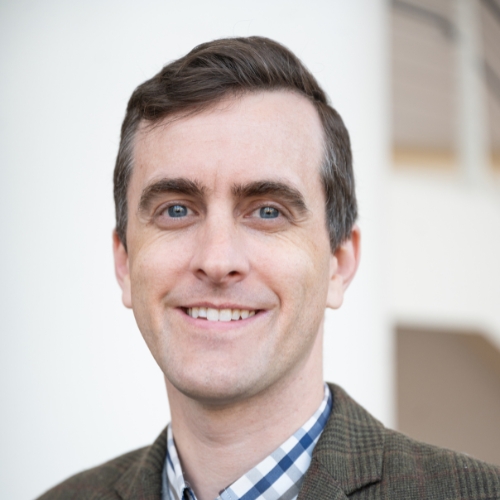
Yann LeCun (center) visits with Hon. Jerry Hultin, immediate past chair of The New York Academy of Sciences Board of Governors, during the Soirée.
“To build truly intelligent systems, they’d need to understand the physical world, be able to reason, plan, remember, and retrieve. The architecture of future systems that will be capable of doing this will be very different from current large language models,” he explained.
LeCun was presented with an Honorary Life Membership to the Academy during the 2024 event.
A Frenchman with a Clever Sense of Humor and Passion for Jazz
Though a serious computer scientist (he received the prestigious ACM Turing Award in 2018), his wry sense of humor often comes through when he talks and on his personal website.
“French people are generally known for their utter contempt of every product of the American culture (“or lack thereof”, as my friend John Denker would say with a smile),” LeCun writes on the “Fun Stuff” section of his website. “But there are two notable exceptions to this attitude, two pure products of the American culture that the French have embraced wholeheartedly (and no, one of them is not Jerry Lewis): Jazz music, and Tex Avery cartoons.”
A fan of jazz music, LeCun considers John Coltrane’s Giant Steps and Miles Davis’s Kind of Blue among his favorite jazz albums of all time. LeCun is a musician himself and plays various woodwind instruments. He even builds his own that combine traditional wind instruments with electronic synthesizers. When he worked at Bell Labs in the 1990s, he played in an informal jazz band with some colleagues. The passion for jazz (and tech) runs in the blood of the LeCun family, as Yann’s brother Bertrand plays the bass (and works at Google in Paris).
From left: Peter Salovey, former president of Yale University and current chair of The New York Academy of Sciences Board of Governors; Yann LeCun, VP and Chief AI Scientist at Meta; and Nick Dirks, President and CEO of The New York Academy of Sciences.
“I have always been interested in jazz because I have always been intrigued by the intellectual challenge of improvising music in real time,” he writes on his website.
Humble in nature—on his website he lists himself as an ACM Turing Award Laureate, but in a parenthetical note next to it indicates “(sounds like I’m bragging, but a condition of accepting the award is to write this next to your name)” —he was nonetheless appreciative of this recent recognition and the broader power of science.
“I like jazz so I’m fond of improvising speeches,” LeCun said when he took to the stage to accept his award, adding that he didn’t use AI to write his speech. “I’ve become a public advocate of science and rationalism. It’s true that today there’s been a lot of attacks against universities, rationalism, science, and scientists. All are being vilified by our own government. We have to stand up for science.”
This year’s award-winning teacher-mentor duo has been inspiring young minds and promoting STEM education for three years. They were recently honored by The New York Academy of Sciences for their work.
Published April 30, 2025
By Brooke Elliott
Megan C. Henriquez (left) and Brittany Beck pose with their awards during the Spring Soirée hosted at the University Club of New York on April 22, 2025.
The New York Academy of Sciences’ (the Academy’s) Scientist-in-Residence (SiR) program was proud to announce this year’s STEM Teacher of the Year: Brittany Beck, biology teacher at the High School of Telecommunication Arts and Technology; and Mentor of the Year: Megan C. Henriquez, who just defended her PhD in biological anthropology at the CUNY Graduate Center in April and will graduate in June.
A Queens native, Henriquez’s interest in STEM began when she was a kid. She remembers coming home from school and watching wildlife documentaries. “Those shows made studying wildlife seem so exciting and foreign, and yet so out of reach for a city kid like me” she recalled. “But through a network of mentorship and opportunity, I ended up becoming a wildlife ecologist doing field work in some of the most remote parts of the world.”
Brittany Beck grew up in rural Missouri. She completed her undergraduate degree in biology and her master’s in science education at Truman State University in Missouri. She has been teaching biology in NYC public schools for 14 years, with 13 of those years at the High School of Telecommunication Arts and Technology. Additionally, she serves as Coordinator of Student Activities, running the Student Government, managing over 30 clubs, and overseeing school events.
This is Beck’s fourth year as a teacher in the SiR program, working with scientists and building novel research projects with her students. Henriquez started working with the program about three years ago as a way to provide students with the same experiences and opportunities that inspired her interest in STEM in her youth.
Engaging Young Minds
Beck considers herself both a scientist and a teacher. Before joining the Scientist-in-Residence program, she was a national Evolution Education fellow in a program where she developed live organism research experiments for her classes alongside scientists at the University of Virginia and the Mountain Lake Biological Station. During that program, she developed a protocol in which students spend a year caring for mealworms, pupae, and darkling beetles in different treatments of Styrofoam to see how these treatments affect their growth and development. When the formal evolution education program ended, she continued this important work with students through the Academy’s SiR program.
Brittany Beck poses with Nick Dirks, President and CEO of The New York Academy of Sciences, during the Spring Soirée hosted at the University Club of New York on April 22, 2025.
What makes Beck and Henriquez such a good team? Trust in not just each other, but in their students. The pair has always let students pick and develop their projects, come up with their research questions, design their experiments, collect data, and decide how they organize and visualize on their own. At times, this may also mean allowing them to learn from mistakes.
The “ABC+M Pedagogical” Model
In terms of teaching technique, Beck often cites the “ABC+M” pedagogical model, which was developed by Rhonda Bondie and Akane Zusho. It requires that all lessons should include an opportunity for student Autonomy and choice. Teachers should build classroom environments where students know they Belong. They should provide opportunities for students to build their Competence, and that all lessons should be Meaningful to students. The work that Beck and Henriquez do with their students exemplifies this thinking.
Henriquez began her work as a mentor for the Academy as a way to pay back the early help and inspiration she received from mentors. Her first experience doing any sort of field work or experimentation was in her high school AP biology class, which makes it all the more meaningful that she gets to work with Beck’s Advanced Placement (AP) Biology class.
This made such a lasting impression that she ended up pursuing a career in biology. “If I could inspire at least one other student to pursue a career in STEM by providing them with the opportunity to see themselves as creative, serious, and legitimate researchers, I feel as though I would have done my part,” she said, adding she feels her work with students makes her own research both more meaningful and impactful.
“I think it’s one thing to read about the scientific method in a textbook, and it’s a completely enhanced experience to go through the process yourself. To develop your research questions, learn about your study system, try something out, revise and draw conclusions,” said Henriquez. “It works a part of your brain that so many people don’t get the opportunity to access.”
Inspiration
Megan C. Henriquez poses with Nick Dirks, President and CEO of The New York Academy of Sciences, during the Spring Soirée hosted at the University Club of New York on April 22, 2025.
Henriquez, who defended her PhD dissertation earlier in the month, feels the characteristics of a good mentor center around excitement and compassion. “No one is doing this for pay, so if you’re not going in excited about your work and what you’re going to share with your students, they’re going to sense that and not be excited either,” she said. She also loves providing interested students with additional opportunities. If a student is particularly interested in ecology fieldwork, she might find a program at the Bronx Zoo or the Junior Academy to keep the student engaged.
“Watching our SiR students make those connections and learn through experience has been one of the most rewarding parts of this program,” she continued, “Having students run up to us and say things like, ‘Look at what happened!’, ‘Look at how much our organisms have grown!’, ‘Our results are refuting or supporting our hypotheses!’ is just so exciting. Seeing them experience new things, overcome challenges, and grow confident in their skills and their problem-solving abilities has been amazing and so rewarding.”
Improvisation
Being able to improvise is another important skill for the mentor and teacher team. “A memory that sticks out is how, during Megan’s and my second year, we had collected water from a local pond and were unsure if we would be able to keep the microorganisms within the water alive. We not only kept them alive, but we also discovered a colony of snail eggs had hatched and grew and which our students then did microplastics experiments on,” Beck recalls.
“There hasn’t been one visit where we haven’t laughed together or enthusiastically yelled about the progress of a group’s experimental organisms. The sea monkeys, the pitcher plants, the butterflies, and especially the snails. We like to challenge ourselves as well as the students, and each year we add a level of complexity to the experimental process,” Beck added.
A snail students raised in 2023-2024, with green microplastics seen in the distance.Brittany Beck and Megan C. Henriquez, PhD, in front of their SiR poster for 2023-2024.With one of their SiR classes in 2022-2023, running student-led experiments on the impact of microplastics in local parks.Brittany Beck and Megan C. Henriquez, PhD, with student presenters in front of their SiR poster for 2022-2023.Looking at Prospect Park aquatic microorganisms together in 2023-2024.Student presenters with Brittany Beck and Megan C. Henriquez at the SiR showcase in 2024.A poster designed by Brittany Beck, Megan C. Henriquez, and their students for the SiR showcase during the 2023-2024 school year.Megan C. Henriquez with students this year, excited to see sea monkeys living among microplastics.Megan C. Henriquez and Brittany Beck in 2022-2023, examining HSTAT’s school garden for microorganisms and microplastics.
A Celebration of Hard Work
Beck feels the Scientist-in-Residence program has strengthened her students’ scientific identity, and graduates have told her they have notably more experience in lab skills than their peers in college, especially in designing laboratory protocols. “My students love it when Megan comes in, and they have a deep sense of ownership over their experimental ‘babies,’ whether they are plants, microorganisms, or bugs,” Beck said.
The duo were formally honored for their hard work during the Academy’s Spring Soirée which took place at the University Club of New York on April 22. When she heard she was named Mentor of the Year, Henriquez said she was in disbelief. From “early mornings jumping fences to get pond water to late nights setting up pitfall traps to catch bugs,” Henriquez feels good that her hard work is acknowledged.
Likewise, when Beck heard the news, she was at the National Science Teachers Association national conference in Philadelphia. “I whooped out loud in the busy exhibit hall and immediately called Megan, and we got to celebrate together,” she said with a laugh.
Three remarkable Laureates and six Finalists were recognized for their groundbreaking scientific discoveries during a gala at The Orangery, Kensington Palace, in London
Published April 3, 2025
By Kamala Murthy
The 2025 Honorees of the Blavatnik Awards in the UK standing outside The Orangery at Kensington Palace.
Each year, the Blavatnik Awards for Young Scientists in the United Kingdom celebrate the brightest young scientific minds across the UK. In 2025, three remarkable Laureates and six Finalists were recognized for their groundbreaking contributions to Life Sciences, Chemical Sciences, and Physical Sciences & Engineering. Their achievements were celebrated at a black-tie gala on March 4, 2025, at The Orangery, Kensington Palace, in London.
Honoring Scientific Excellence
The awards, established by the Blavatnik Family Foundation and The New York Academy of Sciences, are the largest unrestricted prizes for UK scientists under 42. This year’s Laureates, each receiving £100,000 ($130,000) in funding, were selected from a distinguished group of nine finalists. Six Finalists each received £30,000 ($38,800). These visionary scientists are tackling some of the world’s most urgent challenges, from infant mortality to sustainable manufacturing and climate change prediction.
A Night of Celebration and Inspiration
The prestigious gala, hosted by Sir Leonard and Lady Emily Blavatnik, was attended by luminaries in research, academia, business, and the arts. Opening the ceremony, Prof. Shitij Kapur, Vice-Chancellor and President of King’s College London, reminded the honorees of their power to change the world, “As pioneers in your fields – your voices count.” Citing Bishop Desmond Tutu’s words: “‘you can change the world.’”
Nicholas B. Dirks, President and CEO of The New York Academy of Sciences, reflected on the impact of the awards: “Over these 18 years, the Blavatnik Awards have recognized 540 scientists from 120 research institutions [across the US, UK and Israel] a testament to the program’s growing international reach.”
The Legacy of the Blavatnik Awards
Since their inception, the Blavatnik Awards have provided more than £3.1 million (US$4 million) to UK research, supporting over 70 scientists from more than 100 institutions. With honorees founding over 50 companies – six of which are now publicly traded – the impact of the awards extends far beyond academia, influencing industries and economies worldwide.
Prof. Stewart’s research is revolutionizing neonatal care with microbiome-based therapies to combat preterm infant mortality. His work sheds light on the critical role of human breast milk in shaping the gut microbiome of premature babies, leading to groundbreaking advancements in infant health worldwide.
Chemical Sciences: Liam T. Ball, PhD (University of Nottingham)
Prof. Ball is transforming chemical synthesis by developing safer, greener pharmaceutical and agrochemical production methods. His innovative use of bismuth has paved the way for more sustainable industrial manufacturing, reducing environmental impact while enhancing efficiency.
Physical Sciences & Engineering: Benjamin J.W. Mills, PhD (University of Leeds)
Prof. Mills is pioneering Earth Evolution Modeling, enabling scientists to simulate climate changes over billions of years. His work not only deepens our understanding of Earth’s past but also informs the search for habitable exoplanets, advancing both climate science and space exploration.
Meet the 2025 Finalists
Nicholas R. Casewell, PhD (Liverpool School of Tropical Medicine) – A toxinologist studying snake venom to develop better treatments for snakebite, a neglected tropical disease.
Brianna R. Heazlewood, PhD (University of Liverpool) – A physical chemist designing tools to study extreme-temperature chemical reactions, shedding light on space chemistry.
Hannah Price, PhD (University of Birmingham) – A theoretical physicist exploring extra dimensions through innovative experiments, deepening our understanding of higher-dimensional physics.
Filip Rindler, DPhil (The University of Warwick) – A mathematician creating new theories on how metals deform at a microscopic level, impacting materials science.
Andrew M. Saxe, PhD (UCL) – A neuroscientist using math to uncover how artificial and biological systems learn, advancing AI and memory disorder research.
Chunxiao Song, PhD (University of Oxford) – A chemical biologist developing advanced sequencing methods to detect DNA and RNA changes, aiding early cancer detection.
Looking to the Future
The day after the ceremony, the 2025 Laureates and Finalists presented their research to the public at the Blavatnik Science Symposium “Imagining the Impossible: UK Scientists Changing Our World,” held at the Royal Society of Medicine. This event offered science enthusiasts of all ages an opportunity to engage with these pioneering researchers and learn how their work is shaping the future.
The Blavatnik Awards continue to empower young scientists, fostering discoveries that redefine our understanding of the world and beyond. Stay connected and follow their journey at www.blavatnikawards.org.
Dr. Sonya Dougal leads the Chemical Sciences panel at the Blavatnik Science Symposium.The 2025 Laureates with Prof. Shitij Kapur, Vice-Chancellor and President of King’s College London.2025 Toast to Science.Laura Thorén Podesta with Peter Thorén of Access Industries, the Blavatnik Family Foundation and member of the Academy’s Board of Governors.Physical Sciences & Engineering Laureate, Prof. Benjamin Mills, presents his research on Earth Evolution Modeling.Chemical Sciences Laureate, Prof. Liam Ball from the University of Nottingham receives his medal from Academy President & CEO, Nicholas B. Dirks.Life Sciences Laureate, Prof. Christopher Stewart from Newcastle University presents his research on human breast milk and the infant microbiome.(Left to Right) Lord Maurice Saatchi, Sir Leonard Blavatnik, Lady Lynn Forester de Rothschild.The Academy’s Blavatnik Awards UK Team (Left to Right) Edison Huynh, Kamala Murthy, Dr. Sonya Dougal, Dr. Nina R. Montoya, Gabrielle Sirois, Prof. Nicholas B. Dirks.The evening’s hosts, Lady Emily and Sir Leonard Blavatnik.