A new federal proposal to overhaul the allocation of government funding would impact operations for The New York Academy of Sciences.
Published July 15, 2026
By Nick Fetty
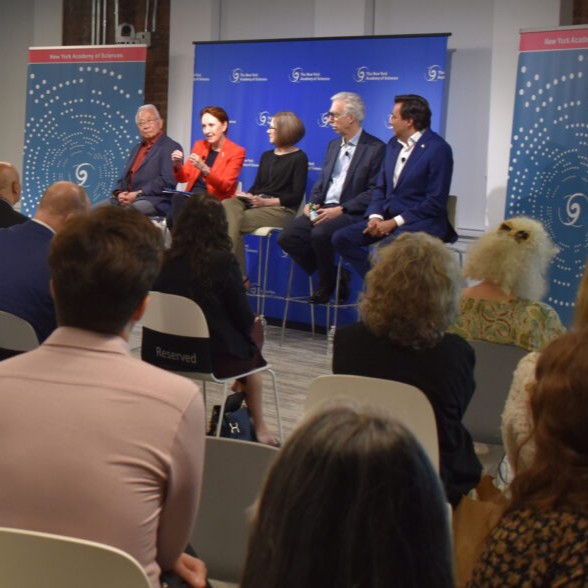
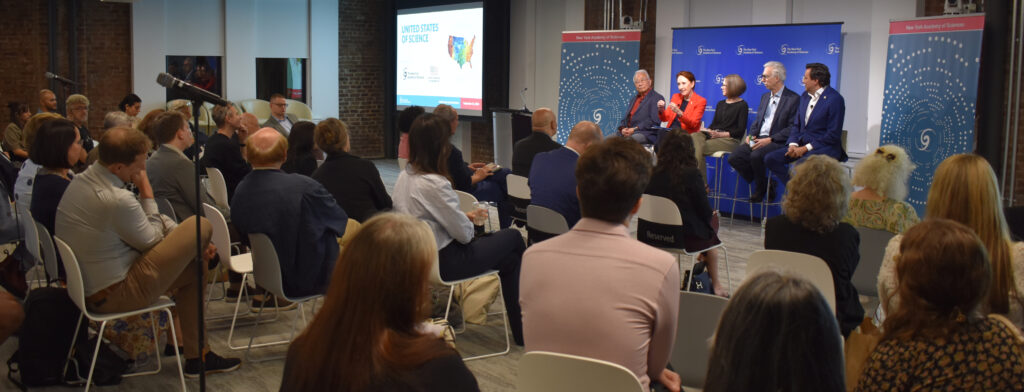
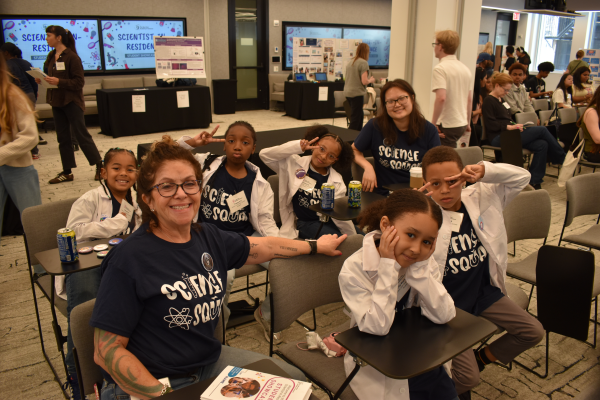
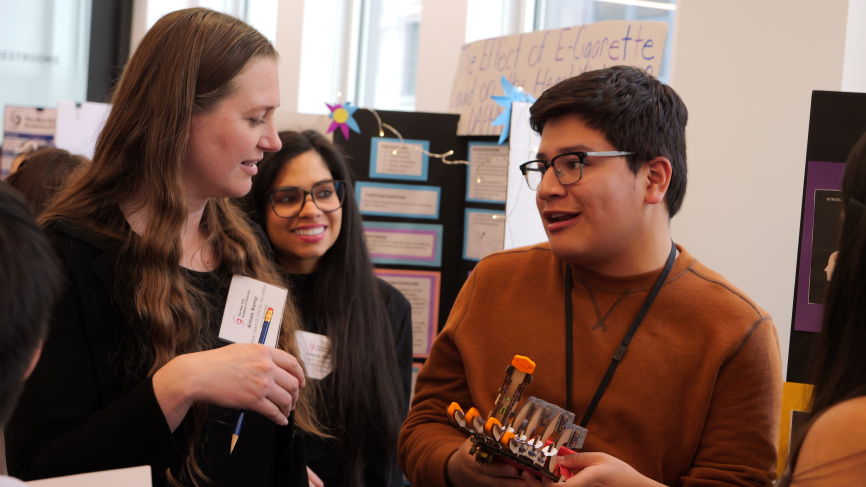
From the Academy’s the “United States of Science” event hosted on September 16, 2024. Each year the Academy hosts dozens of conferences, events, educational/networking opportunities, and more, as part of its mission to advance science for the public good. Photo by Nick Fetty/The New York Academy of Sciences.
The new proposal from the Office of Management and Budget (OMB), titled “Regulation for Federal Financial Assistance,” was issued earlier this year by the Trump Administration. It aims to overhaul federal government funding allocated to municipalities, educational institutions, non-profits, individuals, businesses, and more each year.
Proponents argue the new proposal enables President Trump to carry out his agenda and provides more oversight of taxpayer money, while opponents fear it will take away power from local authorities and defund critical programs, according to Forbes. The distribution of federal funding is usually handled by “civil servants and peer-review panels” but under the new proposal this task would be assigned to political appointees.
One of the oldest scientific societies in the United States—founded in 1817—the Academy is an independent, nonpartisan 501(c)(3) nonprofit organization whose mission is to drive innovative solutions to society’s challenges by advancing scientific research, education, and policy. The Academy serves a global community of scientists at every career stage through scientific conferences and symposia that convene approximately 2,600 participants each year; professional learning and STEM education programs that train more than 2,100 students and early-career scientists annually; international scientific prizes, including the Blavatnik Awards for Young Scientists; fellowships; the International Science Reserve (a global network for scientific crisis preparedness); and its international multidisciplinary journal Annals of the New York Academy of Sciences, published since 1823 and among the oldest continuously published scientific journals in the United States.
The Academy shares OMB’s commitment to responsible stewardship of Federal funds and supports the goals of simplification, plain language, and accountability that animate much of the proposal. However, several of the proposed provisions would conflict with both existing Federal policy and longstanding, objective scientific practice, and would impose administrative burdens and barriers to the dissemination of federally funded research—burdens whose cost would exceed any savings.
…
The practices the proposed OMB regulations would burden, including peer-reviewed publication, open scientific meetings, and professional scientific societies, are not overhead. They are among the objective, longstanding mechanisms by which science tests, refines, and corrects itself, and by which public investment in research yields discoveries and cures, as well as significant productivity and growth of the U.S. economy.
The Academy urges OMB to consider adopting the alternative regulatory language set out in the accompanying Appendix, which preserves OMB’s stewardship objectives while safeguarding the dissemination, validation, and exchange of scientific ideas on which federally funded science has experienced compounded returns over decades.
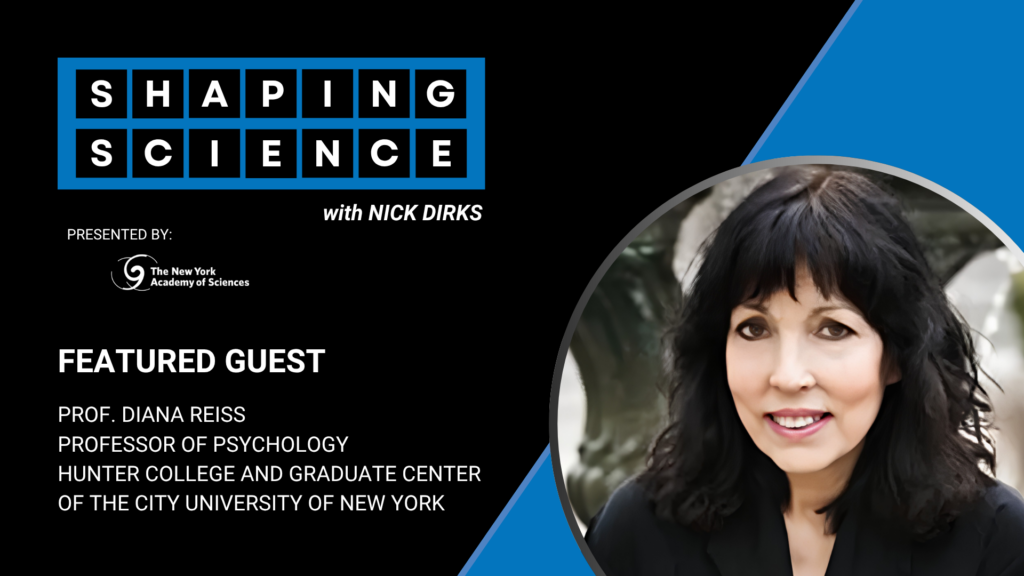
Diana Reiss is a cognitive psychologist and one of the world’s leading researchers on animal cognition and consciousness. Best known for her groundbreaking work demonstrating mirror self-recognition in dolphins – a discovery that challenged long-standing assumptions about human cognitive uniqueness, Reiss has spent decades studying how dolphins and other animals think, communicate, and understand themselves, while also translating this science into advocacy for animal welfare and conservation.
March 16, 2027 | 8:30 AM – March 17, 2027 | 5:15 PM ET
Join leading scientists, clinicians, industry innovators, and translational researchers on March 16-17, 2027 to explore the rapidly evolving field of vaccines for chronic disease.
Vaccines have traditionally been used as the most effective medical interventions to reduce the death and morbidity caused by infectious diseases. Recently, chronic diseases are emerging as an important public health problem with serious human, social, and economic burden. With the growing burden of chronic diseases and the limited availability of curative treatments, it is crucial to explore innovative approaches in vaccine and immunotherapy design for preventing, delaying, and treating a wide range of chronic diseases such as Alzheimer’s disease, Parkinson’s disease, cancer, multiple sclerosis, chronic hepatitis B infection, HIV, HPV-associated diseases, and other major global health challenges.
The program will explore the growing role of vaccines across neurodegenerative disease, cancer, autoimmune disorders, and chronic infectious diseases, while also examining future opportunities in areas such as obesity and addiction. Together, these discussions will provide a comprehensive view of how vaccines are being reimagined to address some of the most pressing and complex diseases of our time.
Sponsors
Presented By
The Microbiology and Infectious Diseases Discussion Group
Recent news coverage of Ebola and hantavirus has raised important questions about the risks these diseases pose, how outbreaks are contained, and what individuals should know for themselves and their communities. Join The New York Academy of Sciences for a timely webinar featuring leading experts in infectious disease, epidemiology, outbreak response, and public health. This discussion will provide a clear, evidence-based overview of both Ebola and hantavirus, including where these diseases occur, how they spread, the populations most at risk, and the measures being taken to monitor and contain outbreaks.
The recording for this event will be available until July 6, 2027.
As research, innovation, and scientific careers become increasingly global, many graduate students, postdoctoral researchers, and early-career scientists are exploring opportunities beyond the United States. For international scholars in the United States, in particular, evolving immigration policies, funding landscapes, and workforce needs can make it valuable to consider a broader range of career destinations.
This workshop provides an introduction to STEM career opportunities outside the United States. Drawing on data, resources, and experiences from globally mobile scientists, participants will explore career and funding opportunities in regions such as Canada, the European Union and Japan, as well as the factors that influence successful international transitions. The session will address differences in hiring practices, workplace culture, and professional norms across countries while highlighting strategies for evaluating relocation decisions and building international professional networks. Whether attendees are actively considering a move abroad or simply seeking to expand their understanding of the global STEM landscape, they will leave with practical tools and resources for making informed career decisions in an increasingly interconnected world.
About the Global STEM Career Pathways Series
Scientific careers are becoming increasingly shaped by global opportunities, evolving funding landscapes, and immigration considerations. The Global STEM Career Pathways series is designed to help graduate students, postdoctoral researchers, and early-career scientists navigate these interconnected factors while exploring long-term career options both within and beyond the United States. Through practical frameworks, diverse international perspectives, and strategic planning tools, participants will gain a broader understanding of how career, funding, and immigration decisions influence professional mobility and success.
The two programs in this series equip attendees with the knowledge and planning strategies needed to evaluate opportunities across borders, make informed career decisions, and build resilient, globally minded STEM careers in an increasingly interconnected research landscape.
For many STEM researchers, career planning extends beyond research goals to include professional development, funding opportunities, and immigration considerations. This is particularly true for international graduate students, postdoctoral researchers, and early-career scientists pursuing long-term careers in the United States. As research funding landscapes, workforce needs, and immigration policies continue to evolve, a strategic and intentional approach can help researchers navigate uncertainty and position themselves for future success.
This workshop introduces practical frameworks for aligning career, funding, and immigration goals within the U.S. STEM ecosystem. Drawing on principles familiar to researchers, participants will learn how to approach career and immigration planning with the same rigor used to design research projects, by defining goals, identifying milestones, and developing actionable strategies. The session will explore tools such as SMART goals and Individual Development Plans (IDPs), strategies for building an immigration portfolio, and approaches for balancing research productivity with career advancement and immigration preparation. Through guided reflection, practical examples, and structured planning exercises, attendees will gain tools to evaluate their current trajectory, identify opportunities for growth, and develop a roadmap for long-term professional success in the United States.
About the Global STEM Career Pathways Series
Scientific careers are becoming increasingly shaped by global opportunities, evolving funding landscapes, and immigration considerations. The Global STEM Career Pathways series is designed to help graduate students, postdoctoral researchers, and early-career scientists navigate these interconnected factors while exploring long-term career options both within and beyond the United States. Through practical frameworks, diverse international perspectives, and strategic planning tools, participants will gain a broader understanding of how career, funding, and immigration decisions influence professional mobility and success.
The two programs in this series equip attendees with the knowledge and planning strategies needed to evaluate opportunities across borders, make informed career decisions, and build resilient, globally minded STEM careers in an increasingly interconnected research landscape.
As competition for traditional research funding continues to increase, many academic researchers are exploring industry partnerships as a complementary source of support for their research programs. While companies invest billions of dollars annually in external research and development collaborations, most scientists receive little formal training in how industry identifies, evaluates, and funds academic research partnerships. As a result, promising opportunities for collaboration often go unrealized.
This introductory workshop provides researchers with a practical framework for understanding how industry approaches research partnerships and what companies look for when evaluating potential collaborators. Participants will examine common barriers that hinder academia–industry engagement, including differences in communication styles, incentives, and expectations surrounding intellectual property and publication. Through real-world examples and actionable strategies, attendees will learn how to identify industry-relevant applications of their research, articulate the value of their expertise to non-academic audiences, and begin developing a plan for industry outreach. Participants will leave with a clearer understanding of how to position their research for collaboration and funding opportunities that advance both scientific and organizational goals.
This interactive workshop will be conducted via Zoom meeting. Participants will be encouraged to engage in practical discussions and activities.
About the Publish and Fund Your Research Series
Researchers today are working in a rapidly changing environment shaped by new AI tools, evolving publishing models, increasing demands for research transparency, and growing competition for traditional funding. This three-part series will help scientists strengthen core professional skills for producing, sharing, and supporting their research in this changing landscape.
Across the series, participants will explore how AI-enabled tools can support literature review, writing, discovery, and research productivity; how scientific publishing is being reshaped by open access, peer review pressures, AI, preprints, research integrity concerns, and changing expectations for trust and authority; and how academic researchers can identify and pursue industry partnerships as a complementary source of research support. The series is designed to help researchers make informed decisions, communicate their work more effectively, and position their research for publication, funding, collaboration, and broader impact.
Scientific publishing, once treated as a relatively quiet final step in the research process, has become one of the places where the future of science is being contested. Questions of evidence, trust, access, credit, ethics, business models, and technological change now converge in the systems that determine how research is evaluated, disseminated, discovered, and preserved.
This virtual event will examine how scientific publishing is changing and why those changes matter for anyone who produces, evaluates, funds, communicates, or relies on research. The discussion will consider the evolving roles of journals, editors, publishers, scholarly societies, and indexing platforms in maintaining the integrity and usefulness of the scientific record. It will also address how artificial intelligence is already affecting manuscript preparation, editorial screening, reviewer selection, literature search, research synthesis, and public access to scientific knowledge.
The session will also offer practical guidance for researchers seeking to publish their work effectively and responsibly, including how editors assess submissions, why manuscripts are rejected before peer review, how to choose journals strategically, how to respond constructively to reviewer feedback, and how to avoid common mistakes that weaken otherwise publishable work.
About the Publish and Fund Your Research Series
Researchers today are working in a rapidly changing environment shaped by new AI tools, evolving publishing models, increasing demands for research transparency, and growing competition for traditional funding. This three-part series will help scientists strengthen core professional skills for producing, sharing, and supporting their research in this changing landscape.
Across the series, participants will explore how AI-enabled tools can support literature review, writing, discovery, and research productivity; how scientific publishing is being reshaped by open access, peer review pressures, AI, preprints, research integrity concerns, and changing expectations for trust and authority; and how academic researchers can identify and pursue industry partnerships as a complementary source of research support. The series is designed to help researchers make informed decisions, communicate their work more effectively, and position their research for publication, funding, collaboration, and broader impact.
Join us on May 13, 2027 in New York City for the Trust in Science and Medicine conference. This one-day symposium will explore critical issues in building and strengthening trust between scientists, physicians, and the public to create a healthier society.
Trust is essential to scientific progress, public health, and informed decision-making. However, recent years have exposed growing challenges to public confidence in scientific institutions, medical expertise, and the broader information ecosystem. This timely symposium will examine how trust is built, lost, and restored. Through presentations and panel discussions, experts from science, medicine, journalism, ethics, law, and community engagement will explore the impact of misinformation, polarization, public health crises, and communication failures, while highlighting strategies to strengthen public confidence and foster meaningful dialogue.
At a time when trust in science and medicine has become of significant concern, don’t miss this opportunity to connect with leaders in the field and learn how to repair trust within our communities.
The Scientist-in-Residence Student Showcase is a culminating celebration where NYC students present the results of the research projects that, over the school year, turned their classrooms and communities into real-world labs.
Published June 24, 2026
By Agata Regula
The New York Academy of Sciences’ Scientist-in-Residence program (SiR), created in 2012, empowers NYC students to engage directly with working scientists from local universities and scientific institutions. By matching 2nd-12th grade teachers with scientists in their subject area, SiR aims to bring science to life in the classroom. Throughout the school year, scientists work with students in their schools, conducting hands-on inquiry-based projects in which students take leading roles. The SiR student showcase allows students to present, discuss, and celebrate these projects with their peers and members of the wider NYC scientific community.
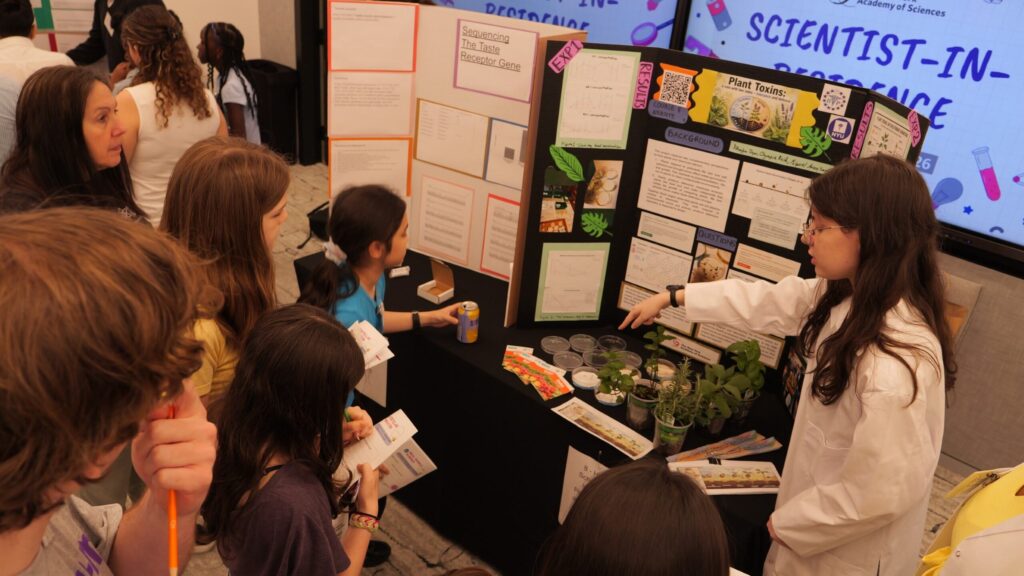
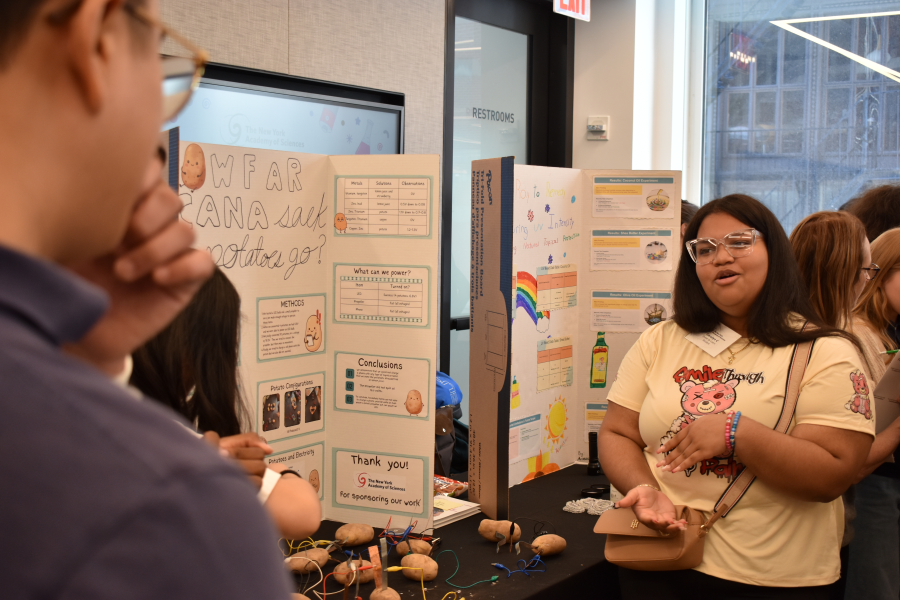
The 2026 SiR cohort was made up of over 1500 students from 47 schools across NYC, 85% of which qualify for Title I funding. More than 250 of those students, representing 45 of the participating schools, had the opportunity to present at the showcase. With tables set up for presentations throughout the room at Cure’s campus, adults and students circulated, discussing their projects and seeing the work their peers had conducted this year. Although the room was full of excitement and conversation, students did not leave their scientific spirit at the door—one group of 5th graders from P.S. 376, who researched the effects of loud sounds on long-term auditory health, could be seen using decibel meters to assess the noise level in the room.
At the 2026 SiR showcase, the daily agenda featured remarks from speakers working in STEM disciplines including aerospace technology, engineering, and entomology, followed by two rounds of poster presentation sessions by student representatives from the 47 participating classrooms. For most of the students, the poster sessions represented their first opportunity to present their research to a broad audience of STEM professionals, teachers, and fellow students, including some who were much younger or older than themselves. This allowed them to practice using their science communication skills to spread information, showcase their knowledge, and explain new research to a diverse audience. Students had to adapt their presentations for both established scientists and children as young as eight, a challenging task for even many STEM professionals.
Photo by Nick Fetty/The New York Academy of Sciences.
NYC-area STEM leaders and advocates offered to share their own experiences in science-recounting stories from their careers while imparting meaningful lessons and advice to the students present. Speakers included:
Nicholas B. Dirks, President and CEO, The New York Academy of Sciences
Seema Kumar, CEO, Cure; Member of the Board of Governors, The New York Academy of Sciences
David Lefer, Industry Professor, NYU Tandon School of Engineering
Noah Guy Lewis Guiberson, PhD, Postdoctoral Associate, Weill Cornell Medicine
Shekar Krishnan, District 25 New York City Council Member & Education Committee Member
Emily Rice, PhD, Associate Professor, CUNY Macaulay Honors College
Hannah Stower, PhD, Assistant Director of Education and Engagement, Institute for Translational Neuroscience / Department of Neuroscience at NYU Langone Health
Carly Tribull, PhD, Associate Professor, SUNY Farmingdale State College
Fernando Vazquez, PhD, Manager, American Museum of Natural History
NYC as a Lab
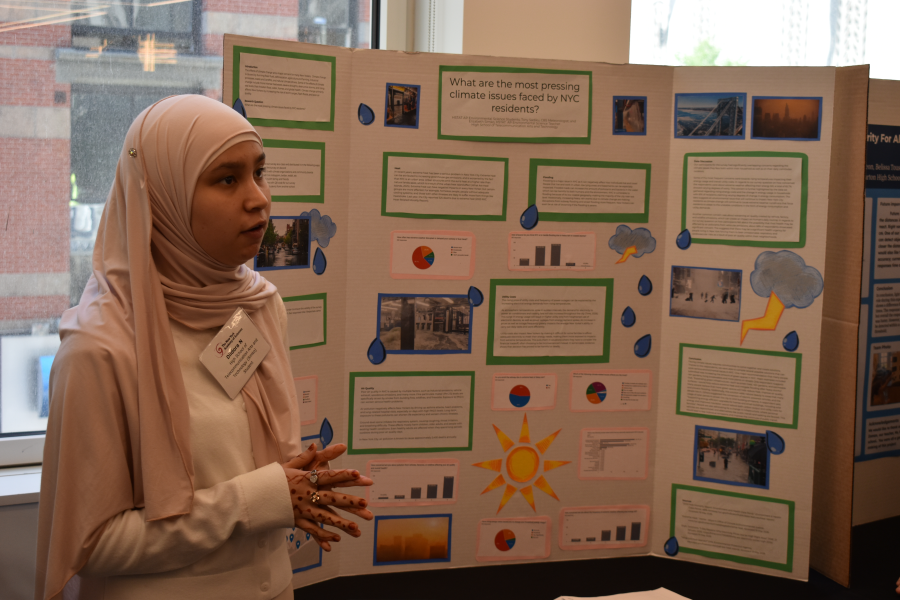
Many student projects made use of NYC’s plentiful ecosystems, waterways, and green areas when conducting their research, including in-school vs. out-of-school air quality, researching street trees and solar panels, exploring ways to diminish the heat island effect and examining anthropogenic effects on the urban environment. Students across the five boroughs used their research to do key work in their community and become advocates for a greener NYC.
Students from United Charter High School – Advanced Math and Science, for example, focused on NYC’s Combined Sewer Overflow system, where stormwater runoff, which is normally released back into waterways, is combined with raw sewage, and often litter, before it reaches its destination. To prevent water contamination, the students designed a water filtration system using only household materials, which successfully filtered out simulated litter and other water pollutants.
For many people, including professional researchers, combating pollution and climate change can seem like a daunting or even impossible task. But by focusing on their local communities, these student groups are translating abstract problems into local concerns with tangible solutions. Additionally, engaging in locally-focused science strengthens the students’ bonds to their communities and shows them that as future scientists, they can directly impact the lives of those around them.
Building STEM Identity and Belonging
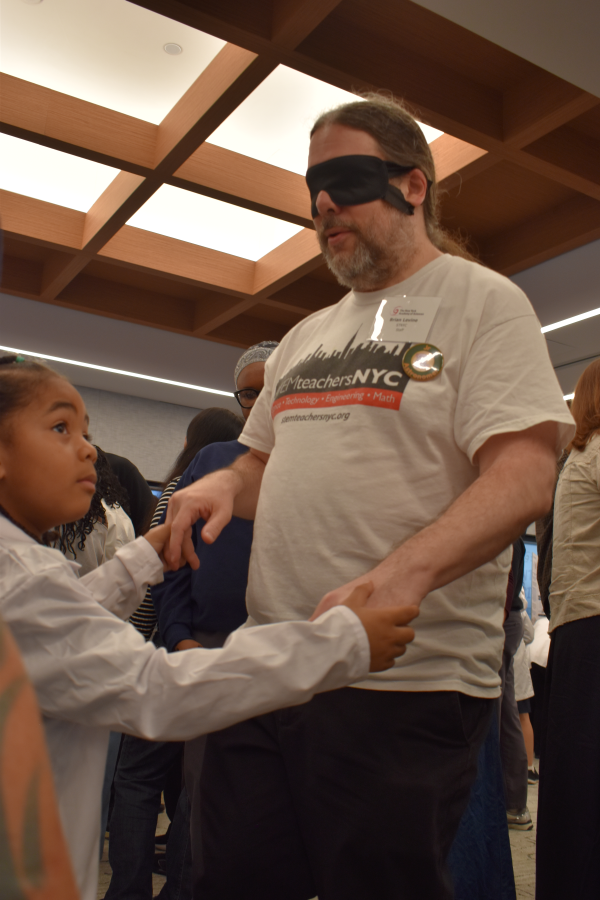
Before meeting a real scientist for the first time, many kids might imagine a man, wearing a white lab coat and goggles, holding test tubes, and having messy hair. Although some students wore lab coats to the showcase to connect with their inner scientist, the SiR program is an amazing opportunity for kids to meet a real scientist and begin to understand that a scientist can look like anyone, and that they too belong in STEM.
Photo by Nick Fetty/The New York Academy of Sciences.
Council Member Shekar Krishnan gave such inspiring words of encouragement to the students, sharing the fact that his Indian mother is a prime example of the Hidden Figures type of scientist: she dedicated her life to discovering breakthroughs and making advancements in biotechnology and treating drug-resistant infections; meanwhile other scientists received the credit. He emphasized how far we have come as a scientific society from that time, while simultaneously calling for students to apply scientific inquiry to their own heritage and culture, citing experiments he performed during high school to study turmeric’s compounds.
“It is incredibly important for students to see themselves represented in STEM careers,” one SiR teacher noted. Being paired with a female scientist the teacher observed, “helped many of our students, especially our girls, see that these careers are possible for them.” Fostering a long-term research-focused relationship between students and scientists helps students dispel stereotypes they may have internalized of what a scientist can be, and help understand that there is more to science than just textbooks.
Students aren’t the only ones who benefit from participating in SiR: one participating teacher said that after completing a year with the program, “I feel more like a scientist and feel supported in growing that identity in myself and my students.” Similarly, a 25-26 scientist mentor noted that after participating in the program they “became more confident in my ability to teach research skills to learners with limited experience, and I learned a lot about how much science I really do know.” Imposter syndrome doesn’t just occur in young, budding scientists; it is something that any distinguished STEM professional can struggle with. For scientists, participating in SiR offers the opportunity to showcase their knowledge and gain valuable experience with hands-on teaching.
Over the past 15 years, SiR has served more than 400 teachers and scientists and over 17,000 students. With hopefully many more years to come, everyone involved with the program can look forward to continuing to foster opportunity and strengthen NYC’s scientific community through supporting its educators, professionals, and future generations.
A big thank you to all of our program sponsors, and to Cure for supporting this special event.