Enjoying What New York City has to Offer

A band performs at the Knitting Factory.

An intrepid neuroscience postdoc at Cold Spring Harbor Laboratory heads downtown for museums, fine dining, and rock ‘n roll.

Published July 1, 2006

By Linda Wilbrecht

Nighttime fun at the Knitting Factory. Image courtesy of Update magazine.

To me “going downtown” has always meant “good food.” This is especially true in Manhattan, where some of the best restaurants in New York City are concentrated below Canal Street.

I asked two friends to join me at the Financier Patisserie, near Hanover Square, ready for a day of exploration downtown. Pouring rain made the cobblestones and pubs outside on Stone Street look more like London than New York. The Financier probably gets noisy at lunchtime on weekdays with its green and white tiled walls and floors, but this Sunday morning it was blissfully quiet, every customer sitting on a French brasserie chair rapt in a news- paper with a bowl of cappuccino resting on a saucer.

Each saucer also held a small golden cake, the traditional French financier made with almonds and egg whites. I scanned the pastry case, trying to decide between éclairs, tarts, and crème brûlées. I settled on the raspberry éclair, its pastry lid held aloft by fresh and perfect berries sitting in cream. Not my usual breakfast, but this felt like a special occasion.

Properly sugared and caffeinated, we moved on to the National Museum of the American Indian. I was surprised I had never noticed it before, installed inside the ornate U.S. Custom House at Bowling Green. I was pleased to find admission was free; the museum is part of the Smithsonian.

From Museums to Shopping

The collection represents a vast number of tribes from the Americas, and includes clothing, pottery, basketry, carvings, even saddlery. I was struck by a model tipi, perhaps a planning model, perhaps a toy. It is made of deer hide, and painted riders dance across its surface with all the lightness of a Chagall. The Born of Clay exhibit showcases pots, jars, and storage vessels spanning 5000 years.

Several water jugs are decorated with paintings of deer with arrows running from their mouths to their bellies. Others are in the shape of trophy heads and maize gods. Contemporary potters are also well represented. On a simple gray basin made in 1986 by Peter Jones, an Iroquois potter, three clay singers emerge from the lip, looking like Edvard Munch figures beating a drum.

By the time we were back out on Bowling Green, the clouds had cleared. My friends were planning a trip to Hawaii, so they needed sandals and a new camera. We were in the perfect neighborhood to shop for both. At Century 21, New York’s most famous discount warehouse (located at 22 Cortland Street), we went elbow to elbow with young women pawing metallic purple Manolo Blahnik stilettos, marked down from $400 to $200. We found our sandals for a more reasonable price.

Passing quickly through the rest of the store, we petted 400 thread-count sheets and racks of silk ties, some garish, some at- tractive. Then we headed just a few blocks away to J&R, the computer and electronic superstore at Park Row (between Beekman and Ann Streets), to scope out cameras. I priced some wireless software, but we all decided to order online, in order not to burden ourselves with more packages for the rest of the day.

Beers and Parks

Now quite hungry, we wandered a few blocks north to Duane and West Broadway where we found Blaue Gans, a festive and relaxed Austrian and German restaurant decorated by a hundred or more colorful art posters. The sunlight poured through the windows onto tall glasses of slightly cloudy lemon-colored hefe  weisse, a wheat beer we used to wash down our starters of brown bread and burenwurst.

For lunch we shared a superb Wiener schnitzel with lingonberries, as well as a salty goulash with buttery spaetzle. Although we were full, our curiosity led us to the dessert menu and we were thrilled to discover the best apple strudel any of us had ever tasted: crispy crust and perfectly cooked apples, not too cloyingly sweet or runny.

We decided to walk off our lunch along the promenade at Hudson River Park. Then, we ducked into the World Financial Center Winter Garden and had a look at the palm trees and the display Recovery to Renewal, showcasing plans for the Freedom Tower and 9/11 memorial at the World Trade Center site. We admired models of the winning designs and debated their superiority to the alternatives, also shown, a discussion rendered more relevant by the fact that cost overruns are now forcing a rethinking of the memorial design.

The Museum of Jewish Heritage

Further south on the river path we came to the Museum of Jewish Heritage at 36 Battery Place. From the outside I had always thought this museum was quite small, but today I realized the rotunda is connected to the new and much larger Morgenthau wing that juts from the waterfront off into Battery Park City. If you want to see the whole exhibit you should schedule at least three hours.

The Museum aims to honor the victims of the Holocaust by celebrating their lives, and affirming today’s vibrant world-wide Jewish community. Everything in the museum is unusually personal, often bearing the original owner’s name and country of origin. I was particularly struck by the dented trumpet of Louis Bannet, “the Dutch Louis Armstrong,” who managed to survive for three years as a musician at the Auschwitz- Birkenau concentration camp.

Above the instrument hangs a quote from Bannet: “This wonderful horn kept me alive.” On the lower level is a large exhibit on Jewish culture, illustrated by videos of synagogues around the world and religious, ceremonial, and everyday objects. A modern Sukkah, or harvest shelter, painted by Aryeh Steinberger with scenes of Budapest and Israel, caught my eye with its rainbow of colors.

The City’s Nightlife

For dinner we wanted to eat outside with a water view. Our options included Steamers Landing, Liberty View, and Southwest NY up near the World Financial Center, but we settled on the elegant Gigino at 20 Battery Place. We sat under a brick archway on the terrace with a direct view of the Statue of Liberty.

As we sipped Italian wine, the sun was setting over the skyscrapers of Jersey City and an enormous cruise ship floated by like an iceberg silently headed out to sea. It dwarfed the little orange Staten Island Ferry as they crossed paths far in the eastern reach of the harbor. I eyed the osso buco di pollo, but decided instead on the duck breast over arugula with pineapple carpaccio.

A day in New York also needs nightlife. We saw singles sitting outside flirting at Merchants NY (90 Washington Street). On Greenwich Street, women in stylish designer clothes were chatting intensely at Yaffa’s outdoor tables (353 Greenwich). We decided we wanted music, so cut east to Leonard Street, near Church, to the Knitting Factory, which has three different performance spaces. It used to offer jazz and experimental music, but now tends to cater to a younger rock and pop audience.

The street outside was lined with young men with shaved heads and Mohawks. We were carded. The band in the main room tonight was the Horrorpops, led by an upbeat young woman in a strapless dress who enthusiastically swayed with an electric double bass. The whole room “pogo-ed” up and down very happily and we joined in until our feet hurt and it was time to go home.

Also read: An Architectural Historian’s Perspective of NYC

An Architectural Historian’s Perspective of NYC

A shot of the downtown Manhattan skyline, with the Freedom Tower at the center of the shot.

Lower Manhattan boasts new work by the world’s foremost landscape designers, as well as timeless vistas of New York Harbor

Published July 1, 2006

By Francis Morrone

Image courtesy of oldmn via stock.adobe.com.

Lower Manhattan was once notorious for its lack of parks and greenery. As the oldest part of New York, it was built up when most of Manhattan Island was still countryside and wilderness. Who needed open spaces when all around was one big open space? As the years went by, the countryside was developed, Downtown’s buildings grew ever larger and its streets ever more congested.

Fortunately for us, the twenty-first century is shaping up as a golden age for open space Downtown. From government-funded baseball fields to the re-landscaped riverside public plaza at privately owned 55 Water Street, a multitude of scenic options beckon those who wish to catch some fresh air and sunshine before or after a meeting. The recently opened 7 World Trade Center, new home of The New York Academy of Sciences (the Academy), is an excellent starting point for a stroll through some of Downtown’s finest outdoor attractions.

Battery Park City and Hudson River Park

Two blocks to the west is Battery Park City, a mixed-use complex under development since the 1980s on Hudson River landfill. (Please bear in mind that this is “Battery Park City,” while “Battery Park” refers to a separate park, which we will visit later, at the very bottom of Manhattan Island.)

It’s a good thing Battery Park City wasn’t built in the 1970s, as was first planned. It would have looked like any gigantic, sterile high-rise housing complex built under the ill-conceived “urban renewal” rubric. In the years of waiting, architects and planners changed their approach to development. They started to stress recreating the charms of traditional cityscapes, with buildings of modulated scale and warm materials along real streets, together with ample outdoor space for recreation and relaxation.

Combining Utility and Aesthetics

New Yorkers are much taken with the waterfront parks and two-mile-long esplanades of Battery Park City, which anchor the southern end of Hudson River Park (and will eventually stretch unbroken all the way north to 59th Street). As you enter from Vesey Street, turn right to see Battery Park City’s northernmost jewel. Nelson A. Rockefeller Park is named for the New York governor (and U.S. vice president) who first conceived of Battery Park City.

This park was designed by a leading landscape architecture firm, Carr, Lynch, Hack & Sandell, as a park for active sports and recreation that was also pleasing to look at—a rare combination. At the northern end a children’s playground sports whimsical bronze sculptures by the popular Tom Otterness. “In this smallish utopia,” says one critic, “safety regs and aesthetics can coexist.” One also sees a gazebo inspired by Greek temples, designed with great care by Demetri Porphyrios, one of the leading classical architects in the world today. Broad lawns slope westward. The park is used for basketball, volleyball, frisbee, and handball, as well as running and biking.

The World Financial Center

Continuing south, one comes to the World Financial Center office complex, at the heart of Battery Park City. Headquarters of American Express, Merrill Lynch, and Dow Jones cluster around the greenhouse-like Winter Garden. Within is a space as big as Grand Central Terminal’s concourse. With its sixteen giant palm trees, benches, and sunlight, the Winter Garden is by day a reposeful haven for office workers.

On nights and weekends, it offers year-round cultural programming and performances. Before September 11, 2001, the grand stairway at the east end led to an aerial bridge over West Street to Six World Trade Center. Not only was that bridge destroyed on that terrible day, so too was the Winter Garden itself. That it was rebuilt and reopened within a year was indescribably heartening to New Yorkers. Today the east end has been redesigned as a viewing platform from which one may look directly down upon Ground Zero.

To the west outside the Winter Garden is World Financial Center Plaza, looking out on a boat basin and the Hudson River. Designed by landscape architect M. Paul Friedberg with artists Scott Burton and Siah Armajani, the plaza overflows with cafe tables and a variety of seating for eating take-out food, making it one of Manhattan’s most pleasant spots for weekday lunch in fine weather.

Beyond Battery Park City

Farther south, beyond Battery Park City’s streets of apartment houses opening off the esplanade, is the unusual South Cove Park, a collaboration of architect Stanton Eckstut, landscape architect Susan Child, and environmental artist Mary Miss. It is in part a recreation of the original 17th- and 18th-century Hudson River shoreline, replete with the rocks, plants, and wooden piers that one might have then encountered. In addition, the artful assemblage of rocks and exotic plantings screens a rear section of the park that is deliciously secluded. It in turn leads south to a curious, freestanding, elevated platform of steel, shaped like the crown of Lady Liberty. From this platform, one can look directly out at the iconic statue itself.

Continue south, past the Museum of Jewish Heritage, which opened in 1997 and was expanded in 2003. Within the museum is an outdoor, contemplative “Garden of Stones” by artist Andy Goldsworthy. Beyond the museum is the southernmost of Battery Park City’s parks, Robert F. Wagner, Jr. Park, named for a three-term mayor of New York. Here are expansive lawns that on warm afternoons are as dense with sunbathers as any spot in Manhattan.

Set among the lawns are granite-rimmed “container gardens” of lavish floral displays created by renowned public gardener Lynden B. Miller, whose designs evoke the shimmering foliage in French impressionist paintings. The large arched structure at the southeast corner of the park has, in its base, a cafe and rest rooms. Climb to the top for splendid views of the gardens, the sunbathers, and the water.

Battery Park

Behind the Wagner Park structure one may follow the sidewalk to the south and east to enter Battery Park. Over the last couple of years, this city park has undergone extensive renovations overseen by the Battery Park Conservancy, a group dedicated to reestablishing it as one of the outdoor treasures of New York. The park has several interesting features. Leading from its northeast entrance (off of Broadway) on a southwest diagonal to the park center is a formal, tree- and bench-lined allée of a kind one seldom sees in New York, where our landscape architecture stems from the British 18th- and 19th-century romantic tradition that hated straight lines.

The French, on the other hand, loved their “Cartesian” straightaways, as did New York master builder Robert Moses when he redesigned Battery Park after World War II. The allée leads to a circular stone structure, Castle Clinton, that was built as a fort just before the War of 1812 to protect the city from a British attack (which never came). When built, the fort was on an island in the water; later the space between it and the Manhattan shoreline was filled in. The fort served for many years as the New York Aquarium, now located in Brooklyn’s Coney Island. Today Castle Clinton serves as the ticket booth for trips to Ellis Island and the Statue of Liberty.

Also at the southwest end of the allée stands the great bronze sphere that sculptor Fritz Koenig designed for the plaza of the World Trade Center in the 1970s. Though badly dam- aged in the terrorist attacks, the sculpture nonetheless was reinstalled in Battery Park, serving as an unofficial 9/11 memo- rial until the memorial park on the World Trade Center site is completed.

The Southern Tip of the Park

At the southern tip of the park, along the water, sprout new fascinating gardens designed by the Dutch gardener Piet Oudolf. Oudolf eschews commonly used flowers like roses and favors a wild and natural look incorporating flowering plants such as sea holly, anemones, and astilbes, as well as wild grasses.

Along the sea wall, a long ribbon of flora is a “Garden of Remembrance”—a tribute to the survivors of 9/11 and a place of solace for all who seek renewal. Wider swirling flower beds surround sitting areas that also include snack kiosks. Oudolf is as famous as a rock star in his native country and, with works by him, Miller, and Child, this stroll showcases some of today’s foremost landscape gardening talent.

Continuing south and east round the waterfront railings, one comes to an austere octet of large granite slabs inscribed with names. Dedicated by President Kennedy in 1963 (his last public speech in New York), the East Coast Memorial honors U.S. servicemen who perished in the Atlantic during World War II.

From Worst to Best

The northeast corner of Battery Park leads to Broadway and Battery Place. A block west on Battery Place, at Greenwich Street, is a noisy, polluting, ugly set of facilities built in the 1950s to serve the Brooklyn-Battery Tunnel: a big ventilation building, a big garage, and a great gash of car access ramps repellent to any walker. That’s why the Lower Manhattan Development Corporation and the New York City Department of City Planning, working with some of the nation’s best designers, plan a complete overhaul of this southernmost part of Greenwich Street—once, unbelievably, the ritziest residential thoroughfare in the city.

Among much else, the gash will be decked over—much as the train yards to the north of Grand Central Terminal were once decked over to create lower Park Avenue. Atop the deck will go a new, two-and-a-half-acre park that promises to transform one of downtown’s worst spots into one of its best. The timetable is uncertain, but will soon come into focus as construction proceeds on other big downtown projects such as the World Trade Center site and the Fulton transit hub.

Up Broadway to City Hall

Broadway is New York’s main street. At its foot stands the majestic edifice of the former U.S. Custom House that in turn faces the city’s oldest public open space, Bowling Green. The compact oval, once the focal point of a neighborhood of mansions and now loomed over by several of the city’s handsomest old office buildings, got its name from the games of lawn bowling that were played on the spot in Dutch colonial times.

In 1776 a mob of New Yorkers, fired with revolutionary zeal, broke through a protective iron fence to topple the equestrian statue of King George III that stood in the center of the green. Our city’s most remarkable relic of revolutionary times is that iron fence, the very one still surrounding Bowling Green. This park itself has also had a recent overhaul that has added to its charm.

Walk north on Broadway to Wall Street. To one’s left is Trinity Church. The church of today, a lovely Gothic revival edifice from the 1840s, is the third Trinity Church on this site. One may step inside at any time during the day for quiet meditation. The surrounding churchyard, with its picturesque gravestones, dates to the 17th century. On the southern end a granite obelisk marks the burial site of Alexander Hamilton.

St. Paul’s Chapel and City Hall Park

Farther north, at Fulton Street, is St. Paul’s Chapel and its surrounding churchyard. Built in the 1760s, it is Manhattan’s oldest standing church. St. Paul’s miraculously survived the Great Fire of 1776, was George Washington’s church when he resided in New York as the first president of the United States, and miraculously survived the destruction of the World Trade Center, which stood directly across Church Street.

In the days after September 11, 2001, the chapel served as a place where rescue workers could take a break, get something to eat, and listen to soothing live chamber music. The chapel then became the magnet for impromptu outpourings of grief and love in the form of banners, signs, flowers, and objects of all kinds, many of them now preserved in exhibits throughout the chapel interior.

City Hall Park is diagonally across Broadway from St. Paul’s. At the park’s north end is the beautiful Louis XV-style City Hall completed in 1811. Prior to its construction, this park was known as the Commons. In the 1990s it was extensively refurbished, with new pavings, plantings, and benches, and the return of an extravagant Victorian 1870s fountain, original to the park, which had spent sixty years in Crotona Park in the Bronx. In addition to being a fine place to relax, the park is a good spot for politician-spotting, as it is a frequent backdrop to Mayor Bloomberg’s photo ops.

After taking in these sights, one may walk west on Vesey Street to the starting point at 7 World Trade Center. Central Park may be more famous, but Downtown’s open spaces are among the most varied and interesting urban spots anywhere.

Also read: Archeological Discoveries Shed Light on Old New York


About the Author

Francis Morrone, an art critic and architectural historian, is the author of five books including An Architectural Guidebook to Brooklyn (Gibbs Smith, 2001).

The Anthropic View of the Universe

According to Leonard Susskind, the universe we know might be just one crude but carefully balanced case among a host of different universes, each with its own physical laws.

Published June 9, 2006

By Sheri Fink, MD, PhD

Sponsored by: The New York Academy of Sciences and Little, Brown & Co.

Image courtesy of Maximusdn via stock.adobe.com.

Stanford University professor Leonard Susskind has had an illustrious career in theoretical physics. He is known as a “father of string theory”—the idea that everything, at its most minute scale, is made of combinations of vibrating strings. String theory began as a search for a unified theory capable of reconciling quantum field theory with general relativity, but has expanded in recent years and has caused a major shift in theoretical and experimental physics.

In his recent popular science book, The Cosmic Landscape: String Theory and the Illusion of Intelligent Design, Susskind addresses some startling recent developments in string theory, and on April 10, 2006 he took the podium as a part of the Academy’s Readers & Writers series to discuss why these ideas are making such waves in the physics community.

Susskind’s book deals with the meeting of two controversial ideas. One is the anthropic principle, which suggests that our corner of the universe is perfectly tailored to our existence—otherwise we would not be here to observe it. The other is string theory’s prediction of the “multiverse,” a giant, diverse universe with a rich landscape of “pocket universes,” each governed by its own laws of physics. The expansive possibilities of the multiverse provide a plausible explanation for the unlikely perfection of our own, relatively small, universe.

The Not-So-Elegant Universe

The array of elementary particles that determine the properties of atoms has grown in recent years. Electrons, photons, quarks, gluons, Z bosons, and neutrinos are just a few of the many elementary particles thought to exist. “It’s a rather large list,” said Susskind. “It’s hardly the kind of list that a minimalist would have invented.”

There is no particular reason known for the existence of these particles. Some of them, however, are requisites for life. For example, atoms need to contain electrons, which are held in the nucleus by the force of photons jumping back and forth from the electron to the nucleus. The nucleus, in turn, is held together by gluons jumping back and forth between quarks.

“To me the whole thing does not look like the product of an elegant mathematical theory,” said Susskind. “It doesn’t look like beautiful numbers like e or pi or √2; instead, it looks like a Rube Goldberg machine! It looks like something that was designed by a rather poor engineer for some purpose. While it works, it’s hardly elegant.”

Aside from particles, the existence of certain forces has allowed life to evolve. Some seem finely tuned such that if the values were slightly bigger, life could not exist. Take gravity, for example—a force 42 orders of magnitude weaker than the electrical force. If it were even one order of magnitude stronger, “the universe would expand and recontract in a much shorter time than it would take for evolution,” said Susskind. “Instead of being filled with galaxies, the universe would be filled with black holes. Even if an earth did form, it would not last very long. It would just have been sucked right into a black hole.”

The Puzzle of the Cosmological Constant

The weakness of gravity, the existence of just the right motley set of particles to form the building blocks of life—are these facts enough to cause physicists to abandon their quest for mathematical elegance and shift to embrace the anthropic principle? No, said Susskind, there is still the possibility that they arose by chance. “But there is one fine-tuning of nature, one accident, one conspiracy we might call it, which is so extraordinary that nobody thinks it’s an accident.”

Even the greatest of scientists have been prone to second-guessing. Einstein was not immune. He posited the existence of the “cosmological constant”—the energy density of empty space, which, if positive, gives rise to a repulsive pressure that counteracts gravity. While he later abandoned the concept, it did not disappear completely. “This is a case of Pandora’s Box,” said Susskind—once the lid had been raised on the idea, scientists could never explain it away.

The cosmological constant is also known as vacuum energy. In quantum theory, the continuous agitation of a vacuum creates energy, leading to the outward pressure that the cosmological constant describes. However, when physicists combine the theory of elementary particles with the theory of gravity and use quantum field theory to calculate the cosmological constant, they derive a gigantic value; if it existed, such a large amount of energy would conflict with astronomical observations and would be disastrous. “It would be enough not only to shatter the earth, it would be enough to shatter every atom and molecule,” said Susskind. “Every nucleus, every quark would go flying apart.”

More Mystery Around the Cosmological Constant

Nothing in known physics explains why the cosmological constant is not the size that quantum field theory predicts it to be. Physicists at first surmised that other particles and constants contributing to the calculation of vacuum energy must cancel out the large value, leading to a cosmological constant that is exactly zero.

In 1987, physicist Steven Weinberg proposed another idea. Physicists believe that gravity forced the bland early universe to differentiate into planets and galaxies by squeezing and contracting slightly denser regions of matter and sucking mass out of less dense regions. Weinberg showed that the cosmological constant must be extremely small—on the order of 10−120 units (joules/cm3)—to prevent a repulsive force from counteracting this process.

“A cosmological constant even ten times bigger than this would have been destructive and deadly to life,” says Susskind. “It would have prevented the creation of the home of life—stars, galaxies, and especially planets.” Using the anthropic principle, Weinberg made a prediction. While life depends on the cosmological constant being smaller than 10−120 units, the value does not need to be very much smaller than that. So, he predicted, if the value of the cosmological constant is determined by the existence of life, then its 121st digit will be a number other than zero.

Several years ago, the 121st decimal place of the cosmological constant was measured through cosmological observation; its value appears to be 2 instead of 0. To Weinberg and to Susskind, this confirmation of the earlier prediction is the best support for the anthropic contention that “some features of our own existence determine certain things about the laws of nature.”

Explaining the Appearance of Design

What else, besides an intelligent designer, could have tailored the universe to fit the needs of planets and people, including unlikely features that defy current mathematical prediction? Susskind’s answer lies in string theory—a mathematical model of nature to which many, if not most, physicists now subscribe.

String theory makes sense in 10 dimensions of space, not our usual three. The extra six-dimensional spaces are known as Calabi Yau or CY spaces. “These spaces control all the properties of the world in a large scale,” said Susskind.

“The (elementary) particles have to be able to fit into these spaces. If they fit, then they’re allowable particles. If they don’t, they’re not allowable. All the laws of nature and string theory are controlled by these features of these CY spaces.” There are about a million different CY spaces, or “manifolds.” Each one can be decorated with “little lines of flux that can wind around them in many, many ways,” said Susskind. “When you start counting up all the possible ways the CY manifolds can be decorated with these fluxes, the numbers are humongous.”

Thus, string theory allows for a landscape of possible universes “so rich that it appears there may be as many as 10500 different environments that can be described.” The number of possibilities is so large that it can compensate for the incredible unlikelihood of the cosmological constant being so exceptionally small.

Do these alternate universes actually exist outside of the realm of possibility, or is the universe everywhere the same as it is here, in all the places we can measure it? Nobody knows the answer yet. What is known is that the universe is far wider than the 10 billion light years across that it was once assumed to be.

Inflationary Cosmology

The school of inflationary cosmology holds that the universe is expanding at an increasing rate. An exponential and perpetual expansion would be possible if, as the universe expanded, new bits of space formed to fill interstitial spaces. The theory of eternal inflation suggests that as the universe grows, bubbles of alternate types of space appear.

“If a bubble is too small, it will melt back into the environment,” said Susskind. “If it happens to grow a little bit, it will then start to really expand.” Within that expanding bubble, more bubbles will form. “It creates this enormous diversity of different properties and in some tiny, tiny fraction of it, perhaps a comfortable little green neighborhood appears where life can exist. That’s where we are.”

Because physics has long posited a world controlled by elegant mathematics, the anthropic principle and the multiverse represent a fundamental shift in the way that many physicists and cosmologists view their fields. In fact, Susskind’s theories have drawn the ire of some prominent scientists. Stanford professor Burton Richter, winner of the 1976 Nobel Prize in Physics, has accused Susskind of having “given up” on the effort to find a theory that explains all the properties of fundamental particles and forces, bringing to an end the “reductionist voyage that has taken physics so far.”

Creationism

Religious figures, on the other hand, abhor Susskind’s views because they contradict the idea that God created the universe. The Roman Catholic cardinal archbishop of Vienna, Cardinal Christof Schonborn, wrote in The New York Times that the multiverse hypothesis was “invented to avoid the overwhelming evidence for purpose and design found in modern science.”

Susskind, for his part, seems to relish the controversy. “Paradigm shifts, serious ones, raise people’s anger, raise people’s passion. They are threatening,” he said. “The anger, the passion, the fighting spirit that goes with these questions is extremely intense.” The fact that Susskind’s ideas have aroused such emotion reflects the great attention that is being paid to this new way of looking at the universe.

About the Speaker

Leonard Susskind, PhD, grew up in the South Bronx, where he worked as a plumber and steam fitter during his early adult years. As an engineering student at the City College of New York, he discovered that physics was more to his liking than either plumbing or engineering. He later earned a PhD in theoretical physics at Cornell University.

Susskind has been a professor of physics at the Belfer Graduate School in New York City and at the Tel Aviv University in Israel. He has also been the Felix Bloch Professor in theoretical physics at Stanford University since 1978. During the past forty years he has made contributions to every area of theoretical physics, including quantum optics, elementary-particle physics, condensed-matter physics, cosmology, and gravitation.

In 1969 Susskind and Yoichiro Nambu independently discovered string theory. Later on, Susskind developed the theory of quark confinement (why quarks are stuck inside the nucleus and can never escape), the theory of baryogenesis (why the universe is full of matter but no antimatter), the Principle of Black Hole Complementarity, the Holographic Principle, and numerous other concepts of modern physics. He is a member of the National Academy of Sciences and the American Academy of Arts and Sciences.

Also read: Cosmic Chemistry and the Origin of Life


About the Author

Sheri Fink is the author of War Hospital: A True Story of Surgery and Survival (PublicAffairs, 2003). Fink obtained her MD and PhD in neurosciences at Stanford University and now, based in New York, writes about medicine, public health, and science for a range of publications.

Strategies from Successful Women Scientists

Author and former scientist Ellen Daniell discussed how participating in a small problem-solving group can lead to success in academic and other careers.

Published May 25, 2006

By Leslie Knowlton

Sponsored by: The New York Academy of Sciences and Yale University Press.

Image courtesy of sutlafk via stock.adobe.com.

Almost 30 years ago, Ellen Daniell, then an assistant professor of molecular biology at the University of California, Berkeley and the first woman in her department, joined a small bimonthly group of faculty, staff, and postdocs formed to reduce isolation and foster solutions to professional and other problems, including gender equity issues.

Today she credits the seven-member “Group” of high-achieving women, several of whom are well-known scientists, for seeing her through several difficult transitions, including being denied tenure at Berkeley, establishing herself in another career in business, and retiring from that to be a writer and enjoy her own interests.

In her book, Every Other Thursday: Stories and Strategies from Successful Women Scientists, Daniell tells the story of her experience with Group in an effort to help others form similar alliances. In her March 14, 2006, talk at The New York Academy of Sciences (the Academy), she explained the effect of Group on her life, saying, “I strongly believe I have made more satisfactory decisions and choices because I’ve talked out the possibilities, as well as the frequently apparent impossibilities, with Group.”

She also recommends this kind of organization to others not only in academia but also in a variety of professions, activities, and stages of life.

Common Concerns

Reading from her book’s preface, Daniell gave representative perceptions expressed by Group members, ingrained ideas and feelings that inhibit many women in many professions from achieving their full potential. They include

  • Maybe having a fulfilling personal life is incompatible with a successful career.
  • I feel like I’m an emotional cafeteria responding to what others want.
  • I feel responsible for everything but have no power to change anything.

Women also have trouble with recognizing personal achievements and taking credit for them. “It starts with forgiving mistakes … and moves from self-acceptance to self-appreciation and then to celebrating accomplishments.” This process requires developing a sense of entitlement. Group jokes that sometimes you have to say, “Maybe I AM the Queen of Sheba.”

After they learn to give themselves credit, it is important for women to take credit publicly when credit is due to them. This is important because in most pursuits, advancement and job satisfaction are affected by the image one presents to others. “We’ve worked long and hard on this while in the phase of careers when struggling to succeed and be recognized, and then found another puzzle—that of how to act as successful as we really are, without being dismissive of others.”

Another problem seen frequently in Group has been being able to make choices with a belief in the right to make them. “Change is stressful, no matter how desirable it is, and many support groups function primarily to help members through times of change and turmoil,” Daniell said. Some efforts are of the “egging-on” variety, giving encouragement to get on with a choice that’s already made. But most of the focus is on helping each other recognize when there are choices that can be made and figuring out how to make them.

How Group Works

Meetings are held evenings at homes of Group members, with the host of each session acting as facilitator. Group keeps a fixed bimonthly schedule, regardless of who can attend a particular session, and follows a set framework to ensure that everyone has an opportunity to speak, work, and listen.

First, the facilitator asks who wants to work on particular issues and how much time each person needs. The facilitator keeps track of the time requested and when that time is up, she asks if the person working wants more time. “Thinking about what you want to discuss and how long you think it might take both to describe the issue and to get feedback that you want is pretty good practice for assessing and asking for what you want outside of Group,” said Daniell.

While members, after becoming very good friends, now discuss personal issues, such as retirement, health, grandchildren, and aging parents, professional concerns still predominate. Members listen very closely, saying nothing until the speaker requests feedback, at which time other members give an honest appraisal of both the issue presented and solutions to it. “We try very hard not to make nice and not to say what it is that we think the person working wants to hear,” Daniell explained.

Eliminating Negative Self Perceptions

To help identify problems, Group raises “pig alerts” in response to certain kinds of statements. A pig is a “negative self-perception, an external judgment that you lay upon yourself and then use to defeat practically anything that you’re trying to accomplish.” They are frequently identified by the words always or never or by personal characteristics, such as being lazy or disorganized. Members attempt to replace pigs with a positive view.

For example, instead of saying, “I have so many papers lined up to be written because I’m lazy or disorganized,” one might change one’s perception by saying, “There are papers lined up because I’ve gotten so many interesting research results from my hard work.” This allows the person with the pig to overcome the negative characterization and address the problem.

After identifying a problem, Group creates a strategy to solve it. Members often make a contract, which includes a concise formulation of objectives, either immediate or long-range, to solve a problem or reach a goal. The contract should be “doable,” recognizing that it is often necessary to break large problems into the many small ones of which they are composed. A benefit of contracts is that often an apparently new issue may relate back to a previous contract. “By using this mode of thinking about something in terms of a contract,” Daniell advised, “you may find connections among various issues that at first didn’t seem connected.”

After work is done, members have refreshments and give each other strokes, positive statements about someone else. Stroke etiquette requires that in receiving a stroke one try to absorb and believe it, or just say you believe it. “It’s easier to give strokes than to get them at first, but once you get into it, they are really quite delicious.”

The Membership

Daniell noted that her book was written with the review and approval of all members, including Christine Guthrie, Carol Gross, Judith Klinman, Mimi Koehl, Suzanne McKee, and Helen Wittmer, each of whom let her struggles and fears be presented to motivate and help others. Women frequently cite isolation and marginalization as reasons that they avoid or get out of science and engineering at major research institutions, she said. They are also underrepresented relative to men in top faculty positions. Daniell sees her book as a way to help those women realize their potential.

Concluding her talk, Daniell said Group helps “alleviate the sense that you’re swimming with sharks and does so in an atmosphere of complete confidentiality—a place where everybody is truly on your side.” Along with practical support comes compassion and humor. In her experience with Group, pig images have become humorous symbols of struggles. All members have collections of ceramic, wood, and glass pigs displayed in their homes, along with pig bookends, plush stuffed pigs, pig earrings, and pig socks. “In contrast to the mental pigs that threaten our well-being, these little tangible pigs are a benign species that remind us to treat ourselves with compassion.”

About the Speaker

Ellen Daniell is a writer and consultant. She graduated from Swarthmore College in 1969 with high honors in chemistry and received her PhD, also in chemistry, from the University of California, San Diego. She was assistant professor of molecular biology at the University of California, Berkeley, and has held management positions in human resources and patent licensing in the biotechnology industry.

Also read: Supporting the NeXXt Generation of STEM

The Art of Sci-Fi: 80 Years of Movie Posters

An illustration of an astronaut shooting a ray gun.

A new art exhibit combines art and science as it explores 80 years of science fiction movie posters. See the styles of different artists from Argentina and the United States to Germany and Japan.

Published May 1, 2006

By Fred Moreno

Ever since science gave birth to the cinema more than a century ago, the link between the two has often been intimate and exciting – and sometimes rather disturbing. Sort of like the relationship between Dr. Frankenstein and his creation. Countless movies have featured aspects of science and technology, both credible (or almost so) and fantastic (mostly). Just as fanciful is the varied collection of absurdly mad or strangely saintly scientist “heroes” that have populated the movies over the years.

Numerous studies have shown that movies are a major source for what the general public thinks about science and scientists. And just as the films themselves have influenced societal perceptions, so too have their movie posters. With its images of heroic sacrifice, spaceships, other worlds, and scientifically engendered creatures, the movie poster has produced some of the most iconic visual signposts of our time.

Coming Attractions! 80 Years of Cinematic Science: Movie Posters from Around the World, an exhibition in The New York Academy of Sciences’ (the Academy’s) Gallery of Art & Science through June 30, brings together posters for more than 25 movies, including examples from such countries as Argentina, Germany, Japan, Russia, Great Britain, Italy, Poland, and the U.S., among others.

The exhibit includes a British poster for the rerelease of Fritz Lang’s Metropolis; one from France for the American eco-drama, Soylent Green; and an Argentinean poster for the Italian film Mission Stardust. Also represented will be posters for such true-to-life dramas as Inherit the Wind, the thinly disguised rendition of the 1925 Scopes “monkey trial,” and a poster for the glossy American tribute to the medical profession, Not as a Stranger.

Visual Lures

All works in the exhibition come from Posteritati Movie Posters, a New York gallery specializing in international movie art. It has more than 12,000 posters in its collection. The works are used courtesy of Posteritati owner Sam Sarowitz.

“Some of the world’s most talented illustrators, painters, art directors, and graphic designers have produced movie posters,” said Tony Stinkmetal, a filmmaker and screenwriter who is serving as curator for the Academy exhibition. “They have used their fertile imaginations to give us a visual impression of both today’s world and tomorrow’s possibilities while, at the same time, luring us into the theater.”

Mr. Stinkmetal noted that the posters in the exhibition reflected a variety of styles and designs, but that similarities in approach were discernible in works from the same country.

“American and British posters tend to be more direct and traditional, such as the masked surgeon in the Not as a Stranger poster,” he said. “On the other hand, more abstract and conceptual treatments are typical of Eastern European illustrators, such as the cosmic bodywork in the poster for Innerspace of Polish artist Andrzej Pagowski or the stark metallic automaton in the Czech poster for The Terminator.”

Also read: From Imagination to Reality: Art and Science Fiction

The Road to Discovery in 20th Century Science

For author Alan Lightman, reading landmark scientific papers provides a window into the lives and intellectual adventures of the men and women behind the 20th century’s most influential ideas.

Published April 14, 2006

By Karen Hopkin

Otto Loewi. Image courtesy of Institute of Pharmacology, Graz, CC-BY-SA-3.0-DE, via Wikimedia Commons.

The key experiment came to him in a dream. It was 1921 and Otto Loewi, a German pharmacologist, was looking for a way to determine how nerve cells communicate. Was the signal conveyed from one neuron to the next—or from a neuron to a muscle or organ—electrical? Or was it chemical?

The scientist awoke, jotted down his musings on a slip of paper, and went back to sleep. “It occurred to me at six o’clock in the morning that during the night I had written down something most important,” he later recalled, “but I was unable to decipher the scrawl.”

From Dream to Nobel Prize

Fortunately, the idea returned the following night. That time, Loewi must have written more legibly, because he was able to carry out his Nobel Prize-winning experiment that day. He dissected the hearts from two frogs and placed them, still beating, into separate dishes of saline solution. Loewi then stimulated the vagus nerve he’d left attached to the first heart. As expected, the heart slowed its beating.

Now here’s the elegant part. Loewi took some of the solution bathing the first heart and poured it over the second heart, from which he’d stripped the vagus nerve. This heart, too, slowed, proving that the message transmitted by the vagus nerve was chemical in nature. The compound, which Loewi called “Vagusstuff,” turned out to be acetylcholine, a neurotransmitter found widely throughout the nervous system.

For Loewi, the experience suggested that “we should sometimes trust a sudden intuition without too much skepticism.” And for Alan Lightman, physicist and author of The Discoveries: Great Breakthroughs in 20th Century Science, the story illustrates how scientists think, and reminds us that science is a process of exploration carried out by human beings.

Hearing the Scientist’s Voice

Over the years, Lightman has come to realize that scientists rarely read original research papers, perhaps because they view science as being all about the bottom line. “If science is an explanation of the way that the world behaves, then you don’t need to know how you got to that understanding,” says Lightman. “You just need to know the facts, ma’am. And that’s all that matters.”

That view, although valid, is limited, Lightman told an audience at The New York Academy of Sciences (the Academy) on January 31, 2006. “You can read a textbook on the theory of relativity and you can understand relativity,” he says. “But you don’t understand the mind of Einstein. You don’t hear his voice.”

To remedy that loss, Lightman assembled The Discoveries, a handpicked collection of 22 of the greatest ideas and experiments in 20th century science. Lightman asked his scientist pals—physicists, chemists, astronomers, biologists—for recommendations and then winnowed down the resulting list to the two dozen stories he presents in the book. For each discovery—from Werner Heisenberg’s enumeration of the uncertainty principle to Barbara McClintock’s revelation that genes can jump from one chromosome to another—Lightman provides a guided tour to the original paper along with an essay on the life and times of the scientists involved.

Measuring the Distance of Stars

Henrietta Leavitt. Image via Wikimedia Commons.

Among Lightman’s favorite tales is that of Henrietta Leavitt’s development of a method for measuring the distance to the stars. Leavitt was hired in the late 1800s by Edward Pickering, director of the Harvard College Observatory, to pore over photographic plates and calculate the positions and brightness of thousands of stars. As one of the cadre of women that formed Pickering’s low-paid battalion of human “computers,” Leavitt was expected to “work, not think,” says Lightman. “But some of the women disobeyed him, and Henrietta Leavitt was one of those.”

Through painstaking measurements, Leavitt uncovered a relationship between the periodicity and luminosity of the Cepheids, a group of stars that brighten and dim in predictable cycles that vary between three and 50 days. Leavitt found that the longer a star’s period, the greater its intrinsic luminosity, and that knowing how bright a star is allows one to calculate how far away from Earth it lies. Thus the Cepheids, which are scattered throughout the night sky, could serve as cosmic beacons by which astronomers could gauge distances in space.

Leavitt’s work laid the foundation for many of the astronomical discoveries that would follow, including Hubble’s determination that the universe is expanding. Yet the scientist remained uncelebrated in her lifetime. “Even today there are very few people who’ve heard of her,” notes Lightman. In 1925, a representative of the Swedish Academy of Sciences wrote to Leavitt to propose nominating her for a Nobel Prize. Unfortunately, Leavitt had been dead for three years by then, rendering her ineligible for the honor.

Passion and Obsession

The most satisfying stories, Lightman says, are the ones in which the researchers’ personalities drive the discovery. Take, for example, Arno Penzias and Robert Wilson’s detection of the cosmic background radiation—the persistent hum left over from the Big Bang. “Both men were incredibly meticulous experimentalists,” says Lightman. “If they hadn’t been so anal compulsive about the details then they wouldn’t have been so certain that this residual hiss in their antenna was something worth investigating.”

But, he adds, “they were so fastidious, so picky, and so careful” that they methodically chased after the source of the noise. And after they eliminated every possible thing they could think of, Penzias and Wilson concluded “this was something worth writing about,” says Lightman. Indeed, their almost comically understated paper, entitled “A measurement of excess antenna temperature at 4080 Mc/s,” formed the basis of their 1978 Nobel Prize.

In the end, Lightman himself discovered a thing or two in putting together the book. Although he did not uncover any particular scientific temperament—scientists’ personalities run the regular human gamut—Lightman did find that, regardless of the field in which they worked or how they came to their discoveries, all the scientists he profiled “were really passionate about what they do. All loved to solve puzzles. They all loved to challenge authority. All were independent thinkers. And all were really obsessed with science.”

And though all didn’t necessarily dream about their work, they did labor tirelessly to solve their favorite puzzles, leaving behind them tales that are certainly worth telling.

About the Speaker

Alan Lightman, PhD, is adjunct professor of humanities at the Massachusetts Institute of Technology. As a novelist, essayist, physicist, and lecturer, Lightman is committed to making science accessible and understandable to a wide audience. His writings cover a range of topics dealing with science and the humanities, particularly the relationship between science, art, and literature. Lightman’s short fiction, essays, and reviews have appeared in numerous popular magazines and publications, including Discover, Harper’s, Nature, and The New Yorker.

He is the author of four novels, including the international bestseller Einstein’s Dreams, which was runner-up for the 1994 PEN New England/Boston Globe Winship Award, has been translated into 30 languages, and is the basis for more than two dozen independent theatrical and musical productions. In addition to his novels, Lightman is the author of several science books, drawing on his research in the areas of gravitational theory, accretion disks, stellar dynamics, radiative processes, and relativistic plasmas.

Lightman holds a PhD in theoretical physics from the California Institute of Technology, and an Honorary Doctorate of Letters from Bowdoin College. He served a postdoctoral fellowship at Cornell University before becoming assistant professor of astronomy at Harvard University and research scientist at the Harvard-Smithsonian Center for Astrophysics. In 1989 Lightman joined the faculty of MIT, and in 1995 was appointed John E. Burchard Professor of Humanities, a position he resigned in 2001 to allow more time for his writing.

For his contributions to physics, Lightman was elected fellow of the American Physical Society and the American Association for the Advancement of Science, both in 1989. In 1996 he was elected fellow of the American Academy of Arts and Sciences, and that same year, was recipient of the American Institute of Physics Andrew Gemant Award for linking science to the humanities.

Resolving Evolution’s Greatest Paradox

Darwin’s theory of natural selection has never been very good at explaining novelty or complexity in living organisms. The new theory of “facilitated variation,” however, promises to fill in the gaps.

Published March 3, 2006

By Robin Marantz Henig

Sponsored by: The New York Academy of Sciences and Yale University Press.

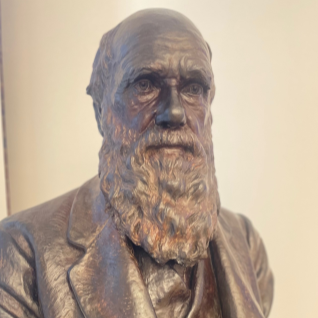
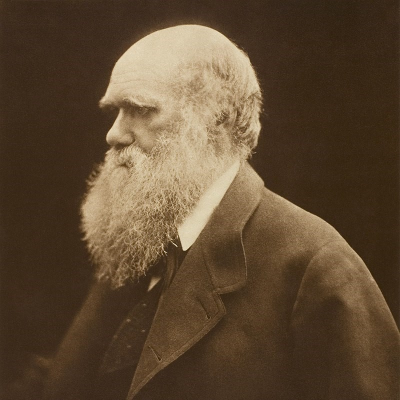
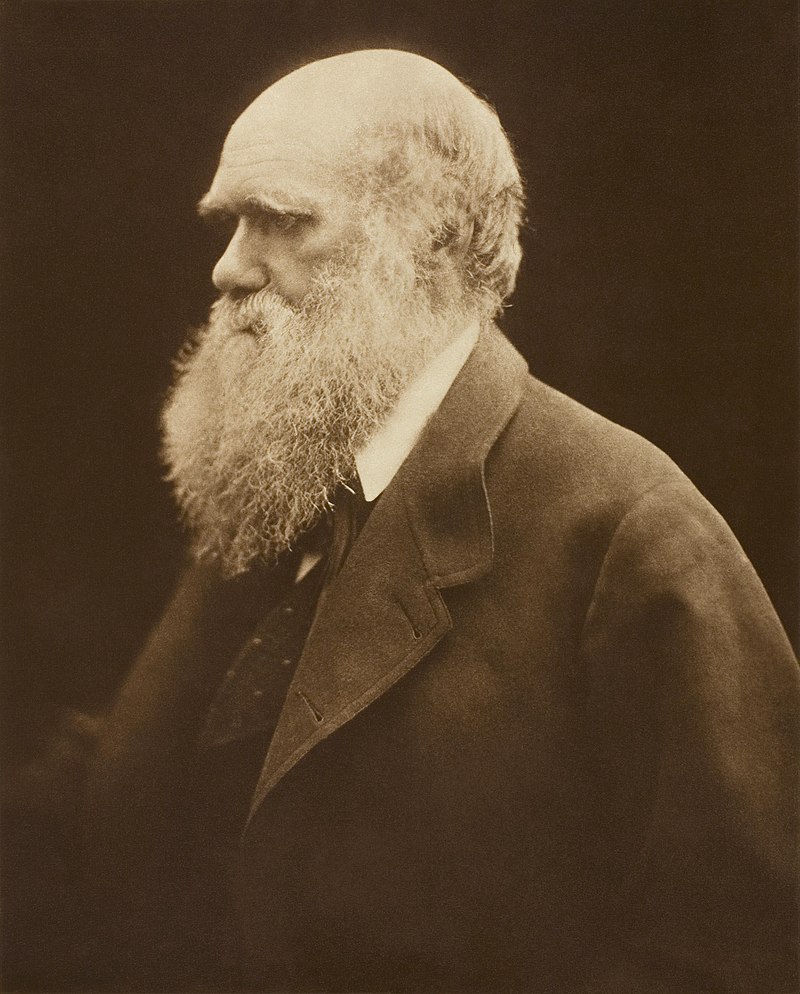
Charles Darwin in 1868. Image courtesy of Wikimedia Commons.

“I came neither to praise Darwin nor to bury him,” Marc Kirschner, founder and chair of the department of systems biology at Harvard Medical School, told an overflow crowd on January 25, 2006, as part of the Readers and Writers lecture series at The New York Academy of Sciences (the Academy). Kirschner, coauthor with John Gerhart of The Plausibility of Life: Resolving Darwin’s Dilemma, said that his goal, in both the lecture and the book, was to achieve a middle ground, a way “to challenge Darwin in the name of buttressing the theory of evolution.”

Kirschner and Gerhart, a professor in the graduate school at the University of California at Berkeley, have long been plagued by a paradox in Darwin’s theory of natural selection, one that creationists and Intelligent Design proponents have used to cast doubt upon evolution as a whole: How it is that extraordinary complexity could have evolved from the accretion of tiny, supposedly random variations?

The answer, at least in part, is that the changes are not as random as they seem. “Even though science has shown that genetic variation is random,” Kirschner told his audience, “phenotypic variation cannot be random—because you can only change what already exists.” You never see a vertebrate with six limbs, he said; some mechanism limits the number of limbs to four, and the number of digits to five. “Yet these limits are hardly very constraining,” Kirschner noted, “generating everything from a whale’s flipper to Artur Rubenstein’s hand.”

The Theory of Facilitated Variation

The constraints on phenotypic variation, “rather than being limiting, greatly enable evolutionary change,” Kirschner said. In his talk, he related how he and Gerhart developed a new theory to explain complexity, which they call the theory of facilitated variation.

As background, Kirschner began by describing the two different paths that biology was taking around the time of Darwin’s publication of The Origin of Species: the fascination with variation that led to the zoos and natural history museums of the late 19th and early 20th century; and the simultaneous realization, with the growth of cell biology and embryology, that much of life is characterized not by differences, but by similarities.

“So where does this leave us?” asked Kirschner. “Two paths in science, one extolling the variety of life, the other obsessed with its universal properties. Herein lies a paradox: how can this immense variation arise from this universality?”

This is where facilitated variation comes in. Kirschner used an analogy borrowed from the kindergarten classroom to explain how his and Gerhart’s theory differs from evolutionary theory up to this point. Traditionally, he said, biologists have compared life to a lump of modeling clay, “incredibly plastic, and able—due to the accrual of many small changes—to go in any direction.” But this is the wrong metaphor, he said. In truth, life is more like a bunch of Lego blocks. As with Legos, the basic building blocks of biology are rigid and quite similar to one another, but “there is a large variety of structures that can be assembled from similar parts.”

If You Give a Monkey a Typewriter

Another way of looking at it, Kirschner said, is to try to imagine trying to get a monkey to write the word “MONKEY.” You could do so by giving the monkey a pen and paper, but that would never work—all you’d get would be “random lines and scratches.” But if you gave him a typewriter, then you might be getting somewhere.

It would take a very long time (Kirschner calculated about ten years, typing at the rate of one keystroke per second round-the-clock), but the monkey would eventually produce all six letters in the right order, because the typewriter restricts the results of his physical actions—always letters instead of scribble-scrabble. “Letters have at least a chance to be useful,” Kirschner said. “Most pen scratches to do not.”

If, instead of a typewriter, the monkey was pounding on a computer keyboard programmed with an automatic spelling corrector, the time it would take for him to type out the word “MONKEY” would be reduced dramatically, from ten years to probably less than a single day. “More constraint equals more useful outcomes,” Kirschner said.

The point is that something similar seems to be at work in nature. Facilitated variation works like that computer spell-checker, leading to “a coordination of conserved processes that are highly adaptive and facile in situations that require change.”

Consider the evolution of limbs. Among vertebrates, Kirschner said, limbs can be “as varied as the wings of an albatross, the hooves of an antelope, and the claws of a tiger.” How could such a vast array have evolved from small and random variations? By having a certain logic to the variations, said Kirschner, something “quite ingenious, simple, and forgiving.”

Gene Feedback Inhibition and Tissue Morphogenesis

Complexity in multicellular organisms—changes and refinements in beak shape, pigmentation, jaw structure, limb formation—can be explained, he said, by forces involved in “changing the time and extent of a process rather than creating a new process.” The forces are those that have been uncovered recently in the field of molecular biology, such as gene feedback inhibition, and the field of developmental biology, such as tissue morphogenesis. They help account for the surprising fact that the human genome isn’t much bigger than the genome of a frog or a fruit fly. The vast differences among these organisms are accounted for not by number of genes, he said, but by how the genes are expressed.

“In multicellular organisms, the same few genes must be reused in many different contexts,” said Kirschner. “The organism has liberated itself from a requirement that each gene has to operate in the same way in each anatomical region.” What this means for evolutionary theory is that even though the variations found in genes can be tiny, they can lead to big differences in the phenotype—and big differences in the appearance and behavior of complex organisms.

Understanding Embryonic Development

Kirschner said that the modern understanding of embryonic development can help explain how facilitated variation works. “Embryonic development is replete with cell types that have multiple options and ranges of options, such as the neural crest, that can form cartilage, nerve, and pigment,” he said. “Thus, changes in beak shape, pigmentation, or jaw structure can easily occur by changing the time and extent of a process rather than creating a new process.” In other words, the gene itself doesn’t have to be different; what changes is the timing or location of the gene’s expression.

The theory of facilitated variation, as outlined in The Plausibility of Life, is a new way of synthesizing the first two pillars of Darwin’s theory of evolution, natural selection and genetics, Kirschner said. He quoted a colleague who once told him that in the future, the only way to teach evolution would be through the explanatory lens of facilitated variation. “Any other approach,” Kirschner’s colleague told him, “would seem like an arbitrary selection of ‘Just-So Stories.'”

About the Speaker

Marc Kirschner, PhD, is founding chair of the department of systems biology at Harvard Medical School. His laboratory investigates three broad, diverse areas: regulation of the cell cycle, the role of cytoskeleton in cell morphogenesis, and mechanisms of establishing the basic vertebrate body plan.

Kirschner was elected Foreign Member of the Royal Society of London and a Foreign Member of the Academia Europaea in 1999. He was the 2001 recipient of the William C. Rose Award, presented by the American Society for Biochemistry and Molecular Biology. He received a 2001 International Award by the Gairdner Foundation of Toronto. He is a member of the National Academy of Sciences and the American Academy of Arts and Sciences, and has served on the advisory committee to the director of the National Institutes of Health and as president of the American Society for Cell Biology.

Kirschner arrived at Harvard Medical School in 1993 from the University of California, San Francisco, where he had served on the faculty as professor for fifteen years. He graduated from Northwestern University and received his PhD from the University of California, Berkeley. Following postdoctoral research at Berkeley and at the University of Oxford, he was appointed an assistant professor at Princeton University.

He and John Gerhart are coauthors of Cells, Embryos, and Evolution and The Plausibility of Life: Resolving Darwin’s Dilemma.

Also read: From the Annals Archive: How Darwin Upended the World

The Genius of Quantum Physicist Richard Feynman

Missives from Feynman in Perfectly Reasonable Deviations from the Beaten Track, a book of his letters edited by daughter Michelle Feynman, reveal his genius and wit. What was his contribution to the canon of 20th-century quantum physics?

Published February 3, 2006

By Chris H. Greene

Richard Feynman in 1959. Image via Wikimedia Commons.

“Science alone of all the subjects contains within itself the lesson of the danger of belief in the infallibility of the greatest teachers in the preceding generation … Learn from science that you must doubt the experts. As a matter of fact, I can also define science another way: Science is the belief in the ignorance of experts.”
— Richard Feynman, 1981

We all know the stories of Richard Feynman. He was at times a showman and a clown. He expressed irreverence toward prestigious, hoary organizations like the National Academy of Sciences and the Royal Swedish Academy of Sciences. The tragic death of his young wife during the time of the Manhattan Project became familiar to millions through the touching Matthew Broderick film, Infinity. But behind his public persona lay one of the truly independent and innovative minds of the 20th century. Richard Feynman felt an intense, personal need to see physical phenomena in his own terms, and from his own perspectives, using theories that he generated himself.

At the same time, Feynman’s theoretical constructs did not arrive on the planet like a bolt from nowhere. His most important contributions were ideas that were in some sense already “in the wind,” but his way of developing them into consistent theoretical descriptions of nature differed dramatically from methods popular at the time.

Paradoxical Infinities

It may seem surprising, but the theoretical program that resulted in Feynman’s 1965 Nobel Prize (also awarded that year to Julian Schwinger and Sin-Itiro Tomonaga) was not aimed so much at explaining the result of any particular experiment, as it was an attempt to resolve some of the apparently self-contradictory aspects of both classical and quantum electrodynamics theory. If you shake an electron, it radiates light waves, whose electric fields must in turn act back on the electron to lower its energy. But attempts to calculate this “radiative reaction force” led to infinities which were paradoxical and in clear contradiction with experience.

In Feynman’s doctoral thesis work with John Wheeler at Princeton, the two entertained fantastic possibilities in a desperate attempt to solve these paradoxical infinities. One peculiar notion that emerged was that if, in a certain sense, the classical fields are allowed to propagate backward in time, the paradoxes and the infinities appeared to be magically removed.

A variant of this idea survived when Feynman wrote down his quantum mechanical formulation of this problem, which he credits to Wheeler for originally tossing out: that the positron, the antiparticle of an electron, can be regarded as an ordinary electron moving backward in time. Surely you’re joking, Mr. Feynman! As fantastic and unbelievable as this idea seems when stated in words, when formulated mathematically it was found that a consistent theoretical framework emerged, without the troubling infinities.

Moreover, Feynman created a simple way for these complicated calculations to be carried out, which is still used today: first, draw lines that represent electrons, positrons, and photons moving forward and backward in time in different ways that can contribute to the process of interest. Then apply Feynman’s rules for translating each such Feynman diagram into a precise mathematical formula.

Quantum Electrodynamics

One of the most famous applications of Feynman’s quantum electrodynamics was his calculation of a tiny frequency difference between two nearly identical energy levels (2S1/2 and 2P1/2) of the simplest atom, hydrogen. Willis Lamb and Robert C. Retherford had caused a stir in 1947 when they measured this frequency difference to be 1057 million cycles per second (MHz), because the then-accepted theory of Paul Dirac suggested that this difference should be identically zero. The methods for calculating this interaction between an atomic electron and the “vacuum-fluctuating electric fields of free space” gave infinity, a useless result entirely irrelevant to the experiment.

Using the Feynman calculus, however, a result very close to the experimental frequency splitting (the so-called “Lamb shift”) was obtained. In the intervening decades, both experiment and theory have improved, and we now know this Lamb shift experimentally to be 1057.8447 (plus or minus 0.0034) MHz, while theory based on Feynman’s work predicts 1057.839 (plus or minus 0.006) MHz.

Within experimental uncertainties, and within theoretical uncertainties associated with our imperfect understanding of the proton’s nuclear structure, these agree. Nature thus confirms the remarkable synthesis of theoretical ideas into working quantum electrodynamics, achieved by Feynman, as well as by Schwinger and by Tomonaga.

Advancing the World of Theoretical Physics

And what are we to take from these strange notions? Are positrons really just electrons moving backward in time? Feynman tended to dismiss such queries as having no more relevance to physics than debates about how many angels fit on the head of a pin. Here is one more example where the equations developed by theoretical physicists, after extensive testing, are the bottom line. Seemingly bizarre philosophical implications, when those equations are stated in words (such as “particles moving backward in time”), do not matter a whit. What matters from the physicist’s perspective is the explanatory and predictive power of the resulting theory.

In the end, Feynman’s work parallels eerily the way the “luminiferous aether” was abandoned as irrelevant, once physicists accepted around the beginning of the 20th century that Maxwell’s equations by themselves adequately describe all classical phenomena of electricity and magnetism. And it is similar to the way Einstein’s equations of relativity, and the peculiar quantum theory, were accepted despite their troubling, almost nonsensical implications for how we think about time, space, and reality. As Niels Bohr wrote and was quoted in Wheeler and Feynman’s 1945 Reviews of Modern Physics article:

We must, therefore, be prepared to find that further advance…will require a still more extensive renunciation of features which we are accustomed to demand of the space time mode of description.

The world of theoretical physics is better today because Richard Feynman was brave enough to contemplate and develop ideas that required such a renunciation.

Also read: The Challenge of Quantum Error Correction

Lee Smolin: A Crisis in Fundamental Physics

With an infinity of universes proposed, and more than 10400 theories, is experimental proof of physical laws still feasible?

Published January 1, 2006

By Lee Smolin

Image courtesy of WP_7824 via stock.adobe.com.

For more than two hundred years, we physicists have been on a wild ride. Our search for the most fundamental laws of nature has been rewarded by a continual stream of discoveries. Each decade back to 1800 saw one or more major additions to our knowledge about motion, the nature of matter, light and heat, space and time. In the 20th century, the pace accelerated dramatically.

Then, about 30 years ago, something changed. The last time there was a definitive advance in our knowledge of fundamental physics was the construction of the theory we call the standard model of particle physics in 1973. The last time a fundamental theory was proposed that has since gotten any support from experiment was a theory about the very early universe called inflation, which was proposed in 1981.

Since then, many ambitious theories have been invented and studied. Some of them have been ruled out by experiment. The rest have, so far, simply made no contact with experiment. During the same period, almost every experiment agreed with the predictions of the standard model. Those few that didn’t produced results so surprising—so unwanted—that baffled theorists are still unable to explain them.

The Gap Between Theory and Experiment

The growing gap between theory and experiment is not due to a lack of big open problems. Much of our work since the 1970s has been driven by two big questions: 1) Can we combine quantum theory and general relativity to make a quantum theory of gravity? and 2) Can we unify all the particles and forces, and so understand them in terms of a simple and completely general law? Other mysteries have deepened, such as the question of the nature of the mysterious dark energy and dark matter.

Traditionally, physics progressed by a continual interplay of theory and experiment. Theorists hypothesized ideas and principles, which were explored by stating them in precise mathematical language. This allowed predictions to be made, which experimentalists then test. Conversely, when there is a surprising new experimental finding, theorists attempt to model it in order to test the adequacy of the current theories.

There appears to be no precedent for a gap between theory and experiment lasting decades. It is something we theorists talk about often. Some see it as a temporary lull and look forward to new experiments now in preparation. Others speak of a new era in science in which mathematical consistency has replaced experiment as the final arbiter of a theory’s correctness. A growing number of theoretical physicists, myself among them, see the present situation as a crisis that requires us to reexamine the assumptions behind our so-far unsuccessful theories.

I should emphasize that this crisis involves only fundamental physics—that part of physics concerned with discovering the laws of nature. Most physicists are concerned not with this but with applying the laws we know to under standard control myriads of phenomena. Those are equally important endeavors, and progress in these domains is healthy.

Contending Theories

Since the 1970s, many theories of unification have been proposed and studied, going under fanciful names such as preon models, technicolor, supersymmetry, brane worlds, and, most popularly, string theory. Theories of quantum gravity include twistor theory, causal set models, dynamical triangulation models, and loop quantum gravity. One reason string theory is popular is that there is some evidence that it points to a quantum theory of gravity.

One source of the crisis is that many of these theories have many freely adjustable parameters. As a result, some theories make no predictions at all. But even in the cases where they make a prediction, it is not firm. If the predicted new particle or effect is not seen, theorists can keep the theory alive by changing the value of a parameter to make it harder to see in experiment.

The standard model of particle physics has about 20 freely adjustable parameters, whose values were set by experiment. Theorists have hoped that a deeper theory would provide explanations for the values the parameters are observed to take. There has been a naive, but almost universal, belief that the more different forces and particles are unified into a theory, the fewer freely adjustable parameters the theory will have.

Parameters

This is not the way things have turned out. There are theories that have fewer parameters than the standard model, such as technicolor and preon models. But it has not been easy to get them to agree with experiment. The most popular theories, such as supersymmetry, have many more free parameters—the simplest supersymmetric extension of the standard model has 105 additional free parameters. This means that the theory is unlikely to be definitively tested in upcoming experiments. Even if the theory is not true, many possible outcomes of the experiments could be made consistent with some choice of the parameters of the theory.

String theory comes in a countably infinite number of versions, most of which have many free parameters. String theorists speak no longer of a single theory, but of a vast “landscape1” of possible theories. Moreover, some cosmologists argue for an infinity of universes, each of which is governed by a different theory.

A tiny fraction of these theories may be roughly compatible with present observation, but this is still a vast number, estimated to be greater than 10400 theories. (Nevertheless, so far not a single version consistent with all experiments has been written down.) No matter what future experiments see, the results will be compatible with vast numbers of theories, making it unlikely that any experiment could either confirm or falsify string theory.

A New Definition of Science

This realization has brought the present crisis to a head. Steven Weinberg and Leonard Susskind have argued for a new definition of science in which a theory maybe believed without being subject to a definitive experiment whose result could kill it. Some theorists even tell us we are faced with a choice of giving up string theory—which is widely believed by theorists—or giving up our insistence that scientific theories must be testable. As Steven Weinberg writes in a recent essay: [2]

Most advances in the history of science have been marked by discoveries about nature, but at certain turning points we have made discoveries about science itself…Now we may be at a new turning point, a radical change in what we accept as a legitimate foundation for a physical theory…The larger the number of possible values of physical parameters provided by the string landscape, the more string theory legitimates anthropic reasoning as a new basis for physical theories: Any scientists who study nature must live in a part of the landscape where physical parameters take values suitable for the appearance of life and its evolution into scientists.

An Infinity of Theories

Among an infinity of theories and an infinity of universes, the only predictions we can make stem from the obvious fact that we must live in a universe hospitable to life. If this is true, we will not be able to subject our theories to experiments that might either falsify or count as confirmation of them. But, say some proponents of this view, if this is the way the world is, it’s just too bad for outmoded ways of doing science. Such a radical proposal by such justly honored scientists requires a considered response.

I believe we should not modify the basic methodological principles of science to save a particular theory—even a theory that the majority of several generations of very talented theorists have devoted their careers to studying. Science works because it is based on methods that allow well-trained people of good faith, who initially disagree, to come to consensus about what can be rationally deduced from publicly available evidence. One of the most fundamental principles of science has been that we only consider as possibly true those theories that are vulnerable to being shown false by doable experiments.

Contending Styles of Research

I think the problem is not string theory, per se. It goes deeper, to a whole methodology and style of research. The great physicists of the beginning of the 20th century—Einstein, Bohr, Mach, Boltzmann, Poincare, Schrodinger, Heisenberg—thought of theoretical physics as a philosophical endeavor. They were motivated by philosophical problems, and they often discussed their scientific problems in the light of a philosophical tradition in which they were at home. For them, calculations were secondary to a deepening of their conceptual understanding of nature.

After the success of quantum mechanics in the 1920s, this philosophical way of doing theoretical physics gradually lost out to a more pragmatic, hard-nosed style of research. This is not because all the philosophical problems were solved: to the contrary, quantum theory introduced new philosophical issues, and the resulting controversy has yet to be settled. But the fact that no amount of philosophical argument settled the debate about quantum theory went some way to discrediting the philosophical thinkers.

It was felt that while a philosophical approach may have been necessary to invent quantum theory and relativity, thereafter the need was for physicists who could work pragmatically, ignore the foundational problems, accept quantum mechanics as given, and go on to use it. Those who either had no misgivings about quantum theory or were able to put their misgivings to one side were able in the next decades to make many advances all over physics, chemistry, and astronomy.

The shift to a more pragmatic approach to physics was completed when the center of gravity of physics moved to the United States in the 1940s. Feynman, Dyson, Gell-Mann, and Oppenheimer were aware of the unsolved foundational problems, but they taught a style of research in which reflection on them had no place in research.

Physics in the 1970s

By the time I studied physics in the 1970s, the transition was complete. When we students raised questions about foundational issues, we were told that no one understood them, but it was not productive to think about that. “Shut up and calculate,” was the mantra. As a graduate student, I was told by my teachers that it was impossible to make a career working on problems in the foundations of physics. My mentors pointed out that there were no interesting new experiments in that area, whereas particle physics was driven by a continuous stream of new experimental discoveries. The one foundational issue that was barely tolerated, although discouraged, was quantum gravity.

This rejection of careful foundational thought extended to a disdain for mathematical rigor. Our uses of theories were based on rough-and-ready calculation tools and intuitive arguments. There was in fact good reason to believe that the standard model of particle physics is not mathematically consistent at a rigorous level. As a graduate student at Harvard, I was taught not to worry about this because the contact with experiment was more important. The fact that the predictions were confirmed meant that something was right, even if there might be holes in the mathematical and conceptual foundations, which someone would have to fix later.

The Disappearance of Contact with Experiment

In retrospect, it seems likely that this style of research, in which conceptual puzzles and issues of mathematical rigor were ignored, can only succeed if it is tightly coupled to experiment. When the contact with experiment disappeared in the 1980s, we were left with an unprecedented situation.

The string theories are understood, from a mathematical point of view, as badly as the older theories, and most of our reasoning about them is based on conjectures that remain unproven after many years, at any level of rigor. We do not even have a precise definition of the theory, either in terms of physical principles or mathematics. Nor do we have any reasonable hope to bring the theory into contact with experiment in the foreseeable future. We must ask how likely it is that this style of research can succeed at its goal of discovering new laws of nature.

It is difficult to find yourself in disagreement with the majority of your scientific community, let alone with several heroes and role models. But after a lot of thought I’ve come to the conclusion that the pragmatic style of research is failing. By 1980, we had probably gone as far as we could by following this pragmatic, antifoundational methodology.

If we have failed to solve the key problems of quantum gravity and unification in a way that connects to experiment, perhaps these problems cannot be solved using the style of research that we theoretical physicists have become accustomed to. Perhaps the problems of unification and quantum gravity are entangled with the foundational problems of quantum theory, as Roger Penrose and Gerard t’Hooft think. If they are right, thousands of theorists who ignore the foundational problems have been wasting their time.

Unification and Quantum Gravity

There are approaches to unification and quantum gravity that are more foundational. Several of them are characterized by a property we call background independence. This means that the geometry of space is contingent and dynamical; it provides no fixed background against which the laws of nature can be defined. General relativity is background-independent, but standard formulations of quantum theory—especially as applied to elementary particle physics—cannot be defined without the specification of a fixed background. For this reason, elementary particle physics has difficulty incorporating general relativity.

String theory grew out of elementary particle physics and, at least so far, has only been successfully defined on fixed backgrounds. Thus, the infinity of string theories which are known are each associated with a single space-time background.

Those theorists who feel that theories should be background-independent tend to be more philosophical, more in the tradition of Einstein. The pursuit of background-independent approaches to quantum gravity has been pursued by such philosophically sophisticated scientists as John Baez, Chris Isham, Fotini Markopoulou, Carlo Rovelli, and Raphael Sorkin, who are sometimes even invited to speak at philosophy conferences. This is not surprising, because the debate between those who think space has a fixed structure and those who think of it as a network of dynamical relationships goes back to the disputes between Newton and his contemporary, the philosopher Leibniz.

Meanwhile, many of those who continue to reject Einstein’s legacy and work with background-dependent theories are particle physicists who are carrying on the pragmatic, “shut-up-and calculate” legacy in which they were trained. If they hesitate to embrace the lesson of general relativity that space and time are dynamical, it may be because this is a shift that requires some amount of critical reflection in a more philosophical mode.

A Return to the Old Style of Research

Thus, I suspect that the crisis is a result of having ignored foundational issues. If this is true, the problems of quantum gravity and unification can only be solved by returning to the older style of research.

How well could this be expected to turn out? For the last 20 years or so, there has been a small resurgence of the foundational style of research. It has taken place mainly outside the United States, but it is beginning to flourish in a few centers in Europe, Canada, and elsewhere. This style has led to very impressive advances, such as the invention of the idea of the quantum computer. While this was suggested earlier by Feynman, the key step that catalyzed the field was made by David Deutsch, a very independent, foundational thinker living in Oxford.

For the last few years, experimental work on the foundations of quantum theory has been moving faster than experimental particle physics. And some leading experimentalists in this area, such as Anton Zeilinger, in Vienna, talk and write about their experimental programs in the context of the philosophical problems that motivate them.

Currently, there is a lot of optimism and excitement among the quantum gravity community about approaches that embrace the principle of background independence. One reason is that we have realized that some current experiments do test aspects of quantum gravity; some theories are already ruled out and others are to be tested by results expected soon.

Collective Phenomena

A notable feature of the background independent approaches to quantum gravity is that they suggest that particle physics, and even space-time itself, emerge as collective phenomena. This implies a reversal of the hierarchical way of looking at science, in which particle physics is the most “fundamental” and mechanisms by which complex and collective behavior emerge are less fundamental.

So, while the new foundational approaches are still pursued by a minority of theorists, the promise is quite substantial. We have in front of us two competing styles of research. One, which 30 years ago was the way to succeed, now finds itself in a crisis because it makes no experimental predictions, while another is developing healthily, and is producing experimentally testable hypotheses. If history and common sense are any guide, we should expect that science will progress faster if we invest more in research that keeps contact with experiment than in a style of research that seeks to amend the methodology of science to excuse the fact that it cannot make testable predictions about nature.

Also read: What Physics Tells Us About the World

References

1 Smolin, L. 1997. The Life of the Cosmos. Oxford University Press.

2 Weinberg, S. 2005. Living in the multiverse.

Further Reading

Smolin, L. 2006. The Trouble with Physics: The Rise of String Theory, the Fall of a Science, and What Comes Next. Houghton Mifflin, New York.

Woit, P. 2006. Not Even Wrong: The Failure of String Theory and the Search for Unity in Physical Law. Basic Books, New York.


About the Author

Lee Smolin is a theoretical physicist who has made important contributions to the search for quantum theory of gravity. He is a founding researcher at the Perimeter Institute for Theoretical Physics in Waterloo, Ontario. He is the author of Life of the Cosmos (Oxford, 1997), Three Roads to Quantum Gravity (Orion, 2001), and the forthcoming, The Trouble with Physics (Houghton Mifflin, 2006).

Reef Madness and the Meaning of Coral

While the nineteenth century’s greatest scientific debate was that over Charles Darwin’s theory of evolution, the century’s other great scientific debate, almost forgotten now, posed problems even more vexing than the species question did.

Published November 11, 2005

By David Dobbs

Image courtesy of Chonlasub via stock.adobe.com.

The Other Debate of Darwin’s day

Asked to name the 19th century’s major scientific squabble, most people will correctly name the row over Darwinism. Few recall the era’s other great debate—regarding the coral reef problem—even though it was nearly as fierce as that over the species problem. The reef debate saw many of the same philosophical issues contested by many of the same players. These included Charles Darwin, the naturalist Louis Agassiz, and Alexander Agassiz, an admirer of the former and the son of the latter. Their tangled struggle is one of the strangest tales in science.

The clash over Darwin’s species theory was partly one between empiricism, as represented by Darwin’s superbly documented Origin of Species, and the idealist or creationist natural science dominant before then. Louis Agassiz, the Swiss-born naturalist who became the leading light of American science after moving to the United States in 1846, offered a particularly seductive articulation of creationist theory. He held huge audiences spellbound as he explained how nature’s patterned complexity could only have sprung from a single, divine intelligence. A species, he said, was “a thought of God.” His elegant description made him a giant of American science, the director of Harvard’s new Museum of Comparative Zoology, and a man of almost unrivaled fame.

But the publication of Origin, in 1859, confronted Agassiz’s idealist creationism with an empirically robust naturalistic description of species origin. Though Agassiz opposed Darwin’s theory vigorously, his colleagues increasingly took Darwin’s view, and by 1870, Louis Agassiz was no longer taken seriously by his peers. He could hardly have fallen further.

A Son

Louis’s only son, Alexander, came of age watching this fall. Smart and careful as child and man—he began his scientific career as an assistant at the Museum of Comparative Zoology and would manage it after his father died—Alexander seemed determined to avoid his father’s excesses. Where Louis was profligate, Alexander was frugal. Where Louis was expansive and extroverted, Alex was reserved and liked to work in private. And where Louis favored a creationist theory based on speculation, Alex preferred the empirical approach established by Darwin.

By the age of 35, Alexander Agassiz had created a happy life. He loved his work at the museum, his wife and three children, and by investing in and for 18 months managing a copper mine in Michigan, he had made himself quite rich. Yet his luck changed in 1873. Louis, then 63, died of a stroke two weeks before Christmas. Ten days later, Alex’s wife, Anna Russell Agassiz, died of pneumonia.

Alexander Agassiz. Image via Wikimedia Commons

Wanderings and Reefs

Devastated by this double blow, Alex spent three years mostly traveling, mortally depressed. He felt able to “get back in harness,” as he put it, only when, in 1876, he engaged the coral reef problem. How did these great structures, built from the skeletons of animals that could grow only in shallow water, come to occupy platforms rising from the ocean’s depths? Naturalists had discerned in the early 1800s how corals grew, but the genesis of their underlying platforms remained obscure.

The prevailing explanation, first offered in 1837, held that coral reefs formed on subsiding islands. The coral first grew along shore, forming fringing reefs. As the island sank and lagoons opened between shore and reef, fringing reef became barrier reef. When the island sank out of sight, barrier reef became atoll. Thus this subsidence theory, as it was known, explained all main reef forms.

Alex, drawn to this problem by his friend Sir John Murray, a prominent Scottish oceanographer, thought the subsidence theory was just a pretty story. The theory rested on little other than the reef forms, while considerable evidence, such as the geology of many islands and most reef observations made during the mid-1800s, argued against it. Now Murray, who had just returned from a five-year oceanographic expedition aboard the HMS Challenger, told Alex of an alternative possibility. Murray had discovered that enough plankton floated in tropical waters to create a rain of planktonic debris that, given geologic time, could raise many submarine mountains up to shallows where coral reefs could form.

Alex immediately liked this idea, for it rose from close observation rather than conceptual speculation and relied on known rather than conjectural forces. Inspired for the first time since his wife’s death three years before, he began designing an extensive field research program to prove it.

There was only one problem: the person who had authored the subsidence theory was Charles Darwin.

Thirty Years of Fieldwork

Darwin had posited the subsidence theory as soon as he returned from the Beagle voyage in 1837. Like his evolution theory, it was a brilliant synthesis that explained many forms as the result of incremental change. But it did not rest on the sort of careful, methodical accumulation of evidence that underlay his evolutionary theory. Darwin conceived it before he ever saw a coral reef and published it when he’d seen only a few.

Yet the theory explained so much that it had launched Darwin’s career. Since then, of course, Darwin had developed his evolution theory, destroyed Louis’s career, and become the most renowned and powerful man in science. Alex knew he was courting trouble when he decided to champion an alternate theory. But he couldn’t resist such an enticing problem. And he firmly believed that Darwin had muffed it.

Alex spent much of the next 30 years collecting evidence. He developed a complicated and nuanced theory holding that different forces, primarily a Murray-esque accrual, erosion, some uplift, and occasionally some subsidence, combined in different ways to create the world’s different reef formations. He found evidence in every major reef formation on the globe. And so as the century ended, an Agassiz again faced Darwin (or Darwin’s legacy, for Darwin had died in 1882). Only this time the Agassiz held the empirical evidence and Darwin the pretty story.

Yet Alex hesitated to publish, even after he completed his fieldwork in 1903. Every year, Murray would ask Alex about the reef book. Every year Alex would say the latest draft hadn’t worked, but that he had found a better approach and would soon finish.

The last time he told Murray this was in 1910, when they met in London before Alex sailed home to the U.S. after a winter in Paris. On the fifth night out of Southampton, he died in his sleep. Murray, hearing the news by cable a couple days later, was much aggrieved—and stunned to hear what followed. A thorough search had found no sign of the coral reef book. It was, Alexander’s son George later wrote, “an excellent example of his habit of carrying his work in his head until the last minute.”

One Irony Among Many

The coral reef debate didn’t end until 1951, when U.S. government geologists surveying Eniwetok, a Marshall Islands atoll, prior to a hydrogen bomb test there, finally drilled deep enough to resolve the mystery. If Darwin was right about reefs accumulating atop their sinking foundations, the drill should pass through at least several hundred feet of coral before hitting the original underlying basalt. If Agassiz was right, the drill would go through a relatively thin veneer of coral before hitting basalt or marine limestone.

It speaks of the power of Alexander’s work that the reef expert directing the drilling, Harry Ladd, expected to prove Agassiz right. But the power of Darwin’s work was such that as the drill spun deep, it passed through not a few dozen or even a few hundred feet, but through some 4,200 feet of coral before striking basalt. Darwin was right, Agassiz wrong.

How did Alex miss this? In retrospect, geologists can identify various observational mistakes Alexander made. But Alex’s bigger problem was his singular place in the profound changes science underwent in the 1800s. Natural science in particular was struggling to define an empirical theoretical method. Alex played by the rules that most scientists, including Darwin, swore to: a Baconian inductivism that built theory atop accrued stacks of observed facts.

In reality, most scientists come to their theories through deductive leaps, then try to prove them by amassing evidence. A theory’s value rests not on its genesis, but on its proof. Today this is accepted and indeed codified as the “hypothetico-deductive method,” and its resulting theories are considered empirical as long as their proof lies in replicable evidence. But in Alex’s day, when pretty stories built on leaps of imagination spoke of reactionary creationism rather than creative empiricism, such theorizing was called speculation, and it was a four-letter word.

Alexander Agassiz was keenly sensitive to the dangers of such work. Yet his singular position fated him to take up a question that not only lay beyond the tools of his time, but which trapped him in the era’s most confounding difficulties of method and philosophy. He sought a solution that belonged to another age.

About the Author

David Dobbs is author of Reef Madness: Charles Darwin, Alexander Agassiz, and the Meaning of Coral, from which this lecture is drawn. You can find more of his work at daviddobbs.net.