A former Blavatnik National Awards Laureate has paid it forward with a prize recognizing scientific excellence in his home country.
Published August 6, 2025
By Kamala Murthy
2014 Blavatnik National Awards Laureate, Marin Soljačić congratulates Pia Pilipović, winner of the 2025 Soljačić Prize. Credit: https://mzom.gov.hr/vijesti/7141
Massachusetts Institute of Technology physicist and 2014 Blavatnik National Awards Laureate Marin Soljačić established the Soljačić Prize in his home country of Croatia. He used part of his $250,000 unrestricted prize money from the Blavatnik Award to create a prize that recognizes exceptional Croatian high school graduates in mathematics and physics, awarding $5,000 annually to outstanding students.
“When I established this prize, there were few such award programs in Croatia, especially for young students – in the USA they are much more common,” said Prof. Soljačić. “The Blavatnik Awards and other prizes played an important, encouraging role in my growth as a scientist, and I wanted to establish something like that for Croatian students. I also wanted to inspire other institutions and individuals to establish similar prizes in Croatia.”
The 2025 Soljačić Prize was awarded to Pia Pilipović, a graduating student from the XV Gymnasium, a school in Zagreb. The school has now produced seven Soljačić winners in the 11-year history of the award. Soljačić is also a graduate of the XV Gymnasium.
Pia interviewed for Croatian Television. Credit: DNEVNIK.HR (Croatia)
Pia delivered extraordinary results on the Croatian national high‑school exit exams (državna matura). She scored a perfect score on the physics and mathematics (A‑level) exams, while also achieving 91.82 % in Croatian language and 85.5 % in English. Her flawless performance in the most complex quantitative subjects earned her the Soljačić Prize.
The prize was formally presented during an award ceremony held at the Ministry of Science, Education and Youth in Zagreb on July 29, 2025. Pia stood among other top graduates receiving various honors.
From left: Len Blavatnik, Founder of the Blavatnik Family Foundation; Marin Soljačić, 2014 Blavatnik National Awards Laureate; Rachel Wilson, 2014 Blavatnik National Awards Laureate; Adam Cohen, 2014 Blavatnik National Awards Laureate; and Ellis Rubinstein, President Emeritus of The New York Academy of Sciences.
The 2025 Blavatnik Science Symposium, hosted by The New York Academy of Sciences, convened an extraordinary group of past and present Blavatnik Awards for Young Scientists honorees for two days of cross-disciplinary exchange and forward-looking discussion on science with real-world impact.
Published July 28, 2025
By Kamala Murthy
A group photo of the attendees at the 2025 Blavatnik Science Symposium. Photo by Nick Fetty/The New York Academy of Sciences.
Held at the Academy on July 14–15, the event spotlighted pioneering research in neuroscience, quantum computing, genetics, AI, immunology, materials science, and sustainability while also serving as a vibrant forum for forging new scientific collaborations.
A Welcome Return to In-Person Dialogue
Opening the symposium, Academy President and CEO Nicholas B. Dirks reflected on the power of community:
“This symposium is more than just presentations — it’s a chance to connect across disciplines and geographies,” he said. “Many creative collaborations have had their beginnings right here, sparked by informal conversations over coffee or during meals, and continued well beyond these two days.”
Dirks underscored the remarkable achievements of the Blavatnik Awards community, which now includes more than 500 scientists from 120 institutions. Collectively, they have secured over 7,300 patents and launched more than 50 companies.
Exploring the Frontiers of Science
(Left to Right) Markita Landry (UC Berkeley) and Moran Shalev-Benami (Weizmann Institute). Photo by Nick Fetty/The New York Academy of Sciences.
The symposium’s first day began with Session I: Insights Engineered from the Molecular World, where Markita Landry (UC Berkeley) introduced nanoscale fluorescent sensors for real-time imaging of neurotransmitters. She was followed by Moran Shalev-Benami (Weizmann Institute), who unveiled a new type of light-sensing protein discovered in Antarctic algae. Speaking virtually, Nieng Yan (Tsinghua University and Shenzhen Bay Laboratory) presented groundbreaking research from her lab on sodium channels that has provided the structural blueprint for non-addictive, non-opioid pain therapies, such as the FDA-approved Journavx.
Session II: Building the Future: Materials for a Sustainable Planet featured keynote talks from two innovators in materials science. Yi Cui (Stanford University), founder of Amprius Technologies, discussed advances in lithium battery chemistry that could quadruple energy density. Geoffrey Coates (Cornell University) shared real-world case studies where polymer science led to startups addressing plastic recycling and green hydrogen production.
The Entangled Realities session panel (left to right) Shruti Puri (Yale), Danna Freedman (MIT), Vinod Vaikuntanathan (MIT), and Ana Maria Rey (CU Boulder) answer questions from the audience. Photo by Nick Fetty/The New York Academy of Sciences.
Quantum science took center stage in Session III: Entangled Realities: How Quantum Ideas Are Reshaping Science, beginning with Danna Freedman (MIT), who presented her work designing molecular qubits. Shruti Puri (Yale University) followed with insights into how entanglement enables quantum fault-tolerance. Vinod Vaikuntanathan (MIT) explored lattice-based cryptography designed to resist quantum attacks, and Ana Maria Rey (University of Colorado) examined how photon-mediated atomic interactions can power next-generation quantum sensors.
In Session IV: Evolutionary Code Underlying Immunity and Inheritance, Harmit Malik (Fred Hutchinson Cancer Center /HHMI) explained how evolutionary “scars” reveal key antiviral defense mechanisms. Sohini Ramachandran (Brown University) addressed the ethical misuse of genetic research and advocated for emphasizing human genetic diversity. Ruslan Medzhitov (Yale/HHMI) offered an evolutionary lens to reframe our understanding of allergies.
A Community of Change-Makers
Day 2 opened with remarks from Sonya Dougal the Academy’s Senior Vice President of Awards & Scientific Programs, who spoke to the lasting connections fostered through the Blavatnik Awards:
“When you become a Blavatnik honoree, you become part of this distinguished and enduring community,” she said. “The ideas celebrated here often gain traction well beyond the lab, attracting investors, crossing into the commercial realm, and generating meaningful societal impact.”
Innovations Across the Brain, AI, and Planetary Science
The “Beyond the Breakthrough: Translating Innovation into Real-World Impact” panel (Left to Right) Edward Chang (UCSF), Viviana Gradinaru (Caltech), Yi Cui (Stanford University), Geoffrey Coates (Cornell University), and Chris Bregler (Google DeepMind). Photo by Nick Fetty/The New York Academy of Sciences.
Session V: Tuning the Brain with Microbes, Molecules, and Machines kicked off the second day’s talks. Edward Chang (UCSF), renowned for developing a brain implant that enabled a paralyzed man to speak, presented new work decoding the neural code of speech. Christoph Thaiss (Stanford/Arc Institute) examined how the brain integrates signals from both the body and the external environment. Viviana Gradinaru (Caltech) shared her lab’s decade-long efforts to engineer viral vectors that cross the blood-brain barrier—a technology now moving into human trials via her company, Capsida Biotherapeutics.
Keynote speaker Chris Bregler (Google DeepMind), a pioneer in AI-generated media and Academy Award winner for visual effects, reflected on the promises and perils of deepfakes. He then moderated a panel, Beyond the Breakthrough: Translating Innovation into Real-World Impact, featuring Edward Chang, Geoffrey Coates, Yi Cui, and Viviana Gradinaru. The panelists shared candid reflections on launching startups, consulting with venture capitalists, and turning research breakthroughs into scalable tools and treatments.
The final session, Observing the Universe: From Earth to the Stars, expanded the symposium’s view to planetary and environmental systems. Kaiyu Guan (University of Illinois at Urbana-Champaign) described how AI and satellite imaging are transforming agriculture and enabling the decarbonization of global supply chains. Rebecca Oppenheimer (American Museum of Natural History) highlighted recent discoveries of new, exotic extrasolar planetary systems. Britney Schmidt (Cornell University) detailed her team’s research in Greenland, where they used under-ice robotics to investigate how subglacial outflows are accelerating ice loss and ultimately influencing marine ecosystems.
Sohini Ramachandran (Brown University) presents on human genetic diversity. Photo by Nick Fetty/The New York Academy of Sciences. Edward Chang (UCSF) speaks about the development of his neuroprosthesis that has enabled paralyzed individuals to communicate through an AI interface. Photo by Nick Fetty/The New York Academy of Sciences.Britney Schmidt (Cornell University) discusses her under-ice robot, ICEFIN, in Greenland’s Glacier ice. Photo by Nick Fetty/The New York Academy of Sciences.Chris Bregler (Google DeepMind) speaks about AI and motion tracking technologies. Photo by Nick Fetty/The New York Academy of Sciences.Ruslan Medzhitov (Yale/HHMI) talks about why we suffer from allergies. Photo by Nick Fetty/The New York Academy of Sciences.
115 Broadway, 8th Floor, New York, NY 10006 or join virtually by Zoom
Join us for our Distinguished Lecture Series featuring speaker, Anand Pandian, and discussant, Robert Desjarlais.
As we now know, Americans have profoundly different ideas about what is real, ideas that sometimes verge on the irreconcilable. These notions depend on walls of the mind: stubborn boundaries that work to enforce particular points of view, as if each of us was stranded on some other island of idiosyncratic thought. Such divides may seem fleeting and intangible, but they are just as hard as any wall made of brick or concrete. Drawing on lessons from a recently published book—Something Between Us: The Everyday Walls of American Life, and How to Take Them Down—this talk will explore barriers that run through the experience of collective life in the United States, and what it takes instead to open our minds to the lives of others.
Speakers
Speaker
Dr. Anand Pandian
Krieger-Eisenhower Professor of Anthropology, Johns Hopkins University
Discussant
Robert Desjarlais
Professor of Anthropology, Sarah Lawrence College
Pricing
All: Free
About the Series
Since 1877, the Anthropology Section of The New York Academy of Sciences has served as a meeting place for scholars in the Greater New York area. The section strives to be a progressive voice within the anthropological community and to contribute innovative perspectives on the human condition nationally and internationally. Learn more and view other events in the Anthropology Section series.
From systemic political attacks on research and threats on academic freedom to the detrimental role of misinformation on public trust and the importance of international collaboration.
Published July 3, 2025
By Nick Fetty
Nicholas B. Dirks
Nicholas B. Dirks, President and CEO of The New York Academy of Sciences recently discussed the role politics will play in scientific and academic research going forward, not only in the United States but across the globe.
Dirks, alongside Ferry Breedveld, President of the Federation of European Academies of Medicine, discussed these matters in a recent episode of Karger in Conversation, a free quarterly online event series created by Karger Publishers, designed to bring together diverse voices from across the academic world, publishing, research, and industry. With Prof. Dirks providing an American perspective and Prof. Breedveld offering observations from Europe, the duo’s conversation covered everything from systemic political attacks on research and threats on academic freedom to the detrimental role of misinformation on public trust and the importance of international collaboration.
Highlights from the 2025 Blavatnik Awards for Young Scientists in Israel.

Published June 13, 2025
By Kamala Murthy
Against the backdrop of the Mediterranean Sea and the luminous Peres Center for Peace and Innovation in Tel Aviv, Israel, over one hundred preeminent scientific researchers, dignitaries, academics, business leaders, and supporters gathered on June 4, 2025, for an unforgettable evening honoring the future of science in Israel. The 2025 Blavatnik Awards for Young Scientists in Israel recognized three of the country’s most promising early-career researchers in the fields of Life Sciences, Chemical Sciences, and Physical Sciences & Engineering.

Now in its eighth year, the Blavatnik Awards in Israel ceremony was both a celebration of scientific discovery and a tribute to resilience. As the sun set over Jaffa and guests moved from the reception to the dinner ceremony, Israeli TV anchor Hila Korach, serving as the evening’s presenter, opened the event with a moving acknowledgment of the October 7th attacks and the remaining captivity of 58 Israeli hostages. The resilient spirit of the evening underscored a powerful message: even in the face of geopolitical hardship in the region, science continues to forge ahead as a force for good.
Welcoming the Laureates and Their Institutions with Fanfare
As trumpeters heralded the opening of the ceremony, flag bearers representing ten of Israel’s premier academic institutions led a procession onto the main stage, followed by this year’s three Laureates. These three outstanding scientists were selected from among 36 top nominees from universities and research institutions across Israel. The following scientists were recognized as Laureates at the ceremony, where they received medals and presented a captivating overview of their groundbreaking research:
Professor Yonatan Stelzer (Weizmann Institute of Science) – Life Sciences
Dr. Benjamin Palmer (Ben-Gurion University of the Negev) – Chemical Sciences
Professor Chaim Garfinkel (Hebrew University of Jerusalem) – Physical Sciences & Engineering
“Laureates, we know you will triumph! We believe in you!”
The flag procession was followed by a dramatic vocal performance of the song “Believer” sung by a youth ensemble from the Artik Music School. The musical performance was designed to inspire guests to be believers in science, with resilience being the key to success.
Science, Hope, and Prosperity
The Blavatnik Award’s two administrative partners underscored the program’s mission to empower young scientists at a pivotal point in their careers when recognition and support can significantly impact their lives as scientists. In his heartfelt remarks, Professor David Harel, President of the Israel Academy of Sciences and Humanities, emphasized the urgent need to protect the freedom and integrity of academic inquiry in science, particularly in politically and culturally challenging times. Nicholas Dirks, President & CEO of The New York Academy of Sciences, spoke to the 18-year success story of the Blavatnik Awards, leading it to become one of the most prestigious international science prizes for early-career scientists. Dirks also emphasized how the Blavatnik Awards have helped drive economic prosperity, turning $20 million in collective prize money into $2.4 billion in market capitalization, with over 50 companies founded by past Blavatnik Scholars, including six companies that are publicly traded.
A recorded message from Israel’s President Isaac Herzog served as a reminder that the Blavatnik Awards in Israel are in addition to being a tribute to three brilliant scientists from Israeli institutions are also a declaration of unwavering faith in science as a beacon of light in turbulent times. Herzog quoted Israel’s first President, Chaim Weizmann: “I trust and feel sure in my heart that science will bring to this land both peace and a renewal of its youth.” A moving performance by Israeli musical icon Aviv Geffen further added to the evening’s theme of hope and determination, echoing the national longing for unity, peace, and progress.
Israel’s Scientific Excellence on Display
Life Sciences Laureate, Yonatan Stelzer, PhD, from the Weizmann Institute of Science transported the audience into the remarkable world of embryonic development. His lab’s pioneering models of mammalian cell differentiation offer profound insight into how identical cells diversify into complex organisms—knowledge that holds transformative potential for regenerative medicine.
Physical Sciences & Engineering Laureate, Chaim Garfinkel, PhD, from the Hebrew University in Jerusalem, followed with a dynamic exploration of climate modeling. He illuminated the atmospheric mechanisms that influence extreme weather events and detailed how improving prediction models can save lives and guide global climate policy.
Finally, Chemical Sciences Laureate, Benjamin Palmer, PhD, from Ben-Gurion University in the Negev, captivated attendees with a dazzling look into organic biomineralization. Studying how creatures like shrimp and plankton create reflective crystals, his lab is revealing new paths to develop sustainable optical materials that may one day replace conventional, toxic alternatives like titanium dioxide.
A Toast to Science and the Future
The evening concluded with a celebratory toast as the Laureates joined Professors Harel and Dirks on stage. Guests lifted their glasses with a collective “L’chaim!” — to science, to knowledge, and to a better future for the region.
The day prior, the 2025 Laureates presented their research at a public symposium held at the Israel Academy of Sciences and Humanities in Jerusalem. 2019 Blavatnik Awards in Israel Laureate Professor Michal Rivlin from the Weizmann Institute delivered the opening symposium lecture. Among the attendees were members of the public and STEM high school students from several regional high schools near Jerusalem.
The 2025 Blavatnik Awards ceremony venue overlooking the Mediterranean Sea.From left: 2025 Blavatnik Awards Israel Laureates: Benjamin Palmer, Yonatan Stelzer, Chaim Garfinkel.From left: Peter Thoren of the Blavatnik Family Foundation; British Economist and Author Noreena Hertz with spouse Danny Cohen of Access Industries; Avi Fischer of Clal Industries.From left: Lisa Shields of Access Industries with Sonya Dougal from The New York Academy of Sciences.President of the Israel Academy of Sciences and Humanities, Professor David Harel.Yonatan Stelzer, Life Sciences Laureate, speaking about his research in embryonic development and epigenetics.Life Sciences Laureate, Benjamin Palmer describes the process of organic biomineralization.Chaim Garfinkel, Physical Sciences & Engineering Laureate gives his talk on climate modeling.L’Chaim, a toast to science! After the Blavatnik Awards Symposium at the Israel Academy of Sciences and Humanities.
The new McClintock Letters Initiative calls on researchers to share their stories about the need for federal financial support of scientific research.
Published June 2, 2025
Barbara McClintock (1902-1992), Department of Genetics, Carnegie Institution at Cold Spring Harbor, New York, shown in her laboratory. This photograph was distributed when McClintock received the American Association of University Women Achievement Award in 1947 for her work on cytogenetics. Image courtesy of the Smithsonian Institution Archives.
By The New York Academy of Sciences
With federal funding to science research in jeopardy, advocates have launched a new effort to encourage the scientific community to better communicate with the public about the need for federally funded research.
The McClintock Letters Initiative is calling for scientists to submit opinion pieces to their hometown media outlets. The hope is that firsthand accounts from researchers about the social and economic impact of science will lead to better public understanding and to advocate for renewed financial support where grants have been cancelled as well as to increase support in general. The effort is named for Nobel Prize-winning geneticist Barbara McClintock, who was elected an Honorary Member of The New York Academy of Sciences (the Academy) in 1985.
According to the initiative’s website, “It is crucial that we improve the general public’s understanding of how scientific research contributes to their everyday health and wealth. And we want to highlight the importance of your research through the voice of the person doing it: YOU!”
The initiative was organized by more than 20 graduate student groups across the United States as well as Science Homecoming and the Cornell Advancing Science and Policy Club. Their goal is to publish more than 1,000 op-eds across the country around June 16th, McClintock’s birthday. McClintock became the first woman to win an unshared Nobel Prize in the sciences, when she earned this prestigious honor in 1983 for her research on the cytogenetics of maize.
Sign up today if you’re interested in supporting this effort to advance science. The McClintock Letters Initiative is not directly affiliated with or endorsed by The New York Academy of Sciences.
The New York Academy of Sciences (the Academy) partnered with MacGillivray Freeman Films to bring science, technology, and the wonders of the human body to students around New York City.
Published May 28, 2025
By Jennifer Atkinson
The movie poster for “Superhuman Body: World of Medical Marvels.”
Hundreds of eyes watched eagerly, shaded by 3D glasses, as simulated blood flowed through arteries, its race through the human body flying off screen. The students were transfixed, watching from each seat in a sold-out IMAX theater as “Superhuman Body: World of Medical Marvels” flashed before them. The screening was part of a series in a city-wide initiative occurring February through May, to connect school children with working scientists and to use the film to engage with STEM education.
Staff from the Academy’s Education and Operations teams travelled to the boroughs of Manhattan, Staten Island, Brooklyn, and the Bronx to facilitate screenings of the film. Mentor scientists, who are part of the Academy’s vast network of STEM mentorship programs, were present to discuss the film and encourage students to ask questions about the subject matter.
The film, produced by Academy Award-nominated filmmakers MacGillivray Freeman Films, covers innovations in medical science and biotechnologies and follows several stories about people who have faced serious illnesses such as cancer. Showcased in the film are the various technologies and treatments working in tandem with human biological processes. One narrative features a non-surgical procedure called TAVR where a person with heart disease is treated with an artificial heart valve replacement without invasive open-heart surgery. Also featured are a revolutionary T-Cell immunotherapy treatment utilized to re-engineer how the body fights leukemia, robotics used in medicine to help children with mobility issues, the life-changing benefits of cataract surgery, and bionic limbs or prosthetics that help amputees live life to the fullest.
Promoting Scientific Interest and Critical Thinking
Using a child-friendly perspective, the film allows young audiences to understand the depth and complicated implementation of the featured scientific research and technologies. It covers each story in digestible bursts while integrating the hard science and verbiage behind its subject matter – featuring key learnings through CGI depictions of biological processes, such as blood flowing through arteries or images of muscles and tendons.
This provides an invaluable learning tool for students of all ages to engage with material that promotes scientific interest and critical thinking. The film has also served as the first time some have encountered subject matter like blood in an educational and cinematic aspect, which has helped them to overcome their apprehensions of these subjects and instead, develop a curiosity or appreciation for them.
After each screening, scientists addressed the students and answered their questions in classic cinematic style, sitting in director’s chairs. In these question-and-answer sessions, students were fascinated by the content of the film and many of them asked questions specifically about cancer, its origins, and its impacts. Many students were also captivated by the type of work the mentor scientists do. At every screening, the question, “What inspired you to become a scientist?” was asked.
This gave the scientists the opportunity to reflect on their own passions for their work while instilling curiosity in the next generation. The scientists were also given questions to prompt the students and engage them with topics regarding the human body or even discussions about robots and if they would make a good friend.
“Science is for everyone”
The event included a question-and-answer session with practicing scientists.
The scientists recalled their widely varied expertise in life sciences, ranging from cancer research and medicine, to marine biology, chemistry, and neuroscience, which complemented the content of the film. The whole experience provided a unique context and exposure to a variety of scientific mediums, providing students with inspiration for future careers in STEM.
“The students were so appreciative of the scientists spending time with them that some even asked for autographs,” said Lori Rick, Senior Director of Marketing and Communications at MacGillivray Freeman Films. “The arts and sciences have always complemented each other, and by pairing them together, can create highly experiential, impactful learning tools to impart inspiration and wisdom to the next generation of STEM change makers.”
At the last IMAX screening, one of the mentor scientists wore a shirt that featured the slogan in bubble letter text, “Science is for everyone.” Her partner mentor repeated this phrase as a rallying call to the students, until all were saying it in a cheerful chant. This effort with McGillivray Freeman Films, bringing Superhuman Body: World of Medical Marvels to students who otherwise may not have had access to this film, embodies that statement.
“It does not matter whether you are old, young, a Nobel-prize winner or a student with a passion; science impacts every aspect of our lives—from working in a research laboratory to watching the silver screen. Science brings about connection and a deeper understanding of ourselves,” said Meghan Groome, PhD, Senior Vice President of Education for the Academy. “Science is truly, for everyone.”
After an interim few years, The New York Academy of Sciences’ (the Academy’s) next substantive home was in a small room at the American Museum of Natural History.
Published May 22, 2025
By Nick Fetty
American Museum of Natural History | 200 Central Park West | 1904-1949
The first cornerstone for the American Museum of Natural History’s (AMNH) 77th Street building was laid by U.S. President Ulysses S. Grant in 1874. Three years later President Rutherford B. Hayes presided over a public ceremony of the building’s grand opening. In May 1878, the Academy deposited its library in AMNH; several years later, in 1904, it would move into a relatively small room there, although the collaborative relationship with the museum was significant.
The five story, red brick and stone, Victorian Gothic structure was designed by architects Calvert Vaux and Jacob Wrey Mould, both of whom also played a role in the development of the adjacent Central Park. An addition in the late 19th century added a 77th Street-facing façade consisting of “smooth and rock-faced Vermont pink granite with steep sloping red slate roofs”. In the following years, various other additions would be built until it became the towering, castle-like structure that exists today. The building was designated a landmark in 1966.
The Academy enjoyed “unprecedented prosperity” in the final decades of the 19th century. In 1887, the American Association for the Advancement of Science held its annual meeting in New York City and the Academy served as the host. During the conference, Albert A. Michelson and Edward W. Morley presented their research disproving the existence of an “ether” through which light was thought to travel in the form of waves. The findings were awe-inspiring to those in attendance and preceded Albert Einstein’s theory of special relativity.
The Original Science Alliance and the Puerto Rico Survey
In 1891, under the leadership of Nathaniel Lord Britton, the Academy launched the original Science Alliance (in the late 20th century, the Academy started a very different program with the same name), an organization that united New York’s scientific clubs and societies. The original Science Alliance also published a bulletin to announce meetings and foster collaboration among member groups.
The 19th century Science Alliance included the Academy, the Torrey Botanical Club, the New-York Microscopical Society, the Linnaean of New-York, the New-York Mineralogical Club, the New-York Mathematical Society, and the New-York Section of the American Chemical Society. Though in existence only 13 years, the Science Alliance convened several times at the AMNH and considered a permanent home at the old City Hall, in part because of its 1200-seat auditorium.
In 1913, the Academy embarked on one of its most impactful contributions in natural history: An extensive survey of Puerto Rico and the Virgin Islands. Spearheaded by Britton and other Academy Members, the survey would eventually last over 30 years and comprise a comprehensive report of 19 volumes of findings in geology, meteorology, oceanography, archaeology, anthropology, botany, and zoology. The survey was a landmark scientific undertaking with a multifaceted and enduring impact.
Sciences Become More Specialized
A 1948 meeting of the Council of The New York Academy of Sciences. Eunice Thomas Miner sits at the head of the table.
During the early 20th century, the Academy hosted a range of lectures and other programming, which reflected the broader trend of science branching into more specialized disciplines. A 1915 Academy talk focused on the then-novel practice of skin grafting for burn victims. By the late 1920s, the Academy was supporting research to examine the potential of solar energy. A 1932 event explored the mystery of hypnosis, while a 1938 session examined the potential health benefits of coffee. A chimpanzee, that had been trained to “eat soup noiselessly” and ride a tricycle, even served as guest of honor during an Academy dinner.
In 1942, the Academy published the book Balinese Character: A Photographic Analysis by anthropologists Margaret Mead (who would become Academy vice-president) and Gregory Bateson that explored “the role of culture in personality formation” in Bali, Indonesia. In 1946, two years after streptomycin was discovered, the Academy hosted the first large scientific conference on antibiotics.
The Academy’s nearly 50-year residence at the AMNH was its longest time at a single place. And owing to significant growth during this period, in large part because of efforts led by Eunice Thomas Miner, the Academy once again found itself in need of a larger, standalone space. Miner’s unique talents and unflagging efforts would, in 1949, lead to Norman Bailey Woolworth gifting to the Academy the Ziegler-Woolworth Mansion on East 63rd Street.
This is the eighth piece in an eleven-part series exploring the Academy’s past homes. Read:
NYC teachers are using artificial intelligence (AI) to transform STEM education. The New York Academy of Sciences (the Academy) is supporting this effort.
Since 2012, The New York Academy of Sciences’ Scientist-in-Residence (SiR) program has paired STEM professionals with public school teachers across New York City to co-design and lead inquiry-based projects in the classroom. Created in partnership with the NYC Department of Education, the program brings authentic, hands-on science learning to students from grades 3 through 12.
For the 2024–2025 school year, SiR is serving 50 classrooms across the five boroughs as well as five classrooms in Elizabeth, New Jersey. The program engages a diverse range of schools—80% Title I—and spans disciplines from biology and chemistry to physics and computer science. The teachers and their scientist partners are transforming the way science is taught and experienced, one classroom at a time.
This year, with support from pilot funding, the Academy launched a new initiative to explore how GenAI tools can elevate classroom projects. Through dedicated workshops, expert coaching, and a “sandbox” where educators can try out new tools, teachers began integrating AI into their existing projects, not for efficiency, but for enhancement. Rather than using AI to automate grading or lesson planning, teachers used it to elevate students’ engagement and understanding.
Tools and Trends from the AI in Classrooms Pilot
1. Elevation over Efficiency
Teachers are not turning to AI to save time—they’re using it to go deeper. By integrating AI into content-specific teaching, educators are enhancing students’ conceptual understanding and critical thinking. One physics class compared AI-generated simulations to actual physical laws, exploring both scientific accuracy and technological limitations.
2. Word of Mouth Matters
The most effective tool adoption happens through trusted networks. Our teacher working group acts as a grassroots recommendation engine. When a tool proves successful in one classroom, it’s shared, tested, and scaled by others.
3. Accessibility and Advocacy
Because many AI tools require approval at the school or district level, teachers are learning how to advocate for access. They share success stories and “tips and tricks” to help one another navigate approval processes—critical as federal AI-in-education guidance and local policies evolve.
4. Ethics as a First Filter
Teachers weigh tools through ethical lenses—considering intellectual property, bias in training data, and environmental impact—often mirroring their students’ own concerns. In the Academy’s high school programs, students consistently prioritize ethical considerations over convenience, a trend echoed by their teachers.
5. Data Analysis is a Gateway
Teachers working with large data sets—from air quality sensors to robot logs—are exploring AI-enabled data visualization tools like Tableau Public, PowerBI, and Google Colab (though the latter is difficult to use in-school). Even simple tools like Google Sheets + Explore are making an impact.
6. Image Analysis Expands Possibilities
From observing plant growth to studying telescope images, teachers are excited by how AI can quantify what once required hours of manual observation. Tools like NASA’s public image analysis platforms, QuPath, and Phyphox are transforming how visual data supports experimentation.
As the Scientist-in-Residence program evolves, it’s clear that NYC teachers are not just ready for the future of education—they’re building it. By fostering innovation, collaboration, and ethical engagement with AI, they’re giving their students the tools—and the inspiration—to become the next generation of scientific leaders.
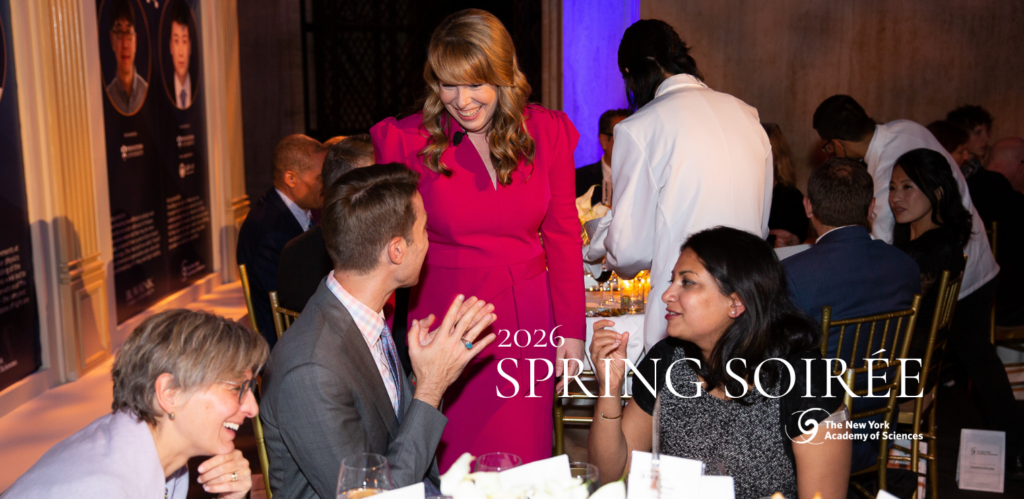
It was an evening celebrating innovation, discovery, and leaders in science when The New York Academy of Sciences hosted its Spring Soirée at the University Club of New York.
Published May 12, 2025
By Nick Fetty
It was a full house for The New York Academy of Sciences’ Spring Soirée, hosted at the University Club of New York.
The inaugural Soiréewas a night to honor scientific excellence as several established and aspiring STEM professionals were recognized for their impactful contributions.
“Tonight, we are celebrating the accomplishment of some exceptionally talented individuals and their lifechanging contributions to society,” said Nicholas B. Dirks, President and CEO of the Academy.
Four outstanding experts in their respective fields, were recognized for impactful contributions in advancing science for the public good.
Trailblazer Award:Yann LeCun, VP & Chief AI Scientist, Meta
Communicating Science Awards:Jared Lipworth, Head of Studio, HHMI Tangled Bank Studios; and Janet Tobias, Emmy Award-Winning Director, Writer and Producer
Additionally, seven representatives of the education community were honored for their contributions to the Academy’s STEM Education efforts, representing their participation in the Scientist-in-Residence program and the Junior Academy.
STEM Teacher of the Year:Brittany Beck, Biology Teacher at the High School of Telecommunication Arts and Technology
Emerging Student Researchers: Mohammad A. K., Prithila B., Afif C., Kwizera P., and Maria R.
Nicholas B. Dirks, President and CEO of The New York Academy of Sciences.
“The importance of passionate and devoted teachers and mentors cannot be overstated,” Dirks said. “We know what happens when talented, motivated students mix with equally passionate mentors and teachers—Great research. Original ideas. Breakthrough science.”
Guided by a Knowledgeable and Dedicated Board of Governors
Dirks also acknowledged the contributions of Hon. Jerry Hultin, immediate past chair of the Academy’s Board of Governors, who continues to serve on the board as a member.
“I feel very honored tonight to thank Jerry for his devoted service and commitment,” said Dirks, adding that Hon. Hultin’s service and leadership is further exemplified through his new role as chair of the Board’s Audit Committee.
Two other former Board members were elected Life Governors: Pablo Legorreta, founder and CEO of Royalty Pharma, as well as N. Chandrasekaran, chairman of the board for Tata Sons.
“Their careers and contributions to science are nothing short of extraordinary,” said Dirks.
The Current Moment and the Imperative to Support Science
Chandrika Tandon, a recognized business leader, Grammy Award-winning artist, and humanitarian who is a member of the Academy’s Board of Governors. She also served as Dinner Chair during the Soirée.
Chandrika Tandon, a recognized business leader, Grammy Award-winning artist, and humanitarian who serves on the Academy’s Board of Governors, served as Soirée Dinner Chair and presenter of ceremony. She set the tone of the evening about the importance of supporting science.
“Welcome to every one of you. Thank you for taking your valuable time, your money, and spending it with us for this incredible event, our first Spring Soirée for The New York Academy of Sciences,” said Tandon. “We are at a seminal, most critical, pivotal moment in the whole area of science and technology.”
Despite the hurdles of the current moment, Tandon expressed optimism about the Academy’s role in advancing science for the public good.
“As I look at The New York Academy of Sciences, this is an extraordinary moment, because the Academy represents a point of view that isn’t of one [political ideology] or the other,” Tandon said, noting that she’s expressing her personal views and not those of the Academy. “It’s a great opportunity for The New York Academy of Sciences to do what it does best.”
Engines of Scientific Discovery, Progress, and Innovation
“We need to think differently about how we support science,” Dirks said. “Science is sometimes seen as something that has an ideology attached to it, but the work of science and of scientists is foundational to our modern society. The reason why we as a nation have achieved such great heights is because of our science.”
The Spring Soirée also included a live auction, led by noted auctioneer Pat Tilly. Attendees vied to outbid each other for exclusive experiential opportunities at NYU, CUNY, and Cure. Proceeds from the auction will help to support future Academy programming.
During his remarks, Peter Salovey, the former president of Yale University, who was named chair of the Academy’s Board of Governors in November 2024, stressed how the Academy’s mission of advancing science for the public good is “more relevant than ever.” He reminisced about growing up in the 1960s when he and his siblings would shadow their father, a polymer chemist at Bell Labs in New Jersey, at work to experience science firsthand. Salovey remembered his father educating them about their Jewish heritage, which included marching with their synagogue during the civil rights movement.
Peter Salovey, former president of Yale University and current chair of The New York Academy of Sciences Board of Governors.
“To him there was plenty of room for it all. For science, for metaphysics. For him, both were the ticket to social progress,” said Salovey. “Scientific literacy strikes me as the single best factor for combatting anti-enlightenment attitudes and distrust of experts. The Academy is and must continue to be a leader with respect to engaging the public in science.”
In the closing remarks, Tandon reiterated that despite the challenges facing science in the current era, science will still play a crucial role in a better future. She said that trust, curiosity, innovation, and “a healthy dose of wisdom” are needed to help prepare the next generation of scientists.
“We all have an obligation to leave this planet, and each other, much better off than how we came into this,” Tandon said in closing. “That’s my mission and I hope in some ways we all share that mission.”
Learn more about how you can support the Academy in advancing science for the public good.
Chris Boshoff, Albert Bourla, and Nicholas Dirks.Peter Salovey, Janet Tobias, Jared Lipworth, and Amy EntelisPeter Saloey, Yann LeCun, and Nicholas Dirks.Chandrika Tandon served as Dinner Chair during the Soirée.Megan C. Henriquez and Brittany BeckA toast to science!