The green building community has made significant progress in designing and constructing energy neutral or ‘net-zero energy buildings’ (nZEBs), but these buildings are rare and are generally relatively low-intensity-use structures under 15,000 square feet. Now the community is developing strategies to scale up and to make the buildings more commonplace within the industry. On January 25, 2011, three speakers presented inspiring projects that are achieving new levels of sustainability in a challenging marketplace. They provided insights into metrics of success, best practices, trends, and prospects in the realm of low/net-zero energy building development.
Paul Torcellini, a commercial buildings researcher at the National Renewable Energy Laboratory (NREL), described the goals and vision that guided the design of the NREL–RSF (NREL–Research Support Facility) building. NREL preferred a design-build bid that would meet as many goals as possible from NREL’s list of priorities.
The energy goals held particular significance. According to Torcellini, the success of the NREL-RSF design-build process was that it provided performance-based guidelines rather than design solutions—thus allowing the design-build contractors to be creative and develop their designs within the performance guidelines. The resulting building, which represents a great step forward in the net-zero energy realm, was constructed with the budget typical for a regular office building. Most of that budget was spent on design and modeling rather than on construction.
Human Behavior: The “Final Frontier”
The value of such a front-loaded design process was echoed by Philip Macey who leads Haselden Construction’s sustainable building division. Macey noted that the design form and function of the NREL-RSF were modeled to meet the energy goal. This required designing the building’s components for synergistic roles and multiple uses. Macey explained that designing with a ‘multi-purpose’ concept for a building’s elements was not new: architects have been applying the same idea to work within space constraints, but the difference this time was that the constraint was an unequivocal and precise energy savings goal. Macey articulated that being goal-oriented from the beginning was crucial to maintaining control, achieving those goals, and reaching project completion within budget.
Bert Gregory, Chairman and CEO of Mithun, expanded the discussion to neighborhoods, which can offer benefits unavailable to single buildings. For instance, integrating water systems is better achieved at the district scale. Gregory outlined several sustainable urban design projects where the goals varied from carbon neutrality, to water neutrality, and, in the case of Mithun’s Lloyd Crossing project, to having a neighborhood that has an environmental footprint equivalent to that of a native Northwest forest by 2050. The Lloyd Crossing project aims to transform the Lloyd district study area, a 35-block area in Portland, Oregon, into an environmentally and financially sustainable community.
In all his examples, the goals and performance metrics were stated at the outset and were followed by the development of strategies to achieve these goals within constraints such as zoning regulations, electricity demand reduction capabilities, renewable energy generation capacity, resource recovery, governance models, financing, and human behavior. According to Gregory, when it comes to achieving the energy saving goals of demand-side management initiatives, human behavior is the “final frontier.”
An Academy event, in collaboration with the Knowledge Economy Institute, assembles high-level clean technology stakeholders at the New York Stock Exchange.
What will it take to build a new generation of high-growth entrepreneurial R&D businesses working at the bio-clean technology interface to produce jobs and solutions for global problems? That was the question at hand when staff with The New York Academy of Sciences (the Academy) moderated a leadership forum at the New York Stock Exchange last week. On Thursday, May 6, and Friday, May 7, the Academy joined partners from the Knowledge Economy Institute and a select group of high-level clean energy stakeholders for the NYSE-KE2 “Clean Tech Economy Leadership Forum.”
The invitation-only forum was designed to explore what needs to happen to ensure that the U.S. can build scale to innovate, commercialize, and rebuild the economy with new jobs and solutions for critical global challenges. Leaders from business, investment, research institutions, government, and philanthropic organizations were invited to discuss and debate how to produce sustainable economic growth in the face of today’s new reality.
The two-day forum emphasized clean energy and the convergence of different fields of science and technology; and of different business models and business sectors, such as biotechnology, energy, IT, and materials. Participants included representatives of CMEA Capital, United Technologies, Ernst & Young Americas Cleantech Network, Deutsche Bank, Kleiner Perkins Caufield and Byers Green Tech Initiative, GE Global Research Center, Goldman Sachs & Co. Environmental Markets Group, McKinsey & Co., and the NYC Mayor’s Office, among many others.
Creating Value in Clean Energy
A roundtable on Thursday afternoon examined ways to find and create value in clean energy, and to mobilize science and technology investments. And on Friday, after Knowledge Economy Institute Managing Director Michael Whitehouse rang the NYSE Opening Bell, discussions centered on achieving U.S. leadership in clean technology, clean technology capital formation and financing strategies, business models and market creation strategies for emerging clean technologies, and public- and private-sector strategies for incubating clean technology.
Forum organizers issued a challenge to participants to come up with new ideas for accelerating the transfer of developments from the research lab to the commercial pipeline and tangible outcomes: “Responding to the need for a more efficient approach to incubating and harvesting promising new technologies, we challenge participants to consider how you can apply your knowledge and resources to accelerate the impact of public investment in research.”
To accommodate a growing world population, while conserving resources and providing for quality of life, cities must find sustainable ways to continue providing clean water, transportation, energy, and waste disposal.
More than three billion people live in cities worldwide, and experts predict that number could grow to five billion by 2025. One billion of those urban dwellers lack basic services and infrastructure. Today’s cities consume almost 70% of global energy resources and, in turn, generate 70% of the world’s greenhouse gas emissions. To accommodate a growing world population, while conserving resources and providing for quality of life, cities must find sustainable ways to continue providing clean water, transportation, energy, and waste disposal.
Converting today’s cities into sustainable environments, however, will require large capital investments. The retrofit of existing building stock in the United States alone is estimated to cost $1 to $2 trillion. Although governments have increased their financial commitments to sustainable infrastructure, private sector investors must become involved to provide the level of funds that are needed. “We have to get better at the financing game,” said Gordon Feller of the Urban Age Institute.
Many Questions Remain
Financing is an integral part of a solution, but many questions remain. On the path toward sustainable urban development, how are businesses and NGOs partnering with governments to accelerate the adoption of new policies and new technologies—while making cities the living lab for that process? How can leaders from the public and private and independent sectors work together to finance cleaner and greener urban initiatives that will smarten the city’s infrastructure and transform the built environment?
To discuss these questions and chart a path forward, as well as to learn about novel financing mechanisms from leaders who are already implementing these methods, key stakeholders in urban planning met at The New York Academy of Sciences (the Academy) on January 7, 2010, for a conference on sustainable city financing presented by the Urban Age Institute and the Academy. The day-long conference was sponsored by the Rockefeller Foundation, Lincoln Institute of Land Policy, Standard & Poor’s/McGraw-Hill, Meeting of the Minds, U.S. Conference of Mayors, and others.
Financial Benefits of Sustainable Cities
Where once development agencies thought it necessary to discourage urban migration, today they recognize that urbanization is essential to the economic vibrancy of a region. “It is a paradigm shift,” said World Bank Group’s Abha Joshi-Ghani, “from urbanization being bad in terms of grime, crime, and congestion, to being the key driver of economic growth and the key aspect of bringing down poverty.”
For this development to proceed, however, the environment cannot be an afterthought. Regional planning is essential. Policy leaders must change how businesses value the environment to attract investors to finance the transition to sustainability. “We have to change from regarding the environment as a cost center to thinking of it as a profit center,” said Albert F. Appleton, former chief of the NYC Department of Environmental Protection.
Show, Don’t Tell
When for-profit companies can be shown the value of a retrofit to their bottom line, they will be inclined to make investments. The evolution of the nationwide garbage disposal company Waste Management, Inc., is a good example. In response to shrinking revenue from their landfills, the company branched into services that help cities reduce waste, recycle, and convert waste into energy, said Waste Management’s Barry Caldwell. The key is to demonstrate the financial benefits of sustainability. “We’ve found that one of the key words that changes the template is ‘money,'” said artist and designer Michael Singer of Michael Singer Studio.
This holds true for government as well. For example, the projected cost of accommodating new residents was the driver behind NYC’s sustainable development plan, or PlaNYC, said Rohit T. Aggarwala of the Mayor’s Office of Long-Term Planning and Sustainability. Through conservation, the city can avoid building new power plants. “We realize that sustainability is not a luxury item,” he said.
To show investors benefits, however, metrics are needed that can quantitatively demonstrate the savings from energy efficiency and other retrofits. E. Sarah Slaughter of the MIT Sloan School of Management said students there are working to develop these metrics.
Aligning Incentives: Attracting Investors to Sustainable City Financing
Demonstrating the benefits of sustainable investments is essential to attracting financing. However sometimes these benefits are misaligned so that the entity making the investment is not the entity that enjoys the benefits. For example, when a utility company installs filters on its smokestacks to cut emissions, rates of respiratory illnesses in the community tend to decline but the utility itself does not realize the benefit. When a homeowner pays for energy-efficient retrofits but later relocates, the benefits go to the new owner of the home.
One mechanism for aligning incentives is the property assessed clean energy (PACE) bond. Jack D. Hidary of SmartTransportation.org explained how these work: The city issues a bond that establishes funds that city residents and property owners can borrow for energy retrofits. The loan is then paid back as a surcharge on the home’s property tax. This is different from other home-retrofit loans, where the loan obligation stays with the borrower even after selling the home. Property taxes have a near zero default rate, so the risk to investors is small.
Climate Change as a Motivation for Sustainable Urbanization
As world governments stall on agreeing to a comprehensive greenhouse gas reduction policy, city and state governments are stepping up to cut emissions on their own. But smaller governments do not have the funds that will be required for such an effort, and they must turn to the private sector. “Finance and investment is a very important part of the formula in terms of climate change and clean energy,” said Vickie A. Tillman of The McGraw Hill Companies, Inc., a leader in information and financial services.
Over the past five years, a number of local government and building codes have driven the trend in green construction. The stimulus bill provides a focus on renovation and renewable energy, while tax breaks provide incentive for residential energy efficiency, said Harvey Bernstein of McGraw-Hill Construction. These government incentives could be leveraged to attract even more investment from the private sector.
While the benefits of environmental investments should reside with the investor, a financial opportunity also arises when the costs reside with the polluter. Carbon cap-and-trade systems, already in place in Europe, are one incentive for greenhouse gas-emitting industries to reduce their emissions. Carbon markets have the potential to become significant investment vehicles if private investors see them as good investments, said speakers from the finance-information company, Standard and Poor’s, a McGraw-Hill company.
Carbon-offset Projects
Many private sector investors are wary of carbon markets because the technological feasibility of reducing emissions and the ease of passing costs to consumers vary by industry, said Michael Wilkins of Standard and Poor’s Rating Services. Few regulatory bodies exist to validate carbon-offset projects. Additionally, environmental regulations present a challenge to credit quality because they put restrictions on how companies do business. Government policy makers must resolve these issues so that controlling carbon dioxide emissions can serve a role in driving the energy-efficient retrofitting of cities.
A number of federal loan programs aimed at stimulating the development of green technology companies are available in the U.S, said Standard and Poor’s’ Steven Dreyer, but many of these projects are highly leveraged and thus present a risk to investors. Incentives for green building can be found in every state, many cities, and at the federal level through tax incentives and subsidies, added Peter V. Murphy of Standard and Poor’s Rating Services. However government spending might be used more effectively if government funds are leveraged to attract investments from the private sector.
Financing the Sustainable City
Overcoming the barriers that have kept private investors from funding sustainable development is one of the keys to moving forward, said Eduardo Rojas of the Inter-American Development Bank. Private investors are more likely to invest in a sustainable public-sector project if the project has a sound structure including clearly defined responsibilities among levels of government and fiscal discipline; citizen representation and oversight; organizational structure, administrative systems, and human resource policies; and adequate public-sector funding from taxes or fees.
A number of mechanisms have already proven successful. One such mechanism is to enlist the human and financial resources already in the community. Brian English of CHF International discussed a program in India that helped slum residents set up a garbage-removal program whereby residents each pay a small fee. Somsook Boonyabancha of the Asian Coalition for Housing Rights in Thailand described how community members pool their money together into a savings account that can be used to invest in community improvements.
Public-private partnerships are attractive mechanisms for allaying fears about the risk of a development project. Pegeen Hanrahan, Mayor of Gainesville, Florida, has established the nation’s first solar feed-in tariff (FIT) project, where the city pays solar energy providers for feeding electricity into the grid. The project has spurred the creation of new solar energy companies.
Sustainable Development in the Developing World
Private sector and global organizations can come together to create new sustainable development in the developing world. Private capital is often reluctant to invest in early phases of urban revitalization because of the uncertainties involved, so public entities are better placed to identify projects, lease or purchase the land, obtain all the relevant permissions and permits, and provide technical support. An example of this approach is the Estruturadora Brasileira de Projetos, S.A.-EBP, a public entity that identifies, develops, and obtains regulatory approval for sustainable development projects and has private companies bid to build the projects, said Helcio Tokeshi of the EBP.
In addition to motivating investors to invest in sustainable development, it is important to find ways to motivate consumers to save energy. Financial mechanisms such as higher fees for garbage disposal and electricity service are potent motivators, but not all human motivations are financial. Competitions between apartments, floors in an office building, and even cities can spur the naturally competitive human spirit, said Jonathan F. P. Rose of Jonathan Rose Companies, which specializes in green real estate policy, planning, development, and investment.
A number of innovative projects have sprung forth from companies led by forward-looking executives, said Peter Miscovich, an executive of the global advisory and management company Jones Lang LaSalle. These innovations are demonstrating that it is possible to break through the logjams that have impeded sustainable development projects.
Sustainable, Livable, and Economically Vibrant Urban Centers
Although some financial mechanisms are available to fund the retrofit and building of sustainable cities, clearly more innovation is needed. “We need mechanisms for financing an urban future,” said Nicholas You, a senior advisor to the executive director of UN-HABITAT. “Here we have a bridge that needs to be built.”
A crucial step in building that bridge is to gather information about the most pressing challenges facing cities, as well as to understand the value that urban inhabitants place on the sustainable provision of energy, water, transportation, and other vital city services. The new Gallup Institute for Global Cities is collecting this information, said Ian Brown of Gallup. IGC is launching several major research initiatives in coming months, in partnership with Urban Age Institute, and is actively looking for insights from conference sponsors and participants.
To work toward developing novel financing strategies, cities must become connected, not just through the Internet but through person-to-person communication, said Tim Campbell of the Urban Age Institute. Research shows that a high volume of exchange is already underway on a global scale and that innovative cities depend on a trusting climate in networks of city leadership. With that trust, city leaders will be able to convert new knowledge to innovation and attract the novel financing mechanisms and technologies they need to develop sustainable, livable, and economically vibrant urban centers.
Water is essential to life, but water scarcity is a serious issue across the globe. From the social to the economic to the political, learn more about efforts to advance public health by improving clean water accessibility.
Ensuring that people have access to sufficient supplies of clean water has become one of the great challenges of the 21st century. Demand for water is growing rapidly and lack of access is implicated in malnutrition and widespread disease.
At a November 13, 2009, symposium organized in collaboration with the Johns Hopkins Bloomberg School of Public Health, the Johns Hopkins University Paul H. Nitze School of Advanced International Studies, and The New York Academy of Sciences (the Academy), four experts provided a wide-ranging set of perspectives on the importance of water in our lives, from its role in global social, economic, and political trends, all the way down to the individual human cell. Topics discussed included the role of climate change in exacerbating cholera epidemics, threats to the U.S. water supply, high- and low-tech inventions for water treatment, and the implications of water shortages for economic development worldwide.
Increases Expected for Global Water Demand
In most places in the developed world, we take high-quality potable water for granted. It comes out of our taps and flushes away our waste 24 hours a day, 7 days a week, 365 days a year, raising little concern that it will cause us harm. But in many places, ensuring that people have access to sufficient supplies of clean water has become one of the great challenges of the 21st century.
The UN Commission on Sustainable Development projects that demand for water will double by the middle of this century, and increase at a rate of 50% with each subsequent generation. Africa, the Middle East, and Asia are likely to be particularly vulnerable, and it is estimated that the portion of humanity that will not have access to sufficient or clean water supplies will increase from 1/3 to 2/3. Even in the United States, regions spanning a wide band in the South are facing increased threat of water shortages.
Today approximately one-half of all hospitalizations around the world are due to waterborne diseases. Nearly 2.5 billion people have poor sanitation, and lack of access to sufficient water supplies is implicated in approximately half of all malnutrition. Because many people have no choice but to use the same water supplies for both drinking and sanitary purposes, waterborne diseases such as cholera, typhus, E. coli infection, and dysentery are a constant threat in many places, with children paying a particularly high toll. Meanwhile, population growth and climate change threaten to make all of these factors much worse.
Water, Global Policy, and International Security
One of the most disturbing things Peterson finds about water is the global community’s inability to understand the magnitude of the problem it poses, and to develop effective public policy for managing the resource. At the same time that patterns of water usage have become unsustainable, he pointed out, there is no commonly accepted pricing and allocation structure, and only limited understanding of how sectors like energy and agriculture are dependent on water availability.
Water is thus not only a public health and environmental issue, but affects social relations, economic prosperity, and—with 260 basins around the world shared by more than two countries—an increasingly important strategic issue. “Clearly, we need to find a better way to build [into] the public policy sphere this critical resource that affects so many people at so many levels,” Peterson argued.
Particularly in the developing world, water shortages have many implications for development. Peterson cited data from the United Nations and World Bank about Ethiopia that correlated reductions in gross domestic product with years of less rainfall. Lack of access to safe drinking water and sanitation services also has huge opportunity costs. UNICEF has suggested that lack of sanitary facilities at schools is an important reason for girls’ high dropout rates in sub-Saharan Africa. A UN survey of 177 countries also determined that women lose approximately 40 billion working hours each year walking long distances to fetch water for their families.
A Complicated Challenge
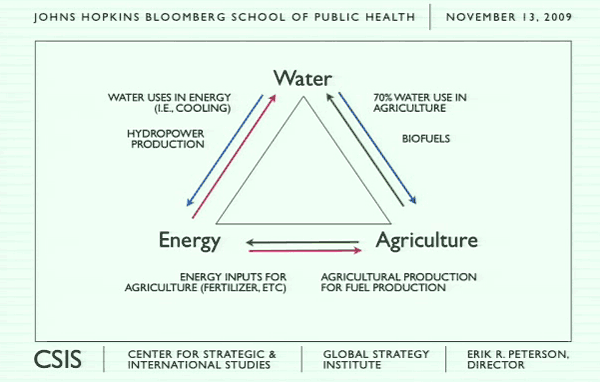
The challenge of ensuring access to sufficient water is complicated by the fact that energy production is dependent on water availability. As population grows, energy demands are also growing, which means the energy sector will need more water to meet everyone’s needs. Peterson pointed out that policymakers considering investments in nuclear power generation need to understand that it requires significantly more water than other generating methods. “As we see countries trying to find energy solutions for increasing populations,” he said, “they’ll need to be thinking long and hard about how to find sufficient water to deal with that increased energy production.”
Some important interactions between water, energy, and agriculture. Image courtesy of Erik Peterson.
Similarly, with 70% of worldwide water use going to agriculture, the dynamic links between water, energy, and farming could lead to political instability. Citing the protests that occurred in the spring of 2008 when rising fuel costs caused food prices to spike, Peterson forecast, “As the global economy revives, the likelihood is that [with] additional increases in demand, especially in the areas of energy and food, we’re likely to see the geopolitics of resources assume ever sharper definition.”
A New Bureau for International Water Policy
Developments such as these suggest that there is an “ironclad case” for making water a core element of an integrated international policy strategy in the United States, Peterson said. There is a spectrum of goals and interests in relation to water, from human health, to humanitarian aid, to gender equality, to economic development, to environmental sustainability, to geopolitical stability, although currently there is only minimal integration among the various federal agencies for whom water is a concern.
In a CSIS report published in 2008 with coauthor Rachel Posner, Peterson recommends creating a new Bureau for International Water Policy that be tasked with “speaking for water” in collaboration with the U.S. State Department, the United States Agency for International Development (USAID), and other policy-making bodies. Developing an integrated, far-sighted water policy would recognize that addressing the issue is not just altruism, but is very important to national interests—particularly, he concluded, because “these pressures are growing by the day.”
Cholera and Climate Change
Environmental microbiologist Rita Colwell has studied cholera for 40 years, and sees it as a case study for understanding a disease caused by an environmental bacterium, coupled with the effects of poor sanitation on human health. The cholera story is also one that she sees as emblematic of the ways in which climate change could exacerbate current challenges posed by infectious diseases.
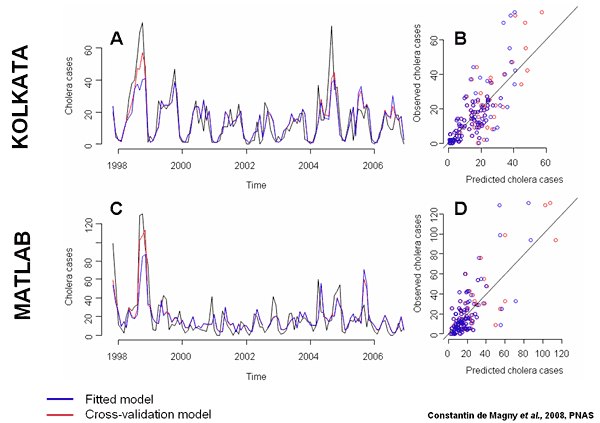
Two sets of graphs comparing epidemiologic data (black) with Colwell’s team’s predictive models (blue and red) in Kolkata, India and Matlab, Bangladesh.
Cholera is caused by ingestion of the bacterium Vibrio cholerae, which replicates in the small intestine of humans. Toxins produced by V. cholerae cause massive loss of fluid and death within hours if not treated. It is an ancient disease and the causative agent, Vibrio cholerae, is found in aquatic environments in many parts of the world. Cholera, in some years, causes approximately 250,000 deaths. In Zimbabwe, an ongoing cholera epidemic that public health officials have connected to corruption in the Mugabe government has had a fatality rate of 30%–40% in some parts of the country.
Although researchers once believed that the only mode of transmission of cholera was from person to person, Colwell and her colleagues have ascertained that Vibrio cholerae is associated with seasonal zooplankton and phytoplankton blooms. These creatures proliferate when seas warm, and can move up into rivers when sea levels rise. These factors combine to cause cholera outbreaks seasonally, typically in spring and fall, when humans ingest water containing the Vibrio-carrying organisms.
Models to Predict Cholera Epidemics
Using satellite-based remote sensing to observe factors such as sea level fluctuations, the presence of chlorophyll, and water temperature, Colwell and her colleagues are developing models to predict cholera epidemics in Bangladesh, India, and Senegal months before they occur. What they have discovered reflects the important role of the aquatic world for human health. “The effect of poor sanitation is, of course, person-to-person transmission, but the source is really the environment,” Colwell observed. “This tells us that we are very intertwined with the environment and that water is fundamental to our lives and health. If we do not have access to safe water, we have a devastatingly serious health problem.”
Warming and rising seas threaten to make these problems worse, not only from the perspective of disease, but also with regard to the habitability of many low-lying areas of the world. Colwell remarked, “It grieves me to have to point out that with a predicted one-meter rise in sea level, we are going to see 17%–20% of Bangladesh permanently underwater, which means that we will have perhaps 100 million climate change refugees. Furthermore, if the glaciers in the Himalayas recede to the point of disappearance, we will have a water shortage of immense proportions occurring in this country, which already suffers as one of the poorest, economically, in the world.”
Water Issues in the United States
Although the areas most threatened by water shortages and contamination are in the developing world, Kellogg Schwab, director of the Johns Hopkins Center for Water and Health, reminded the audience that “if you look within the United States, we have extreme water needs within our own country…It’s not an ‘us-them’ issue, it’s a ‘we’ issue.”
Much of the country benefits from an abundance of rain, but areas including California, the Atlanta area, and the Southwest have faced dangerous droughts in recent years. Moreover, much of the nation’s water infrastructure is aging and fragile, and will be very expensive to upgrade. And even if the arrival of chlorinated drinking water in the early 1900s effectively ended the era when Americans had to fear dying from cholera or typhoid, a host of emerging contaminants in the U.S. water supply—including pharmaceuticals, endocrine disrupting compounds, methyl tertiary butyl ether (MTBE), tetrachloroehtylene (TCE), and bisphenol A—are posing new kinds of health threats.
Schwab sees a paradox at the core of the water problem. “I attest to you that water is an inalienable right for every one of us,” he asserted. At the same time, however, those who own water rights defend them vigorously, and “to produce high-quality, potable water takes money, resources, and energy.” Ongoing debate is exploring the question of how to account for this fundamental economic issue, and whether passing the true costs of extraction and delivery along to users could help ensure accountability and financial sustainability.
Technologies for the Developing World
Schwab pointed out that a variety of existing technologies—including clay pots, membrane filtration, and community water treatment plants—can improve sanitation in the developing world. The challenge is how to deliver these devices to communities in ways that effectively address their needs.
One new approach that engineers have begun to investigate is whether aquaporins could be used to filter contaminants from water. Peter Agre was awarded the 2003 Nobel Prize in Chemistry for discovering aquaporins, channels in the cell membrane that allow water to move inside the cell without resistance. At the Academy he provided an overview of the roles of various aquaporin subtypes in human health, and their vital roles in maintaining water equilibrium in the body. Aquaporin dysfunction in this class of proteins is implicated in a range of conditions, including pulmonary capillary defects, diabetes, congenital cataracts, malaria, and hyperthermia.
Low-tech Interventions
Schwab explained that researchers at Hopkins and elsewhere are exploring whether it might be possible to create a living membrane made of auquaporins that would exclude everything except H2O. This approach would be high-tech in the laboratory, but if developed well, could be low-tech, and therefore more practical, in the field.
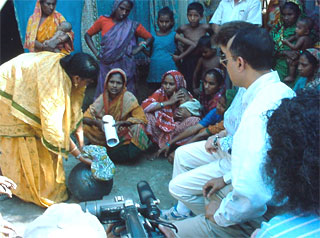
Demonstration of a simple water filtration method in Bangladesh. Image courtesy of Rita Colwell.
Referring to her team’s discovery of the role of plankton in cholera, Rita Colwell also described a low-tech intervention they conducted to help defend villagers in Bangladesh against the disease. After testing its effectiveness in the laboratory, they conducted a three-year study educating the women to fold old sari cloth, the material used to make their dresses, over the openings of their pots when gathering water for their families.
“We found that we could reduce cholera 50% by this simple filtration technique,” she explained. Their effort had a persistent effect, and as word spread, control villages started filtering as well. The strategy helped to reduce the incidence of cholera even in local homes that did not filter due to the herd effect on disease transmission. Colwell is also working with Abdul Hassam, a colleague in Bangladesh, on another low-cost filtration technique to remove arsenic from well water.
A Problem that Has to be Solved
Behavioral interventions can also have an effect in the West. Schwab encouraged the audience to be aware of their water consumption. In the United States, where a flush of the toilet is equal to the volume of water consumed by a person in many parts of the world in a day, personal decisions that can help conserve water are also important. In the question and answer period following the formal lectures, discussion considered the roles that taxation, financial incentives, and better education could play in reducing water use.
If there was an overarching message to the meeting, it was that solving the problem of delivering safe water will only occur with a focused, forward-thinking, and interdisciplinary effort. As Colwell observed, the problem “is a scientific, a social behavioral, an economic, an engineering, and a political problem, and you need all these dimensions. This means it’s a tough problem, but it’s a problem that has to be solved.”
Nobel Laureate and Academy Governor R.K. Pachauri says business must take the lead in promoting a more sustainable future across the globe.
Published September 1, 2009
By Adrienne J. Burke
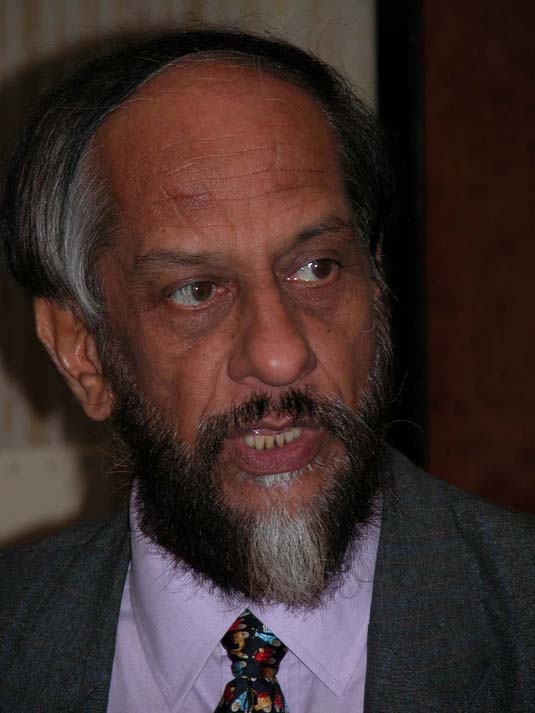
Rajendra K. Pachauri. Image courtesy of Nick Sundt/U.S. Climate Change Science Program/U.S. Department of Commerce via Wikimedia Commons.
Rajendra K. Pachauri stepped into the global green spotlight in 2007 when he accepted the Nobel Peace Prize on behalf of the Intergovernmental Panel on Climate Change with former Vice President Al Gore. The 69-year-old industrial engineer and economist has chaired the IPCC, established by the World Meteorological Organization and the United Nations Environment Program, since 2002, and recently took a half-time position as head of Yale University’s Climate and Energy Institute. But he has been working on issues of sustainability and climate change for far longer. He has directed The Energy and Resources Institute, one of Asia’s leading centers of sustainable development research and education, since 1981, and he helped lay the groundwork for the 1997 Kyoto Protocol.
In the interest of continuing to build its strength as a global resource of sustainable science and technology expertise, The New York Academy of Sciences (the Academy) recently elected R.K. Pachauri to its International Board of Governors, and will honor him for his work promoting urban sustainability at the Sixth Annual Science & the City Gala in New York on November 16.
An ardent vegetarian who urges individuals to take responsibility for the environment, Pachauri has also been outspoken about the importance of corporate leadership in sustainability. The Fourth Assessment Report issued by the IPCC under his leadership is considered the most detailed analysis of global climate change ever undertaken. Among its numerous recommendations is the advice that “changes in lifestyle and behavior patterns can contribute to climate change mitigation across all sectors. Management practices can also have a positive role.”
How do you define sustainability?
Simplistically, it is what Mrs. Brundtland and the World Commission on Environment and Development put forward in 1987: a form of development which meets the needs of the current generation without compromising the ability for future generations to meet their own needs. It’s simple, but how one applies it in practice is not all that easy.
Is there a different definition for corporate sustainability?
No, I wouldn’t say so, because the principles are the same. Corporates also have a responsibility to see that we don’t degrade the environment, that we don’t overspend our natural resources.
Could corporations be models of sustainability for communities, cities, or governments?
As a matter of fact, they have to become models for all of society because there’s going to be a greater and greater level of economic activity in the corporate sector, and therefore what they do will have a profound and a very wide impact on society as a whole.
What do you mean when you say that a “complete reorientation of thinking” among the leadership of the corporate sector is overdue?
There’s been a disproportionate focus on profits, not only in the very narrow financial sense but also in the very short term. You’ve seen many examples of corporates who found over a period of time that their profitability was actually impaired because they had this narrow and short-term focus. Given the changes that are taking place in the world, customers and even suppliers are going to be much more sensitive to the corporate responsibility that leaders show towards society. If corporate organizations don’t take this newly apparent dimension into account, they are obviously going to lose markets and their market share. This is why a complete reorientation of thinking will be necessary.
Sustainability contains a genuine profit motive?
Yes, and that profit motive essentially would require reflection for a longer period of time than has been the case traditionally. Let me take the example of Wal-Mart—this is one major company that has moved more genuinely towards sustainability, towards green issues. Or you take a company like General Electric. They’re pursuing the business that they’ve been doing in the past, but they have shown a clear commitment to looking at the future of green technologies and investing in them. To different extents, a number of organizations are beginning to show this, and the ones that have practiced this philosophy have actually benefitted.
Where governments have failed, then, could corporations take the lead in promoting sustainability?
You really need the combination of the two. If government has policies, for instance, which impose irrational prices rather than promote sustainability, then clearly the corporation will not be able to do much about it. Corporations are answering to their shareholders. It’s important, of course, for shareholders to be educated and to show a certain sensitivity to social causes, but there’s a limit to that. If governments come up with policies that run counter to sustainable development, then there’s nothing you can do about it. You really need a combination of enlightened government policy and enlightened corporate leadership. In the absence of that, I don’t think you get the right results.
You’ve said it’s crucial that governments from around the world reach agreement on tackling the challenge of climate change at the United Nations Climate Change Conference this December in Copenhagen. What will you consider to be a successful outcome of that gathering?
There are three [desired] outcomes. First, a very firm commitment to reduce emissions by 2020. Then, a commitment to provide funding for those countries that are really deprived, that don’t have the money to adapt to the effects of climate change. And something that allows relatively easy access to clean technologies for the developing countries.
Is addressing climate change and getting to sustainability a bigger challenge for policymakers or for R&D scientists?
First and foremost, it’s a challenge for people at large. You really have to convince the public of the fact that what we’ve been practicing for a long time is not sustainable and we have to bring about a shift. In a democracy, you would expect that the public will put pressure on the politicians and the leadership to do what’s expected.
And it’s essential for scientists to become effective communicators. Unless they do that, the public is not going to get to know the seriousness of some of the problems that we’re facing and the kind of solutions that are required. Scientists have an increasing role in informing the public.
The Fourth Assessment report from the IPCC suggests that management practices could have a positive role in climate change mitigation. What are examples of such management practices?
There’s a tangible part of the impact and an intangible part. The tangible part is what you actually save, what you actually reduce in energy consumption. On the shop floor or in a factory, launch a program of energy efficiency whereby you ensure that every unit of energy is consumed using the most efficient methods, the most efficient ecologies. Just cutting out waste as part of management practices could have a major impact.
The intangible part is creating a culture that would ensure that the organization will always focus on sustainability. It’s like safety. There are organizations that are extremely safety conscious with seldom any accidents or explosions. Similarly, for organizations that are very particular about the efficiency of energy use and minimizing waste, it’s all part of managing practices which can achieve a great deal.
Examining the state’s clearest strengths and most promising prospects for commercializing the technology today that will create tomorrow’s cleantech economy.
Over the past two years, in collaboration with the New York State Foundation for Science, Technology and Innovation (NYSTAR) and the New York State Energy Research and Development Authority (NYSERDA), The New York Academy of Sciences (the Academy) has been leading an effort to identify areas of science and technology that hold the most economic promise for New York State. Specifically, the initiative has identified clean technology as an emerging area of research in which the state holds significant assets and resources in specific areas.
Over the past year, the Academy has been conducting extensive interviews with key cleantech stakeholders in industry, academia, and government, as well as independent research on cleantech R&D assets and appropriate innovation/public private partnership models. On May 18, 2009, representatives of the Academy presented their findings to key stakeholders, and then moderated breakout sessions to discuss and refine their recommendations.
The breakout sessions focused on ways to foster innovation and to define clean technology priorities. Ultimately, the event revealed that New York has a broad set of assets that could assist in its economic development, including the necessary R&D base, strong programs, and an emerging vision and set of policies capable of optimizing a cleantech innovation system and creating a competitive cleantech industry.
Significant Potential for Economic Impact
In particular, the initiative has identified the following set of clean technology areas as having significant potential for economic impact:
Photovoltaics
Energy Storage
Fuel Cells
Biomass
Buildings
Smart Grid
During both interviews and the breakout sessions, systems integration was also identified as a discrete set of activities that constitute a core strength of New York State and could, itself, provide significant opportunity for economic development. In general, a systems approach could enable the diverse but interconnected set of clean technology areas to be unified into a cleantech “ecosystem.” It could also facilitate the incorporation of technologies not identified in the Academy’s initial findings that were identified as being important in the breakout sessions. These include nuclear energy, wind energy, electric transportation, water systems, and hydrogen produced from electricity, coal, and natural gas.
Four Goals for Commercializing Technology
In addition to identifying promising technology areas, the event also focused on how to foster a productive innovation system that allows researchers in all fields to commercialize their technologies. New York State has already demonstrated strong support for innovation, and the initiative has identified four key goals as being particularly important:
Incorporating innovation assets
Connecting assets through a robust network
Aligning resources and stakeholders by setting a challenge
Investing in a well rounded technology portfolio
As with the technology areas, these components hold the potential to provide their most significant outputs when treated as complementary and co-dependent components of an innovation economy. The meeting focused on strategies for generating interest among venture capitalists and entrepreneurs; fostering public-private partnerships that connect researchers, investors, and government agencies; and setting challenges through better coordinated RFP’s that address state cleantech priorities.
A New Cleantech Economy
During the event, there was wide appreciation of current initiatives already undertaken by the State, particularly by NYSTAR, NYSERDA, and the Governor’s Office, to improve New York’s already competitive innovation system. Their efforts, combined with supportive administrations at the local and national levels, create a window of opportunity that participants in the workshop agreed should not be missed.
There is clearly momentum toward developing an optimized cleantech innovation system in New York State. Building on its existing strengths, the State is well positioned to create significant economic impact through an impressive portfolio of cleantech assets and policies. With continued leadership from the Governor’s Office and organizations such as NYSTAR and NYSERDA, the gathering indicated that New York could become home to a new cleantech economy.
Academy member Trey Taylor, co-founder and president of Verdant Power, believes that underwater turbines that convert flowing water into electricity augur the future of energy production.
Trey Taylor is in the business of sharing ideas. The co-founder and president of Verdant Power, LLC, a sustainable energy company, has built a career around assessing market forces, bringing together the best and brightest minds in a field, and passionately working for a cause. Most recently, that cause has been renewable energy, in the form of hydropower.
Taylor’s eclectic and varied background gives new meaning to “more than the sum of its parts.” His knack for storytelling and talent for explaining complex ideas betray his years of studying history and political science at Portland State University and graduate work in urban education at the University of Minnesota.
But more than anything, it is Taylor’s skill at recognizing the needs of a market—and the means by which to fill them—that has propelled him through a successful career marketing for such large multinational corporations as Procter & Gamble, ITT Corporation, and British Telecom. Transitioning from marketing to advertising, Taylor became a master at networking while serving as director of advertising for some of the country’s largest trade associations: the American Council of Life Insurers, the Health Insurance Association of America, and the Edison Electric Institute (EEI).
A Hydropower Epiphany
While at EEI, the trade association of investor-owned utilities, Taylor began thinking about how new, computer-based technologies were creating an increased need for electricity. The deregulation of electrical utilities at that time meant no more power plants were likely to be built. This sparked his interest in renewable energy, and in discovering sources that hadn’t been tapped to the extent that they could be.
It was an “ah ha!” moment for Taylor. He says, “After realizing that more than a third of the world’s population didn’t have access to electricity, but lived near some form of moving water—one of the greatest untapped renewable energy sources in the world—I formed a company to commercialize technological concepts for converting kinetic hydropower to electricity.”
In 2000, Taylor co-founded Verdant Power and brought together a team of engineers and scientists to design turbines for placement in rivers and tidal estuaries where they could harness the power of flowing water. Unlike traditional hydropower technologies such as dams, underwater turbines which local communities can easily install. This was the case for Verdant’s first customer, New York City’s Roosevelt Island.
Exceeding Expectations
Trey Taylor
With support from various state and local groups, Verdant runs the Roosevelt Island Tidal Energy (RITE) project, which relies on a field of water turbines to convert the kinetic energy of the East River to electricity for the island.
In December 2002, the output of Verdant’s first turbine there exceeded expectations, producing an average power output of 14.5 kilowatts per hour. “That single turbine produced 8,000 kilowatt hours per month, delivered to a Gristedes supermarket,” Taylor says. “Now you start looking at the math: What if you had 300 turbines? It’s pretty cool!”
In early April, Verdant Power installed four additional turbines for Roosevelt Island that will provide electricity not only to the supermarket, but also to a parking garage, where hybrid electric buses will plug into tidal power. The company will conduct an 18-month environmental study of the turbines to gather empirical evidence demonstrating that the turbines are not harming fish that pass through the area. A concurrent operational test has several goals, two of which are to optimize the manufacturing of the next generation of turbines and to expand the Roosevelt Island field.
A Hybrid Renewable Future
Taylor is excited to expand Verdant’s work on the island, and eventually to other sites in the United States and around the world. He foresees hybrid renewable energy systems consisting of complementary uses of wind, solar and hydropower, along with fuel cells. “Therein lies the answer for the future of energy production in the world. We can start getting these systems right, and then integrating them in really cost-effective ways,” Taylor predicts.
Taylor now divides his time between Verdant Power’s offices on Roosevelt Island, Washington, DC, and Toronto. He and his team are exploring the installation of turbines in the Saint Lawrence River and are working with the Brazilian government to bring the technology to rural villages in the Amazon basin. Additionally, the company is looking into prototypes for use in man-made canals such as the 11,000 miles of irrigation channels in California.
The possibilities for new applications and hybrid integration are what fuel the company. But for Taylor, the picture is even bigger: “What I get excited about is the new thinking, not only among academicians but also other entrepreneurs. It’s the mass collaboration, open source energy, all these ideas come pouring in for applications and problem solving,” he says. “It’s a different way of looking at electric energy production than the old utility mind-think—the idea of powering and empowering sustainable communities.”
With the threat and potential impact of climate change becoming increasingly clear, scientists and researchers are shifting their focus to try to mitigate the inevitable.
Climate change may be the most media-unfriendly topic scientists have ever studied. It focuses on phenomena that are so gradual and insidious that they are virtually impossible to film; its conclusions reveal the terribly disturbing truth that the comfortable standard of living to which most of the world aspires is, in fact, destroying the planet; and its celebrity spokesman is Al Gore.
How, then, does one explain the current moment?
“Who would have thought that a singer singing a song about global climate change in a movie called An Inconvenient Truth would win an Academy Award for the best song in any movie in the United States in the past year? This gives you an idea of the situation that we’ve gotten to,” says Peter Raven, director of the Missouri Botanical Garden.
On February 27, 2007, The New York Academy of Sciences (the Academy) hosted an event to honor the launch of a new scientific report on the same subject. Titled “Confronting Climate Change: Avoiding the Unmanageable, Managing the Unavoidable,” the report was written by an expert panel organized by Sigma Xi, the scientific honor society, and sponsored by the UN Foundation. The meeting at the Academy was the first opportunity for the scientific community to learn about and respond to the report, and followed a meeting between the report’s lead authors and UN Secretary General Ban Ki-Moon earlier that day.
Presenting their main conclusions to an audience of about 200 in the Academy’s main auditorium, the authors discussed the problems that have dragged climate change into the media spotlight, and proposed solutions for mitigating climate change and preparing for its inevitable effects.
Keeping Our Cool
The new report, written by an international panel of 18 scientists at the behest of the United Nations Commission on Sustainable Development, complements the series of reports now being published by the UN’s Intergovernmental Panel on Climate Change (IPCC). “It differs from the IPCC report in that we have selected between possible reactions to climate change and provided a roadmap,” says Raven, the Sigma Xi report’s lead author.
Besides being more prescriptive, the Sigma Xi report is also more blunt than most politically vetted climate change assessments. “Global climate change is real, it is primarily caused by human activities…[and] it is accelerating,” says John Holdren, director of the Woods Hole Research Institute.
Indeed, the evidence for human-driven climate change has become overwhelming in recent years. “The incidence of extreme weather events…has been going up, sea level rise has been accelerating, sea ice is melting, glaciers are retreating, permafrost is thawing, boundaries of ecosystems are moving,” says Holdren.
Researchers have linked the accelerating changes with the gigatons of carbon dioxide, methane, and other “greenhouse” gases emitted by human activities every year. By causing the atmosphere to retain more of the sun’s heat, these emissions are driving the global average surface temperature inexorably upward.
Worse, the accumulating evidence suggests that climate change may not remain gradual. Several major “tipping points,” such as the collapse of the West Antarctic ice sheet, major melting of the Greenland ice cap, desertification of the Amazon rainforest, and changes in the frequency of strong El Niño oscillations could cause sudden and catastrophic changes over the course of a few years rather than a few centuries. Climate change may be hard to sell, but it’s now also hard to ignore.
Staying within the Recommended Range
The Sigma Xi panel concluded that allowing the global average surface temperature to rise more than 2°C to 2.5°C over the next 100 years would sharply increase the risk of these catastrophic impacts. Greenhouse gases now in the atmosphere have already committed the planet to a rise of about 1.5°C.
To stay within the recommended range, the researchers assert that human greenhouse gas emissions must stabilize not much above current levels no later than 2015, then decline to no more than one third of current emissions by 2100. Compounding the problem, these reductions must occur right when the world’s poorest countries are making the transition to modernity—in other words, at the very moment when global energy demand is about to skyrocket.
Conceding that cutting emissions while raising living standards will be an immense job, Holdren is nonetheless optimistic: “It is a challenge to which we believe society can rise,” he says. In order to meet it, the panel outlined a series of recommendations, highlighting the win-win” solutions that cut energy demand while boosting economic growth.
Unfortunately, win-win solutions, such as increasing vehicle fuel economy and providing incentives for cleaning up power plants, will not be enough. The report admits that achieving long-term emissions reductions will also require “win-lose” solutions, such as a carbon tax or a “cap-and-trade” system of emissions permits.
Besides choosing the right solutions, policymakers will need to implement them properly. Picking one topical example, Holdren explains that “in the transport sector, we should be increasing the use of biofuels to replace oil, [but] we cannot do that witlessly, because expanding biofuels witlessly will pose serious problems of competition with food production…environmental destruction, [and] loss of biodiversity.”
Jousting the Four Horsemen
Food production and biodiversity were also major topics for Rosina Bierbaum, dean of environmental and natural resource policy and management at the University of Michigan. Using a pair of world maps, Bierbaum showed the group’s projections of future ecosystem upheavals and crop failures.
Even if governments follow the panel’s recommendations to mitigate climate change, some of these events are probably inevitable. “Adaptation to climate change can’t any longer be seen as sort of a cop-out; it’s not instead of mitigation, but it’s needed in addition to mitigation,” says Bierbaum.
In a generation, Mississippi may be growing coconut palms instead of loblolly pine lumber, and Vermonters’ maple syrup might come from northern Canada. More ominously, major crop failures in the tropics could cause widespread famines in Africa, South America, and Southeast Asia. Meanwhile, rising ocean temperatures and sea levels will likely increase extreme weather events and displace entire communities from coastlines. “There will be tens of millions of environmental refugees that the world will need to deal with,” says Bierbaum.
But like the mitigation measures, many of the report’s adaptation recommendations will take a concerted effort. During the question session after the presentations, for example, an audience member asked about the depressingly instructive case of New Orleans, where a multi-billion-dollar rebuilding effort is now underway on land that is infamously below sea level.
Raven concedes that the outlook is grim. “It’s a lot easier to explain the problem than to forge a solution,” he says, adding that “if we can’t really address the problem of New Orleans in an intelligent and adaptive way, and the signs are relatively few that we will, how do we get together and address the problem of Bangladesh?”
Challenges Beyond Building Codes
The challenge goes well beyond building codes. “The wetlands that are south of New Orleans have been the shock absorber for hurricanes for a very long time, and they’ve been losing for the last 50 years about 25 square miles per year,” says Michael MacCracken of the Climate Institute. MacCracken adds that “no matter what they do to New Orleans, if they don’t recover the wetlands, they’re going to get inundated [again].” The same is true for many other low-lying regions around the world.
Framing the issue more optimistically, Richard Moss, senior director of climate and energy at the UN Foundation, says that humanity still has the opportunity to choose between two futures. “The path that we’re currently on…involves increasingly serious climate change impacts,” he says. In the alternative future, however, intelligent policymaking and sustained investment in appropriate technology could help avert the climate change disaster while simultaneously boosting living standards worldwide. “We must act collectively and urgently to change our course through the leadership at all levels of society. There really is no more time for delay,” says Moss.
Alan Dove is a science writer and reporter for Nature Medicine, Nature Biotechnology, and Bioscience Technology. He also teaches at the NYU School of Journalism, and blogs.
From the “place-specific language” of architecture and “Archi-Neering” to vertical urban design and rooftop gardens, the sky’s the limit for today’s skyscrapers.
One of New York City’s first officially green office towers, 7 World Trade Center, the new home for The New York Academy of Sciences (the Academy), has the distinction of having earned LEED (Leadership in Energy and Environmental Design) Gold Status for its environmental achievement. So it was only fitting that one of the first initiatives of the new Physical Sciences and Engineering program should be a series of lectures entitled “Mixed Greens,” an international survey of state-of-the-art, sustainable skyscraper design. Organized in collaboration with the city’s Skyscraper Museum, the series brought together for five lectures the world’s leading architects and engineers who have pioneered innovative green strategies ranging from high-performance structures to low-tech, bioclimatic towers.
To kick off the series in January, Ross Wimer, design partner with Skidmore Owings and Merrill (SOM) and one of the designers of the Skyscraper Museum, introduced the concept of “Environmental Contextualism.” Wimer’s track record demonstrates the global pervasiveness of the green skyscraper movement—buildings he has designed form part of the skyline of more than 20 cities on five continents.
“Place-Specific” Language
Using illustrations from design competitions ranging from a new New York City streetlight to the WTC Freedom Tower, Wimer emphasized SOM’s goal of finding in each instance the “place-specific” language of architecture. For streetlights, this meant striking a balance between city specifications, emergent light technology, and signage considerations. In Dubai, by contrast, SOM won the design competition for a residential tower by conceiving a twisting 75-story helical structure. The helix fulfilled the requirement that the building have an oblong base parallel to the marina, but the twisting enabled more of the apartments to have spectacular views of the Persian Gulf. For the tower’s skin, SOM used inset, perforated screens to regulate and diffuse the glare of the sunlight.
Currently, New York’s only other green skyscraper (besides 7 WTC) is the 46-story Hearst Tower, designed by Foster and Partners (F&P). In February, one of its senior partners, Brandon Haw, illustrated his talk on “sustainable works” by showing how F&P developed new approaches to sustainable design with each new project. Haw showed how, for instance, the cylindrical design of the Swiss Re London headquarters, with its innovative air circulation system, evolved from ideas first explored in the triangular design of Frankfurt’s Commerzbank, the first green skyscraper.
A current project, the design for the Moscow City Tower, “takes the Commerzbank design and turns it inside out,” according to Haw. F&P is designing WTC Tower Two, and Haw expects it to incorporate their research into a “new generation of cladding systems.”
Architecture + Engineering = “Archi-Neering”
The third speaker, Helmut Jahn, Director of Design of Murphy/Jahn Inc. Architects, might not call himself a green architect, but his approach to design takes efficiency into account at every step in a way that cannot help but yield green results.
In his March talk, Jahn explained how his work blends architecture and engineering in a system he refers to as “Archi-Neering,” a system that seeks to break down the barriers between the two disciplines so that new technologies, new concepts, new materials, and new systems of building will emerge, conserving resources and using recyclable materials to create buildings that rise to the level of art.
The Deutsche Post Tower in Bonn, for example, is an aerodynamic ellipse of a building that takes advantage of the winds that descend on the Rhone. The building’s visual transparency is matched by its functional transparency—winds move through the façade and throughout internal corridors, making air conditioning unnecessary. Interspersed throughout the building every nine floors are what Jahn calls “sky gardens”—five indoor gardens that also function as outflow elements of the ventilation system. Sunshades cool the building in the summer, and warm it in the winter. Furthermore, water from the Rhone helps to cool the building.
Vertical Urban Design
In April the Malaysian architect and London-based pioneer of bioclimatic towers, Ken Leang, delivered a passionate description of his passive, low-tech approach to skyscraper design. “Everything we build should be a balance of organic and inorganic mass,” says Leang, and a distinctive feature of his buildings is the continuous vegetation, inside and out. If you spread a 24-story building flat, Leang observes, it would cover six acres. When you design six acres, you are doing urban design and that, according to Leang, is what skyscraper design should be: vertical urban design.
In the final lecture on May 8, Roger Frechette, another SOM partner and an electrical/mechanical/pump engineer, will discuss the myriad systems that will interact to make the Pearl River “Zero-Energy” Tower in Guangzhou, China, the world’s tallest energy-efficient skyscraper.
The response to this series has been sufficiently enthusiastic that a new series of lectures, also co-sponsored by the Skyscraper Museum, has already been scheduled. Starting May 23, the “World’s Tallest Building” series will focus on Burj Dubai, soon to be the world’s tallest building.
British climate change expert James Lovelock says Earth is under a more dire threat than even most environmentalists imagine. He spoke with the Academy prior to his lecture on September 7, 2005, where he’ll discuss his new book, The Revenge of Gaia: Earth’s Climate Crisis & the Fate of Humanity.
*some quotes have been lightly edited for length and clarity*
You’ve got a gloomy view of our future here on Earth!
You’re right, but it’s primarily a wake-up call. When I spoke to a whole group of climate scientists here in the UK, it was amazing how almost all of them viewed [climate change] almost as an academic exercise — not something that would affect our lives immediately.
And each of them was looking at more or less a single picture of the earth: some were looking at the melting ice in the arctic and others were looking at the disappearance of the forests in the tropical regions. They knew about each other’s work, but they didn’t seem to make it up into one single view of the planet. This worried me a lot, and since I had a kind of top-down view of the Earth as a result of Gaia theory, it seemed a lot worse than any of them were saying. That’s why I wrote the book.
You say that even the people who are talking about sustainable development right now are not even going far enough. You talk about sustainable retreat instead.
Exactly. I think — and so do many of my colleagues — that we may have passed the point of no return and that sustainable development as a program is probably too late. This means that change will take place more or less whatever we do, and therefore our prime tasks are both amelioration, if we can do it, and defense and preparing for the climate damage that will be inevitable.
How hopeful or optimistic are you that technologically developed nations will start to initiate a retreat like that?
Well, I have a feeling that when you in the US really start noticing or believing in climate change — I think it’s been denied for quite a while — you’ll almost certainly say, “but we can fix it,” and try to think of technological solutions.
Already several have been proposed. Perhaps the most intriguing is the idea of sun shades in space. Other ones, much simpler and probably more practical, like putting an aerosol in the stratosphere, are well worth considering because they may buy us time. But, they are not a long-term answer to the problem any more than going on dialysis is a long term solution for one of us if one of our kidneys fail.
A lot of environmentalists might be surprised to read your position on things like wind energy, biofuel, and organic farming: they are not necessarily solutions let alone good directions to be headed, according to your book.
Well I’m afraid you’re right. My reason for that is that, by and large, environmentalists are not scientists; they’re well-intentioned people, usually fairly wealthy, who think of remedies to get back to what they would think of as a natural world. I’m very sympathetic with their desires for things like organic food and so on, but I think we’ve reached such a state now that they’re not very practical.
… I am concerned about waking them up from their very strange objection to nuclear energy, which is one of the very useful ways that we can get energy for our needs — and we do need it to keep civilization going — without adding all these greenhouse gasses or doing anything in particular to the climate. That was my purpose really, in, if you like, chasing the environmentalists.
[Nuclear power] is one of the most useful answers we have — not the only one, but one of the many — whereas the things the environmentalists suggest, like biofuels, could be even more dangerous than doing nothing. If you think about it, the average car produces 10 times as much carbon dioxide as its driver. Now, we’re having trouble getting enough land to feed all the people in the world, how on Earth could we possibly feed all the cars?
And not only that, but the land surface that would be used to produce the food also exists as part of the greater system that regulates the climate and keeps it comfortable. We’ve taken about 40 percent [of the land] for food and forestry products for ourselves, and that’s a big loss of ability of the planet to keep things as comfortable as we’d like.
For the background of our readers, would you describe in a nutshell Gaia Theory, which you originated?
That’s always one of the most difficult questions. There are lots of ways of looking at it. The one I prefer, really, is … try to look at the earth as an evolving system, on which it isn’t just the organisms that evolve by natural selection, but the whole planet. The organisms and the world around them are so tightly coupled that they evolve as a single system.
In other words, organisms don’t just adapt to a geology which is described in another building in the university. They adapt to, what is in effect, the blood and the breath and the bones of their ancestors. The whole thing is tied together so tightly that it is ridiculous to try to separate the earth from the organisms that are on it, in systems terms.
You’ve merged Darwinian evolution with geological evolution?
Exactly. You couldn’t have put it better.
About James Lovelock
James Lovelock, PhD, Dsc, is the originator of the Gaia Hypothesis (now Gaia Theory), on which he has written several books. He is also the author of more than two hundred scientific papers. He was elected a Fellow of the Royal Society and has received numerous awards, including the American Chemical Society’s award for Chromatography, the Norbert Gerbier Prize of the World Meteorological Organization, and in the Amsterdam Prize for the Environment by the Royal Netherlands Academy of Arts and Sciences. In 2006, he received the Wollaston medal from the Geological Society of the United Kingdom.
He has received honorary Doctorates in Science from seven universities in England, Sweden and the United States. He was made a Commander of Order of the British Empire in 1990, and in 2003 a Companion of Honour by Her Majesty Queen Elizabeth II.