The Academy’s new home on the 40th floor of 7 World Trade Center will convey our distinguished heritage while also establishing an efficient environment for new ideas.
Published July 1, 2006
By Hugh Hardy
Reception area at 7 WTC. Image courtesy of H3 Hardy Collaboration Architecture.
In 1950, a mansion on East 63rd Street was the answer to The New York Academy of Sciences’ (the Academy’s) dreams. With its sixteenth-century Italian mantel in the entry hall and a library of carved English oak, the building exuded an air of old-world scholarship and elegance that suited members and impressed visitors.
Today, however, the Academy needs more office and meeting space than the mansion can provide. What’s more, the building’s traditional interiors and furnishings give no hint of the Academy’s progressive nature and mission. Rather than shrink from change, as its current rooms dictate, this institution embraces it. This outlook will become astoundingly clear when members make their first visit to the Academy’s new home, forty stories in the air, at 7 World Trade Center. With spectacular urban and water views from all points of the compass, this aerie will dramatize the institution’s central role in New York’s scientific life and signal its vitality to visitors who come from around the world to participate in its activities.
Of course, the Academy is not abandoning its traditions. Science is built upon the work of previous generations and on many legacies of investigation and thought, even as it crosses frontiers into the unknown. This project’s design challenge lies in conveying the Academy’s distinguished heritage while also establishing a contemporary and efficient environment for its forward-looking activities.
A Magnificent Blank Slate
The Academy looked for space in many older office buildings, where it would have had to make decisions about what lobby space, offices, and conference rooms to keep and what to change. Instead, by renting (on advantageous terms) the entire 40th floor of a spanking new building, the organization was presented with an expanse of raw space, a magnificent blank slate. Seven World Trade Center is the only structure in the city whose floor plate is a parallelogram from bottom to top, and it offers 28,000 usable square feet per floor, without a single column between its central core and its perimeter walls of glass.
Our floor plan for the Academy bisects the building’s parallelogram on a north-south axis to accommodate two basic functions, one private, one public. The eastern portion is devoted to public areas, containing a lobby, reception space, three meeting rooms, “breakout” areas, and the president’s office. The western half of the floor contains offices for the staff and support areas.
The Academy’s links to the past are made clear in the entrance lobby, where a monumental bronze bust of Charles Darwin, which long graced the Academy’s garden, is prominently displayed to the left of the entry. Behind the reception desk is a sculptural metal “art wall.” Its openwork filigree echoes nineteenth-century street patterns and illustrates the Academy’s three original downtown locations. This patterned surface forms a sloping wall, dividing the entrance lobby from a generous socializing space by the windows. From here, views of Lower Manhattan will astonish visitors. At this vantage point, flatscreen monitors will direct participants to their meeting areas, announce current activities, and present the latest multimedia web offerings from www.nyas.org.
A Focus on Flexibility and Sustainability
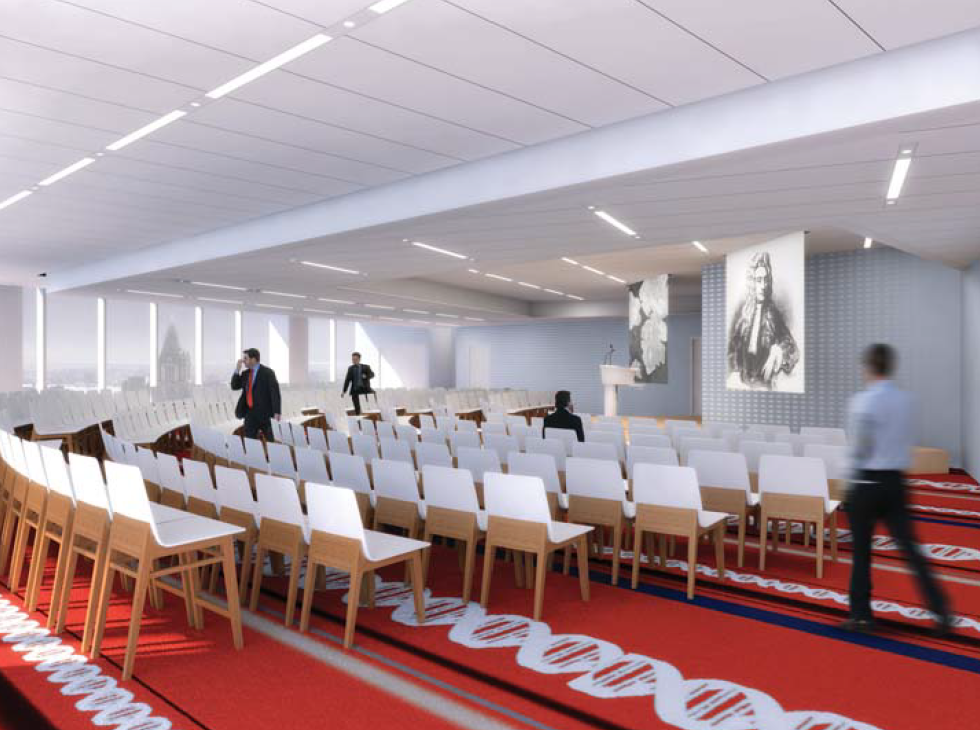
A meeting room at 7 WTC. Image courtesy of H3 Hardy Collaboration Architecture.
Conferences and meeting presentations require concentration, without the distraction of fascinating views. Therefore, three meeting rooms are fashioned so that each can shut out the panoramas. One of the conference rooms, shaped like a pod, is totally enclosed, while the others have shades that can hide the view. Groups from 30 to 300 people can be accommodated.
To the northeast, in one of the wide corners of the parallelogram, movable walls provide further flexibility, permitting corridors to be joined with the largest presentation room. A pantry permits catered food service for special events. Throughout the project, we worked with the goal of flexibility, knowing that activities will change within rooms from hour to hour, day to day.
Green concerns informed our planning. Lighting zones are monitored by motion sensors, and lights turn off after an allotted time if no one is present. Photometric sensors tied to westernmost lights automatically turn lights off during bright afternoon sunlight. In addition, almost all of the lighting is energy efficient fluorescent. Carpet tile is being used to reduce waste.
If areas of the carpet wear out over time or are stained, only those tiles need to be replaced instead of an entire run of carpet. The desk chairs are 44 percent recycled and 99 percent recyclable, and offices and workstations use high proportions of recycled materials, including steel paneling and mineral board, and glues and finishes that do not contain volatile organic compounds. Fabric for all of the upholstered walls and cubicles is 100 percent recycled polyester.
Combining Utility and Aesthetics
This institution has long held art in high esteem, using many forms of expression to suggest the shared interests of artists and scientists. An 80-foot-long gallery runs the length of the building’s interior core and will contain artworks relating to the Academy’s programs. Photographic panels, designed by the graphics firm 2×4, will decorate the conference rooms.
Those large images—some in black-and-white, some in color—depict details of the natural environment as seen through an electron microscope, as well as flowers distorted by anamorphic projection. The Academy’s new interior design utilizes materials that juxtapose tradition with innovation. We custom-designed a red carpet woven with a decorative gray-and-blue version of the DNA double helix. The carpet will offset paneling of light-colored wood.
After the Academy’s move this fall, visitors will enjoy a distinctive new facility that will encourage communication, discovery, and the generation of research and ideas. The Academy’s physical transformation represents its confidence in the future and its prominent role in the scientific and intellectual leadership of New York.
Hugh Hardy and his firm, H3 Hardy Collaboration Architecture, are designing the space. Among Hardy’s well known projects in New York are the redesign of Bryant Park, the visitor center at the New York Botanic Garden, and the restoration of the BAM Harvey Theater.
From the boilers that heat water in our homes to the engines in our vehicles that allow us to travel with ease, thermodynamics are an often-invisible part of our everyday lives.
The president of France, Sadi Carnot, was stabbed by an anarchist on June 24, 1894. The vein to his liver was severed, and he bled to death in the hospital. This touches our story in two ways:
First, the darkness of venous blood was one of the “tells” that led people to accept the idea of energy conservation, the first law of thermodynamics. Questions about how blood manages human body temperatures had helped people to see that our bodies achieve both work and heating from the chemical energy of food.
Second, President Carnot’s uncle, also Sadi Carnot, and his grandfather, Lazare Carnot, were key players in the struggle to understand the rules that govern heat and work. Their efforts led to what we call the second law of thermodynamics, the idea that no engine can ever be 100 percent efficient, and that all natural processes degrade energy. Yet neither senior Carnot accepted the first law of thermodynamics – the idea of energy conservation.
Black and Phlogiston
Many towns in France have a square, avenue, or street named Carnot but it is hard to tell which Carnot it honors: Lazare, best known as the “organizer of victory” during the revolutionary wars of the 1790s; his son, Sadi, who died at 36 having published just one work, yet whose name is inextricably linked to the origins of thermodynamics; or Sadi’s nephew who presided over the French Republic from 1887 until his assassination.
The story of the thermodynamical Carnots best begins about the time of Lazare Carnot’s birth, in 1753. Heat was then regarded as the “subtle fluid” phlogiston – the “substance” released during combustion. The young Scottish chemist Joseph Black was still thinking of heat as wedded to chemical change, but was asking just how much phlogiston it took to increase a material’s temperature one degree.
The Kindred Concept of Latent Heat
Black recognized that the amount must vary from material to material. By this time, both Fahrenheit and Celsius had provided excellent means for measuring the intensity of heat – its temperature. But should one not also have means for measuring its extent – its quantity? Black realized that he could heat a mass of water by transferring energy to it from another material. Since the heat leaving one mass is the same as that entering another, he could determine the heat capacity of any material by heating or cooling a known amount of water.
He also took an interest in the kindred concept of latent heat. At the transition points where a liquid boils or condenses (or a solid melts or freezes) it does so with no change in temperature. To measure the latent heat transferred in, say, melting, Black surrounded a known mass of ice with a known mass of hot water; then he measured how much the water temperature fell as the ice melted away.
These experiments led naturally to the British thermal unit or Btu (the energy needed to raise the temperature of a pound of cold water one degree Fahrenheit).
The Rise of Caloric
Black at first thought he was manipulating chemical changes in matter, but he began to see that heat was not some component of matter, as phlogiston was imagined to be. Rather, it flowed in and out of matter. Phlogiston was about to be displaced by the new term caloric. Caloric gained its full definition in 1779 when Black’s student, William Cleghorn, set down rules for its behavior. Cleghorn’s rules helped to make a useful tool of caloric, but they also helped expose its eventual failings.
Cleghorn determined that caloric had to be a subtle invisible fluid. He explained thermal expansion by imagining caloric to be elastic, with particles that repelled each other. Cool bodies attracted caloric to different extents. That explained heat conduction and specific heats. Caloric had to take a latent form as water boiled at 212° F. It was “sensible” when it raised a material’s temperature. Caloric had to have weight because metals gained weight when they were heated.
Today we know that bodies expand as they are heated because their molecules repel one another. We recognize the gain in weight in metals as a chemical change, oxidation.
Not the Whole Story
Black knew Cleghorn’s rules were not the whole story, but he allowed that they correctly explained the experiments of Benjamin Franklin and others. He cautiously called the caloric theory, “the most probable of any that I know.” Antoine Lavoisier, the French chemist, also liked the idea and coined the term calorique.
So the caloric theory remained for about seventy years. Not until atoms were far better understood would we realize that heat merely reflected atomic motion. However, in everyday life, we still speak of heat flow, or of bodies holding their heat, as if heat were behaving like a caloric fluid.
In our bones (or more accurately, in our muscles) we have always known that we can create heat by doing work. But how could frictional heating be reconciled with heat as a fluid? Caloric theorists tried to resolve that with increasingly tenuous arguments about how friction or deformation “released” caloric. They looked at frictional heating and saw, not a contradiction, but a phenomenon to be explained in terms of caloric. All the while, it was perfectly clear to everyone that the amount of caloric they could create was limited only by their own stamina.
A New Science of Thermodynamics
So the stage was set for the last act in the drama of writing a new science of thermodynamics. What had to be digested was the fact that thermal energy and mechanical work can be traded back and forth (the essence of the first law of thermodynamics).
Which takes the story back to venous blood. Natural philosophers were beginning to suspect that chemical reactions turned blood from red to dark. But estimates of the extent of chemical heating were too low to account fully for the heat.
Eighteenth-century physiologists had attributed blood heat to friction despite the caloric theory, and they continued to think that friction accounted for blood heat, well into the 19th century. Not until 1843, did French chemist Pierre Dulong have accurate enough data to show that chemical heating accounted for virtually all of blood heat. In an ironic twist, Dulong effectively bolstered the lingering caloric theory when he removed frictional heating from physiology.
Everyone who has ever studied the history of heat has struggled with the obviousness of mechanical friction. Yet even the idea that blood is heated by friction had failed to animate an anti-caloric movement. The recognition of friction as an instance of the convertibility of heat and work replaced caloric as a competing theory only in the 19th century, after cannon-boring experiments made in Bavaria by American expatriate Benjamin Thompson/Count Rumford. Thompson had become Count Rumford in Bavaria after a rapid and convoluted series of moves that began when he had to flee colonials who learned he was spying for the British.
Count Rumford’s Canon
As a result of tests in which he generated unlimited caloric by boring cannon with blunt bits under water, Rumford was able to state quite plainly, Anything which an insulated body, or system of bodies, can continue to furnish without limitation cannot possibly be a material substance; and it appears to me to be extremely difficult, if not quite impossible, to form any distinct idea of any thing, capable of being excited and communicated in the manner the Heat was excited and communicated in these experiments, except it be MOTION.
Rumford continued his advocacy of a mechanical theory of heat after he left Bavaria and returned to England and France. At that point he took up a four-year relationship with Lavoisier’s widow, Marie, which ended in a short and disastrous marriage. It’s quite possible that the scientifically savvy Marie Lavoisier egged him on in his attack on caloric. In any case, before the marriage Rumford crowed: “I think I shall live to drive caloric off the stage as the late M. Lavoisier drove away Phlogiston. What a singular destiny for the wife of two Philosophers!!”
With that kind of rhetoric, we can hardly be surprised that the marriage failed. Rumford did indeed help drive caloric “off the stage” by setting a foundation for the first law of thermodynamics. But that would not happen yet.
An anti-caloric faction failed to arise, even after Rumford, for this is where Lazare and Sadi Carnot enter the story.
Lazare Carnot, Revolutionary Leader
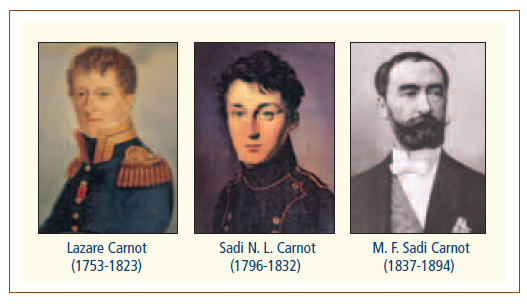
From left: Lazare Carnot (1753-1823), Sadi N. L. Carnot (1796-1832), and M. F. Sadi Carnot (1837-1894).
Lazare Carnot was a remarkable figure. He was born in 1753 – the same year as Benjamin Thompson – and was educated in mathematics and military engineering. During his military service, he competed for mathematics prizes, and also had political dealings with the infamous Robespierre. While he was on garrison duty in the 1780s, Lazare Carnot began an intense affair with an aristocrat’s daughter.
Unbeknownst to Carnot, her father arranged her marriage to another aristocrat. Carnot, furious, went to the fiancé and revealed the affair. That broke up the marriage plans, but the father had Carnot thrown in jail for conduct unbecoming an officer and gentleman. This was 1789. The first events of the French Revolution were just taking place, and they led to Carnot being retrieved from prison after only two months.
His life had been pretty static up to that point. Now it began moving very rapidly. He was soon married (to someone else) and was elected to the Assembly. His skills in administering military missions led to his selection in 1793 as one of the 12 men on the Committee of Public Safety and, in 1796, as a member of France’s five-man ruling group, The Directory. They reorganized the government and ran it until Napoleon took power. Carnot served longer than any revolutionary leader except Napoleon.
A Mathematician and Technocrat
Carnot also started the Little Corporal on his rapid ascent to power by appointing him head of the Army of Italy, and Carnot would rally to Napoleon as his Minister of Interior when he returned from Elba. However, after Napoleon’s fall, the returning monarchy remembered Carnot’s vote to behead Louis XVI and he spent the rest of his life exiled to Germany.
Lazare Carnot was first a mathematician, yet strongly interested in technology. Also, he advocated active defense in fortification design, including what became known as Carnot walls – the high, heavy, detached walls built in front of forts, with loopholes for the exchange of fire. He befriended the Montgolfier Brothers, and Robert Fulton, who showed up in France trying to sell submarine designs. Carnot was an excellent violinist, but he thought like a technocrat. He once remarked: If real mathematicians were to take up economics and apply experimental methods, a new science would be created – a science which would only need to be animated by the love of humanity in order to transform government.
From Waterwheel to Steam Engine
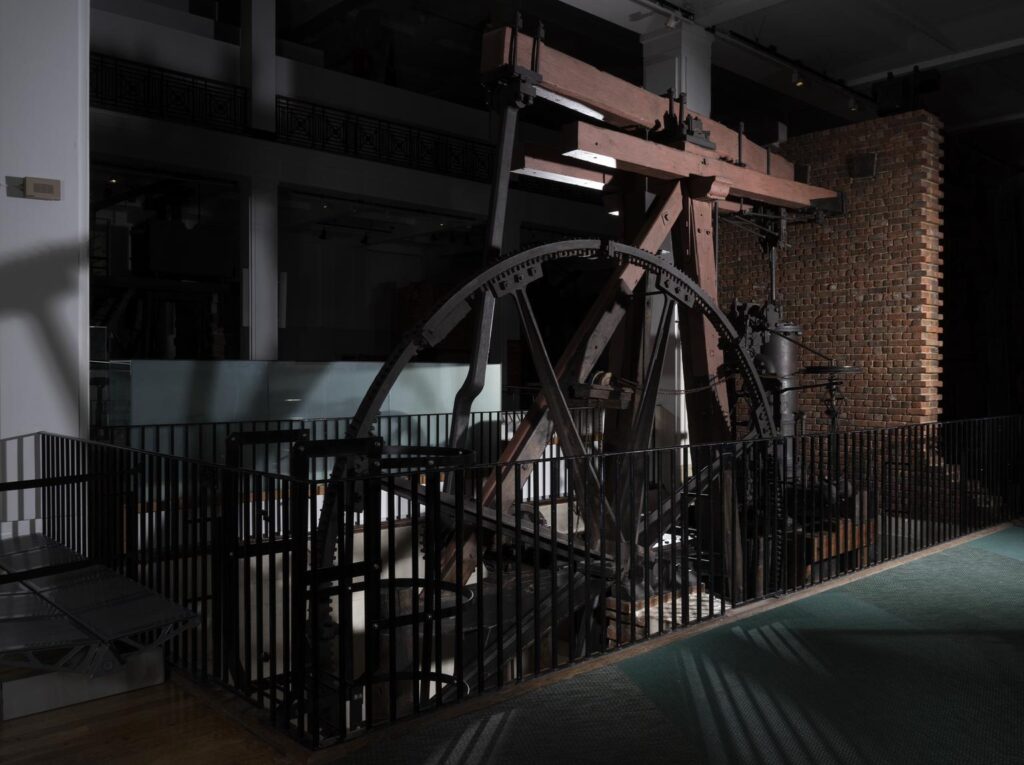
Lazare Carnot’s attention naturally turned to power production. Imagine a perfect waterwheel, he said, in which no energy is wasted or dissipated. Water is stationary before it enters and stationary at the exit. Then he reached a very important insight: all motions would be completely reversible. Run the perfect waterwheel backward, and it would become the perfect pump.
Here Lazare’s son, Sadi, claimed his inheritance. In 1824, one year after his father died, 28-year-old Sadi Carnot wrote his sole monograph, Reflections on the Motive Power of Heat. In it, he asks us to conceive a perfectly reversible steam engine. If we could build such a machine, we could run it in reverse and pump heat from a low-temperature condenser to a high-temperature boiler. When the first refrigerators appeared 36 years later, they were exactly the reversed heat engines that Sadi Carnot had described.
Sadi “operated” his perfect engine in a thought experiment. In his mental engine, he used an ideal gas instead of steam. When he assumed the not-yet-fully-accepted fact that no engine can possibly act as a perpetual motion machine, he was able to show that the work of one kilogram of air in such an engine depends only upon the temperatures at which the air is heated and cooled.
The Basis for Carnot’s Theorem
That was the basis for Carnot’s Theorem: The motive force of a perfectly reversible engine depends solely upon the high and the low operating temperatures. (Those would be the boiler and condenser temperatures in a steam engine.) This sole dependence on temperature was the first step toward the second law of thermodynamics.
Carnot’s theorem would be true whether the engine used steam, air, or any other fluid. His ideal engine mirrored his father’s perfect waterwheel – a waterwheel that depends solely upon how far water falls through it. Yet neither father nor son accepted the conversion of work into heat or vice versa. (I can find no evidence that Lazare Carnot and his contemporary, Count Rumford, ever communicated.)
Sadi Carnot assumed that caloric was conserved as it passed through an engine, just as water passing through a waterwheel is conserved. Today we know that only part of the heat flowing into a boiler turns into useful work. A good fraction of the heat passes into the condenser. But since Carnot had couched his work in terms of indestructible caloric, the validity of what he said about steam engine performance seemed to bolster the caloric theory.
Clausius and Entropy
This strange turn of affairs meant that the demise of caloric had to await a new generation. Rudolf Clausius, born in 1822, finally synthesized our science of thermodynamics from these seemingly contradictory parts. Clausius showed how Carnot’s theorem and the conservation of energy complemented one another. Energy conservation said that less heat left a steam engine than entered it – the difference being converted into useful work. While that contradicted Carnot, it left Carnot’s theorem intact.
Clausius saw that something was being conserved in Carnot’s perfectly reversible engine – but something other than heat. He called it entropy, and defined it as the heat flow from a body divided by its absolute temperature. Entropy changes in a perfectly reversible engine balance out. As heat flows from the boiler to the steam, the boiler’s entropy is reduced. As it flows into the condenser coolant, the coolant’s entropy increases by the same amount.
No heat flows as steam expands in the cylinder or as condensed water is compressed back to the boiler pressure. Therefore, the entropy of the water or steam changes only when heat flows to and from the condenser and the boiler. The net entropy change is zero in that perfectly reversible engine and its surroundings. Under Clausius’s definition of entropy he was able to show that everything Sadi Carnot had claimed was true – except the part about heat or caloric being conserved.
Carnot’s Single Error
Once he corrected Carnot’s single error, Clausius could conclude that the efficiency of a perfectly reversible heat engine did indeed depend upon nothing other than the temperatures of the boiler and the condenser, just as Carnot had said it must. Carnot’s belief in caloric denied him the specific use of the word efficiency, but his central deduction remained intact.
Sadi Carnot died of cholera in 1832 and the image of his fevered blood brings to mind the dark venous blood of his nephew, Lazare’s grandson, its life-giving energy spent. What bizarre convergences these three generations offer – contradiction and resolution, terrorist politics and idealism, maddening complexity and elegant simplicity – and a crucial path along the road to understanding how things work.
1. Brown, S. C. 1981. Benjamin Thompson, Count Rumford, MIT Press, Cambridge, MA.
2. Carnot, S. 1897. Réflexions sur la Puissance Motrice du Feu (Reflections on the Motive Power of Heat), R. H. Thurston, Ed. John Wiley, New York.
3. Gillespie, C. C. 1970-1979. The Dictionary of Scientific Biography, Charles Scribner’s Sons, New York.
4. Lienhard, J. H. June 2006. How Invention Begins: Echoes of Old Voices in the Rise of New Machines, Oxford University Press, Oxford, New York. Much of the material in this article, and all the resources used in its making, are in this book.
5. Lienhard, J. H. Engines of Our Ingenuity radio program Web site. www.uh.edu/engines. Short essays on many of the themes of this article can be found and heard here.
About the Author
John H. Lienhard is M. D. Anderson Professor Emeritus of Mechanical Engineering and of History at the University of Houston, and the author and voice of The Engines of Our Ingenuity, a radio program heard nationally on Public Radio. His latest book is the forthcoming, How Invention Begins: Echoes of Old Voices in the Rise of New Machines. (Oxford University Press)
How is your mind like a movie? Will new technologies enhance the way films convey cognitive experience? How will the ancient human capacity for processing emotions keep pace with rapidly accelerating cognitive experiences?
These and other questions were tackled by a panel of four scientists and three filmmakers recently at the Sundance Film Festival in Park City, Utah. An audience of 250 filmmakers, journalists, and film enthusiasts attended the event called “What’s on Your Mind? The Science and Cinema of the Brain,” hosted by New York’s Alfred P. Sloan Foundation on January 27, to engage in a discussion about how movies can be tools for exploring the mind, for fulfilling the human need to vicariously experience emotion, or for mimicking the editing process in which our brains engage.
Meet the Panel
Moderating the panel was John Underkoffler, an MIT-trained engineer who has consulted as a science and technology advisor on films such as Steven Spielberg’s “Minority Report” and “The Hulk,” in which Nick Nolte plays a mad scientist.
Panelists, in order of appearance, were:
Lynn Hershman Leeson, artist and director of the films “Conceiving Ada,” about the contributions of the Countess of Lovelace to early computer science, and “Teknolust,” which won the Sloan Award at the 2002 Hamptons Film Festival;
Hal Haberman and Jeremy Passmore, the directing and writing team that created a film screened this year at Sundance called “Special,” about a man who enters a clinical trial and suffers a breakdown and thinks he is a superhero;
Antonio Damasio, a neurologist and neuroscientist who directs the University of Southern California Institute for the Study of the Brain and Creativity;
Martha Farah, director of the University of Pennsylvania’s Center for Cognitive Neuroscience; and
Kay Jamison, professor of psychiatry at Johns Hopkins University School of Medicine and author of several books on manic depression and bipolar disorder, including her autobiography, An Unquiet Mind.
Storytelling and Technology
Underkoffler kicked off the discussion pointing out that new technologies such as functional MRI are enabling neuroscientists to see where in the operating mind different activities are taking place, and to address for the first time questions that were previously the domain of philosophers, only answerable through intuitive thought, not scientific analysis. Considering that film is a unique vehicle for conveying states of mind, Underkoffler asked, “Is film privileged as a tool for exploring these ideas of mind and brain?”
*Here is an abridged version of the conversation that followed.*
Leeson: The technology always has some kind of way of altering the way we think. Some people have said that iPods are restructuring the way we create narratives. The advent of multidimensional possibilities with DVDs or other aspects of Internet use has created varying levels of how we communicate and what stories we tell and how we develop ideas of fractured intelligence, identity, and even artificial intelligence as characters and character subplots.
Haberman: For me, technology influences how we make movies, but in terms of changing the actual stories we’re telling and the structure of the stories we’re telling, I don’t think those are much different from the way I would have told the story in a movie if I had been alive to make one 30 years ago.
Passmore: I’d agree with that. The film doesn’t happen on the screen or in the speakers; the film happens when it’s synthesized by your brain when you’re sitting in the audience. Film is inherently the medium by which you experience alternate realities. As the technology evolves, whatever is after cinema is going to become even more so.
Frames in the Mind
Damasio: Film, and before it theatre and literature in general, have been historically means of inquiry into the human mind. Greek theatre was doing things similar to what filmmakers are doing today: using narrative you’re looking into the human mind and human behavior.
There’s something privileged about cinema that is different from the other modalities, [because] it’s probably so far the closest we can have to the kind of subjective experience we have of our own mind. It has to do with the fact that there is a frame in our minds when we’re looking at the world, whether we’re looking at the actual world, or into our minds with our eyes closed. The visual and the auditory are very powerful and are the bread and butter of film making. They bring us much closer to the experience of our own mind.
It’s as if film has [copied] some of the characteristics of the human mind. Editing is something we do all the time when we apportion attention differently to one image or another. We are constantly running an editing machine in our own mind by bringing a character into focus more strongly, by reframing it, or by the duration for which we allow the image of that character to linger.
It’s quite interesting that there are very close connections between the mind process and what our eyes are doing. John Huston might have been the first to point out that you cut on the blink in filmmaking. It’s something that shows film to be very privileged in its connection to brain and mind science, far more so than literature or theatre of any kind I can think of.
Simulating Experiences
Farah: I think the film “Being John Malkovich” illustrates your point well — that through film we can simulate the subjective experience of another person. “Special” does the same thing with this ambiguity between Les’s perception of what is going on and the reality. It’s a seemingly unbridgeable gulf that cognitive neuroscientists are continually trying to bridge, between subjective mental experience and objective observable things.
Haberman: “Being John Malkovich” is interesting also because it shows how you can illustrate things cinematically for a broader audience than scientists. A lot of people probably don’t know what a feedback loop is, but when they walk down the tunnel and there are John Malkoviches everywhere, I think intuitively [the audience] understands what’s happening. It illustrates a scientific principle without feeling like it’s telling or explaining to you.
Redefining Film
Leeson: I think the whole definition of film is radically changing right now, in a way that we haven’t seen in the last hundred years. We’re developing different options for how we look at moving images and therefore the whole definition of what film is and dealing with possibilities for entering virtual realities … We’ve never been able to have these possibilities before.
Jamison: If you’re trying to convey mood or desolation or despair or psychosis, or madness or ecstasy or expansive mood, it’s so much in the acting and directing and writing. The technology is not my bailiwick, but it seems to me that tremendous portrayal has been done so well since the beginning of film. If you’re trying to convey a mood such as desolation or despair, what is it in the technology recently that has made any difference in how well that would come across now to an audience as opposed to 30 years ago?
Underkoffler: Technologically, it seems like nothing. The digital resolution, sound, would have no bearing.
Leeson: Some artists are using PDAs to create environments that do alter moods when one goes there. They create installations and environments that are addressing these very particular issues.
A Wider Domain
Haberman: I think the most obvious example is video games that are so popular right now. That experience couldn’t have happened 10 years ago. They’re playing a narrative. It’s a whole way of watching a story.
Passmore: It’s kind of like antidepressants. It’s our version of “we don’t really know what the long term effects of it will be.”
Leeson: We’ve never had the connectedness that we have now. We’re able to interpret and hear so many points of view that it seems like we’re congealing things beyond a particular culture to a wider domain.
Haberman: But that’s something people have been thinking has been going on for years and years. Even if you look at things people were writing in the 1960s, it was all about connectedness and different cultures coming together. And all the poststructuralist film theory from the 1980s is the same thing: People always want to feel they’re more and more connected with each other and that technology does that, but I’m not convinced it does.
Transhumanists Thinking Like Bats
Underkoffler: I’m also interested in technologically expanded options for what cinema might become. It’s interesting to wonder what else is possible. Peter Greenway famously and cantankerously said sometime in the early 1990s that film had done nothing but produce illustrated 19th century novels in the sense that they follow a comprehensible narrative. What else could film do to map our cognitive or mental states onto other possibly even nonhuman or transhuman artifacts or situations? Might we elicit some kind of state that is impossible to elicit in any other way?
Farah: Well, it’s like the famous article “What Is It Like to Be a Bat?” by the philosopher Thomas Nagel, who ends up concluding that you can’t know what it’s like to be a bat because you don’t have a bat brain, you don’t have a bat experience.
Underkoffler: And you don’t have a bat body.
Passmore: What we need is a bat filmmaker.
The Essence of the Subjective Experience
Farah: How close could you get to a bat experience by watching a film? I’m going to say not very. If you can’t get the essence of the subjective experience of being a bat by walking around in the world having light impinge on your retina because it’s reflecting off surfaces around us, I don’t see how having light impinge on your retina because it’s coming from a movie screen is going to make a difference.
But one thing that might make a difference is a sort of wacky idea that Ray Kurzweil describes in his new book The Singularity is Near: When Humans Transcend Biologyall about how changes in computer- and nanotechnology are going to increasingly be incorporated into our bodies, including our central nervous systems. Eventually we’ll gradually transform ourselves into these cyborg creatures that won’t resemble much the humanity version 1.0, which is what we are sitting around here today.
One interesting scenario he describes is the use of nanotechnology to penetrate our nervous systems. We would first use nanotechnology to get a highly detailed, three-dimensional image of the state of somebody else’s brain. A nanobot would go into John’s ear and infiltrate his brain and get the picture and then I could inhale them into my brain and they could simulate the same state and thereby let me know what it’s like to be John Underkoffler. And maybe they could do the same thing with a bat.
The Cyborgian Age
Leeson: I think we already are posthuman and we’ve already entered the cyborgian age. More and more symbiosis with technology is altering the way we’re thinking. And as far as projections into the future, I think one that’s very close is how we distribute narratives, not just only on screens in dark rooms, but on computers and through software programs that incorporate moving images and build memory.
Damasio: I think with the Kurzweil scenario, there’s no need for immediate worry. It’s far into the distant future. If the Kurzweil scenario comes to pass it will lead to different relationships within ourselves and with technology, and I don’t know if it will illuminate our experience with nonhuman species, but I don’t think it will affect film as it is in itself. Film could portray all of this, but it doesn’t follow that it will alter it necessarily and change that fundamental technique.
How Movies Nourish Emotions
Passmore: My opinion is that this technology is great, it will help bring new ways of telling stories to people, but I think there’s a reason the narrative structure hasn’t changed over 1,000 years. It’s because we want to experience someone else’s life, someone else’s reality. We want to see a character and view the world through that character’s eyes and I think that’s the basis of narrative and I don’t see that changing anytime soon.
At the end of the day, you have an audience that wants someone they can identify with. There are always going to be people trying to beat their heads against the wall trying new things, but eventually the strength of the narrative in its current form is going to carry on forever.
Damasio: That has a lot of do with our own needs to experience vicariously emotional states. There are a lot of things going on in movies traditionally and in classical novels and theatre that is a way to experience emotion we would like to have and sometimes experience emotions that we would not like to have.
I don’t think anybody would choose to be in situations that cause extreme horror and terror and so on, but the fact is that people flock to movies that have suspense and show fear and that lead you to experience enormous horror sometimes. I think there’s one reason that continues, and that is that we rehearse. In some way we get rid of the need to worry about them, because we are going through that experience in a way that we know once the lights come up we’re not going to get killed or nothing terrible is going to happen to us.
Our Own Mortality
Passmore: It tricks us into thinking that we’ve dealt with our own mortality.
Damasio: Exactly. We need to have nourishment for our own emotions. And here I would point out biology. There is a big disconnect between the way our brain and our organism processes emotions, and the way our organism processes what people call straight cognition. Cognition is like lightning. Cognition is very rapid, and has the potential to become more rapid.
It’s quite likely that people in the world who are growing up with new technologies are going to have even more rapid cognition. But that doesn’t mean that they’re going to have faster emotional processes, because the emotional processes are very old, in terms of evolution, and they’re probably much more rigid and difficult to change at least over a course of a relatively limited period of time.
Leeson: Do you think there’s a difference in generational cognition and that it’s changing?
Jamison: I would address the emotional side, which is the more ancient side, and that probably is not changing nearly so rapidly. The thinking process probably is, but the moods and the fears and so forth are not changing so rapidly, so it’s a fascinating time in human evolution.
For mathematician Edward Belbruno, by embracing “chaos” he was better able to understand the three-body problem of celestial physics. His notion of chaos describes motion that defies precise long-term predictions.
In 1990, Edward Belbruno was packing his belongings, getting ready to leave the Jet Propulsion Laboratories in Pasadena. His five-year effort to interest NASA in low-energy trajectories for spaceflight had failed.
A graduate of the Courant Institute of Mathematics in New York, Belbruno had long been playing with the idea of charting very precise flight paths through the sky or into space. He wanted to allow space probes to slip into orbit around a moon or planet without the use of powerful, fuel-consuming retrorockets. His task was made immensely complicated – if not impossible – by the three-body problem of celestial physics.
When first formulating the laws of gravity, Isaac Newton had calculated the interaction of two bodies. They could be a stone falling to Earth, a spacecraft in orbit, or the Earth itself on its trajectory about the Sun. In each case, the two bodies both revolve around the center of mass – a point somewhere between their two centers, like the balancing point of a see-saw.
The interaction of three bodies, however, is immensely more difficult. In fact, in the late 1950s, V. Arnold, a Russian mathematician, and J. Moser, a German, independently proved that the three-body problem could not be solved at all. The proof came from solving the more general problem of chaos in nearly periodic motion, as outlined by Arnold’s teacher, A. N. Kolmogorov, in the 1920s. It is now known as the Kolmogorov-Arnold-Moser (KAM) theorem.
Order in Chaos
The obstacle to finding a solution is that the three-body problem leads, literally, to chaos. To a mathematician, that does not mean a dark abyss or a mad frenzy. Rather, chaos describes motion that defies precise long-term predictions.
However, mathematics offers tools even for dealing with the unknowable. Using the mathematics of chaos, Belbruno felt that he could fudge the three-body problem enough to create a proper trajectory. The difficulty was that his slow dance to the Moon would take two years, whereas conventional rockets can make the trip in three days. NASA lost interest, and Belbruno was shown the door.
Then a miracle happened. The Japanese had launched a two-part Moon probe, Muses A, the size of a desk, and Muses B, the size of a grapefruit. The two had separated while in Earth orbit and the grapefruit headed for the Moon. Upon arrival, however, Muses B’s radio failed, and the probe was lost. Now Muses A was circling the Earth with very little fuel and nothing to do. A JPL engineer remembered Belbruno’s work. Suddenly Belbruno had an audience. Could he help? Belbruno said he could.
“In the same instant, I realized that I could add the Sun’s gravitational field to the equation,” Belbruno says. Ten months later, Muses A – now rechristened Hiten, after a Buddhist angel – fired half its remaining fuel and, guided by Belbruno’s equations, glided into a 2-million-mile itinerary beyond the Moon and back again. It was like flicking a paper airplane into space, hoping it would eventually settle into a trajectory where its momentum perfectly matches the Moon’s gravity.
The Angel of Chaos
Belbruno’s formulas worked, and the mission was saved. “They used it again for the Genesis probe of the Sun and the European Space Agency mission SMARTONE,” says Belbruno. “NASA now takes my work a lot more seriously.”
So seriously that Belbruno was commissioned to call a conference at the University of Maryland in 2003 to investigate astrodynamics and chaos. Also under study were formation flying, navigation and control of unmanned spacecraft, orbital dynamics, mission proposals, and possible propulsion methods for pushing probes deep into the solar system. The results have been collected as Astrodynamics, Space Mission, and Chaos, Volume 1017 in Annals of the New York Academy of Sciences.
Although Belbruno and his fellow authors could not know it, space probes were about to be brought back front and center by President George W. Bush’s announcement of a mission to Mars, somewhere around 2020. “The cost for delivering cargo to the Moon is now $1 million per pound,” says Belbruno. “Every pound of fuel we can save is another pound of payload that can be delivered.
“I don’t agree with everything the president does, but I think he has shown great vision on this initiative,” he adds. “The idea of going step by step to the Moon, building a base, and then moving on to Mars and back is very practical. I think there’s a good possibility we’ll succeed.”
Ensuring the integrity of the popular plebiscite, the most basic of democratic processes, in the 21st century cyber age may in the end come down to an age-old principle – trust, but verify.
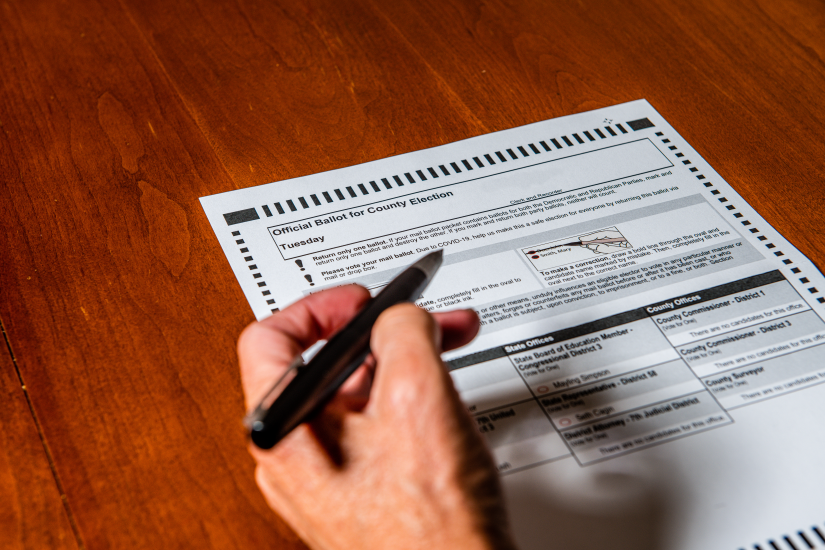
In August, Venezuelans, voted on whether to keep Hugo Chávez as president. This nationwide tally of more than 14 million registered voters was taken on direct-recording electronic (DRE) voting systems.
Chávez was not recalled, and the ink was barely dry on the voting machine printouts when accusations of fraud were made. The vote was a recall on Mr. Chávez, based on a petition signed by more than 3 million voters. Surely the vote, which was 57.8% in favor of retaining Chávez, must have been manipulated, thought some. And what better way to manipulate the vote than by subverting DRE machines?
A Simple Concept
There are several basic designs for DRE machines, with various permutations and combinations of features. Bernard Liu, legal staff attorney for the Elections Division of the Secretary of State’s office in Connecticut, described these machines as “the most simple application” of computer technology. A common automated teller machine (ATM), he explained, is more sophisticated. DREs simply record and compute votes.
The machines, many of which have touch screens like ATMs, must be activated for each voter. In some cases the poll worker activates the machine, either directly or through a local workstation. In others the poll worker may give the voter an electronic key: a card with a magnetic strip or a smartcard that contains a computer chip.
The poll worker will program the card to allow only one person to vote. If there are primaries being run on a given day, the card can be programmed for the primary ballot of a specific party. The ideal system will have no information programmed into the card that will identify the voter. Once the voter or poll worker activates a machine, a ballot will come up on the screen.
Frank Wiebe, president of AccuPoll, Inc., a small vendor of voting machines in Tustin, California, explained how his company’s machines work; other companies’ machines may work slightly differently. The AccuPoll machine is activated for a voter with a memory-only smartcard. The machine, said Wiebe, verifies that the card is for the correct polling place and is enabled for voting. It also has encoded within it the type of ballot that the voter needs to see.
Tangible Representation on Paper
The initial screen contains a set of instructions. After reading the instructions, the voter is asked to hit the “next” button to see each individual contest. At the end of the ballot, the voter sees a ballot review screen. Wiebe explained that the machine will not allow an over-vote – i.e., if you are supposed to vote for two of five names, you cannot vote for more than two – and will issue a warning if you have under-voted by skipping races or voting for fewer candidates for given offices.
“If they [voters] decide to change their minds, they would just touch the button for that contest,” Wiebe said. The machine would return to that specific contest to allow the voter to make the change. After reviewing the ballot, the voter would push the “cast your ballot” button.
After that button is pushed, Wiebe continued, “the representation of the ballot is written into memory [and] the go-vote key is disabled.” The vote is stored in the hard drive and in flash memory. Some machines do not print out a paper representation of the vote, but the AccuPoll machines do. “They have a tangible representation on paper, which the voter can confirm, that the vote could be recorded as desired,” noted Wiebe. The voter then puts the paper ballot into a ballot box so that the vote can be verified.
In some cases, as with the AccuPoll machines, the individual voting machines are networked to a central workstation at the polling place. In others, the machines are linked via the Internet to a computer at a centralized election office. And in yet others, the machines are not linked at all.
Variations on a Theme
There also are various permutations of a completed paper ballot. Some machines – those that have been most criticized by computer experts – provide no paper record at all. Others provide a “receipt” that cannot be proved against the record within the computer, as it cannot be matched with a specific ballot. Other machines generate a random number for the electronic ballot that also is on the paper ballot. That allows the paper ballot to be compared with the computer’s record.
Eugene Spafford, executive director of Purdue University’s Center for Education and Research in Information Assurance and Security, noted that there are a number of areas in which the electronic voting system can be compromised – beginning with people. “You have a very broad range of individuals who are working as the election clerk and monitors,” Spafford said, and there are no standardized tests for elections officials. In a medium-to-large-sized county, Wiebe noted, “it’s a 6- to 12-month project to transition from an old system to a new system.” And the transition includes educating both voters and poll workers.
A person intent on subverting the system could fabricate smartcards or smart keys to allow multiple votes. In their often cited paper, “Analysis of an electronic voting system” (T. Kohno et al., IEEE Symposium on Security and Privacy 2004, IEEE Computer Society Press, May 2004), Johns Hopkins’ Avi Rubin and colleagues review vulnerabilities of one DRE system. They note that there is no cryptography in the smartcards, thus, “there is no secure authentication of the smartcard to the voting terminal.” They further note that poll workers may have access to cards that can administer or end an election. These, too, can be duplicated.
Software Vulnerability
Another vulnerable area is the software, Spafford said, noting that the people who build voting machines are not necessarily security experts. He said companies “don’t build-in all the safeguards because that would be too expensive.” While the vendors may claim that their machines are safe, Spafford said, “Most of these vendors certainly don’t have the level of software testing that a Microsoft or Oracle has.” A Trojan horse – capable of wreaking havoc on software – can’t be found by the usual testing done on DREs, Spafford said.
Concern about the integrity of the software used in electronic voting systems is shared by Jennifer McCoy, of Georgia State University, in Atlanta. Commented McCoy, who led the Carter Center’s observation of the Venezuelan plebiscite: “I think it’s theoretically possible to manipulate the software.”
Local area networks (LANs) are also subject to potential tampering, and wireless LANs are particularly insecure. “There are definitely a lot of security exposures for a wireless LAN and we would never advocate for such,” says Wiebe. Liu says Connecticut is not considering networked machines or machines that are connected to the Internet. The advantage of stand-alone machines, he noted, is that people set on malfeasance would “have to hack into every single machine you have to try to change the vote.”
The Human Touch
Vote tabulation is also vulnerable to tampering. Transmission from the individual terminals to the polling place workstation can be compromised, as can transmission from the polling place workstation to the central tabulation location. With no verifiable paper trail, “you cannot do a recount; all you can do is a re-read,” Spafford explained. And if, when the machines are opened, the counts are all zeros, he added, then “all the votes are gone.” Posting results at the polling place and again at the central tabulation location, he added, shows that there has been no tampering between the time the tabulations left the polling place and when the numbers were entered into a central computer.
The Venezuelan plebiscite illustrates why a verifiable paper trail is so important. So far, the Carter Center has gone through two audits of the results. The first was what McCoy called “a quick count,” where election observers called in the machines’ data to headquarters on the polling day. The second was in response to a report that criticized the first audit as not relying on a random sample.
“The paper ballot had the number of the machine on it; it had the result of the vote; then it had a 32-character string, numbers and letters combined,” noted McCoy. These numbers could be matched up to numbers printed on a tally sheet for each ballot that was cast.
Absentee Ballots
The center’s second audit report also compared voting machine results and numbers of signatures on the recall petition, but was based on a random sample.
Arnold Urken, a demographics and electronic voting expert from Stevens Institute of Technology in Hoboken, New Jersey, participated in a recent panel discussion on electronic voting held at The New York Academy of Sciences (the Academy) and sponsored by the Science Writers in New York. Other members of the panel included former Undersecretary of the Navy Jerry MacArthur Hultin, now of Stevens Institute; journalist Steve Ross; and former ABC White House correspondent Steve Taylor.
Urken indicated his sense of insecurity with the DREs by advising: “If you want your vote to be counted as carefully as your money, consider requesting an absentee paper ballot so that you do not run the risk of having your vote changed, corrupted, or eliminated by a computer malfunction.”
Myrna E. Watanabe, PhD, is a freelance writer based in Patterson, NY. Her articles appear in many publications, including Nature, Nature Medicine, The Scientist, and The Hartford Courant.
Author Robin Kerrod is inspired by science, so much so that his new book explores “the extraordinary beauty and aesthetic qualities of the images” produced by the Hubble telescope.
Published August 1, 2004
By William Tucker
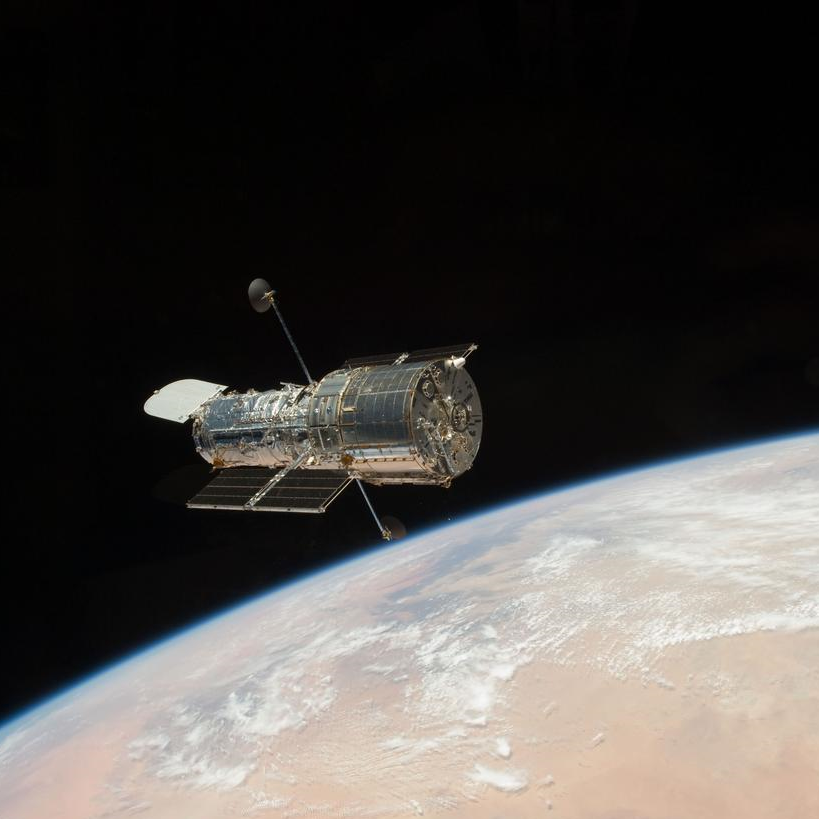
Image courtesy of J. Hester and A. Loll (Arizona State University)/ NASA, ESA via Flickr. Public Domain.
To celebrate the Hubble telescope’s achievements, Robbin Kerrod has written a coffee-table book, Hubble: The Mirror on the Universe, to bring down to Earth the romance that Hubble has been carrying with the heavens for the past decade and a half. “I don’t think the public at large truly appreciated the extraordinary beauty and aesthetic qualities of the images Hubble has sent back to us,” he says.
Kerrod is particularly pleased that his book has been presented to prominent politicians in Washington and the White House as part of an ever-growing “Save the Hubble” lobby. The campaign is trying to persuade NASA and the government to change their mind about abandoning the Hubble Space Telescope (HST).
But then writing books has never been a chore for Kerrod, who has been a full-time author for more than 35 years. He has penned more than 200 titles – for children and adults – on all aspects of science and technology, from Robots (1984) and Whales and Dolphins (1998) to The Way the Universe Works (2002). “I’ve always loved writing,” he says. “There’s a seemingly endless source of inspiration in the sciences. There’s always something exciting going on somewhere.”
Hubble No Longer Sees Double
At its outset, Hubble came close to being one of the biggest scientific flops in history. Originally proposed in 1946 by American astronomer Lyman Spitzer, the space telescope was funded in 1979, and scheduled for launch in the mid-1980s. Then came the 1986 Challenger disaster. Lift-off was moved back and didn’t occur until April 24, 1990.
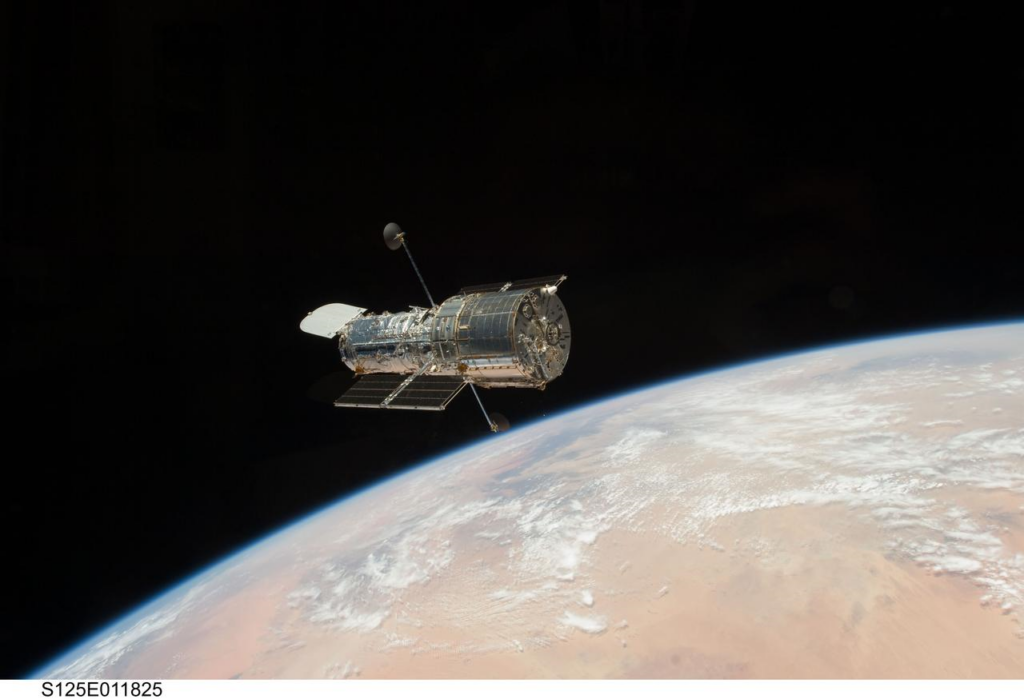
The 12-ton, 43-foot long satellite houses an 8-foot-diameter parabolic mirror made of silica-titanium oxide glass that took two years to polish to the proper looking-glass quality. Four main instruments (all since replaced) produced images and analyzed the light:
– The Wide-Field and Planetary Camera was designed to look at large swathes of sky, bringing images into sharp focus; The Faint Object Camera was so sensitive that it needed filters to look at anything brighter than magnitude 21. (Stars of magnitude greater than 6 are already too faint for the naked eye, and the best Earth-bound telescopes can see out to magnitude 24.)
– The High-Speed Photometer measured fluctuations of light sources from high-energy objects, from supernova remnants to ordinary stars.
– The Goddard High Resolution Spectrograph spread out light waves in order to detect the telltale dark bands that indicate the elements in the stars.
Within hours, however, things began to go wrong. Discovery Space Shuttle crew member Steven Hawley sent the instructions to unfurl the telescope’s two panels that gather solar energy. One of them stuck. A space walk by astronauts Kathy Sullivan and Bruce McCandless freed the frozen panel, but it would later vibrate each time the fast-moving satellite passed between light and dark (16 times a day), blurring many of Hubble’s images.
The Correction Optics Space Telescope Axial Replacement
Worse was yet to come. A month later, when Hubble’s first images were relayed back to Earth, they were unaccountably blurred. Something was obviously wrong. Not until a year later was it determined that someone had made the simple mistake of failing to convert English to metric measurements in manufacturing the mirror.
The aberration – only two microns, 1/50th the width of a human hair – was still enough to make Hubble lose focus. “Pix nixed as Hubble sees double!” said one headline.
In 1993, NASA engineered a rescue mission. COSTAR (Correction Optics Space Telescope Axial Replacement), an ingenious device fitted with ten small mirrors, corrected Hubble’s vision just like a pair of spectacles. In order to make room, however, the High-Speed Photometer had to be removed. Both solar panels were replaced, along with six failed gyroscopes and two nonworking memory banks.
Finally, after three years and 35 hours of space walking, Hubble was sending back breathtaking images of the wonders of the Universe. The pictures are in the public domain and Kerrod has assembled them in an exquisite collection – probably the best summation of Hubble’s work ever made.
The Hubble Space Telescope enables us to see intricate and colorful photos from outer space that are otherwise invisible to the naked eye. However, the future of this space mission is uncertain.
During its 14 years in orbit, the Hubble Space Telescope has unveiled some memorable images of the heavens. But one of its latest pictures, released earlier this year to international fanfare, may become the telescope’s enduring legacy.
Called the Hubble Ultra Deep Field (UDF), the photograph is the most sensitive view of the distant universe ever taken. It reveals thousands of galaxies spread throughout a tiny patch of the sky, arrayed like gems against the black velvet of space. The photo, which took nearly 300 hours to produce, is sharp even by Hubble’s standards. “It’s a magnificent, beautiful, stunning image,” says astrophysicist Michael Shara of the American Museum of Natural History (AMNH) in New York.
Indeed, the UDF is so scientifically rich that Shara and other astronomers in the area decided to share their research efforts with thousands of people. For six days in March, researchers and students from AMNH, Columbia University, and Stony Brook University pored over the image in front of fascinated onlookers beneath the white sphere of the Hayden Planetarium. The teams worked at banks of computers, fielded questions, and even produced a daily video that aired on a giant screen in Times Square.
“This was a unique opportunity to share the excitement of scientific research with the general public,” says organizer Kenneth Lanzetta, an astronomer at Stony Brook.
How Galaxies Change and Grow
Hubble’s leaders conceived of the UDF as a way to improve upon the original Hubble Deep Field, a 10-day-long photographic exposure of thousands of remote galaxies. That 1995 image and a 1998 follow-up opened startling windows into the depths of the universe, where galaxies were a fraction of their current age. The two Deep Fields launched a new era of research into how galaxies change and grow over time. But the images also tantalized astronomers with hints of the true original building blocks of modern galaxies, which lay beyond Hubble’s grasp in the 1990s.
Now, the telescope can detect those objects thanks to a powerful new tool: the Advanced Camera for Surveys. Astronauts installed the camera in 2002 during the space shuttle’s last service call to Hubble. It gives the telescope a crisper focus for photography and a wider field of view. The patch of sky captured in the UDF is still small by the standards of the human eye – just 1/67th the size of the full moon – but it’s big enough to display about 10,000 galaxies of all shapes and sizes, with unsurpassed clarity. “The quality of the data is better than anything we’ve ever done with Hubble,” says Steven Beckwith, director of the Space Telescope Science Institute in Baltimore, Maryland.
The new camera is sensitive to near-infrared light, just past the reddest wavelengths of light that our eyes perceive. As the entire universe expands, light shining from distant galaxies stretches into redder and redder light. For extremely remote objects, most of the optical light shifts into infrared radiation, which we know as “heat.” Hubble’s new camera, along with a revitalized instrument that detects infrared light exclusively, endowed the telescope with the vision it needed to see galaxies near the fringes of the observable universe.
The Universe: 13.7 Billion Years Old
Hundreds of galaxies in the UDF shine most brightly in the infrared, including some faint objects that may have existed just 800 million years after the Big Bang. Astronomers believe the universe is about 13.7 billion years old today. Seeing such distant galaxies is like looking at pictures from the childhood album of a 50-year-old adult – all the way back to age 3.
Astronomers who are trying to devise a coherent picture of how galaxies assembled will focus most intently on the faint red objects in the UDF. Even a glance at the image reveals that these galaxies look nothing like the gorgeous spirals and other large metropolises of stars we see today. “The objects really are quite irregular,” says Beckwith. “We’re clearly seeing back to a time when the universe was chaotic. We see a variety of unusual shapes that we can’t identify right now.”
These blotches were scrutinized by the Stony Brook team at the AMNH public event. Prior to the release of the UDF, Lanzetta expected the image might reveal galaxies shining a mere 500 million years after the Big Bang. However, after six days of working nearly round the clock to analyze the light from a whopping 8,172 galaxies, the team determined that none of them was quite so far away. Still, knowing the distances to that many objects – and studying their shapes – will help astronomers figure out how galaxy collisions and waves of star-birth transformed ragged shreds of stars into the grand galaxies of today.
Distant Object Detected
The Columbia researchers, led by astronomer Arlin Crotts, scoured the UDF for changing flares of light. The Hubble team assembled the photograph from a series of shorter exposures over a four-month period. If any star in a distant galaxy exploded as a supernova during that time, it might appear as a brighter pinprick of light in some of the exposures. Crotts anticipated that his group might see a half-dozen such flares, but they found none – an outcome that came as a mild surprise.
Meanwhile, Shara and his AMNH colleagues examined the images for evidence of moving objects. Specifically, the team searched for nearby stars that move quickly through space – so quickly that their motion would show up during the four months of UDF exposures. Such stars would have to be close to our sun – perhaps within 10 or 20 lightyears – but so faint that previous surveys had not detected them. After six days of intense hunting, says Shara, “We have exactly one candidate. Talk about a needle in a haystack!” The team hopes to confirm the object – and learn its nature – with further research, including another view by Hubble within a year.
The combined results of the three teams didn’t make any headlines – and that was just fine, the participants agreed. This raw process was in full view at AMNH, and the scientists could not have been more pleased.
“The single most important reason was to demystify, insofar as we could, astronomical research,” Shara says. “Most of the public still has this view of astronomers as old pipe-smoking men sitting at a telescope on a dark night and peering through the eyepiece. We wanted to show that astronomy is done by living, breathing people, many of them quite young, almost half of them female, and we don’t know the answers.”
Working to Save Hubble
One particular issue rang out during the public discussions, Crotts notes: “Saving Hubble was one of the major issues on people’s minds.” Most visitors were aware that in January, NASA announced it would no longer fly the space shuttle to maintain and upgrade the telescope. Without another such mission, Hubble probably will expire by 2006 or 2007 – several years earlier than astronomers had planned. Although NASA administrator Sean O’Keefe insists that the decision is based on the safety of the astronauts, scientists and science lovers have reacted strongly and negatively.
Regardless of Hubble’s fate, the UDF image will persist as one of the telescope’s profound contributions to science. And in New York, thousands of people watched as astronomers labored to comprehend our cosmic ancestry – encoded within swirls of light on their glowing computer screens.
Theoretical physicist and Columbia University professor Brain Greene delves into the intense rivalry between loop quantum gravity and string theory, and how it ties to Einstein.
As philosopher Paul Feyerabend once noted, science moves more rapidly when there are several competing approaches to a problem. Much of the excitement in theoretical physics today surrounds the intense rivalry between loop quantum gravity (LQG) and string theory.
Both theories aspire to achieve the Holy Grail of modern physics: the unification of general relativity and quantum mechanics. They both have their champions and detractors. Both have had difficulty finding experimental verification of their predictions, yet both claim to be on the verge of discovering results that will do just that.
Loop quantum gravity’s best known proponent is Lee Smolin, author of Three Roads to Quantum Gravity, and a research physicist at Perimeter Institute for Theoretical Physics in Waterloo, Canada. String theory’s most high-profile current spokesperson is Brian Greene.
Professor of Physics and Mathematics at Columbia University, Greene came to The New York Academy of Sciences (the Academy) on Oct. 16, 2003, for an informal conversation as part of his whirlwind tour to promote the NOVA series based on The Elegant Universe: Superstrings, Hidden Dimensions, and the Quest for the Ultimate Theory, his bestselling 1999 book. Four years in the making and with a budget of $3.5 million, “The Elegant Universe” premiered with a two-hour segment, “Einstein’s Dream” and “String’s the Thing” on PBS on Tuesday, Oct. 28, 2003, and concluded with a one-hour program, “Welcome to the 11th Dimension,” on November 4.
String Theory’s Core
Much as he did in his first NOVA segment, Greene began his talk by briefly describing the history of the conflict: how Einstein revolutionized our worldview by conceiving of space and time as a continuum, spacetime; how scientists in the 1920s and ‘30s invented quantum mechanics to describe the microscopic properties of the universe; and how these two radical worldviews clashed.
String theory promises to reconcile these two views of spacetime – Einstein’s vast fabric and the jittery landscape of quantum mechanics. The NOVA animations made clear just how visually captivating this story is. One showed an “elevator of the imagination” traveling to floors smaller by 10 orders of magnitude to illustrate the transition from the placid Einsteinian realm of large things down to the turbulent, frenetic world of atoms, electrons, protons and quarks.
It is at this lowest level of matter that we find the core contribution of string theory. At the smallest of scales, inside a quark, lies not a point but a fundamentally extended object that looks like a string. A vibrating loop of string. At the microscopic level the world is made up of music, notes, resonant vibrating frequencies. This is the heart of string theory.
The Mechanism for Reconciling Relativity
What enables these strings to become the mechanism for reconciling relativity and the laws of the microworld is that these strings have size. In particle physics, point particles have no size at all. In principle you could measure and probe at any scale. But if particles have length, then it makes no sense to believe you can probe into areas that are smaller than the length of the particle itself.
String theory posits that at the smallest of scales, the smallest elements do have a defined length, what is called Planck length, “a millionth of a billionth of a billionth of a billionth of a centimeter” (10-33 centimeter). For analogous reasons loop quantum gravity also posits a smallest unit of space. Its minimum volume is the cube of the Planck length.
In one of the most memorable animations from the show, we travel again to the lowest, most turbulent level of the microscopic world, the world of point particles. But much as when the landscape on a map zooms out when the scale changes, when we define the lowest level as one in which the smallest elements have a defined size, the spatial grid rises above the turbulence and the jitters calm down.
Worlds of Dimensions
One of the most provocative components of string theory is its insistence that the world has more than three spatial dimensions. String theory calls for six or seven extra dimensions. In the television series, Greene focuses more on how there could be these extra dimensions, rather than on why they need to exist.
Greene’s book acknowledges that the need for the extra dimensions is primarily driven by the mathematics behind string theory. In order for the negative probabilities of the quantum mechanical calculations to cancel out, the strings need to vibrate in nine independent spatial directions. Of course, these are not dimensions as we know them. Greene instructs us to “imagine that these extra dimensions come not uniformly large that we can see with our eyes, but small, tightly curled up. So small we just can’t see them.”
If any aspect of string theory is ripe for visual exploitation via animation, this is it. Many readers of the book will enjoy the series if only to get the chance to see what animated Calabi-Yau manifolds look like. In 1984 a number of string physicists identified the Calabi-Yau class of six-dimensional shapes as meeting the conditions the equations for the extra dimensions require.
The manifolds consist of overlapping and entwined doughnut shapes, each of which represents a separate dimension. If we zoom again into the microscopic world we can envision encountering curled up dimensions that look much like these Calabi-Yau manifolds – “simple rotating structures” in Greene’s description.
“That’s the basic idea of string theory. In a nutshell it requires the world to have more dimensions than we are familiar with.”
In an extensive question-and-answer exchange after his talk, Brian Greene amplified his ideas.
Experimental Verification
Elegant as it is, string theory has roused the ire of some physicists because it has thus far defied being able to be proven true or false by experiment. Familiar with this complaint, Greene described what he considered several promising developments.
For a long time string theorists had thought that the extra dimensions must be as small as the size of the Planck length and, therefore, beyond detectability. In the last few years work has been done suggesting that some dimensions might be as big as 10-2 cm. “That’s a size you can almost see with your eyes.” We haven’t seen them because the only force that could penetrate into these extra dimensions is gravity.
Unfortunately, the force of gravity is many powers of 10 weaker than the smallest size that can be currently probed in physics laboratories. However, there are some experiments planned to be done at CERN in 2007 in which we may actually see the extra dimensions by observing the effect of gravity on other dimensions.
Greene’s current research involves looking for signatures of string theory in astronomical data. Proponents of loop quantum gravity are also looking to the stars for confirmation of their calculations. The Gamma-ray Large Area Space Telescope (GLAST), due to be launched in 2006, should be sensitive enough to detect from the light from gamma-ray bursts the verification LQG researchers seek.
M-Theory
In recent years string theory has undergone a transformation. Much of this dates from a milestone event, the “Strings 1995” conference at the University of California that marked the beginning of the Second Superstring Revolution.
It was there that Edward Witten delivered his startling finding that string theory requires 11 dimensions and that what had until then been viewed as five competing superstring theories are really all part of one superstring framework, which he called “M-Theory.”
What the “M” refers to is not clear. “Mysterious” is one proposed meaning, since how the framework relates the theories to each other has not been defined. M-theory also “inflates” strings into two-dimensional “branes” (from “membranes”) that could contain entire alternate universes.
And most important to its critics from LQG, M-theory is expected, as it develops, to enable string theory to be “background independent,” like LQG, so that it does not need to rely on the standard model of spacetime.
The Next Book
For all of their competitiveness, researchers in both string theory and LQG frequently speculate that they could be working on different paths toward what may be one unified theory. This may explain why Greene’s next book, The Fabric of the Cosmos: Space, Time, and the Texture of Reality, due from Knopf in February 2004, seems designed to encompass a range of theoretical possibilities.
He noted that his coverage of space and time in The Elegant Universe addressed only what was needed as background for his explanation of string theory. Many other aspects he left uncovered.
In his new book they get center stage as he probes how our fundamental ideas of space and time have changed in their nature and importance over the past century. If Greene’s knack for engaging broad audiences holds true, it will undoubtedly expand the ranks and enjoyment of those eager to follow the lively scramble to the ultimate Theory of Everything.
From local sourcing of materials to utilizing renewable energy, the sustainable building design revolution has transformed the way that architects and engineers approach construction.
As environmental awareness spreads around the globe, the so-called “greening” of architecture has ignited a revolution in the design and construction of buildings, according to one of the nation’s leading experts in the field.
“The concept of sustainable building design has led to a new architectural vocabulary – known as ‘green buildings’ – that is transforming the way we act and think about the environment and the buildings we construct,” said Hillary Brown. Titled “Visioning Green: Advances in High-Performance Sustainable Building Design,” Brown spoke at a August 26 2003, meeting, cosponsored by The New York Academy of Sciences (the Academy) and the Bard Center for Environmental Policy.
Former director of Sustainable Design for the New York City Department of Design and Construction, Brown now heads her own firm, New Civic Works, which specializes in helping local government, universities and the nonprofit sector incorporate sustainable design practices into their policies, programs, and operations.
“These new practices are beginning to catalyze not only the construction industry, but also the wider society” as people learn about the issues at stake, Brown said. “All sectors are mobilizing around sustainable building design.”
Paying Attention to Nature
“The increased recognition that buildings can contribute directly toward a healthy environment in which to live and work,” Brown said, provides the context for the architectural revolution.
Brown presented a blueprint for “green principles” in new buildings, including climate-responsive designs and an understanding of the relationship between the building and its location. “In this view, water, vegetation and climate are taken into account in the design of the building, with special attention paid to how the building’s infrastructure affects its surroundings,” she said.
“Nature and natural processes should be made visible in green buildings,” Brown added, noting that the form and shape of the building should take into account the interactions between the occupants and the building itself.
“Technology often displaces our connection to the natural world,” Brown contended. Green buildings, she pointed out, “help to improve a sense of health and well being as occupants are put in touch with their natural surroundings.”
According to Brown, studies show that “people are more comfortable in green buildings than conventional buildings.” She asserted that four factors have a substantive impact on performance and mood inside buildings: air quality, thermal comfort, amount of natural light, and appropriate acoustics.
Minimizing Waste of Resources
In addition to aesthetics and comfort, green buildings respond to ecological concerns by “minimizing the impact of human activity in lowering the levels of pollution during both the construction and maintenance of the building,” Brown said.
“Conventional methods of building design and construction leads to depletion of natural resources,” she added, “especially because carbon-based fuels are used extensively during construction and in the operation of the buildings’ infrastructure after completion. Green buildings attempt to minimize the waste of water, energy, and building materials,” Brown said. Within the construction industry, architects and builders have set goals to substantially reduce emission of carbon dioxide during construction and operation of buildings.
Brown noted that green buildings employ the use of daylight in combination with high-efficiency lighting. Use of horizontal “light shelves” and other well-designed building apertures, for example, can reflect daylight deeper into buildings, displacing the need for artificial lighting. Other passive comfort-control techniques include the use of natural ventilation and an improved building envelope to reduce dependence on mechanical systems. Still other green buildings are cooled/heated by utilizing the constant ground temperatures of the earth as a heat source or heat sink.
Designers of green buildings also seek to reduce or eliminate construction materials that contain unstable chemical compounds that, as they cure over time, are released into the environment – such as adhesives, sealants and artificial surfaces. “We need to think about eliminating these noxious chemicals from the building palette,” Brown said.
In addition, Brown said that architects are paying more attention to recycled and local materials in construction. “The selection of local and regional materials means a lower consumption of transportation energy during construction,” she noted. Brown also encouraged the increased use of renewable materials, woods – such as bamboo – or other wood products that are “certified” grown in renewable forests.
Improving Public Spaces
Although architects and builders have been slow to integrate “green principles” into most residential blueprints, Brown cited their incorporation into public buildings such as courthouses, libraries, and performance spaces and schools.
She cited a study from California that revealed elementary students in classrooms with the most daylight showed a 21% improvement in learning rates when compared to students with the least amount of daylight in their classrooms.
For businesses, Brown said improved air quality would likely result in reduced absenteeism from asthma and other respiratory diseases, may lower other health-related costs, and generally help to improve productivity in the workplace. Although she acknowledged that the average well-designed green building might have a slightly higher initial construction cost, up to 3%, she stressed that the long-term savings in operating expenditures can be as much as 33% or higher.
Brown also said urban streetscapes should employ sustainable design practices, including efforts to reduce the “heat-island affect” with increased planting of trees and use of light- or heat-reflective materials in sidewalks, streets, and roofing membranes. In addition, she cited opportunities for improved water resource management by recycling once-used tap water from sinks for irrigation and cleaning, and by installing green roofs or other systems that harvest usable storm water from the roofs of buildings.
‘Civic Environmentalism’
Brown said that although there are still some barriers to incorporating green principles in construction – such as increased costs, the difficulties of apportioning savings to both tenant and developer, and various regulatory disincentives – she noted that the federal government, several states, and many municipalities are beginning to demand or incentivize green buildings. She predicted that building and zoning codes would eventually more adequately reflect the interest in green buildings as society embraces what she called, “civic environmentalism.”
Picture a world economy built around the profitable production of non-polluting and endlessly renewable energy supplies – a global society freed from the shackles of dependence on oil, coal and other carbon-based fossil fuels.
Such a scenario has long been the vision, or dream to skeptics, of Dr. Amory B. Lovins, co-founder and CEO of the Rocky Mountain Institute (RMI), whose widely published views on environmental and energy-related topics have gained him global recognition for more than three decades. Lovins described his “Roadmap to the Hydrogen Economy” to a crowded meeting room of both skeptics and believers at the Environmental Science Forum held September 4, 2003 at The New York Academy of Sciences (the Academy.)
Hypercar® vehicles – ultralight, ultra-low-drag, and originally based on hybrid gasoline-electric designs – were invented at RMI in 1991 and are the most attention-getting route to energy efficiency on Lovins’s roadmap. At that time, hybrid-electric propulsion, invented by Dr. Ferdinand Porsche in 1900, was still thought to be decades away, but Honda introduced the hybrid Insight in the United States in 1999, and Toyota debuted its hybrid Prius in the U.S. in 2000. DaimlerChrysler, Ford Motor Company, and General Motors have all announced hybrid vehicles for release in the next year or two.
Eliminating the Need for Internal Combustion Engines
Dr. Amory B. Lovins
Today, Lovins told the gathering, hydrogen could be used in combination with advanced fuel-cell technology to eliminate the internal combustion engine altogether, powering a new generation of ultra-high-efficiency hypercar-class vehicles. And, he added, hydrogen-powered fuel cells that can provide economical on-site electricity to business and residential buildings can set the hydrogen economy in motion – greatly accelerating the hydrogen transition that has led Honda and Toyota already to market early (and correspondingly expensive) hydrogen-fuel-cell cars, with three more automakers set to follow suit by 2005 and another six by 2010.
“U.S. energy needs can be met from North American energy sources, including local ones,” he said, “providing greater security.” Hydrogen production just from available windy lands in the Dakotas, he said, could fuel all U.S. highway vehicles at hypercar-like levels of efficiency.
Along with a more secure domestic energy supply, moreover, Lovins said the transition from a fossil fuel-based to a hydrogen-based economy would offer a “cleaner, safer and cheaper fuel choice” that could be very profitable for both the oil and auto industries. “Hydrogen-ready vehicles can revitalize Detroit,” Lovins said.
Molecular hydrogen (H2) – a transparent, colorless, odorless and nontoxic gas – is the lightest-weight element and molecule. One kilogram of H2 packs the same energy content as a gallon of gasoline weighing almost three times as much. It’s far bulkier, too, but that may be acceptable in uses where weight matters more than bulk, such as efficient cars.
And hydrogen is in abundant supply as it may be readily derived from water, as well as from natural gas or other forms of energy.
An Energy Carrier, Not an Energy Source
Unlike crude oil or coal, however, hydrogen is not an energy source. Rather, it is an energy carrier, like electricity and gasoline, which is derived from an energy source – and then can be transported.
“Hydrogen is the most versatile energy carrier,” Lovins said. “It can be made from practically anything and used for any service. And it can be readily stored in large amounts.”
Hydrogen is almost never found in isolation, however, but must be liberated – from water by electrolysis, which requires electricity; from hydrocarbons or carbohydrates using thermos-catalytic reformers (which typically extract part of the hydrogen from water); or by other currently experimental methods.
About 8% of the natural gas produced in the U.S. is now used to make 95% of America’s industrial H2, Lovins said. Only 1% is made by electrolysis, because that’s uneconomic unless the electricity is extremely cheap. And less than 1% of hydrogen is delivered in super-cold liquid form, mainly for space rockets, because liquefaction too is very costly. But, Lovins noted, there’s already a major global H2 industry, making one-fourth as much annual volume of H2 gas as the natural-gas industry produces, and already demonstrating safe, economical production, distribution and use.
Proper Handling of a “Hazardous Material”
A highly concentrated energy carrier, hydrogen is by definition a hazardous material. But because H2 burns in “a turbulent diffusion flame – it won’t explode in free air,” Lovins said the gas consumes itself rapidly when it ignites, rising up away from people on the ground because it’s extremely buoyant and diffusive. Its clear flame, unlike hydrocarbon flames, can’t sear victims at a distance by radiated infrared.
As a result, he said, nobody aboard the Hindenburg (a hydrogen dirigible whose 1937 flammable-canopy and diesel-oil fire killed 35% of those aboard) was killed by the hydrogen fire. The modern view, he reported, is that hydrogen is either comparable to or less hazardous than common existing fuels, such as gasoline, bottled gas and natural gas.
News media interest in the potential of hydrogen-fueled electric vehicles run by emission-free fuel cells was piqued after President George W. Bush mentioned the technology in his State of the Union address this year. But Lovins noted that evaluating the technology requires an understanding of unfamiliar terms and concepts that cut across disciplines, often confusing both supporters and critics.
To explain the fuel cell, Lovins referred to the common electrolysis experiment that many students remember from their high school chemistry class. An electric current is passed through water in a test tube, splitting the water into bubbles of hydrogen and oxygen.
The proton-exchange membrane (PEM) fuel cell does the same thing in reverse: It uses a platinum-dusted plastic membrane to combine oxygen (typically supplied as air) with hydrogen to form electricity. The only by-product is pure hot water. The reaction is electrochemical, takes place at about 80 degrees Celsius, and there’s no combustion.
No Carbon Dioxide Emissions
Conventional electric generating plants make power by burning carbon-based fossil fuels (coal, oil or natural gas), or by means of costly nuclear fission, to heat water and turn large steam-turbine generators. (Hydroelectric plants use water to turn the turbines.) While fuel cells do not release carbon dioxide and other emissions, they are not yet economically competitive with fossil fuels for large, centralized electricity generation. However, Lovins said, at the point of actual use, such as the light or heat delivered in a building or the traction delivered to the wheels of an electrically propelled vehicle, mass-produced fuel cells can offer a highly competitive alternative to conventional technology.
“A fuel cell is two to three times as efficient as a gasoline engine in converting fuel energy into motion in a well-designed car” Lovins said. “Therefore, even if hydrogen costs twice as much per unit of energy, it will still cost the same or less per mile – which is typically what you care about.”
“If you buy gasoline for $1 a gallon, pre-tax, and use it in a 20-mile-a-gallon vehicle, that’s a nickel a mile,” Lovins continued. “If you reform natural gas at a rather high cost of $6 per million BTU in a miniature natural gas reformer, you get $2.50 per kilogram hydrogen, which has an energy content equivalent to $2.50 a gallon gasoline.”
That sounds expensive. But used in an ultralight and hence quintupled-efficiency hydrogen-fuel-cell powered hypercar vehicle, he added, that translates to a cost of 2.5 cents a mile. Or more conventionally, Lovins reported, in Toyota’s target for a fuel-cell car – 3.5 times more fuel efficient than a standard gasoline car – the same hydrogen would yield an operating cost of 3.3 cents per mile, still well under today’s gasoline cost.
Peak Aerodynamic Efficiency
Designed for peak aerodynamic efficiency, cutting air drag by 40% to 60% from that of today’s vehicles, hypercar vehicles would be constructed using molded carbon-fiber composites that can be stronger than steel, but more than halve the car’s weight – the key to its efficiency. Such vehicles could use any fuel and propulsion system, but would need only one-third the normal amount of drive-power, making them especially well-suited for direct-hydrogen fuel cells.
That’s because the three-times-smaller fuel cell can tolerate three-times-higher initial prices (so fuels can be adopted many years sooner), and the three-times-smaller compressed-hydrogen fuel tanks can fit conveniently, leaving lots of room for people and cargo. Replacing internal combustion engines – and related transmissions, drive-shafts, exhaust systems, etc. — with a much lighter, simpler, and more efficient fuel cell amplifies the savings in weight and cost.
Carbon-fiber composite crush structures can absorb up to five times as much crash energy per pound as steel, Lovins said, as has been validated by industry-standard simulations and crash tests. The carbon-fiber composite bodies also make possible a much stiffer (hence sportier) vehicle, Lovins said, adding: “It doesn’t fatigue, doesn’t rust, and doesn’t dent in 6-mph collisions. So I guess we’ll have to rename fender-benders ‘fender-bouncers.’”
The main obstacle to making ordinary cars out of carbon-fiber composites – now confined to racecars and million-dollar handmade street-licensed versions – has so far been their high cost. But Lovins said Hypercar, Inc.’s Fiberforge™ process is expected to offset the costlier materials with cheap manufacturing “that eliminates the body shop and optionally the paint shop – the two biggest costs in automaking. This could make possible cost-competitive mid-volume production of carbon-composite auto-bodies, unlocking the potential of hypercar designs.”
Making the Transition
Some 156 fuel-cell concept cars have been announced. In mass production, Lovins added, investment requirements, assembly effort and space, and parts counts would be “perhaps an order-of-magnitude less” than conventional manufacturing. With aggressive investment and licensing, initial production of the first hypercar vehicles could “start ramping up as soon as 2007 or 2008.”
Lovins acknowledged that transitioning to a hydrogen economy creates something of a “chicken and egg” conundrum. How can you ramp up mass production of hydrogen-fueled cars in the absence of ubiquitous fuel supplies? And who will invest in building that refueling system before the market for it exists?
Fuels cells used to provide electricity for offices and residential buildings, Lovins said, can hold the answer. “You start with either gas or electricity, whichever is cheaper (usually gas), and use it to make hydrogen initially for fuel cells in buildings, where you can reuse the ‘waste’ heat for heating and cooling and where digital loads need the ultra-reliable power. Buildings use two-thirds of the electricity in the country,” he added, “so you don’t need to capture very much of this market to sell a lot of fuel cells.” Tellingly, the fuel-cell-powered police station in Central Park kept going right through the recent New York blackout, he noted.
Leasing hydrogen-fueled cars to people who already work or live in buildings that house fuel cells would create a perfect fit, Lovins suggested. For a modest extra investment, the excess hydrogen not needed for the building’s fuel-cell generators could be channeled to parking areas and used to re-fuel the fuel-cell cars. This would permit a novel value proposition for car owners, whose second-biggest household asset sits 96% idle: Lovins said the hydrogen-powered fuel-cell cars could constitute a fleet of “power plants on wheels.”
A Need for More Durable Fuel Cells
During working hours, when demand for electricity peaks, he said the fuel cells in parked cars could be plugged in, “selling power back to the electric grid at the time and place that they’re most valuable, thus earning back most or all of the cost of owning the car: the garage owner could even pay you to park there.”
While today’s PEM fuel cells can be “better than 60 percent efficient,” Lovins acknowledged that more durable fuel cells are needed, and that mass-production is needed to bring down their cost. Eventually, he added, efficient decentralized reformers could be placed conveniently around cities and towns, mainly at filling stations.
No technological breakthroughs are needed, Lovins said, to reach the hydrogen economy at the end of his roadmap. “The hydrogen economy is within reach” – if we do the right things in the right order, so the transition becomes profitable at each step, starting now.
“[Sir Winston] Churchill once said you can always rely on the Americans to do the right thing,” Lovins concluded, “once they’ve exhausted all the alternatives.” We’re certainly, he wryly added, “working our way well down the list. But, as Churchill also said, ‘Sometimes one must do what is necessary.’”
Dr. Klaus S. Lackner
Adding fuel to the discussion, Dr. Klaus S. Lackner, the Ewing Worzel Professor of Physics in the Department of Earth and Environmental Engineering, The Earth Institute at Columbia University, briefly responded with some thoughts on Lovins’s proposals.
Other Points of View
After agreeing that “things will have to change, business as usual will not work,” due mainly to the need to curb carbon dioxide emissions, Lackner raised a number of issues he believes proponents of the hydrogen economy should consider.
For example, Lackner said off-peak power costs should not be used to calculate the cost of producing hydrogen fuel from electricity, as the hydrogen-generation industry will “destroy” the structure of off-peak pricing. “There may be a benefit to the electricity market in that power generation profiles become flatter, but this will be a benefit to people running air conditioners at 4 p.m., not to the hydrogen economy.”
“Hydrogen will be made from fossil fuels,” Lackner stated, “because it is much cheaper than by any other route.” He also noted that fuel cells and hydrogen are not synonymous. “Hydrogen can work without fuel cells, and fuel cells can work without hydrogen.” Although Lovins’s vision emphasizes PEM fuel cells, Lackner added that “some fuel cells run on methane. You can use any hydrocarbon you like; we can debate which is the best fuel.”
Many Competing Options
It’s also important to remember that hydrogen is an energy carrier, like electricity, not an energy source. “One needs to compare the advantages of hydrogen as an energy carrier with those of other energy carriers,” Lackner said.
Regarding Lovins’s designs for ultralight hypercar vehicles, Lackner said there are many competing options for changing the internal combustion engine. “It’s not fair to compare old fashioned conventional cars, on the one side, with the new, fancy cars on the other side. We need to compare each of the potential energy carriers side by side, and not assume that the competition stands still.”
Lovins largely agreed with these comments, but felt that they didn’t affect the validity of his recommendations.