To attend, click the “Register” button at the time of the presentation. It will take you directly to the Zoom call.
Welcome and Introductions: 11:30 AM to 11:45 AM
Main Presentation: 11:45 AM to 2:30 PM
Our April Program has four parts. The overall moderator is our president, Clif Hotvedt.
1. REVIEW OF PROGRAM GROWTH FOR THE PAST 12 MONTHS, AND PLANNING FOR NEXT SEASON
We will introduce our resourceful Lyceum Planning Team: Chairman, Phil Apruzzese, Bill Rosser (VP), Stuart Kurtz, Uldis Blukis, and Herb Klitzner. Each person on this team has given numerous talks to Lyceum over the years. In addition, together, the team has developed new concepts for talks, such as our successful periodic “Making of a Scientist” series and our annual “Nobel Prize Winners” sensitive profiles.
2. EVOLUTION AND THE RISE OF CREATIVE POTENTIAL
We will discuss and develop our scheduled May 4 Talk on the topic of Evolution of Creativity, Resilience, and “Anti-Fragility,” producing unusual individuals of different kinds to truly rescue society in times of crisis, when conventional tools fail in the face of a new challenge. Bill Rosser will organize and lead the discussion. Bill is our Lyceum VP and was a senior executive at Gartner Group, the leading market research firm in emerging computer technologies.
As part of our discussion, to help us understand this process of rescue, Stuart Kurtz,world-traveledchemical engineer and interpreter of the science endeavor will share with us an important example from the History of Science – the growing “Nitrogen Fertilization Shortage” from the late 1800s to 1913 just before the opening of WW 1.
In addition, Jean Smith, a planner at the Science Discussion Network of the Unitarian Universalist Congregation at Shelter Rock, in Manhasset, Long Island, will describe her unique experience in resourcefully applying scientifically based deeply creative techniques to first understand and then solve a serious infection that had been diagnosed as untreatable. As part of her process of evolving a successful treatment for herself, she created a Facebook group of eventually 8,000 people whose conditions resembled her own, along one dimension or another, helping them to move forward in their own lives.
3. OTHER NEW PROGRAM HIGHLIGHTS
We will also examine three other pivotal subject area clusters, listed below.To explore possibilities, we will sample one specific topic to focus on next season from each of the three clusters:
BioMed/Pharma/Physical Therapy (PT).
AI, Math, Values, Human Development, Psychology, the Science of Aesthetics, and the Designing of Future AI-Customized Tools.
History of Science, and the Connectedness of Science and Culture.
4. OPEN DISCUSSION
At the last part of our meeting, we will open up the discussion to the audience for further comments and suggestions. Please join us with your ideas in this special future-oriented program discussion.
While artificial intelligence (AI) is currently experiencing a revolution, The New York Academy of Sciences has been at the forefront of pre-AI technologies since at least the 1960s.
Published March 4, 2026
By Nick Fetty
Computers and smartphones are a ubiquitous part of our lives, but the early ancestors of this technology would be hardly recognizable today.
Some of the earliest electronic computers in the middle of the 20th century were mammoth machines that took up entire rooms and crunched numbers for national defense purposes. Today, handheld smartphones can deliver us everything from live sports to dinner…literally. Similarly, the earliest forms of AI would be considered primitive based on our understanding today. But these technological precursors nonetheless played a significant role in the development and adaptation of today’s popular AI tools like ChatGPT and Google Gemini.
Here are five times when the Academy was ahead of its time with efforts to promote and advance what can be considered pre-AI technologies.
Computers Making Decisions (1960)
During a 1960 conference at the Academy, MIT researcher Warren S. McCulloch, MD, discussed a new “thinking machine” known as Leo. Leo was being used by managers at a British restaurant chain to operate more efficiently. As Dr. McCulloch pointed out during the event, this showed that machines were “moving in on the last realm of [humankind’s] sovereignty—making decisions.”
A psychologist by training with expertise in neurophysiology, psychiatry, and cybernetics, Dr. McCulloch was blunt in his assessment of the then-new technology’s potential.
“I don’t think brains are such marvelous things at all,” he says, according to reporting by Associated Press science writer John Barbour. “Man is a slow computer. He is prone to error.”
Dr. McCulloch further explained that human brains can process about “25 bits of information” per second, while “at least a million times as much can flow along the wires of a machine.” Unbeknownst at the time, this was a bit of foreshadowing.
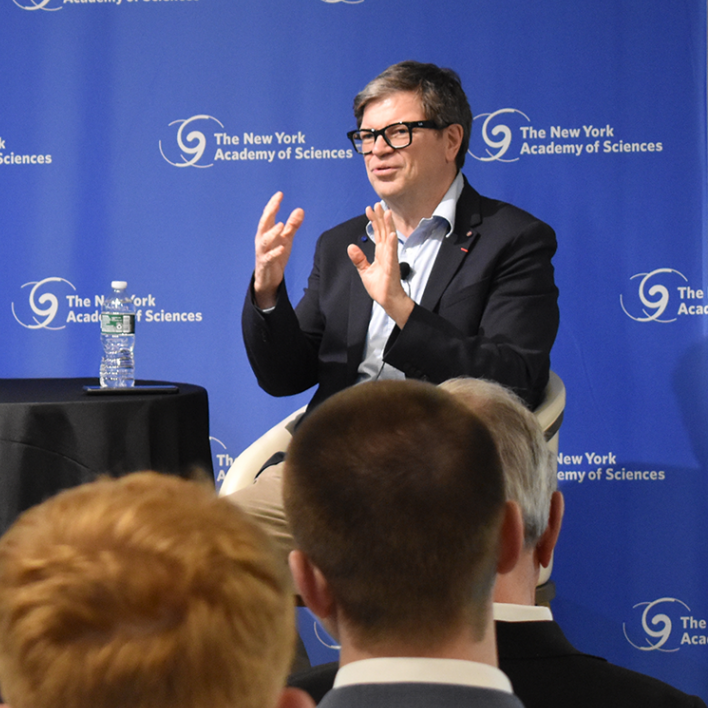
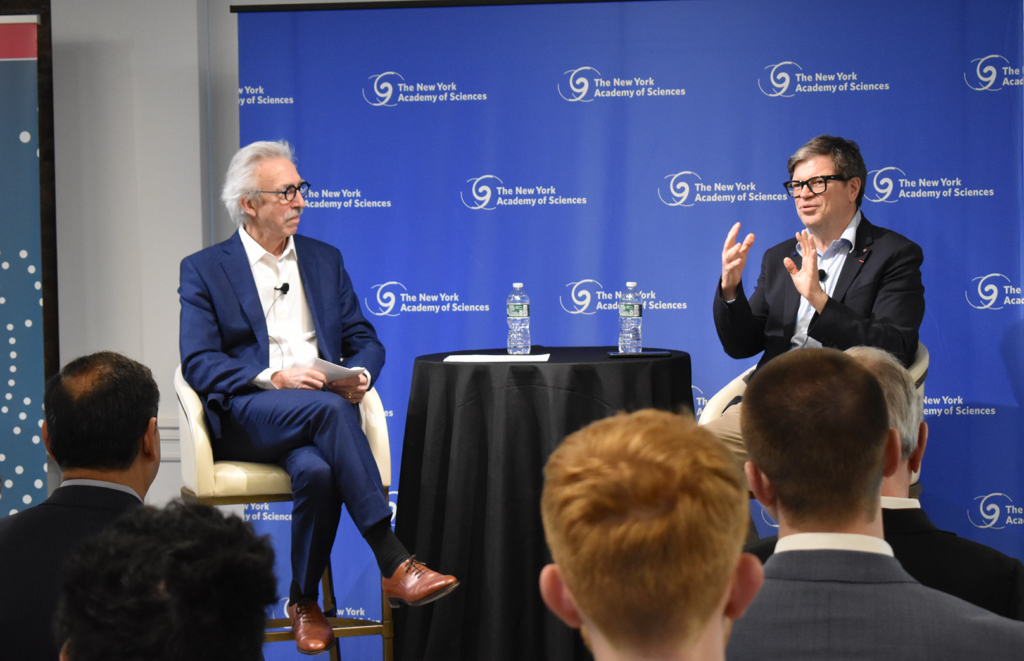
Yann LeCun (right) during an event at the Academy on March 14, 2024. Photo by Nick Fetty/The New York Academy of Sciences.
Modern AI expert Yann LeCun would echo a similar sentiment during a 2024 Academy event. LeCun made the case that with modern AI technology, sensory, as opposed to language, inputs were superior for developing more efficient AI. He pointed out that while reading text or digesting language, the human brain processes information at about 12 bytes per second. This is compared to sensory inputs, such as from observations and interactions, which the brain processes at about 20 megabytes per second.
“To build truly intelligent systems, they’d need to understand the physical world, be able to reason, plan, remember and retrieve. The architecture of future systems that will be capable of doing this will be very different from current large language models,” LeCun says.
During his 1960 talk Dr. McCulloch predicted that properly built machines would eventually replace humans in the workplace.
Multiplying Human Capacity (1967)
The concept of machines replacing humans has been a theme of science fiction and other parts of popular culture for decades. However, this concept appeared to be less in the realm of fiction when it was brought up during the Academy’s 150th anniversary meeting in 1967.
Simon Ramo, PhD, an American physicist, engineer, and business leader, asserted that a robot society was inevitable, though he was optimistic about a more technologically based future. He pointed out that machines can do instantaneously what it takes the human brain months or even years to do. Instead of competing with humans, he saw machines as being a tool to multiply human capacity.
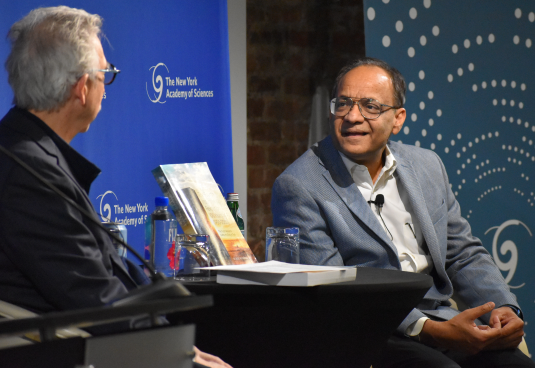
Alok Aggarwal (right) during an event at the Academy on December 5, 2024. Photo by Nick Fetty/The New York Academy of Sciences.
Alok Aggarwal, PhD, CEO and Chief Data Scientist at Scry AI, visited the Academy in 2024 to give a talk on his recently published book The Fourth Industrial Revolution & 100 Years of AI (1950-2050). Dr. Aggarwal would likely agree with Dr. Ramo about the utility of technology that improves human productivity. During his talk, Dr. Aggarwal pointed out that “AI can be applied to laborious, mundane activities, where humans are prone to making mistakes like sifting through invoices to reconcile financial records or submitting the proper documentation for a mortgage loan.”
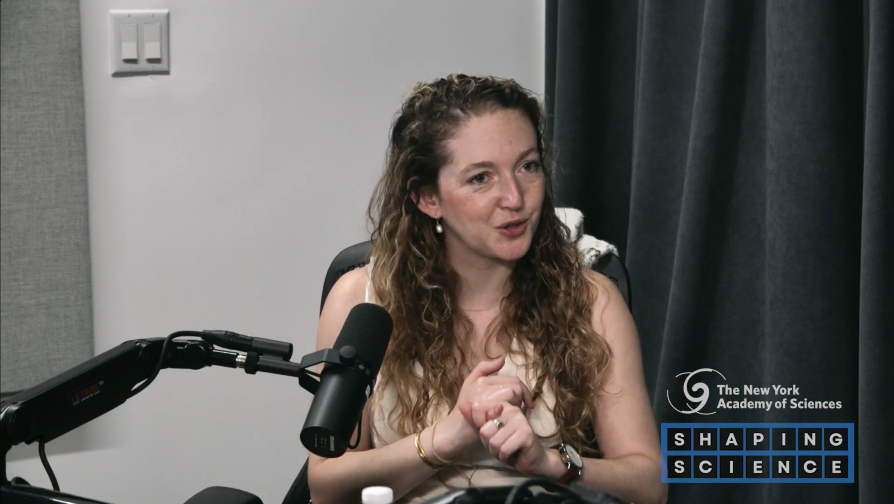
However, not all predictions come to fruition. In 1967, Dr. Ramo suggested that machines could contribute to “instant democracy,” envisioning a future “where every home had an electronic voting machine, enabling all to participate in day-to-day decisions.” While political campaigns can use modern tools like social media, algorithms, targeted marketing, mobile games (such as the one developed by Shaping Science podcast guest Ian Bogost, PhD) and more in their attempt to win elections, it may be a while before voters are casting a ballot over their smartphones.
Voice Activated Commands (1971)
While movies like 2001: A Space Odyssey and shows like Star Trek depicted primitive concepts of human-computer interfaces as early as the late 1960s, the practicality of this technology wasn’t as farfetched as it might have seemed at that time.
During this era, New Jersey-based Bell Labs was developing “a device that dials telephone numbers when it ‘hears’ spoken commands,” as reported by The Sciences magazine. The Sciences was an award-winning magazine focused on scientific news and research published by The New York Academy of Sciences between 1961 and 2001.
This then-new technology was being developed for individuals with physical impairments who would otherwise struggle with dialing a phone number. Focusing on the technical aspects of how the device functioned, The Sciences reported: “Integrated circuitry converts sound waves into electrical pulses that open and close the electromechanical switches necessary for obtaining dial tone, dialing and terminating a call.”
While the technology started off as a tool to help those with physical impairments, its applications today are much broader. From Amazon’s Alexa to Apple’s Siri and everything in between, voice-assisted devices are now used to make relatively mundane daily tasks more efficient. Voice-to-text capabilities enable us to do everything from safely sending text messages while driving to dictating notes that once needed to be manually transcribed.
The jury is still out whether the future of voice-assisted technology will follow the helpful and supportive path of the beloved Computer from Star Trek or whether it exhibits the troubling agentic and rogue properties of something like HAL 9000 from 2001: A Space Odyssey.
Computers and Consciousness (1985)
As computers continued to develop into the late 20th century, the idea that the technology could gain its own consciousness became an ethical and philosophical concern. This was addressed directly in a 1985 article published in The Sciences magazine.
In the article, senior editor Robert Wright pondered whether a computer or robot could be programmed in a way “that it will be aware of its calculations, and perhaps even be capable of experiencing anger, fear, or sympathy.” A growing number of what Wright called “scientific materialists” or “mechanics” feel that humans and other forms of life are “entirely explicable in terms of engineering.”
“Every aspect of behavior, sensation, and thought, they maintain, is a product of the way information is processed and transmitted; so presumably, it is possible, by controlling the flow of information, to replicate human experience with precision,” Wright wrote.
These “mechanics” felt that with the correct hardware and software, coupled with sufficient time, they could “create computers flushed with pride, riddled with doubt, or alienated by the rapid pace of technological and social change.” If or when computers develop emotions, feelings, and thoughts, the optimistic “mechanics” feel it will be “additional proof that science can conquer all.”
Wright did point out that the optimism of the “mechanics” could be misguided. He wrote “If computers do someday evince a subjective life, the mechanics’ view of consciousness will have been undermined; if computers don’t show signs of consciousness, this silence will be an annoying reminder that the mechanics can never know for sure whether they are right about what consciousness is.”
While the technology has developed immensely in the 40 years since the article was published, philosophical and ethical concerns around computers gaining consciousness continues to be a hot topic today.
Nobody Knows You’re a Dog (1995)
While AI technologies like ChatGPT have helped to usher in the modern era of “chatbots,” the precursors to these virtual beings have existed since the commercial Internet’s early days in the 1990s.
Sherry Turkle, PhD, an MIT sociologist and psychologist, touched on this in a 1995 article in The Sciences, which was later adapted for her book Life on the Screen: Identity in the Age of the Internet. Prof. Turkle wrote about her travails in “multi-user domains/multi-user dungeons” known as MUDs, which were like early forms of chatrooms or social media. She described a bot known as Julia, developed at Carnegie Mellon University, which interacted with users so realistically, many struggled to tell if “she” was real or fake.
“As the boundaries erode between the real and the virtual, the animate and the inanimate, the unitary and the multiple self, the question becomes: Are we living life on the screen or in the screen?” Prof. Turkle writes.
In yet another instance of scientific prescience, English mathematician Alan Turing foresaw in the 1950s issues people would eventually have differentiating autonomous beings from fellow humans. To combat this, he developed the Turing test. Nitin Verma, PhD, a former AI and Society Fellow currently at the University of Illinois Urbana-Champaign, analyzed the relevance of the Turing test in the modern AI era.
“Passing a challenging test can be seen as a marker of progress. But would we truly rejoice in having our AI pass the Turing test, or some other benchmark of human–machine indistinguishability?” Prof. Verma ponders in a 2024 blog post.
Whether it’s life imitating art or art imitating life, The New Yorker really was on to something with their 1993 cartoon, that has since become a meme, in which Peter Steiner declared “On the Internet, nobody knows you’re a dog.”
A Forbes article by UL Solutions Senior Vice President and Chief Scientist Robert Slone dispels the notion that regulating AI will impede innovation.
Published March 2, 2026
By Nick Fetty
Robert Slone, PhD
Throughout history, new forms of technology and innovation have caused feelings of promise and fear among the public. AI is just the latest tech to find itself at this precipice.
Robert Slone, PhD, a member of the Executive Board of the International Science Reserve (an effort in coordination with The New York Academy of Sciences), used history as a basis for how to approach regulating AI in an article he wrote for Forbes. Dr. Slone, who also serves as Senior Vice President and Chief Scientist at UL Solutions, questioned “Can we build the structures of trust and reliability early enough to allow innovation to accelerate to new heights, without sacrificing safety?”
Dr. Slone compares the advent of AI to other modern technologies like the automobile or microwave, which were met with skepticism by the public before being fully embraced. He cites the International Data Corporation which predicts that generative AI will pump nearly $20 trillion into the global economy by 2030 and lays out six practical actions that leaders can take today to get the most out of AI in their operations.
Optimistic but cautious, Dr. Slone concludes: “Risk is not a signal to stop, but to lead, design better and move forward with intention.”
To attend, click the “Register” button at the time of the presentation. It will take you directly to the Zoom call.
Welcome and Introductions: 11:30 AM to 11:45 AM
Main Presentation: 11:45 AM to 2:30 PM
Biological Rhythms, the Secret Language of your Vital Signs
Daniel Forger
From the firing of neurons in a fraction of a second to the monthly cycle of ovulation to a seasonal shift in sleep patterns, the human body runs on rhythms—all more knowable now than ever, thanks to wearables. Making sense, and making use, of these signals is something else, and this is precisely what Daniel Forger explains in his book Biological Rhythms, which will be the focus of our discussion. Sorting through a plethora of data gathered over the past decade, this practical, user-friendly book gives readers the tools for reading and interpreting the rhythms that regulate physiological processes as varied and critical as sleep, brain activity, heart rate, hormone secretion, metabolism, and temperature. Once translated, the language of biological rhythms can be used to improve health and productivity, by athletes, travelers, and shift workers, sufferers of fatigue or sleep disorders, or those wishing to lose weight, monitor infection, or time fertility, in short, anyone with an interest in reading and understanding the body’s vital signs.
Speaker
Daniel B. Forger is Robert W. and Lynn H. Browne Professor of Science, Professor of Mathematics, and Research Professor of Computational Medicine and Bioinformatics at the University of Michigan, Ann Arbor. He directs the Michigan Center for Applied and Interdisciplinary Mathematics and is the CSO of Arcascope. Hundreds of thousands of people have used his apps and algorithms for scoring sleep and circadian rhythms, predicting mood and fatigue, and analyzing time series data. Dr. Forger was also active in the Junior Academy of the NY Academy of Sciences when he attended Stuyvesant High School.
The Artemis II mission carries four brave souls on a historic ten-day voyage around the Moon, proving that human courage and our brightest dreams can reach the deep stars. This journey transforms space from a distant government frontier into a shared home for all, inviting every heart on Earth to follow the light of discovery in real-time.
Four astronauts sit atop the most powerful rocket ever built. This March, the Artemis II mission launches from Florida. The crew includes Commander Reid Wiseman and Pilot Victor Glover. Mission Specialists Christina Koch and Jeremy Hansen join them. They represent a new chapter in lunar history.
Artemis II pushes these four explorers to the edge of human limits. They travel farther from Earth than any crew in fifty years. This ten-day flyby tests deep-space survival for the first time since Apollo. There is no quick return and no nearby safe haven. Unlike the space station, this capsule offers no regular resupply.
The crew relies entirely on their training and onboard systems. Communication delays remind them of their total isolation. This distance places immense mental pressure on every team member. The crew selection is a deliberate strategic move. These experts bring skills in engineering, piloting, and long-duration flight.
They simulate the multidisciplinary teams needed for Mars. Their ability to solve problems under stress remains vital. Physical strain defines this lunar journey. The crew leaves the protection of Earth’s magnetic field. They face high radiation levels and prolonged microgravity. This mission gathers critical data on human biology in deep space.
The Orion spacecraft faces its first real human trial. It is a validation of life-support systems in extreme conditions. Astronauts live in confined quarters while managing complex hardware. They function as part of the engineering experiment itself.
Finally, this crew carries the weight of human history. Their success determines the future of lunar bases. They prove that sustained exploration beyond Earth is possible again. This flyby is a rehearsal for our deep-space future. We are watching the next era of discovery begin.
A Mission for All Humanity
Space is no longer just a “government project.” NASA now leads a vast global coalition. This mission includes the Canadian Space Agency and European partners. It relies on private companies like SpaceX and Lockheed Martin. This shift creates a sustainable space economy for everyone.
We are moving toward a shared human endeavor. Private firms now build habitats and lunar landers. Governments provide the vision and safety standards. This model lowers costs and invites rapid innovation. It turns the Moon into a place for research and industry.
The goal is a permanent human presence. We are not just visiting the Moon again. We are learning to live there. This requires a diverse global workforce. Engineers, artists, and doctors all have a role. Space belongs to the pioneers, not just the agencies.
Small businesses now contribute critical components for the Orion capsule. Universities run experiments that fly alongside the crew. This commercial ecosystem creates jobs across many sectors. It ensures that space exploration remains a common goal. We share the risks and the rewards of discovery.
The Artemis Accords establish a framework for peaceful cooperation. Over forty nations sign on to these principles. They agree to share scientific data and protect heritage sites. This prevents a new space race and fosters global unity.
Transparency is the hallmark of this new era. Private-public partnerships make space travel more accessible. We see more launches and more breakthroughs than ever before. This collective effort ensures that we stay in deep space for good. We are building a bridge to the stars together. The Moon is just the first step in our journey.
Join the Lunar Journey
You do not need an astronaut suit to participate. Local science centers offer real-time mission tracking for everyone. Many museums host live watch parties for the launch and flyby. These hubs provide high-definition feeds and expert commentary. They bring the lunar far side directly to your neighborhood.
Digital platforms offer an intimate look at the flight. NASA streams live views from the Orion capsule cameras. You can watch the Earth rise over the lunar horizon. Social media creators share behind-the-scenes updates every single day. Science enthusiasts join the global conversation using official mission hashtags.
Interactive apps let you see what the astronauts see. You can track the spacecraft’s exact speed and position. Virtual reality experiences allow you to sit inside the cockpit. These tools bridge the gap between Earth and deep space. They turn a distant mission into a local event.
Schools can download official STEM toolkits for their classrooms. These resources allow students to solve real mission flight problems. Students calculate trajectories and study lunar geology from their desks. Teachers use live data to inspire the next generation of explorers. This mission belongs to the classroom as much as the cockpit.
Families can use mobile apps to spot the Moon together. Every person on Earth can witness this journey as it happens. We invite you to look up and join us. This is a shared human moment for all people. Your curiosity fuels the future of space exploration.
While the desirability of change in the health care system is well accepted, how it is to be achieved is not. One flashpoint has been the involvement of private capital firms in healthcare. In theory, private equity brings capital and discipline to firms in a manner that should be helpful to the healthcare industry. But popular accounts and academic studies have raised troubling questions.
As technology-driven advancements and clinical innovation accelerate the evolution of the life sciences, can PE play a constructive role to enable life sciences firms to better position themselves for success in a competitive and rapidly evolving environment? Or are the temptations to profit at the expense of the customer too great in these settings?
This session will explore the evidence about these important and controversial issues. In particular, this program will focus on two issues:
How advances in information and communication technologies, which have transformed everything from urban transport to payments to navigation, can address the effectiveness of medical delivery, and the role of venture capital in facilitating this transformation.
The role of private capital in financing the “white spaces” in the delivery of medical services: e.g., the areas where consumers are underserved, whether geographic, demographic, or class of care (e.g., primary care).
Series Moderator
Josh Lerner
The Jacob H. Schiff Professor, Harvard Business School; Director, Private Capital Research Institute
Panelists
Abrar Mir
Co-founder and Managing Partner, Quadria Capital
Charles Ruprecht
Principal, GHO Capital
Kevin Tracey
Karches Family Distinguished Chair in Medical Research, The Feinstein Institutes for Medical Research
Paula Volent
VP & Chief Investment Officer, The Rockefeller University
Sponsors
Series Sponsor
Presented By
Pricing
All: Free
About the Series
The “Private Capital and Discovery: Strategic Investing in Scientific Innovation” series is brought to you by The New York Academy of Sciences and The Private Capital Research Institute. Through expert panels and thought-provoking discussions, the series examines how private equity is uniquely positioned to drive transformative advancements—while also exploring the ethical and strategic dilemmas that can arise when financial incentives influence the trajectory of science. Learn more about the series.
To attend, click the “Register” button at the time of the presentation. It will take you directly to the Zoom call.
Welcome and Introductions: 11:30 AM to 11:45 AM
Main Presentation: 11:45 AM to 2:30 PM
Alchemy, AI and Snow’s Two Cultures in Historical Perspective
Farzad Mahootian
I will explore the imaginal space between four themes: alchemy, Jung, the history of science, and AI. The talk will interweave these themes in ways that reflect my mind since early adulthood. I am recently energized by support from NYU’s IT office and library in my efforts to render my mode of investigation consistent with its subject matter, as I consider chemists and historians of chemistry. Chemists have benefited greatly by integrating computational tools to exponentially expand chemical space. By contrast, historians of chemistry and alchemy have been somewhat less enthusiastic about applying computational methods to their domain. This is not a question of technophobia exclusively, it’s a cultural issue. I believe that AI can efface some of the structural barriers between C.P. Snow’s “two cultures.”
Speaker
Farzad Mahootian has been a Clinical Associate Professor of Global Liberal Studies at New York University since 2010. He has an interdisciplinary background (PhD Philosophy, Fordham; MS Chemistry, Georgetown). His research focuses on interactions between philosophy, science and society within the mythological imagination. His interests include process philosophy, coupled systems, artificial intelligence, and premodern sciences. Recent publications include “Jung and Whitehead: An Interplay of Psychological and Philosophical Perspectives,” “Kant, Cassirer, and the Idea of Chemical Element.”
Through a series experiments, reviews, and perspectives, this collection of papers explores the wide prevalence, impact, and utilization of rhythm in humans and other animals. These papers address the importance of rhythm and how it is involved in language, cognition, physiology, communication, and medical interventions. The wide range of topics and methods include communication in sperm whales, infant development, mathematical modeling, music perception, and electrophysiology. The virtual issue is edited by Andrea Ravignani (Sapienza University of Rome) and Teresa Raimondi (Sapienza University of Rome).
Learn about the economics behind investments in climate technology.
New York, NY (January 12, 2026) – As investment in climate technology faces growing headwinds, questions are emerging not about the urgency of decarbonization, but about the financial durability of the companies seeking to deliver it. Are today’s climate tech ventures positioned to generate sustainable returns, or are investors once again confronting the risk of a boom and bust cycle reminiscent of the cleantech era of the late 2000s and early 2010s? These issues will be explored further by an expert panel during an upcoming event hosted by The New York Academy of Sciences and The Private Capital Research Institute (PCRI).
The panel will dive into the nuances of climate tech investing during a free, virtual webinar at 12 p.m. ET on January 22, 2026. Josh Lerner, PhD, Director of PCRI, will moderate a four-person panel to explore how investors are evaluating climate tech opportunities in the current market, including capital allocation strategies, risk and return profiles, and lessons learned from prior investment cycles. The discussion will center on the economic viability of new ventures, investor confidence, and what it will take for climate tech companies to succeed at scale in today’s financial environment.
Panelists include:
Reuben Munger | Vision Ridge
Ron Gonen, MBA | Closed Loop Partners
Emily A. Carter, PhD | Princeton University
Patrick Lynch, MBA | Featherlight Capital
Reuben Munger, a leader in sustainable investing and a former Partner at The Baupost Group, LLC, is an expert in electrified mobility, renewable electricity generation, and the built environment. He founded Vision Ridge in 2008 to shed light on financial opportunities associated with sustainable solutions.
Ron Gonen, MBA, served as Deputy Commissioner of Sanitation, Recycling and Sustainability in New York City during the Bloomberg Administration and is the author of The Waste-Free World. He founded and currently serves as CEO of Closed Loop Partners, a firm at the forefront of building the circular economy.
Emily A. Carter, PhD, is the Gerhard R. Andlinger Professor in Energy and the Environment in the Department of Mechanical and Aerospace Engineering at Princeton University. Her research combines applied physics, materials science, and propulsion and energy sciences.
Patrick Lynch, MBA, is a Co-Founder and Managing Partner of Featherlight Capital. He has over 25 years of private markets experience at some of the most sophisticated institutional investors. He has led over 60 investments ($6.7bn) and acted on investment committees that oversaw $40bn of commitments in private markets.
This session is the third in a four-part series titled “Private Capital and Discovery: Strategic Investing in Scientific Innovation,” presented by The New York Academy of Sciences and PCRI. The series, sponsored by Ropes & Gray, is focused on fostering a broader understanding of the recent scientific and technological trends and their implications for private capital investors. These roundtables emphasize opportunities and challenges associated with marshaling the capital required to translate cutting-edge technologies into marketplace solutions.
Each roundtable brings together a combination of scientific, investment, and business perspectives on a challenge associated with the commercialization of breakthrough science. These webinars are conducted and covered under Chatham House rule. Proceeding summaries will be made available to attendees after each event.
While the Academy excels in fostering scientific discovery and interdisciplinary collaboration, PCRI focuses on enhancing the understanding and impact of private capital investments. This collaboration allows for a unique intersection where cutting-edge scientific research meets strategic investment insights.
Both non-profit organizations seek to present substantive, fact-based research in a form that maximizes broad accessibility of these ideas and their applicability to the concerns of investors, business leaders, and policymakers, as well as influential intermediaries.
Based at Harvard Business School, the Private Capital Research Institute’s mission is to encourage research about private capital’s potential to be a constructive force to power economic development, innovation, and business transformation.
To attend, click the “Register” button at the time of the presentation. It will take you directly to the Zoom call.
Welcome and Introductions: 11:30 AM to 11:45 AM
Main Presentation: 11:45 AM to 2:30 PM
New Drug Approvals in 2025: How did the FDA fare?
2025 has been a tumultuous year in Washington. Notwithstanding DOGE layoffs and the government shutdown, the Food and Drug Administration (FDA) has approved 41 drugs and biologicals this year. While some will likely be blockbusters with sales above a billion dollars a year by 2030, some of the rest might be considered bespoke biologicals—exquisitely-targeted drugs for smaller populations (e.g., hereditary angioedema, which affects about 1/50,000 people across all ethnicities). But, when there are fewer potential patients, the research and development cost has to be spread across patients receiving the therapy. When data is available, we’ll talk about cost and, with drug price controversy embedded in the ongoing health insurance crisis, who should or can or might pay, and how much.
Speaker
Clif Hotvedt‘s diverse scientific background reflects his experience in the pharmaceutical industry, as a medical writer in the regulatory and clinical affairs departments of Ives Laboratories and at leading public relations firms including Robert Marston & Associates, Manning Selvage & Lee, and Ketchum, where he served as vice president and global director of medical & scientific affairs. For 46 years, he has counseled companies on over 100 small molecule drugs, biologicals and devices for indications including cardiovascular disease, rheumatology, metabolic disease, dermatology, central nervous system disease, vaccines, infectious disease, and cancer.
A New Mexico State University graduate in secondary education and journalism, Clif continues to use his teaching background to develop and present courses on the FDA approval process, pharmacokinetics, pharmacodynamics, and biostatistics among other topics for coworkers and clients. Clif is a member of the Lyceum Society and has been a frequent presenter at our meetings. His previous topics have included: “The FDA Drug Approval Process”(November 2015); “How the new PCSK9 Cholesterol-Lowering Drugs work” (May 2016); “How to read a Drug Label” (April 2017); “Biosimilars: the New ‘Generics’?(June 2018); “The Human Microbiome” (May 2019); “Drug Pricing” (June 2020); “Artificial Intelligence (AI) and Health Care” (October 2020); “Drug Pricing Revisited” (November 2020); and “The Nobel Prize in Physiology or Medicine 2022” (December 2022).