The Junior Academy Induction Ceremony

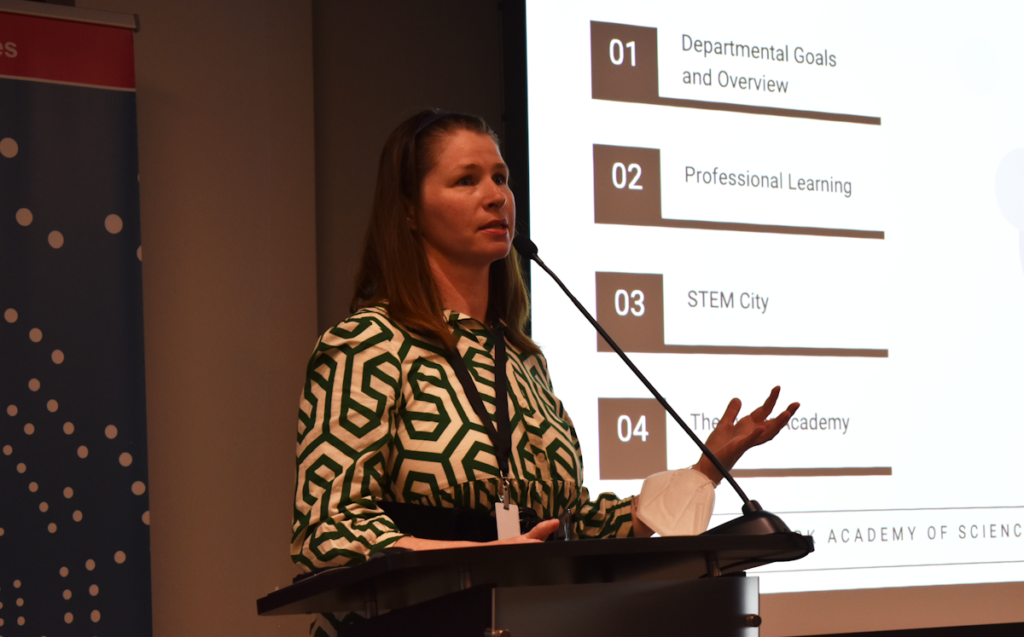
A woman gives a presentation during an Academy staff meeting.
Dr. Groome presents during The New York Academy of Sciences’ 205th Annual Meeting.

Nearly 3000 students were inducted into the Junior Academy as part of its newest cohort.

Published November 14, 2023

By Meghan Groome, PhD

At its 205th Annual Member Meeting on November 14, 2023, The New York Academy of Sciences launched a new tradition: the induction of our Junior Academy members into our membership ranks.

The Junior Academy has been engaging students since its founding in 1948 when the Academy began hosting the City-wide science and engineering fair. The arrival of this research competition dramatically increased the need for mentored research experiences in labs around the City. Recognizing the opportunity gap, the Academy began hosting regular meetups. These conversations led to a match making program that eventually found a new home online with the creation of Launchpad in 2016. Through Launchpad, a matchmaking and collaboration platform designed to help students find research partners and mentors, Junior Academy programming became more accessible than ever before. Today, any student with a device and access to the internet can participate in a world-class mentored research program.

At the Junior Academy, we work with partners to build a community of students and mentors who work in teams to solve open innovation challenges. The challenges are real world problems scoped out by our sponsors and brought to life by our education team. Since moving online, we’ve served over 10,000 students from over 100 countries by administering over 50 open innovation challenges.

Working in a group presents a unique set of challenges, especially in STEM research – which is itself no easy task. However, we know that diverse teams produce better research and innovation. We believe – and the proof is in our evaluations – that great teamwork can be taught and mentored. Collaboration, communication, and creativity are essential components of teamwork and skills that will translate to overcoming obstacles in any setting. We at the Academy are proud to provide a space for students and mentors to come together to participate in engaging STEM programming that believes in science for the greater good.

The Junior Academy wouldn’t be possible without the mentorship that our members provide. Research has proved, time and time again, that mentors are often the difference between loving STEM and persisting in STEM. Their energy and enthusiasm have allowed us to make a generational impact both abroad and in New York. Our members have donated over 4.5 million hours of their time to mentor the next generation.

At our 205th Annual meeting, we inducted 2,834 students from around the world into the Academy. These students completed our rigorous semester-long research experience during the 2022-2023 School Year.

Last year, over 700 teams of students:

  • Designed ways to use 5G and the Internet of Things to improve energy efficiency;
  • Explored the extremes of space, underwater and the edges of scientific discovery;
  • Documented the impacts of climate change on public health;
  • Discovered the connection between forest management and a sustainable future;
  • Designed urban micro gardens to address malnutrition and hunger in their neighborhoods;
  • Led the way in understanding the connections between human rights and cybersecurity;
  • Uncovered decades of water mismanagement to design and retrofit new, safe drinking water systems;
  • Rose to the challenge of building green schools, homes and other community structures; and finally,
  • Made healthier snacks that balance taste and nutrition.

At the Academy, we like to say that we shape the future of science. And that’s very true, but it’s important to point out that our youngest members aren’t just the future. They’re doing incredible things right now.


Transcript

Thank you for welcoming us to the Annual Meeting. My name is Dr. Meghan Groome and I’m the Senior Vice President for Education at the Academy. I’m here to represent all of the people at the Academy who make our education programs so powerful including the program team of Kaitlin Green, Rosemary Puckett and Sabrina Debler. I’d also like to thank the entire education team, AV/ IT, communications, membership and marketing teams.

This is truly a cross organizational effort and I want to thank everyone from the executive office to HR for all their hard work to bring this program to life. I’d especially like to thank our Advancement team who raised the funds to allow this program to be completely free to our students. And with that, I’d like to thank our generous sponsors who support our work with not only their funding but also their guidance, insight, and expertise.

They include:

  • The Royal Academy of Engineering in Sweden
  • The J. Christopher Stevens Virtual Exchange Initiative i.e. Stevens Initiative sponsored by the US Department of State, with funding provided by the U.S. Government, and is administered by the Aspen Institute and supported by the Bezos Family Foundation and the governments of Morocco and the United Arab Emirates
  • Clifford Chance’s Cornerstone Initiative
  • Ericsson
  • The Ministry of Higher Education of Oman, and
  • NEOM
  • Foundation for the National Institutes of Health
  • S & P Global

I’d also like to thank our incredible on the ground partners including the Royal Health Awareness Society in Jordan, Mentor Arabia and AMU.

I’d also like to thank all the parents, teachers, siblings, friends and alumni who cheer on our students, encourage them to apply and help explain to worried parents that no, they really are up at 3am watching a live stream about the flexible use of electricity.

Lastly, we also would like to take a moment to thank our international cohort of Mentors who worked with student teams and guided them through The Junior Academy learning process. Our members are the engine of our programs, serving as mentors, judges and now, a generation of alumni. Their energy and enthusiasm have allowed us to make a generational impact both abroad and especially in New York. We are so grateful for your time and expertise.

It’s clear from the research that mentors are often the difference between loving STEM and persisting in STEM. If you have a moment, I’d like you to think about your own mentor. How they shaped you. How they gave you a critical boost. I’d personally like to thank my mentor, Ruth Cohen, and I encourage all of us to thank our mentors and pass their wisdom forward to the next generation.

With all of my thanks out of the way, I’d like to talk about the Junior Academy itself. Founded in 1948, the Academy began hosting the City-wide science and engineering fair. The arrival of this research competition dramatically increased the need for mentored research experiences in labs around the City. Recognizing the opportunity gap, the Academy began hosting regular meetups. These conversations led to a match making program that eventually found a new home online in 2016.

With the advent of a new online platform, mentored research experiences could be moved online and scaled to any student with a device and access to an internet connection. In today’s Junior Academy, we work with partners to build a community of students and mentors who work in teams to solve open innovation challenges. The challenges are real world problems scoped out by our sponsors and brought to life by our education team. Since we moved online, we’ve served over 10,000 students from over 100 countries by administering over 50 open innovation challenges.

Last year, nearly 700 teams:

  • Designed ways to use 5G and the Internet of Things to improve energy efficiency,
  • Explored the Extremes of Space, underwater and the edges of scientific discovery,
  • Documented the impacts of climate change on public health,
  • Discovered the connection between forest management and a sustainable future,
  • Designed urban micro gardens to address malnutrition and hunger in their neighborhoods,
  • led the way in understanding the connections between human rights and cybersecurity,
  • Uncovered decades of water mismanagement to design and retrofit new, safe drinking water systems
  • Rose to the challenge of building green schools, homes and other community structures, and finally, my favorite,
  • Made healthier snacks that balance taste and nutrition.


In addition to the Junior Academy, nearly 800 students participated in the 1000 Girls, 1000 Futures program. Students worked in close-knit teams with mentors to build core scientific and work ready skills that complement their research projects.

On its own, STEM research is hard. In a team, STEM reach can be even harder. But we know that diverse teams produce better research and innovation. We believe, and the proof is in our evaluations, that great teamwork can be taught and mentored. Collaboration, communication, and creativity are essential components of team work, and for that matter, overcoming obstacles in any setting. We at the Academy are proud to provide a space for students and mentors to come together to participate in engaging STEM programming that believes in science for the greater good.

Bringing together young people from around the globe in a STEM-enriched environment can open doors and prepare students for science paths otherwise unknown and we are so pleased to be a part of their STEM journey.

Today, we inducted 2,834 students from the Junior Academy and 1000 Girls 1000 Futures to join the New York Academy of Sciences as Young Members. We are so proud of you and pleased to connect you with the legacy of the Academy. At the Academy, we like to say that we shape the future of science. And that’s very true, but I always like to point out that our youngest members aren’t just the future, they’re doing incredible things right now.

Please join me in welcoming the Junior Academy Class of 2023 into the New York Academy of Sciences.


Board of Governors

Board

Chair

Immediate Past Chair

  • Jerry Hultin, Chair and Co-Founder, Global Futures Group, LLC

Vice-Chair

Treasurer

  • Amber Miller, President, William and Flora Hewlett Foundation

President

  • Nicholas B. Dirks, President and Chief Executive Officer, The New York Academy of Sciences

Corporate Secretary

Executive Associate to the Corporate Secretary

Governors

  • Armen Avanessians, Former Head and Chief Investment Officer, Goldman Sachs Asset Management’s (GSAM) Quantitative Investment Strategies Group
  • Serg Bell, Founder and Chairman, Constructor Group, and Founder, Acronis
  • MaryEllen Elia, President, Success for Students, Inc.; former Partner and Senior Fellow, International Center for Leadership in Education; former Commissioner of Education and President of The University of the State of New York
  • Thomas C. Franco, Senior Advisor, Clayton, Dubilier & Rice, LLC
  • Stacie Grossman Bloom, Vice Chancellor for Global Research and Innovation, Vice Provost for Research, Chief Research Officer, New York University
  • Aida Habtezion, Adjunct Professor of Medicine, Stanford University; Former Senior Vice President, Chief Medical Officer and Head of Worldwide Medical & Safety, Pfizer Inc.
  • Jerry Hultin, Chair and Co-Founder, Global Futures Group, LLC; Chair Emeritus, The New York Academy of Sciences
  • Seema Kumar, Chief Executive Officer, Cure.; former Global Head – Office of Innovation, Global Health and Scientific Engagement, Johnson & Johnson
  • Ravi Kumar S., Chief Executive Officer, Cognizant​
  • R. May Lee, President, Olin College of Engineering
  • Jeff Legos, Executive Vice President and Chief Oncology Officer at Pfizer
  • Jim Reddoch, EVP, Investments & CSO, Royalty Pharma
  • John Reed, Executive Vice President, Innovative Medicine, R&D, Johnson & Johnson
  • Lowell Robinson, Corporate Director and Advisor, Barnes & Noble Education
  • Laura Sachar, Managing Partner and Co-Founder, StarVest Partners
  • Konstantin Shakhnovich, Former Global Head of Trading, Citadel Asset Management; former Partner and Global Head of Systematic Market-Making, Goldman Sachs
  • Subra Suresh, President, Global Learning Council; Former President of Carnegie Mellon University, and former Director of the US National Science Foundation
  • Chandrika Tandon, Recognized Business Leader, Grammy Award Winning Artist, and Humanitarian
  • Peter Thorén, Executive Vice President, Access Industries
  • Grace Wang, 17th President of Worcester Polytechnic Institute
  • Jeremy Wertheimer, Chief Executive Officer, Biological Engineering Ventures
  • H. Michael Wiliams, Accomplished executive leader in the global financial marketplace, intercollegiate athletics arena, and non-profit sector.
  • George D. Yancopoulos, Co-Founder, President and Chief Scientific Officer, Regeneron
  • Michael Young, Nobel Laureate; Richard and Jeanne Fisher Professor and Vice President for Academic Affairs, The Rockefeller University

Life Governors

  • Natarajan Chandrasekaran, Chairman of the Board, Tata Sons
  • Paul Horn, Executive Chair and Founding Partner, Venly; Distinguished Scientist in Residence, New York University; former Senior Vice Provost for Research, New York University; former Senior Vice President and Director of IBM Research
  • Pablo Legorreta, Founder & CEO, Royalty Pharma
  • Torsten Wiesel, Nobel Laureate; President Emeritus and Vincent and Brooke Astor Professor Emeritus, The Rockefeller University; former Secretary-General, Human Frontier Science Program Organization

International Board of Governors

  • Seth F. Berkley, Chief Executive Officer, Gavi, The Vaccine Alliance
  • Gerald Chan, Chairman, Chief Executive Officer and Co-Founder, Morningside Group
  • S. “Kris” Gopalakrishnan, Co-founder, Infosys; Chairman, Axilor Ventures
  • Toni Hoover, Director, Strategy Planning and Management, The Bill and Melinda Gates Foundation
  • Johan Rockström, Director, Potsdam Institute for Climate Impact Research and Professor, Earth System Science, University of Potsdam
  • Paul Stoffels, Chief Executive Officer and Chairman, Galapagos NV; Former Chief Scientific Officer, Johnson & Johnson

Emeriti

Chairs Emeriti

  • Jerry Hultin (2019-2024), Chair and Co-Founder, Global Futures Group, LLC
  • Paul Horn (2016-2019), Executive Chair and Founding Partner, Venly; Distinguished Scientist in Residence, New York University; former Senior Vice Provost for Research, New York University; former Senior Vice President and Director of IBM Research
  • Nancy Zimpher (2011-2016), Chancellor Emeritus, The State University of New York
  • John E. Sexton (2007-2011), Former President, New York University
  • Torsten N. Wiesel (2001-2006), Nobel Laureate; President Emeritus and Vincent and Brooke Astor Professor Emeritus, The Rockefeller University; former Secretary-General, Human Frontier Science Program Organization

President Emeritus

  • Ellis Rubinstein, Former President and Chief Executive Officer, The New York Academy of Sciences

President’s Council

  • Peter Agre, Nobel Laureate; University Professor and Director, Johns Hopkins Malaria Research Institute; Department of Molecular Microbiology and Immunology, Bloomberg School of Public Health
  • Richard Axel, Nobel Laureate; University Professor, Columbia University; Investigator, HHMI
  • Etienne-Emile Baulieu, Former President, French Academy of Sciences
  • Len Blavatnik, Founder, Access Industries
  • Irina Bokova, Former Director General, United Nations Educational, Scientific, and Cultural Organization (UNESCO)
  • Michael S. Brown, Nobel Laureate; Professor of Molecular Genetics, University of Texas Southwestern Medical Center
  • Linda Buck, Nobel Laureate; Investigator, HHMI; Member of the Fred Hutchinson Cancer Research Center
  • Karen E. Burke, Dermatologist and Research Scientist
  • Thomas R. Cech, Nobel Laureate; Distinguished Professor, University of Colorado Boulder
  • Martin Chalfie, Nobel Laureate; University Professor of Biological Sciences, Columbia University
  • Aaron J. Ciechanover, Nobel Laureate; Distinguished Research Professor, Tumor and Vascular Biology Research Center, Faculty of Medicine, Technion-Israel Institute of Technology, Israel
  • Kenneth L. Davis, President and CEO of the Mount Sinai Health System in New York City
  • Peter Doherty, Nobel Laureate; Researcher, St. Jude Children’s Research Hospital (Memphis, TN); Researcher, the Department of Microbiology and Immunology, University of Melbourne
  • Mikael Dolsten, Former President, Worldwide Research and Development; Former Senior Vice-President, Pfizer Inc.
  • Jan Eliasson, Former Deputy Secretary-General to the United Nations
  • Jerome I. Friedman, Nobel Laureate; Institute Professor & Professor of Physics, Emeritus, Massachusetts Institute of Technology
  • Joseph Goldstein, Nobel Laureate; Chairman, Molecular Genetics, University of Texas Southwestern Medical Center
  • S. Kris Gopalakrishnan, Chairman, Axilor Ventures / Co-founder Infosys
  • Glenda Greenwald, President, Aspen Brain Forum Foundation
  • William A. Haseltine, President, The Haseltine Foundation for Medical Sciences and the Arts; Chairman, Haseltine Global Health, LLC
  • Hon. Jerry MacArthur Hultin, Senior Presidential Fellow, New York University; President Emeritus, Polytechnic Institute of NYU; Former Under Secretary of the Navy
  • Eric Kandel, Nobel Laureate; Professor, Physiology and Cell Biology, Columbia University
  • Kiyoshi Kurokawa, Former Science Advisor to the Prime Minister of Japan; Professor, National Graduate Institute for Policy Studies (GRIPS)
  • Gregory Lucier, Chief Executive Officer, Corza Health
  • Roderick MacKinnon, Nobel Laureate; John D. Rockefeller, Jr. Professor, Rockefeller University; Investigator, HHMI
  • Richard Menschel, Senior Director, Goldman Sachs
  • Ronay Menschel, Chairman of the Board, Phipps Houses; Board of Overseers, Weill Cornell Medical College
  • David K.A. Mordecai, Co-Managing Member, Numerati® Partners LLC, RiskEcon® Lab for Decision Metrics @ Courant Institute for Mathematical Sciences NYU, and Co-Founder, Risk Economics, Inc.
  • John F. Niblack, Former President, Pfizer Global Research & Development
  • Paul Nurse, Nobel Laureate; Former President, The Rockefeller University; Former President, The Royal Society, London; Chief Executive, The Francis Crick Institute
  • Yoshinori Ohsumi, Nobel Laureate; Professor, Institute of Innovative Research, Tokyo Institute of Technology (IIR)
  • Venkatraman Ramakrishnan, Nobel Laureate; Former President, the Royal Society
  • Richard Roberts, Nobel Laureate; Chief Scientific Officer, New England Biolabs
  • James E. Rothman, Nobel Laureate; Yale University School of Medicine, Fergus F. Wallace Professor of Cell Biology and Professor of Chemistry; Chairman, Department of Cell Biology; Director, Nanobiology Institute
  • Bengt Samuelsson, Nobel Laureate; Professor, Medical and Physiological Chemistry, Karolinska Institute; Former Chairman, The Nobel Foundation
  • Ismail Serageldin, Director, Bibliotheca Alexandrina, The Library of Alexandria, Egypt
  • Phillip A. Sharp, Nobel Laureate; Director, The McGovern Institute, MIT Center for Cancer Research
  • Feike Sijbesma, CEO/Chairman of the Managing Board, Royal DSM
  • Michael Sohlman, Former Executive Director, The Nobel Foundation
  • Paul Stoffels, Chief Scientific Officer, Johnson & Johnson; Member of the Johnson & Johnson Executive Committee and Management Committee; Worldwide Co-Chairman, Pharmaceuticals Group
  • Jack W. Szostak, Nobel Laureate; Investigator, Howard Hughes Medical Institute; Professor of Genetics, Harvard Medical School; Professor of Chemistry and Chemical Biology, Harvard University; Alex A. Rich Distinguished Investigator, Department of Molecular Biology, Massachusetts General Hospital
  • Marc Tessier-Lavigne, Former President, Stanford University
  • Craig B. Thompson, President and CEO, Memorial Sloan Kettering Cancer Center
  • Shirley Tilghman, President Emerita/Professor of Molecular Biology, Princeton University
  • Frank Walsh, Chief Executive Officer, Ossianix, Inc.
  • George Whitesides, Woodford L. & Ann A. Flowers University Professor, Harvard University
  • Torsten N. Wiesel, Nobel Laureate; Chairman Emeritus, The New York Academy of Sciences; Former Secretary General, Human Frontier Science Program Organization; President Emeritus, Rockefeller University
  • Frank Wilczek, Nobel Laureate; The Herman Feshbach Professor of Physics, MIT
  • Ernst-Ludwig Winnacker, Secretary General, Human Frontier Science Program; Former Secretary General, European Research Council; Former President, Deutsche Forschungsgemeinschaft, Germany
  • Andrew Witty, Former Chief Executive Officer, GlaxoSmithKline
  • Tan Sri Zakri Abdul Hamid, Science Adviser to the Prime Minister of Malaysia
  • Elias Zerhouni, Former Head of Global Research and Development, Sanofi

Board Voices

Board Spotlight

Annual Report & Audited Financials

The Annual Report offers our members, supporters, and the global scientific community a snapshot of the most impactful accomplishments of the year.

Fiscal Year 2024 Annual Report

Fiscal Year 2023 Annual Report

Fiscal Year 2022 Annual Report

Fiscal Year 2021 Annual Report

Fiscal Year 2020 Annual Report

Fiscal Year 2019 Annual Report

Fiscal Year 2018 Annual Report

Fiscal Year 2017 Annual Report

Fiscal Year 2016 Annual Report

Fiscal Year 2015 Annual Report

The New York Academy of Sciences’ financials are reviewed annually by independent auditors and provided to the IRS with the information required for tax-exempt organizations by filing Form 990.

Fiscal Year 2024 Audited Financials

Fiscal Year 2024 Form 990

The Academy Hosts Open House to Inaugurate Its New Headquarters

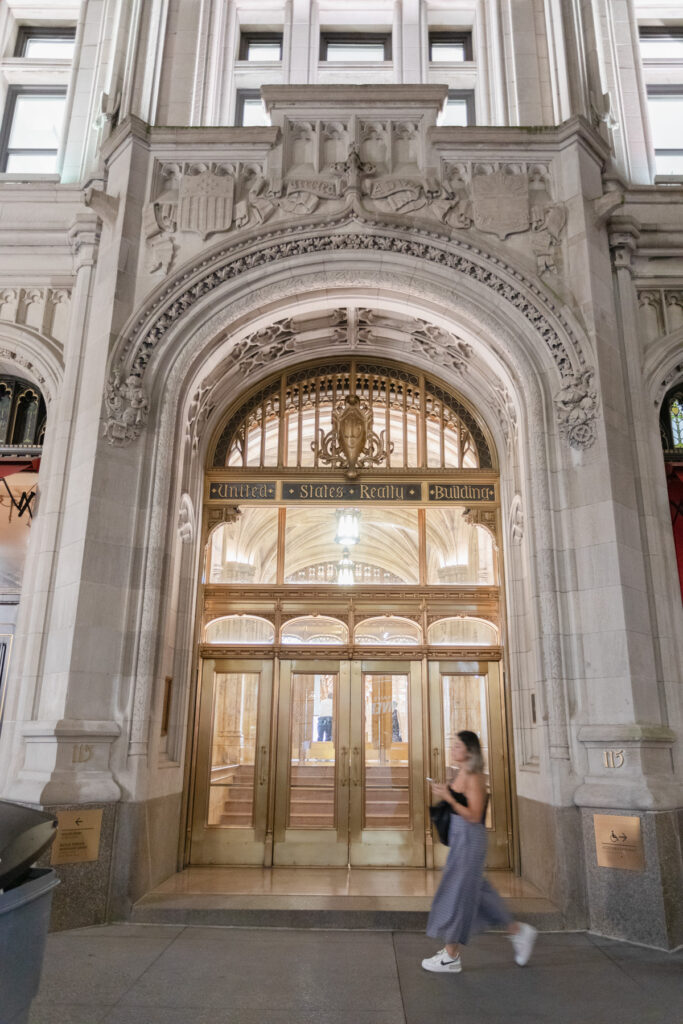
AN exterior shot of the U.S. Realty Company building in lower Manhattan.

The Academy moved into the landmark building at 115 Broadway last May and celebrated by hosting almost 200 scientists and science enthusiasts for a special panel discussion and networking reception.

Published September 25, 2023

By David Freeman

Entrance to the Academy’s new headquarters at 115 Broadway

The New York Academy of Sciences inaugurated its new headquarters in Manhattan’s Financial District on September 14, 2023, with an Open House that hosted almost 200 scientists and science enthusiasts on the eighth floor of the U.S. Realty Building, a neo-Gothic skyscraper erected in 1907. The Academy moved into the landmark building at 115 Broadway last May.

The festive gathering opened a new chapter in the Academy’s 206-year history and marked the resumption of its robust program of in-person events. It featured science-themed interactive displays and idea boards on which attendees posted notes jotted in response to questions such as “What recent developments in green tech do you find most promising?” and “What do you think will be among the diseases cured by gene-editing techniques such as CRISPR Cas9?”

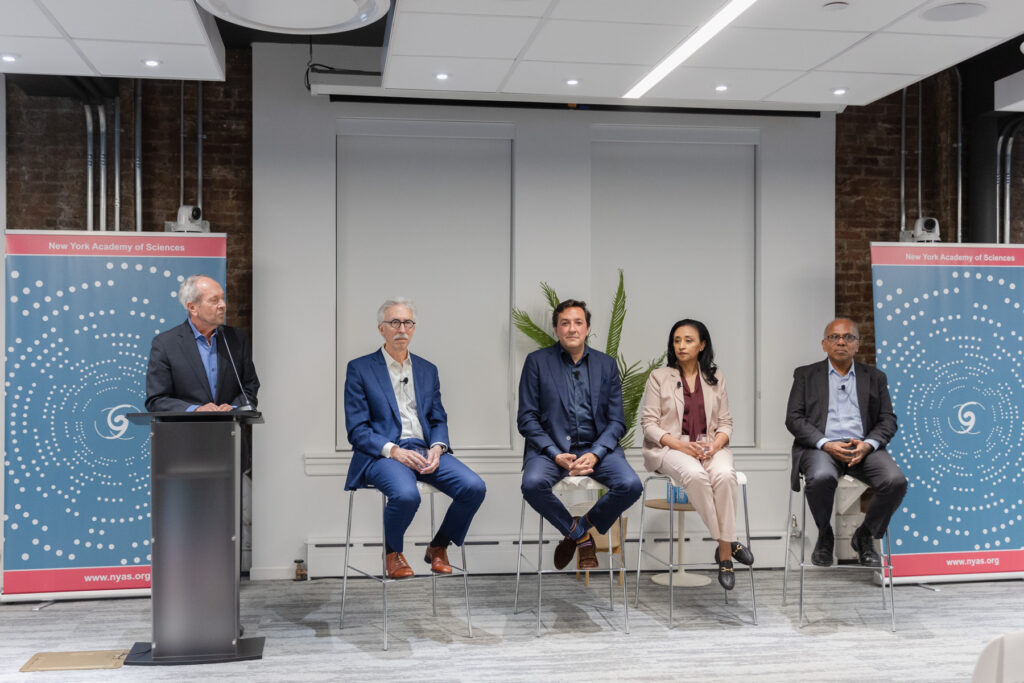
Attendees were also treated to a panel discussion on the future of science moderated by Nicholas B. Dirks, the Academy’s President & CEO, followed by remarks from the Chair of the Academy’s Board of Governors, Hon. Jerry Hultin.

“It’s great to have you here for the first open house,” Dirks told the audience before introducing the panelists, all members of the board. “We’ve held a few conferences here but nothing quite like this.”

Dirks asked the panelists to discuss “things that they are keeping their eyes on, both in terms of opportunities but also challenges and potential dangers.”

Advances in Quantum Computing

Darío Gil, PhD, senior vice president and director of research at IBM, predicted that a new generation of quantum computers—which perform calculations using quantum mechanical analogs of the zero and one binary digits, or bits, used by classical computers—would bring “exponential advancements” in the ability to simulate the physical world. As a result, he said, quantum computing would find wide use in chemistry, materials science, physics, and biology and “help us tackle some of the most pressing and important problems” facing humanity.

“That’s going to matter for everything from fertilizers for agriculture to new alloys for aerospace or batteries for automotive or new molecules in biology,” Dr. Gil said, adding that quantum computing would also transform encryption systems.

“We have not yet quite crossed a threshold where we can do things that are impossible to do with classical machines,” he said. “But that crossover is going to happen … it’s going to happen a hundred percent in this decade.”

Science in the Development of Vaccines

Panel on the Future of Science
(from L) Hon. Jerry Hultin, Board Chair, The New York Academy of Sciences; Nicholas Dirks, President & CEO, The New York Academy of Sciences; Darío Gil, PhD, senior vice president and director of research at IBM; Aida Habtezion, MD, chief medical officer and head of worldwide medical & safety at Pfizer; Subra Suresh, PhD, former director of the National Science Foundation and former President of Carnegie Mellon

Aida Habtezion, MD, chief medical officer and head of worldwide medical & safety at Pfizer, detailed the key role that data science played in the rapid development of Covid vaccines. She said the confluence of artificial intelligence (AI) and machine learning, in particular, would speed the development of more new vaccines and drugs and better ensure their safety and effectiveness for large populations.

“Engineering is now actually moving into medicine, what we thought traditionally was a separate field,” Dr. Habtezion said.

Nanotechnology and Artificial Intelligence

Subra Suresh, PhD, former director of the National Science Foundation and former President of Carnegie Mellon, referenced the merging of technologies as an important trend in scientific research. He described recent experiments in which nanotechnology used in conjunction with Artificial Intelligence (AI) had given scientists key insights into altering the properties of diamond and other semiconductor materials. “No supercomputer available today can do this,” he said of the research, adding that similar work might yield new advances in microelectronics and energy storage.

Dr. Suresh made the case that AI may approach problems and conceive new inventions in ways that humans find hard to do. For example, he said, chess-playing AI has shown a willingness to sacrifice one’s queen as a route to victory—a gambit few human chess players are bold enough to try. And humans can be surprisingly slow to recognize opportunities even for simple but high-value innovations. To illustrate that point, he shared the observation that “the first patent for putting a wheel on a suitcase was filed after Neil Armstrong” set foot on the moon.

“Innovation comes in many different shades,” Dr. Suresh said. “There are sexy ones and not-so-sexy ones, and here is an example of a not-so-sexy one which is a lot more useful on a day-to-day basis for hundreds of millions of people.”

Zenna Tavares, co-founder and director, Basis AI

In his remarks, Jerry Hultin thanked the attendees for supporting the academy and reminded them that some of history’s greatest thinkers had been members. “We’re very proud of the fact that Thomas Jefferson, Charles Darwin, Margaret Mead all belonged to the Academy,” he said. “I think they’d be impressed tonight to know where the Academy has come to.”

Making Their New Space “Home”

Speaking after the event, Dirks said he hoped the new headquarters would become “one of the principal spaces for convening debates, deliberations, explorations into the best way to shape science going forward…My hope is that we become not only the virtual go-to space but we actually become the physical go-to space where people think ‘this is the place where I can hang out, I can interact with really interesting, smart people, I can engage in conversations that reflect the academy’s fundamental purpose.’”

The headquarters—its walls hung with science-inspired artwork on loan from artists throughout NYC laboratories and Cape Cod –occupies about 20,000 square feet, roughly half of which is set aside for events. The new offices are just a few blocks away from where the Academy was founded in 1817 at the College of Physicians and Surgeons on Barclay Street near Broadway.

The open house was made possible through the generous support of: Columbia Engineering, Kasirer, AKA Strategy, BenefitPlan Manager, EisnerAmper, and NYU.

Watch the video recording of the panel discussion on the Future of Science

Working at the Academy

The New York Academy of Sciences’ staff share a constructive spirit and a willingness to take responsibility to address the challenges faced by society through scientific enterprise. Our organizational culture fosters openness, inclusivity, and innovation, and we are proud to work with a network of like-minded partners worldwide to deliver high-quality programs and publications to our members and beyond. 

At the Academy, supervisors utilize a comprehensive onboarding plan to guide new employees during their first six months, equipping them with the necessary tools and resources for success. Through a structured approach to goal-setting and by providing continuous feedback throughout the year, employees are supported in achieving success matching their role’s objectives. 

In the age of the hybrid workplace, the Academy is committed to finding new ways to enhance employee connections with their colleagues while building collaborative cross-functional teams.

Supporting the ongoing development of the whole person fosters long-term talent retention, and to that end, we encourage employees to shape their Academy experience to align with their purpose and future goals. 

The Academy relies on our employees and partners to serve as ambassadors who adhere to the following principles, which guide us toward achieving our organizational goals: 

  • Excellence: We maintain high standards and ambitious goals across all programs and services.
  • Passion: We are inspired by the potential of science to make a positive impact.
  • Integrity: We cultivate an environment of trust, respect and credibility.
  • Ingenuity: We value creativity, innovative thinking, open-mindedness, resourcefulness and efficiency.
  • Collaboration: We encourage teamwork, knowledge sharing and partnerships.
  • Commitment to the Public Good: We tackle society’s challenges and aim to improve the human condition through scientific enterprise.

Job Openings

What We Do

Through a collective action approach, the Academy promotes holistic, innovative solutions to advance the sciences for the economic and social wellbeing of society through research, education and policy.

Read More >

Mission & Values

The mission of The New York Academy of Sciences is to drive innovative solutions to society’s challenges by advancing scientific research, education, and policy.

Read More >

Working with Us

We encourage our employees to shape their Academy working experience so it aligns with their personal sense of purpose and future goals.

Read More >

New in Annals

Media Resources

Press Guidelines

Effective communication and outreach are essential for the Academy to fulfill its mission, and this includes coverage from external media outlets.

We ask that members of the media mention The New York Academy of Sciences as the event host in any write-ups or articles that result from attendance at this event. Please note that on first reference the name of our organization is The New York Academy of Sciences (with cap T) – the Academy thereafter. We also request that media representatives refrain from using any unpublished data presented without permission from the presenter, and that if you are planning to video/audio record the event, that you clear it with The New York Academy of Sciences media team beforehand.   

If you are interested in interviewing Academy and presenting experts, please contact media@nyas.org. Please send links to any resulting event coverage to media@nyas.org when it is live so we may promote through the Academy’s social media channels to our 16,000+ members and 90,000+ followers.

Contact Information

Contact media@nyas.org 

  • Apply for press credentials for upcoming Academy events
  • Book an Academy expert for an interview TV segment or podcast, or to speak at an event.
  • Sign up to receive Academy press releases
  • Access to Annals of the New York Academy of Sciences
  • Access to back issues of The Sciences magazine, published from 1961-2001
  • All other external media inquiries

Academy Logo Downloads

Academy Logos

Popular Links for the Press

Annual Report and Audited Financials

A snapshot of the most impactful accomplishments of the year.

Press Releases

Latest news and major announcements from the Academy.

Academy Speakers Bureau

Learn more about our experts and contact us to book an interview.

Academy Blog

Thought leadership, a look inside the Academy, engaging stories in sciences, and more.

Event Calendar

Listing of upcoming Academy Events.

Speakers Bureau

Nicholas B. Dirks is a widely respected and highly influential historian and anthropologist, and a prominent leader in higher education.

Douglas Braaten, PhD

Dr. Braaten is Chief Scientific Officer, Scientific Publications, and oversees the strategic development and planning of all scholarly scientific publishing at The New York Academy of Sciences. 
Read more >


Melanie Brickman Borchard, PhD, MSc

Dr. Brickman Borchard has nearly 20 years of experience as a public health researcher focused on the juncture of health, demography, policy, and geography, as well as a non-profit leader who brings scientific communities together. 

Read more >


Sonya Dougal, PhD 

Dr. Dougal is a cognitive neuroscientist who serves as Senior Vice President, Scientific Programs, and Awards. She has more than 15 years of experience in scientific research and program development.

Read more >


Brooke Grindlinger, PhD

Dr. Grindlinger is a microbiologist who serves as Chief Scientific Officer, where she fosters collaborations among stakeholders in academia, industry, government, and the public sector. 

Read more >

Science by Scientists

The Academy can tap into its network of thousands of scientists to provide speakers on the following topics and more. Contact us at media@nyas.org for more information.

• Neuroscience
• Immunology
• Microbiology
• Virology
• Public Health
• Climate Change
• Artificial Intelligence
• Global Crisis Response
• Science Communication
• K-12 STEM Education
• STEM Careers
• Women in STEM

Press Releases

The Academy produces a range of media content to educate the public not only about happenings at the Academy but about the sciences more broadly. Content includes press releases for major announcements as well as blog posts focused on everything from academy news and events to content produced by subject-matter experts and coverage from external media outlets.